Sinitic Civilization-Book 1
Sinitic Civilization-Book 2
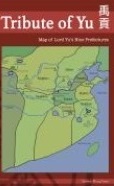
Tribute of Yu

Heavenly Questions
Zhou King Muwang's Travels
The Legends of Mountains & Seas
The Bamboo Annals - Book 1

The Scourge-of-God-Tetralogy:
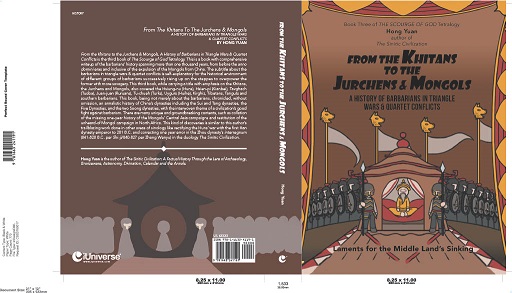
From the Khitans to the Jurchens & Mongols: A History of Barbarians in Triangle Wars and Quartet Conflicts
(available at iUniverse;
Google;
Amazon;
B&N)
|
|
TIBETANS
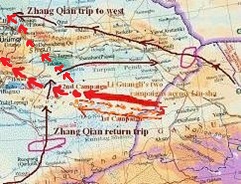 For details on when the east met with the west, see this webmaster's discussion on the Huns, the Yuezhi, the Tarim Mummies, the Yuezhi-Yushi misnomer,
the Mongoloid-Caucasoid admixture at 2000 B.C.E.,
the fallacy of the Aryan bearing of the Chinese civilization,
the fallacy of the Yuezhi jade trade,
the Yuezhi migration timeline,
as well as
the location of the Kunlun Mountain,
Queen Mother of the West,
the legendary book of mountains and seas at the Imperial China blog,
and the Qiang's possible routes of passage into Chinese Turkestan
at
http://www.imperialchina.org/Barbarians.htm which was embedded within the
Huns.html and
Turks_Uygurs.html pages.
(Note that Western Queen Mother had the prototype in an "earth mother" deity, not related to Queen Sheba of Charles Hucker.
The Mt. Kunshan jade was more likely the Mt. Huoshan jade in the Han dynasty book Huai Nan Zi, or the Mt. Yiwulü jade or the Kunlun jade that were juxtaposed together in the same book Huai Nan Zi, not related to Queen Mother of the West.
http://www.sino-platonic.org/complete/spp115_chinese_proto_indo_european.pdf provides another perspective of looking at things of the past from the perspective of language cognates. Rather believing that the Indo-Europeans ever invaded China and gave the Sinitic people the language, we could actually deduce that "Old Chinese", for its 43% correlation with the Proto-North-Caucasian, rather 23% with the Proto-Indo-European, was the source for both the cognates of the Proto-North-Caucasian and the Proto-Indo-European -- with the Proto-North-Caucasian falling under the umbrella of the Dene-Caucasian (Sino-Caucasian) Language Family that encompassed the [Proto-North-]Caucasian, Yeniseian and Sino-Tibetan languages. This is because our cousins, i.e., the N haplogroup people, relocated to North Asia and then to Latvia, Estonia, Finland and Scandinavia, bringing along the Sinitic language to the Proto-North-Caucasian who in turn gave it to the Proto-Indo-European. Note the Sinitic language cognates' 74% correlation with the Proto-Tibeto-Burman who split from the Sinitic people merely 5000-6000 years ago.)
For details on when the east met with the west, see this webmaster's discussion on the Huns, the Yuezhi, the Tarim Mummies, the Yuezhi-Yushi misnomer,
the Mongoloid-Caucasoid admixture at 2000 B.C.E.,
the fallacy of the Aryan bearing of the Chinese civilization,
the fallacy of the Yuezhi jade trade,
the Yuezhi migration timeline,
as well as
the location of the Kunlun Mountain,
Queen Mother of the West,
the legendary book of mountains and seas at the Imperial China blog,
and the Qiang's possible routes of passage into Chinese Turkestan
at
http://www.imperialchina.org/Barbarians.htm which was embedded within the
Huns.html and
Turks_Uygurs.html pages.
(Note that Western Queen Mother had the prototype in an "earth mother" deity, not related to Queen Sheba of Charles Hucker.
The Mt. Kunshan jade was more likely the Mt. Huoshan jade in the Han dynasty book Huai Nan Zi, or the Mt. Yiwulü jade or the Kunlun jade that were juxtaposed together in the same book Huai Nan Zi, not related to Queen Mother of the West.
http://www.sino-platonic.org/complete/spp115_chinese_proto_indo_european.pdf provides another perspective of looking at things of the past from the perspective of language cognates. Rather believing that the Indo-Europeans ever invaded China and gave the Sinitic people the language, we could actually deduce that "Old Chinese", for its 43% correlation with the Proto-North-Caucasian, rather 23% with the Proto-Indo-European, was the source for both the cognates of the Proto-North-Caucasian and the Proto-Indo-European -- with the Proto-North-Caucasian falling under the umbrella of the Dene-Caucasian (Sino-Caucasian) Language Family that encompassed the [Proto-North-]Caucasian, Yeniseian and Sino-Tibetan languages. This is because our cousins, i.e., the N haplogroup people, relocated to North Asia and then to Latvia, Estonia, Finland and Scandinavia, bringing along the Sinitic language to the Proto-North-Caucasian who in turn gave it to the Proto-Indo-European. Note the Sinitic language cognates' 74% correlation with the Proto-Tibeto-Burman who split from the Sinitic people merely 5000-6000 years ago.)
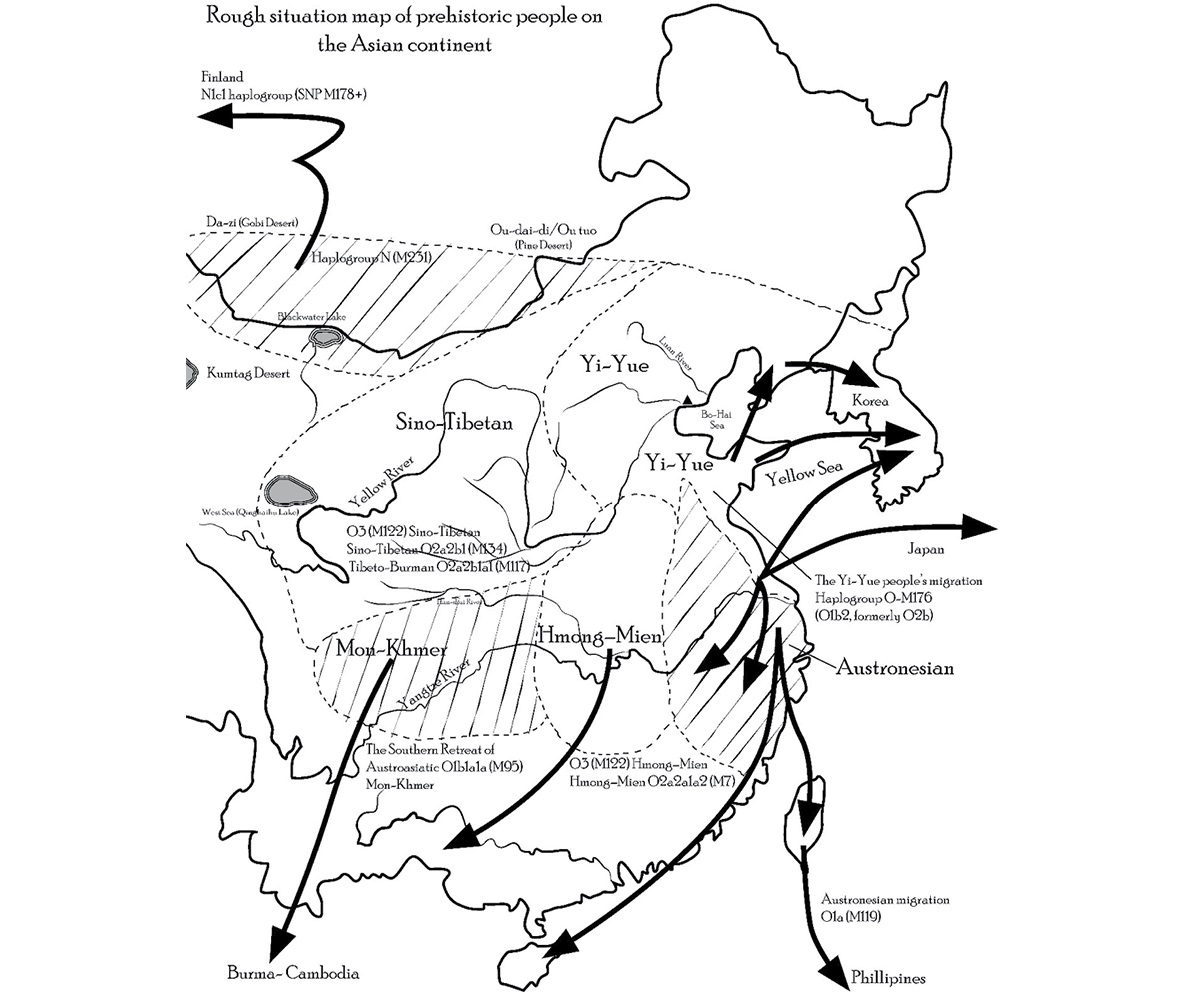
Li Hui of Fudan University of China analyzed the Asian DNAs to have derived a conclusion that ancestors of the [East] Asians possessed a distinctive Mark M89 by the time they arrived in Southeast Asia.
About 30,000 years ago, from the launching pad of Southeast Asia, the early Asians went through a genetic mutation to marker M122.
Li Hui claimed that the early migrants to the Chinese continent took three routes via two entries of today's Yunnan and Guangxi-Guangdong provinces.
More studies done after Li Hui had ascertained the dates of the O1, O2 and O3 haplogroup people, with the (O1, O2) entrants along the Southeast Chinese coast dated to have split away from the O3-haplogroup people like 20,000 years ago, much earlier than the continental peers, i.e., the Sino-Tibetans (O3a3c1-M117), Hmong-Mien (Miao-Yao, O3a3b-M7) and Mon-khmers.
According to
https://www.ncbi.nlm.nih.gov/pmc/articles/PMC5255561/
"Y chromosome suggested Tibeto-Burman populations are an admixture of the northward migrations of East Asian initial settlers with haplogroup D-M175 in the Late Paleolithic age, and the southward Di-Qiang people with dominant haplogroup O3a2c1*-M134 and O3a2c1a-M117 in the Neolithic Age. Haplogroup O3a2c1*-M134 and O3a2c1a-M117 are also characteristic lineages of Han Chinese, comprising 11.4% and 16.3%, respectively. However, another dominant paternal lineage of Han Chinese, haplogroup O3a1c-002611, is found at very low frequencies in Tibeto-Burman populations, suggesting this lineage might not have participated in the formation of Tibeto-Burman populations."
Namely, the haplogroup O3a1c-002611 Sinitic people, not the O3a2c1*-M134 and O3a2c1a-M117 barbarians, were responsible for engendering the Yangshao and Longshan civilization, and partially with the N-haplogroup people, engendering the Hongshan civilization.
The Zhou people were archaeologically speculated to have origin from today's Shanxi for the link to the Guangshe Culture –- which was in turn a derivative of the You'ao-type Laohushan Culture of the mixed N-haplogroup and O-haplogroup people.
(Since the O3a1c-002611 people were separated from the Northwestern cousins and Tibeto-Burmese at an early age, for it to have a part in the history of Northwestern China, the explanation would be to treat the Haplogroup O3a2c1*-M134 and O3a2c1a-M117 people as the historical Qiang and Hu barbarians, with the latter's paleo-Northwestern genes replacing the paleo-North-China and paleo-Central Plains genes of O3a1c-002611 Sinitic people by the Soong dynasty (A.D. 960-1279), that was likely triggered by the multiplication of the Tang dynasty's imperial house that had its origin from the Western Corridor.
The Soong dynasty royals took Tianshui of western China as the ancestral homeland, which was similar to the Tang dynasty royals' origin from the Western Corridor in western China, i.e., the Qin and Zhao states' common ancestral place.
The Soong royal house, however, could be of the Shatuo Turks' Q-haplogroup gene.
Also see this webmaster's discussion on
the ethnic nature of the ancient Huns belonging to part of the epic Jiang-rong human migration
of the Jiang-surnamed San-miao people and Yun-surnamed Xianyun people.)
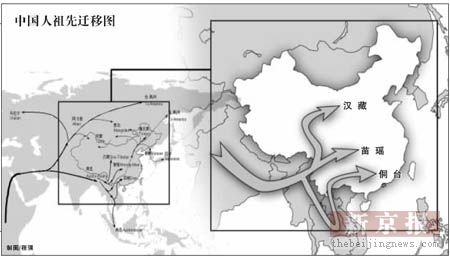 Li Hui commented that one branch of the early Asians, over 10,000 years ago, entered China's southeastern coastline with genetic marker M119. Li Hui, claiming the same ancestry as the Dai-zu and Shui-zu minorities of Southwestern China, firmly believed that his ancestors had dwelled in the Hangzhou Bay and the Yangtze Delta for 7-8 thousand years.
The people with the M119 marker would be the historical "Hundred Yue People".
The interesting theory adopted by Li Hui would be the migration of one branch of people who continued to travel non-stop along the Chinese coastline to reach the Liao-he River area of today's Manchuria.
Li Hui's speculation on basis of the DNA technology was an evolving process.
This would be likely the O2-haplogroup people, rather than the C-haplogroup or North Asia people whose historical presence in Asia could be dated 50,000 years ago, just after the earlier D-haplogroup people who were now mostly restricted in the area of Hokkaido, Japan, and known as the Ainu.
The C-haplogroup people developed into what this webmaster called by the Altaic-speaking people,
i.e., ancestors of the Mongols and Manchus.
What likely happened was that the O2-haplogroup people first travelled along the coast to reach Manchuria, and then traced back towards the south to reach the Yangtze area about 7-8000 years ago, where they evicted the O1-haplogroup people to the Southeast Asian islands.
At about the same time, the O3-haplogroup people, moving through the continent, reached today's western Liaoning at least 5000 years ago, or like 11,000 years ago on basis of the evidence of the pottery aging.
See the genetical analysis conducted by Li Hongjie of Jirin University on the remains of prehistoric people extracted from the archaeological sites.
Li Hui commented that one branch of the early Asians, over 10,000 years ago, entered China's southeastern coastline with genetic marker M119. Li Hui, claiming the same ancestry as the Dai-zu and Shui-zu minorities of Southwestern China, firmly believed that his ancestors had dwelled in the Hangzhou Bay and the Yangtze Delta for 7-8 thousand years.
The people with the M119 marker would be the historical "Hundred Yue People".
The interesting theory adopted by Li Hui would be the migration of one branch of people who continued to travel non-stop along the Chinese coastline to reach the Liao-he River area of today's Manchuria.
Li Hui's speculation on basis of the DNA technology was an evolving process.
This would be likely the O2-haplogroup people, rather than the C-haplogroup or North Asia people whose historical presence in Asia could be dated 50,000 years ago, just after the earlier D-haplogroup people who were now mostly restricted in the area of Hokkaido, Japan, and known as the Ainu.
The C-haplogroup people developed into what this webmaster called by the Altaic-speaking people,
i.e., ancestors of the Mongols and Manchus.
What likely happened was that the O2-haplogroup people first travelled along the coast to reach Manchuria, and then traced back towards the south to reach the Yangtze area about 7-8000 years ago, where they evicted the O1-haplogroup people to the Southeast Asian islands.
At about the same time, the O3-haplogroup people, moving through the continent, reached today's western Liaoning at least 5000 years ago, or like 11,000 years ago on basis of the evidence of the pottery aging.
See the genetical analysis conducted by Li Hongjie of Jirin University on the remains of prehistoric people extracted from the archaeological sites.
  Northeast (southeastern Inner Mongolia)
    Niuheliang, Lingyuan, the Hongshan Culture, 5000 YBP,
    4 N, 1 C*, 1 O

  North
   Yuxian County (the Sanguan site), Hebei,
   the Lower Xiajiadian Culture, 3400-3800 YBP, all O3
Combining Li Hui's study with the pottery excavation, we could see a clear path going north extending from around 15,000 years ago to 10,000 years ago.
Refer to Yaroslav V. Kuzmin's discourse on potteries
to see the path of migration of
proto-Mongoloids
from southwestern China (approx. 15,120+/-500 BP) to
Northeast Asia (Manchuria [13,000 BP, or c. 14,000 - 13,600 cal BC] and
Japan [c. 11,800-10,500 cal BC (c. 13,800 - 12,500 cal BP)]) to
Siberia (11,000 BP, or 11,200 - 10,900 cal BC).
In the timeframe of about 10,000 years, developing a genetic mutation to the marker M134, one branch of people who went direct north, per Li Hui, would penetrate the snowy Hengduan Mountains of the Tibetan-Qinghai Plateau to arrive at the area next to the Yellow River bends.
Owning to the cold weather environment, some physique, such as big noses, heavy lips and longer faces, developed among this group of people, i.e., ancestors of the Sino-Tibetans.
Splitting out of the northbound migrants would be those who went to the east with a new genetic marker M117, i.e., ancestors of the modern Han [a misnomer as the proper term should be Sino-Tibetan, nor the later Sinitic] Chinese.
We could say that our Sino-Tibetan ancestors forgot that they had penetrated northward the Hengduan Mountains from the Indo-China "CORRIDOR" in today's Burma-Vietnam.
"Walking down Mt Kunlun", i.e., the "collective memory of the ethnic Han Chinese" throughout China and the Southeast Asian Chinese communities, that was echoed in Guo Xiaochuan's philharmonic-agitated epic, would become the starting point of the eastward migration which our Chinese ancestors remembered.
(Li Hui grouped the 3000-year-old Chu and Qi people in the same category as the Han Chinese, albeit meeting the ancient classics' records as to the Qi statelet's lineage from the Qiangic-Tibetan Fiery Lord.
According to
https://onlinelibrary.wiley.com/doi/full/10.1111/j.1759-6831.2012.00244.x
"the frequencies of the three main subhaplogroups of O3-M122: O3a1c-002611, O3a2c1*-M134, and O3a2c1a-M117 in Han Chinese are 16.9%, 11.4%, and 16.3%, respectively (Yan et al., 2011).
The northward migration of haplogroup O3a1c-002611 started about 13 thousand years ago (KYA). The expansions of subclades F11 and F238 in ancient Han Chinese began about 5 and 7 KYA immediately after the separation between the ancestors of the Han Chinese and Tibeto-Burman.
Haplogroup O3a1c-002611 and O3a1c1-F11 started their northward migration about 12 KYA from Southeast Asia, along with other O3-M122 lineages, and reached the upper and middle Yellow River basin. About 7 KYA, haplogroup O3a1c2-F238 originated in the ancestors of modern Sino-Tibetan populations. About 6 KYA, the Han Chinese split from the Proto-Sino-Tibetan, and started their migration to the east and south (Su et al., 2000b). About 5 KYA, haplogroup O3a1c1-F11 experienced rapid expansion, probably in the Eastern Han Chinese, with recent gene flow with surrounding populations and eventually became prevalent in different ethnic groups in East Asia.)
Li Hui then pointed out that the ancient Wu people, with M7 genetic marker, came to the lower Yangtze area about 3000 years ago.
While Li Hui claimed that the M7 Wu people had split away from the northbound M134 Sino-Tibetan people, the historical Chinese classics pointed out that the Wu Statelet was established by two uncles of Zhou Dynasty King Wenwang, i.e., migrants from the Yellow River area.
The general layout by Lu Hui seems to have corroborated with Scholar Luo Xianglin's claim that early Sino-Tibetan people originated from the Mt Minshan and upper-stream River Min-jiang areas of today's Sichuan-Gansu provincial borderline and then split into two groups, with one going north to reach the Wei-shui River and upperstream Han-shui River of Shenxi Province and then eastward to Shanxi Province by crossing the Yellow River.
--Though, this webmaster's analysis of China's prehistory shows that the Sino-Tibetan people who moved to the eastern coast was one group, with the future Tibetans being actually the exiles to Northwest China from eastern and central China during the era of Lord Shun. Namely, the split of the Sinitic and proto-Tibetan people occurred prior and during the exile in the late 3rd millennium B.C.E.
(George Driem proposed that the Sino-Tibetans had splitoffs like the Western Tibeto-Burmans and the Eastern Tibeto-Burmans, with the Eastern Tibeto-Burmans forming two groups of northern and southern, who in turn split into the Northwestern Tibeto-Burmans, the Northeastern Tibeto-Burmans, the Southwestern Tibeto-Burmans, and the Southeastern Tibeto-Burmans, with a claim that the western offshoots went all the way to the Kashmir before returning east along the northern slope of the Himalayas to have a reunion with their cousins and that the Northeastern Tibeto-Burmans were the Sinitic people.)
What Li Hui did not touch on in his earliest studies were the cousin tribes of the Sino-Tibetans, namely, the Hmong-miens and Mon-khmers.
As noted at http://www.ncbi.nlm.nih.gov/pmc/articles/PMC3164178/, "A clear hierarchical structure (annual ring shape) emerged in the network of O3a3b-M7 (Fig. 2B), in which MK (Mon-Khmers) haplotypes lay at the center of the network (immediately next to the origin), HM (Hmong-Mien) haplotypes were distributed at the periphery to the MK haplotypes, and the ST (here the subfamily Tibeto-Burman) haplotypes were only found further away from the origin."
|
|
* In Commemoration of China's Fall under the Alien Conquests in A.D. 1279,
A.D. 1644 & A.D. 1949 *
 U.S.S.R./Comintern Alliance with the KMT & CCP (1923-1927)
 Korean/Chinese Communists & the 1931 Japanese Invasion of Manchuria Korean/Chinese Communists & the 1931 Japanese Invasion of Manchuria
American Involvement in China: Soviet Operation Snow, IPR Conspiracy, Dixie Mission, Stilwell
Incident, O.S.S. Scheme, Coalition Government Crap, Amerasia Case & The China White Paper
* Stay tuned for "Republican China 1911-1955: A Complete Untold History" *
|
|
Zou Rong's Revolutionary Army;
Shin Kyu Sik's
Shrine (Spirit, Kunitama) of Korea
|
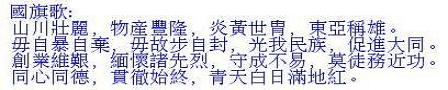
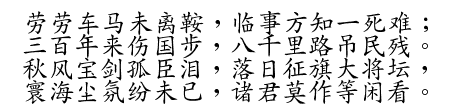
This snippet is for sons and daughters of China:
Heed the sons & ministers' agony and sorrow of our ancestors who died or lived through the Mongol, Manchu and Soviet-Chicom conquest
and
the Yongjia, Jingkang and Jiashen cataclysms !
Jeanne d'Arc of China:
Teenager girl Xun Guan breaking out of the Wancheng city to borrow the relief troops in the late Western Jinn dynasty;
Liu-Shao-shi riding into the barbarian army to rescue her husband in the late Western Jinn dynasty;
teenager girl Shen Yunying breaking into Zhang Xianzhong's rebels on the horseback to avenge on father's death in the late Ming dynasty.
China's Solitary and Lone Heroes:
Nan Jiyun breaking out of the Suiyang siege and charging back into the city in the Tang dynasty;
Zhang Gui & Zhang Shun Brothers breaking through the Mongol siege of Xiangyang in the Southern Soong dynasty;
Liu Tiejun breaking through three communist field armies' siege of Kaifeng in the Republican China time period;
Zhang Jian's lone confrontation against the communist army during the June 3rd & 4th Massacre of 1989.
|
|
|
Mankind became active on the globe only after the dissipation in 9000 B.C. of the last Ice Age, last one of the 17-19 glaciations extending from 3 million years ago. This timeframe would be labeled the Upper Paleolithic. Research shows that the Tibetan Plateau began to be occupied by the human beings around the 2nd to 3rd century as a result of the warm weather and the thaw of ice. The human movements into Tibet could be roughly be classified as from two sources, namely, the westward or southward move by the Sino-Tibetans, and the northeastward move by possibly the Indo-Iranians.
The Tibetans belong to a larger language family called the Sino-Tibetan. Two major branches could be differentiated here. The Tibeto-Burman is one of two major branches of the Sino-Tibetan
family, the other being the Sinitic (Chinese) languages. The two branches are different in their morphological and syntactic typology. The Tibeto-Burman branch consists of
2-300 languages spoken primarily in the uplands of Inner, South, and Southeast Asia, and could be found from Sichuan and Qinghai in the north to Myanmar (Burma), and northwestern Vietnam to the south, and northern Pakistan in the west.
The Tibetans are related to the minorities in today's southwestern China, for example, the Mo-so and Lo-lo people. The Mo-so and Lo-lo people are pockets of the minorities who had survived thousands of years of human migration from north to south. Most of the early southerners would have been pushed out of southern China a long time ago, and a migration path could be separately painted for the Polynesians, the Southeast Asians in the Philippines and Indonesia/Malaysia, and the people in Vietnam, Burma and Thailand. Those were the early waves of migration before the Mongols destroyed the independent state of Nan-Zhao (Da Li), an event that would lead to another chain reaction that would form today's ethnicity in Southeast Asia. Today's Shan and Thai people in Burma and Thailand are descendants of the refugees of the Nan-Zhao (Da Li) Statelet.
In this webmaster's opinion, the Sino-Tibetan Qiangic people, who split from the Sinitic people about 4000-5000 years ago, or 6000 years ago, further diverged into the Western Qiangic people about 2500 years ago to become ancestors of the Tibetans [after absorbing the high-plateau gene of the D-haplogroup natives, of course].
During Qin Lord Li4-gong's reign (?-443 B.C.), the Qin army campaigned westward against the Qiangs around the Yellow River Nine Winding area. Wuyi[slave]-Yuanjian[chieftain], who escaped from the Qin captivity, later led his clansmen in a relocation to the Xizhi-he River area, in today's Tibet-Qinghai borderline, to become the Tibetan ancestors.
Hou Han Shu continued to state that there were 150 varieties of the Yuanjian descendants, with nine branches dwelling at the upperstream Xizhi-he River.
Half a century later, Qin lord Xian'gong turned west to attack the Yuan-rong (Huan-rong) barbarians at the upperstream Weishui-River, driving Shu-fu-mao's tribe towards the Xizhi-he River area, near Tibet.
This land would be the gateway between Sinitic China and the Sichuan basin.
(The Yuan-rong or Huan-rong barbarians carried the name of an ancient river called by Yuan-shui or Huan-shui, that was noted as the He-yi barbarians in Yu Gong.
This was a river that was noted in history to be near the legendary Mt. Panzhong-shan and the bird-rat-same-cave [i.e., bat cave] mountain, with the He-yi barbarians travelling along the Yuan-shui River {Xiqing ying Yuan(Huan) er lai}, then floated on the Qian-shui River {fu yu Qian}, then cross-hopped into the Mian-shui River {yu yu Mian}, then entered the Wei-shui River {ru yu Wei}, and finally sailed in the Yellow River {luan yu He} --something that the scholars of the past thousand years scratched their heads to find a linkage among the waterways, something more like a midland relay that was omitted in Yu Gong.)
George Driem proposed that the Sino-Tibetans had splitoffs like the Western Tibeto-Burmans and the Eastern Tibeto-Burmans, with the Eastern Tibeto-Burmans forming two groups of northern and southern, who in turn split into the Northwestern Tibeto-Burmans, the Northeastern Tibeto-Burmans, the Southwestern Tibeto-Burmans, and the Southeastern Tibeto-Burmans, with a claim that the western offshoots went all the way to the Kashmir before returning east along the northern slope of the Himalayas to have a reunion with their cousins and that the Northeastern Tibeto-Burmans were the Sinitic people.
From the physical anthropology's angle, today's northern Chinese had the traits of ancient northwestern Chinese, not the same as the ancient Sinitic people.
On basis of genetic evidence,
the haplogroup O3a1c-002611 Sinitic people was responsible for engendering the Yangshao and Longshan civilization, and partially with the N-haplogroup people, engendering the Hongshan civilization.
Since the O3a1c-002611 people were separated from the Northwestern cousins and Tibeto-Burmese at an early age, for it to have a part in the history of Northwestern China, the explanation would be to treat the Haplogroup O3a2c1*-M134 and O3a2c1a-M117 people as the historical Qiang and Hu barbarians, with the latter's paleo-Northwestern genes replacing the paleo-North-China and paleo-Central Plains genes of O3a1c-002611 Sinitic people by the Soong dynasty (A.D. 960-1279), that was likely triggered by the multiplication of the Tang dynasty's imperial house that had its origin from the Western Corridor.
https://www.ncbi.nlm.nih.gov/pmc/articles/PMC5255561/ carried an article stating that
"Y chromosome suggested Tibeto-Burman populations are an admixture of the northward migrations of East Asian initial settlers with haplogroup D-M175 in the Late Paleolithic age, and the southward Di-Qiang people with dominant haplogroup O3a2c1*-M134 and O3a2c1a-M117 in the Neolithic Age. Haplogroup O3a2c1*-M134 and O3a2c1a-M117 are also characteristic lineages of Han Chinese, comprising 11.4% and 16.3%, respectively. However, another dominant paternal lineage of Han Chinese, haplogroup O3a1c-002611, is found at very low frequencies in Tibeto-Burman populations, suggesting this lineage might not have participated in the formation of Tibeto-Burman populations."
Furthermore, the O3a1c-002611 Sinitic people, a lineage this webmaster belonged to, contained a predictable 5000-year-old admixture of about 10-20% Eurasian Q-haplotype heritage --that the northwestern O3a2c1*-M134 and O3a2c1a-M117 people lacked.
Rather believing that the Indo-Europeans ever invaded China and gave the Sinitic people the language,
as
http://www.sino-platonic.org/complete/spp115_chinese_proto_indo_european.pdf
claimed,
we could actually deduce that "Old Chinese", for its 43% correlation with the Proto-North-Caucasian, rather 23% with the Proto-Indo-European, was the source for both the cognates of the Proto-North-Caucasian and the Proto-Indo-European. This is because our cousins, i.e., the N haplogroup people, relocated to North Asia and then to Latvia, Estonia, Finland and Scandinavia, bringing along the Sinitic language to the Proto-North-Caucasian who in turn gave it to the Proto-Indo-European. Note the Sinitic language cognates' 74% correlation with the Proto-Tibeto-Burman who split from the Sinitic people merely 5000-6000 years ago.
The monosyllable and pictographic Sinitic written language, no matter how primitive, artificial and against the human nature of polysyllable pronunciation, served as a constraining force to bind the culture and customs to it, and should have possessed a history of 6000-8000 years for it to leave its imprints on the Tibeto-Burmese language.
The composition of the Tibetans is not that simple.
Two groups of people could be easily identified: 1) The group of people who were active in today's Qinghai-Gansu, comprising of the Qiangs around the turn of A.D.-B.C. centuries, and 2) the mixed group of people such as the Tuyuhun Xianbei [who migrated there from the Manchuria-Mongolia border] in the 4th-5th centuries and the Tanguts (Dangxiang) with relation to the Tuoba Xianbei of Western Xia Dynasty in the 9th-13th centuries.
Origin Of the Qiangic people
In the section on prehistory, This webmaster has traced the origin of the Qiangic people to the Fiery Lord (Yandi) Tribe which carried the name of 'Jiang'. A famous linguist believed that Qiang was a mutation of 'Jiang'. A good website about the today's Qiangs would be http://www.infomekong.com/p_group_Tibetan_1.htm.
Wang Ming-ke included ancient viewpoints in regards to the Fiery Lord in his article on "From the Qiang Barbarians to the Qiang Nationality".
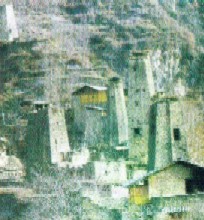 Qiang-zu, numbering 112000 per 1982 census, possibly the most orthodox descendant of the ancient Qiangic people, now dwell mostly around the Minjiang River area of Sichuan Province.
Qiang-zu are fond of building their houses into citadels, per Cai Ah-dong, a tradition most likely resulting from their historical confrontations with the people around them.
Qiang-zu, numbering 112000 per 1982 census, possibly the most orthodox descendant of the ancient Qiangic people, now dwell mostly around the Minjiang River area of Sichuan Province.
Qiang-zu are fond of building their houses into citadels, per Cai Ah-dong, a tradition most likely resulting from their historical confrontations with the people around them.
The earliest people in western China had the blending of the 'San Miao' people.
The 'San Miao' people were exiled to today's Gansu-Qinghai Provinces (called Inner Tibet [against Frontal Tibet or Outer Tibet] as a result of aiding Dan-zhu, the son of Lord Yao, in countering Lord Shun.
(Shan Hai Jing also stated that some of the San-miao people escaped to Nan-hai, i.e., the south sea.
The south sea, in a restrictive sense, was today's Qinghaihu Lake, south of the Qilianshan Mountain. In a broader sense, the south sea could be today's Poyang Lake, near the Yangtze River.
The Wei Ce section of Zhan Guo Ce carried a dialogue between Wu Qi and Wei Marquis Wuhou, in which Wu Qi stated that the fortification of a nation could not guarantee the invincibility, mentioning the demise of the San-miao nation, the last Xia King Jie, and the last Shang King Zhouwang, to the effect that the San-miao nation was situated in a place with Lake Pengli to the left/west, Lake Dongting to the right/east, Mt. Wenshan to the south and Mt. Hengshan to the north.
While the names like Pengli and Dongting were later applied to the south-of-the-Yangtze lakes, in an inverse east-west position, the locality of Mt. Hengshan was ascertained by Lih Daoyuan and Du You et al.,, as well as in Shan Hai Jing, to be the mountain known as the Mt. Funiu-shan and Mt. Chufang-shan of northern Henan Province. Namely, next to the heartland of Sinitic China.)
At the times of Lords Yao-Shun-Yu, the so-called 'San-miao' (Three Miao) people had been living in the land to the south and east of the Sinitic Chinese. This place would remain marshlands and lakes till the time of the Chu State of the Warring States period (403-221 BC). The State of Chu, 1500 years after the Xia Dynasty was first established, would still belong to an alien ethnical group, and they were the first group of people to reject the overlordship of Zhou Dynasty by declaring themselves as a king of equal footing.
(The Chu people had ingredients from the people in the areas of today's Hanzhong, namely, the interface area of Sichuan, Hubei and Shenxi, a land which was called the "Minor South-of-the-Yangtze Paradise" north of the Yangtze. The people in this area, such as Yong and Pu, had participated in Zhou King Wuwang's campaign against Shang Dynasty as the allied army from the west. The Yong statelet continued resistance against Zhou Dynasty for hundreds of years till it was defeated and absorbed by the Chu, Ba and Qin statelets.)
According to Sima Qian, the 'San-miao' people were mostly relocated to western China to guard against the western barbarians. Lord Shun relocated them to western China as a punishment for their aiding the son of Lord Yao (Dan Zhu) in rebellion. To the west of today's Dunhuang was a mountain named 'San Wei Shan' (namely, the San-miao Precarious Mountain) where the Three Miao people were exiled. The ancient Chinese classics, Yu Gong, Section on Liu Sa (namely, the flowing sand or the quick sand [Kumtag]), had good description of this part of the country. Interesting will be the claim that the 'San Miao' could be traced to the unfilial son of Yandi the Fiery Lord. In the paragraph on the barbarians vs the Chinese exiles, we explored into the nature of the Chinese exiles at the times of Lord Yao-Shun-Yu.
Here, we have the undisputable link between the Lord Yao's people and the San-miao people, with the latter in a similar position as i) the Kunwu-shi people defending the Xia rule as the garrison army and ii) the Qin people defending the Shang rule as the garrison army.
Speculation As To the San-Miao Exile vs the Yuezhi Timeframe
Lord Yao or Tangyao (reign 2357-2258 BC ?) took over the overlord post after 9 year's weak rule by Zhi (reign 2366-2358 BC ?).
This could lead to a sound speculation that the Sino-Tibetan speaking San Miao people had dwelled in Gansu much earlier than the later misnomer 'Indo-European' Yuezhi people. The approximate date would be about 2258 BC for the relocation.
Nova, in its TV series,
http://www.pbs.org/wgbh/nova/chinamum/taklamakan.html
shows the excavations of mysterious 3000-year-old mummies in China's western
desert, inside today's New Dominions Province. The dating of 3000-year-old mummies shows that there developed some admixture at about 2000 B.C.E. in today's Chinese Turkestan, apparently a consequence of the relocation of the San Miao people, about 200 years before the admixture with the Indo-European people.
Note that when the Chinese overlords exiled the rebellious San-miao people to today's Northwest China, they could be treating Northwest China as their backyard.
In history, you have the Tang Dynasty emperor exiling the Korgureo (Koguryo) people to south of the Qinling Ridge from the northern Korean peninsula, with the logic that the rebellious people, once uprooted from their homeland, could be better managed.
http://www.taklamakan.org/allied_comm/commonv-1-8.html carried an article by Takla entitled "The Origins of Relations Between Tibet and Other Countries in Central Asia", stating that "according to the researches of Sir Aurel Stein [i.e., the arch thief of China's Dunhuang Grotto treasures] on the origins of the people of Khotan, most were the descendants of the Aryans. They also had in them Turkic and Tibetan blood, though the Tibetan blood was more pronounced. He discovered ancient documents at a place called Nye-yar [Niya] in Khotan and he has stated that the script of these documents contained no Pali, Arabic (Muslim) or Turkic terminology. All were Tibetan terms and phrases."
The Tibetans, clearly the descendants of the Sino-Tibetan-speaking Qiangic San-miao people, had their influences reaching southern Chinese Turkistan in addition to the He-xi [west of the Yellow River] Corridor.
P.T. Takla stated further that "according to Wu Hriu(2), the facial features of the people of Khotan were dissimilar to those of the rest of the Horpa nomads of Drugu (Uighurs belonging to the Turkic people) and similar, to an extent, to the Chinese. Khotan in the north-west was called Li-yul by the ancient Tibetans. Since Khotan was territorially contiguous with Tibet, there are reasons to believe that the inhabitants of Khotan had originated from Tibet."
(In Chinese classics, there were repeating citations to the effect that the people in Khotan looked like the Chinese, after the possible penetration of the Central Asians into Chinese Turkestan between the 1st century A.D. and the 5th century A.D. Please refer to the Huns section for Wang Guowei's research.
Wang Guowei had good points worthy of acknowledgment. Wang Guowei, who did not have the knowledge of mummies, dug through the ancient records to conclude that Tu-huo-luo used to be located at the southern rim of the Taklamakan Desert or between Khotan and the Pamirs, and that they did not migrate to Bactria till about 155 B.C.E. around, twenty years ahead of the consecutive Schythian and Yuezhi invasion from north of the Amu Darya River. Wang Guowei, citing the Han Shu, claimed that the deep-eyesocket people were noted beyond the Dayuan [central Asia] in Han Dynasty but appeared to be reaching the area west of Gaochang [Turpan] by the time of the Southern-Northern Dynasties as recorded in Bei Shi, concluded that the Caucasoid had moved east from beyond the Pamirs in a matter of 500 years. All in all, Wang Guowei, continuously citing Monk Hui-chao's travels in Central Asia, pointed out that the invaders, i.e., the Turks, had distinction from the central Asia 'Hu' [who had exclusively-appropriated the said 'Hu' naming after the decline of the Huns - who self-designated themselves with such a name], the original inhabitants of Central Asia, and hence believed that both the Yuezhi and the Tu-huo-luo [Da-xia or the Great Xia] people were actually the Mongoloid "invaders", the same as the later Huns, Turks and Mongols.)
Qiang[1] vs the Rong-di[2] people
In the paragraph on Rong's Possible Link To the Qiangic People, This webmaster detailed the compositions of the Rong to derive a good conclusion that some of the Rongs at the time of Zhou Dynasty could be of Qiangic, and the Rong people in the west shared the same blood-line with the Xia Chinese but differed in 'Culture' such as cuisine, clothing, money [actually gifts of value bestowed on each other] and language. Among the various Rong people would be the Western Rong, Doggy Rong and Rong-di Rong.
Scholar Liu Qihan stated that the difference between the Rong and the Chinese lied in 'culture', not 'blood-line'.
In article The Rong People In the Nine Ancient Prefectures versus the Rong-yu Xia People, Liu Qihan cited ancient classics Zhou Yu's paragraph: "In the ancient times, Gong-gong-shi ... had first worked on repairing the 100 rivers (including the flooding of the Yellow River) ... Gong-gong-shi's descendant, Count Yu (i.e., Lord Yu, aka Rong-yu), repented over his father Gun's mistake in flood control ... Gong-gong-shi's grandson, Si-yue, had acted as an assistant to Lord Yu in flood control ... Hence, Si-yue was conferred the fief of Si-yue-guo Statelet and assigned the surname of 'Jiang' which included the clan name of 'Lü' ... Today (i.e., in Zhou Dynasty times), the clan names of Shen and Lü had declined in prestige and influence but the 'Jiang' family still prevailed in Qi Principality." (Gong-gong-shi was said to be the same person as Gun, the father of Lord Yu.)
Liu Qihan further cited ancient classics Zuo Zhuan and listed the statement of Ju-zhi, a son or prince of Jiang-rong, as paraphrased below: "Everyone had said that our folks, i.e., the miscellaneous Rong people, belonged to the descendants of Si-yue ... Our various Rong people differed from Hua (i.e., the Xia Chinese) in cuisine, clothing, money and language."
(Liu Qiyu speculated that the clan names of Shen-Lü-Qi-Xu, etc., who entered China during Western Zhou Dynasty, had been the Rong people who came eastward to China earlier, while the Jiang-rong would be the original Rong people who later came into China during the Eastern Zhou Dynasty time period.
This was of course a simplistic deduction since the distinction between the Sinitic and proto-Tibetan/Qiangic ancestors lied in the culture and politics, which was basically some rituals and a system to observe as well as an ancient court-to-court courier system to keep the ruling cliques in touch, through pilgrimage and assemblies.)
A caveat here in regards to Liu Qihan's research. The 'Rong' people, whether they came east during Western Zhou Dynasty or during the Eastern Zhou Dynasty time period, was a later development.
The source of the 'Rong' people would still have to go the original San-miao exile during the 23rd century B.C.E.
Of course, there dwelled the natives in Northwest China in prehistory, before the arrival of the San-miao people.
Since prehistory, there were the legends about the Kunlun Mountain, Queen Mother of the West, and the jade trade with the Sinitic Chinese. The Bamboo Annals, with the forged sections covering the pre-Xia-dynasty events, mentioned the stories of contacts between Queen Mother and the Yellow Overlord (Emperor)
(Yellow Thearch, ? B.C.E. 2697 - 2599; reign 2403-2304 B.C.E. with rule of 100 years per Zhu Yongtang's adjustment of [the forgery contemporary version Jin Ben of] The Bamboo Annals)
and Lord Shun
(? 2257 - 2208 B.C.E. per Lu Jinggui; 2222-2173 B.C. per Seng Yixing; 2285-2225 B.C. per Shao Yong; 2042-1993 per the forgery bamboo annals; reign 2044-2006 B.C.E. with rule of 39 years and life of 100 years per Zhu Yongtang's adjustment of [the forgery contemporary version Jin Ben of] The Bamboo Annals).
Lord Yu was said to have personally traveled to Mt Kunlun for inspecting on the western border Liu-sha (i.e., the Kumtag Desert) and met with Queen Mother of the West. This would be after Lord Shun had exiled the San-miao people (with the Yi elements of eastern China per Feng Shi, Bian Ren and Chen Ping, et al.) to Liu-sha (the Kumtag Desert).
The original ancient Qiangic people, [who, as this webmaster had speculated previously, did not participate in the eastern migration of the proto-Sino-Tibetan to the coast at the beginning,] could have in fact been exiled to the northwest from the eastern coast in the 23rd century B.C.E. This could be an ancient epic of migration in the Chinese prehistory.
Ever since the Yellow Lord defeated the people in eastern China [such as the "Jiu Li" under Chi-you and/or the people under Yandi who could be the same person as Chi-you], there was the constant rebellion of the so-called "San Miao" people and subsequently the "Nine Yi" people throughout the reigns of Lord Yao, Lord Shun and Lord Yu, as well as through Xia Dynasty, as ascertained in The Bamboo Annals. Ancient historians speculated and wrote about the equivalency of two leaders of the people in the east, namely, Chi-you of the Jiu-li (Nine Li) people being the same as Yandi the Fiery Lord. Historian Huang Wenbi believed that the ancient Yi people in eastern China, who had an opposite direction as far as wrapping the clothing and hair style were concerned, namely, "bei4? pi1?[dangling] fa1 [hair] zuo3 [left] REN4 [overlapping part of Chinese gown]", shared the same symptoms as the later Qiangic people in western China, who could have been exiled there from the east as this webmaster had repeatedly said.
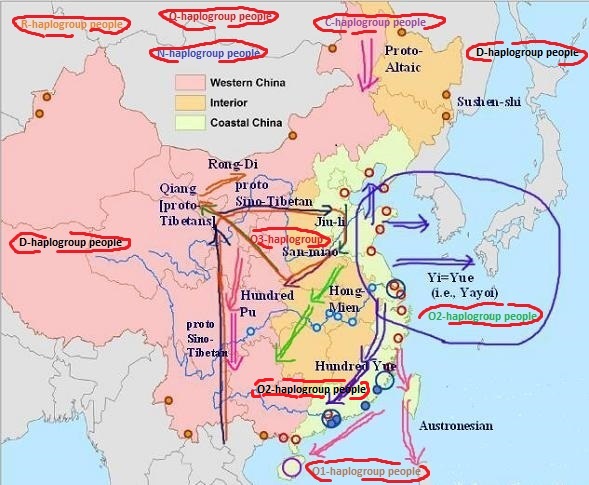
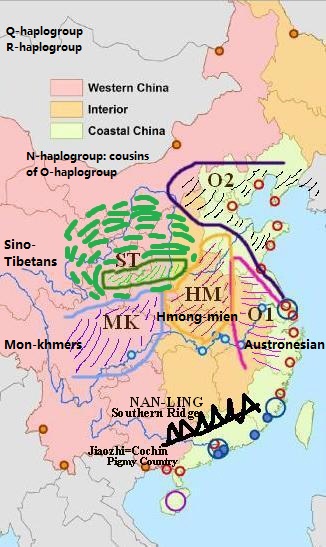
From this perspective, it could then be deduced why the Ainu on the Japan islands were said to have shared some similarity of genes to the Tibetans --because the Tibetans, i.e., descendants of the Jiang-surnamed Qiangs, were exiled to northwestern China from eastern China, and then inter-mixed with the D-haplogroup people who were marginalized on the plateau the same as the Ainu people's being cornered onto the Hokkaido Island.
Hence, in the late 3rd millennium B.C.E., there were the infusion of the two groups of people from the east, i.e., i) the San-miao people; and ii) the Yi people, or specifically the Yun-surnamed Xianyun people (i.e., the ancestors of the Huns), who relocated to today's Gansu Province during the 23rd century B.C.E. under the order of Lord Shun.
Descendants of the San-miao and Yun-surnamed Xianyun barbarians [who were exiled to the west by lord Shun in the 2200s B.C.E.] stayed on in the area.
Zhou King Muwang resettled those barbarians at the origin of the Jingshui River, among them, Yiqu, Yuzhi, Wuzhi, Xuyan and Penglu, namely, the five Rongs as noted in history -- which could be the origin for the misnomer 'Indo-European' Yuezhi.
During the 17th year reign [i.e., 985 BC per the forgery contemporary version of The Bamboo Annals], Zhou King Muwang was noted for defeating the barbarians, reaching the Qinghai-Gansu regions in the west, meeting with Queen Mother of West on Mt Kunlun [possibly around Dunhuang area], and then relocating the barbarians eastward to the starting point of the Jing-shui River for better management [in a similar fashion to Han Emperor Wudi's relocating Southern Huns to the south of the north Yellow River Bend].
The Qiangic People
Ancient classics stated that the word 'qiang' means the shepherds in the west. The chronicle 'Continuum To Hou Han Shu' stated that the Qiangs were an alternative race of the Jiang surname tribes of San Miao.
During the Later Han (A.D. 25-220) dynasty, the Qiangs had been mercenaries of the Han emperors in numerous wars. Various campaigns against the Northern Huns would comprise of several groups of barbarians, including the Qiangs, the Southern Huns, and the Xianbei-Wuhuan. When the Chinese outposts were in danger of being attacked by the Huns in today's Chinese Turkistan, the Qiangs were called upon by the Han Emperor to provide both the logistic support and the fighting manpower. (In addition to the Qiangs, there was another notable group of people called the Yueh-Chih Minor or the Lesser Yuezhi aiding the Chinese emperors on most occasions.) In the Hun section, we mentioned that one of the two colonial policies of Han China was to segregate the Huns from the Qiangs by setting up castles on the Silk Road.
Beginning from the late 1st century, the Qiangs began to rebel against the Chinese frequently. Largely as a result of the urgency to cope with the Qiangic threats, the Han Court had very much given up the early efforts in controlling Chinese Turkistan, a policy called cutting off the right arm of the Huns by driving the Hunnish influence out of the fertile Turkistan areas. The Qiangs would have wars with Han China for dozens of years.
By the end of the Han Dynasty, the eastern Qiangs were controlled by warlord governors in the northwestern part of China. Dong Zhuo, who hand-picked last Han Emperor Xiandi, might have some heritage of the barbarians in this Qiangic area. During the Three Kingdom time period, the Qiangs had participated in the wars as mercenaries. After the fall of the Western Jinn Dynasty, the Qiangs as well as the Di[1] nomads would play their part in the later landslide campaigns in northern China, i.e., 'Five Nomadic Groups Ravaging China' of the 4-5th centuries. Posterior Qin Dynasty (A.D. 384-417), established in today's Shenxi Province, was of the Qiangic nature.
The Qiang[1] & the Di[1]people
Ancient classic, Shi Jing, recorded that "Di[1] & Qiang[1] dared not stop paying pilgrimage to the Shang dynasty."
The Qiangs aided the Zhou Dynasty in defeating last Shang King Zhouwang. Shi Ji recorded that Zhou King Wuwang's army at the Battle of Muye consisted of the 'people from the west', i.e., the allies including eight barbarian statelets, the Qiangs from Gansu, the Shu-Sou-Mao-Wei statelets in Sichuan Province, Lu and Peng from the northwest, and Yong and Pu south of the Han-shui River.
The difference between Di[1] and Qiang is not clear.
The Di[1] people were said to be descendants of Xi-nan-yi, i.e., the southwestern barbarians. Ancient classics mentioned that Di(1) meant for the sheep. The word 'qiang' means the shepherds in the west.
Records show that Di[1] belonged to an alternative race of the ancient 'Xi Yi', namely, the western Yi barbarians. They were alternatively called 'Bai Ma', i.e., the white horse, and 'Bai Di[1]', i.e., the white Di[1]. During the Qin-Han times, the Di[1] people resided in the areas south of Qishan (the Zhou ancestral land) and Long (Gansu Province) and west of Hanzhong (the areas between Sichuan and Shaanxi) and Chuan (Sichuan Province).
Han Emperor Wudi (r. nominal October 141-Dec 87 B.C.; actual January 141-Feb 87 B.C.) sent General Guo Chang/Wei Guang against them and set up the Wudu Commandary in the Di[1] land. The Di people fled to the mountains and two groups were known, Qing Di (Green Di) and Bai-Di(1) or Bai-ma-di (White Horse Di).
In 112 B.C., the Xianling-qiangs attacked the Lingjusai fort and Fuhan city.
In September of 112 B.C., the Qiangs, in collusion with the Huns, attacked Gu[4]'an and Fuhan
(Linxia, Gansu), while the Huns invaded Wuyuan north of the Yellow River sheath. In October of 112 B.C., Li Xi, et al., took an army
of 100,000 to quelling the Qiangic rebellion.
In 88 B.C., the Lesser Yuezhi (Yüeh-chih) served as a messenger between the Huns and the Qiangs.
In March of 80 B.C., the Di barbarian rebellion at Wudu (Lixian, Gansu) was quelled by Ma Shijian,
Haan Zeng and Tian Guangming.
In 63 B.C., the
Qiangic tribes, with the Huns' agitation, made an alliance. Lang-he, a chieftain from the Yuezhi Minor,
i.e., Marquis Qiang-hou, attempted to borrow the troops from the Huns to sever the Han dynasty's
trade route at Shanshan and Dunhuang. In 61 B.C., Yiqu Anguo, against Zhao Chongguo's divide and
conquer tactic, cheated over thirty Xian-ling Qiangic chieftains to a meeting and killed them all, which
led to the Qiangic and Xian-ling Qiangic rebellion. In the spring, Yiqu Anguo retreated to Lingju.
Zhao
Chongguo and Xu Yanshou were dispatched to the west.
During
Han Emperor Xuandi (Liu Xun, reign 73-49 B.C. [actual Jun 74-Dec 49 B.C.])'s reign, Zhao Chongguo defeated the Xianling-Qiangs.
The Han dynasty established the 'hu-Qiang jiao-wei' office and conducted
farming at the Huang-shui River.
The Han army quelled the Western Qiangic
land by disrupting the Qiangic tribal alliance and setting up the Jincheng farming fort.
What happened was that
in 61 B.C.,
citing the five planets' gathering in the east skies and the Venus' position in the high sky,
the emperor ordered 'po-Qiang jiang-jun' Xin Wuxian's 6100 troops,
'Dunhuang tai-shou' Kuai's 2000 soldiers,
'Changshui jiao-wei' Fu Chang, and
Duke Jiuquan-hou Feng Fengshi to command Nuo-qiang (Ruo-qiang) and Yuezhi troops of 4000 and 'wang-lu' miscellaneous dislodged barbarians of 12000 to attack the Han-qiang (Han-Jian-qiang) with 30 days' supplies, with the troops reaching the Xian-shui River's 'gou-lian' angle-winding area, about 800-li distance from Jiuquan, as well as Zhao Chongguo's army for a pincer-attack from the north and east.
Zhao Chongguo countered the emperor with defeating Xianling-qiang and then pacifying Han-qiang and Teng-qiang without a fight.
In 60 B.C., the
farming garrison was revoked after the success in quelling the Qiangic rebellion and executing Xian-ling chieftain Yang Yi (Marquis Guiyi-qiang-hou).
Zhao Chongguo (137-52 B.C.), a Shanggui native, had
his portrait listed among eleven meritorious ministers at the Qi-lin-ge Palace after death in 52 B.C.
Later,
Jia Juanzhi claimed that
the campaign against the Qiangs [in 61 B.C.] cost all the royal savings at the Da-si-nong ministry, etc.
In the autumn of A.D.
5, Wang Mang, after making a claim that the barbarian states from the east sea, south sea and north
sea had expressed subordination, with the Qiangs offering to surrender 'xian-shui [fresh water] hai
[lake]' and 'yungu yan-chi [salty pond]', proposed to establish the Xihai-jun (west sea) Commandery for
resettling the nationwide convicts. Later in A.D. 5, Qiangic chieftains Pang Tian and Fu Fan rebelled
and expelled magistrate Cheng Yong, with the rebellion quelled by Dou Kuang the following spring.
The place where Xihai-jun was belonged to habitat of the Beihe-qiang and the Yuezhi Minor that was renamed to Yicong-Hu for their assisting the Han dynasty in quelling the Qiangic rebellion of 112 B.C.
Wang Mang's usupation of the Han dynasty led to turmoil and civil wars in China and rebellion of the barbarians around the perimeter of China.
On the Western Corridor, Dou Rong, whose ancestors stationed in
the Western Corridor as either colonel ('xiao') for pacifying the Qiangs or the magistrate ('tai shou'),
sought suzerainty with Emperor Guangwudi, accepted the Han dynasty's calendar, and attacked Kui
Xiao's Qiangic allies and Kui Xiao.
Eastern Han relaunched the
'hu-Qiang jiao-wei' office in the He-Huang area.
In late A.D. 34, the Xianling-qiang barbarians attacked Jincheng and Longxi. Lai
She repelled the Qiangs at Wuxi (five valleys).
Xianling-qiang
The Qiangs invaded Lintao in the summer of A.D. 35.
In late A.D. 35, Ma Cheng quelled Wudu, while Ma Yuan tacked on the magistrate post for Long-xi
and defeated the Xianling-qiang barbarians at Lintao (Minxian, Gansu). In A.D. 36, Ma Yuan further
repelled the Shenlang-qiang's invasion against Wudu.
About this time, Shaodang-qiang chieftain Dian-liang, a 'xuan-sun' great grandson of Shaodang who was in turn a purported 18th generation grandson of Wuyi-yuanjian, defeated the Xianling-qiang and Beinan-qiang, and took over the Greater Da-yuzhong area.
In the autumn of A.D. 57, Shaodang-qiang chieftain Dian-wu, who was Dian-liang's son,
invaded Long-xi and defeated Longxi Prefect Liu Xu at Yunjie.
The Qiang people who guarded the border for the Han Dynasty in Longxi all rebelled against the Han Dynasty.
The trigger was arrest of a Shaohe-qiang female chieftain by the name of Bitonggian and killing of hundreds of Qiangs.
Han Emperor Mingdi sent Zhang Hong ('ye-zhe') to quelling the Shaodang-qiang rebellion.
The Qiangs defeated and eliminated the Han army led by Zhang Hong ('ye-zhe') at Yunwu.
In November, the emperor sent Dou Gu (zhong-lang-jiang), Ma Wu and 40,000 troops against the Qiangs.
In July of A.D. 58, Ma Wu ('pu-lu [capturing the enemy]
jiang-jun')
and
Wang Feng ('zhong-langjiang')
defeated the Qiangs
and
chased the Qiangs to Dong-gan and Xi-gan (Hualong, Qinghai).
The Shaodang-qiangs were resettled elsewhere.
Dian-wu surrendered the next year.
Dou Lin, i.e., 'hu-Qiang jiao-wei', took the chieftains to the Han court.
A.D. 76, Lejie-qiang and Beinan-qiang rebelled against Han.
In A.D. 77, due to an incident of a Han official wrestling over a Beihe-Qiangic woman in Anyi, for which he was killed, county magistrate Zong Yan hunted for the culprit, which led to rebellion of the Qiangs including Shaodang-qiang, Shaohe-qiang, Beinan-qiang (Beihe-qiang), Dangjian-qiang, Dangtian-qiang, Yuezhi-hu, and Lushui-hu, etc.
Zong Yan was killed.
Shaodang-qiang chieftain Mi-wu, a son of Dian-wu, joined the rebellion with the Lejie-qiang and Wuliang-qiang tribes, and defeated Jincheng-jun magistrate Hao Chong.
Emperor Zhangdi sent Wuwei-jun magistrate Fu Yu against the Qiangs as 'hu-Qiang jiao-wei'.
Mi-wu, rallying 50,000 Qiangs including the Fengyang-qiang tribe, attacked the Longxi-jun and Hanyang-jun commanderies in June, defeated and
killed 'hu-Qiang jiao-wei' Fu Yu, and took over the He-Huang area
In August,
'hangche-cheji jiang-jun' Ma Fang
and
'Changshui jiao-wei' Geng Gong
were
sent to quelling the rebellion with 30,000 troops comprising of five colonels' units of Yueji, Dunji, Bubing (infantry), Changshui and Shesheng, plus bowmen of various commanderies.
In A.D. 78, Ma Fang was promoted to 'che-qi jiang-jun' for defeating the Shaodang-Qiangs at Jixian (Tianshui) and relieving the siege of Lintao.
In A.D. 86, 'Longxi tai-shou' Zhang Yu caught Mi-wu's brother Hao-wu and released him.
The Qiangs went to Mi-wu in the areas north of the Yellow River due to instigation of Fu Yu ('hu-Qiang
jiao-wei') who attempted to use the Hu people against the Qiangs.
In March of A.D. 87, Fu Yu ('hu-Qiang
jiao-wei') was killed at Sandougu (three helmets valley) in an ambush battle with the Shaodang-Qiangs.
'Longxi tai-shou' Zhang Yu, as 'hu-Qiang jiao-wei', was sent against the Qiangs.
Zhang Yu defeated the Qiangs at the Mushenggu (Dashenggu) valley (Huangyuan, Qinghai), and in a Linqiang banquet hosting Mi-wu, poisoned Mi-wu and killed over 800 chieftains.
In
A.D. 88, Mi-tang attacked the Yuezhi Minor, with the new 'hu-Qiang jiao-wei' Deng Xun opening up the gate to offer asylum to the Yuezhi.
Mi-tang, i.e., Mi-wu's son, allied with Shaohe-qiang, Dangjian-qiang and Dangtian-qiang, attacked Longxi-sai in revenge, and fought against 'Longxi taishou' Kou Xu at Baishi-xian (Linxia, Gansu).
Deng Xun, correcting Zhang Yu's mistake, befriended the Qiangs, pacified Mi-wu's uncle Hao-wu, and exited the border to defeat Mi-tang at Xiegu.
In
A.D. 89, Deng Xun sent zhang-shi and 6000 Huang-zhong troops to defeating Mi-tang 's attempt at returning to Yugu.
Mi-tang was defeated and left the Yugu valley for Poyangu.
Mi-tang fled to Fa-qiang at Subi, which forced some Fa-qiang vacating the Yushu Grassland for Naqu Grasslands to the west.
In A.D. 96, 'hu-Qiang jiao-wei' Shi Chong ordered the Guiyi-Qiang-Hu to exit the border to attack Mi-tang.
Mi-tang defeated Shi Chong.
In A.D. 97, Mi-tang led 8,000 people to invade Longxi.
Mi-tang invaded Longxi twice.
With
other Qiang tribes and rallying a force of of 30,000 infantry and cavalry, Mi-tang defeated the Longxi soldiers and killed the Daxia-xian County magistrate Wang Chaoyu.
Emperor Hedi sent Liu Shang, a 'Yueji jiao-wei' deputy commander and 30,000 miscellaneous Han-Qiang-Hu army against Mi-tang.
Liu Shang chased Mi-tang to south of Lintao and defeated Mi-tang at Gaoshan.
In A.D. 99, Mi-tang surrendered to Geng Tan ('ye-zhe'), with 2000 remnants settled in Jincheng.
When Emperor Hedi ordered them back to Yugu (elm valleys) in today's Xunhua-Guixian and south of the Yellow River, with grains and cattled offerred by 'hu-Qiang jiao-wei' Wu Zhi, Mi-tang took the bridges as posing danger to him and rebelled again in A.D. 100.
Mi-tang's Shaodang-qiang previously defeated Xianling-qiang and Beinan-qiang, with Beinan-qiang relocating to the upper Min-jing River area after several defeats in wrestling back the Yugu area.
In A.D. 101,
Mi-tang returned to Cizhi (i.e., Xizhi, the Yellow river winding area),
which led to
'hu-Qiang jiao-wei'
Zhou Tun and Jincheng prefect Hou Ba's attacking Mi-tang with 30,000 troops.
The Qiangs were defeated and resettled in Hanyang-jun, Anding-jun and Longxi-jun.
Defeated at Yunchuan (Gonghe, Qinghai) and with 6000 Qiangs surrendering to the Han army, Mi-tang fled across the source of the Cizhi-he River and took refuge with the Fa-Qiang tribe.
Fa-qiang in turn went to the Tangmao tribe at the Qiangtang Plateau, where they launched the Tangma state, next to Zhangzhung (Xiangxiong or Yangtong).
Many years later, Mi-tang died of illness, and his son Lai-long returned to the east to surrender, by which time there were no more than dozens of households in the tribe.
In April of A.D. 106, Xianbei attacked Yuyang, and 'Yuyang tai-shou' Zhang Xian, against the advice of 'bingma yuan' clerk Yan Shou, chased out of the border with several hundred people and was ambushed and killed.
The young emperor Han-Xiao-Shangdi (Liu Long, r. A.D. 105-106) died in August at age two.
Prince Qinghe-wangzi Liu Hu was selected as a successor, i.e. Emperor Andi (r. A.D. 106-125).
Liang Jin was sent to the western territories as 'Xi-yu fu jiao-wei' in September.
Liang Jin managed to persuade King Qiuci Bai-ba into permission to relocate the protector-general office to Qiuci (Kuqa) from Tagan, which triggered the Qiuci locals' rebellion in collusion with Wensu (Onsu/Aqsu, Aksu) and Gumo (Baluka/Aqsu, Aksu).
When Wensu and Gumo came to lay a siege of Qiuci with several tens of thousands of troops, Liang Jin called over Duan Xi and Zhao Bo, and combinng troops into 8-9000, defeated Wensu and Gumo and chased to kill over 10,000.
In A.D. 107, the court ministers made a petition to revoke the protector-general office in the western territories, with a decision made in June, that led to a chain reaction of Qiangic rebellions as a result of invoking the Qiangic peopple into 'qi du-wei' Wang Hong's Guan-zhong army for retrieving Liang Jin, Duan Xi, Zhao Bo, and Yiwu (Araturuk) and Liuzhong (within the willows, i.e., Shanshan/Piqan) farming troops.
The Han court drafted the Qiangs for the Western Territories (i.e., Chinese Turkestan), with hundreds up to a thousand cavalrymen from Jincheng, Longxi and Hanyang called up.
The Qiangs, fearing no returning home once in Chinese Turkestan, fled to the west while stopping in the Jiuquan area.
The fleeing Qiangs scared the Lejie-qiang and Dangjian-qiang tribes into running loose.
Ma-nu, i.e., Mi-tang's nephew, fled with his Shaodang-qiang tribe as well, and exited the border pass with his brothers.
Dianling-qiang and Zhong-qiang raided into the Western Corridor and cut the Long-dao road.
The Qiangs fled to the west.
Ma-nu, i.e., Mi-tang's nephew, fled with his Shaodang-qiang tribe.
Dianling-qiang and Zhong-qiang raided into the Western Corridor and cut the Long-dao road.
Han generals Deng Zhi ('cheji jiang-jun') and Ren Shang ('zheng-xi jiao-wei') were sent to quelling the rebellion with 50,000 troops but were defeated by the Qiangs in January of A.D. 108.
In A.D. 108, chieftain Dianling of the Xianling-qiang tribe proclaimed as an emperor in the Beidi-jun commandery, and
with Shenlang-qiang (Orion wolf, with 'shen' meaning 'shen-xing
{three stars or triaster of Alnitak, Alnilam and Mintaka}) of Wudu-jun and miscellaneous Qiangs from Shang-jun and Xihe-jun,
cut off the Long-dao (Gansu Road, i.e., the link to the Western Corridor), intruded into and plundered the San-fu capital district areas of Chang'an, and went further southward to enter the Yizhou (Sichuan) area, and killed Hanzhong-jun prefect Dong Bing.
In A.D. 109, Lejie-qiang and Dangjian-qiang sacked the Poqiang-xian county (Ledu, Qinghai) and attacked Lintao.
Zhong-qiang sacked the Lindao city and captured 'Longxi-Nan-nu du-wei'.
In A.D. 110, Dianling-qiang invaded the Han-zhong basin, forcing prefect Zheng Qin into relocating to Baozhong.
In A.D. 111, Xianling-qiang made a long-distance trek to attack Henei-jun (Wushe, Henan), with the capital city of Luoyang shaken and the Chang'an city dilapidated.
In this year, panic led to the emperor's order to have various shires to build forts against the Qiangs's continuous attack towards the east and south.
Ren Shang, reinstated as 'shi-yushi', defeated the Qiangs at mount Yangtou-shan of Shangdang.
With the Longxi and northern commanderies vacated,
the emperor was disuaded from abandoning Longxi.
In A.D. 112, Qiangic chieftain (emperor) Dian-ling died and was succeeded by son Ling-chang.
Since Ling-chang was young, clansman Lang-mo located a Chinese by the name of Du Jigong as a general to fight against the Han army.
Du Jigong's brother Du Qi, Du Jigong and Wang Xin back in autumn of A.D. 111 colluded with the Qiangs in a rebellion and took over Shanggui.
This was after the Han court approved the relocation of governing offices of Longxi, Anding, Beidi and Shangjun to Xiangwu, Meiyang, Chiyang and Ya, respectively, and ordered to destroy the houses and cut the planted crops to force the populace to relocate to the hinterland.
Du Qi was killed by an assassin sent by 'Hanyang-jun tai-shou' Zhao Bo, and Wang Xin was killed by 'shi-yushi' Tang Xi in A.D. 111, which led to Du Jigong's fleeing to Dian-ling for asylum.
In A.D. 113, Lao-qiang fought against Han General Hou Ba in Anding-jun.
Ma Xian (qi-duwei) and Hou Ba defeated the Lao-qiang.
In A.D. 114, Hao-duo, Lejie-qiang and Lingchang-qiang attacked Wudu and Hanzhong, and then returned to have junction with chieftain Ling-chang.
Banxun-man of the Ba-jun commandery assisted the Han army in repelling Hao-duo, Lejie-qiang and Lingchang-qiang in the defense of Hanzhong, and 'Hanzhong wu-guan yuan' Cheng Xin led the brave men in joining Banxun-man against the Qiangs.
Hao-duo returned west to cut the Long-dao road and colluded with Ling-chang against the Han army.
Ma Xian (qi-duwei) and Hou Ba commanded the Huangzhong clerks and pacified Qiang-Hu in defeating the Qiang rebels at Fuhan.
Meanwhile, 'Liangzhou ci-shi' Pi Yang defeated the Qiangs at Didao.
In A.D. 115,
Xianling-qiang fought against 'zhong-lang-jiang' Yin Jiu in the Yizhou prefecture.
In this year, Hao-duo surrendered with 7000 Qiangs.
In the summer of A.D. 116, 'du-Liao jiang-jun' Deng Zun commanded chanyu and 'zuo guli-wang' of the Southern Huns in attacking chieftain (emperor) Ling-chang in Lingzhou and killed more than 800. Hunnic 'zuo guli-wang' Xu-shen was conferred the title of Marquis Polu-hou.
Ren Shang defeated Xianling-qiang at Dingxi-cheng.
End of the year, Ren Shang sent an army to attacking Ling-chang in Beidi, killing Ling-chang's wife and children, burning dwellings, and beheading more than 700, with booty of Qiangic imperial era documents and seals, etc.
In A.D. 117, in the spring, 'hu-Qiang jiao-wei' Ren Shang
hired a Dangdian-qiangic person by the name of Yu-gui for assassinating Du Jigong, for which Yu-gui was conferred the imperial title of Marquis Qiang-hou,
and in the autumn,
hired a Xiaogong-zhong Qiangic person by the name of Hao-feng for assassinating Ling-chang, over which Hao-feng was conferred the title of King Qiang-wang.
Subseuqently, Ren Shang and Ma Xian (qi-duwei) attacked Lang-mo in Beidi.
Ma Xian first repelled Lang-mo's attack at Qingshi'an in Anding.
Moving with two armies to Gaoping, Ren Shang and Ma Xian forced Lang-mo into retreating.
After sixty days' confrontation, the Han army
defeated Lang-mo's Qiangic army in Shanghe (upper river) of Fuping, killing 5000 and capturing thousands. Over 11,000 Qiangs from the Qianren tribe surrendered to 'du-Liao jiang-jun' Deng Zun in Xihe (west of the Yellow River).
In A.D. 118, Deng Zun hired Diao-he, a Quanwuzhong Qiangic person from Shangjun, to get Lang-mo assassinated, over which Diao-he was conferred the imperial title of Marquis Qiang-hou and Deng Zun Marquis Wuyang-hou with 3000 households for his status as a brother of the dowager-empress while Ren Shang was ordered to be executed for competing against Deng Zun and exaggerating the war feats.
With Lang-mo and Ling-cahng dead, counties in the former three capital districts of Chang'an and the Yizhou prefecture were all pacified.
In A.D. 119, Lejie-zhong (Lejie-qiang) and chieftain Longxi-zhong-qiang Hao-liang conspired for rebellion, over which Ma Xian attacked and defeated the Qiangs at An'gu, with Hao-liang killed.
In the spring of A.D. 120, the Shen-Di-qiang of Shang-jun, with 5000 persons, attacked Zhangye.
In the summer, Ma Xian with 10,000 troops attacked Shen-di-qiang, and after an initial defeat, attacked and defeated the rebels in a second fight, and killed 1800 enemies.
To render relief to the Shen-Di-qiang who were attacked by Ma Xian at Zhangye on the Western Corridor, Dangjian-qiang chieftain Ji-wu attacked Jincheng.
Ma Xian ('hu-Qiang jiao-wei'), with 10,000 troops, returned to Jincheng, and chased to defeat Ji-wu, with enemies killed by thousands. Dajian-qiang derived from the Xianling-qiang tribe.
Shaodang-qiang and Shaohe-qiang, hearing that Ma Xian left Zhangye, attacked the city and killed the Han zhang-shi official.
In A.D. 121, Ren-liang of the Shaodang-qiang, being dissatisfied with Ma Xian's treatment of the Ma-nu brothers, rebelled in invading Huangzhong and Jincheng with 3,000 men.
Earlier, Ma Xian induced to killed Ji-wu's tribal hegemon Lu-cong and wrestled over over 100,000 cattle, for which Ma Xian was conferred the title of Marquis Anting-hou.
Ma Xian led the Xianling-qiang to fight back, but the Han army failed to win at the Battle of Muyuan (horse ranch).
Ma-nu and others defeated the Wuwei and Zhangye troops at Lingju, hijacked over 4,000 households of Xianling-qiang and Shen-di-qiang, and attacked Wuwei. Ma Xian chased Ma-nu to Luanniao, pacified the Qiangs and forced Manu to return to Huangzhong.
In A.D. 122, Ma Xian pursued Ma-nu to Huangzhong, crossed the Saidu-he (border pass crossing) River, and defeated the Western Qiangs who went to surrender to 'Liangzhou ci-shi' Zong Han.
In the winter, Manu, with over 3000 households, surrendered to 'Hanyang-jun tai-shou (prefect)' Geng Zhong.
In this year, 'du-Liao jiang-jun' Geng Kui commanded the various commanderies' troops and the Wuhuan cavalry in defeating the Qianren-zhong-qiang and Shang-jun-Hu's rebellion in Shang-jun.
In A.D. 124, the Longxi-jun office returned to Didao.
In A.D. 126, Zhong-qiang in Longxi rebelled. Ma Xian (jiao-wei), with over 7000 troops, defeated the rebels at Lintao and decapitated over 1,000, for which Ma Xian was conferred the title of Marquis Duxiang-hou.
In A.D. 129, 'shang-shu pu-ye' Yu Xu petitioned Han Emperor Shundi to relaunch the three commanderies that were dilapidated after over twenty years' wars with the Qiangs.
The emperor ordered 'ye-zhe' Guo Huang to be in charge of relocating the exiles back to their respective counties, with citywalls revuilt, canals and rivers dug, 'hou-yi' (marquis' relay) posts established, and farming started, that saved 100 million coins annually from the hinterland commanderies.
Anding, Beidi, Shang-jun, Longxi, and Jincheng were mandated to store grains for emergency usage lasting years.
In the 5th year of Emperor Shundi's Yonghe Era, i.e., A.D. 140, Zhong-qiang and others attacked Jincheng, and the mixed Qiang and Hu from Xisai and Huangzhong attacked the San-fu districts and killed local officials. The imperial court sanctioned 'Bingzhou ci-shi' Lai Ji and 'Liangzhou ci-shi' Liu Bing, and appointed Ma Xian as 'zheng-xi jiang-jun' (the general to conquer the west), and qi-duwei (cavalry captain) Geng Shu as deputy, to station 100,000 troops at Hanyang-jun, including
'zuo [left] yulin-jun',
'you [right] yulin-jun',
five 'jiao-wei' (colonels)'s troops,
and
soldiers from various commanderies and . In A.D. 141, Ma Xian was defeated and killed together with two in an ambush.
It would be during the reign of Emperor Huandi that Zhang Huan, Huangfu Gui and Duan Jiong quelled the Qiangic rebellion, with
Duan Jiong estimating
quelling of the Qiangic rebellion ensuing from the Yongchu Era to have cost the imperial court 24 billion coins, and that in the late Yonghe Era costing more than 8 billion.
At the end of the Eastern Han dynasty, the Qiangs rebelled again, and compounded the Yellow Turbans rebellion, that led to demise of the dynasty.
When the Qiangs rebelled again, Huangfu Song, Zhang Wen and Dong Zhuo were called upon to quell the Qiangs.
Dong Zhuo, who capsized the Han dynasty, achieved his power via cracking down on the Qiangs in the northwestern part of China.
Dong Zhuo earlier followed zhong-lang jiang Zhang Huan in quelling the Qiangic rebellions and was conferred the post of jun si-ma by Emperor Huandi; he was later offered the post and title of langzhong, ci-shi of Bingzhou, and tai-shou of the Hedong Commandery.
Zhang Huan, a follower of paramount in-law minister Liang Ji, was 'Anding-shu-guo du-wei' since A.D. 155, responsible for cracking down on the Hunnic and Wuhuan rebellion; in A.D. 158 commanded the southern Hun mercenaries against Xianbei; in A.D. 161 acted as 'du-Liao jiang-jun' against the barbarians in today's Manchuria; and in A.D. quelled the Qiangic and Xianling Qiang rebellion in western China.
In the early A.D. 200s, a Di[1] chieftain called Yang Teng was named Duke of Qiuchi (Chouchi). Ts'ao Wei Dynasty conferred a Qiuchi descendant, Yang Qianwan, the title of King of Di[1]. A nephew of the Yang family, Yang Maoshou (Linghu Maosou), was conferred the title of King Youxianwang (i.e., the rightside virtuous king) by Western Jinn Emperor Huidi (reign 290-306) and the title of King Zuoxianwang (i.e., the leftside virtuous king) by Western Jinn Emperor Mindi (reign 313-317).
In A.D. 291, Jinn Empress Jiahou's machination led to start of the Turmoil of eight Sima kings.
In A.D. 296, Baima-Di[] under Yang Maoshou (Linghu Maosou) rebelled against Jinn China, took the Wudu and Pinping-jun commanderies and launched the Anterior Qiuchi state.
In this year, i.e., the 6th year of Yuankang Era, a Hun by the name of Hao-Duyuan rallied the Qiang and Hu tribes in rebellion, with Di[1] chieftain Qi-Wannian answering the rebellion and defeating Jinn General Zhou Chu at Liangshan (Qianxian, Shenxi).
Qi-Wannian's rebellion continued to A.D. 299.
In A.D. 299, after the Western Jinn dynasty quelled Qi
Wannian's Di-Qiangic rebellion, Jiang Tong, who was the crown prince's tutor, submitted a petition
termed Xi Rong Lun (petition to relocate the barbarians to their homeland). Jiang Tong blamed Ma Yuan
and Cao Cao as to the relocation of the Qiangs to the capital districts, and warned the court against
the barbarians' possibility of 'hua xia' (jeopardizing the Xia Chinese), with a claim that the barbarians
had taken the proportion of close to half the number in the 'Guan-zhong' capital districts
To the south of Qiuchi,
Empress Jiahou's death in A.D. 300 triggered the turmoil in the Sichuan basin when Zhao Xin, 'ci-shi' for the Yizhou prefecture and a crony of Empress Jiahou, declared independence in the Sichuan basin
and
recruited the marauders from the Qiangic and Di barbarian territory, like the Li Te brothers who belonged to the ancient Ba-di[1] people and alternatively termed called by 'Cong-ren' carrying a similar sound to a prehistoric Sichuan king Cancong {the silk worm}.
Zhao Xin, fearing the 4000 mercenary cavalry, then killed Li Xiang the cavalry chief in A.D. 301, which then triggered the rebellion led by Li Te who intruded into Chengdu in January A.D. 301 and killed Zhao Xin at Guangdu.
Li Te was credited as founder of the Cheng-Han dynasty with start year A.D. 303 and posthumous title of Emperor Jinghuangdi (r. Jan-Feb A.D. 303).
Li Xiong, i.e., Li Te's son, sacked Chengdu in A.D. 304 and called himself King Chengdu-wang, officially launching the Cheng-Han regime, and in A.D. 306 upgraded himself to be an emperor.
Internal killings among the Di[1] family ensued. The Di people sought vassalage with Shi Hu's Jiehu Posterior Zhao Dynasty, Eastern Jinn Dynasty, and Fu Jian's Anterior Qin Dynasty, consecutively. In A.D. 371, another Di, Fu Jian of Anterior Qin Dynasty, conquered the Qiuchi Di and relocated all of them to Guanzhong, namely, the areas of ancient Chinese capital Xi'an of Shenxi Province. After the death of Fu Jian in the hands of the Qiangs, a Di descendant called Yang Ding, would lead his people to Longyou, the areas to the rightside of Long (i.e., Gansu Province), and declared himself Duke of Qiuchi, i.e., Posterior Qiuchi (A.D. 385-443), and declared himself King Longxi-wang four years later. In A.D. 389, Yang Ding occupied the Qinzhou Prefecture (Gansu Province), i.e., about the area ancestors of China's first empire Qin dwelled, and declared himself King of Longxi (i.e., western Gansu) at Shanggui.
In 394, Yang Ding was defeated and killed by Qifu Qiangui (Qifu Gangui)of the Western Qin Dynasty. Cousin Yang Sheng succeeded the throne.
Yang Ding's son, Yang Shen, later sought vassalage with the Jinn Dynasty. Yang Shen would be conferred the title of King of Chengdu by Liu Yu, founder of the Liu Soong Dynasty. Yang Shen told his son, Yang Xuan, to always seek vassalage with the Southern Chinese regimes. Yang Xuan would be conferred the title of King of Nan-Qin (i.e., southern Qinzhou Prefecture).
Posterior Qiuchi was destroyed by the Northern Wei Dynasty in A.D. 443.
(Note that ancient China divided today's Gansu Province into Longxi, Qinzhou and other prefectures.
In this area, this Qiuchi state was surrounded by Posterior Qin to the northeast, Western Qin to the north, and Tuyuhun to the west, plus Qiao-Shu regime in the Sichuan basin to the south - that was retaken by the Eastern Jinn dynasty.)
The Xianbei & Qiangic Blends
The Tibetans, according to New History of the Tang Dynasty, belonged to the Xi Qiang, namely, the western Qiangic people. There were 150 different groups of the Qiangic people, widely dispersed among today's Sichuan, Gansu, Qinghai and Shenxi provinces. New History of the Tang Dynasty also cited a mutation of pronunciation for the name of a founder of Southern Liang (a Xianbei Statelet, A.D. 397-414), Tufa Lilugu. What it said is that the Southern Liang's last name or clan name, Tufa, had mutated into Tubo in Chinese pronunciation or the English word Tibet.
Southern Liang's last name Tufa was ascertained to be the original name of the Tuoba Wei dynasty's ruling clan, rather the concocted Sinicized transliteration of 'tuo' for mud and 'ba' for the Yellow Thearch's descendants who dwelled in the northern wilderness from prehistory.
After Cao-Wei's substitution of the Han dynasty (202 B.C.-8 A.D., 25-220 A.D.), chieftain Tuoba Jiefen's successor, i.e., Tuoba Pigu, relocated west to Liangzhou at the Western Corridor, where they came to be known as Tufa Xianbei.
In A.D. 258, the remnant Tuoba Xianbei in the Yellow River sheath area relocated eastward to Shengle (at the Northeastern Yellow River Bend) from Wuyuan under chieftain Tuoba Liwei, and were to become ancestors of the later Tuoba Wei dynasty.
In December of A.D. 317, Liu Cong killed Zi-ye, i.e., deposed Jinn Emperor Mindi, which officially ended the Western Jinn dynasty. Though Emperor Mindi was dead, his Jianxing Era was being used by Anterior Liang at the Western Corridor till A.D. 353, when Zhang Zuo usurped the throne belonging to the family of his brother Zhang Gui and renamed the era to Heping.
Zhang Gui established
the Wuxing-jun commandery at Guzang, and the Jinxing-jun commandery south of the Huangshui River for resettling the Chinese refugees. At the northwesternmost segment of the Western Corridor, a Jinchang-jun commandery was set up.
Under the attack of Hunnic Anterior Zhao (formerly Hunnic Han, A.D. 304-329), Zhang Mao, i.e., Zhang Shi's brother, received the conferred title of King Liang-wang, i.e., the regime of
Anterior Liang (A.D. 317-376) at Liangzhou.
Zhang Jun, i.e., Zhang Shi's son, inherited Zhang Mao's title but proactively attacked Hunnic Anterior Zhao.
In A.D. 327, Zhang Jun was defeated by Hunnic Anterior Zhao.
Liu Yao's Anterior Zhao Dynasty allied with the Di[1]-Qiang army to counter Zhang Jun and Yang-nan-di's threat from the west and southwest.
After Anterior Liang's defeat, Murong Tuyan, i.e., Murong Tuyuhun's son, was pressured by the Huns into leaving the Xia-he River area (i.e., Linxia basin) in A.D. 329 for the Bailan-qiang's high plateau, to the north of mount Jishishan (Animaqing), where he was killed by Qiangic chieftain Jiang Cong.
By A.D. 328-329, Shi Le's Posterior Zhao destroyed Liu Yao's Anterior Zhao Dynasty, and took control of Longdong and Linxia.
Tuyan was succeeded by Yeyan who relocated to Mugetan, a pasture surrounded by the Yellow River on three sides, and launched the Tuyuhun state.
Yeyan's son Pixi sought vassalage with Fu Jian's Anterior Qin Dynasty (A.D. 351-394).
Zhang Jun's Anterior Liang, for borrowing path through the Sichuan basin and linking up with Eastern Jinn, submitted to Cheng-Han Emperor Li Xiong as a minister.
In A.D. 335, Zhang Jun dispatched Yang Xuan into the Western Territories (i.e., later Chinese Turkestan) for pacification.
In June 346, Shi Shu sent a Jiehu army to attacking the Western Corridor.
In January 347, Huan Wen's Eastern Jinn army sacked Chengdu and destroyed the Cheng-Han dynasty.
Meantime, Anterior Liang recovered part of the Longxi territory.
In August, Zhang Chonghua (r. A.D. 346-353) defeated Ma Qiu's Jie-hu army.
In September, Murong Jun succeeded Murong Huang (who in November 337 self-enthroned himself as King of Yan, i.e., Anterior Yan A.D. 337-370).
Ran Min's Ran Wei Dynasty (A.D. 350-352), which usurped Jiehu's Posterior Zhao dynasty (A.D. 319-352), was destroyed by the allied army of Xianbei, Qiang, Di[1] and Jiehu, which left a vaccum for Fu Jian to rise up in western China to launch Anterior Qin (A.D. 351-394).
In A.D. 352, Anterior Qin attacked Wang Zhuo at Longxi and pressed him into seeking asylum on the Western Corridor.
In May of A.D. 353, Zhang Chonghua, i.e., son of Zhang Jun, assembled 20,000 troops for an attack against Anterior Qin at Shanggui.
Later in A.D. 353, Zhang Zuo usurped his nephew's Anterior Liang throne and adopted the era of Heping.
Anterior Qin took Tiefu Huns' land in Beidi and the Yellow River sheath area, further encroached onto Anterior Liang, and eliminated Anterior Yan (A.D. 337-370) at Yecheng.
In A.D. 371, Fu Jian of Anterior Qin Dynasty conquered the Qiuchi Di state,
and took over the Sichuan basin in A.D. 373.
Anterior Qin continued on to take out
Anterior Liang and
Tuoba's Dai-guo state in A.D. 376.
Fu Jian, in order to reunite China, launched a war against Eastern Jinn against death-bed objection from counselor Wang Meng, while in A.D. 382 dispatching Lü Guang against the Western Territories with an army of 75,000.
As a result of the collapse of the barbarian allied army's campaign against the Eastern Jinn court at the A.D. 383 Battle of Fei-shui, Anterior Qin collapsed. After the fall of Di's Anterior Qin,
the Xianbei re-established Posterior Yan (A.D. 384-409) and the Qiangs would set up Posterior Qin (A.D. 384-417).
Near the Anterior Qin capital city of Chang'an, two brothers Murong Hong and Murong Chong combined forces and launched Western Yan (A.D. 384-386, 386-394).
Among the Western Xianbei, Qifu set up Western Qin (A.D. 385-400, 409-431), and Tufa set up Southern Liang (A.D. 397-414).
Qifu Guoren, who was sent by Anterior Qin to quell the Qifu Xianbei rebellion, colluded with the rebels against Fu Jian, took over Hezhou and Qinzhou, set up Western Qin (A.D. 385-400, 409-431).
The Qifu group of Xianbei, who mixed up with the Dingling people, migrated southward to the area west of mount Liupanshan under chieftain Qifu Youling before launching Western Qin (A.D. 385-400, 409-431).
Back in A.D. 270-271, Tufa Xianbei under chieftain Tufa Shujineng first rebelled against Jinn China in Longxi.
In A.D. 270, Tufa Shujineng killed Qinzhou satrap Hu Lie at Wanhudui (Gaolan, Gansu), and
in A.D. 271, Tufa Shujineng
attacked and sacked Liangzhou, and killed satrap Qian Hong at Qingshan (Huanxian, gansu), threatening the He-Huang area to the south.
Shujineng then in Jinshan (Shandan, Gansu) killed new satrap Suyu.
It would be in A.D. 279 that Shujineng was killed by Jinn General Ma Long, with cousin Tufa Wuwan succeeding as the chieftain.
What's to be emphasized is that the Xianbei migrants who set up the Southern Liang or Western Qin would be a minority in comparison with the Qiangic people who had dwelled in this area for thousands of years, since the prehistory times of Lords Yao-Shun-Yu.
The Qiangs first built their dynasty, Posterior Qin (A.D. 384-417), by rebelling against the Di(1) barbarians' Anterior Qin (A.D. 351-394).
Yao Chang declared himself King 'wan-nian [1000 years] Qin-wang' at Beidi (Yaoxian, Shenxi) and after defeating and killing Anterior Qin Emperor Fu Jian in A.D. 385, intruded into Chang'an after the Western Yan Xianbei abandoned the city for Hedong.
After the death of Fu Jian in A.D. 385, Lü Guang launched Posterior Liang (A.D. 386-389, 389-403) at Guzang (Wuwei, Gansu),
calling himself 'zhongwai [inside and outside of China] da-dudu', 'da-jiangjun', 'Liangzhou mu', Duke Jiuquan-gong.
Posterior Qin was later conquered by General Liu Yu of Eastern Jinn (A.D. 317-420) in a northern expedition in A.D. 417. The remaining Qiangs joined hands with a branch of the Xianbei barbarians to create a lasting kingdom called 'Tuyuhun'.
Tuyuhun competed against the Tibetans well into the 7th century.
At one time, the Tang Chinese were at war with Tuyuhun. One Qiangic tribal leader, who was allied with Tuyuhun via inter-marriage and carrying the last name of Tuoba, aided Tuyuhun by refusing to surrender to the Tang Chinese.
Do note that the Tuyuhun people were i) an outsider force, ii) of the Xianbei origin, and iii) relocated from today's Manchuria. The Xianbei element in Tuyuhun was embodied by several noted stories.
The Tuyuhun Legends
One story is to do with the split of the two Xianbei brothers who descended from
Murong Xianbei chieftain Mohuba who followed Cao-Wei Dynasty tai-wei Sima Yi in the A.D. 238 Manchuria campaign against Gongsun Yuan, over which Murong Mohuba was conferred the title of King Shuaiyi-wang (king who led the righteous).
In A.D. 281, Murong Shegui's Xianbei rebeled against Jinn. In 282 A.D., Yan Xun, Jinn "an-bei jiang-jun" General, repelled Murong Shegui's invasion at the Changli-jun Commandary. Murong Shegui's sons would be Murong Tuyuhun, Murong Wei (Murong Gui) and Murong Yun.
After Murong Shegui died in A.D. 284, brother Murong Shan was at odds with the nephews.
Murong Tuyuhun led 1700 households of people in a westward migration to the area between the Yinshan Mountain and Northern Yellow River Bend.
It is said that the elder brother (namely, Tuyuhun) was born by a concubine and hence did not inherit the Xianbei royal line. When the horses of the two brothers fought against each other, the younger brother complained about it. The older brother hence said he would lead his people, about 700 households (Fang Xuanling's Jinn Shu stating 1700 households), to the west. This elder brother grazed his horses by about 500 units of grazing distance to the west every day. The younger brother had regrets about his offending the elder brother and sent some elderly people to pursuing his elder brother. The elder brother said he would return should his horses be willing to return to the east. But the horses refused to go east even though the elderly people tried to bring the horses eastward 15 times. Hence the elder brother moved across the inner Mongolian plains to the west of China. The younger brother made a song called 'Ode To Ah Gan' ('gan' meaning brother) and sang it in remembrance of his elder brother. The younger brother would be fater of Murong Huang, the later founder of Xianbei's Anterior Yan Dynasty (A.D. 337-370).
The Tuyuhun people, under pressure from the Tiefu Huns, in A.D. 313, left the mount Yinshan area for relocation to the south. After crossing mount Longshan, Tuyuhun arrived at the Xia-he River area, with the Tao-he and Xia-he river area located to the north of the Tibetan grasslands and to the east of the Yellow River Nine Winding area.
The other stories would be about the descendants of the Tuyuhun founder. A grandson, called Yeyan, would name his statelet 'Tuyuhun' by claiming that the ancient Chinese gave their statelets the names on basis of the fact that the son of a duke or king usually used the name of the duke or king as a family name or statelet name. After his father (Tuyan) was killed by a Qiangic chieftain, he would make a straw man in the image of the Qiangic chieftain and shot arrows at it. Yeyan would cry aloud when he shot at the target but got mad when he missed the target. At one time, Yeyan's mother got sick and did not eat anything for 5 days. Yeyan did not eat anything either, a true filial son according to the Confucian standards. Yeyan's son, Pixi, sought vassalage with Fu Jian, the emperor of Anterior Qin Dynasty (A.D. 351-394). Pixi, fond of his three brothers, died of sadness when his ministers killed his three brothers.
After Anterior Qin Emperor Fu Jian's death and Anterior Qin's taking control of Qinzhou and Hezhou, Tuyuhun sought suzerainty with the Qifu Xianbei.
Pixi's son, Shilian, sought vassalage with Qifu Qian'gui and was conferred the title as King of Bailan and 'Shazhou mu' in A.D. 390. Shilian's son, Shi Pi, declined the title of King of Bailan and hence angered Qifu Qiangui. Qifu Qian'gui defeated him. Shi Pi's brother, Wuheti, attacked Qifu Qian'gui when Qifu was busy entering Chang'an (i.e., Xi'an) of today's Shenxi Province. Qifu Qian'gui defeated him again, with Wuheti fleeing to Southern Liang for asylum and dying there. Then, Shi Pi's son, Shuluogan, declared himself the Great Chanyu and the King of Tuyuhun, but he was defeated by Qifu Qian'gui (r. 385-400, 409-412), too.
Taking advantage of Juqu Mengxu's defeating Tufa Nutan in A.D. 410, Shuluogan wrestled over Jiaohe from Southern Liang by defeating Tufa Hutai.
Qifu Chipan (r. 412-428), i.e., successor of Qifu Qian'gui, relocated the capital city to Fuhan (Linxia) in A.D. 412.
Western Qin defeated the Tuyuhun at Chi-shui (red river), first appointed Tuyuhun chieftain the post of 'Chi-shui duhu' and then robbed Jiaohe from Tuyuhun the following year.
Qifu Xianbei's Western Qin,
after eliminating Tufa Xianbei's Southern Liang (A.D. 397-414), continued west to attack Tuyuhun Xianbei who were living to the north of the Bailan-qiang and Fa-qiang people, to the west of mount Minshan, and to the south of mount Qilianshan.
Southern Liang king Tufa Nutan (r. 402-414) was attacking the Yifo tribe in A.D. 414 when he was attacked in the rear by Western Qin.
Shuluogan, and brother A'cai, fled to mount Bailanshan, to the southeast of the Chaidamu (Tsaidam, Qaidam) Basin, for refuge.
Qifu Chipan (r. 412-428) further defeated the Tuyuhun people.
Qifu Xianbei's Western Qin also subjugated the Yifowudi state north of the Qinghaihu Lake, that was a former vassal to Northern Liang, with the two states of Yifowudi and Northern Liang straddled across mount Qilianshan.
Northern Liang (A.D. 397-439) in turn went west to defeat the Chinese Western Liang state (A.D. 400-421) which was situated along the northwesternmost Western Corrdior, with Western Liang King Li Bao fleeing to Yiwu with uncle Tang Qi and expressed loyalty to the Ruruans as the Posterior Western Liang dynasty enjoying the Ruruan title of King Yiwu-wang.
In the Western Territories, the newly-arising stepp empire of Rouran (Ruruans) took over Shule (Kashgar) and Yutian (Khotan).
Shuluogan's brother, Ah Chai (A'chai), examined the source or origin of the Yangtze River and asked his ministers where it flowed into. When told about the Liu Soong Dynasty (A.D. 420-479) in southern China, Ah Chai sent an emissary seeking for pilgrimage. Ah Chai was conferred the title of Duke by the Liu Soong Dynasty.
Tuyuhun was cut off from Eastern Jinn and Liu Soong after Jinn satrap at Ningzhou (i.e., today's Yunnan-Guangxi-Guizhou area and a prefecture or commandery launched by Shu-Han prime minister Zhuge Liang) surrendered the Nanzhong basin to Cheng-Han.
(The origin of the Yangtze was wrongly taken to be at Mt. Minshan of today's Sichuan, with Yu Gong stating that Lord Yu started the repair of the Yangtze from Mt. Minshan, with the flow to turn into the Tuo-shui River to the east.
Kong Zi Jia-yu, i.e., Confucius' Mottos, purportedly carried a statement from Confucius to the effect that the Yangtze originated from Mt. Minshan, where the water was like the drip from a wine cup.
Guo Pu, in Jiang Fu [ode to the Yangtze], further expounded on the Yangtze origin statements in Shan Hai Jing to state that two origins of the Yangtze existed, with the 'middle' Yangtze water coming from Mt. Laishan [which was to the northeast of Mt. Minshan] and the 'northern' Yangtze water coming from Mt. Jushan [which was to the east of Mt. Laishan].
The error in the Yangtze origin, similar to that of the Yellow River, was a result of human limits in exploration from the ancient world.
In Soong Dynasty, Su Shi further explained that the 'middle' Yangtze water or 'zhong jiang' came from Mt. Minshan and the Min-jiang River, and the 'northern' Yangtze water came from Panzhong, flowed into the Han-shui River and the Yangtze [while the southern Yangtze River came from Yuzhang or today's Nanchang].
Su Shi had adopted Tang scholar Xu Jingzong's method of making distinction among the water flows of different rivers through the taste and temperature of the water.)
Ah Chai later returned east to the Mugetan land.
Before Ah Chai died, he returned the throne to the son of his brother Wuheti. Ah Chai was recorded to have asked his nephew and a dozen or so sons to break the arrows by a single stick and by a bundle. This is to show his sons that should they unite together they could not be defeated.
Tuyuhun King A'cai's successor Suixi surrendered horses and tributes to Anterior Qin after seeing the demise of Anterior Yan (A.D. 337-370).
Suixi received the conferral as General 'anyuan jiang-jun' and Marquis Qiangchuan-hou.
Fu Jian's Anterior Qin instead eliminated the Anterior Qiuchi state in A.D. 371 and taking advantage of Eastern Jinn general Huan Wen (312-373)'s death, campaigned against the Sichuan basin.
In A.D. 376, Anterior Qin attacked and sacked Anterior Liang's Guzang city.
Liangzhou satrap Zhang Tianxi surrendered to Anterior Qin.
Mukui continued to seek pilgrimage with the Liu Soong Dynasty and was conferred the title of Duke of Longxi (namely, western Shenxi/Gansu Province) by Liu Soong Emperor Wendi (reign A.D. 424-474). Mukui would later capture the last ruler of Hunnic Xia (i.e., Helian Ding) and delivered him to Tuoba Wei Emperor Taiwudi (reign A.D. 424-452) of Tuoba Wei Dynasty, namely, Tuoba Tao.
This was when Helian Ding defeated and eliminated Western Qin at Fuhan in A.D. 431 and attempted to cross the Yellow River to attack ally Northern Liang, that the Huns were attacked by 30,000 Tuyuhun cavalrymen, for which Tuyuhun was allowed to control the former Western Qin territories of Jincheng and Longxi, etc.
Mukui received the conferral as King of Xi-qin (namely, western Qin).
Tuyuhun continued on to attack and eliminate the Yifowudi state at the Qinghaihu Lake.
There is no separate English name for the Tuyuhun, and most history books skipped this tribe altogether. It had lasted for about 350 years in history, from the end of the Yongjia years (the A.D. 310s) of Jinn Dynasty to the 3rd year of Longshuo (A.D. 663) of Tang Dynasty. 'Tuyuhun' would be under attacks by various nomadic dynasties, but it managed to be an independent country well into the 7th century, till it was absorbed by the Tibetans. It survived the Sixteen Nations (A.D. 304-420), the North Dynasties (A.D. 386-581), and Sui Dynasty (A.D. 581-618). It had at one time raided deep into the Chinese Turkistan. During the early Tang Dynasty (A.D. 618-907) time period, it had inter-marriage with the Tang princess. The Tibetans took them as No. 1 enemy. At one time, 'Tuyuhun' was conquered by the Tibetans, but one son of the Tibetan prime minister later brought several thousand tents of the 'Tuyuhun' people back to Tang Dynasty's domain.
The Warring States' Time Period in Northwestern China
In the early 5th century, the Eastern Jinn dynasty retook both the Sichuan basin and the Hanzhong basin.
In A.D. 417, Liu Yu launched a northern expedition, crossed the Qinling Ridge, and recovered Guan-zhong from Posterior Qin.
However, Liu Yu was eager to return south to usurp the Jinn throne (A.D. 317-420), which gave Helian Bobo's Tiefu Huns, the Western Xia dynasty (407-431), a chance to attack south to take over Chang'an.
At about the same time, Tuoba Xianbei's Northern Wei, while building the Great Wall against the Ruruans to the north, moved south as well, defeated the Liu Soong dynasty's army along the Yellow River, took over Luoyang, then attacked Helian Bobo's Western Xia and took over Chang'an in A.D. 426, and further in A.D. 427 sacked the Western Xia capital city Tongwancheng to the north of today's Yenan.
Helian Chang fled to Tianshui to the southwest, which bordered with Western Qin to the west and Posterior Qiuchi to the south.
Helian Chang struck an alliance with Northern Liang.
Helian Chang attacked Western Qin, i.e., Hunnic Northern Liang's enemy, and sacked the Xiping city in the Huangshui area, which was to the east of the Qinghaihu Lake.
After that, Juqu Mengxun, commanding the Northern Liang army, crossed mount Qilianshan to sack Xiping.
Western Qin remnants retreated to the south of the Yellow River Nine Winding area, while Yifowudi defected back to Northern Liang.
Taking advantage of Northern Wei's northern campaign against the Ruruans, Helian Ding's Xia army, departing Pingliang, attacked Guan-zhong and retook the Wei-he River area.
Northern Wei, after defeating the Ruruans and Gaoche, came back to defeat the Western Xia Huns and retook Guan-zhong.
In A.D. 431, Helian Ding exited mount Longshan to attack Western Qin again, and defeated and eliminated Western Qin at Fuhan.
While attempting to cross the Yellow River to attack ally Northern Liang, Helian Ding was attacked by Tuyuhun from the hind.
Tuyuhun, with 30,000 cavalrymen, defeated and captured Helian Ding, and handed Helian Ding to Northern Wei, for which Tuyuhun was allowed to control the former Western Qin territories of Jincheng and Longxi, etc.
Beginning from A.D. 500, the Di people began to seek vassalage with Tuoba Wei Dynasty in the north. Wars between Tuoba Wei Dynasty and Southern Liang Dynasty erupted over the control of the Di people.
Tuyuhun versus Tuoba
Mukui's brother, Muliyan (r. A.D. 436/437-452), succeeded the throne.
Muliyan received the Tuo Wei conferral of King Xiping-wang and Liu Soong conferral of King Longxi-wang.
In A.D. 439, Muliyan was upgraded to King Henan-wang by the Liu Soong court.
Tuoba Wei's elimination of Northern Liang (A.D. 397-439) scared Muliyan into escaping west at one time.
The Liu Soong court, through Tuyuhun in the Hehuang area and Juqu Wuhui at Gaochang (Karakhoja), connected with the Ruruans in an alliance against the Tuoba Wei dynasty.
To retaliate against Tuyuhun for linking up Liu Soong with Ruruans, Tuoba Tuo campaigned against Tuyuhun King Muliyan in A.D. 444.
When attacked by Tuoba Wei as a result of his cousin's defection to Tuoba Wei, Muliyan fled to the west and conquered the Statelet of Yutian (Khoten) in today's Chinese Turkistan.
The Tuoba attack was also triggered by Tuyuhun's internal turmoil.
Muliyan's nephew Wei-dai colluded with Tuoba Wei's emissary, over which Muliyan killed Wei-dai, with Wei-dai's brother Chiliyan fleeing to Tuoba.
Tuoba King Wei-wang (Tuoba Fuluo) attacked and defeated Muliyan.
Muliyan fled to Bailan (Dulan/Balong of ??Qinghai);
his nephew Shiyin fled to Hequ;
and
his younger brother Funian and 13,000 people surrendered to the Northern Wei Dynasty. In A.D. 445, after another defeat by Tuoba King Gaoliang-wang of the Northern Wei Dynasty at Bailan and Mantou-shan Mountain,
Muliyan fled across the quick sand desert
for Shanshan.
While one Tuoba army chased Muliyan through the Chaidamu (Tsaidam, Qaidam) basin, another army moved along the Western Corridor for pincer-attacking Muliyan.
Tuoba took over Shanshan.
Muliyan continued to flee to Khotan where he killed the Khotan king and tens of thousands of people.
Muliyan then move along the Taklamakan Desert's edge to conquere Jibin (Kashmir/Kabul), with plan to pass through Kashmir and India for southern China.
Muliyan then sent envoys to the Liu Soong Dynasty for help.
He returned to the old land after Liu Soong Dynasty invited him back in the A.D. 440s.
Muliyan quit the idea of taking the roundabout trip through the Indian subcontinent.
At one time in A.D. 450, Muliyan sent tribute to the Liu Soong Dynasty and requested for passage through Longgan (Songpan, Sichuan) for taking refuge in the Liu Soong Dynasty land.
When the Tuoba Wei army withdrew troops from the Hehuang area in A.D. 446 for countering Liu Soong, Muliyan returned home in A.D. 449 but relocated the capital city westward to mount Bailan-shan in the Chaidamu area, where he built the Tuyuhun city.
Tuhun During the Five Dynasties
During the Five Dynasties time period, the remnant Tuyuhun people would come to be known as 'Tuhun'. It once joined efforts with Tang China in cracking down on the Pang Xun rebellion. They were relocated to northern China, near today's Datong of Shanxi Province. Shatuo's Posterior Tang (A.D. 923-936) conferred them the royal family name of Li.
Later, Posterior Jinn (A.D. 936-946) ceded the land north of the Yanmen'guan Pass to the Khitans. Hence, the Tuhun people were enslaved by the Khitans. Chinese history recorded that the Tuhun people were later defeated by Liu Zhiyuan, founder of Posterior Han (A.D. 947-950).
During this time period, there were a list of barbarian groups along today's Inner Mongolian belt, including
the White Xi[2] (Tiele), Xi and Khitans to the north and east; the Western Turk and Eastern Turk remnants, the Three-Tribe Shatuo, the Six-prefecture Sogdians, the Tuyuhun (Hun[2], Tuihun, Tuhun, or Sheng-Tuhun[raw Tuhun]) and Tanguts (Dangxiang-Xiao-bo carrying the Tibetan 'bo' name), and the Qibi (Tiele) people to the south and west; and the Mount Jiashan Tanguts (Jiashan-Dangxiang) in the Yinshan Mountains.
The Tuyuhun people, who were conquered by the Tibetans, were part
of the Tibetan mercenary army in the invasion of China, and long after the Tuyuhun disappeared in
western China, the remnants, who were known as the Tuhun people, dwelled in northern China in
close quarters with the Shatuo Turks, the Da-da tribes, the Huihe (Uygur) tribe and the Dangxiang
Qiangic tribe. The Tuhun people carried the Helian surname, which was a Hunnic surname from
Helian Bobo's Xia dynasty (A.D. 407-431), which was similar to the Dangxiang-Qiangs' inheriting
the Tuoba Xianbei's Tuoba surname, not knowing that their respective ancestors were of different
ethnic and genetic stocks.
In the 9th-10th centuries,
there were
the Tuyuhun (Hun[2], Tuihun, Tuhun, or Sheng-Tuhun[raw Tuhun]) and Tanguts (Dangxiang-Xiao-bo carrying the Tibetan 'bo' name) in northern China, and
the Mount Jiashan Tanguts (Jiashan-Dangxiang) in the Yinshan Mountains.
The Qiangic Elements Of Dangxiang
The Dangxiang people were remnants of the Western Qiang people. The Dangxiang people would be living to the south of the Tuyuhun people.
This dwelling place of the Dangxiang people and the Tuyuhun people would be called Inner Tibet [against Frontal Tibet or Outer Tibet] in the later times. Out of the remaining Tuyuhun people and the Dangxiang people would evolve into the later Xixia Kingdom led by the Dangxiang (Tanguts) barbarians or the Tanguts. History recorded that there evolved eight Dangxiang tribes by the time of the Five Dynasties (A.D. 907-960), with one tribal group carrying the old Tuoba name. The Tuoba Dangxiang people had inter-marriage with the Tuyuhuns, and at one time made an alliance against the Tang army.
The Dangxiang-qiang legends claimed that they originated from Bai-he [the white river, i.e., the ancient Bailongjiang or Qiang-shui] and the cross-border areas of today's Qinghai-Gansu-Sichuan provinces. Their epics also inferred to their tradition of pasting the red color onto their dark faces, building the stone citadels, pointing to the ancient Gao-yao-mi statelet as their origin, and eulogizing a Tibetan girl as the wife of their ancestor.
From A.D. 635 to 678, the Tibetans kept on assaulting the Qiangs. In 635, the Tibetans defeated the Qiangs in the Dangxiang and Bailan area. By A.D. 678, the Qiangs lost the territories of Yangdong to the Tibetans.
Tang Emperor Xuanzong (reign 712-756) allowed the Qiangs of 25 Qiangic prefectures to relocate to Qingzhou (Qingyang of Gansu Prov).
Tuoba Sidai (speculated to be Tuoba Sitou) received the conferral from Tang Xuanzong.
The Tibetans termed the stranded Qiangs in the original habitation area as 'Miyao' and later applied the term to all Qiangs and consecutively the Tanguts.
At the times of Tang Emperor Dezong (reign A.D. 780-785), the Dangxiang nomads sought vassalage with Tang. They were relocated to the Qingzhou and Xiazhou prefectures along the Yellow River Bend. At the times of Posterior Tang Emperor Mingzong (reign A.D. 926-933), the frontier areas were noted for trading in horses. The horses from the Dangxiang and Huihu (ancestors of the Uygurs) weighed heavy in the trades. The Dangxiang and Huihu people were especially delighted in trading with Posterior Tang because Emperor Mingzhong gave very favorable terms to them no matter the horses were fat or thin. Besides, the Dangxiang and Huihu merchants were given benefits as emissaries, and they enjoyed free food/drinks and accommodation. This cost a lot of royal savings to Posterior Tang. Hence, the Dangxiang and Huihu were ordered to trade at the frontiers, only. But the Dangxiang continued to come deep into the Chinese territories, and moreover, the Dangxiang pillaged China and robbed the Huihu of the horses. The Dangxiang continued the pillage well into the Posterior Zhou Dynasty (A.D. 951-960).
The Tibetans vs Tuyuhun
Tibet was unified by Tibetan King Songtsen Gampo (Songzan Ganbu, Chisong Zan [Khri Srong Tsan],
Qizong-nong-zan, Qisunong, Nongzan, A.D. ?-650) and his father Yarlung king Gnam-ri Slon-tsan
(Namri Songtsen, Nangri-un-zan/Lun-zan-suo) in the 7th century after the conquest of Sen-bo, Zang-fan,
Niya-nidabu tribes, etc. Gnam-ri Slon-tsan, or son Songtsen Gampo, was said to have conquered
the Tangmao Qiangs of the Yarlung Valley, i.e., Congci-qiang who had origin in the Shaodang-Qiang chieftain Mi-tang and Fa-qiang (dangling hair Qiangs) of the 1st and 2nd centuries and derived
the 'scallion' name from Congling (scallion ridge) or the Pamirs and had previously replaced the
Zhangzhung (Xiangxiong or Yangtong) as a strong power in Tibet.
The Tibetan origin in the ancient Qiangs could be traced to two lines, i.e., the Subi tribal group and the Maoniu (Tibetan yak) tribal group.
The Maoniu Qiangs first migrated southward to the mountains of western Sichuan, and then under the pressure of the Qin state (10th century
B.C.-207 B.C), were speculated to have migrated southwestward to the Bowo (Bomi) area in the 6th century B.C., where the legendary ancestor Niechi-zanpu was born (? 417 B.C.).
Niechi-zanpu was said to have moved to love among the Bangga (Boka) tribe, one of twelve Tibetan tribes in the Yarlung Valley and the Yarlung Tsangpo (Yarlung Zangbo/Yalu-zangbu) River area, was supported as head of the six Yak tribes, and united the Yarlung tribes into the Xibuye-shi Tibetan tribe.
Another major input would be the Fa-qiang tribe that migrated west under the pressure of the expansion and building of the Great Wall in the Lintao area by Qin Lord Xian'gong (r. 385-362 B.C or with 24 years of reign per Qian Mu/Qin Ben-ji of Shi-ji; r. 384-361 B.C or with 24 years of reign per Qin Ben-ji of Shi-ji; r. 384-362 B.C or with 23
years of reign per Qin-shihuang Ben-ji of Shi-ji).
According to Hou Han Shu, during Qin Lord Li[4]gong g (r. 476-443 B.C.)'s reign,
Wuyi[slave]-Yuanjian[chieftain]
escaped from the Qin captivity, and led his clansmen in a relocation to the Xizhi-he River area.
Hou Han Shu continued to
state that Qin Lord Xian'gong attacked the Wan�rong (heteronym Huan[2]-rong/Yuan[2]-rong) barbarians at the upperstream Wei-shui (Wei-he) River,
driving Shu-fu-mao's tribe towards the Xizhi-he River area, near Tibet.
Wuyi[slave]-Yuanjian's descendants, who were related to the Wudu-qiang and Baima-qiang in the Bailongjiang River area, relocated westward to the Subi tribe on the Tibetan plateau, where they united the locals into the Subi tribal group.
In the west, Tonpa Shenrab (Shenrab Miwo) was credited with founding the Bon religion in Ngari (Ali) of southwestern Tibet, i.e., Zhangzhung, known as Major Da-Yangtong in the Tang dynasty annals Tong Dian, that bordered with a Minor Xiao-Yangtong to the west.
Tonpa Shenrab was speculated to be Zoroastrian who escaped from
the collapse of the Achaemenid Empire in the hands of Alexander the Great
in 330 B.C.
Songtsen Gampo or his father, being
Sino-Tibetan or not, established a state at Luosuo and called the country by Da-bo (Tu-bo). Recorded
in the Chinese annals as carrying the Xibuye-shi clan name, Songtsen Gampo was said to be born
at Jiangbamingjiulin (Jiama-chikang [Gyama] of Mozhugongka), a region to the northeast of modern
Lhasa. After quelling rebellion of Zhangzhung (Xiangxiong or Yangtong), Subi of the Tangmao tribe
(in Yushu of Qinghai), Niya-nidabu, Gong-bu, Niang-bu, etc., Songtsen Gampo moved the seat of his
newly unified kingdom from Qiong-jie (Qonggyai) in the Yarlung Valley to Luo-xie (Rasa) in the Kyichu
Valley, i.e., Lhasa. Subsequently, Songtsen Gampo took over Kam (Kang/Khams) and Amdo (Anduo)
to border with Tang China and Tuyuhun (Azha). Credited with introducing Buddhism from Tang
China [through Tang King Li Dazong who escorted Princess Wencheng to Tibet and brought 360 volumes of
religious and classic canons] as well as the creation of the Tibetan script through Nepali consort Bhrikuti
of Nepal's Licchavi dynasty or minister Thonmi Sambhota who was sent to India, Songtsen Gampo
was the first Tibetan ruler to have ruled over the Tibetan plateau as a state, not a tribal chieftain.
Buddhism was introduced from Tang China, not India. The Tibetan Buddhism was said to have displayed a bit of syncretism with the native animist religion, Bön. The form of Buddhism is the late Tantric, Vajrayâna Buddhism of India.
The
Tibetan Buddhism was said to have displayed a bit of syncretism with the native animist religion,
Bön. The form of Buddhism is the late Tantric Vajrayâna Buddhism of India. Claiming to be a 33rd
Tibetan king, the successive kings included Song-tsen Gam-po (reign c 618-649), Man-song Mang-tsen
(reign 649-704), Du-song Mang-po-je (reign 676-704), Tri-de Tsug-ten (reign 704-754), Tri-song De-tsen
(reign 754-797), Mu-ne Tsen-po (reign 797-800), Tri-de Song-tsen (reign 800-815), Tri-tsug De-tsen (reign
815-838), Lang Darma (reign 838-842)
In year A.D. 640, Tibetan king Songtsen Gampo, learning of Tuyuhun's intermarriage with Tang, initiated a war against Tang and requested intermarriage with Tang princess Wencheng who arrived in Tibet one year later. The Indian King also sent over a daughter to Songtsen Gampo. Intermarriage by marrying the Nepalese and Chinese princesses created alliance with neighbors to the East and West.
Taking advantage of the vacuum left by Tang China which recalled the garrison armies from Central Asia for cracking down on the An-Shi Rebellion, the Tibetans took over the areas west of the Yellow River.
After the An-Shi Rebellion of the late Tang Dynasty, the Tibetans occupied over a dozen prefectures in He-xi [west of the Yellow River] and Long-you [rightside or western Gansu Province] as well as the Western Territories [today's New Dominion Province] by taking advantage of the vacuum left by the Tang army's departure.
By the time of Tang Emperor Daizong (reign 760-779), the Dangxiang-qiang in the Lingzhou & Qingzhou areas colluded with the Tibetans in harassing the Tang border. General Guo Ziyi petitioned to have the Dangxiang-qiang relocate to Yinzhou (Yulin of Shenxi Prov) and Xiazhou (Baichengzi of today's Inner Mongolia).
In A.D. 763, the Tibetans briefly occupied the Tang capital, Ch'ang-An.
Later, the Tibetans had internal upheavals. The last King, Lang Darma, turned against Buddhism. The kingdom fragmented after him.
Tibetan King Songtsen Gampo, who asked Princess Wencheng from Emperor Taizong, died in A.D. 650. At the time of Songtsen Gampo, the Tibetans had once helped a Tang emissary in
attacking Middle India (one of the five Indian kingdoms of the time) when the Tang emissary was assaulted by the new king of the Middle Indian Kingdom. Zanpu's
young grandson would be the new Tibetan king. Tibetan prime minister Ludongzan and his four sons had the actual power over Tibet, however.
Ludongzan, together with 10 families of the Western Khanate, first attacked
Tuyuhun, i.e., Tibet's number one rival. Tang Emperor Gaozong was asked to intervene
by the Tuyuhun king. Emperor Gaozong rejected two Tibetan requests:
1) the land of Chishui (i.e., red water), and 2) the Tibetan intermarriage with
the Tanguts. Tibetan prime minister Ludongzan hence obtained
the aid of the Yutian (Hotan) people and took over 18 prefectures in the western territories, including the Qiuci State. General Xue Rengui,
in A.D. 670, was ordered to quell the Tibetan rebellion, but he was defeated
by Ludongzan's 400 thousand troops due to the fact that his logistics general
lost all equipment to the enemy. General Xue negotiated a peace
treaty in which Tang would promise not to enter the Tuyuhun territory.
When Xue returned to the capital, he was demoted into a civilian and would
not be called upon till the Eastern Turks rebelled in the north in A.D. 680-681.
Hence, Tibet entered Tuyuhun and relocated all Tuyuhun people to the Lingzhou prefecture
which was already taken by the Tibetans. In A.D. 678, Emperor Kaozong campaigned against Tibet again, but the Tang army was defeated by the Tibetans.
In A.D. 696, the Tibetans sought peace with Tang, requesting that Tang revoke the administrations in the four cities of Qiuci (Kuqa), Yutian (Hotan), Shule (Kashi) and Suiye (today's Tokmok? in Kyrgyzstan) and that Tibet & Tang divide the 10 Western Turkic families into two halves. But Tang rejected the request. Shortly thereafter, the Tibetan king killed the
sons of his previous prime minister Ludongzan, with only one surviving son fleeing to Tang with 7000 tents of the Tuyuhun people.
The Tibetans' war with Tuyuhun did not end. The Tibetans would attack Tuyuhun again in A.D. 756-758.
Tang Dynasty relocated the remnant Tuyuhun people to the west of the Yellow River Bend.
At that time, the Tuyuhun people still enjoyed three big families, with a Tuoba name, and the Hunnic names of Helian and Murong.
Tang Emperor Yizong (reign A.D. 859-875) conferred the governor-general post of Yinshan to Helian Duo, and later, the Tang post of 'jiedu-shi' (governor-general) of Datong. The Tang post of 'jiedu-shi' exercised authorities over the multiple regions. Posterior Tang (A.D. 923-936) conferred them the family name of Li. Later, Posterior Jinn (A.D. 936-946) seceded the land north of the Yanmen Pass to the Khitans. Hence, the Tuhun people were enslaved by the Khitans. Chinese history recorded that the Tuhun people were later defeated by Liu Ziyuan, the founder of Posterior Han (A.D. 947-950). Tuyuhun disappeared after that.
The Tibetans vs the Tang Chinese
In A.D. 681, Western Turkic Khan Ashina (Eshina/Ahshina) Duozhi, together with the Tibetans, attacked Tang's Anxi Marshal Presidio. Emperor Gaozong ordered the release of a Persian Prince in the
attempt of having the Persians impede the Western Turks. In the early times, the Persian King died in the hands of the Arabs. The new Persian King, Beirusi, sought the help of the Tang Chinese by sending his son Niniesi to the Tang capital. Tang had made the city of Jiling as the marshal-governor
office and designated Persian King Beirusi as the Persian Marshal.
Tang civil minister Fei Xingjian was ordered to accompany the Persian prince
back to Persia. When Fei passed the land of the Western Turks, he led
a column of tribal leaders of the Anxi marshal presidio nomads, and captured Turkic Khan Duozhi via a surprise strategy:
Fei earlier broadcasted that he would go west after the season and the Turkic khan took Fei's words for granted and hence did not make preparation for defence. Fei asked the
Persian Prince to continue the trip back to his country, and he re-constructed
the city of Suiye, and delegated the power of the Anxi Marshal Presidio to
his general Wang Fangyi. Later, Fei Xingjian would be responsible
for quelling the Eastern Turkic rebellion in A.D. 680 and in A.D. 681 via some similar
strategies, like hiding soldiers inside the grain carts and offering 10,000
liang (ounce?) gold for the head of the khan. In A.D. 682, the Western Turks
rebelled again, and Fei was ordered to go west, but he died on the road
at the age of 64. His general Wang Fangyi succeeded him in quelling the
Western Turks thereafter.
In A.D. 692, Governor-General Tang Xiujing of the Xizhou prefecture defeated the Tibetans and re-took the four cities of Qiuci (Kuqa), Yutian (Hotan), Shule (Kashi) and Suiye (today's Tokmok
in Kyrgyzstan). In A.D. 696, the Tibetans sought peace with Tang, requesting
that Tang revoke the administrations in the four cities and that Tibet
& Tang divide the 10 Western Turkic families into two halves. But Tang
rejected the request. Shortly thereafter, the Tibetan king killed the
sons of his previous prime minister Ludongzan, with only one surviving son fleeing to Tang with 7000 tents of the Tuyuhun people. The Tibetans would attack Tuyuhun again in A.D. 756-758.
Tang had quite some good news around that time. The Khitans
in the east were also quelled by two Khitan generals who had surrendered
to Tang earlier. However, in A.D. 712, the Khitans colluded with the Eastern Turks
again in attacking Tang.
As to Tibet, it had an internal revolt on the
southern Tibetan Plateau. The Tibetan king sought peace with Tang again.
When Emperor Zhongzong was restored in A.D. 705, he had promised to have
princess Jincheng (daughter of a Tang duke-king) marry with the son of
the Tibetan king. After the Tibetan king died, his seven year old son
got enthroned. In A.D. 710, Emperor Ruizong sent Prince Jincheng to Tibet
to marry the new Tibetan king who just grew up, together with a patch of
land called Jiuqu (nine winding) in Hexi (west of the Yellow River) as
a gift. In A.D. 714, the Tibetans invaded Lanwei (today's Lanzhou &
Wei River) areas, using the Jiuqu land as a bridge. Tang General Wang Jun
selected 700 brave soldiers to have them dress in the Tibetan clothes and
sneaked into the Tibetan camp. General Wang, using the strategy, had caused the
Tibetan to have internal fights at night to the extent of almost 10,000 deaths. The
Tibetans, however, continued to encroach upon the Tang capital from the territories
of Tuyuhun and Jiuqu.
In A.D. 744/45, the Uygurs defeated the Turks in Mongolia and established a Uygur Empire. The Uygurs, considered a vassal of Tang, would now control north and west Mongolia, from Lake Balkash to Lake Baykal, till A.D. 840, for almost a whole century. History said the Tang Chinese conspired to have the Uygurs and Karlaks attack the Orkhon Turks under Khan Muchuo (Mo-ch'o). To check the Orkhon Turks, the Tang Chinese also allied with the Western Turks called Turgesh who were situated in today's Ili, between the Arabs and the Chinese from A.D. 716 to A.D. 733.
The Turgesh Turks rebelled against the Chinese in A.D. 739 and were defeated. In A.D. 741, General Kao Hsien-chih led the troops into today's Turkistan, and in A.D. 747, General Kao defeated the Tibetans near the Gilgit Pass in the Hindu Kush mountains and checked the expansion of the Arabs over the passes of the Pamirs to the upper valley of the Amu-darya.
In A.D. 747-749, General Kao also defeated the Karluks who had replaced the Turgesh Turks as a power in the area. In A.D. 748, the Chinese invaded the Ferghana Valley where Kazakhstan, Uzbekistan, Kyrgyzstan, Turkmenistan and Tajikistan converge.
In A.D. 749/50, the Abbasids seized the Caliphate from the Umayyads and subsequently transferred the capital to Baghdad. In A.D. 750, General Kao's crushing of the Tashkent Kingdom led to a Turkic rebellion. In A.D. 751, the Tang Chinese army of 30 thousand, led by general Kao-hsien-chih (a Korean), were defeated by the alliance of the Arabs and the Karluks at the Battle of the Talas River in the high Pamirs. (The Karlaks defected to the Arabs during the war.) It was said the Chinese paper technology was relayed to the West via the prisoners of war. From then on, the Karluks controlled Western China while the Uygurs controlled Mongolia. The Arabs halted their push after a defeat in the hands of the Khazars in Azerbaijan.
Tang nomadic general An Lushan's rebellion (An-Shi rebellion) broke out in Oct, A.D. 755. Emperor Xuanzong sneaked out of capital without notifying his court. Xuanzong, in order to continue on his flight into today's Sichuan Province, orally decreed that his elder son, Suzong, to stay behind to be the new emperor. Emperor Suzong led his people northward to today's
Ningxia area where he reorganized the army and requested with the Uygurs
whose khan sent his elder son and 5000 cavalry to help Suzong in recapturing both Chang-An (Chang'an) and Lo-yang (Luoyang) in 757.
Tang emperor Suzong had organized an army of over 100 thousand under the
banners of two famous generals, Guo Ziyi & Li Guangbi. After the fall of Luoyang, the Uygurs did their best in pillaging the capital. Luoyang would be pillaged two more times
by the Uygurs during the 8 year long rebellion. Later, Emperor Suzong
granted the Uygur Khan one of his daughters, Princess Ningguo, in marriage.
To the south of the Luoyang, a county magistrate equivalent, Zhang Xun, organized the resistance against the An Lushan-Shi Siming rebellion by defending the cities of Suiyang etc., for years.
Tang General Guo Ziyi would emerge to defend Tang against the encroachment from both the Tibetans and the Uygurs. The Tibetans, taking advantage of the An-Shi rebellion, had
taken over areas in today's Gansu-Qinghai provinces, and they had once
entered the western capital of Chang'an and forced emperor Daizong into
fleeing. One Tang general (a Uygur, called Pugu Huaien, who had
been responsible for going to the Uygur tribe in borrowing Uygur cavalry
of 5000 in fighting the An Lushan rebels and again borrowing 3000 cavalry
in fighting the Shi Siming rebels) defected to the Tibetans and he sacked the city
of Taiyuan. Altogether 100 thousand Tibetan-Uygur army came to attack the
Tang capital again. General Guo succeeded in defeating them.
In A.D. 765, Pugu Huaien led the Tibetan-Uygur joint army to attack Tang again by cheating the Uygurs that the Tang emperor and general Guo were both dead. On the
way, Pugu Huaien himself died due to illness. General Guo led 500
cavalry into the camp of the Uygurs and successfully persuaded the Uygurs
in allying with Tang and attacking the Tibetans. Pugu Huaien's mother,
who disapproved of his son's betrayal of Tang, was later invited by the Tang
emperor to live in the capital
Tang China's decline was a result of the An-Shi Rebellion. As a result of this rebellion, Tang China recalled all
stationed armies and garrisons to the west of the Yellow River Bend. The recall of army forces being not enough, the Uygur
mercenaries were also called upon to quell the 8-year-long rebellion. Since
then, Tang China lost the western territories, including the pasture where the hundreds of thousands of the
military horses were raised.
Tang Emperor Suzong would call upon all the Chinese armies to the west of the Yellow River and
to the right side of today's Gansu Province to come east to quell the rebellion. Hence, the Tibetans took advantage of
the vacuum and moved in.
Over one million Tang Chinese came under the rule
of the Tibetans, including the prefectures of Ganzhou, Liangzhou, Guazhou
and Suzhou on the Western Corridor.
In the land to the west of the Yellow River and to the right side of Gansu
Province, Tang China used to have 33 prefectures called 'zhou'. Tang China
set up the Anxi Governor-General post here and it used to control 36
statelets in Western China. Xin Wu Dai Shi (new history of the five dynasties) said Tang
had raised altogether 300,000 horses in this area. Half a century later, when a Chinese emissary (under Tang Emperor
Wenzong, reign A.D. 827-836) passed through the four Western Corridor prefectures, the emissary
noted that those Chinese had changed a bit in accent but the clothing
remained unchanged. The local Chinese, with tears, asked the emissary, 'Did
the Emperor still remember the people stranded in the land occupied by the
Tibetans?"
The Tibetans, by taking over the Western Corridor, also cut off the link between China proper and today's Chinese Turkistan, where the four Tang China's forts continued existence for the dozens of years to come, often receiving the nominal awards from the Tang emperors for fending off the sieges from the barbarians, without the actual benefit of the Tang army coming to their aid.
Guo Xin (?-A.D. 808), who was Guo Ziyi's nephew, in A.D. 781, sent an emissary through the Huihe (Uygur) territory to reach the Tang court.
Emperor Dezong conferred the title of King Wuwei-jun-wang onto Guo Xin.
Fifteen years ago, in A.D. 766, Guo Xin was sent to the He-xi and An-xi territory as an inspector.
Upon learning that Tang China was under Emperor Dezong, Guo Xin ordered to mint the "Da Tang Jian-zhong" coins which were unearthed in the modern times.
Tang China appointed "guancha-shi" (inspector) Guo Xin as "jiedu-shi" of the four forts, and "An-xi da du-hu" for Anxi, while Li Yuanzhong "Bei-ting da du-hu".
Both Guo Xin and Li Yuanzhong received the title of "shang-shu pu-yi".
The Tang Chinese garrison defenders relied on the Shatuo Turks and the Huihe for defense against the Tibetans.
In A.D. 787, the Tibetans sacked the Bei-ting fort, cutting off the northern route of communication between China and the west.
Yang Xigu, i.e., Li Yuanzhong's successor, fled to Xi-zhou where he was killed by the Huihe.
In A.D. 789, when monk Wu-kong passed the Western Territories for returning to China, he met with the four Chinese "zhenshou-shi" generals, who were Lu Yang at Shule, Zheng Ju at Yutian (Hotan), Guo Xin at Qiuci, and Yang Riyou at Yanqi.
In A.D. 808, the Tibetans sacked Qiuci, on which occasion Guo Xin and his white-haired army troops all died to the last person.
There was no record of contact from the Western Territories.
The year A.D. 808 was based on the excavated coins carrying the words of the eras used by Guo Xin's garrison armies.
From the Qyzyl Grotto, there was discovery of some words carrying the year of the 10th year of the Zhenyuan Era, i.e., A.D. 794.
In the late A.D. 790s, 7000 Shatuo tents, under Shatuo Jinzhong, sought suzerainty with the Tibetans. Together with the Tibetans, they attacked the Beiting governor office. The Tibetans later relocated the Shatuo to the Ganzhou Prefecture.
The Tibetans, suspicious of Shatuo's loyalty, intended to relocate Shatuo to some distant place. In A.D. 808, Shatuo Jinzhong and Zhuye Jinzhong led 30,000 people on an exodus to Tang China. The Tibetans chased them all the way and killed Zhuye Jinzhong. Tang General Fan Xichao of the Lingzhou Prefecture received the Shatuo and assigned them to the Yanzhou Prefecture. The Shatuo elderlies and children would find their way to Yanzhou to get a reunion. Fan Xichao selected two thousand Shatuo cavalry and named it the 'Shatuo Column'.
In the land to the west of the Yellow River and to the right side of today's Gansu Province, Tang China used to have 33 prefectures called 'zhou'. Tang China set up the Anxi Governor-General post here and it used to control 36 statelets in Western China. New History of the Five Dynasties said Tang had raised altogether 300,000 horses in this area. The Tang China, however, underwent the An-Shi Rebellion beginning in A.D. 755. Tang Emperor Suzong would call upon all the Chinese armies to the west of the Yellow River and to the right side of today's Gansu Province. Hence, the Tibetans took advantage of the vacuum and moved in. Over one million Tang Chinese came under the rule of the Tibetans, including the prefectures of Ganzhou, Liangzhou, Guazhou and Shazhou of the Western Corridor. Half a century later, when a Chinese emissary (under Tang Emperor Wenzong, reign A.D. 827-836) passed through the four prefectures, the emissary noted that those Chinese had changed a bit in accent but the clothing remained unchanged. The local Chinese, with tears, asked the emissary, 'Did the Emperor still remember the people stranded in the land occupied by the Tibetans?"
Chinese has a saying, 'Feng Sui' or good fortune rotates. ('Feng Shui', or "wind and water," is a name of the Chinese geomancy combining the Buddhist element of air with the Chinese element of water, stating that a soul would stop floating when encountering the water.) The Tibetans lost their prominence by the end of the Tang Dynasty. Throughout the time period of Five Dynasties, it would be the Dangxiang (i.e., Tanguts) and the Uygurs who would be competing with the Chinese in the area called 'Frontal Tibet'.
The Tibetans had some upheaval after their king was killed by the monks in A.D. 842.
Along the Western Corridor, there was a Liugu confederation or the six valleys' tribal alliance, having its origin from the Yangfei-gu valley tribe, some remnants of the Tubo (Tibetan) state which was dissolved in A.D. 842 after its king ('zan pu') Lang-da-ma was killed by the monks over the Buddhism suppression movement.
Zhang Yichao, A.D. 799-872, a civilian-turned Tang Dynasty general who was famous for re-asserting the Tang China's rule over the western territories, i.e., Today's Turkestan, defeated the Tibetans in the Guazhou and Shazhou territories in A.D. 848, recovered the Xizhou (Turpan) territory in A.D. 850, recovered the Guazhou and Shazhou territories from the Tibetans in A.D. 851, and recovered the Liangzhou territory from the Tibetans in A.D. 861.
The Tang Chinese army called themselves by the Guiyi-jun [returning the loyalty] Army.
(The Tang Chinese rule continued among Zhang Chaoyi's generals and their descendants till A.D. 1028, when Tangut Emperor Li Yuanhao led a surprise attack at Ganzhou [Zhangye of Gansu Province], took over the city from Huihe, took over Shuzhou, and pacified General Cao Jushun, i.e., the Tang China's Guiyi-jun [returning the loyalty] Army commander at Guazhou.)
The Tibetans vs Nan-Zhao
In A.D. 710, Tang Emperor Ruizong listened to 'she jiancha yu-shi' Li Zhigu's opinion as to
attacking the Yaozhou barbarians south of the Sichuan basin, with Li Zhigu killed by the Tibetans
who were invited by the Yaozhou barbarians. Yaozhou was launched in A.D. 621 in western Yunnan
and upgraded to the Yaozhou dudu-fu office in A.D. 664 but was taken under the control of the
Tibetans who sacked the Anrong-cheng fort (Ma'erkang, southwest of Maozhou of Sichuan) in A.D. 680
and intruded southward into the Erhai Lake area; and was at one time in A.D. 707 taken back by 'Yao-
Xi-dao taoji-shi’ Tang Jiuzheng who burnt down the Tibetan iron bridges and forts along the Yang-
Bi-shui River and erected an iron pillar to demarcate the boundary—before the Tibetans returned to
the area after the pullout of the Tang expedition army. The Tibetans, in Tieqiao (iron bridge, Dajin-du
crossing), Tacheng of Lijiang) and Langqiong (wavy expanse, Eryuan of Yunnan), stationed two governors
of 'Shenchuan (divine river) dudu' and 'Langqiong qianyu-shi' offices to rule over Nanzhao.
The Scourges-of-God Tetralogy
would be divided into four volumes covering
Hsiung-nu (Huns), Hsien-pi (Xianbei), Tavghach
(Tuoba), Juan-juan (Ruruans), Avars, Tu-chueh (Turks), Uygurs (Huihe), Khitans, Kirghiz, Tibetans, Tanguts, Jurchens, Mongols and Manchus and
southern barbarians.
Book I of the tetralogy would extract the contents on the Huns from
The Sinitic Civilization-Book II,
which rectified the Han dynasty founder-emperor's war with the Huns on mount Baideng-shan to A.D. 201 in observance of the Qin-Han dynasties' Zhuanxu-li calendar.
Book II of the Tetralogy would cover the Turks and Uygurs.
And
Book IV would be about the Manchu conquest of China.
From the Khitans to the Jurchens & Mongols: A History of Barbarians in Triangle Wars and Quartet Conflicts
, i.e., Book III of
the Scourge-of-God-Tetralogy,
focused on the Khitans, Jurchens and Mongols, as well as provided the annalistic history on the Sui and Tang dynasties, the
Five Dynasties & Ten Kingdoms, and the two Soong dynasties.
Similar to this webmaster' trailblazing work in rectifying the Han dynasty founder-emperor's war with the Huns to 201 B.C. in The Sinitic Civilization - Book II,
this Book III of the Scourge-of-God-Tetralogy
collated
the missing one-year history of the Mongols' Central Asia campaigns and restituted the
unheard-of Mongol campaign in North Africa.
|
The Scourges of God: A Debunked History of the Barbarians" - available at iUniverse|Google|Amazon|B&N
From the Khitans to the Jurchens & Mongols: A History of Barbarians in Triangle Wars and Quartet Conflicts
(The Barbarians' Tetralogy - Book III)
Epigraph,
Preface,
Introduction,
Table of Contents,
Afterword,
Bibliography,
References,
Index
|
|
Table of Contents
(From the Khitans to the Jurchens & Mongols: A History of Barbarians in Triangle Wars and Quartet Conflicts)
Chapter VII: The Tibetans .........................................................................................................80
Origin of the Qiangs and Tibetans ..............................................................................................82
The Qiang [1] vs. the Di [1] People ...........................................................................................84
The Tuyuhun Xianbei, the Tibetans & the Tanguts .......................................................................87
The Tibetans vs. the Tuyuhun ......................................................................................................89
The Tibetans vs. the Tang Chinese ..............................................................................................91
The Khitans, the Shatuo, the Tanguts vs. the Five Dynasties .......................................................170
Chapter XV: The Tangut Xia Dynasty (A.D. 1038-1227) ..........................................................258
Origin of the Tanguts ................................................................................................................259
The Tanguts vs. the Five Dynasties ...........................................................................................261
The Tanguts vs. the Soong Dynasty ...........................................................................................263
The Tanguts Attacking the Western Corridor Garrisons, the Tibetans & the Uygurs.......................264
Launch of the Grand Xia (Da-Bai-Gao-Xia) Dynasty .....................267
The Soong Debacle at the Battles of Sanchuankou (in A.D. 1040) , Haoshuichuan
(in A.D. 1041) and Dingchuanzhai (in A.D. 1042) ..............................271
The Triangle & Quartet Wars Among the Khitans, Jurchens, Tibetans,
Tanguts and Soong ..............................................273
The Triangle & Quartet Wars Among the Tanguts, Jurchens, Mongols and Soong .......................280
The Mongols' Attacking the Jurchen & Soong's Western Territories after
Elimination of the Tangut Xia Dynasty ............................360
Chapter XXII: The Mongol Attacks on the Tatars, Naimans, Keraits, Tanguts,
Jurchens, Khitans in Manchuria & Kara-Khitay (from A.D. 1202
to 1219) .....403
Continuous Mongol Attacks on the Tanguts ...............................................................................421
Chapter XXIV: Demise of the Tangut Xia Dynasty (A.D. 1038-1227) ........................................453
Southern Soong's Triangle & Quartet Wars with the Tanguts, Jurchens and
the Mongols .................................................................553
|
|
Xi Xia Dynasty Of the Tanguts
Out of the Qiangic people would evolve the later Da Xia or Xixia Kingdom led by the Dangxiang (Tanguts) nomads or the Tanguts. History recorded that there evolved eight Dangxiang (Tanguts) tribes of Qiangic nature by the time of Five Dynasties (A.D. 907-960), with one tribal group carrying the old Tuoba name. The Tuoba Tribe of the Dangxiang (Tanguts) people had inter-marriage with the Tuyuhuns, and at one time made an alliance against the Tang army. Looking back, This webmaster would say that Tangut people were possibly descendants of the Tuobas, Xianbei people, the Di nomads, Chinese, early Tibetans and the Uygurs.
Tuoba Sigong, a Dangxiang nomad with a Tuoba family name, had come to the aid of Tang Dynasty by the end of Tang in A.D. 907 when rebel Huang Cao sacked Xi'an the Tang capital. Tang conferred him the title of Duke Xia and the Tang family name of Li.
In A.D. 1002, Li Jiqian of the Tanguts attacked Lingzhou. Soong Dynasty zhi zhou shi (magistrate equivalent) Fei Ji defended the city for over one month, cut his finger and wrote a blood letter for requesting relief with the Soong court, and later died in street fighting. Wang Chao made an excuse for not going to Lingzhou on time. After taking over Lingzhou, Li Jiqian renamed Lingzhou [Yinchuan area of Ningxia] to Xiping-fu and made it the capital of Xixia [Western Xia Dynasty].
One year later, Li Jihe of Soong Zhi-Zhenrong-Jun Garrison wrote to the Soong court that a chieftain (Tibetan) from Liugu (six valleys), by the name of Balaji (Panluozhi), intended to attack Tanguts on behalf of Song. Zhang Qixian proposed that Soong conferred the title of 'King of Liugu' and the post of zhao tao shi (campaigning emissary) onto Balaji. Soong decided to offer Balaji the title of Shuofang jie-du-shi (satrap or governor for northern territories) onto Balaji. Balaji claimed that he had assembled 60,000 strong army for fighting Tanguts.
Tangut ruler Li Deming, aka Zhao Deming, had a son by the name of Li Yuanhao. Li Yuanhao often proposed to Li Deming that the Tanguts defeat the Huihe (Uygur) and Tibetans first. Li Yuanhao led a surprise attack at Ganzhou [Zhangye of Gansu Province], and took over the city from Huihe. Li Deming made Li Yuanhao into the crown prince. Li Yuanhao often instigated his father in rebelling against Song. After the death of Li Deming, Li Yuanhao got enthroned.
Li Yuanhao dispatched an army of 25,000 against the Tibetans. Tanguts were defeated and Tangut general Sunuer was taken as prisoner of war. Li Yuanhao personally led an expedition against the Tibetans, but he was defeated by the Tibetans, too.
Li Yuanhao then changed target to the Huihe (Uygur) people. In A.D. 1036, Li Yuanhao took over the Huihe territories of Guazhou (Gansu-xian and Anxi-xian of Gansu), Shazhou (Tunhuang-xian of Gansu) and Suzhou (Jiuquan of Gansu Prov), and hence the Tanguts controlled the He-xi Corridor for 191 years.
At one time, Emperor Li Renxiao sought aid with Jurchen Emperor Jin Sizong for quelling rebellion and hence allied with Jurchen Jin in A.D. 1165.
The Tanguts or the Dangxiang (Tanguts) were attacked by the Mongols in A.D. 1205, 1207 and 1208 before they were defeated in A.D. 1209.
In A.D. 1209, Genghis Khan personally led the 650 mile march on the Tanguts and in Jan 1210, the siege of Tangut capital was released when the waters were breached by the Tanguts and flooded the Mongol camp. Peace was secured only when Tangut emperor delivered his youngest daughter (rumored to be later responsible for poisoning Genghis when he re-attacked Xixia) to Genghis Khan as a bride, but the Tanguts refused to supply troops to the Mongols as auxiliary. Tanguts would pay for this later. After the Mongols left, the Tanguts, angry that the Jurchens did not come to their aid, broke the peace treaty with the Jurchens which had been effective as of A.D. 1165, and a new treaty would not be signed till A.D. 1225 when they faced new waves of Mongol attacks. The Tanguts attacked the Jurchen Jin border towns but were defeated, and hence asked Genghis Khan to attack the Jurchens.
Since Western Xia had refused to provide troops in Genghis Khan's war against the Khwarizm, and moreover, signed another alliance treaty with Jurchen Jin, Genghis Khan led a force of 180,000 troops for a new campaign against the Tanguts. Late in A.D. 1226, in the winter, the Mongols struck southward. On the banks of the frozen Yellow River, the Mongols defeated a Xixia army of more than 300,000. The Mongols killed the Tangut emperor. His son took refuge in the walled city of today's Ningxia. Leaving one-third of his army attacking Ningxia, Genghis Khan sent Ogedei eastward, across the Yellow River, to attack the Jurchen Jin forces.
Genghis Khan, deeply ill himself, nominally agreed to the surrender request but secretly ordered the slaughter of the city before his death.
In July, Genghis Khan died at age 66 (73 ? per different record) somewhere near today's Liupanshan Mountain, Gansu Province, rumored to have been poisoned or killed by his Tangut wife.
The Tanguts officially surrendered in A.D. 1227, after being in existence for 190 years, from A.D. 1038 to A.D. 1227
In August, Xia-Modi left the capital for the Mongol camp where Tu-lei killed him on the spot. The Mongols killed the Tangut emperor and his royal family members. Pillaging erupted throughout the capital.
The Mongol Regents & the Manchu Invasion
After the Mongol conquest of the Tangut Xixia or Hsi-Hsia state, the Tibetans offered submission to the Mongols in A.D. 1227. The Mongols did not go into Tibet till A.D. 1240. In A.D. 1249, a Tibetan Lama was appointed the Mongol regent of Tibet.
In 1252 and 1253, Khubilai ordered Subetei's son to attack Dali (i.e., Nanzhao) in today's southern Chinese province of Yunnan, with three columns of army. King for the Dali statelet, Duan Zixing, whose lineage could be from the Western Corridor, surrendered. Then, the Mongol army invaded the Shanshan statelet in southern Chinese Turkistan and entered the Tibetan plateau. A Tibetan lama led the Mongols into the capital. The Tibetan chieftain surrendered. Khubilai also entered Tibet and met the lama. When Mengke recalled Khubilai, Khubilai would take a 15 year old son (Phagsba) of the lama back to northern China and made him the Imperial Tutor.
Yuan Shi claimed that in August of A.D. 1252, Khubilai defeated Tu-bo (Tibet), and exited Shi-men (stony gate) to attack Dali.
The Mongol army purportedly invaded the Shanshan statelet in the Chinese Turkistan and entered the Tibetan Plateau.
This part of the Mongol invasion history against Tibet could have errors.
A Tibetan lama was said to have led the Mongols into the capital. The Tibetan chieftain surrendered. Khubilai entered Tibet and met Lama Ba-si-ba (Hphags-pa bio-gros rgyal-mtshan, or Pakpa Lodro Gyeltsen, 1235-1280), i.e., patriarch Saskya Pandita (1182-1251)'s successor.
What happened was that Khubilai took the path of Lintao for a short-cut march through today's Ganzi Tibetan Autonomous Region and arrived at Tela (Songpan of Sichuan or Diela of Gansu) in September, where the Mongol armies split into three routes to attack Dali to the south.
Back in the summer of A.D. 1251, Khubilai, while stationing at Liupanshan, sent an invitation to Saskya Pandita who in turn sent nephew Ba-si-ba (Hphags-pa) to seeing Khubilai from Liangzhou (Wuwei).
In A.D. 1253, Khubilai and Ba-si-ba (Hphags-pa) met again at Tela before the Mongols' southern campaign against Dali.
Khubilai returned north after defeating Dali at the turn of A.D. 1253-1254 and in the spring of A.D. 1254.
Khubilai stationed at Hu3zhou and Huanzhou by August of A.D. 1254.
When Mengke recalled Khubilai, Khubilai
made Ba-si-ba (Hphags-pa) into the Imperial Tutor of all Wu-si-zang Buddhist sects in A.D. 1254,
took Ba-si-ba (Hphags-pa) back to the Mongol capital city of Shang-du (Duolun) in A.D. 1255,
and made him into the Imperial Tutor in charge of all Buddhist sects when Khubilai got enthroned in A.D. 1260 and declared the Zhongtong Era as Emperor Xue-chan.
Ba-si-ba (Hphags-pa) purportedly won a debate with Taoist monk Qiu Chuji (Changchun-zhenren) and forced the Taoists into returning the confiscated Buddhist monasteries.
In A.D. 1280, a special title was produced for the regents, Tisri, or Ti-shih in Chinese. The rule of the Tisris, lasting 1280-1358, continued until the Mongol authority waned. The Second Tibetan Statelet was established by King Chang-chub (reign 1350-1364). When the Mongol Yuan Dynasty was overthrown in China, Tibet was already semi-independent. Several kings ruled till the Mongols staged a comeback in A.D. 1642. From A.D. 1642-1717, four Mongol khans ruled in Tibet. When the Mongol rule was imposed in 1642, the Fifth Dalai Lama began to assume effective rule.
The line of Lamas originated from the First Larma, Gedun Truppa, during A.D. 1391-1588. Lamaism, a mixture of shamanism and Buddhism, enjoyed protection by the Mongols after the reform of the Yellow Cap sect of Tsong-ka-pa in Tibet. A Tibetan lama mission to Mongolia converted in A.D. 1578 Altan Khan who bestowed the title of Dalai ("Ocean") on the Third Lama. The title was retroactively applied to the earlier lamas in the lineage.
The Manchus invaded Tibet in A.D. 1720. The pretext of the Manchu conquest was over the overthrow of a local Mongol dynasty by the other Mongols from Zungaria (Dzungaria), who installed their own candidate for Dalai Lama. The Manchus supported the legitimate and popular (Seventh) Dalai Lama. After erecting some Tibetan kings, the Manchus settled down on the Dalai Lamas for control over Tibet beginning from A.D. 1750. An equally monastic Panchen Lama was also in existence.
As to the Tibetans, the Manchu court adopted the policy of "respecting the Tibetan religion but suppressing its administration".
Scholar Luo Xianglin pointed out that the Manchus decreed that every Tibetan household must dispatch one son to the monasteries for studying the Buddhism, hence making the Tibetan population unable to multiply. Further, the Manchus dispatched an "imperial minister" to Tibet for monitoring Dalai Lama and Pancho Lama, and intentionally mixed up religion and politics so that the Tibetans could not conduct any reform on the administration.
Intermarriage between the Tibetans and the Chinese were forbidden by the Manchu.
Russia, Britain & Japan - Tibet, Xinjiang, Mongolia & Manchuria
Per Scholar Yang Yuqing, the Sino-USSR relations could never have a breakthrough on the matter of i) Mongolia, and ii) the Zhong-dong Railroad of Manchuria (i.e., the Chinese Eastern Railway).
In 1910 and 1911, Russia and Japan had reached secret treaties in regards to their 'spheres of influence' in Mongolia and Manchuria. (Tang Degang pointed out that Russia and Japan, after the 1904-5 war, became friends overnight, and signed the secret treaties on July 30th, 1907 and July 4th, 1910 for subdividing Manchuria into two spheres of influence. The line of division would be in present Jilin Province, from the Russian-Korean border to Gunchun, to the Jingbo Lake [Bi-er-teng Lake], to Xiushuidian.)
When the Xin Hai Revolution broke out in 1911, the Mongolian lama, under the instigation of Czarist Russia, expelled the Manchu officials and declared the Mongolia independence on Nov 30th (lunar calendar).
http://www.un.int/mongolia/histdoc.htm claimed that in July 1911, the Khalkha princes, high functionaries and lamas had already discussed the separation of Mongolia from Manchuria.
On Dec 28th (lunar calendar), the Mongolian lama declared the era of Gongdai, i.e., 'supporting together'.
http://www.un.int/mongolia/histdoc.htm claimed that "on 29 December Jebtzundamba Khutukhtu YIII was proclaimed Bogd Khan, head of the religion and the State."
Russia tried to force Manchu China into acknowledging the Mongolia independence. The Russia emissary also visited London to have an agreement on acknowledging Britain's interests in Tibet in exchange for Britain’s reciprocal acknowledgement of Russia's claim in Outer Mongolia.
Tang Degang pointed out that the Russian governor for Siberia, Nikolai Muraviev, in 1854, had proposed to Czar a suggestion to wrestle Outer Mongolia from China.
On July 8th, 1912, Russia and Japan signed the 3rd secret treaty over Inner Mongolia.
Russian S.D. Sazonov and Japanese Honno Ichiro [[Benye Yilang]] signed the secret treaty in St Petersburg to subdivide Inner Mongolia into two halves.
On Oct 3rd of 1912 (lunar cal), the Russian minister-envoy to China, Ivan Korostovets, went to the Mongolia capital for signing a "Russo-Mongolia Treaty", making Mongolia a puppet protectorate of Czarist Russia.
The Russians recruited 40000 Mongols from four banners for organizing a Mongol Army, and supplied 40000 rifles, 4000 cases of bullets, 8 cannons, and 2 million Russian currency.
R.O.C. foreign minister Liang Ruhao resigned at the news of the Russian-Mongolian treaty.
Yuan Shikai ordered that Lu Zhengxiang succeeded the post for negotiating with the Russians in Nov 1912.
Only America expressed opposition to the Russian attempts in Outer Mongolia but softened its stance due to its colonialism in the Philippines, while Japan & Britain kept silence over their secret treaties.
Yuan Shi-kai's Cabinet tried very hard to retain Mongolia and exchanged wires with the Mongolian lama several times. The Mongolia lama expressed his opinions of trying to have self-protection rather than following the suit of Korea, Vietnam and Taiwan.
Meantime, Yuan Shi-kai ordered that Zhang Shaozeng meet the banner leaders of two Inner Mongolian tribal alliances and successfully solidified China's control over Inner Mongolia.
On the other side of the border, the imperialists had been probing into Tibet incessantly.
Back in 1845, two French priests were caught in disguise of merchants and expelled from Tibet; two more French priests were killed in 1851 & 1854 by the locals while penetrating into the Cha-yu-he river valley from India; and in 1861, the French priests encountered resistance from the Tibetan lamaists in Lhasa and the entire southwestern China.
The British, after colonizing India, never let loose its eyes on Tibet.
Historian Tang Degang pointed out that Britain, which had supported the U.S. in propagating the 'Open Door Policy' in the aftermath of the 1900 Boxer Incident, never intended to have anyone else share its interests in Tibet.
Prior to the Xin Hai Revolution, Britain had coerced Manchu China into five unequal treaties on Tibet, i.e., in the years of 1890, 1893, 1904, 1906, 1908.
The British swindled the Sino-Tibetan mountain states of Nepal, Sikkim and Bhutan --all vassals of Tibet which was under the Chinese suzerainty.
Sikkim was stolen from Manchu China by the British in 1890 and then annexed by the post-WWII India through a bloody military intervention in the mid-1970s, for example.
Later, during WWII, the Sikkim prince, who was pro-China and enthusiastic about China's war efforts against Japan, was among General Sun Liren's entourage in the retreat to Assam from Burma.
Tang Degang further pointed out that it was not Manchu's skillful diplomacy but the British cunningness that allowed Manchu China to claim suzerainty over Tibet as a way to defray the possible Russian encroachment.
Indeed, the 13th Dalai Lama received the Russian conferral of "emperor for safeguarding the Buddhist laws".
However, taking advantage of the 1904 Russian-Japanese War, Britain, under Sir Francis Younghusband, invaded Lhasa in the summer.
The 13th Dalai Lama fled to Qinghai and then Kulun for seeking the Russian help.
The British erected the 9th Panchen [Panchan] Lama as a puppet.
Britain tried to extract 500,000 pounds as war compensation. The
Manchu resident-minister to Tibet was dismissed.
Tang Shaoyi of the Tientsin customs office was sent to India for negotiating with the British.
Dalai Lama, however, requested for a visit to the Forbidden City before Dowager Empress Cixi and Emperor Guangxu died.
Yuan Shikai & Zhang Zhidong proposed that the Sichuan Province army escorted Dalai back to Tibet.
In 1909, Tibet was pacified by Governor-general Zhao Erfeng who, two years later, was killed by the revolutionaries for his loyalty towards the Manchu court.
The British secretly coerced Dalai to India.
The 13th Dalai Lama was deprived of his title by the Manchu court in 1910.
After the 1911 Xin Hai Revolution, in June 1912, the British escorted Dalai Lama back to Lhasa, expelled the Manchu-era officials, and slaughtered the pro-China folks.
(At the time, the Dalai lama was in charge of 3550 monasteries or 302,500 monks and 1201,438 households of serfs, while the Panchen lama 327 monasteries or 13700 lamas & 6752 households of serfs.)
After the Tibetan lamas attacked Sichuan Province, the new governor-general for Sichuan Province, i.e., Yi Changheng, counter-attacked the Tibetan army.
The Tibetans retrieved Dalai Lama in 1911 for declaring the independence after the Xin-hai Revolution that overthrew the Manchu rule.
The British escorted Dalai back to Tibet.
On the matter of Tibet, Yuan Shi-kai ordered that Yunnan Governor-general Cai E and Sichuan Governor-general Yi Changheng quell the Tibetan independence rebellion in the Tibet/Sichuan areas.
Sichuan Governor-general Yi Changheng dispatched General Zhong Ying as "xing zheng shi" or administrator to Tibet.
In July of 1911, Yuan Shi-kai reached a compromise with the British minister-envoy in restoring the title of the 13th Dalai Lama in exchange for Britain's acknowledgement of the Republic of China.
On April 6th of 1912, the Tibetans, under instigation of the British, drove off the Chinese army and intruded into Sichuan Province; on Sept 1st, Dalai Lama requested for peace; and on Oct 28th, Dalai Lama was restored his title.
In Oct 1913, Yuan Shikai's government dispatched a delegation to the Simla Conference which ended in July 1914 to no avail.
The British intended to divide Tibet into two parts, i.e., Outer Tibet and Inner Tibet [Qinghai, and parts of Sichuan & New Dominion Province].
The British first proposed the McMahon Line in the attempt of cutting apart the Tibetan territory south of the Himalaya ridge for India.
Sir Henry McMahon planned to grab a territory three times the size of the Taiwan Island.
The Chinese delegation refused to acknowledge the McMahon line.
The British and the Tibetan lama secretly struck the agreement on the McMahon line --which was used by today's India to encroach on the Chinese territory, as seen in the Indian annexation of 'Southern Tibet' (what the Indians called by Arunachal Pradesh) and Sikkim, all land belonging to the Sino-Tibetan-Burmese population.
In the mid-1910s, fortunately, Britain had to exert its efforts to WWI, hence suspending its ambition against Tibet for the time being.
(The McMahon dispute would lead to the Sino-Indian Border War in 1962. When Tang Degang visited India in the name of Columbia University, he noticed that the Indian women and beggars were busy going through the military exercises for recovering the "lost" McMahon territories.
Tang Degang ridiculed the Indians' inheriting the WWI-WWII "nationalism" eras by likening it to i) the Thai royal family's collusion with the Japanese [for expanding the Thai influence throughout southeast Asia and southwestern China during WWII], and ii) Communist China's making up in southwestern China a so-called Zhuang-zu Minority, the name of which Li Zongren of the Guangxi nativity had never heard of since birth.
Communist China, busy with the purge of the cultural revolution of the 1960s, gave Indian a free land to invade the mountain states and conduct the bloody massacre and ethnic cleansing against the Tibetan-Burmese cousins.
Most notorious of all would be traitor-son party-secretary Jiang Zemin's wholesale giving-away of all disputed territories to India, Russia and whoever in the years around 2005.)
Yuan Shi-kai's Cabinet, headed by Zhao Bingjun, conferred the foreign minister post onto Lu Zhengxiang. China and Russia, after eight months' negotiation, reached an agreement on Feb 7th of 1913, with the nominal Chinese sovereignty over Outer Mongolia.
http://www.un.int/mongolia/histdoc.htm mentioned that "one of the documents to prove this is the Sino-Russian declaration of October 23, 1913, whereby Russia recognized China's suzerainty over Mongolia. In fact the 1915 agreement confirmed China's suzerainty status. Some historians tend to interpret the agreement as if Bogd Khan's Mongolia was an autonomous part of China."
Zhao Bingjun's Cabinet collapsed after Song Jiaoren was assassinated; Lu Zhengxiang's cabinet negotiated for five months with the Russians since Nov 1912, but the draft was disapproved by the Senate; and the new foreign minister, Sun Baoqi, re-negotiated with Russia for another four months. By Nov 4th [Nov 5th per TDG] of 1913, Sun Baoqi signed the treaty with Russia after Yuan Shi-kai incapacitated the Congress by expelling 360 Nationalist (KMT) members due to Sun Yat-sen's launch of the Second Revolution.
On June 7th, 1915, Russia, China & Mongolia signed the 22-clause trilateral treaty in Kyakhta.
The treaty, in four languages, did acknowledge China's nominal suzerainty over Outer Mongolia as well as China's territorial integrity with the inclusion of Outer Mongolia.
Tang Degang pointed out that the Russians yielded the suzerainty issue for fear that Japan might take advantage of WWI to partition China on the matter of Southern Manchuria, the Shandong Peninsula and Eastern Inner Mongolia.
Later, Chiang Kai-shek, after establishing his control over China in 1927, organized a Mongolia-Tibet Committee, but did not have the chance to dispatch any official to Tibet till 1934 when the Tibetan religious factions were having a dispute over the heir of the 13th Dalai Lama.
Huang Musong of the Mongolia-Tibet Committee was dispatched to Lhasa to enforce the Emperor Qianlong tradition that was established in 1792 after the Manchu defeated and expelled the Gurkha mercenaries from Tibet.
On Feb 23rd, 1940, Wu Zhongxing came to Lhasa for hosting the heir pick, and left Kong Qingxiang in Tibet as administration department chief of the Mongolia-Tibet Committee of the ROC.
Tibetan regent Rizhen Hutuketu, to express his affinity with the Chinese, had dispatched a solicitude delegation with 10000 sheep skin and 500,000 silver dollars to Chongqing as support for the Chinese generals and soldiers who were resisting the Japanese aggression.
In spring of 1944, taking advantage of the British weakness in the India turmoil, Chiang sent Shen Zonglian to Tibet with huge amounts of gold, silver and foreign currency.
In New Delhi, Shen Changhuan & Shen Zonglian argued with Sir Olaf Caroe as to the difference of territorial ownership and suzerainty over Tibet.
Sir Basil Gould followed the path of Shen Zonglian in bringing over gifts for the Tibetan lamas and nobles.
A grandiose National Day reception was held in Lhasa on Oct 10th, 1944.
On Aug 14th, 1945, the Tibetans and the Chinese celebrated the victory over Japan.
At the urge of Shen Zonglian, Tibet dispatched two representatives to the "National Representative Assembly" in 1946-7.
To rein in the Tibetans, Shen managed to have the son of Dalai Lama's brother sent to China for studies.
After WWII, China was imposed a worldwide arms embargo by the powers after the Soviet-agents-hijacked U.S. government colluded with the Soviet Union and Britain in promulgating the three foreign ministers' declaration, which was to forbid any assistance to the Republic of China should China continue the civil wars.
Britain, to renegade on the promise made in 1942-3 to return Hong Kong to China after the defeat of the Japanese, did its best to sabotage China's cause throughout the resistance war time period.
After the Japanese surrender, to postpone the Chinese demand for HK, the British transferred a dozen American lend-lease warships to China.
When the nationalist government lost the war to the Soviet-backed communist army, the pro-communist American State Department began to instigate the Tibetan independence, commented that the Chinese communists should attack and take out Taiwan before invading Southwestern China, and in coordination with Owen Lattimore [who had 'adopted' the Mongols and Tibetans, possessed an unofficial desk in the U.S. State Department, and harbored the CPUSA gang from the Qinghua University class 1925 in the Institute of Pacific Research], issued visas to the Tibetans through the American consulate in Hongkong.
The State Department approved the Hongkong consulate in issuing visas to the Tibetan monks without a passport, namely, Lattimore's scheme to have the Tibetans come to present the case to the U.S. government for the Tibetan independence.
Communist Massacre of the Tibetans 1956-1962
|
|
|
|
|
|
|
Sovereigns & Thearchs;
Xia-Shang-Zhou dynasties;
Zhou dynasty's vassalage lords;
Lu Principality lords;
Han dynasty's reign years
(Sexagenary year conversion table-2698B.C.-A.D.2018; 247B.C.-A.D.85)
|
|
The Sinitic Civilization - Book I is
available now on
iUniverse,
Barnes & Noble,
Amazon,
Google Play|Books
and
Nook.
The Sinitic Civilization - Book II is
available at
iUniverse,
Amazon and Barnes & Noble.
Check out the 2nd edition preface that realigned the Han dynasty's reign years strictly observing the Zhuanxu-li calendar of October of a prior lunar year to September of the following lunar year, and the 3rd edition introduction that had an overview of Sinitic China's divinatory history of 8000 years.
The 2nd edition preface had an overview of the epact adjustment of the quarter remainder calendars of the Qin and Han dynasties, and the 3rd edition introduction had an overview of Sinitic China's divinatory history of 8000 years.
The 2nd edition realigned the Han dynasty's reign years strictly observing the Zhuanxu-li calendar of October of a prior lunar year to September of the following lunar year.
Stayed tuned for Book III that is to cover the years of A.D. 86-1279, i.e., the Mongol conquest of China, that caused a loss of 80% of China's population and broke the Sinitic nation's spine.
Preview of annalistic histories of the Sui and Tang dynasties, the
Five Dynasties, and the two Soong dynasties
could be seen in
From the Khitans to the Jurchens & Mongols: A History of Barbarians in Triangle Wars and Quartet Conflicts
(The Barbarians' Tetralogy - Book III: available at iUniverse;
Google Play|Books;
Amazon;
B&N).
(A final update of the civilization series is scheduled for October of 2022, that would put back the table of the Lu Principality ruling lords' reign years, that was inadvertently dropped from Book I during the 2nd update.)
|
|
Now, the Scourge-of-God-Tetralogy.
Book III of
The Barbarian Tetralogy, i.e., this webmaster's barbarism series, is released in October of 2022 by iUniverse. This barbarism series would be divided into four volumes covering the Huns, the Xianbei, the Turks, the Uygurs, the Khitans, the Tanguts, the Jurchens, the Mongols and the Manchus.
Book I of the tetralogy would extract the contents on the Huns from
The Sinitic Civilization-Book II,
which rectified the Han dynasty founder-emperor's war with the Huns on mount Baideng-shan to A.D. 201 in observance of the Qin-Han dynasties' Zhuanxu-li calendar.
Book II of the Tetralogy would cover the Turks and Uygurs.
And
Book IV would be about the Manchu conquest of China.
From the Khitans to the Jurchens & Mongols: A History of Barbarians in Triangle Wars and Quartet Conflicts
, i.e., Book III of
the Scourge-of-God-Tetralogy,
focused on the Khitans, Jurchens and Mongols, with the missing one-year history of the Mongols' Central Asia campaigns rectified.
This webmaster, other than the contribution to the Sinology studies in rectifying the Huns' war to 201 B.C., and realigned the missing one-year history of the Mongol Central Asia war, had one more important accomplishment, i.e., the correction of one year error in the Zhou dynasty's interregnum (841-828 B.C. per Shi-ji/840-827 per Zhang Wenyu) in
The Sinitic Civilization-Book I, a cornerstone of China's dynastic history.
|
The Scourges of God: A Debunked History of the Barbarians (available at iUniverse|Google Play|Google Books|Amazon|B&N)
From the Khitans to the Jurchens & Mongols: A History of Barbarians in Triangle Wars and Quartet Conflicts
(The Barbarians' Tetralogy - Book III)
Epigraph,
Preface,
Introduction,
Table of Contents,
Afterword,
Bibliography,
References,
Index
|
|
Written by Ah Xiang
|
|
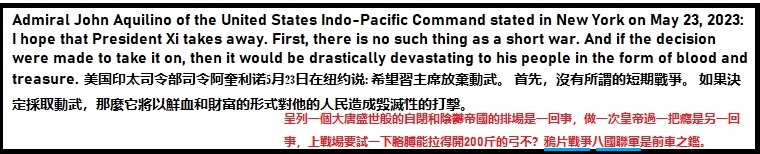
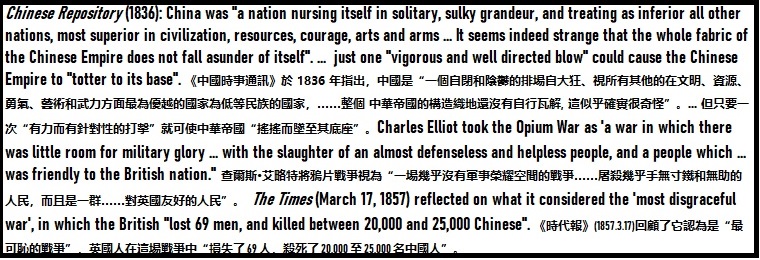


 ***
***


![Though, Anna Wang [Anneliese Martens], in her memoirs, expressed jealousy over Gong Peng by stating that the Anglo-American reporters had flattered the Chinese communists and the communist movement as a result of being entranced with the goldfish-eye'ed personal assistant of Zhou Enlai](GongPeng.jpg)