Sinitic Civilization-Book 1
Sinitic Civilization-Book 2
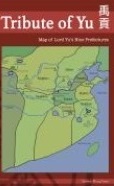
Tribute of Yu

Heavenly Questions
Zhou King Muwang's Travels
The Legends of Mountains & Seas
The Bamboo Annals - Book 1

The Scourge-of-God-Tetralogy:
From the Khitans to the Jurchens & Mongols: A History of Barbarians in Triangle Wars and Quartet Conflicts
(available at iUniverse;
Google;
Amazon;
B&N)
|
|
 This website's contents are the result of 20 years' writings --that could be compared to the "archaeological deposits" in a literary sense.
The freelance-style writings on the website were not proof-read.
Portion of the writings, i.e., related to Pre-History, Xia, Shang, Zhou, Qin, and Han dynasties, was extracted, polished, reconciled, and synthesized into
The Sinitic Civilization - Book I which is
available now on
Barnes & Noble,
Amazon,
Google Play|Books
and
Nook.
Book II is
available now on
Amazon
and Barnes & Noble.
Check out this webmaster's 2nd edition --that realigned Han dynasty's reign years strictly observing the Zhuanxu-li calendar of October of a prior lunar year to September of the following lunar year
and
cleared this webmaster's blind spot on the authenticity of the Qinghua University's Xi Nian bamboo slips as far as Zhou King Xiewang's 21 years of co-existence with Zhou King Pingwang was concerned.
To give the readers a heads-up, this webmaster had thoroughly turned the bricks concerning the Sinitic cosmological, astronomical, astrological, historical, divinatory, and geographical records, with the indisputable discovery
of the fingerprint or footprint of the forger for the 3rd century A.D. book Shang-shu (remotely ancient history),
and
close to 50 fingerprints or footprints of the forger of the contemporary version of The Bamboo Annals --a book that was twice modified and forged after excavation.
All ancient Chinese calendars had been examined, with each and every date as to the ancient thearchs being examined from the perspective how they were forged or made up.
Using the watershed line of Qin Emperor Shihuangdi's book burning to rectify what was the original before the book burning,
this webmaster filtered out what was forged after the book burning of 213 B.C.
This webmaster furthermore filtered out the sophistry and fables that were rampant just prior to the book burning, and validated the history against the oracle bones, bronzeware and bamboo slips.
There are dedicated chapters devoted to interpreting Qu Yuan's poem Asking Heaven, the mythical mountain and sea book Shan Hai Jing, geography book Yu Gong (Lord Yu's Tributes), and Zhou King Muwang's travelogue Mu-tian-zi Zhuan, as well as a comprehensive review of ancient calendars, ancient divination, and ancient geography.
One chapter is focused on the Huns, with a comprehensive overview of the relationship between the Sinitic people and the barbarians since prehistory.
The book has appendices of two calendars: the first Zhuanxu-li anterior quarter remainder calendar (247 B.C.-85 A.D.) of the Qin Empire, as well as a conversion table of the sexagenary years of the virtual Yin-li (Shang dynasty) quarter remainder calendar versus the Gregorian calendar, that covers the years 2698 B.C. to 2018 A.D.
Refer to
Introduction_to_The_Sinitic_Civilization,
Afterword,
Table of Contents - Book I (Index)
and
Table of Contents - Book II (Index)
for details.
This website's contents are the result of 20 years' writings --that could be compared to the "archaeological deposits" in a literary sense.
The freelance-style writings on the website were not proof-read.
Portion of the writings, i.e., related to Pre-History, Xia, Shang, Zhou, Qin, and Han dynasties, was extracted, polished, reconciled, and synthesized into
The Sinitic Civilization - Book I which is
available now on
Barnes & Noble,
Amazon,
Google Play|Books
and
Nook.
Book II is
available now on
Amazon
and Barnes & Noble.
Check out this webmaster's 2nd edition --that realigned Han dynasty's reign years strictly observing the Zhuanxu-li calendar of October of a prior lunar year to September of the following lunar year
and
cleared this webmaster's blind spot on the authenticity of the Qinghua University's Xi Nian bamboo slips as far as Zhou King Xiewang's 21 years of co-existence with Zhou King Pingwang was concerned.
To give the readers a heads-up, this webmaster had thoroughly turned the bricks concerning the Sinitic cosmological, astronomical, astrological, historical, divinatory, and geographical records, with the indisputable discovery
of the fingerprint or footprint of the forger for the 3rd century A.D. book Shang-shu (remotely ancient history),
and
close to 50 fingerprints or footprints of the forger of the contemporary version of The Bamboo Annals --a book that was twice modified and forged after excavation.
All ancient Chinese calendars had been examined, with each and every date as to the ancient thearchs being examined from the perspective how they were forged or made up.
Using the watershed line of Qin Emperor Shihuangdi's book burning to rectify what was the original before the book burning,
this webmaster filtered out what was forged after the book burning of 213 B.C.
This webmaster furthermore filtered out the sophistry and fables that were rampant just prior to the book burning, and validated the history against the oracle bones, bronzeware and bamboo slips.
There are dedicated chapters devoted to interpreting Qu Yuan's poem Asking Heaven, the mythical mountain and sea book Shan Hai Jing, geography book Yu Gong (Lord Yu's Tributes), and Zhou King Muwang's travelogue Mu-tian-zi Zhuan, as well as a comprehensive review of ancient calendars, ancient divination, and ancient geography.
One chapter is focused on the Huns, with a comprehensive overview of the relationship between the Sinitic people and the barbarians since prehistory.
The book has appendices of two calendars: the first Zhuanxu-li anterior quarter remainder calendar (247 B.C.-85 A.D.) of the Qin Empire, as well as a conversion table of the sexagenary years of the virtual Yin-li (Shang dynasty) quarter remainder calendar versus the Gregorian calendar, that covers the years 2698 B.C. to 2018 A.D.
Refer to
Introduction_to_The_Sinitic_Civilization,
Afterword,
Table of Contents - Book I (Index)
and
Table of Contents - Book II (Index)
for details.
|
|
Table of lineages & reign years:
Sovereigns & Thearchs;
Xia-Shang-Zhou dynasties;
Zhou dynasty's vassalage lords;
Lu Principality lords;
Han dynasty's reign years
(Sexagenary year conversion table-2698B.C.-A.D.2018; 247B.C.-A.D.85)
|
Epigraph|Preface|Introduction|T.O.C.|Afterword|Bibliography|References|Index
(available at iUniverse|Google|Amazon|B&N)
|
|
THE TURKS & UYGURS - PART I
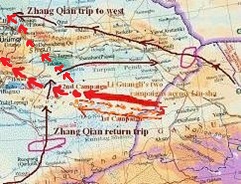 For details on when the east met with the west, see this webmaster's discussion on the Huns, the Yuezhi, the Tarim Mummies, the Yuezhi-Yushi misnomer,
the Mongoloid-Caucasoid admixture at 2000 B.C.E.,
the fallacy of the Aryan bearing of the Chinese civilization,
the fallacy of the Yuezhi jade trade,
the Yuezhi migration timeline,
as well as
the location of the Kunlun Mountain,
Queen Mother of the West,
the legendary book of mountains and seas at the Imperial China blog,
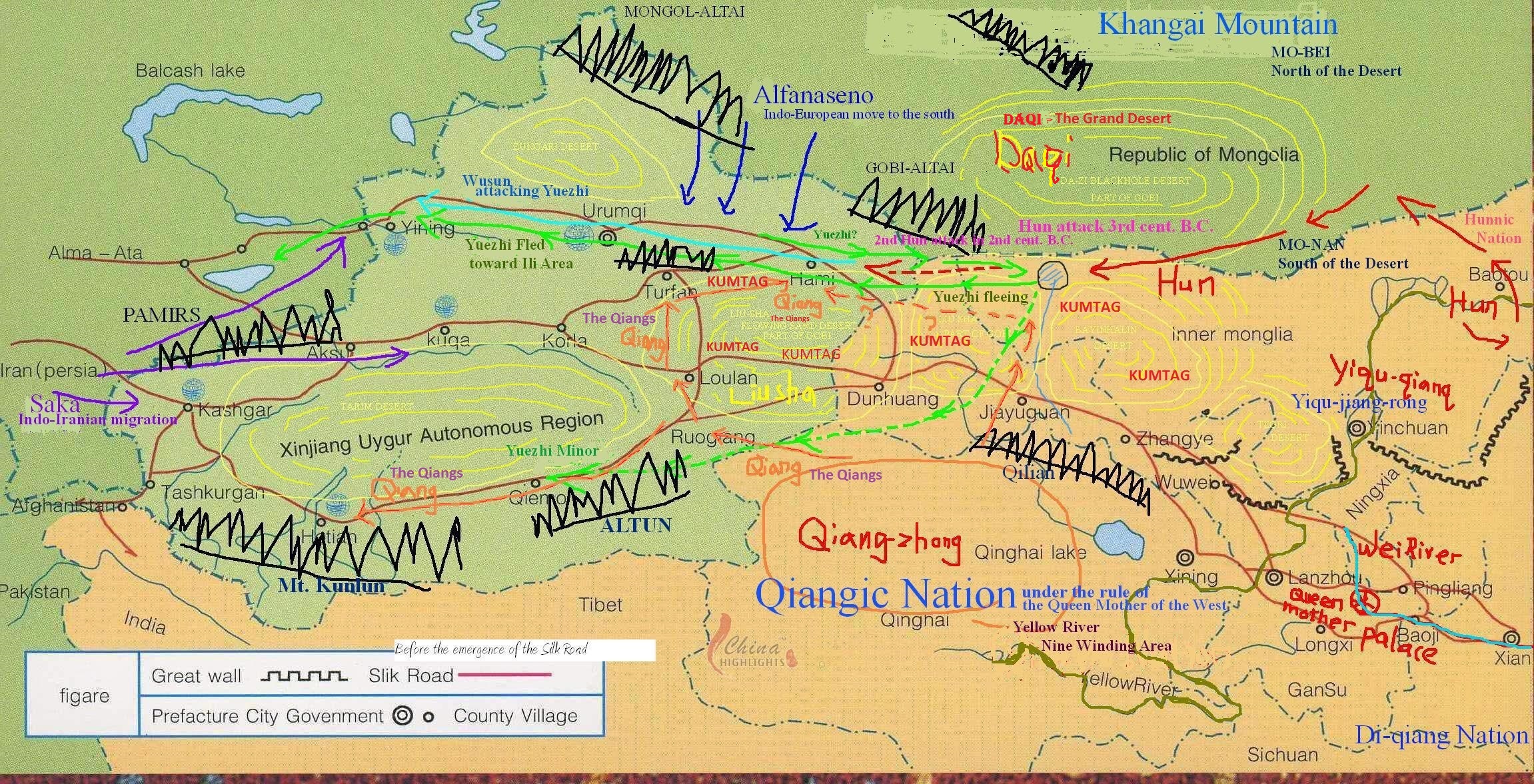
and the Qiang's possible routes of passage into Chinese Turkestan
at
http://www.imperialchina.org/Barbarians.htm which was embedded within the
Huns.html and
Turks_Uygurs.html pages.
(Note that Western Queen Mother had the prototype in an "earth mother" deity, not related to Queen Sheba of Charles Hucker.
The Mt. Kunshan jade was more likely the Mt. Huoshan jade in the Han dynasty book Huai Nan Zi, or the Mt. Yiwulü jade or the Kunlun jade that were juxtaposed together in the same book Huai Nan Zi, not related to Queen Mother of the West.
http://www.sino-platonic.org/complete/spp115_chinese_proto_indo_european.pdf provides another perspective of looking at things of the past from the perspective of language cognates. Rather believing that the Indo-Europeans ever invaded China and gave the Sinitic people the language, we could actually deduce that "Old Chinese", for its 43% correlation with the Proto-North-Caucasian, rather 23% with the Proto-Indo-European, was the source for both the cognates of the Proto-North-Caucasian and the Proto-Indo-European -- with the Proto-North-Caucasian falling under the umbrella of the Dene-Caucasian (Sino-Caucasian) Language Family that encompassed the [Proto-North-]Caucasian, Yeniseian and Sino-Tibetan languages. This is because our cousins, i.e., the N haplogroup people, relocated to North Asia and then to Latvia, Estonia, Finland and Scandinavia, bringing along the Sinitic language to the Proto-North-Caucasian who in turn gave it to the Proto-Indo-European. Note the Sinitic language cognates' 74% correlation with the Proto-Tibeto-Burman who split from the Sinitic people merely 5000-6000 years ago.)
For details on when the east met with the west, see this webmaster's discussion on the Huns, the Yuezhi, the Tarim Mummies, the Yuezhi-Yushi misnomer,
the Mongoloid-Caucasoid admixture at 2000 B.C.E.,
the fallacy of the Aryan bearing of the Chinese civilization,
the fallacy of the Yuezhi jade trade,
the Yuezhi migration timeline,
as well as
the location of the Kunlun Mountain,
Queen Mother of the West,
the legendary book of mountains and seas at the Imperial China blog,
and the Qiang's possible routes of passage into Chinese Turkestan
at
http://www.imperialchina.org/Barbarians.htm which was embedded within the
Huns.html and
Turks_Uygurs.html pages.
(Note that Western Queen Mother had the prototype in an "earth mother" deity, not related to Queen Sheba of Charles Hucker.
The Mt. Kunshan jade was more likely the Mt. Huoshan jade in the Han dynasty book Huai Nan Zi, or the Mt. Yiwulü jade or the Kunlun jade that were juxtaposed together in the same book Huai Nan Zi, not related to Queen Mother of the West.
http://www.sino-platonic.org/complete/spp115_chinese_proto_indo_european.pdf provides another perspective of looking at things of the past from the perspective of language cognates. Rather believing that the Indo-Europeans ever invaded China and gave the Sinitic people the language, we could actually deduce that "Old Chinese", for its 43% correlation with the Proto-North-Caucasian, rather 23% with the Proto-Indo-European, was the source for both the cognates of the Proto-North-Caucasian and the Proto-Indo-European -- with the Proto-North-Caucasian falling under the umbrella of the Dene-Caucasian (Sino-Caucasian) Language Family that encompassed the [Proto-North-]Caucasian, Yeniseian and Sino-Tibetan languages. This is because our cousins, i.e., the N haplogroup people, relocated to North Asia and then to Latvia, Estonia, Finland and Scandinavia, bringing along the Sinitic language to the Proto-North-Caucasian who in turn gave it to the Proto-Indo-European. Note the Sinitic language cognates' 74% correlation with the Proto-Tibeto-Burman who split from the Sinitic people merely 5000-6000 years ago.)
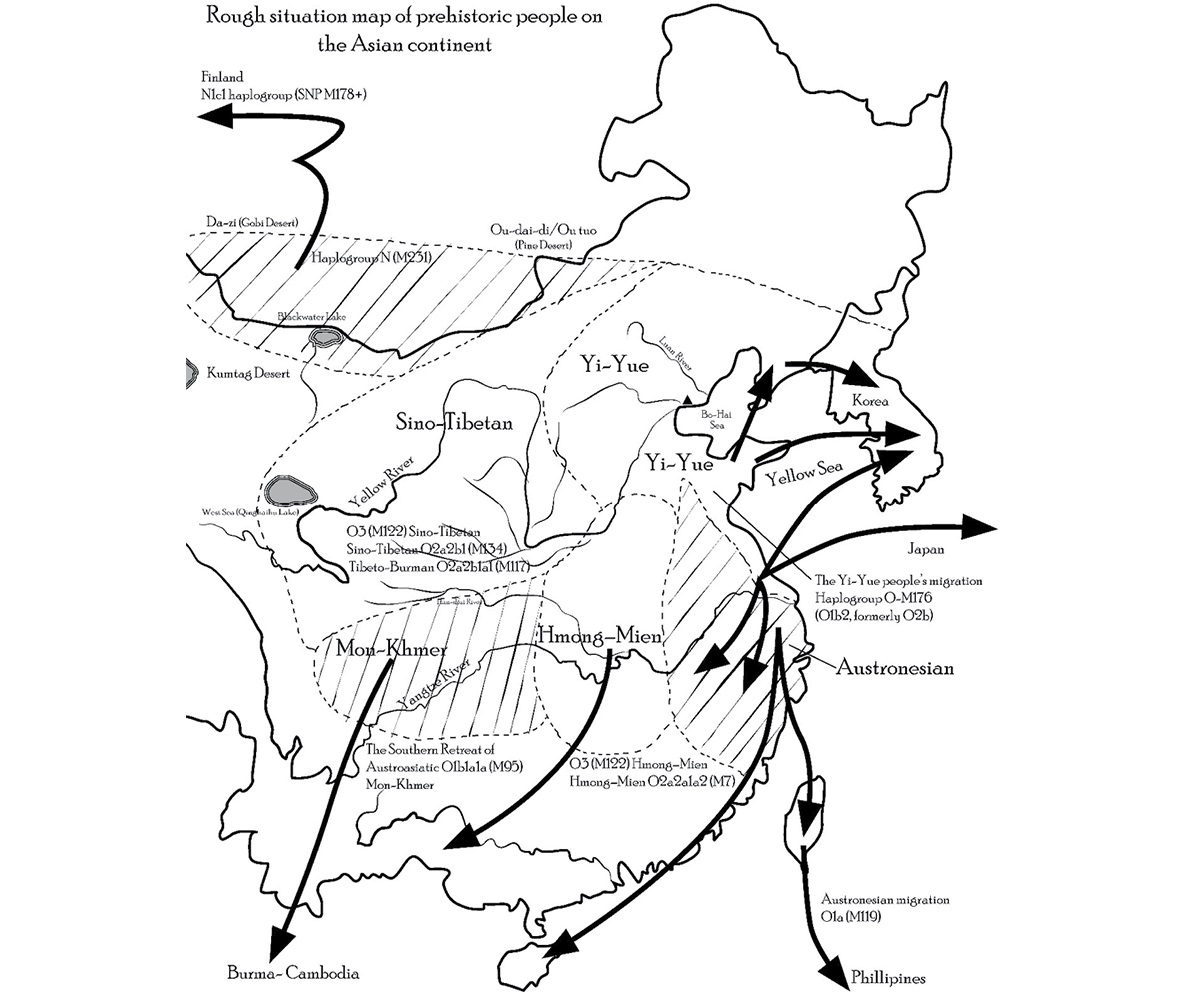
Li Hui of Fudan University of China analyzed the Asian DNAs to have derived a conclusion that ancestors of the [East] Asians possessed a distinctive Mark M89 by the time they arrived in Southeast Asia.
About 30,000 years ago, from the launching pad of Southeast Asia, the early Asians went through a genetic mutation to marker M122.
Li Hui claimed that the early migrants to the Chinese continent took three routes via two entries of today's Yunnan and Guangxi-Guangdong provinces.
More studies done after Li Hui had ascertained the dates of the O1, O2 and O3 haplogroup people, with the (O1, O2) entrants along the Southeast Chinese coast dated to have split away from the O3-haplogroup people like 20,000 years ago, much earlier than the continental peers, i.e., the Sino-Tibetans (O3a3c1-M117), Hmong-Mien (Miao-Yao, O3a3b-M7) and Mon-khmers.
According to
https://www.ncbi.nlm.nih.gov/pmc/articles/PMC5255561/
"Y chromosome suggested Tibeto-Burman populations are an admixture of the northward migrations of East Asian initial settlers with haplogroup D-M175 in the Late Paleolithic age, and the southward Di-Qiang people with dominant haplogroup O3a2c1*-M134 and O3a2c1a-M117 in the Neolithic Age. Haplogroup O3a2c1*-M134 and O3a2c1a-M117 are also characteristic lineages of Han Chinese, comprising 11.4% and 16.3%, respectively. However, another dominant paternal lineage of Han Chinese, haplogroup O3a1c-002611, is found at very low frequencies in Tibeto-Burman populations, suggesting this lineage might not have participated in the formation of Tibeto-Burman populations."
Namely, the haplogroup O3a1c-002611 Sinitic people, not the O3a2c1*-M134 and O3a2c1a-M117 barbarians, were responsible for engendering the Yangshao and Longshan civilization, and partially with the N-haplogroup people, engendering the Hongshan civilization.
The Zhou people were archaeologically speculated to have origin from today's Shanxi for the link to the Guangshe Culture –- which was in turn a derivative of the You'ao-type Laohushan Culture of the mixed N-haplogroup and O-haplogroup people.
(Since the O3a1c-002611 people were separated from the Northwestern cousins and Tibeto-Burmese at an early age, for it to have a part in the history of Northwestern China, the explanation would be to treat the Haplogroup O3a2c1*-M134 and O3a2c1a-M117 people as the historical Qiang and Hu barbarians, with the latter's paleo-Northwestern genes replacing the paleo-North-China and paleo-Central Plains genes of O3a1c-002611 Sinitic people by the Soong dynasty (A.D. 960-1279), that was likely triggered by the multiplication of the Tang dynasty's imperial house that had its origin from the Western Corridor.
The Soong dynasty royals took Tianshui of western China as the ancestral homeland, which was similar to the Tang dynasty royals' origin from the Western Corridor in western China, i.e., the Qin and Zhao states' common ancestral place.
The Soong royal house, however, could be of the Shatuo Turks' Q-haplogroup gene.
Also see this webmaster's discussion on
the ethnic nature of the ancient Huns belonging to part of the epic Jiang-rong human migration
of the Jiang-surnamed San-miao people and Yun-surnamed Xianyun people.)
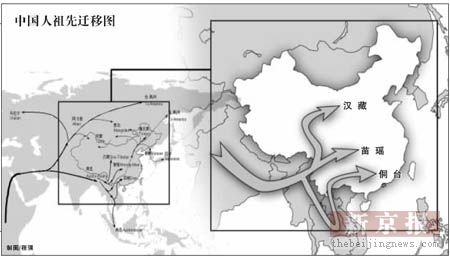 Li Hui commented that one branch of the early Asians, over 10,000 years ago, entered China's southeastern coastline with genetic marker M119. Li Hui, claiming the same ancestry as the Dai-zu and Shui-zu minorities of Southwestern China, firmly believed that his ancestors had dwelled in the Hangzhou Bay and the Yangtze Delta for 7-8 thousand years.
The people with the M119 marker would be the historical "Hundred Yue People".
The interesting theory adopted by Li Hui would be the migration of one branch of people who continued to travel non-stop along the Chinese coastline to reach the Liao-he River area of today's Manchuria.
Li Hui's speculation on basis of the DNA technology was an evolving process.
This would be likely the O2-haplogroup people, rather than the C-haplogroup or North Asia people whose historical presence in Asia could be dated 50,000 years ago, just after the earlier D-haplogroup people who were now mostly restricted in the area of Hokkaido, Japan, and known as the Ainu.
The C-haplogroup people developed into what this webmaster called by the Altaic-speaking people,
i.e., ancestors of the Mongols and Manchus.
What likely happened was that the O2-haplogroup people first travelled along the coast to reach Manchuria, and then traced back towards the south to reach the Yangtze area about 7-8000 years ago, where they evicted the O1-haplogroup people to the Southeast Asian islands.
At about the same time, the O3-haplogroup people, moving through the continent, reached today's western Liaoning at least 5000 years ago, or like 11,000 years ago on basis of the evidence of the pottery aging.
See the genetical analysis conducted by Li Hongjie of Jirin University on the remains of prehistoric people extracted from the archaeological sites.
Li Hui commented that one branch of the early Asians, over 10,000 years ago, entered China's southeastern coastline with genetic marker M119. Li Hui, claiming the same ancestry as the Dai-zu and Shui-zu minorities of Southwestern China, firmly believed that his ancestors had dwelled in the Hangzhou Bay and the Yangtze Delta for 7-8 thousand years.
The people with the M119 marker would be the historical "Hundred Yue People".
The interesting theory adopted by Li Hui would be the migration of one branch of people who continued to travel non-stop along the Chinese coastline to reach the Liao-he River area of today's Manchuria.
Li Hui's speculation on basis of the DNA technology was an evolving process.
This would be likely the O2-haplogroup people, rather than the C-haplogroup or North Asia people whose historical presence in Asia could be dated 50,000 years ago, just after the earlier D-haplogroup people who were now mostly restricted in the area of Hokkaido, Japan, and known as the Ainu.
The C-haplogroup people developed into what this webmaster called by the Altaic-speaking people,
i.e., ancestors of the Mongols and Manchus.
What likely happened was that the O2-haplogroup people first travelled along the coast to reach Manchuria, and then traced back towards the south to reach the Yangtze area about 7-8000 years ago, where they evicted the O1-haplogroup people to the Southeast Asian islands.
At about the same time, the O3-haplogroup people, moving through the continent, reached today's western Liaoning at least 5000 years ago, or like 11,000 years ago on basis of the evidence of the pottery aging.
See the genetical analysis conducted by Li Hongjie of Jirin University on the remains of prehistoric people extracted from the archaeological sites.
  Northeast (southeastern Inner Mongolia)
    Niuheliang, Lingyuan, the Hongshan Culture, 5000 YBP,
    4 N, 1 C*, 1 O

  North
   Yuxian County (the Sanguan site), Hebei,
   the Lower Xiajiadian Culture, 3400-3800 YBP, all O3
Combining Li Hui's study with the pottery excavation, we could see a clear path going north extending from around 15,000 years ago to 10,000 years ago.
Refer to Yaroslav V. Kuzmin's discourse on potteries
to see the path of migration of
proto-Mongoloids
from southwestern China (approx. 15,120+/-500 BP) to
Northeast Asia (Manchuria [13,000 BP, or c. 14,000 - 13,600 cal BC] and
Japan [c. 11,800-10,500 cal BC (c. 13,800 - 12,500 cal BP)]) to
Siberia (11,000 BP, or 11,200 - 10,900 cal BC).
In the timeframe of about 10,000 years, developing a genetic mutation to the marker M134, one branch of people who went direct north, per Li Hui, would penetrate the snowy Hengduan Mountains of the Tibetan-Qinghai Plateau to arrive at the area next to the Yellow River bends.
Owning to the cold weather environment, some physique, such as big noses, heavy lips and longer faces, developed among this group of people, i.e., ancestors of the Sino-Tibetans.
Splitting out of the northbound migrants would be those who went to the east with a new genetic marker M117, i.e., ancestors of the modern Han [a misnomer as the proper term should be Sino-Tibetan, nor the later Sinitic] Chinese.
We could say that our Sino-Tibetan ancestors forgot that they had penetrated northward the Hengduan Mountains from the Indo-China "CORRIDOR" in today's Burma-Vietnam.
"Walking down Mt Kunlun", i.e., the "collective memory of the ethnic Han Chinese" throughout China and the Southeast Asian Chinese communities, that was echoed in Guo Xiaochuan's philharmonic-agitated epic, would become the starting point of the eastward migration which our Chinese ancestors remembered.
(Li Hui grouped the 3000-year-old Chu and Qi people in the same category as the Han Chinese, albeit meeting the ancient classics' records as to the Qi statelet's lineage from the Qiangic-Tibetan Fiery Lord.
According to
https://onlinelibrary.wiley.com/doi/full/10.1111/j.1759-6831.2012.00244.x
"the frequencies of the three main subhaplogroups of O3-M122: O3a1c-002611, O3a2c1*-M134, and O3a2c1a-M117 in Han Chinese are 16.9%, 11.4%, and 16.3%, respectively (Yan et al., 2011).
The northward migration of haplogroup O3a1c-002611 started about 13 thousand years ago (KYA). The expansions of subclades F11 and F238 in ancient Han Chinese began about 5 and 7 KYA immediately after the separation between the ancestors of the Han Chinese and Tibeto-Burman.
Haplogroup O3a1c-002611 and O3a1c1-F11 started their northward migration about 12 KYA from Southeast Asia, along with other O3-M122 lineages, and reached the upper and middle Yellow River basin. About 7 KYA, haplogroup O3a1c2-F238 originated in the ancestors of modern Sino-Tibetan populations. About 6 KYA, the Han Chinese split from the Proto-Sino-Tibetan, and started their migration to the east and south (Su et al., 2000b). About 5 KYA, haplogroup O3a1c1-F11 experienced rapid expansion, probably in the Eastern Han Chinese, with recent gene flow with surrounding populations and eventually became prevalent in different ethnic groups in East Asia.)
Li Hui then pointed out that the ancient Wu people, with M7 genetic marker, came to the lower Yangtze area about 3000 years ago.
While Li Hui claimed that the M7 Wu people had split away from the northbound M134 Sino-Tibetan people, the historical Chinese classics pointed out that the Wu Statelet was established by two uncles of Zhou Dynasty King Wenwang, i.e., migrants from the Yellow River area.
The general layout by Lu Hui seems to have corroborated with Scholar Luo Xianglin's claim that early Sino-Tibetan people originated from the Mt Minshan and upper-stream River Min-jiang areas of today's Sichuan-Gansu provincial borderline and then split into two groups, with one going north to reach the Wei-shui River and upperstream Han-shui River of Shenxi Province and then eastward to Shanxi Province by crossing the Yellow River.
--Though, this webmaster's analysis of China's prehistory shows that the Sino-Tibetan people who moved to the eastern coast was one group, with the future Tibetans being actually the exiles to Northwest China from eastern and central China during the era of Lord Shun. Namely, the split of the Sinitic and proto-Tibetan people occurred prior and during the exile in the late 3rd millennium B.C.E.
(George Driem proposed that the Sino-Tibetans had splitoffs like the Western Tibeto-Burmans and the Eastern Tibeto-Burmans, with the Eastern Tibeto-Burmans forming two groups of northern and southern, who in turn split into the Northwestern Tibeto-Burmans, the Northeastern Tibeto-Burmans, the Southwestern Tibeto-Burmans, and the Southeastern Tibeto-Burmans, with a claim that the western offshoots went all the way to the Kashmir before returning east along the northern slope of the Himalayas to have a reunion with their cousins and that the Northeastern Tibeto-Burmans were the Sinitic people.)
What Li Hui did not touch on in his earliest studies were the cousin tribes of the Sino-Tibetans, namely, the Hmong-miens and Mon-khmers.
As noted at http://www.ncbi.nlm.nih.gov/pmc/articles/PMC3164178/, "A clear hierarchical structure (annual ring shape) emerged in the network of O3a3b-M7 (Fig. 2B), in which MK (Mon-Khmers) haplotypes lay at the center of the network (immediately next to the origin), HM (Hmong-Mien) haplotypes were distributed at the periphery to the MK haplotypes, and the ST (here the subfamily Tibeto-Burman) haplotypes were only found further away from the origin."
|
|
* In Commemoration of China's Fall under the Alien Conquests in A.D. 1279,
A.D. 1644 & A.D. 1949 *
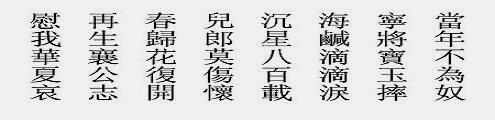 U.S.S.R./Comintern Alliance with the KMT & CCP (1923-1927)
 Korean/Chinese Communists & the 1931 Japanese Invasion of Manchuria Korean/Chinese Communists & the 1931 Japanese Invasion of Manchuria
American Involvement in China: Soviet Operation Snow, IPR Conspiracy, Dixie Mission, Stilwell
Incident, O.S.S. Scheme, Coalition Government Crap, Amerasia Case & The China White Paper
* Stay tuned for "Republican China 1911-1955: A Complete Untold History" *
|
|
Zou Rong's Revolutionary Army;
Shin Kyu Sik's
Shrine (Spirit, Kunitama) of Korea
|
This snippet is for sons and daughters of China:
Heed the sons & ministers' agony and sorrow of our ancestors who died or lived through the Mongol, Manchu and Soviet-Chicom conquest
and
the Yongjia, Jingkang and Jiashen cataclysms !
Jeanne d'Arc of China:
Teenager girl Xun Guan breaking out of the Wancheng city to borrow the relief troops in the late Western Jinn dynasty;
Liu-Shao-shi riding into the barbarian army to rescue her husband in the late Western Jinn dynasty;
teenager girl Shen Yunying breaking into Zhang Xianzhong's rebels on the horseback to avenge on father's death in the late Ming dynasty.
China's Solitary and Lone Heroes:
Nan Jiyun breaking out of the Suiyang siege and charging back into the city in the Tang dynasty;
Zhang Gui & Zhang Shun Brothers breaking through the Mongol siege of Xiangyang in the Southern Soong dynasty;
Liu Tiejun breaking through three communist field armies' siege of Kaifeng in the Republican China time period;
Zhang Jian's lone confrontation against the communist army during the June 3rd & 4th Massacre of 1989.
|
|
|
The Turkish website said proudly that their ancestors comprised of Huns and the White Huns, and the Uygur nationalists had further provided two lineages of the eastern and western Hunnic kings to support their claim of a Hunnic heritage, in direct competition with the Mongols who celebrated the 2000th anniversary of the first Hunnic empire in 1991. The Turks were a group of group no secondary to the Huns, and their influence would be felt in the Ottoman Empire's
conquest of the Byzantium and the Balkans as well as the waves of raids into the Indus Valley. Their history had been full of extraordinary events like the slaves turning into rulers. Their linguistic flavor found entries in the Finno-Ugric language. They pushed the Islam to its apex. It is too broad a topic for this webmaster to cover them all in here.
In this section, this webmaster will concentrate on the Turkic origin and influence in China and Mongolia during their early developments.
The Turks had impacted the Chinese more than the Huns.
During the Tang Dynasty, Pugu Huai'en, a Uygur, had obtained a post as a general in the court. After the fall of Tang Dynasty (A.D. 619-907), three dynasties among the Five Dynasties of northern China, i.e., Posterior Tang 923-936, Posterior Jin 936-946, Posterior Han 947-950, were ruled by the Shatuo (Sha'to) Turks. (The Sha'to [Shatuo] Turks were a group of Western Turks who were first employed by the Tibetans as their herald armies, but they later defected to the Tang Chinese and were assigned the border posts in northern China to guard against the other nomads and the Khitans.) One more interesting thing would be the fact that the Uygur Turks had a long history of co-living with the Chinese. There is on record a big Uygur community around Yuan-shui River in today's Hunan Province, Central China. The famous writer, Jian Bozan, who committed suicide during the Cultural Revolution, happened to be an ethnic Uygur from Hunan Province.
Who were those people called the Turks then? They did not disappear as the Huns did. Today's Turkish people in Turkey are direct descendants of the Osmanli Turks who belonged to the Oghuz confederation which had the origin in today's Mongolia. This webmaster had traced the original Huns to a group of people driven out of the Hetao sheath area [where the Yiqu-rong, i.e., possibly the Hunnic forerunners lived for hundreds of years], south of the Yellow River, by Qin (BC 221-206) emperor Shi Huangdi (Shihuangdi). the Chinese history books invariably claimed that the Gao-che people, the Tiele Tribe (ancestors of the Uygurs), the Ruruans (Rou Ran or Ru Ru), and the Turks were some alternative races of the Huns. This webmaster would sort out their relationship below.
There was one common feature among those ancient tribes, namely, they loved the nomadic way of life, they never settled down, and they preyed upon Chinese Turkistan and Northern China as an outsider force. In contrast, the tribal states of Chinese Turkistan, i.e., Loulan (Rongjiang), Cheshi/Jushi (Gaochang), Qiuci (Guqa or Kuqa), Yanqi, Yutian (Hotan or Khoten), Shule (Kashi), were recorded to have the city-walls and cultivation.
Unlike the Huns, the Chinese of Former Han Dynasty did initiate quite some colonization efforts in Chinese Turkistan. The Uygur claim, at http://www.uygur.org/enorg/history/uygurlar_kim.htm, was not that correct in one of the assertions, namely, the Chinese never colonized Xinjiang or Chinese Turkistan. The Chinese, like the Huns and Turks, had been outside contenders. The Huns, after driving out the Yuezhi during the 3rd century B.C. Hunnic-Yuezhi War, did station some official in Chinese Turkistan. The Huns, according to Ban Gu, devised an official entitled 'Tongpu Duwei', similar to governor, and sent this person to the post in charge of ancient tribal states of Yanqi, Weixu and Yuli [Weili], located to the southwest of today's Urumqi. The Hunnic 'Rizhuowang' (the king of sun chasing) was usually stationed in the 'west court', a place to the north of Altai, while the Hunnic 'central court' was always in today's Outer Mongolia.
In 121 BC, Han Emperor Wudi ordered a campaign against the Huns, with Huo Qubing and Gongsun Ao departing from northern border, while Li Guang and Zhang Qian departing from today's Beijing area in the east. Huo attacked the Huns in and around the Qilian Mountains, the ice and glacier of which fed the farming of the so-called He-xi Corridor (i.e., corridor to the west of the West Yellow River Bend). Hunnic King Hunye, for fear of punishment by the Hunnic Chanyu, killed King Xiutu and surrendered his 40,000 people to Huo Qubing. Wudi relocated the Huns to five prefectures, Longxi (today's Weishui and Taohe Rivers, Gansu Province), Beidi (today's northern and northeastern Shenxi Province), Shangjun (today's northeastern Shenxi Province), Shuofang (somewhere on the north bank of the Northern Yellow River Bend), and Yunzhong (today's Tuoketuo County, Inner Mongolia). Wudi further set up the Wuwei and Jiuquan Commandaries in the old territories of King Hunye.
In 102 BC, the Zhangye and Dunhuang Commandaries were set up along the corridor.
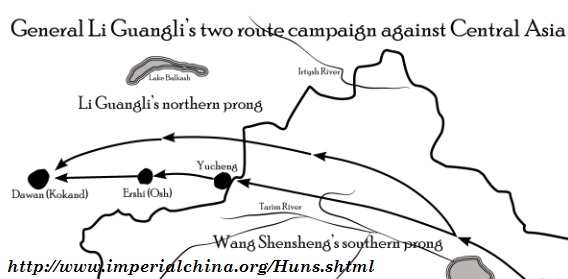
Civilians were relocated to guard the posts along with the army. After General Li Guangli campaigned against the ancient state of Dawan (Fergana) in Central Asia, more posts were set up on the Silk Road. From Dunhuang to Chines Turkestan, hundreds of the 'farming soldiers' were stationed.
By the time of Emperor Xuandi (reign 73-48 B.C.), south of the Tianshan Mountains was firmly under the Han Chinese control. Hunnic 'Rizhuowang' (the king of sun chasing) offended the Hunnic Chanyu, and he defected to Han China, yielding to Chinese the Hunnic control of the northern part of Chinese Turkistan. By 62 BC, north of the Tianshan Mountains was controlled by the Chinese as well. Colonization went as far as the ancient state of Sha'che. This post was responsible for reporting on the situation in such states as Kangju (Kang-chu), near Sogdia (Sogdiana), and Wu'sun (Ili).
During the reign of Emperor Yuandi, 48-32 BC, another group of the Huns surrendered to the Chinese, and colonization reached Che'shi.
The Uygurs and the Mongols, however, could be both right or both wrong in their assertion in regards to the Hunnic ancestry. The Uygur claim could be built on basis of their ancestor Huihe's membership in the Tiele Tribes, a group of people sandwiched between the Huns/Turks and the original dwellers of Xinjiang or Chinese Turkistan. (The Uygurs claimed they descended from 'Chunwei', the son of Jie, last Xia Dynasty lord.)
The Mongols' claim could be built on basis of the nomadic tribal groups which never left the Mongolian plateau. Western history books tried in vain to make a distinction, and they said that the Genghis Mongols were descendants of the Ruruans. The Ruruans, however, were more Hunnic than the Mongol as this webmaster would explore in this section and had explored in the section on the Huns.
The 'Mongol' claim for the Ruruans could be built on basis of one comment in History of the Tuoba Wei Dynasty, namely, the founder of the Ruruan people might have origin in the Eastern Hu nomads, a group more associated with the Tungusic people of Manchuria and eastern Mongolia. This webmaster's research into various records, however, shows that the Ruruans were more Hunnic than anything else after relocating to the west. After the Ruruan founder fled to the Altai Mountains, he conquered and absorbed the remnant Hunnic and Gaoche tribes there.
To provide as detailed description as possible, this webmaster had traced the Huns and the Turks according to the specific naming as recorded in history, rather than the generic naming. This webmaster traced the ending of the Eastern Huns to their relocation to today's Hebei Province by the Tuoba in A.D. 523 and that of the western Huns to Attila and his warfare in Europe in A.D. 433-453. The third group of Huns, the Ruruan, and their relationship with the Nie-ban (Nirvana) Huns, would be touched upon below and in the Huns section.
The Turks did not come about till they, employed as a group of iron miners in the Altai Mountains, rebelled against the Ruruans in A.D. 546-553.
In A.D. 552, the Turks launched its own statelet.
We need to make a distinction here between the words of 'Turk', 'Turkic' and 'Turkish'. The word 'Turk' would denote the group of people as recorded in the middle 6th century. The word 'Turkic' means more a language that was spoken by the Eurasian nomads, and the earlier Huns were said to be Turkic as well. The word 'Turkish', however, would denote specifically the people and the language in today's Turkey, i.e., Anatolia.
Western history books classify the Ruruans as 'Mongol', but the term 'Mongol' was a much later concept. The term 'Mongol' did not appear till Khubilai endorsed it in the 13th century, supposedly
on basis of the word 'Mengwu Shiwei'.
The closest match for the Mongol word would be Genghis Khan’s declaration of the ‘Kuoke-menggu’ (Yeke-Mongghol) Ulus, i.e., the tents’ world of Yeke-Manghuole-ulusi – with ‘Manghuole’ deriving from a name of ancestor Bei-er-tie-chi-na (Börte-chino, meaning grey wolf)’s wife Huo-ai-ma-lan-le (Gua Maral, white deer/fallow doe) or Manghuole-zhen-huo’a, i.e., Manghuole woman (‘zhen’) beauty (‘huo’a’) according to communist historian Wu Han.
Conventional history would make such a distinction between the Turkic and Mongol ethnicity. Here, this webmaster will refer to the Ruruans as 'Hunnic' versus their Turkic adversaries for clarification's sake.
The Ruruans were said to be the successors to the Huns, and this group of people had also been responsible for pressuring the so-called 'Huns' into migration towards Europe as well as cracking down on the eastern Huns in collaboration with
the Tuoba. The Ruruans, as this webmaster detailed in the Hun section, were more Hunnic than those whom they chased away towards Europe.
The two groups, the Ruruans and Turks, were hostile towards each other. Numerous records point to the Turks' chasing the Ruruan khan to the Western Wei Dynasty (A.D. 535-557) as well as chased other Ruruan royal family members to the Hephthalite Empire of the White Huns (Ye-tai). The Ruruans had inter-marriage with both Western Wei and the Ye-tai. In A.D. 553-68, the Turks and the Sassanians in today's Iran allied in destroying the Hephthalite Empire of White Huns [Ye-tai].
What went into oblivion in China’s history was the Shimao Culture that predated the literature-corroborated Da-Xia (great Xia) Sinitic civilization by just a few hundreds of years in history. The Shimao Culture (about 2300-1800 B.C.), that was excavated in 1976, was a jade city in today’s Shenmu of Shenxi at the Northeastern Yellow River Bend and within the river sheath, about the Jishi (piled-up rocks, likely kind of ancient burial) place where Lord Yu started the flood control in the late 3rd millennium B.C. The Shimao (stony round-shaped hill) Ruins had produced thousands and maybe tens of thousands of jade artifacts that were sold to the antique markets of the world without an origin tag in the last one hundred years. Shimao, bing classified under the development stage of the Longshan Culture, possessed a city with the outer walls and inner walls that spanned the range of 2000 and 2840 meters long. Unfortunately, very little was known about the Shimao people other than the ruins and the ‘fei-zu li’ (three-fat-legs) cookers, a type of pottery also seen in the Laohushan (tiger mountain) Culture according to Haan Jianye of the Chinese People’s University, that was in turn a mixed type of the Yangshao and Miaozigou cultures, with the latter ascribed to the N-haplotype people, i.e., the Finno-Ugric people who once populated the entire belt of today’s Inner Mongolia.
It is more plausible that people of the Xia and Shang dynasties of ancient China had the company of the N-haplogroup people, with both the Sinitic O-haplogroup and the N-haplogroup people actually sharing the same origin for over 20,000 years, with both groups plus the ancient Sinitic Chinese likely falling under the same proto-Borean (Northern) language family. Whereas, the Zhou people could be interfacing with the later Q-haplogroup people towards the northwest, which implied that the northern barbarians or the Huns' composition could have changed through history. The Huns at the times of the Zhou dynasty, for their position and timeline of appearance, more likely belonged to the Q-haplogroup people than the N-haplogroup people.
In 2012, Li Hongjie of Jirin University published a paleogenetic study of the ancient DNA of prehistoric people dwelling in northeastern China, northern China, and northwestern China, with the results showing that the predominant population in Niuheliang of southwestern Manchuria, Dadianzi of Inner Mongolia and Hami of northeastern Chinese Turkestan over 3000-5000 years ago, that roughly matched with the Xiajiadian Culture and Hongshan Culture's timeframe, belonged to the Y-chromosome people of the N-haplogroup type, namely, the Finno-Ugric people related to ancestors of the Finnish, Sami and Hungarian people. And it would be about 2000-4000 years ago that the R-haplogroup and Q-haplogroup people began to be seen in Chinese Turkestan and northwestern China.
The N-haplotype people and the ancient Sinitic people of the paleo-North-China type were linguistically bundled under the Dene-Caucasian (Sino-Caucasian) Language Family that encompassed the [Proto-]North-Caucasian, Yeniseian and Sino-Tibetan languages. For the Sinitic people to have interchangeable cognates with the Finno-Ugric people, with the proto-Caucasians, and with the Indo-Europeans through an apparent midway relay, the Sinitic people and the Finno-Ugric people must have dwelled in a much northern latitude area over 4000 years ago and before the launch of the Xia dynasty (2207-1766 BC per Lu Jinggui's obfuscatory chronicling; 1978-1559 B.C. per the forgery contemporary version [Jin Ben] of The Bamboo Annals). Note that before the appearance of the Q-haplogroup people in Pengyang of the Yellow River sheath area 3000 years ago, the paleo-North-Asia type people were already observed to have appeared at the Karasuk Culture (1400-800 B.C.) in southern Siberia according to Jiebez of the Institute of Ethnology of the Soviet Academy of Sciences, a group of people who were described to have the Paleo-North-China medium jaw shape and the medium cranial forehead inclination and who brought the patented Sinitic potteries and bronzeware to southern Siberia.
While the later Turks were ascertained to have origin in the Altai Mountain, the Uygurs, for their original position in the the three rivers area of Tu’ula, Kerulen and Onon, and the Orkhon River area, could be originally Finno-Ugric.
|
|
The Turkic Language
Unlike other earlier nomads who left no records of a written language, the Turks possessed the so-called Orkhon inscription (a Kok Turk invention related to Eastern Khanate around A.D. 682) in a runic-like script, and this script was deciphered back in 1896. There was some element of the Chinese language among the early Orkhon scripts, though. Note the Han Dynasty Chinese had no problem communicating with the Huns who were speculated to be Turkic-speaking as well. The forms of the lost languages of the Khitans, Tanguts and Jurchens, like the Korean writing, had all appeared to be some kind of revision on top of the Chinese pictographs. Among the Turks, the Uygurs were great language masters, and adopted their own script which became known as the Uygur script. They helped Chingiz Khan's Mongols in devising the written Mongol language
in the early 13th century. The Uygur script indirectly influenced the Manchus when the latter adopted the Mongol script in 1599. (The Manchus first used the Khitans' Siniform script and finally adopted the Chinese logographic characters.)
The Turkic language was one of the three language branches in the purported Altaic language family, namely, Turkic, Mongolian and Tungusic.
This webmaster's suspicion is that the branches did not distinguish themselves till much later, and the three-language branch designation was the product of the linguists of the 20th century any way. When you look at the photos of the ruins of Karakorum, near the Orkhon River, southwest of Ulaanbaatar as well as the few slates of tomb stones on the desolate Gobi, the impression will be all yours to imagine who the successive dwellers had been on that land.
The control of the area of Mongolia had passed from the Turks to the Uygurs, then to the Kyrgyz. (The Kyrgyz were said to be the last Turkic people to have resided in Mongolia, but in the section on the Mongols, this webmaster had listed quite a few groups of people who appeared to be more Turkic than the later Mongols.)
A simple comparison of some words in later Mongolian language yields the following interesting points: The word for the Mongols, Mongqol irgen, is the same word 'irgen' as used in the ancient Chinese pronunciation which could be corroborated by the Cantonese pronunciation of 'irgen' and the Japanese pronunciation of 'nin' or 'dgen'. Still more interesting is the fact that Genghis Khan's name, Timuchin, shared the same prefix as some of his brothers and sister, with Ti meaning nothing more than a Chinese word 'Tie' for iron or smith.
JOHANN WILHELM ADOLF KIRCHHOFF (1826-1908) mentioned two Kara-Kirghiz groups, i.e., "the On or "Right" in the east, with seven branches (Bogu, Sary-Bagishch, Son-Bagishch, Sultu or Solye, Cherik, Sayak, Bassinz), and the Sol or "Left" in the west, with four branches (Kokche or Kfichy, Soru, Mundus, Kitai or Kintai)". As stated at http://57.1911encyclopedia.org/K/KI/KIRGHIZ.htm, the "Sol section occupies the region between the Talass and Oxus headstreams in Ferghana (Khokand/Kokand) and Bokhara, ... The On section lies on both sides of the Tian-shan, about Lake Issyk-kul, and in the Chu, Tekes and Narin (upper Jaxartes) valleys." Once again, the ancient Chinese words, like right for 'you' (mutated into 'on') and left for 'zuo' (mutated into 'sol'), were adopted by the nomadic tribes on the steppe. Note that the Huns used to designate their officials into the rightside and leftside virtuous kings, similar to the Qin Principality's adoption of rightside and leftside prime ministers.
Isenbike Togan of the Middle East Technical University stated that the "written Chinese is also a system of signs... Central Asian people who were not Chinese used this system at some time in the past, including the Turks." Isenbike Togan concluded that the Turkish word for 'freezing' came from the Chinese word 'dong[4]'.
Reader jianx mentioned that "...many words
have similar sound and meaning as chinese -- the madarin... A few examples:
Chinese: Bo2: father's brother --> turkish: Bey: same meaning( more general);
Wa(1)Di(4): low land --> Vadi: valley;
Shui(3): water --> Sui: water;
Jie(2): sister --> ajia: female relative, sister.
...Turkish people have chinese last names. For example,
Turkish 'Tan' is obviously a chinese last name. In turkish, it
means 'sunrise', which is nearly identical to 'Dan(4)' in chinese --- the
Zhou Dynasty's famous Zhou(1)Gong(1) Dan(4) --- you should know it means that
the sun is rising over the horizon."
As to the Turkic language,
there was the Orkhon script. The Persian language had been found in the same area. Excavated in the areas rear Turfan would be manuscripts in Bactrian, the ancient language of Bactria in northern Afghanistan. Kushan ruler Kanishka, who was of the Yuezhi origin, adopted Bactrian as the language of his coinage. After the collapse of the Kushan empire, the Bactrian language continued in use till the ninth-century, as evidenced by inscription from the Tochi valley in Pakistan and the remnants of the Buddhist and Manichean manuscripts found in the Turfan oasis.
In the following, this webmaster will tentatively explore into the origin of the Uygurs, the Turks and their history.
Origin Of the Turks & The Uygur Turks
Nationalist Uygurs, at http://www.geocities.com/CapitolHill/1730/buh.html,
stated that "after 210 B.C., the Uygurs played important roles in the Hun
(220
B.C. - 386 A.D.), Tabgach (To'pa) (386-554
A.D.), and Kok Turk (552-744
A.D.) empires which were established in Central Asia".
This statement would be erroneous in its lumping together different groups of people.
The Turks, specifically called Tujüe or Tujue (Turks) at the time of North Dynasties (A.D. 386-581) and Sui/Tang Dynasties, asserted themselves in late time period of Tuoba Northern Wei Dynasty (A.D. 386-533). Tuoba Wei split into Eastern and Western Wei Dynasties in A.D. 534. The Turks rebelled against the Ruruans in A.D. 546-553. However, there were earlier references to Turkic tents in the 4th and 5th centuries, respectively. Below, I will cite a few records in Chinese history. Among the following sayings, personally, this webmaster is more inclined to believe that the ancestors of Turks might be related to the 500 families who fled to the Altai Mountains after Tuoba Wei Emperor Daowudi (Tuoba Gui, reign 386-409) defeated the Hunnic Statelet of Juqu in today's Gansu Province.
Note that the Juqu clan continued their rule in today's Chinese Turkistan.
In A.D. 460, the Ruruans attacked Gaochang (Kara-Khoja), exterminated the Juqu-shi lineage from the Northern Liang era, and made Kan Bozhou the new king.
In China, the 16 Nations (A.D. 304-420) were comprised of various nomadic groups of people: the Huns, the Jie-hu, the Xianbei (including the Wuhuan & Tuoba), the Qiang, & the Di[1]. Ultimately, the Tuoba (To'pa), who were of Xianbei heritage, took over northern China. Leftover Huns were absorbed by the Ruruan, and the Ruruan were subsequently defeated and exterminated by the Turks.
The Tuoba would deal with the onslaughts by the Ruruans first and then the Turks. The Tuoba got Sinicized in northern China. Ultimately, Tuoba Wei Dynasty would be usurped by two generals of the Xianbei heritage. Northern Qi and Northern Zhou replaced the two Tuoba Wei dynasties. Sui China would be built on Northern Zhou Dynasty of the Yuwen clan.
The origin of the Turks was interesting as well as the name of it. Tang Dynasty writer, Li Yanshou, in his book History of the Northern Dynasties, wrote that the Turks were an alternative race of the Huns whose ancestors had originally dwelled to the right side [northside] of the Xi-hai [West Sea] ('xi-hai zhi [whereoff] you [rightside]'), or above the Xi-hai Sea ('xi-hai zhi [whereoff] shang [above]') in Sui Shu. According to the Chinese records, the ancestor of the Turks came from a boy whose arms were cut off and whose ankles were also deliberately disabled by the tribal feuds.
History of the Northern Dynasties said that the Turkic clan to which the boy belonged dwelled to the west side of 'Xi Hai' (west sea).
A wolf would be responsible for saving the life of the boy. When the enemies found out about the boy, they killed the boy. The pregnant wolf fled to the mountains near the ancient Gaochang Statelet (Turpan, Kara-Khoja), or was thrown by some divine spirit to the east of the West Sea ('xi-hai zhi [whereoff] dong [rightside]') and descended onto the mountains to the northwest of Gaochang,
where she gave birth to 10 children who ultimately became the ancestors of the later Turks.
This would make the West Sea something like Lake Balkash to fit in with description of 'xi-hai zhi [whereoff] dong [rightside]'.
Alternatively speaking, Zhou Shu (history of the Posterior Zhou dynasty) claimed that the Turks had four sons, with one son turning into a white swan, a son creating a state called Qi-gu (i.e., Kirghiz) at the Afu-shui and Jian-shui rivers, a third son at the Chuzhe-shui River (taken to be the Yenesei), and the eldest son Neduliu-she
(Neduliu shad/Yizhi Nishidu) at the Jiansi-chuzhe-si-Shan mountain where the Abangbu (Epangbu/Apangbu) tribes stayed.
(This led to Turkic Khan Tumen, i.e., Ashina Bumin, ?-552, who was a son of Ashina Tuwu whose grandfather A'xian-she
purportedly first carried the Ashina surname and was a son of legendary ancestor Neduliu-she.
The ten Turks used their wives' family name as their respective clan name. Ashina was one of the ten names.)
'Xi Hai' was also the denotation for the Mediterranean Sea.
The name 'Xi Hai' was more than the denotation for the Mediterranean Sea.
Xue Zongzheng claimed the west sea was for the Caspian, while Yu Taishan's fuzzy interpretation could point to existence of three west seas including the Persian Gulf (Arabian Sea), the Mediterranean Sea (the Caspian) and the Indian Ocean at the end of three Silk Roads.
The west sea, for Zhou Shu's description, was also speculated to be where the Great Lakes Hollow was, i.e., lakes Uvs Nuur, and Khyargas Nuur, etc., that were enclosed by the Altai, Khangai and Tannu-Ola mountains.
More wild claim pointed to the Bositeng or Bosten Lake, which was to the southwest of Turpan, with Bosten being merely one of numerous "west seas" that were scattered in different parts of the mountains and seas' of Shan Hai Jing (The Legends of Mountains & Seas), like
in
the "southern mountain range",
the "western mountain range",
the "inner seas",
and
the "western overseas wilderness".
In here the concept of 'xi-hai' or west sea, in the opinion of this webmaster, was denoting the Blackwater Lake which was to the east of the Altaic Mountain, not today's Qinghai-hu Lake south of the Qilian-shan Mountain, which was a 'west sea' concept that Wang Mang, who usurped the Han dynasty, had devised on basis of his interpretation of the four seas in Shan Hai Jing (The Legends of Mountains & Seas), while the ancient China of the 1st millennium B.C. had only the concept of 'da-ze' or the Black Water Lake as contained in Mu-tian-zi Zhuan. The above geography could only pinpoint the ancient Da-ze Lake as the west sea, in the opinion of this webmaster.
(Being faraway from Kara-Khoja and in the late 6th century A.D., Khan Shabolüe's Turkic court, according to Xin Tang Shu, was located at Mount Dujing-shan, i.e., Hangayn or Khangai Mountain, with the biographical sections on Xue-yantuo and Huihe tribes specifically pinpointing an area between Duweijian-shan [Dujing-shan] and Duluo-shui [Tu'ula] River, or between Wudejian-shan [Dujing-shan] and Kun-he [Orkhon] River.)
Li Yanshou also recorded another theory, namely, the ancestors of the Turks were the mixed Ashina Hu nomads in the Pingzhou and Liangzhou areas,
in today's Gansu-Ningxia.
About 500 households of them fled to the Ruruan for protection, dwelled to the south of the Altai Mountains, and became the iron slaves ('tie-gong' [ironsmith workers]) of the Ruruans,
at the time when Tuoba Wei Emperor Daowudi (reign 386-409) defeated the Hunnic Statelet of Juqu's Northern Liang on the Western Corridor in today's Gansu Province.
The name "Turk" was said to be in fact something denoting the cloth-made cap (or a helmet) that the people wore on the head,
said to be of the same shape as the Altai mountains in today's Western China.
Li Yanshou also said that the Turks could have their origin from a statelet called Suoguo which was to the north of the Huns.
The tribal chieftain, i.e., A'pangbu, possessed 70 brothers, with one of them born with a wolf.
Brother Nishidu revived the tribe after it was conquered by the neighbors. Nishidu had four sons, with one son leading the Qigu (Jiegu, i.e., Xiajiasi or the Kirghiz) statelet,
and the elder son living on Mount Ba-si-chu-zhe-shi-shan. This elder son was made into a chieftain, and he bore ten sons,
with the youngest named Ashina. Ashina was later selected as the chieftain because he could jump the highest against the tree.
Ashina had one of his descendants by the name of Tumen (Bumin). In A.D. 545, a Western Tuoba Wei emissary visited Tumen.
Tumen was delighted at the visit by the grandiose [Tuoba] Chinese emissary and thought this visit might for sure bring along luck to him.
Tumin sent in tributes to the Tuoba Wei Dynasty the second year.
(This account by Li Yanshou would have traced the origin of the Turks to be of the same family as the later Nine Tiele Tribes [which included the Qigu or Jiegu tribe], i.e., the main adversaries to the Ashina Turks.)
Reconciling all above accounts about the Turks' origins, Historian Lü Simian went ahead to reconcile the history about ten Turkic names and attempted to expound the origin and location
of the original Turks.
Lü Simian cited Mongol Yuan Dynasty's writing to state that
the westernmost Turkic tribe, i.e., a He-sa/Ke-sa [soundex Khazar] Tribe, dwelled to the right side of the West Sea ('xi-hai zhi [whereoff] you [rightside]'), albeit talking about a branch of the Western Turks spanning the time frame by hundreds of years, not the very original Turks.
Lü Simian did cite the Western and Eastern Turks' common practice of paying pilgrimage to the wolf cave in the Altai Mountain,
to the northwest of today's Urumqi, as evidence that the early Turks fled there and then worked as the iron miners.
While equating the Turks to the Ashina surname, Lü Simian pointed out that the "Nine Names" must have more affinity with the Ashina Turks
than to the Huihe [Uygur/Urghur] Tribe.
In the opinion of this webmaster, Lü Simian, having committed the spatial and time blunder in equating the Khazars to the He-sa/Ke-sa subtribe under the Tiele tribal group, had further mixed up the 'Nine Name' Tiele tribal alliance with the "Nine Name 'Hu' Central Asian merchants".
Lü Simian stated that the 'Nine Names', without distinction between the two different categories of the nine names, must have more affinity with the Ashina Turks
than to the Huihe [Urghur] Tribe.
(This was a Lü Simian confusion that started from where the exact sea referred to by 'Xi Hai' or the West Sea was.
The ancient classics claimed that the Arabs and the Parthians traded with the Romans at the Xi-hai Sea in the section on Gan Ying's trip across Central Asia.
Hence, Xihai was considered by Lü Simian to be likely the Mediterranean Sea or the Caspian Sea. Some Chinese believed that the West Sea referred to the Arab Sea, thinking that the word the "right side" of the West Sea could be construed as the west bank of the Caspian, or the Aral Sea, the Sea of Azov and Black Sea.)
This webmaster's conviction is that
the West Sea referred here on the origin of the Turks could be Lake Juyan, i.e., the Blackwater Lake, not the West Sea where the Parthians and the Romans made their trades in the Han Dynasty's records.
See the Turk versus Tiele (Tara or Tole) for details on the difference of the Nine Tiele Tribes versus the "Jiu [Nine] Xing [Surname] Hu [Barbarians]" of the Yuezhi Zhaowu Origin.
As said earlier, this webmaster is more inclined to believe Li Yanshou's third of his four theories, that ancestors of the Turks might be related to the 500 families who fled to the Altai Mountains after Tuoba Wei Emperor Daowudi (Tuoba Gui, reign 386-409) defeated the Hunnic Statelet of Juqu in today's Gansu Province.
Another branch of the Juqu clan continued their rule in today's Chinese Turkistan, till A.D. 460, when the Ruruans attacked Gaochang (Kara-Khoja), exterminated the Juqu-shi lineage from the Northern Liang Dynasty's time era.
The point made here is that the Turks did not originate from Central Asia, but somewhere between the Tianshan Mountain and the E-ji-na [Blackwater] Lake. When the Turks invaded Central Asia, they were the outsiders, ruling as a separate elite clan.
In the Hun section, this webmaster stated that
Wang Guowei, an erudite, pointed out that the [Asiatic] invaders came from the East while the [Central Asia] traders came from the West.
From the standpoint of one Chinese historian writer (Cai Dongfan), the Turks were a so-called "bie zhong" of the Huns, namely, an "alternative race" or a "different race" if translated literally. The Turks became a strong power after they, under Tumen, defeated the 'Tiele Tribe' and absorbed about 50,000 households in A.D. 546. Juqu's Northern Liang connection is the most credible explanation, in my opinion.
In separate sections, this webmaster touched on the hair style of the barbarians, including the pigtail style of Tuoba, the cut hair style of the Xianbei and Wuhuan, and the cut hair and pigtail style of the Jurchens and Manchus, to state that both the Huns and the later Turks had in fact shared a similar hair style as the Sinitic Chinese, namely, no hair cut plus the bundling of hair. The difference between the Huns and the Sinitic Chinese was "hu2 [Huns] fu2 [clothing] ZHUI1 [back of the head] jie2 [bundling the hair]", while the Sinitic Chinese bundled the hair at the top of the head. As commented by historian Huang Wenbi, the Qiangic people in western China, who had been exiled there from the east as this webmaster had repeatedly said, shared the same customs as the ancient Yi people along the eastern Chinese coast, namely, they did not bundle hair and further had an opposite direction as far as wrapping the clothing was concerned, namely, "bei4? pi1?[dangling or cut] fa1 [hair] zuo3 [left] REN4 [overlapping part of Chinese gown]".
The point was that there were two groups of the barbarians in northwestern China, with the Qiangs carrying the eastern Yi people's dangling or cut hair style while the other group of either the Huns or the Turks carrying the full hair as the Sinitic Chinese.
The Early Turkic History
In A.D. 546, the Turks under Tumen (?-552), first subjugated the Tiele tribes to the north of the Tianshan Mountain.
The Turks, thinking that they helped in rearing the Tiele Tribes on behalf of the Ruruans, proposed a marriage with the princess of the Ruruans. The Ruruans declined their request. Hence, the Turks sought for marriage with Tuoba's Western Wei Dynasty. In the 17th year of Western Wei's Datong era, i.e., A.D. 551, Turkic Khan Tumen (Bumin) obtained Tuoba Princess Changle as a bride. When Western Wei Emperor Wendi died, Tumen sent in 200 horses as condolence. In the first year of Western Wei Emperor Feidi, i.e., A.D. 552, Tumen defeated the Ruruans, causing Ruruan Khan to commit suicide and Ruruan Khan's son to flee to Northern Qi Dynasty. Tumen declared himself Khan Yili, setting his capital at Mt. Yuedujun-shan, to the south of the Orkhon River, and gave his wife the title of Ke-hedun or Kedun (similar to the Hunnic title of Yanzhi for queen). Tumen's son, named Keluo, was Khan Yixiji. Khan Yixiji defeated the Ruruan Khan's brother, i.e., Dengshuzi. Yixiji's brother, Sijin (Sinjibu?), aka Yandu, would succeed Khan Yixiji as Khan Muchu. Sijin (Khan Muchu) was recorded to be red-faced and possessed the liuli [brown] eyes.
Sijin (Khan Muchu) defeated Dengshuzi at Mount Beilaishan and drive Dengshuzi into the Northern Zhou territories for asylum.
Dengshuzi and his 3000 followers would later be handed over to the Turks for execution by Northern Zhou.
("liuli", now meaning the brown and green imperial construction, previously meant for the five-color glass. This kind of records, however, did corroborate the fact that the Central Asian features, maybe in the areas like the deep socket eyes and high nose bridge, were rare in relationship with the general physique of the people in the steppe area. Speculation would be that the majority Huns were of the Mongol stock, but a few Altaic people, like the Jiehu & Ashina Turks, had inherited or picked up the Caucasian features of Chinese Turkistan or Central Asia, possibly after the ancestral Huns raided to the west.)
Sijin (Khan Muchu) then defeated the Ye-tai in the west, the Khitans in the east, and the Qigu (Jiegu, i.e., Xiajiasi or the Kirghiz) in the north.
Ashina Shidianmi (Istemi Kagan), i.e., Tumen Khan's brother and Muchu Khan's uncle, who stayed behind while Tumen was campaigning east against the Ruruans, conducted a western campaign in A.D. 552.
Ashina Shidianmi allied with Khosrau I of the Sassanid Empire in attacking the Ye-da, and by A.D. 558, defeated the Yeda and divided the Yeda land at the River Amu Darya. Then, Ashina Shidianmi expelled the Avars to the Volga, for which he was promoted to be khan. In A.D. 567, Ashina Shidianmi crossed the River Amu Darya to take over the area in today's Afghanistan in an alliance with the East Romans against the Sassanids.
(In A.D. 576, Datou, i.e., Ashina Shidianmi's son, succeeded the Western Turkic Khanate.)
Hence, the Turks controlled the vast territories extending from Central Asia, today's Chinese Turkistan to Manchuria. The Turks were recorded to have about 28 levels of officials, including Yehu, She(4), Teqin, Silifa, Tudunfa etc. Tents were always opened towards the east where the sun rose. They had the same customs as the Scandinavian pirates in that they would burn the dead body of their chieftain together with the belongings like horses and clothes.
Or, alternatively speaking, the Turks had the same practice as the Yiqu-rong barbarians who resided to the north of the Qin people in the 3rd millennium B.C.E.
The tomb was marked with stones which symbolically represented the number of people whom the dead killed in his life.
In the third year of Northern Zhou Emperor Wendi (?), the Turks defeated the Tuyuhun Xianbei in today's Qinghai-Gansu area. Sijin (Khan Muchu) had once wavered, in face of gifts from the two Chinese states, several times, in marrying over his daughter to either Northern Qi or Northern Zhou, and he finally settled down on intermarriage with Northern Zhou.
In A.D. 561, i.e., the first year of Baoding Era (Northern Zhou Emperor Wudi), the Turks under Sijin (Khan Muchu), with 100,000 strong army, joined Northern Zhou's Duke Sui (Yang Zhong) in attacking Northern Qi. The Turks reached ancient Bingzhou Prefecture (northern Shanxi Province). The Turks requested for a second attack on Northern Qi. Sijin (Khan Muchu) yielded his post to his brother at death bed.
Sijin (Khan Muchu)'s brother, i.e., Tabo [Tuobo] Khan, made Shetu as Khan E'fu in charge of the east and a brother (Khan Rudan) as Khan Buli in charge of the west. Tuobo Khan would play Northern Zhou and Northern Qi for tributes and treated the two Chinese statelet rulers as stepsons. A Northern Qi monk called Huilin converted Tuobo to Buddhism. After Northern Zhou destroyed Northern Qi, Tuobo Khan would welcome a Northern Qi prince called Gao Baoyi (King of Fanyang) and make him the nominal new emperor of Northern Qi.
In A.D. 578, the first year of Xuanzheng Era of Northern Zhou Emperor Wudi, Tuobo attacked today's Beijing area and killed a Northern Zhou general called Liu Xiong. Tuobo Khan raided today's Jiuquan of Gansu Prov on the Western Corridor thereafter; meantime, Yutian [Khotan], Persia and Ye-tai rebelled against the Turks in the west.
Northern Zhou Emperor Wudi promised to send Princess Qianjin to Tuobo Khan for reconciliation. Tuobo Khan raided Bingzhou and stopped raiding when Princess Qianjin was delivered. Tuobo then expelled Gao Baoyi to Northern Zhou years later after reaching a deal with Northern Zhou. At the death of Tuobo Khan in A.D. 581, Tuobo Khan asked his son to yield the throne back to his second brother's son. The elder brother's son, Shabolüe, refused to acknowledge the new khan. Hence, the Turks would possess four [or five] different khans.
After Sui Dynasty replaced Northern Zhou in A.D. 581, Shabolüe's wife, i.e., Princess Qianjin, persuaded the Turks into avenging on the Sui Dynasty rulers. Defeated by Sui, Shabolüe Khan would blame Khan Ah'bo and hence attacked and killed the mother of Ah'bo. Ah'bo fled to the west for asylum with Datou (Tardu) Khan. The Turkic Khans attacked each other.
Datou (Tardu) Khan, son of Shedianmi the Western Turkic khan, ascended to the Western Turkic Khanate throne in A.D. 576.
Datou (Tardu) Khan, in the west, attacked the Byzantium Empire in A.D. 576 for Emperor Tiberius' receiving the Avars and further attacked today's Crimea in A.D. 581.
In A.D. 582-583, the Turks split into the Eastern Khanate [or the Northern Khanate] and the Western Khanate.
From A.D. 581 onward, the Turks invaded the Sui
dynasty until A.D. 607 when the Eastern Turks surrendered. In the winter of A.D. 582, the Turks
invaded Sui. Yu Qingze was appointed the post of marshal. The Sui army suffered from severe cold,
with 1,000 troops losing fingers. Daxi Changru’s 2,000 cavalry troops, entering the battle through
Biedao (alternative route), were surrounded by the Turks and suffered a loss of 80 to 90% while Yu
Qingze failed to render aid. Yu Qingze sent Zhangsun Sheng (Zhangsun Cheng) to lobbying with
Shabolüe Khan and other khans, followed by Emperor Wendi’s sending Yu Qingze to the Turks as an
official emissary at Shabolüe Khan’s request, with Shabolüe marrying a daughter to Yu Qingze and
surrendering 2000 horses to Sui. In A.D. 583, the Turks split into the Eastern Khanate and Western
Khanate. What happened was that in A.D. 583, Khan Datou (Tardu) joined forces with the Eastern
Turkic Khan Shabolüe to attack the Sui dynasty, but retreated without authorization, which resulted
in Shabolüe Khan’s being defeated by the Sui army. Since Shabolüe Khan repeatedly attacked the
Sui dynasty, Zhangsun Sheng (Zhangsun Cheng) was sent to lobbying with Khan A’bo (Daluobian) and
[Western] Khan Datou (Tardu/Dianjue) to divide the Turkic forces, which explained Datou’s leaving
Shabolüe’s battle against Sui. Datou (Tardu)’s disobeying the orders of the Eastern Turks marked the
beginning of the official split between the Eastern and Western Turks. Zhangsun Sheng suggested to
the Sui emperor the strategy of making friendship with foe from afar and attacking the foe nearby.
Khan A’bo and Khan Datou attacked Shabolüe Khan, which pressured Shabolüe Khan into making
peace with Sui. Later, Datou (Tardu) made an alliance with the Eastern Turkic Dulan Khan against
the Ran’gan Khan (later Qimin Khan) who was allied with the Sui dynasty and in A.D. 599 defeated
Ran’gan, but was subsequently defeated by the Sui reinforcements. The Turks, for a time, became the
co-lord of the entire Turks.
In 583, Datou (Tardu) Khan pretentiously answered Eastern Turkic Khan Shabolüe in attacking Sui Dynasty. But, half way, Datou (Tardu) Khan changed mind to pull off the campaign, causing Shabolüe a defeat in the hands of the Sui army.
Datou (Tardu) Khan further allied with Ah'bo Khan to attack Shabolüe, hence officially splitting from the Eastern Khanate.
Later, Datou (Tardu) Khan allied with Eastern Turkic Khanate rivals such as Dulan Khan against Sui Dynasty and Ran'gan Khan.
Sui sent an official called Yu Qingzhe and persuaded Shabolüe into seeking vassalage with Sui. Shabolüe gave his sister to Yu Qingzhe as an appreciation of the peace efforts. When attacked by the Turks from the west and the Khitans from the east, Shabolüe Khan was allowed to relocate to the south of the desert and Sui Dynasty acknowledged him as a minister instead of a vassal. Sui Emperor Wendi conferred the family name of Yang onto Princess Qianjin and renamed her to Princess Dayi.
After the death of Khan Shabolüe, Sui Emperor Wendi mourned for three days. Khan Shabolüe's brother, Shetu (Khan E'fu), was in charge of the east. Shetu asked his son to see another Shabolüe brother called Chuluo-hou and made Chuluo-hou the new khan (i.e., Mohe Khan). Chuluo-hou (Mohe Khan) attacked the Turks in the west by demonstrating the flags conferred by the Sui court and he captured Khan Ah'bo. After Chuluo-hou (Mohe Khan) died of an arrow wound, Shetu's son, Yongyulu, was made into Khan Duolan, while Ran'gan was made into Khan Tuli to be in charge of the northern territory.
Khan Duolan (Yongyulu) took over the stepmother, namely, Northern Zhou Princess Qianjin (thousand ounce gold) who was re-titled Princess Dayi (grand justice).
When Sui Emperor sent over the screens of deposed Southern Chinese Dynasty of Chen to Prince Dayi, Prince Dayi thought about revenge again and she contacted a Western Turkic Khan for assistance. Shabolüe's son, Tuli Khan, was in charge of the north. Sui Dynasty asked Tuli Khan to advise Khan Duolan in killing Princess Dayi before Tuli Khan could marry Princess Anyi of Sui Dynasty.
After the death of Princess Anyi, Tuli Khan (Ran'gan) would marry with Princess Yicheng of Sui Dynasty in A.D. 597.
Sui Emperor played a trick in bestowing a lot of gifts on Tuli Khan, hence angering the Arch Turkic Khan Duolan into a rivalry against Tuli Khan. Khan Duolan killed all brothers and children of Khan Tuli, and allied with Western Turkic Khan (Datou) in attacking Tuli Khan.
Shabolüe Khan passed the throne to brother Chuluohou, i.e., Khan Mohe (Bagha, r. A.D. 587-588)
who was in turn succeeded by Shabolüe Khan’s son Ashina Yongyulü (Khan Dulan [Tulan], r. A.D. 588-
599). After Khan Mohe (Bagha) took over the throne in A.D. 587, Mohe Khan attacked and captured
Khan A’bo who was wanted by the Sui dynasty for Khan A’bo’s attacking Sui, and delivered Khan
A’bo to the Sui dynasty. Khan A’bo’s people supported Yangsu-teqin’s son and Muchu Khan’s another
grandson as Khan Nili [Niri] who had a Chinese wife called Xiang-shi. Khan Dulan, who took over
Princess Qianjin (then renamed to Princess Dayi who inscribed a poem of revenge on the Southern Chen’s
booty screens that Emperor Wendi sent over as insult), killed the princess in A.D. 597 at the instigation Tuli
Khan (Khan Tolis) - which was a demand of Sui Emperor Wendi as precondition to marry Sui Princess
Anyi to Tuli Khan (Khan Tolis/Ashina Ran’gan, i.e., Khan Mohe’s son and later Khan Qimin [Jami]). Sui
Emperor Wendi sowed dissension between Khan Dulan and Khan Tuli by granting a huge number
of gifts and money to the latter to enrage the former. Khan Dulan allied with Western Turkic Khan
Datou (Tardu/Dianjue, r. A.D. 576-603) to attack Khan Tuli, which led to Khan Tuli’s escaping to Sui
for asylum in A.D. 599.
Datou would proclaim himself Khan Bujia and fought wars with both Sui and the Eastern Turks under Khan Tuli.
Tuli, after a defeat in 599, fled to Shuozhou of Sui Dynasty together with Sui emissary Zhangsun Sheng, and received Sui's conferral as Yilizhendou-Qimin Khan. Under further attacks from Khan Duolan, Tuli Khan crossed the Yellow River to the territory between Xiazhou and Shengzhou.
Similar to Han Emperor Wudi, Sui Emperor Wendi dispatched multiple columns of armies against the rivalry Turks, several times, deep into northwestern territories. Tuli Khan would be entitled Qiren Khan (Qimin Khan) and was allowed to stay south of the Yellow River, at Xia-zhou and Shen-zhou prefectures.
In A.D. 599, Datou (Tardu), i.e., Bujia Khan, in alliance with Eastern Turkic Khanate rival Dulan Khan, defeated Ran'gan Khan (i.e., Qimin [Qiren] Khan or Jami Quyan ?-609).
Subsequently, the Sui-Eastern Turks defeated the Western Turks and Dulan Khan.
Dulan was killed.
Khan Duolan (i.e., Ashina Yongyulu) was killed by his own people in A.D. 599.
In the first year of Renshou Era, A.D. 601, Datou (Bujia Khan) attacked Sui border posts and defeated Daizhou "zongguan" Haan Hong.
A Turkic sijin crossed the Yellow River to abduct over 6000 people and over 200,000 cattle.
Yang Su was conferred the post of Grand Marshal of Yunzhou and led Khan Qiren Khan to fighting the Western Turks under Nili Khan.
Yang Su took back the cattle and gave them to Qimin Khan.
In 603, the Turks under Datou defected to Khan Qimin. Datou (Khan Bujia) fled to the Tuyuhun territory and died there in about 610 A.D. Qimin Khan was arranged to dwell at Zi-kou (the desert entry point, i.e., north of today's Hohhot). Khan Qiren took over the people of both Nili Khan and Bujia Khan (Datou).
While Sui Dynasty was attacking the Turks, the Tiele Tribes joined in and defeated the Turks in the northwest. The Sui armies, joined by Qimin Khan, would quell the rivalry Turks. In A.D. 607, the third year of Daye Era of Sui Emperor Yangdi, Qimin Khan and Princess Yicheng came to today's Yulin (southwest of Tuoketuo) to pay respect to Emperor Yangdi and offered 3000 horses when Yangdi arrived at Yulin, Shenxi, in the Hetao (sheath) area. In 609, Qimin Khan came to Luoyang to see Emperor Yangdi. When Khan Qiren died, Sui Emperor mourned for three days. Khan Qiren's son, Tujieli, would succeed as Khan Shibi. During the 11th year of Sui Emperor's reign, Khan Shibi came to the Sui capital. Later, Khan Shibi attacked Sui emperor at Yanmen'guan Pass. Duke of Tang, Li Yuan, defeated the Shibi Turks at Mayi.
When Sui was in upheaval, Shibi Khan welcomed Sui Empress Xiaohou. The Chinese fled to the Turks in hordes for avoiding civil wars, and the Turks became powerful while Tang China was weak after emerging victorious from the civil wars after the demise of Sui Dynasty.
In the west, the Turks was led by the son of Muchu Khan. When conflicting with Khan Shabolüe, the Western Turks set up two courts, one in ancient Shi-guo Statelet and the other in ancient Qiuci (Chouci) Statelet. Chouci, Tiele and Yiwu etc., were all subject to the Western Turks. After Chuluo-hou captured the western Turkic khan, Nili Khan (grandson of Ah'bo Khan) would be enthroned in A.D. 587. Nili Khan's wife was a Chinese woman called Lady Xiang.
In A.D. 604, Nili Khan's son, Ashina Daman, would enthrone as Nijue-Chuluo Khan who resided in the old Wusun territory, i.e., today's Ili. By A.D. 605, the western Turks were in constant fights with the Tiele Tribes. Sui Dynasty sent a minister called Pei Ju to persuade Western Turkic Khan Chuluo to seek vassalage with Sui. Khan Chuluo's mother, named Lady Xiang, was a Chinese who was living in the Sui capital at the time. Sui tried to have Chuluo Khan attack Tuyuhun using the pretext that Chuluo could safely come to the Sui capital to see his mother should Tuyuhun be cleared in the midway. Since Khan Chuluo refused to pay respect to Sui Emperor Yangdi in person, Yangdi would adopt Pei Ju's advice in supporting the grandson of Tardu (Datou) to have Chuluo replaced. Chuluo Khan fled to the Gaochang Statelet and he later was persuaded into surrender by his mother, Lady Xiang. Chuluo Khan later followed Yangdi in the Korean Expedition and was entitled Hesana Khan. Princess Xingyi was married to Khan Chuluo. When Sui Emperor Yangdi was killed by the palace corps in Yangzhou, Chuluo Khan fled back to the Sui capital, but he was killed by the Turks from the north.
When Tang Dynasty's founder, Li Yuan, rebelled against Sui Dynasty, he sent his minister (Liu Wenjing) to the Eastern Turks (ruled by Khan Shibi at the time) for borrowing 2000 horses and 500 cavalry. At this time, Khan Shibi subjugated Tuyuhun in Gansu-Qinghai, Gaochang near Turpan, the Khitans and Shiwei in northwestern Manchuria and eastern Mongolia. Khan Shibi intervened in China's civil wars and assisted Li Yuan's rivals, such as Liu Wuzhou & Liang Shidu. After the death of Khan Shibi, his brother, Chuluo Khan (same name as Chuluo Khan during Sui Dynasty time period), would be enthroned. Chuluo Khan assisted another Tang rival, Wang Shichong. Later, Chuluo Khan retrieved ex-Sui Empress Xiao and ex-Sui royal family from still another Tang rival called Dou Jiande. Chuluo Khan erected an ex-Sui royal member as the new Sui King. Chuluo Khan was determined to fight Tang on behalf of dethroned Sui Dynasty, saying that he wanted to return favor to Sui for Sui's helping his ancestors in the restoration of the Turkic khanate. Later, Chuluo Khan died and his brother, Khan Xieli, would be enthroned.
Khan Xieli was dissuaded from an alliance with another Tang rival called Xue Ju. Khan Xieli would erect his cousin, i.e., Shibi Khan's son, as Khan Tuli (same name as Tuli during Sui Dynasty time period) in the east, and Tuli would take charge of the ancient tribes of the Khitans and Malgals (ancestors of Jurchens) people. Khan Xieli would take over Princess Yicheng as his wife. Princess Yicheng's brother (Yang Sanjing) and Wang Shichong's emissary would somehow persuade Khan Xieli into challenging Tang Dynasty on behalf of dethroned Sui.
In A.D. 621, Khan Xieli invaded Yanmenguan Pass and Dai Prefecture. For several years, Tang and the Turks fought numerous battles across the northern border areas. By the 7th year of Tang Emperor Gaozu, in A.D. 626, Li Shimin or Li Shih-min (i.e., King Qin of Tang Dynasty and later Tang Emperor Taizong or Tai-tsung, A.D. 597-649), would sow a dissension among Xieli Khan and Tuli Khan. Unable to call upon Tuli to fight Tang further, Xieli Khan sent Tuli Khan and Simo to Tang for sake a peace treaty with Tang. Tuli Khan and King Qin promised to be brothers, while Tang Emperor Gaozu said to Simo that he felt he had seen Khan Xieli by meeting with Simo.
Simo, for his appearance similar to the Hu barbarians of today's Central Asia, was suspected to be not of the Ashina stock, and hence was conferred the post as 'Jiabi Tele [te-le]', not a higher post as 'she[4]'.
In the following two years, Tang was busy building ships around the North Bend of the Yellow River for defence against Turks, while Turks broke the peace and kept attacking Tang. In A.D. 627, Tang Emperor Taizong got enthroned after staging "Xuan Wu Men Coup D'etat" during which he killed two brothers and forced Emperor Gaozu into abdication. This year, the Tiele Tribes, including Xueyantuo, Huihe and Bayegu, rebelled against the Turks. Khan Xieli accused Khan Tuli of failing to quell the Tiele rebellion. Being attacked by Khan Xieli, Khan Tuli requested for help with Tang Emperor Taizong in A.D. 628. The next year, Xueyantuo proclaimed themselves as a khan and sought alliance with Tang. In the fourth year, A.D. 630, Tang ordered General Li Jing on a full campaign against Khan Xieli and captured Khan Xieli.
Further details of Turkic history will be covered in Eastern Khnanate and Western Khnanate.
The Scourges-of-God Tetralogy
would be divided into four volumes covering
Hsiung-nu (Huns), Hsien-pi (Xianbei), Tavghach
(Tuoba), Juan-juan (Ruruans), Avars, Tu-chueh (Turks), Uygurs (Huihe), Khitans, Kirghiz, Tibetans, Tanguts, Jurchens, Mongols and Manchus and
southern barbarians.
Book I of the tetralogy would extract the contents on the Huns from
The Sinitic Civilization-Book II,
which rectified the Han dynasty founder-emperor's war with the Huns on mount Baideng-shan to A.D. 201 in observance of the Qin-Han dynasties' Zhuanxu-li calendar.
Book II of the Tetralogy would cover the Turks and Uygurs.
And
Book IV would be about the Manchu conquest of China.
From the Khitans to the Jurchens & Mongols: A History of Barbarians in Triangle Wars and Quartet Conflicts
, i.e., Book III of
the Scourge-of-God-Tetralogy,
focused on the Khitans, Jurchens and Mongols, as well as provided the annalistic history on the Sui and Tang dynasties, the
Five Dynasties & Ten Kingdoms, and the two Soong dynasties.
Similar to this webmaster' trailblazing work in rectifying the Han dynasty founder-emperor's war with the Huns to 201 B.C. in The Sinitic Civilization - Book II,
this Book III of the Scourge-of-God-Tetralogy
collated
the missing one-year history of the Mongols' Central Asia campaigns and restituted the
unheard-of Mongol campaign in North Africa.
|
The Scourges of God: A Debunked History of the Barbarians" - available at iUniverse|Google|Amazon|B&N
From the Khitans to the Jurchens & Mongols: A History of Barbarians in Triangle Wars and Quartet Conflicts
(The Barbarians' Tetralogy - Book III)
Epigraph,
Preface,
Introduction,
Table of Contents,
Afterword,
Bibliography,
References,
Index
|
|
Table of Contents
(From the Khitans to the Jurchens & Mongols: A History of Barbarians in Triangle Wars and Quartet Conflicts)
Section One: The Barbarians of the Steppes
Chapter I: The Hu (Huns) & Eastern Hu Barbarians ............................................1
The Huns .............................................................................................................3
The Eastern Hu (Dong-hu) Barbarians: Xianbei & Wuhuan ....................................7
The Duan, Murong & Yuwen Xianbei Clans, and the Tuoba Xianbei ..................... 13
The Khitans, Xi, Kuzhen-xi, Shi-wei & Malgal ......................................................15
Section Two: The Sui & Tang Dynasties
Chapter III: The Turks vs. the Sui Dynasty .............................................................25
Chapter IX: The Shatuo Turks ..............................................................................106
Origin of the Shatuo ..............................................................................................106
Shatuo Mercenaries Serving the Tang Dynasty .......................................................109
Shatuo Quelling the Rebellion of Pang Xun, Wang Xianzhi & Huang Chao ............. 110
The Khitans, the Shatuo, the Tanguts vs. the Five Dynasties ..................................170
Chapter XXII: The Mongol Attacks on the Tatars, Naimans, Keraits, Tanguts,
Jurchens, Khitans in Manchuria & Kara-Khitay (from A.D. 1202
to 1219) ....................403
Chapter XXIII: The Mongol Campaigns Against Semiryechye & Central Asia
(A.D. 1216-1224) ................423
The Mongol Campaign against Kuchlug's Kara-Khitay (A.D. 1218) ........................425
|
|
The Uygurs
Huihe would be a more correct name for the ancestors of the Uygurs. Interestingly, nationalist Uygurs had produced two lineages of eastern and western Hunnic kings on their website dating back to the Before Christ era. Uygurs claimed they descended from 'Chunwei', the son of Jie, last Xia Dynasty lord. According to Shi Ji, Chunwei fled to the northern plains where he became ancestors of the Huns.
The Hunnic successors will include the Ruruans, Gaoche, the Tiele Tribes and the Turks etc.
New History of the Tang Dynasty, written by Song Dynasty's Ouyang Xiu, mentioned that the ancestors of Huihe were Hunnic, and they were called Gaoche because of their custom of riding in high-wheeled carts. They were alternatively called by 'Chile' which was to mutate into 'Tiele'.
History of the Northern Dynasties mentioned that the Gaoche people could be related to 'Dingling', descendants of the Chi Di or Red Di people who once resided in the Shanxi areas. They dwelled to the northwest of the Luhun (?) Sea.
Chinese history put Gaoche (descendants of Chidi or Red Di people, also known as Dingling), in a different category from the dozens of tribal states in Chinese Turkistan. Chidi once dwelled in Hetao and should belong to the earlier Rong-di Rongs. (Rong-di could relate to the Sino-Tibetan Qiangic people. See hun.htm section for details.) Rongdi had intermarriage with the Zhou court, while Chidi with the Jinn Principality. Chidi first was called Dili, and then Dingling and Gaoche. They were recorded to have similar language to the Huns.
The Gao-che People
Record showed that the Gaoche people had similar traits as the early Huns and they were the nephews of the Huns. Among the Gaoche would be clans like Hulü, Di(2), Yuanhe, Jiepi, Hugu, and Yiqijin. Twelve family names could be found: Qifuli, Tulu, Dalian, Dabo, A'lun, Muoyun, Sifen, Fufuluo, Qiyuan, and Youshupei etc. The words Gao-che mean "high wheeled carts" which was to point to the fact that the Gaoche people liked to ride in high-wheeled carts. The high-whelled carts were said to have lots of radius grooves or shafts. I have noticed that some Uygur website had adopted the Yuanhe clan of the Gaoche people as their ancestors.
http://www.factmonster.com/ce6/society/A0849917.html
had mentioned that the Uygurs (Uigurs) were the Yue-che of ancient Chinese records. This should be a typo of the Yuanhe clan.
http://ignca.nic.in/pb0013.htm
claimed that the phrase of Yue-che or Yueche was nothing other than a mutated form of spelling for the Yuezhi or Yueh-chih people who relocated to Bactria from Gansu.
This could be wrong, though, as the Chinese history consistently made a difference between the Nine Tiele Tribes and the Nine Name Hu who were said to be descendants of the Nine Zhaowu Clan of the Yuezhi era.
The Gaoche people had a split in A.D. 486, with over 100,000 households of the Fufuluo Tribe moving west towards the Gaochang Statelet.
In A.D. 487, when Ruruan Khan Doulun attacked Tuoba's Northern Wei Dynasty, the Gaoche people under Fufuluo Tribe chieftain Ahfuzhiluo (Kezhiluo) and brother Qiongqi, over 100,000 people, defected from the Ruruans for a move to the west and launched the Gaoche Kingdom in the territory to the northwest of former Cheshi.
Ahfuzhiluo claimed to be Houloufule (Houloufulei). The Gaoche people defeated the Ruruans several times, pressing the Ruruans into moving east. The Gaoche allied with Tuoba Wei Dynasty in pincer-attacking the Ruruans.
In the Gaochang (Turpan, Kara-Khoja) territory, Ahfuzhiluo killed Gaochang King Kan Shougui who was pro-Ruruan, and selected Zhang Mengming as the new king.
Gaoche further defeated Shanshan.
(Back in A.D. 460, the Ruruans attacked Gaochang, exterminated the Juqu-shi lineage from the Northern Liang era, and made Kan Bozhou the new king.)
Thereafter, the Ye-tai people attacked Gaoche, killing Qiongqi.
Ahfuzhiluo was assassinated by his own ministers.
Ye-tai further killed Ahfuzhiluo's successor, Baliyan, and made Qiongqi's son, Mi'etu, as the new Gaoche chief to be a Ye-tai vassal.
In 508 A.D., Mi'etu, north of the Puleihai Sea, defeated and killed Ruruan Khan Yujiulü Futu (i.e., Khan Tuohan). Yuliulü Futu's son, Chounu or Ruruan Khan Douluofubadoufa (?-520), counterattacked Gaoche and killed Mi'etu in A.D. 516, making the skull into a drinking vessel.
Ruruan Khan Douluofubadoufa's successor, Yujiulü Ahnagui (?-552), who claimed to be khan in A.D. 520, at one time sought asylum with Tuoba Wei Dynasty as garrison for the Huaishuo-zhen.
After the death of Mi'etu, the Ye-tai let go a brother of Mi'etu, i.e., Yifu, to be the new Gaoche king. Yifu sought conferral with Wei Dynasty Emperor Xiaomingdi.
Gaoche defeated the Ruruans.
In 522, Yifu was defeated by the Ruruans.
Brother Yueju, who killed Yifu, was further defeated by the Ruruans.
Yifu's son, Bishi, killed Yueju, and proclaimed himself Houloufule (Houloufulei), i.e., king.
Around 540, Bishi (reign 530-540) was defeated by the Ruruans.
Son Qubin fled the Ruruans for Eastern Wei Dynasty and died in North China. Hence the [western] Gaoche kingdom came to demise.
In A.D. 546, the Turks eliminated the Gao-che statelet.
In A.D. 546, when the Tiele Tribes campaigned east against the Ruruans, the Turks under Tumen attacked the Tiele Tribes and pacified over 50,000 households.
Tumen, who requested for marriage with Ahnagui, was cursed as an ironsmith slave.
In 552, Tumen attacked the Ruruans, defeating them north of the Huaihuang-zhen Garrison (Zhangbei, north of Kalgan) and causing Ahnagui to commit suicide. Ahnagui's son, Anluochen, fled to Northern Qi while Ahnagui's uncle Dengshuzi was made into the new Ruruan khan.
The Tiele Tribes
History records from the Tuoba Wei period contain many references to the 'Tiele' or 'Chile' tribes and their rebellions against the Tuoba Wei Dynasty. Tuoba Emperor Daowudi defeated the Gaoche people. Gaoche tribes sought vassalage with Tuoba, and one chieftain was conferred the post of Yangwei (exhibiting awe) Jiangjun (general), and another chieftain Weiyuan (awe far-reaching) Jiangjun (general). Both enjoyed Tuoba bestowals in clothing and grains.
The Ruruan Khan, Shelun, would invade the Gaoche lands. Hulü tribe defeated the Ruruan army and then slept with the Ruruan women for days. Ruruan Khan Shelun then attacked Gaoche all of a sudden. Only 20-30 percent of the Hulü people escaped and they sought asylum with Tuoba Wei Dynasty. Hulü Beihouli was conferred the title of Duke Mengdugong and King of Zhongzhuangwang posthumously. Tuoba General Yiwei later conquered the remnant Yuanhe Tribe. At a place called Sinipo, Tuoba Wei Emperor Daowudi conquered over 100,000 households of the Gaoche people and then relocated them to south of desert. Gaoche began to learn agriculture. When Tuoba Emperor Xiaowendi called upon them to campaign in the south, the Yuanhe Tribe selected a person called Shuzhe as a chieftain and fled to the north. Tuoba General Yuwen Fu was defeated. Yuanhe first fled to the Ruruans, but then left the Ruruans.
According to History of the Tuoba Wei Dynasty, the Uygurs originated from the Tiele Tribes who were in turn descendants of the Huns. The Tiele Tribes would be a generic name pointing to the dozens of tribal states across the northern belt of today's western China or Chinese Turkistan. These people were subject either to the Eastern Turks or to the Western Turks by the time of Sui Dynasty.
During late Tuoba Wei Dynasty, there appeared many references to the 'Tiele' or 'Chile' tribes and their rebellions against the Tuoba. History said that the Tiele Tribes derived from the Gaoche people.
As mentioned in the Hun section, there were two distinct groups of people in Western China: the Huns and the Yüeh-chih. The Yüeh-chih dwelled to the west of Chinese, in today's Gansu Province. After a defeat by the Huns, about 500,000 (?) Yüeh-chih migrated to the Afghanistan. The Yüeh-chih tribal affiliates, like Kangju (Kang-chu) and Wu'sun, also fled to the west and set up satellite kingdoms. Those Yüeh-chih statelets invariably used the city name of 'Zhaowu' of Gansu Province as their royal family names. The Yüeh-chih people are said to be Indo-European, with speculation of links to the mummies excavated in Western China. A good speculation will be to link the Tiele Tribes to the mixed group of people between the Huns and the Yüeh-chih. Bear in mind that the Huns and the Yüeh-chih were feuds, not friends. The Huns had retained the skull of a Yuezhi king as a drinking utensil for hundreds of years, and at one time, two Chinese emissaries had an oath with the Huns by killing a White horse and drinking wine from this "skull" utensil. The later White Huns (Ye-tai) were also of the Yüeh-chih family according to Chinese history. Chronicles stated that Ye-tai was a family name of Yüeh-chih.
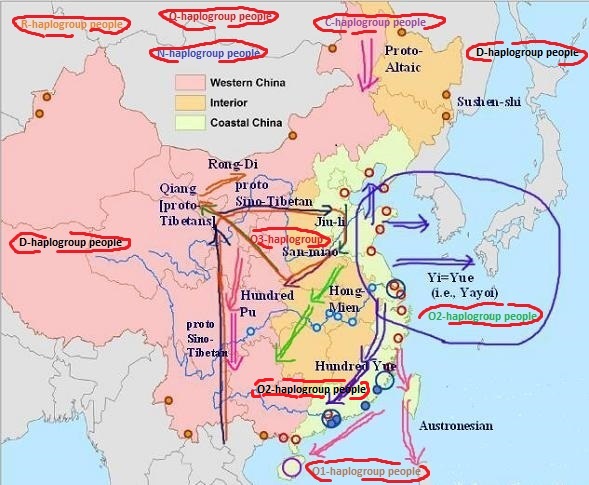
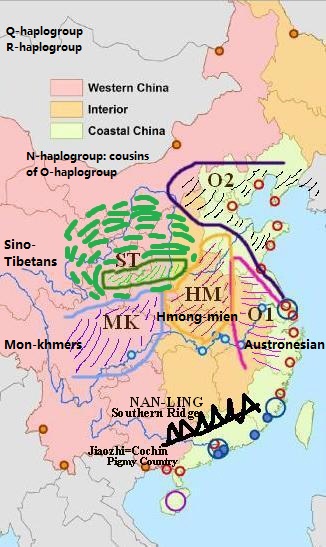
Reading though history, two conclusions could be reached, i.e., that the tribal states of Loulan (Rongjiang), Cheshi (Gaochang, Kara-Khoja), Qiuci (Guqa or Kuqa), Yanqi, Yutian (Hotan), Shule (Kashi) had been in continuous existence though the actual inhabitants of those states might have changed over the course of history, and that both the Huns and the Turks had appeared to be an outsider force that preyed upon those tribal states from the northern altitude of the Altai Mountains and Mongolia. More, according to Ban Gu of Latter Han Dynasty, the tribal states of Loulan (Rongjiang), Cheshi (Gaochang), Qiuci (Guqa or Kuqa), Yanqi, Yutian (Hotan), Shule (Kashi) are recorded to have city-walls and cultivation, while the Huns or later Turks did not possess those features.
Tuoba, Gao-che (Yuanhe), Ruruan
During early Tuoba period, Tuoba Wei Emperor Daowudi (reign 386-409), launched numerous campaigns against the Ruruans as well the Gaoche people.
While Gaoche were at odds with the Ruruans, they raided into Tuoba Wei as well. Daowudi personally led several campaigns against Gaoche and quelled their tribes. The Gaoche people, however, were frequently mentioned as an ally in the war against the Ruruans. The early Gaoche people had different names from the later Tiele Tribes. There is an often-mentioned name called 'Hulü' among the Gaoche, and in Tuoba Wei Dynasty, quite a few generals bearing this name were in existence. One Gaoche lord, Hulü Beihouli, fled to Tuoba Wei after being defeated by the Ruruans, and he was conferred the title of Duke Mengdu. Daowudi relocated the Gaoche people to the south of the desert and the Gaoche people began to learn cultivation. Gaoche possessed 12 family names, and they were enslaved by the Ruruans mostly. Gaoche rebelled against the Ruruans frequently. Gaoche were also subject to attacks from the Ye-tai (i.e., the so-called White Huns).
The Tiele Tribes (Huihe)
By late Tuoba Wei's Northern Wei Dynasty, a new alliance of people called the Tiele (Toles) would emerge. The Tiele Tribes, descendants of the Huns, with many of the later familiar Huihe family names, were recorded to have spread everywhere, i.e., north of the Luo River (e.g., clans like Tongluo, Bayegu, Pugu, Weihe, Fuluo, carrying the names of Mengchen, Tuluhe, Sijie, Hun, Huxie), west of Yiwu & north of Yanqi (clans like Qibi, Boluozhi, Subo, Nahe, Wuhu, Hegu, Yunihu), southwest of the Altai Mountains (e.g., Xueyanto or Sheyanto, Shiban, Daqi), north of the ancient Kangju Statelet (e.g., Ye-tai, Hejie, Bahu, Bigan, Juhai, Hebeiji, Bayemo), east and west of Nihai (?) Sea (Sulujie, Sahu), south of the Beihai Sea (Dubo), and east of Byzantium (Eng'qu, A'lan, Beiru, Qiuli), numbering tens of thousands in each direction. History said the Tiele people in the west were good at cultivation and they had more buffalos and less horses. The Tiele people would now include the Ye-tai, with a strong hint that the composition would be both Yüeh-chih and Hunnic.
By the end of the Kaihuang Era [581-600], King of Jinn (Yang Guang, i.e., later Sui Emperor Yangdi), defeated Bujia Khan of the Western Turks and dispersed the Tiele vassalage of the Turks. In the first year of the Daye Era, i.e. A.D. 605, Chuluo Khan attacked various Tiele Tribes as well as suspected the loyalty of the Xueyantuo Tribe. Chuluo Khan assembled hundreds of Xueyantuo chieftains and killed them all. Xueyantuo selected their own leader, Silifa and Sijin, and fought against Chuluo Khan. The Xueyantuo people declared themselves as Khan Yihuzhenmuohe. Khan Yihuzhenmuohe would take over Yiwu, Gaochang (Kara-Khoja) and Yanqi from the Turks.
Before Gaoche-Tiele, namely, in earlier Han times, there are simply too many tribal groups
and states sandwiched between the Huns and the Han Chinese to pinpoint
exactly where the Uygur [purportedly Huihe] ancestors came from. By the time of Sui-Tang, The Tiele tribes had over a dozen or so tribes which include the Xueyantuo (Sheyanto) tribe that the Uygurs defeated later. (The Xueyantuo Tribe was from the last name of 'Xue' and a conquered tribal name of 'Yantuo'.) The Huihe was comprised of four of the dozen or so Tiele tribes, including Pugu, Tongluo, Bayegu and Weiqi.
The Huihu
Huihe was renamed to Huihu in A.D. 809. According to Old History of the Five Dynasties, the Huihe people sent an emissary to the Tang court in A.D. 809 and claimed that they changed their name to Huihu [Huigu] by which they meant for a kind of eagle called 'hu' flying rotationaly in the skies. (The character for 'hu' could also be pronounced as 'gu' for a different bird called 'gu zhou', and could be pronounced as 'he' when combined with character 'hui'.)
It is a bit unscientific to use the names of Uygur and Huihe/Huihu interchangeably here. The above historic literature points to the Uygur's ancestor being the Huihe people. The name 'Uygur' was probably a mutation of Huihu. In Ming Dynasty's records, the name Wei-wu-er ('Uygur') was widely cited in the descriptions about their tributaries. I will come back to this naming in the section on Ming Dynasty.
Today's Uygurs, also spelled as UIGUR, UIGHUIR, UIGUIR, UYGHUR and WEIWUER in Mandarin, live largely in Xinjiang or the Xinjiang Uygur Autonomous Region (so-called Eastern Turkestan). They have a
present population of over 10 million around or more. There are also considerable number of them in Western Turkestan which includes Kazakhstan, Uzbekistan, Kyrgyzstan,
Turkmenistan and Tajikistan. Among the Uygurs inside of China, there
are three major groups, consisting of the Yugur or Yellow Uygur in today's
Gansu Province, and the Uygurs south and north of Khan Tengri (Tianshan
Mountains). The nationalist Uygurs disputed the specific naming like the Kazaks, Uzbeks, and Turkmens etc, and they claimed they were of the same family.
The Huihe people would come into prominence during the Tang times. At Tang times, the Huihe people were a long time ally of Tang Chinese in campaigns against both the Eastern Turks and the Western Turks, at least for a time period of over 200 years to A.D. 840.
The Huihe people had once ranked second to the Xueyantuo tribe among the eleven tribes which had helped Tang in defeating the Eastern Turkic Khanate in A.D. 630-640. For almost a hundred years, they would assert control over north Mongolia with the remaining Turks who re-established the Eastern Khanate in A.D. 682/683 in Mongolia and the Turkic Khanate in the Tarim Basin in A.D. 691.
Around A.D. 640s, the Uygurs helped the Tang army in quelling the rebellion of Turkic tribe 'Xueyantuo' which took advantage of emperor Taizong's first Korean expedition in attacking
Tang. Tribes of the Huihe killed the khan of
Xueyantuo tribe and hence controlled northern Mongolia where the Turkic tribe
Xueyantuo once held. A review of the major Turkic tribes in Mongolia yielded a tribe called 'Sakiz Oghuz' or the Eight Oghuz with a similar pronunciation to Xueyantuo. The historic records showed 'Sakiz Oghuz' was a name which existed in the 8th century, later than the fight between the Uygurs and the Xueyantuo tribes.
The Uygurs hence relocated to Mongolia and they ultimately set up the Uygur Kingdom in A.D. 744/45 after defeating the remnant Turks in the area. (The 'Sakiz Oghuz' tribe is said to have some remnants left in Mongolia.) When the Kirghiz defeated the Uygurs in A.D. 840 and took over northern Mongolia, there was a group of people called the Naimans who remained in their homelands in the Altai Mountains and attached themselves to the Kirghiz. The Naimans were said to be a Mongol name for a group of the Turkic tribe called 'Sakiz Oghuz'. (The Oghuz Turks would find their way to Anatolia, separately.)
The Huihe (Uygurs) & the Karlaks vs the Turks:
Emperor Xuanzong, in A.D. 714, defeated Khan Mochuo of the Eastern Turk (Orhkon Turks) at Beiting [i.e., Lake Issuk-kul area] and won over the defection of Mochuo's brother-in-law.
Back in 713, Governor-general Sun Quan of Youzhou Prefecture attempted to recover Yingzhou from Xi-Khitans by leading 20,000 army together with Li Kailuo & Zhou Yiti.
At Lengjing, chieftain Li Dapu of Xi-Khitan ambushed the Chinese. Only Li Kailuo escaped. Li Dapu surrendered Sun Quan & Zhou Yiti to Khan Muchuo for execution as a show of alliance against China.
The two parties hence allied to harass the Chinese border. Tang court sent emissary to the Turks for peace. Muchuo dispatched son Yangwozhi to the Tang court for marriage with Chinese princess.
Emperor Xuanzong promised to marry over Prince Nanhe-xian the daughter of King SHu-wang.
In spring of A.D. 714, Muchuo dispatched son Tong'e-tele and brother-in-law Huoba-xielifa-shishibi on an attack at Bei-ting Governor-general Office as a retaliation over Emperor Xuanzong's delay of releasing princess. Protector General Guo Qianguan ambushed the Turks outside of the citywall, pierced dead Tong'e, killed over half the Turk force, and chased Huoba. Huofa, being rebuked by Khan Muchuo, fled to seek asylum with Chinese together with wife and sons, and received the conferral of King Yanshan-jun-wang.
While the Western Khanate ended in the hands of the Turgesh and the Karluks, the Orkhon [Eastern] Khanate ended in the hands of the Huihe alliance. History said the Tang Chinese conspired to have the Bayegu and Huihe etc., attack the Orkhon Turks of Khan Muchuo (Mo-ch'o). To check the Orkhon Turks, the Tang Chinese also allied with the Western Turks called the Turgesh [who were situated in today's Ili, between the Arabs and the Chinese] from A.D. 716 to A.D. 733. After Khan Mochuo was killed by the tribesmen from the Tiele Tribes, the Orkhon Turks came to terms with the Chinese, and their successors were said to have erected a stone monument cursing the Chinese for the treachery and the Tiele tribesmen for betrayal.
The Uygurs ultimately set up the Uygur Kingdom in A.D. 744/45 after defeating the remnant Turks in the area.
After the Orkhon Turks were defeated by the Huihe and Bayegu etc, the Huihe (Uygurs) would control the Kirghiz and the Khitans. After the fall of Tang Dynasty (A.D. 619-907), three dynasties among Northern China's Five Dynasties (A.D. 907-960), i.e., Posterior Tang 923-936, Posterior Jinn 936-946, Posterior Han 947-950, were ruled by the Sha'to Turks. The remaining Orkhon Turks were not heard from after China's Five Dynasties time period. Uygurs (Uighurs) took refuge in Ganzhou and Xinjiang after being replaced by the Kirghiz.
The Huihe (Uygurs) vs the Kirghiz:
Uygur nationalists claimed that "in A.D. 840, Tang Chinese emperor, in order to get rid of the encroachment of the Uygur (who were earlier invited by Tang emperor to come to Tang capital to quell rebellion) and wipe out the humiliation, had incited the Kirghiz in attacking and replacing the Uyghurs in Mongolia. The Uygurs fled to Gansu [Kansu] province, south and north of Khan Tengri (Tianshan Mountains) and established three separate successive
Uygur kingdoms."
According to New History of the Five Dynasties, Kirghiz belonged to the ancient 'Jiankun' Statelet which was located to the western-most of the Huns. At one time, during Tang Emperor Suzong's reign of A.D. 758-760, the Huihu (Uygur) conquered the Jiankun Statelet of the Kirghiz. The Kirgiz allied themselves with Tibetans, Arabs and Karlaks. Kirghiz, with the help of a defector Huihu (Uygur) general and combining a cavalry forces of 100000, defeated Huihu (Uygur) and killed the Huihu khan around A.D. 840s. Tang emperors did not intend to support the Kirghiz as a replacement for the Uygurs for fear that someday the Kirghiz would pose a threat to Tang China as in the case of the former. It would be in A.D. 859 that Tang Emperor Xuandi decided to confer the Kirghiz the title of Khan Bravery-Intelligence.
New History of the Five Dynasties said that the Kirghiz possessed lighter skin, red hair, green eyes and taller height, and that those Kirghiz with black hair must be the descendants of Li Ling. See the Hun section for more descriptions of Non-Mongolian Physiques.
Yellow Uygur: The Yugur or Yellow Uygur are one of China's 56 officially recognized nationalities, consisting of 12,297 persons according to the 1990 census. Linguistically, this group of people were classified by belonging to Mongol language.
The Yugur live primarily in Gansu Province, in Sunan Yugur Autonomous County, within the county of Zhangye. The Yugur live in an area where four different language
groups, Turkic, Mongolic, Chinese and Tibetan converge. The Yugur
nationality itself consists of four linguistically different groups.
The largest of these groups are the Turkic speaking Western Yugur. The Mongolian speaking Eastern Yugur number the next. A very small number of the Yugur speak Tibetan. The remaining Yugur of the Autonomous County speak Chinese. The Western Yugur are considered to be the descendants of a group of Uygur that fled from Mongolia southwards to Gansù after the collapse of the Uygur Empire in 840 A.D. The Yugur people have been living together for about six centuries.
Turfan Mummies
In Turfan, a town of oasis
famous for grapes, Hami melons (from seed introduced by Henry Wallace in
1940s) and mummies, not far away from Urumqi, there have been excavated
a huge number of mummies. Those mummies are not of the kind of so-called
"Loulan Beauty". They are all of Tang Dynasty Chinese from
1200 years ago, wealthy officials who chose this propitious place for their
tombs which usually ran ten steps into a corridor underground, decorated
with murals on both sides. People, especially Western people,
however, are more interested in the Caucasoid mummies. Nova,
in its TV series, had provided evidence that Caucasians did exist very
close to China once upon a time. http://www.pbs.org/wgbh/nova/chinamum/taklamakan.html
shows the excavations of mysterious 3000-year-old mummies in China's western
desert, inside today's New Dominions Province.
NOVA pointed out that those preserved
3000-year-old mummies excavated in late 1980's show that Chinese civilization
did not evolve alone and Western counterpart might have played an important
role in elevating the Chinese via possible introduction of 'donkey carts'
and wheels, and even bronze knives. It further extrapolated that those
mummies belong to the so-called Tocharians (http://www.wlc.com/oxus/tocharia.htm) with a tongue that is more closely related to the languages of Indo-European origin. This leads me to say that it sounds almost like another revolution similar to the Indo-European invasion of ancient India. But, if the mummy people had so advanced system, they could have crushed Chinese the lowland sedentary people easily and accomplished the feats of the Huns thousands of years earlier. Besides, the Indo-European language
would have replaced the pictographic Chinese language of today. http://homepages.utoledo.edu/nlight/uyghhst.htm had a good exposition of the "remarkably racialized ideas" and approaches built on basis of the mummies.
"Loulan Beauty", the name given
to a woman excavated near Loulan and those exotic mummies, however, only
corroborate the historical fact that the ancient Scythians, warrior tribes
of Saka, had once roamed the Altaic region, with today's Kyrgyzstan
as their base. The Scythians are a loosely denoted term for
Caucasoid nomads, while the Huns, on the other hand, would point to another
loosely-termed Mongoloid nomads who roamed the trans-Eurasian continent
of the time.
The Scythians are better known in Persian, Rome and Greek records. Before the Scythians, there were the Cimerians of roughly 1000 BCE. http://www.geocities.com/kaganate/tribelist.html has a good account of historic Steppes nomad tribes, saying
that the Scythians, approximately in the 8th century BCE, took the place of the Cimerians;
that Scythians were related to the Saka in the area of modern Kazakhstan; and
that the Amazons (possibly so-called Nü-ren or Women Statelet in Chinese records,
and the Sarmatians, offspring of the Scythians and the Amazons, came onto the scene in roughly the 3rd century BCE.
Alexander the Great met stiff resistance from Saka tribes in his 4th century B.C. advance through Central Asia. Later, the Yüeh-chih or Yuezhi people, a relative of the Saka people, migrated southwest in 141-128 B.C. to the Oxus Valley, i.e., the modern Amu Darya, after being defeated by the Huns in Gansu, China in 174-161 BC. The Yüeh-chih would push the Scythians out of their way and overran the Greco-Bactrian kingdom, which is renamed Tocharistan.
Continuing the mummy topic. Note more Tang Chinese mummies were found in Chinese Turkestan than Indo-Europeans mummies.
http://homepages.utoledo.edu/nlight/uyghhst.htm had a good exposition of the "remarkably racialized ideas" and approaches built on basis of the mummies.
More,
further diggings in Loulan area, i.e., the ancient Salty Lake and Salty River (Peacock Rover), led to a site called by Xiaohe or the Little River, next to the Salty River (Peacock Rover), where Mongoloid Mummies were discovered.
It appears to me there was indeed good carbon dating on Xiaohe excavation, saying "The entire necropolis can be divided, based on the archeological materials, into earlier and later layers. Radiocarbon measurement (14C) dates the lowest layer of occupation to around 3980 ± 40 BP (personal communications; calibrated and measured by Wu Xiaohong, Head of the Laboratory of Accelerator Mass Spectrometry, Peking University), which is older than that of the Gumugou cemetery (dated to 3800)." The article claimed that the 'Mongoloid' mtDNA had similarity to some present South Siberian population. (For details, check http://www.biomedcentral.com/1741-7007/8/15 for the full article "Evidence that a West-East admixed population lived in the Tarim Basin as early as the early Bronze Age".)
The linking of this certain mtDNA in Xiaohe/Loulan area to a modern Siberian population could be said to be circumvential at best since a lot of things had happened in the past 2-3000 years.
It kind of had the same timing as the Mongoloid mummies that were discovered to the north and east of the Tianshan Mountain.
More than what was found about the mtDNA at Xiaohe/Loulan, there were mummies of the Khams Tibetan type found to the further north,
at the Tianshan-Altaic mountain areas, which presented a much more convincing point that the proto-Tibetan Qiangs had indeed crossed over the strip of the sand desert near Loulan to reach the north side of Tianshan.
Possibly, the Khams [proto-]Tibetan, after reaching the Tianshan Mountain Range, moved towards Hami (Qumul) to the east as well, where there were the Hami (Qumul) Mongoloid mummies excavated.
In Turpan, archaeological finds made in the early 20th century will also include Nestorian literature and extant Manichaean literature. Whatever mummies, later historical developments point to the influx of Mongoloid people into this area, and today's residents in Central Asia possessed more Mongoloid lineage than Caucasoid. Further, after the people of Yüeh-chih/Scythians and before the rise of the Turks/Uygurs, there had existed numerous other groups of people: Huns, Ruruans (i.e., Juanjuans, successors of the Huns), Xianbei, Qiang, and Tuoba, making it difficult to trace the origins of Turkic people.
For further discussions on Barbarians & Chinese, please refer to
Nomadic Players
Hun, Xianbei & Tuoba:
Hunnic Han Dynasty & Hunnic Zhao Dynasty (A.D. 304-329), set up in today's Shaanxi, Shanxi and Henan Provinces, ended when Shi Le's Posterior Zhao (Jiehu barbarians, one of the five nomadic groups "ravaging China at the time", comprising of Huns, Jiehu, Xianbei- Wuhuan-Tuoba, Qiang, & Di) usurped the power. Thereafter, the five nomadic groups would set up a dozen of short-lived states, categorically called "Sixteen Nations" in Chinese chronicle (prior to south-north dynasties), until Tuoba's Northern Wei united northern China in A.D. 386. Tuoba nomads are said to be the northern-most branch of the Xianbei nomads, the proto-Tungus people who had descended from Dong-hu or Eastern Hu nomads. Dong-hu split into Xianbei in the north and Wuhuan in the south after they were defeated by Hunnic Chanyu Mote (Modu).
Tuoba Xianbei was recorded to have dwelled to the northeasternmost of all Xianbei, in a place called 'Ga Xian Dong', somewhere near the north segment of the Greater Xing'an Ridge.
The Xianbei (Syanbiy) were the northern branch of the Donghu (or Tung Hu, the Eastern Hu), a proto-Tungus group mentioned in Chinese histories. By the first century, two major subdivisions of the Donghu had developed: the Xianbei in the north and the Wuhuan in the south. The Xianbei expanded their territories by taking advantage of the Hunnic decline, and they took over most of the northern territories held by the Huns previously. There appeared a Xianbei chieftain called Tanshikui (reign A.D. 156-181) who established a Xianbei alliance by absorbing dozens of thousands of Huns (numbering 200 thousand). Tanshikui Xianbei dissolved after the death of this chieftain. By the time of Three Kingdoms Period (A.D. 220-280), the Wuhuan nomads took control of today's Hebei Province and Peking areas. Warlord Yuan Shao campaigned against the Wuhuan and controlled three prefectures of Wuhuan nomads.
Before Tuoba's march towards northern China, the Xianbei people had absorbed most of the Wuhuan branch. Wuhuan fell apart after Cao Cao defeated Yuan Shao and his Wuhuan allies.
After Ts'ao Ts'ao defeated Yuan Shao, Yuan's two sons (Yuan Shang and Yuan Xi) fled to seek refuge with the Wuhuans. Ts'ao Ts'ao campaigned against the Wuhuan, killed a chieftain called Datu (with same last character as Hunnic Chanyu Motu), and took over the control of southern Manchuria.
Xianbei alliances would consist of Greater Xianbei under Budugeng, Lesser Xianbei under Ke'bineng, and Manchurian Xianbei. Cao Wei Dynasty broke a new Xianbei alliance by sending an assassin to kill a Xianbei chieftain called Kebineng.
By the "Sixteen Nations" time period, Xianbei could be distinguished into: a) Eastern Xianbei; b) Western Xianbei; and c) Tuoba Xianbei. The Eastern Xianbei would include tribes like Yuwen, Murong and Duan, while the Western Xianbei would include Qifu & Tufa (to mutate into Tubo in Chinese and Tibet in English). One ancient Chinese account put early Yuwen tribe in the Hunnic category.
The Xianbei would later establish many successive states along the Chinese frontier. Among these states was that of the Tuoba Xianbei, Tufa Xianbei and Murong Xianbei etc.
In earlier times of Western Jinn Dynasty, Tuobas were befriended by a Chinese
border general called Liu Kun whose strategy was to "fight the aliens via
the aliens". Liu Kun, a general famous for "practicing swords
in early mornings at the sound of cock crow" with general Xie Xuan in their
teenage times, had requested with Western Jinn emperor for the authorization
to have the Tuoba settle down in today's Yanmenguan Pass, an area called the
Dai prefecture in Qin Empire's times. Liu Kun would later die in the hands of his Xianbei ally in today's Beijing area. Tuobas, before their ascension to power, were at first very vulnerable to attacks from the Xianbei whose Murong (or Mujong) kingdom would evolve into Anterior Yan, Posterior Yan and Southern Yan. (Northern
Yan is Chinese.)
Chinese family clans, such as Zu Di, Liu Kun & Xie Xuan, had undertaken the tasks of safeguarding the southern Chinese Jinn court or northern expeditions at the time of turmoil.
Eastern Jinn Chinese, under the banner of General Liu Yu, would retake from the Xianbei nomads
the garrisons in Hebei-Shandong areas of northern China, and then took over Shaanxi-Henan areas by defeating the Qiang nomads in today's Xi'an.
However, General Liu Yu, eager to go back to Nanking to usurp the power (and formally started the history of South-North), would only leave his 13 year old son in charge of Xi'an, despite pleas from local elderly who said that they said they had not seen Han clothes for almost 100 years by that time and feared that they would be lost to the nomads again should General Liu leave.
A short-lived Hunnic Dynasty, called Xia, would attack the Chinese in Xi'an. General Liu's son would barely escape alive after the Chinese generals had internal turmoil in face of Hunnic attacks. One general, Wang Zheng'er, a general responsible for taking Xi'an from the Qiangs in early campaigns and the grandson of Wang Meng who had aided Emperor Fu Jian of Anterior Qin (Di nomads) as prime minister, was killed by his comrades. The remnant Chinese then fled south. Tuobas, having emerging from Dai in the Shanxi Province area between A.D. 338 and 376, would take advantage of Chinese northern expedition against Xianbei and Qiang in establishing control over the region as the Northern Wei Dynasty (A.D. 386-533). Tuoba first defeated the Xianbei. Tuoba (Tuoba) would finish Hunnic Xia Dynasty soon and then unite northern China.
Ruruans, Kok Turks & Tuobas:
Meanwhile, the Ruruans, a newly arising people, called Rouran or Rui-rui in Chinese (Juan-Juan), came into power in steppes north of the Altai Mountains in the 4th century AD.
Western historians called the Ruruans by "Mongolian", a term that would not appear till the 14th century. The Ruruans lost the wars to the Tuoba Wei Dynasty in northern China, in a similar fashion as the Huns losing the war to the Han Chinese Dynasty.
The Ruruan founder, who was said to be a 'Hu' by the Tuoba people, was said to have the same origin with each other.
In a conversation, the Tuoba people acknowledged the status of the Ruruan founder as being a 'slave' (i.e., a cavalry bodyguard).
The Tuoba claimed heritage from Huangdi and hence despised other nomads as 'Hu'. The terminology for 'Hu' was categorical.
The Tuoba, in order to show their disdain for the Ruruans, despised the Ruruan and nicknamed them as 'ru ru' (i.e., crawling), meaning a kind of slow crawling insect crawling on the ground.
Tuoba, claiming the Yellow Emperor heritage, certainly treated other nomads as barbarians the same way as the Han Chinese treating the Huns.
There is one more comment in History Of the Tuoba Wei Dynasty, namely, the founder of Ruruan might have origin in Eastern Hu nomads.
Chinese records showed that the ancestor of the Ruruans was a Hu nomad who served as the bodyguard for the Tuoba founder.
This person later offended the Tuoba founder and fled to the Altai Mountains where he subjugated the remaining Hunnic tribes and Gao-che people.
Tuoba (Tuoba) treated the Ruruans as the descendants of the Huns and commented that "though the Ruruans were Hunnic in nature but their ancestry was hard to corroborate".
On another occasion, Tuoba Wei Emperor agreed with the Rouran asylum-seeker that they were in deed from the same family, i.e., the Eastern Hu barbarians.
(See Li Yanshou's Bei Shi, namely, History of the Northern Dynasties. Alternatively speaking, it is no strange to see non-Chinese websites advocating a school of thought stating that Ruruan [Zhuzhan], like Tuoba, were people of Eastern Mongolia and Western Manchuria and that "from the IInd and up to the IVth centuries, Altai lived under the influence of Syanbiy tribes. From the end of the IVth century the Altaian tribes were subjugated by the Zhuzhans ... and were to pay tribute to them [by ironware]." Also see
http://www.altai-republic.com/history/altai_history_eng.htm for details.)
But after the Ruruan founder fled to the Altai Mountains, he conquered and absorbed remnant Hunnic tribes and Gao-che people there. The Ruruans and Gao-che people warred with each other as well as allied with each other.
Hence, the Ruruans were more Hunnic than anyone else. History Of the Tuoba Wei Dynasty further commented that the "Ruruans, though the descendants of the Huns, could not have their exact ancestry traced."
The Western history books stated that "in c. 370, the so-called Huns were pressured by the Ruruans into invading Europe from the Central Asian steppe." This webmaster could say that the Ruruans were more Hunnic than the Western Huns they drove away towards the Europe, especially so after the Ruruans subjugated the remaining Hunnic tribes in the area. Western history recorded that the Attila Huns were so savage and barbaric that they ate raw meat. This life style was totally different from those eastern Huns who were semi-Sinicized and civilized.
A brief discussion of the relationship between the Ruruans and the remnant Hunnic statelets to the west and northwest is needed. To the west and northwest of Ruruans will be Hunnic tribes such as Nie-ban [Nirvana], Jian-kun [Kirgiz] and Su-te [Sogdiana] etc.
The Ruruans employed a group of people called the Turks as slaves or serfs working in the iron mines in the Altai Mountains. The Turks, after rearing the Tiele Tribes on behalf of the Ruruans, competed against the Ruruans. The Turks, who incorporated the Tiele tribes, ultimately defeated and exterminated the Ruruans, hence taking over the steppe and today's Chinese Turkestan as the new master.
In northern China, the remnant Huns, who served in Tuoba's army, rebelled in today's Wuyuan area, Inner Mongolia in A.D. 523. The Tuobas, together with the Ruruans, cracked down on the Huns. Thereafter, the Tuobas moved over 200 thousand Huns to today's Hebei province.
Northern Wei split into Eastern and Western Wei Dynasties in A.D. 534. At almost the
same timeframe, the Turks rebelled against the Ruruans in A.D. 546-553, and they defeated the Ruruans and forced the Ruruan khan into seeking refuge inside of Western Wei.
The Turks succeeded the Ruruans in controlling the vast land west and northwest of China. This Turkic empire would be called Turkic Khaganate (552-744 A.D.), alternatively called Kok Turk.
The later Turks would be more complicated than the early Turks as a result of expansion and assimilation, and the later Turks would include Khazars, Pechenegs, Cumans, Sabirs, Saragurs, Kuturgurs, Barsils and Seljuks etc. To fully understand how Western Turks evolved, multiplied and expanded, some serious studies need to be conducted as to how the Tiele Tribes warred with each and allied with each other. See Turk versus Tiele (Tara or Tole) for further explanations.
The early Turks came to their apex in A.D. 593. Both Sui Dynasty and Tang Dynasty would play the trick of dissension among Turkic khans. Eastern Khans would end in the hands of Xueyantuo, a Tiele Tribe. Western Khanate would be dispersed by Tang armies. Remaining Eastern Turks, i.e., Orchon Turks, would officially end when the Huihe, i.e., ancestors of the Uygurs defeated them and set up the Huihe Kingdom in A.D. 744.
The Tiele tribes, or the Huihe (Uygurs), i.e., the Nine-surname Oghuz people or the Tiele people, belonged to the same family as the Turks
according to the Kul-tigin Stele (A.D. 732).
In the west, the Khazar Turks allied with the Sassanians of Persia to destroy the Hephthalite Empire of the White Huns in 553-68.
A Turkic khan sent emissaries to Byzantium in A.D. 568, about 9 centuries before other Turks were to take over the city of Constantinople.
In 572-91, the Khazar Turks and the Byzantines allied against the Sassanian
Persia. In 576, the Turks invaded the Caucasus and established
the Khazar Khanate, Khazaria where they were converted into Judaism in
AD 740 by Jewish immigrants who came from Persia after the Arab conquest.
In Asia Minor, the Western Turks allied with the Sassanian Persians (Chosroes
of Persia) in A.D. 565, dividing the Ephthalite (Hephthalite) empire of the White Huns.
To the east of the Gobi, the Eastern Turks defeated the Khitans who were possibly related to the Xi people and the Shiwei tribes.
The two Wei dynasties would
be usurped by Xianbei-origin generals to become Northern Qi Dynasty (A.D. 550-577) and Northern Zhou Dynasty
(A.D. 557-581), separately.
The Turks had earlier helped the Ruruans by cracking down on the Tiele Tribe and absorbing about 50,000 people. Then, the Turks proposed to the Ruruan Khan for a marriage with the princess. The Ruruans cursed the Turks about the marriage, and the Turks killed the Ruruan messenger and cut off relations with their Ruruan master. The Turks then proposed for marriage with Western Wei Dynasty and obtained Princess Changle of Tuoba-Wei royal family, certainly with the nodding approval of the later founder of Northern Zhou Dynasty. The Turks then attacked the Ruruans and the Ruruan royals fled to Northern Zhou. Turks forced Northern Zhou into handing over the Ruruan khan whose royal family, numbering in 3000, were slaughtered by Turks while still being deported inside the boundary
of Northern Zhou. Turks played Northern Qi and Northern Zhou
against each other for tributes. Northern Zhou, located to
the west of China's central plains, used Han Chinese "intermarriage" strategy
in marrying their princesses over to the Turks, with one princess re-married
to successor Turk kings three more times. At one time, the
Turks and Northern Zhou combined their forces in attacking Northern Qi
of today's Shandong province, but were defeated by Qi army.
Ruruans, Ephthalites
(White Huns) & Avars:
The Ruruans were the successors to the Huns. They were
famous for introducing a new cavalry warfare called the stirrup.
We called it "introducing" because they did not invent the "stirrups", an art
of war which led to the feudal class of the European Middle Ages according
to Lynn White (Medieval Technology and Social Change).
Primitive stirrups had appeared much earlier. Many excavations of ancient tombs in northern Korea showed that the Xianbei barbarians had developed some form of stirrups. It was the Xianbei nomads who were frequently mentioned as mercenaries of the Jinn Chinese in fighting the Huns and Jiehu barbarians on behalf of the Chinese emperors.
(Before the invention of stirrups, the steppe barbarians had no chance to counter the Sinitic nation's advanced bows and chariots.)
The Ruruans once helped the Tuobas in cracking down on the Huns. But soon they were defeated by the Turks.
According to the Chinese chronicle, the Ruruan khan and his family, who sought refuge inside of China, were handed over to the Turks, and they were brutally slaughtered by the Turks
while still within the boundary of Northern Zhou Dynasty (A.D. 557-581), en route of being deported.
Before the rebellion of the Turks, the Ruruans --who had the same Dong-hu origin as the Tuoba -- moved west after being pressured by the Tuoba Wei Dynasty, with some of them said to have reached Hungary by the 6th century, where they were called Avars -- which could be unfounded.
(Other than Avars, there were Székely in Hungary, with those Turkic elements being relatively new entrants versus the Magyars. The Hungarians, i.e., the Magyars belonged to the same stock as the Sami and the Finnish people who once populated the entire belt of today's Inner Mongolia 4000-8000 years ago.
There was a good chance that the early Sinitic kings, especially the Shang dynasty kings, could have some admixture of the Finno-Ugric people who were responsible for engendering the Hongshan civilization.)
http://www.best.com/~heli/wargame/variant/maharaja/eph.txt mentioned that in A.D. 522, the time of the apex of Ephthalite power, some Ruruan (Juan-Juan) chief fled to the Ephthalites for protection.
In A.D. 552, the Turks, after overthrowing the Ruruans, began conflicts with the Ephthalites (White Huns).
Turkic
Khan Muchu (Mugan/Muqan) defeated the Ye-tai (Yeda/Yida/Yanda/Yitian) in
the west, the Khitans in the east, and the Qigu (Jiegu/Jiankun/Xiajiasi/Kirghiz) in the north, hence
expanding the Turks’ territory from the Caspian Sea in Central Asia to the Liao-hai in Manchuria,
and from the Amu Darya River in the south to Lake Baikal in the north. Alternatively speaking, it
was Muchu Khan’s uncle Ashina Shidianmi (Istemi Kagan) who defeated the Ye-tai (Yeda/Yida/Yanda/
Yitian). Before the Turks defeated the Ye-tai (Ye-da), the Ye-tai (Ye-da) for about 250 years controlled
the area of today’s Central Asia and Chinese Turkestan, more than what the later Khwarazm empire
of the 12th-13th centuries had achieved. Ye-tai was taken to be Yandaiyilituo or the Hephthalites, who
were speculated to be descendants of the Kushan Yuezhi; or speculated to be mutation of ‘Hua’ for
chieftain San-hua of the first century A.D. Though, between the Kushan Yuezhi (which was equated
to the Gandhara state by monk Xuan-zang of the 7th century A.D.) and the Ye-tai (Hephthalites) of the 5th
century A.D. there was the Sassanid Empire (A.D. 224-651) invasion of Gandhara of the 3rd century,
and after the successive rule of the Sassanians and the Hephthalites, today’s Afghanistan, where the
Kushan Yuezhi used to be, was renamed back to Du-huo-luo (Tukhara/Tochari) in the 7th century A.D.
Bei Shi (history of the northern dynasties) specifically name King Ji-duo-luo (Kidarite King Kidara I, circa
350-386 C.E.) as belonging to the Yuezhi Major people with capital at Shengyanshi-cheng (Sheng-Jianshi,
i.e., Balkh) and bordering with the Ruruan in the north but made a confusing second entry about
Yuezhi Minor’s descent as from a son of King Ji-duo-luo and its conflict with the Huns as if living in
the 3rd and 2nd centuries B.C, five hundred years prior. Namely, Bei Shi could have mixed up historical
records in both entries on Yuezhi, with Kidarite King Kidara not related to the Yuezhi but actually
the very Huns who warred with the Ruruans of the Eastern Hu origin and conquered the descendants
of the Kushan Yuezhi from the A.D. 430s onward.
Ashina Shidianmi (Istemi), i.e., Tumen Khan’s brother and Muchu Khan’s uncle, who stayed
behind while Tumen was campaigning east against the Ruruans, conducted a western campaign in
A.D. 552.
Ashina Shidianmi (Istemi), i.e., Tumen Khan’s brother and Muchu Khan’s uncle, who stayed
behind while Tumen was campaigning east against the Ruruans, conducted a western campaign in
A.D. 552. Ashina Shidianmi allied with Khosrau I of the Sassanid Empire in attacking the Ye-tai
(Ye-da), defeated the Ye-tai (Ye-da) in 557 in a battle near Bukhara, continued the campaign into the
former Kushan Yuezhi territories, and about A.D. 558 to 567, divided the Ye-tai (Ye-da) land with
the Persians along the River Oxus (Amu Darya). Ashina Shidianmi expelled the Avars to the Volga
and displaced the eastern Bulgars, for which Shidianmi was promoted to be a khan of semi-equal
footing as the Eastern Turkic khan.
In A.D. 565, the Western Turks and Chosroes of Persia allied to capture and divide the Ephthalite empire.
(Father of Sassanian Persian King Chosroes, Kubad, were previously twice placed on Sassanid throne with the help of the Ephthalites. Chosroes married a daughter of the Turk chief Sinjibu. The Turkic chief Sinjibu conquered the Hephthalites and killed their king.)
Avar was the same name as the Avar khanate formed by remaining Hephthalites (White Huns).
Hephthalites moved west to the Russian steppe to form the Avar Khanate in the late 6th cent after its Hephthalite Empire was destroyed by the Turks and Sassanians in today's Iran in A.D. 553-568.
http://www.silk-road.com/heph.htm stated that the White Huns "disappeared by 565 ... only small number of them survived.
Some surviving groups living south of Oxus escaped Chosroes' grasp ...
later fell to Arab invaders in the 7th century. One of the surviving
groups fled to the west and may have been the ancestors of the later Avars
in the Danube region."
(The Chinese character 'hua', similarly, was abused by the non-Chinese enthusiasts for the Chinese history.
In the Xia-Shang Dynasty, this webmaster had alerted to the morphology extrapolation of as to the pronunciation of 'hua' and 'xia',
and pointed out one such fallacy of equating 'hua' [slippery] to 'hua' [flowery] seen at
http://encyclopedia.lockergnome.com/s/b/Huaguo. Should Southern Liang Dynasty [A.D. 502-557], in the inscription on Liang chih-kung-t'u, fail to speculate more on the "Hua-guo" [the Avar or Hephthalites] other than a claim that it was possibly a country founded by the descendants of a Western Territory chieftain called "San-hua" [three slippery] who followed General Ban Yong of Han Dynasty in campaigns, then who are you to claim that this 'Hua' [slippery] was the same as China's Hua [flowery] or Zhou Dynasty's vassal "hua-guo"? )
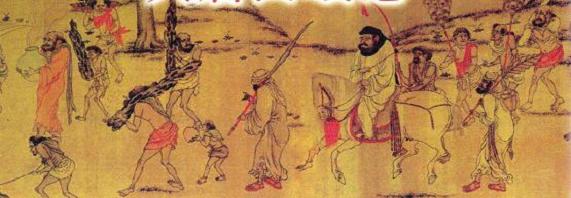
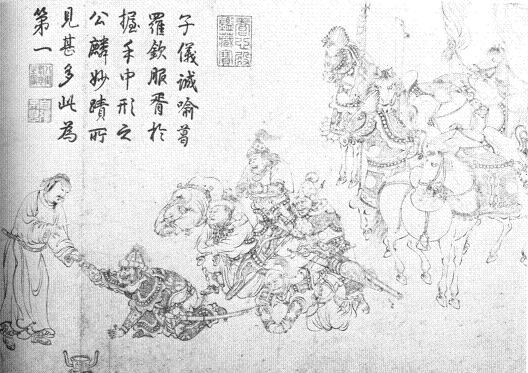
|
Below maps were added to the http://www.imperialchina.org/Barbarians.htm which was embedded within the
http://www.imperialchina.org/Huns.html and
http://www.imperialchina.org/Turks_Uygurs.html
pages.
On basis of the new archaeological findings and historical Chinese records, this webmaster will tentatively speculate on when the east met with the west.
First this webmaster wants to debunk the fallacies in regards to the equation of the ancient Yu-shi tribe to the Yuezhi, and the speculation on the jade trade that the Yuezhi was falsely accredited with.
The forged Guan Zi [管子] statement contained a reference which was a misnomer related to the 'Yu-shi' tribe, a term that was erroneously speculated by a few annotators in history, as well as scholar Wang Guowei of the early 20th century,
to be the same as Yuezhi per soundex.
Guo Yu, a political discourse book that was similar to Zhan Guo Ce, could be merely Han dynasty Confucian compilings, while Guan Zi, i.e., the fabled Legalist founding master, was at most a political economy book written in the late Western Han dynasty or at the turn of B.C. and A.D.
See Barbarians.htm for more discussion on the forged statements in Guan Zi [管子] (which historian Ma Feibai pierced sentence by sentence).
Around the Xin (New) Dynasty (AD 6-23), there occurred
a forgery movement by the Chinese scholars, possibly with the intention of substantiating the mandate of the usurper Wang Mang's dynasty.
The classics which were proved to be forgeries
include "Guan Zi [管子]", which historian Ma Feibai pierced sentence by sentence.
Using Ma's same logic, this webmaster had found the two other books, "Yi-zhou-shu" [逸周书] or "Zhou-shu" (Zhou Dynasty [11th cen. B.C. - 256 B.C.] [abbrev. 周书] book,
not the Zhou-shu [周书] from Posterior Zhou Dynasty of the South-North Dynasty time period of AD 557-581) and "Shang[1]-shu" [商书] (Shang Dynasty [16-11th cent. B.C.] book, not Shang[4]-shu [尚书], i.e., the remotely ancient book which was said to be abridged by Zuo Qiuming [Zuoqiu Ming]),
to be written in the exact same style and could be forgeries by possibly the same person[s].
Discarding the forgery of Guan Zi [管子] basically eliminated the whole foundation upon which the existence of the Yuezhi and the jade trade was built,
a fallacy which was widely cited in
the most recent 10-20 years, i.e., the 1990s and 2000s, to the effect that the fabricated Yuezhi had lived close to the heartland of China, playing the role of bearing the Aryan civilization to China.
Another school of thought, which was intended to discredit the Yellow Civilization, would be the false claim that the Sinitic Civilization "began in 3000 B.C. at Liangzhu", namely, the Yangtze River estuary --which was a taken-out-of-context judgment on the new findings from the multiple Neolithic sites and their age from across China.
Still another school would be the claim that the Shang Chinese were the ancient Koreans.
(A recent writing on the ancient forgeries at the imperialchina.org blog, which was not in the sense of political correctness till the later Western Han Dynasty, is available in pdf format: ImperialChinaOrg-on-forgeries.pdf.)
 This webmaster never thought the people of the Central Asia or in Chinese Turkestan were an intermediary form of human evolution,
which was the basis of calling the Siberian origin of the Koreans a 'moo' point.
This webmaster had pointed out that in the collective memory of the Sino-Tibetans, that passed down by generations through millennia,
the Sinitic Chinese had forgot that they had travelled north from today's Burma-Vietnam while claiming to have walked down Mt Kunlun.
Previously, this webmaster checked into the historical context as well as the geo situation to find out about when the east met with the west,
and believed that the 3rd century B.C.E. Hun-Yuezhi War could be the start of the contact between Sinitic China and the West, i.e., the trigger that led to the chain reaction of the Yuezhi attacking the Wusun, and the Wusun attacking the Scythians, and so on.
With the new archeological findings, this webmaster would add that about 5000 years ago, the proto-Tibetan Qiangs had indeed penetrated into Chinese Turkestan,
to the north side of Mt Tianshan, from perhaps the southeastern rim of the Taklamakan Desert, 2000 years ahead of the Hun-Yuezhi War.
This webmaster never thought the people of the Central Asia or in Chinese Turkestan were an intermediary form of human evolution,
which was the basis of calling the Siberian origin of the Koreans a 'moo' point.
This webmaster had pointed out that in the collective memory of the Sino-Tibetans, that passed down by generations through millennia,
the Sinitic Chinese had forgot that they had travelled north from today's Burma-Vietnam while claiming to have walked down Mt Kunlun.
Previously, this webmaster checked into the historical context as well as the geo situation to find out about when the east met with the west,
and believed that the 3rd century B.C.E. Hun-Yuezhi War could be the start of the contact between Sinitic China and the West, i.e., the trigger that led to the chain reaction of the Yuezhi attacking the Wusun, and the Wusun attacking the Scythians, and so on.
With the new archeological findings, this webmaster would add that about 5000 years ago, the proto-Tibetan Qiangs had indeed penetrated into Chinese Turkestan,
to the north side of Mt Tianshan, from perhaps the southeastern rim of the Taklamakan Desert, 2000 years ahead of the Hun-Yuezhi War.
Now, this webmaster made a hypothetical claim here that the Huns could have encountered the Yuezhi at the "Great Lake" ("da ze"), namely, the Juyan Lake.
In the Juyan-ze Lake area, the bamboo strips (slips) were discovered, with evidence of the existence of names of the [famed] nine Zhaowu clans, 80 years or 3-4 generations after the first Hunnic attack against the Yuezhi: K'ang (Samarkand), An (Bukhara), Shih (Tashkent, i.e., Kishsh [Kashana]), Mi (Maymurgh [Penjikent]), Ts'ao (Kaputana), Ho (Kushanik [Kusanya]),
Mu (Murv, ? Huoxun [Khwarezmia]), and Su (Sudi, Bilinmemektedir). Here, the likely event was that the nine clans invaded Central Asia, where they mutated their [possibly Sinitic] names to the multiple-syllable statelet names, before the descendants of the nine clans returned to the east in the subsequent half millennium.
See Wang Guowei's theory of invaders coming from the East while traders from the West for understanding the nature of the nine Zhaowu clans of the Yuezhi.
Note the difference of one year in the chronicling, as seen across the history writings on the Han dynasty, which was the result of the wholesale misunderstanding of the Qin Empire's Zhuanxu-li calendar and the virtual Yin-li (Shang dynasty) calendar, something covered in this webmaster's book The Sinitic Civilization.
All history books had error in the Han dynasty's reign years, including the Hunnic chronicling years.
The Huns’ military activities could have happened any time between 209 B.C. and 202 B.C.
Nicola Di Cosmo (Ancient China and its Enemies: The Rise of Nomadic Power in East Asian
History, Cambridge University Press (2002)) claimed that the attacks of Donghu and Yuezhi happened in
208 B.C. and 203 B.C, respectively.
Thomas Barfield (The Perilous Frontier,
Cambridge, MA: Basil Blackwell (1989)) stated that the Han founder-emperor's October-November 201 B.C. Baideng
debacle happened in year 200 B.C., not knowing that the early Han emperors' reign years started in
October of a prior year and ended in September of the consecutive year.
Professor Gernet hedged himself in pinning the Hunnic-Han War, namely, Emperor Liu Bang's defeat at the Baideng mountain, to the period "201-200 B.C.", which should be November 201 B.C. when strictly observing the Zhuanxu-li calendar's ordinal months.
Click on the below picture for the enlarged map showing the first Hunnic attack at the Yuezhi possibly around the ancient Juyan Lake
(later known as the
Kharakhoto [Blackwater] Lake, Ejina or Juyan - before this 'West Sea' concept was applied to today's Qinghai-hu Lake by the usurper-emperor Wang Mang when he set up the Xi-hai-jun commandary using the imaginary four-seas' concept in Shan Hai Jing (The Legends of Mountains & Seas).
The reason that this webmaster made this hypothesis is that the Huns were more subsequently recorded to have fought another war against the Wusun, Loulan, Hujie and etc., i.e., the twenty-six statelets of Chinese Turkestan, at the place somewhere near Yiwu in the 2nd century B.C.,
to the east of Turpan, which then triggered the Wusun migration to Ili where they further drove the Yuezhi towards
today's Afghanistan.
(See Barbarians.htm for more discussions on the Yuezhi migration timeline.)
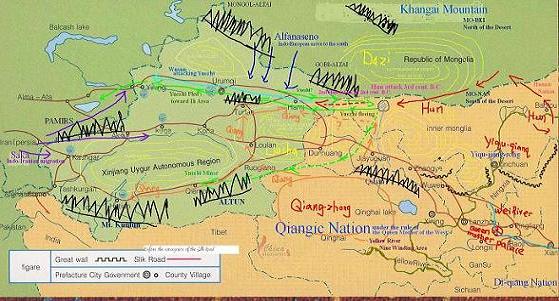
|
|
|
|
|
|
|
Sovereigns & Thearchs;
Xia-Shang-Zhou dynasties;
Zhou dynasty's vassalage lords;
Lu Principality lords;
Han dynasty's reign years
(Sexagenary year conversion table-2698B.C.-A.D.2018; 247B.C.-A.D.85)
|
|
The Sinitic Civilization - Book I is
available now at
iUniverse,
Barnes & Noble,
Amazon,
Google Play|Books
and
Nook.
The Sinitic Civilization - Book II is available at
iUniverse,
Amazon and Barnes & Noble.
Check out the 2nd edition preface that had an overview of the epact adjustment of the quarter remainder calendars of the Qin and Han dynasties, and the 3rd edition introductory that had an overview of Sinitic China's divinatory history of 8000 years.
The 2nd edition, which realigned the Han dynasty's reign years strictly observing the Zhuanxu-li calendar of October of a prior lunar year to September of the following lunar year, also cleared this webmaster's blind spot on the authenticity of the Qinghua University's Xi Nian bamboo slips as far as Zhou King Xiewang's 21 years of co-existence with Zhou King Pingwang was concerned, a handicap due to sticking to Wang Guowei's Gu Ben Bamboo Annals and ignoring the records in Kong Yingda's Zheng Yi.
Stayed tuned for Book III that is to cover the years of A.D. 86-1279, i.e., the Mongol conquest of China, that caused a loss of 80% of China's population and broke the Sinitic nation's spine.
Preview of annalistic histories of the Sui and Tang dynasties, the
Five Dynasties, and the two Soong dynasties
could be seen in
From the Khitans to the Jurchens & Mongols: A History of Barbarians in Triangle Wars and Quartet Conflicts
(The Barbarians' Tetralogy - Book III: available at iUniverse;
Google;
Amazon;
B&N).
(A final update of the civilization series, that is scheduled for October 2022, would put back the table of the Lu Principality ruling lords' reign years, that was inadvertently dropped from Book I during the 2nd update.)
|
|
Book II - Table of Contents:
Section Seven: The Han Dynasty
Relationship with the Huns 392
Chapter XXXIII: The Hunnic Empire 409
Origin of the Huns 409
The Rong & Di Barbarians in the Context of Relation to the Fiery Thearch, the San-miao Exiles and the last Xia Dynasty King 413
The Zhou, Qin and Jinn's Zigzag Wars with the Barbarians & the Construction of the Great Walls 417
Mote's Hun Empire, the Yuezhi People, and the Early Han Dynasty 424
The Huns & the Eastern Hu Barbarians 430
The Hunnic Government Structure & the Dragon Reverence 431
Chapter XXXIV: The Han Dynasty's Wars with the Huns 435
Chapter XXXVI: The Western Expedition, The Kunlun Mountain & Shan Hai Jing 489
Han Emperor Wudi Seeking Elixir from the Immortals on the Kunlun Mountain 491
Credible Geography Book on the Mountains Possibly Expanded to Include the Legendary Kunlun Mountain 493
Unearthly Things in the Mountains' Component of The Legends of Mountains & Seas 501
The Divination Nature and Age of the Seas' Component of The Legends of Mountains & Seas 506
Chapter XXXVII: Shan Hai Jing & The Ancient Divination 520
Chapter XL: The Latter Han Dynasty's Chronological History 560
The Relation with the Southern Huns 561
|
|
On the modern map, there was a tiny sand bridge between Chinese Turkistan and China, which was the narrow strip of desert sand to the east of Hami.
However, this corridor, today's Kumul line, could be a recent event.
There was the historical Da-qi4 blackhole desert to the east, nowadays called by the generic name GOBI. Specifically, near today's Hohhot, there was an ancient Chinese geological name called "qi4 kou", namely, the entry point into the Da-qi4 Desert.
The ancient Sino-Tibetan migration into the Tianshan Mountain could have come north from south, i.e., the Tibetan Plateau/Ruoqiang direction to the south --though this webmaster hesitated about the
passibility of the "Liu-sha" [quick sand] desert between Ruoqiang and Loulan (Lop Nur), which was another tiny sand bridge noticeable on the modern map.
Judging from Han Dynasty emissary Zhang Qian's change of mind on his return trip to go home along the Hami strip rather than going straight east across the Qiang-zhong [i.e., the middle Qiang nation land], we could tell that the northern strip was perhaps the most traveler-friendly.
(Could Zhang Qian had changed his mind in the hope of sneaking into the Hunnic territory to see the child he had with a Hunnic woman?)
That was Han Emperor Wudi (commonly-taken wrong reign 140-87 B.C. or 140-86 B.C.; nominal Oct 141-Dec 87 B.C.; actual Jan 141-Feb 87 B.C.)'s reign of B.C. 141-87, i.e., 141 BC and later, much later than Hun-Yuezhi wars.
Now, let's talk about the human migration.
There were widespread discussions of the 'Caucasoid' mummies in Chinese Turkestan, with the 'Loulan Beaty' purportedly dated 2000 B.C., while the southern 'cousins' in the Khotan area dated 100-300 B.C.
The timeline suggested a move from north to south, not west to east.
The 2000 B.C. Caucasoid mummies found in Loulan, in the Turpan Depression/Kumtag Desert, in-between Altaic/Tianshan Mountains and the Altun Mountain (Ruoqiang), could be the Indo-European people coming from the north of the Altaic Mountain [the Mongol Altaic Mountain of today], near the Alfaniesevo (Alfanesevo) bronze culture.
Though, Yuezhi might not be of this group of people coming from north.
Further diggings in the Loulan area, i.e., the ancient Salty Lake and Salty River (Peacock Rover), led to a site called by Xiaohe or the Little River, next to the Salty River (Peacock Rover), where the Mongoloid Mummies were discovered.
It appears to this webmaster that there was indeed good carbon dating on the Xiaohe excavation, which stated that "The entire necropolis can be divided, based on the archeological materials, into earlier and later layers. Radiocarbon measurement (14C) dates the lowest layer of occupation to around 3980 +/1 40 BP (personal communications; calibrated and measured by Wu Xiaohong, Head of the Laboratory of Accelerator Mass Spectrometry, Peking University), which is older than that of the Gumugou cemetery (dated to 3800)." The article claimed that the 'Mongoloid' mtDNA had similarity to some present South Siberian population. (For details, check http://www.biomedcentral.com/1741-7007/8/15 for the full article "Evidence that a West-East admixed population lived in the Tarim Basin as early as the early Bronze Age".)
The linking of this certain mtDNA in the Xiaohe/Loulan area to a modern Siberian population could be said to be circumvential at best since a lot of things might had happened in the past 4000 years.
That is, the linkage to the Siberian population could be actually an effect, not a source.
This area kind of had the same timing as the Mongoloid mummies that were discovered to the north and east of the Tianshan Mountain.
More than what was found about the mtDNA at Xiaohe/Loulan, there were mummies of the Khams-Tibetan type found to the further north,
in the Tianshan-Altaic mountain areas, which presented a much more convincing point that the proto-Tibetan Qiangs, from the south, had indeed crossed over the strip of the sand desert near Loulan to reach the north side of Tianshan.
Possibly, the Khams [proto-]Tibetan, after reaching the Tianshan Mountain Range, moved towards Hami (Qumul) to the east, where there were the Hami (Qumul) Mongoloid mummies excavated.
Note that today's Kham Tibetans were not far away from the historical Sanxingdui (three star) Excavations in western Sichuan, that was discovered by Gaway Hann (an American professor of the former Hua-xi [west China] University),
a Neolithic/Bronze culture dating from about 4800 to 2800 years ago, as well as a bridge providing Southwest China's tin to the Shang dynasty
and the Zhou dynasty.
This webmaster's reasoning was that the Qiangs had a dominance in the area since China's prehistory, like 5000 years ago, at least the time of the Yellow Emperor [Huangdi (? BC 2697 - 2599; reign 2402-2303 with rule of 100 years per Zhu Yongtang's adjustment of
The Bamboo Annals], and they controlled the southern rim, southeastern rim and eastern rim of the Taklamakan Desert, and somehow around 2000 B.C., penetrated northward to reach the two sides of the Tianshan mountain range, while the so-called Caucasoid oases in their path, namely, the Loulan area, might have risen and fallen numerous times in history -- if they ever existed there prior to the penetration by the Khams [proto-]Tibetans.
Or the other way around, the Khams [proto-]Tibetans could be speculated to have penetrated to the two sides of the Tianshan mountain range earlier than the Indo-Europeans, and subsequently encountered the Indo-Europeans near the Tianshan Mountain, and ultimately the Indo-Europeans gradually dominated over the area and eliminated the trace of the Khams [proto-]Tibetans, pressing them back to the southeastern rim of the Taklamakan Desert.
(See Barbarians.htm for more discussions on the ancient human migrations.)
There could have been a striking similarity between the Mongol attack at the Tanguts in the 13th cent. A.D. and the Hun attack at the Yuezhi in the 3rd cent. B.C.
Both took the desert road towards the Blackwater Lake.
It kind of gives you a picture how the Huns first raided to the west against the Yuezhi, forcing the Yuezhi Major to flee west while the elderly and the children, i.e., the Yuezhi Minor,
crossed the Qilian mountain to seek asylum with the Qiangs, and per Yu Taishan, continued to move on towards the southeastern rim of the Taklamakan Desert,
towards
Khotan where the people were recorded to be Chinese or Hua-xia-looking, throughout China's Han and Tang dynastic records, till annihilated sometime during the Islamic invasion of the
Buddhist stronghold of Khotan or possibly during the earlier Turkic-Uygur conquest of the Chinese Turkistan.
Note the discovery of the so-called 100-300 BC Caucasoid in Khotan, which matched with the escape timeframe of the Yuezhi Minor.
(Another recent writing on Zhou King Muwang's travelogue at the imperialchina.org blog, is available in pdf format [Mu-tian-zi.pdf], exhibited the westernmost extent of the ancient Chinese kingdom to be no more than the edge of the Kumtag Desert and right at the Black Water Lake.)
This webmaster tried to reconcile Sima Qian's statement in regards to the migration of the Lesser Yuezhi,
in the aftermath of the Huns' attack in the last years of the 3rd century BCE,
to give the Yuezhi people some credit of living a bit further to the east, i.e.,
staying somewhere near the Blackwater Lake [i.e., the Ejina Lake].
By making this assumption, this webmaster assumed that the Lesser Yuezhi people, namely, the sick, the elderly and the young,
climbed the Qilian-shan Mountain [today's Qilian-shan, not what Yu Taishan et al had postulated to be the Tianshan
or the Heavenly Mountain Range in Turkestan] to live among the Qiangs
--unless Sima Qian actually meant that the Huns had raided deep into the Chinese Turkestan in the first place,
driving the Greater Yuezhi into a flee towards the Ili area to the west and the Lesser Yuezhi into a move across today's Tianshan
or the Heavenly Mountain Range to live with the Qiangs in Khotan, at the southeastern rim of the Taklamakan Desert,
a historical dwelling place of the Qiangs since the late 3rd millennium BCE.
In conclusion, there were two points of contact between the west and the east, one time around the 2000 BCE, and another time in the 4th century BCE (or more exactly the 3rd century BC when the Huns attacked the Yuezhi, triggering the chain reaction to the west).
The demarcation point of the 4th century BCE or the 3rd century BCE was important in determining the second point of contact between the Mongoloid and the Caucasoid,
after the first Mongoloid-Caucasoid mummy contact around 2000 BCE near today's
Tianshan or the Heavenly Mountain, known as Bei-shan or the Northern [Turkestan] Mountain at Han Emperor Wudi (commonly-taken wrong reign 140-87 B.C. or 140-86 B.C.; nominal Oct 141-Dec 87 B.C.; actual Jan 141-Feb 87 B.C.)'s timeframe.
There were widespread discussions of the 'Caucasoid' mummies in Chinese Turkestan, with the 'Loulan Beaty' purportedly dated 2000 B.C., while the southern 'cousins' in the Khotan area dated 100-300 B.C.
The timeline suggested a move from north to south, not west to east.
The 2000 B.C. Caucasoid mummies found in Loulan, in the Turpan Depression/Kumtag Desert, in-between Altaic/Tianshan Mountains and the Altun Mountain (Ruoqiang), could be the Indo-European people coming from the north of the Altaic Mountain [the Mongol Altaic Mountain of today], near the Alfaniesevo (Alfanesevo) bronze culture.
Archaeologically speaking,
the admixture mummies in Chinese Turkestan pointed to the west-east interbreeding around 2000 B.C., after an interruption of contacts for like 6,000 years, as seen in the spread of the North China microlithic stone tools to the west about 10,000 years ago, including today's Chinese Turkestan, and its replacement of the European Paleolithic bladelet tools. About 3500-2500 B.C., the proto-Indo-Europeans, with the haplogroup R1b-M269, arrived at Minusinsk where they founded the Afanasevo chalcolithic culture and bronze culture (3200-2000 B.C.). People of the Afanasevo culture spread southward to today's Chinese Turkestan with the patented grey sand-textured (coarse) round-bottom pottery jars with engraved and embossed patterns.
Direction-wise, the Q-haplogroup people, i.e., cousins of the Caucasoid R-haplogroup people, likely arrived in today's Siberia heartland before the Last Glacial Maximum, while within the last 10,000 years, the C-haplogroup people pushed west and south from the northeastern direction and the N-haplogroup people pushed west and north from the southeastern direction. The patented Sinitic gourd-shaped colored and red potteries with a beam neck were seen to have penetrated to Central Asia. It could be the O3-haplogroup ancient Qiangs who brought the Sinitic colored (painted) potteries to today's Chinese Turkestan in late 3rd millennium and the early 2nd millennium B.C. While the millet and sorghum (as seen in the Begash site in Kazakhstan) could have spread westward to Central Asia with the colored potteries, the wheat products, sheep and goats, and the spoke-wheeled carts might have spread to China through this east-west contact along the two sides of the Tianshan Mountain.
The 'Tokharai' Yuezhi people, however, might not be the misnomer Indo-European as they could be part of the
barbarians whom Zhou King Muwang resettled at the origin of the Jing-shui River in the 11th century
B.C., among them, the later known five Rong groups of Yiqu, Yuzhi, Wuzhi, Xuyan (Quyan) and
Penglu, or the later Yiqu-rong barbarians as noted in the Warring States time period --which could
be the origin for the misnomer 'Indo-European' Yuezhi. The recent DNA analysis of the remains of
the ancient tombs had found the trace of the Q-haplogroup people at Pengyang of Ningxia, next to the
Western Yellow River Bend, and along the routes that the Yuezhi people had dwelled.
According to the recent DNA studies, before the emergence of the Indo-Europeans, the proto-Indo-Europeans, who had origin in southwestern Siberia approximately 38,000 years ago, relocated to the Volga area about 28200-22800 years ago, where they split into R1a (i.e., ancestors of modern Eastern Europeans, Indians) and R1b (i.e., ancestors of Basques, Celts and modern Western Europeans).
The Scythians, or the purportedly Indo-European 'Tokharai' Yuezhi, and majority stocks of the later Central Asians, belonged to the R1a offshoot.
There was the spread of North China's microlithic stone tools towards the west over 10,000 years ago.
The 6000-year-old Lingjiatan piglet-bird-head jade octagram could imply an ancient transfusion of the 10,000-year-old double-head emblem to Central Asia from China.
It would not be farfetched to state that the Sumerian cuneiform's speedy transformation to logophonetic, consonantal alphabetic and syllabic signs among different groups of the Central Asia and Middle Eastern people could imply the Sumerian script's likely origin as an out-of-area and imported product from let's say North China.
Here, with the existence of the obscure pre-2000 B.C copper-based metallurgy in northern China, such as the controversial brass pieces of the fourth and third millennium B.C., there was no rebutting the spread of ancient metallurgy technology to China from the west.
A tentative conclusion could be made in that the ancient world(s) did have some unknown form of discrete, disparate and non-continuous links between the East and West. However, this kind of East-West links were disrupted numerous times, with the consequence of loss of such links amounting to thousands of years in-between, as seen in the westward spread of the microlithic tools, the octagram, the double-head eagle emblem, the pictographic characters, and the red potteries.
http://www.sino-platonic.org/complete/spp115_chinese_proto_indo_european.pdf provides another perspective of looking at things of the past from the perspective of language cognates. Rather believing that the Indo-Europeans ever invaded China and gave the Sinitic people the language, we could actually deduce that "Old Chinese", for its 43% correlation with the Proto-North-Caucasian, rather 23% with the Proto-Indo-European, was the source for both the cognates of the Proto-North-Caucasian and the Proto-Indo-European. This is because our cousins, i.e., the N haplogroup people, relocated to North Asia and then to Latvia, Estonia, Finland and Scandinavia, bringing along the Sinitic language to the Proto-North-Caucasian who in turn gave it to the Proto-Indo-European.
Linguistically, the proto-Caucasian should fall under the umbrella of the Dene-Caucasian (Sino-Caucasian) Language Family that encompassed the [Proto-North-]Caucasian, Yeniseian and Sino-Tibetan languages.
In 2012, Li Hongjie of Jirin University published a paleogenetic study of the ancient DNA of prehistoric people dwelling in northeastern China, northern China, and northwestern China, with the results showing that the predominant population in Niuheliang of southwestern Manchuria, Dadianzi of Inner Mongolia and Hami of northeastern Chinese Turkestan over 3000-5000 years ago, that roughly matched with the Xiajiadian Culture and Hongshan Culture's timeframe, belonged to the Y-chromosome people of the N-haplogroup type, namely, people related to ancestors of the Finnish, Sami and Hungarian people. And it would be about 2000-4000 years ago that the R-haplogroup and Q-haplogroup people began to be seen in Chinese Turkestan and northwestern China. Following this timeline, it is more plausible that people of the Xia and Shang dynasties of ancient China had the company of the N-haplogroup people, with both the Sinitic O-haplogroup and the N-haplogroup people actually sharing the same origin for over 20,000 years, and the Zhou people could be interfacing with the Q-haplogroup people towards the northwest, which implied that the northern barbarians or the Huns' composition could have changed through history. The Huns, for their position and timeline of appearance, more likely belonged to the Q-haplogroup people than the N-haplogroup people, with both groups plus the ancient Sinitic Chinese likely falling under the same proto-Borean (Northern) language family.
This webmaster, possessing the amber-colored or hazel eyes with a greenish ring, had been found to possess about 15% ancient Euro-Asian hunters' gene, specifically, N1a (N-M96 (N-CTS7095, N-P189), a branch of the Finno-Ugrian people.
It would be in the 4th century BCE that Shi-zi first wrote down the sentence speculating that 2000 years earlier, at the time of the
Yellow Overlord, there were the deep-eyesocket people living to the north.
This brilliant piece of work by Shi-zi apparently adopted some then-current information available as of the 4th century BCE, in a similar fashion to
the later forgery Guan Zi which, relying on the then-current information available as of the 1st century AD, claimed that
Qi Hegemony Lord Huan'gong had crossed the 'Kumtag Desert' to conquer the Yu-shi [or misnomer Yuezhi] people.
Here, mark this webmaster's words: Yu-shi, having absolutely nothing to do with the Yue-zhi people [as erudite Wang Guowei claimed --a No. 1 blunder of the most famous Chinese scholar of the 20th century], could be taken as either the western Yu [Wu] or the northern Yu [Wu] remnants from the descendant of one of the two elder brothers who 'emigrated' to the Yangtze River and the Taihu Lake 3000 years ago.
(Shi-zi could be a latter-day add-on as well since half of the original texts were lost in the Three Kingdom time period, and the majority of the re-compiled texts were lost again in the Soong Dynasty. One important fact about Shi-zi that this webmaster wants to emphasize is that it could be on the same par as the classics Shan Hai Jing, i.e., the Book of Mountains and Seas, and the author or the authors of some of the contents of the two books of Shi Zi and Shan Hai Jing could be of the same origin.
Note that the seas or overseas' components of Shan Hai Jing, i.e., The Legends Mountain and Sea Legends, though carrying the names of countries like in today's Korea, Chinese Turkestan and India, etc., were not about geography at all but divination. The divination materials, similar to those in Shi1 Fa, Gui-cang Yi, the Wangjiatai divination script, and the divination in Mu-tian-zi Zhuan, served the same augury purpose of the late Warring States time period, albeit possessing their separate freelance or freewheeling traits.
For example,
The one eyed son of Lord Shaohao in the "great northern wilderness" (Da Huang Bei Jing) section of Shan Hai Jing, like the one-hand and one-eye 'shen-mu-guo' (the deep eye socket) state in the "Northern Outer Seas" section, which was speculated to be the legendary one-eyed state Arimaspi that was described by Herodotus in Histories as located north of Scythia and east of Issedones and linked to the three-eye stone statutes of the Okunev Culture in Minusinsk, could have its source in some one-eye bird in the northern mountain range of Shan Hai Jing, and the one-eye and three-tail 'huan' foxlike animal on Mt. Yiwang-zhi-shan in the western mountain range.)
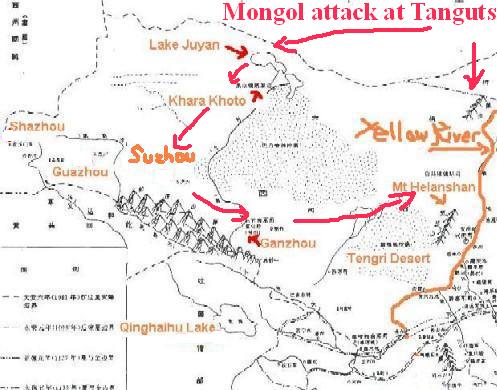
|
|
For further details, check into this webmaster's "Extrapolation of prehistoric people using the mitochondrial and nuclear DNA analysis, as well as cranial analysis, on the ancient remains extracted from the archaeological sites" on basis of the Jirin University DNA analysis.)
The History of the Ye-tai (White Huns) & Their Relationship To the Yuezhi:
The Hephthalites (or the Ephthalites or Epthalites or Hunas or White Huns
or Hayathelites or Ye-tai) crossed (A.D. 425) the Syr Darya (Jaxartes) River
and invaded Persia, conquered Kabul's Kushans (founded in c. A.D. 50 by Kujula
Kadphises who united the five Yüeh-chih tribes and established the Kushan Empire
stretching from Persia to Transoxiana to Tarim Basin to the Ganges in Upper Indus).
The Yüeh-chih had migrated southwest in 141-128 B.C. to the Oxus Valley, i.e., the modern
Amu Darya, after being defeated by the Huns in 174-161 BC. Under the attacks of Wusun Statelet, they moved on to take over the Bactria (called Daxia in Chinese), which is renamed Tocharistan. Around that time, the Scythians (called the 'Sai' people in Chinese), allied with Parthians, had already conquered the Greco-Bactria kingdom by defeating the remaining divided Greeks there. After 135 BC, the Scythians or Sakas and Parthians, known as Pahalavas in India, would enter India under the pressure of the Yüeh-chih. By 75 BC, Scythians took over Punjab, and by 25 BC, Scythians terminated the Greek rule in India.
The Kushans followed the path of the Scythians in entering India, reducing the Sakas to the tributary vassal in the Punjab. Kushans' expansion towards Chinese Turkistan was checked by General Pan Ch'ao in A.D. 90. Kushans allied with Romans in skipping their common enemy in trade, Parthia, by linking China/India to the Roman Empire via the Indian Sea. Emperor Trajan received the Kushan emissary in A.D. 99. The Kushans will be responsible for reviving Buddhism and propagating it across Central Asia and to China.
Hephthalites (White Huns or Ye-tai) crossed the Syr Darya (Jaxartes) River in A.D. 425, invaded Persia, conquered Kabul's Kushans.
In 473-479, the Ye-tai conquered Sogdiana (Samarkand), driving the Kidarites Yüeh-chih to the west. (Modern Tadjiks were said to be descendants of the Yüeh-chih.)
After the Ye-tai conquered Bactria, they settled down in Afghanistan. They first invaded India in A.D. 455 but were defeated by the Gupta forces under Skandagupta. They invaded India again in 464. In A.D. 465-470, they conquered Gandhara, setting up a Tegin (a viceroy). In India, they temporarily overthrew the Gupta empire but were eventually defeated in A.D. 528 by a Hindu coalition. Though they were defeated by the Hindus and had to seek refuge in Kashmir in A.D. 528, their damages to the Gupta empire and Buddhism were irremediable. The Gupta Empire of India ended in A.D. 535. While the White Huns in Central Asia were broken by the Turks and disappeared, their Indian members settled down and became absorbed into Hindu society.
In the east, the Ye-tai conquered Khotan and Kashgar, and in A.D. 493-508 extended influence as far as Zungaria (Dzungaria), then Turfan [?] and Karashar [?].
Chinese historians disapproved the claim of Ye-tai expansion into Chinese Turkistan. This webmaster will come back to this topic another time.
Between 507 and 531, the Ye-tai, under king named Ye-dai-yi-li-tuo, sent
thirteen emissaries to Tuoba's Northern Wei (A.D. 439-534). Approximately
AD 522, the Ye-tai dominated north and south of the Tien Shan range,
controlling as far as Tieh-lo in the south, Gaoche (Kao-ch`e^) in the north,
to Khotan in the east, and up to Persia in the west.
Based in today's Pakistan, the Ye-tai had once controlled forty
countries in the whole Asia Minor area.
History Of the Northern Dynasties mentioned that the Ye-tai people lived to the south of the Altai Mountains and to the west of the ancient Yu-Tian Statelet. (Yu-Tian Statelet was recorded to be the only statelet in the west where the people looked similar to the Chinese.)
About 30 statelets, including Kang-ju, Shu-le and Yu-tian, submitted to the Ye-tai rule. The Ye-tai had inter-marriage with the Ruruans. From A.D. 455 onward, Ye-tai sent emissaries to Tuoba Wei Dynasty, and in A.D. 553 to Western Tuoba Wei Dynasty.
They visited southern China as well. On Southern Liang Dynasty [A.D. 502-557] tribute pictorial, i.e., Liang chih-kung-t'u, "Hua-guo" statelet was on number one spot.
In A.D. 558, they paid tribute to Northern Zhou, but later they were defeated by the Turks. Around A.D. 610s, Ye-tai sent emissary to Sui Dynasty.
History Of the Tuoba Wei Dynasty said that the White Huns or Ye-tai people were a branch of the Yüeh-chih. History of the Jinn Dynasty also mentioned that Ye-tai was just a family name of Yüeh-chih people. History Of the Northern Dynasties also mentioned that the Ye-tai people could be either of the same origin as Yüeh-chih or they could be of the same family as the ancient Gaoche Statelet.
The timing of the Hun migration to Europe in A.D. 370 and the White Hun in A.D. 440 to Transoxiana,
Bactria, Khurasan, and eastern Persia is pretty close; however, the directions
of movement are not the same. "There is no definite evidence that they
(i.e., White Huns) are related to the Huns. .."
According to Chinese records, this group of people were called "Ye-tai" who lost the wars to the Turks. History Of the Tuoba Wei Dynasty also mentioned the existence of Turkic tents in the 4th century, much earlier than the Turkic rebellion against the Ruruans. The Ye-tai people were first mentioned by the Chinese,
who described them (A.D. 125) as living in Dzungaria.
There are quite some confusions
here about the Ephthalites or Ye-tai. Procopius, a Greek, wrote that they
had "white bodies and countenances which are not ugly", but
'short and ugly in their features' according to the Chinese pilgrim Xuanzang,
remarks made while seeing a small settlement of 'White Huns' by Kunduz
in the Hindu Kush in A.D. 644 A.D. They were said to have originally
lived in Dzungaria in A.D. 125, and because of the pressure from the Ruruan
(Juan-juan), moved south from the Altai region to occupy Transoxiana, Bactria,
Khurasan, and eastern Persia in A.D. 440. According to http://www.silk-road.com/heph.htm,
"they probably stemmed from a combination of the Tarim basin people and
the Yüeh-chih. There is a striking resemblance in the deformed
heads of the early Yüeh-chih and Hephthalite kings on their coinage."
But according to http://www.best.com/~heli/wargame/variant/maharaja/eph.txt,
"Iranian customs also are common in the Ephthalite world. For example,
the practice of several husbands to one wife, or polyandry, was always
the rule, ... Tellingly, polyandry has never been associated
with any Hun tribe, but is known of several Central Asian ones, including
the Aryans in India, other Indo-Europeans and probably in prehistoric Iran."
Lack of written records from
the Asia Minor, Caucasus and Volga areas has led to the above historical
confusion in regards to the Ruruan Avars and the Hephthalite Avars.
Some recounts of the above events are intended to alert the readers about
the riddles of Central Asia which will now be complicated further by the
introduction of Takla Makan mummies. The Avars would be there
to stay. The Avars, together with Persians, attacked Byzantium
in A.D. 626. Charlemagne the Great would face the Avars and the
Slavs for control of Carinthia and Bohemia in the late 8th century.
Turks Of Afghanistan & the Hindus:
Turks were not the first Moslems to invade India. Before the Turks converted to Islam, their ancestors were in fact believers of Buddhism. It is a bit ironic to see the later Turks dealing a devastating blow to Buddhism. Arabs of the Umayyad caliphate first invaded India in A.D. 711 and captured Sind. But the Arabs stopped here and were satisfied with exacting a poll tax in exchange for allowing the Indians to have their own religion. But the Turks turned out to be some people who would turn India upside down. The Turks, with almost heroic episodes of slaves turning into kings, as in the case of their first rebellion against the Ruruans and the later Egyptian Mamluks' wrestling Damascus from the Mongols, would produce several figures of similar background in its warfare against India. The Turks of Ghazni in Kabul, Afghanistan would have a slave, called Sabuktegin, as their king. In A.D. 989 and 991, respectively, he raided into the Indus, and his successor, Mahmud of Ghazni, waged 17 wars against India between A.D. 997 and 1030, and he annexed Punjab. After the Ghazni, the Ghoris, a mountain Turkic principality in Western Afghanistan, would succeed the Ghaznavids in conquering India under Muhammad Ghori. Ghori's slave, Kutbu-d-din Aibak, was appointed as a general and this person slaughtered all monks and destroyed monasteries in A.D. 1199. Hindu Kush, in fact, meant for the 'Blood of the Indians'. In A.D. 1200, Aibak invaded Bengal and the Rajput principalities in northern India all ended. An internal rebellion, which killed Ghori, made Aibak declare to be the sultan of the slave dynasty in Delhi in A.D. 1206. The Delhi dynasties continued three dynasties, Slave, Khilji and Tughlak, till A.D. 1388. In between, the Genghis Khan Mongols once pursued the son of Kharism sultan to the Punjab in A.D. 1220, and the Turks repelled Mongol invasion from 1246 to 1287. Timur would sack Delhi in A.D. 1398. Babur, after losing Fergana Valley, entered Kabul with 300 followers in A.D. 1504, and then invaded Lodi, India in A.D. 1526. The successor, Akbar, would take measures to remove discriminatory policies against the Hindus as well as removed the poll tax. Though those rulers invariably claimed the Mongol or Mugul heritage, their Turkic elements might weigh more than the Mughal.
Western Turks
The concept of 'Turks' in the ancient times is not the same as that of today. This webmaster already mentioned the difference between the words of Turkish, Turkic and Turk. In the discussion on the origin of Turks and Uygurs above, this webmaster had ascribed the term 'Turk' to the most restrictive definition, namely, those early Turks who rebelled against the Ruruans and then split into two parts of Eastern Khanate and
Western Khnanate.
Around A.D. 740s, the Eastern Khnanate Turks, aka the Orkhon Turks under Khan Muchuo (Mo-ch'o), were defeated by the Uygurs and the Karlaks as a purported result of conspiracy by the Tang Chinese.
After this defeat, Chinese history said the Eastern Turks were still paying pilgrimage to Tang Dynasty regularly.
The remaining Orkhon Turks were not heard from after China's Five Dynasties.
Western History books, in order to make a distinction between the Turks and the Mongols, would fallaciously claim
that the Turks were 'finally' expelled in A.D. 924 by the Khitans (i.e., Kitai, to evolve into the name of Cathay for China).
Among the tribes in Genghis Khan's Mongolia of the 13th century, there would be various designations
like Turkic (Kyrgyz, Kerait, Uygur), Mongol (Oirat, Tartar, ) and Turko-Mongol (Naiman, Merkit) --all appearing to this webmaster to be a fallacious way of reading
the origin and development of the steppe people.
(The terminology of Tatar or Da-da, with different pictograph transliteration of Da-da1, Da-da3, Da-dan4 and Ta-tan, etc, originally meant for a group of adversaries living to the east of the Turks in the 5th century, and was seen in the Turks' steles, such as Otuz-Tatar (san-shi-xing [thirty surnames] Da-da2) on the Kul-tigin Stele (A.D. 732) that was known as the Orkhon [river valley] stele inscription, and
Toquz-Tatar (jiu-xing [nine surnames] Da-da2)
on the Bilge Qaghan Stele (A.D. 734).)
Western Turkic Khanate, however, had already been dispersed by the Tang's westward expansion in 651 AD.
After the defeat of Western Khanate, the Tibetans competed with the Tang Chinese for the control of Chinese Turkistan and Central Asia.
Chinese history recorded that altogether ten Western Turkic family names continued existence in Central Asia, and that at one time,
the Tibetans proposed to the Tang Chinese to have a 50-50 division of the ten families.
Remnant Western Turks would be Turkic tribes like the Turgesh and the Karlaks (Qarluk). The Karlaks replaced the Turgesh as a major power in Central Asia.
In A.D. 751, the Tang Chinese army of 30 thousand, led by General Gao Xianzhi (governor-general of the four cities of Chouci-Yutian-Shule-Suiye), were invited by locals to counter the Arab invasion.
However, the Karluks defected to the Arabs. Kao's army were defeated by the alliance of the Arabs and the Karluks.
Kao-hsien-chih barely escaped home alive.
(Gao Xianzhi was spelled Kao-hsien-chih or Ko Son-ji in Korean. Gao was the son of Koguryo General Ko Sagye who was captured by the Tang army during the Chinese expedition against the Korean peninsula and then served Tang Dynasty.)
Hence the Karluks controlled today's western China while the Huihe [Uygurs] controlled Mongolia and the Gobi.
After the Kirghiz (who were conquered by the Huihe [Uygurs] in A.D. 758-760) defeated the Huihu (Uygur) and killed the Huihu khan around A.D. 840s, some Uygur families fled to the Karlaks for protection, while some fled to the Tibetans for asylum.
The Turks would migrate like their predecessors. During the course of the history, this webmaster saw the similar patterns of migration. The Yüeh-chih migrated southwest in 141-128 B.C. to the Oxus Valley after being defeated by the Huns in 174-161 BC, and they pushed out the Scythians. The son of Yüeh-chih was ordered to stay behind and they were referred to as the Yüeh-chih Minor who survived in Western China for hundreds of years. The Scythians went to take over Greco-Bactria kingdom, and they, under the pressure of the Kushan Yueh-chih, entered India after 135 B.C. and finished the last remaining Greeks there. Kushan Yüeh-chih followed the path of the Scythians certainly and they would dominate Central Asia for hundreds of years. Then, Hephthalites (White Huns or Ye-tai) crossed the Syr Darya (Jaxartes) River in A.D. 425, invaded Persia, conquered Kabul's Kushans. After the decline of the Huns, Tuobas took over northern China and pressed the Ruruans westward. The Ruruans, in turn, pressured the Huns (?) into invading Europe in A.D. 370 around. I would stress again that the Ruruans were more Hunnic than those they drove off towards Europe. Turks rebelled against the Ruruans in A.D. 546-553. In Asia Minor, the Turks allied with Sassanian Persians (Chosroes of Persia) in A.D. 565, dividing Ephthalite empire of the White Huns. Some people claimed that the remaining Hephthalites (White Huns) moved west to the Russian steppe to form the Avar Khanate late 6th cent, and some people also claimed that the earlier Ruruans had fled westward to form the Avars. Just bear in mind that the Ruruan (Juan-Juan) chief had fled to the Ephthalites for protection and the kinsmanship between the two could be a factor. (History Of the Tuoba Wei Dynasty said that the White Huns or Ye-tai people were a branch of the Yüeh-chih.) In 576, another group of Turks invaded the Caucasus and established the Khazar Khanate
Western Turkic people, notably the Khazars, Cumans, and Pechenegs, had played important roles in the medieval history of South Russia and Southeastern Europe. The affiliations with the Magyars, Avars, and Székely in Hungary, Ukraine, the Balkans would be too complicated a topic to be included here.
http://www.factmonster.com/ce6/history/A0827540.html pointed out that "Khazars are a group of ancient Turkic people who appeared in Transcaucasia in the 2d cent and subsequently settled in the lower Volga region. Emerging in the 7th cent, the Khazars extended their control, during 8th-10th centuries, from the northern shores of the Black Sea and the Caspian Sea to the Urals and as far westward as Kiev. They conquered the Volga Bulgars and the Crimea, levied tribute from the eastern Slavs, and warred with the Arabs, Persians, and Armenians. In the 8th cent, the Khazar nobility embraced Judaism. The Khazar empire fell when Sviatoslav, duke of Kiev, defeated its army in A.D. 965." The Khazars (or Chazars) are believed by some to have been the ancestors of many East European Jews.
http://www.factmonster.com/ce6/society/A0838008.html continued saying that "Pechenegs or Patzinaks, in the 8th and 9th cent, inhabited the region between the lower Volga and the Urals. Pushed west (c.889) by the Khazars and Cumans, they drove the Magyars before them and settled in southern Ukraine on the banks of the Dnieper. They long harassed Kievan Rus and even threatened (934) Constantinople. After unsuccessfully besieging Kiev (968) and killing the Kievan duke Sviatoslav (972), they were defeated (1036) by Yaroslav and moved to the plains of the lower Danube. Attacked (1064) by the Cumans, many Pechenegs were slain or absorbed. After once more besieging Constantinople (c.1091), they were virtually annihilated by Emperor Alexius I. There were some significant communities of Pechenegs in Hungary today.
Cumans or Kumans, identified with the Kipchaks (or the western branch of the Kipchaks) and known in Russian as Polovtsi, had come from northwestern Asian Russia. They conquered Southern Russia and Walachia in the 11th cent., and for almost two centuries warred intermittently with the Byzantine Empire, Hungary, and Kiev. In the early 12th cent. the main Cuman forces were defeated by the Eastern Slavs. The Mongols decisively defeated the Cumans in A.D. 1245. Some were sold as slaves, and many took refuge in Bulgaria and also in Hungary, where they were gradually assimilated into the Hungarian culture. Others joined the khanate of the Golden Horde (also called the Western Kipchaks)."
In Asia Minor and Anatolia would be the Seljuks and the Osmanli or Ottoman Turks, both members of the Oghuz confederations. http://www.factmonster.com/ce6/society/A0861663.html continued saying that "the Arab annexation of the area of ancient Sogdiana in the 7th cent brought the Oghuz Turks into direct contact with the Abbasid caliphate and later the Persian Empire. The Turks, who embraced the Sunni Muslim faith, began to migrate to the Middle East. At first as mercenaries for the Abbasids, the Turks would become the actual rulers of the empire. At the beginning of the 11th cent, Seljuk Turks, led by Tughril Beg, conquered Khwarazm and Iran. They entered Baghdad in 1055, with Tughril Beg proclaimed sultan. His successor, Alp Arslan, conquered Georgia, Armenia, and much of Asia Minor, overran Syria, and defeated (1071) the Byzantine emperor Romanus IV at Manzikert, opening Byzantium (except for a small area around Constantinople) to Seljuk and Turkmen occupation. After final downfall of the Seljuk empire in 1157, all the Seljuk states were overrun in the 13th cent by Genghis Khan (Jenghiz Khan) and his successors, whose hordes comprised both Mongols and Turks and became generally known as Tatars. After the Mongol wave had receded, the Osmanli Turks, a minor tribe and the last of the Turkish invading people who had been assigned in 13th cent to the border area of the Byzantine Empire by their Seljuk overlords, would complete the overthrow of the Byzantine Empire. Highly disciplined, they would, in the 14th cent, make themselves masters of the ruins of the Seljuk empire in Anatolia. Their historic ruler ... [Suleyman the Magnificent], at one period, ruled from Vienna to the Indian Ocean and from Tunis to the Caucasus. The people of modern Turkey, founded after the collapse of the Ottoman Empire in 1918, are direct descendants of Osmanli Turks. The original Osmanlis had merged at an early stage with the Seljuks, and their descendants mixed extensively with Muslim converts from the Ottoman Empire."
Written by Ah Xiang
|
|
|
|
|
|
|
Sovereigns & Thearchs;
Xia-Shang-Zhou dynasties;
Zhou dynasty's vassalage lords;
Lu Principality lords;
Han dynasty's reign years
(Sexagenary year conversion table-2698B.C.-A.D.2018; 247B.C.-A.D.85)
|
|
The Sinitic Civilization - Book I is
available now on
iUniverse,
Barnes & Noble,
Amazon,
Google Play|Books
and
Nook.
The Sinitic Civilization - Book II is
available at
iUniverse,
Amazon and Barnes & Noble.
Check out the 2nd edition preface that realigned the Han dynasty's reign years strictly observing the Zhuanxu-li calendar of October of a prior lunar year to September of the following lunar year, and the 3rd edition introduction that had an overview of Sinitic China's divinatory history of 8000 years.
The 2nd edition preface had an overview of the epact adjustment of the quarter remainder calendars of the Qin and Han dynasties, and the 3rd edition introduction had an overview of Sinitic China's divinatory history of 8000 years.
The 2nd edition realigned the Han dynasty's reign years strictly observing the Zhuanxu-li calendar of October of a prior lunar year to September of the following lunar year.
Stayed tuned for Book III that is to cover the years of A.D. 86-1279, i.e., the Mongol conquest of China, that caused a loss of 80% of China's population and broke the Sinitic nation's spine.
Preview of annalistic histories of the Sui and Tang dynasties, the
Five Dynasties, and the two Soong dynasties
could be seen in
From the Khitans to the Jurchens & Mongols: A History of Barbarians in Triangle Wars and Quartet Conflicts
(The Barbarians' Tetralogy - Book III: available at iUniverse;
Google Play|Books;
Amazon;
B&N).
(A final update of the civilization series is scheduled for October of 2022, that would put back the table of the Lu Principality ruling lords' reign years, that was inadvertently dropped from Book I during the 2nd update.)
|
|
Now, the Scourge-of-God-Tetralogy.
Book III of
The Barbarian Tetralogy, i.e., this webmaster's barbarism series, is released in October of 2022 by iUniverse. This barbarism series would be divided into four volumes covering the Huns, the Xianbei, the Turks, the Uygurs, the Khitans, the Tanguts, the Jurchens, the Mongols and the Manchus.
Book I of the tetralogy would extract the contents on the Huns from
The Sinitic Civilization-Book II,
which rectified the Han dynasty founder-emperor's war with the Huns on mount Baideng-shan to A.D. 201 in observance of the Qin-Han dynasties' Zhuanxu-li calendar.
Book II of the Tetralogy would cover the Turks and Uygurs.
And
Book IV would be about the Manchu conquest of China.
From the Khitans to the Jurchens & Mongols: A History of Barbarians in Triangle Wars and Quartet Conflicts
, i.e., Book III of
the Scourge-of-God-Tetralogy,
focused on the Khitans, Jurchens and Mongols, with the missing one-year history of the Mongols' Central Asia campaigns rectified.
This webmaster, other than the contribution to the Sinology studies in rectifying the Huns' war to 201 B.C., and realigned the missing one-year history of the Mongol Central Asia war, had one more important accomplishment, i.e., the correction of one year error in the Zhou dynasty's interregnum (841-828 B.C. per Shi-ji/840-827 per Zhang Wenyu) in
The Sinitic Civilization-Book I, a cornerstone of China's dynastic history.
|
The Scourges of God: A Debunked History of the Barbarians (available at iUniverse|Google Play|Google Books|Amazon|B&N)
From the Khitans to the Jurchens & Mongols: A History of Barbarians in Triangle Wars and Quartet Conflicts
(The Barbarians' Tetralogy - Book III)
Epigraph,
Preface,
Introduction,
Table of Contents,
Afterword,
Bibliography,
References,
Index
|
|
|
|






 ***
***


![Though, Anna Wang [Anneliese Martens], in her memoirs, expressed jealousy over Gong Peng by stating that the Anglo-American reporters had flattered the Chinese communists and the communist movement as a result of being entranced with the goldfish-eye'ed personal assistant of Zhou Enlai](GongPeng.jpg)