Copyright reserved 1998-2025:
This website expresses the personal opinions of this webmaster (webmaster@republicanchina.org, webmaster@imperialchina.org, webmaster@communistchina.org, webmaster@uglychinese.org: emails deleted for security's sake, and sometime deleted inadvertently, such as the case of an email from a grandson of Commander Frank Harrington, assistant U. S. naval attache, who was Mme Chiang Kai-shek's doctor in the 1940s). In addition to this webmaster's comments, extensive citation and quotes of the ancient Chinese classics (available at http://www.sinica.edu.tw/ftms-bin/ftmsw3) were presented via transcribing and paraphrasing the Classical Chinese language
into the English language. Whenever possible, links and URLs are provided to give credit and reference to the ideas borrowed elsewhere.
This website may be used or reproduced in any form or by any means, with or without the prior written permission, on the pre-condition that an acknowledgement or a reciprocal link is expressively provided. This acknowledgment was for preventing future claims against the authorship when the contents of this website are made into a book format.
For validation against authorship, https://archive.org/, a San Francisco-based nonprofit digital library, possessed snapshots of the websites through its Wayback Machine web snapshots.
All rights reserved.
WARNING: Some of the pictures, charts and graphs posted on this website came from copyrighted materials. Citation or usage in the print format or for the financial gain could be subject to fine, penalties or sanctions without the original owner's consent.
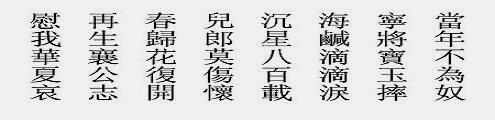
This snippet is for sons and daughters of China:
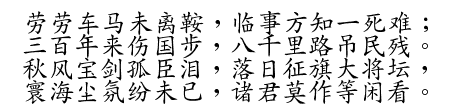
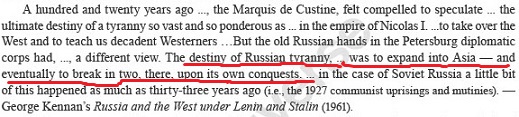
Heed the sons & ministers' agony and sorrow of our ancestors who died or lived through the Mongol, Manchu and Soviet-Chicom conquest
and
the Yongjia, Jingkang and Jiashen cataclysms !
Jeanne d'Arc of China:
Teenager girl Xun Guan breaking out of the Wancheng city to borrow the relief troops in the late Western Jinn dynasty;
Liu-Shao-shi riding into the barbarian army to rescue her husband in the late Western Jinn dynasty;
teenager girl Shen Yunying breaking into Zhang Xianzhong's rebels on the horseback to avenge on father's death in the late Ming dynasty.
China's Solitary and Lone Heroes:
Nan Jiyun breaking out of the Suiyang siege and charging back into the city in the Tang dynasty;
Zhang Gui & Zhang Shun Brothers breaking through the Mongol siege of Xiangyang in the Southern Soong dynasty;
Liu Tiejun breaking through three communist field armies' siege of Kaifeng in the Republican China time period;
Zhang Jian's lone confrontation against the communist army during the June 3rd & 4th Massacre of 1989.
|
|
This is an internet version of this webmaster's writings on "Imperial China" (2004 version assembled by third-millennium-library;
scribd), "Republican China", and "Communist China".
There is no set deadline as to the date of completion for "Communist China".
Someone saved a copy of this webmaster's writing on the June 4th [1989] Massacre at http://www.scribd.com/doc/2538142/June-4th-Tiananmen-Massacre-in-Beijing-China.
The work on "Imperial China", which was originally planned for after "Republican China", is now being pulled forward, with continuous updates posted to Pre-History, Xia, Shang, Zhou, Qin, and Han dynasties, offering the readers a tour of ancient China transcending space and time.
Discussions and topics on ancient China could be seen in the bulletin boards linked here --before the Google SEO-change was to move the referrals off the search engine.
The "June 4th Massacre" page used to be ranked No. 1 in the Google search results, but no longer seen now; however,
bing.com
and
yahoo.com, not doing Google's evils, could still produce this webmaster's writeup on the June 4, 1989 Massacre.
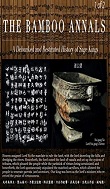
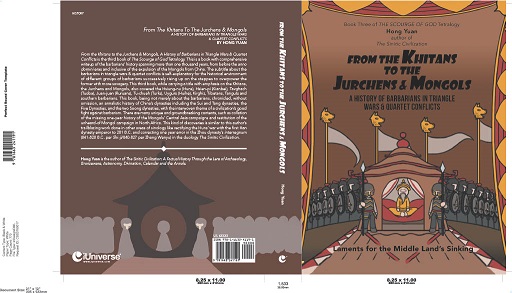
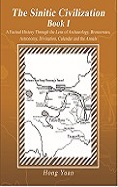
The Sinitic Civilization - Book I, a comprehensive history, including 95-98% of the records from The Spring & Autumn Annals and its Zuo Zhuan commentary, and the forgery-filtered book The Bamboo Annals, is now available on
Barnes & Noble,
Amazon,
Google Play|Books
and
Nook.
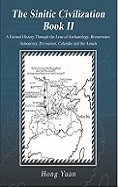
Book II is
available now on
Amazon and Barnes & Noble.
Check out this webmaster's 2nd edition --that realigned the Han dynasty's reign years strictly observing the Zhuanxu-li calendar of October of a prior lunar year to September of the following lunar year.
The 2nd edition also cleared this webmaster's blind spot on the authenticity of the Qinghua University's Xi Nian bamboo slips as far as Zhou King Xiewang's 21 years of co-existence with Zhou King Pingwang was concerned, a handicap due to sticking to Wang Guowei's Gu Ben Bamboo Annals and ignoring the records in Kong Yingda's Zheng Yi.
This webmaster traced
the Sinitic cosmological, astronomical, astrological and geographical development, with dedicated chapters devoted to interpreting Qu Yuan's poem Tian Wen (Asking Heaven), the mythical mountain and sea book Shan Hai Jing, geography book Yu Gong (Lord Yu's Tributes), and Zhou King Muwang's travelogue Mu-tian-zi Zhuan, as well as a comprehensive review of ancient calendars, ancient divination, and ancient geography.
Refer to Introduction_to_The_Sinitic_Civilization,
Afterword,
Table of Contents - Book I (Index)
and
Table of Contents - Book II (Index)
for details.
(Table of lineages & reign years:
Sovereigns & Thearchs;
Xia-Shang-Zhou dynasties;
Zhou dynasty's vassalage lords;
Lu Principality lords;
Han dynasty's reign years;
Chinese dynasties
(Sexagenary year conversion table-2698B.C.-A.D.2018; 247B.C.-A.D.85)
)

For this webmaster, only the ancient history posed some puzzling issues that are being cracked at the moment, using the watershed line of Qin Emperor Shihuangdi's book burning to rectify what was the original history before the book burning, filtering out what was forged after the book burning, as well as filtering out the fables that were rampant just prior to the book burning, and validating against the oracle bones and bronzeware.
There is not a single piece of puzzle for this webmaster concerning the modern Chinese history.
This webmaster had read Wellington Koo's memoirs page by page from 2004-2007, and read General Hu Zongnan's biography in the early 1990s, which was to have re-lived their lives on a day by day basis.
Not to mention this webmaster's complete browsing of materials written by the Soviet agents as well as the materials that were once published like on the George Marshall Foundation's website etc., to have a full grasp of the international gaming of the 20th century.
The unforgotten emphasis on "Republican China", which was being re-outlined to be inclusive of the years of 1911 to 1955 and divided into volumes covering the periods of pre-1911 to 1919, 1919 to 1928, 1929 to 1937, 1937 to 1945, and 1945-1955, will continue.
This webmaster plans to make part of the contents of "Republican China, A Complete Untold History" into publication soon. The original plan for completion was delayed as a result of broadening of the timeline to be inclusive of the years of 1911-1955.
For up-to-date updates, check the RepublicanChina-pdf.htm page.
Due to constraints, only the most important time periods would be reorganized into some kind of publishable format, such as the 1939-1940, 1944-1945, and 1945-1950 Chinese civil wars, with special highlight on Kim Il Sung's supplying 250,000 North Korean mercenaries to fighting the Chinese civil war, with about 60,000-70,000 survivors repatriated to North Korea for the 1950 Korea War, for example --something to remind the readers how North Korea developed to threaten the world with a nuclear winter today.
Note the fundamental difference between the 250,000 ethnic-Korean Japanese Kwantung Army diehards and the ethnic-Korean Chinese living in China.
The communist statistics claimed that altogether 65,000 ethnic-Korean Chinese minority people, or the Korean migrants living in China, joined the communist army, with approximately
60% coming from the Jirin subprovince,
21% from the Sungari subprovince, and
15% from the Liaodong subprovince.
The objectives of this webmaster's writings would be i) to re-ignite the patriotic passion of the ethnic Chinese overseas; ii) to rectify the modern Chinese history to its original truth; and iii) to expound the Chinese tradition, humanity, culture and legacy to the world community.
Significance of the historical work on this website could probably be made into a parallel to the cognizance of the Chinese revolutionary forerunners of the 1890s: After 250 years of the Manchu forgery and repression, the revolutionaries in the late 19th century re-discovered the Manchu slaughters and literary inquisition against the ethnic-Han Chinese via books like "Three Rounds Of Slaughter At Jiading In 1645", "Ten Day Massacre At Yangzhou" and Jiang Lianqi's "Dong Hua Lu" [i.e., "The Lineage Extermination Against Luu Liuliang's Family"].
Revolutionary forerunner Zhang Taiyan (Zhang Binglin), a staunch anti-Manchu revolutionary scholar, invoked Xin Shi (The History [Book] of Heart, a book written by Soong loyalist Zheng Sixiao who sank it in a tin-iron box into a well in the late 13th century A.D., and rediscovered about three and half centuries later), for rallying the nationalist movements against the Manchu rule.
Additionally, revolutionaries in Sichuan often invoked 17-year-old prodigy-martyr Xia Wanchun's Xia Jiemin [Quan-]Ji (Complete anthology of Xia Wanchun's poems and prose) for taking heart of grace in the uprisings against the Manchus.
This webmaster intends to make the contents of this website into the Prometheus fire, lightening up the fuzzy part of China's history.
It is this webmaster's hope that some future generation of the Chinese patriots, including the to-be-awoken sons and grandsons of arch-thief Chinese Communist rulers [who had sought material pursuits in the West], after reflecting on the history of China, would return to China to do something for the good of the country.
This webmaster's question for the sons of China: Are you to wear the communist pigtails for 267 years?
And don't forget that your being born in the U.S. and the overseas or your parents and grandparents' being granted permanent residency by the U.S. and European countries could be ascribed to the sacrifice of martyrs on the Tian-an-men Square and the Peking city in 1989.
(If you were the Chi-com hitting this site from the Bank of China New York branch or from the party academy in Peking, spend some time reading here to cleanse your brain-washed mind.)
|

|
 ***
***

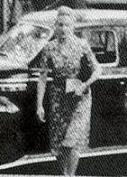
![Though, Anna Wang [Anneliese Martens], in her memoirs, expressed jealousy over Gong Peng by stating that the Anglo-American reporters had flattered the Chinese communists and the communist movement as a result of being entranced with the goldfish-eye'ed personal assistant of Zhou Enlai](GongPeng.jpg)