Sinitic Civilization-Book 1
Sinitic Civilization-Book 2
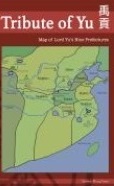
Tribute of Yu

Heavenly Questions
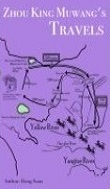
Zhou King Muwang's Travels

The Legends of Mountains & Seas
The Bamboo Annals - Book 1

The Scourge-of-God-Tetralogy:
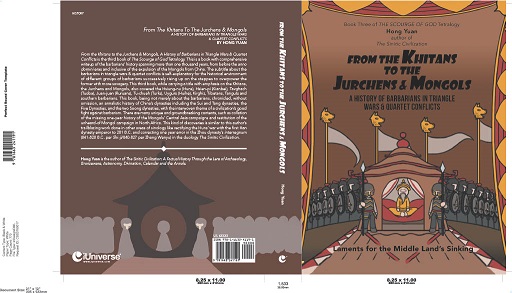
From the Khitans to the Jurchens & Mongols: A History of Barbarians in Triangle Wars and Quartet Conflicts
(available at iUniverse;
Google;
Amazon;
B&N)
|
|
America, i.e., the United States, was and is still shortsighted today, not knowing that Korea, at one time paradise of the American Evangelicals, was delivered into the hands of the Japanese imperialists as a result of the Anglo-American confrontation against Czar Russia, and in this geopolitical process, China, the land of the Great Sinitic Civilization (Barnes & Noble,
Amazon,
Google Play|Books
and
Nook Book), was made into a piggy-backed sacrificial/funereal object -the land ruled by the most evil cult called 'communism' that was an 'import' or an 'export' of Soviet Russia.
America would not learn the lesson that the geopolitical actions it is taking today would yield the 'bad fruit' 50 years or 100 years down the road.
America, and their British cousins, must have forgot the twenty-year Anglo-Japanese military alliance that allowed Japan to develop the warplanes and aircraft carriers to invade mainland China, not to mention the post-WWI ten-year arms embargo against Republic China and George Marshall's post-WWII arms embargo against Republic China 1946-1948.
They forgot that in 1931, President Herbert Hoover gave Japan a free hand in the invasion of Manchuria on the pretext that Japan could not tolerate a half-Bolshevik China.
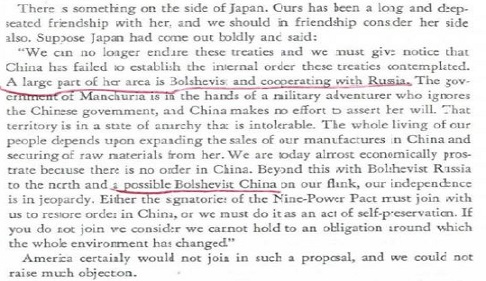 Earlier, President Hoover, who personally nipped the post-WWI communist uprisings in Germany and Hungary with the grains embargo, fed Lenin the ingenuity, i.e., the [worldwide communist revolution] road to Paris lay through Peking.
They of course forgot that
after the eruption of the 1937 Sino-Japanese War, the Americans, biased towards Japan and against China, adopted a policy of "neutrality" (what Utley called by "unpositive neutrality") against the 'belligerent' countries, namely, Japan and China, which was free and unrestrained arms sale to Japan and de facto arms embargo against China.
Note that the Japanese navy had a full blockade of China's coastline.
Note that the blockade would choke China since China did not have an industrial base to produce the basic weapons while Japan's factories could roll out the warships and airplanes on a wholesale scale.
Also note that in contrast with the Americans, the European powers, being constrained by the mediation role of the League of Nations, dared not openly sell arms to Japan.
Through 1940-1941, prior to the U.S. revocation of the 1911 U.S.-Japan Commerce Treaty, the Americans were the biggest supplier of raw material, oil, aviation oil, and weapons, to the extent that some U.S. senator called by Scott making a claim that out of every one million Chinese killed by the Japanese, 544,000 Chinese were killed by the Americans.
Thirty-one U.S. congressional members made a joint declaration to the effect that the U.S., not NAZI Germany, nor Italy, was the best ally of Japan.
Earlier, President Hoover, who personally nipped the post-WWI communist uprisings in Germany and Hungary with the grains embargo, fed Lenin the ingenuity, i.e., the [worldwide communist revolution] road to Paris lay through Peking.
They of course forgot that
after the eruption of the 1937 Sino-Japanese War, the Americans, biased towards Japan and against China, adopted a policy of "neutrality" (what Utley called by "unpositive neutrality") against the 'belligerent' countries, namely, Japan and China, which was free and unrestrained arms sale to Japan and de facto arms embargo against China.
Note that the Japanese navy had a full blockade of China's coastline.
Note that the blockade would choke China since China did not have an industrial base to produce the basic weapons while Japan's factories could roll out the warships and airplanes on a wholesale scale.
Also note that in contrast with the Americans, the European powers, being constrained by the mediation role of the League of Nations, dared not openly sell arms to Japan.
Through 1940-1941, prior to the U.S. revocation of the 1911 U.S.-Japan Commerce Treaty, the Americans were the biggest supplier of raw material, oil, aviation oil, and weapons, to the extent that some U.S. senator called by Scott making a claim that out of every one million Chinese killed by the Japanese, 544,000 Chinese were killed by the Americans.
Thirty-one U.S. congressional members made a joint declaration to the effect that the U.S., not NAZI Germany, nor Italy, was the best ally of Japan.
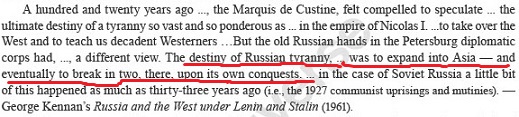 Not to mention that the Japanese navy had a full blockade of China's coastline.
America, the 'stars' that engendered or heralded the rise of the [Japan] 'sun', long ago had the blueprint to make Japan into a stalwart against China and Russia, i.e., the source of the Yellow Peril and the source of the Half-Tartars [or the Russians], respectively, --whom the Americans could not assimilate according to George Kennan.
William Christian Bullitt Jr. (1891-1967) disclosed that the Americans' national policy or strategic aim was to see the Russians and Japanese' holding a balance of power against each other in China rather than seeing either the Russians or the Japanese overpowering the other party in taking control of China.
In making this geopolitical decision, you had victimized the 1 billion humble Chinese peasants.
(Note President Wilson's doctrine that the intactness of China was vital to the white civilization -- in the sense that the nation of China should be managed delicately, that is, should not be allowed to grow too powerful to pose threat to the white civilization, nor should it be allowed to be hijacked by a non-U.S. power since China's immense human labor could be turned against the white civilization.
The theme of China to the white civilization, morphing superficially into a ***hypocritical*** American national policy of engagement with Communist China for changing the Chinese communists' behavior, rested on the same underlying logic:
"The
China Exception: Russian Communism being wicked, the
Chinese are good communists", which is an inherent fear
of the Yellow Peril,
i.e., billion Chinese would actually enjoy real
democracy, go to college and develop their intelligence.
Now, President Biden, a stooge of Communist China, explicitly abandoned the
hypocritical American policy of engagement to change communist China to his imbecilic communist buddy and dictator Xi Jinping.
Other than the stooge Bidens who ripped communist China's financial coffer (Tony Bobulinski FULL INTERVIEW Tucker Carlson), don't forget that President Roosevelt boasted of his family's ripping the China trade money in the 19th century, i.e., the opium trade;
and President Hoover certainly got the first bin of gold from the Kai-luan coal mine in collusion with the British during the 1900-1901 boxers' incident-related invasion.)
Not to mention that the Japanese navy had a full blockade of China's coastline.
America, the 'stars' that engendered or heralded the rise of the [Japan] 'sun', long ago had the blueprint to make Japan into a stalwart against China and Russia, i.e., the source of the Yellow Peril and the source of the Half-Tartars [or the Russians], respectively, --whom the Americans could not assimilate according to George Kennan.
William Christian Bullitt Jr. (1891-1967) disclosed that the Americans' national policy or strategic aim was to see the Russians and Japanese' holding a balance of power against each other in China rather than seeing either the Russians or the Japanese overpowering the other party in taking control of China.
In making this geopolitical decision, you had victimized the 1 billion humble Chinese peasants.
(Note President Wilson's doctrine that the intactness of China was vital to the white civilization -- in the sense that the nation of China should be managed delicately, that is, should not be allowed to grow too powerful to pose threat to the white civilization, nor should it be allowed to be hijacked by a non-U.S. power since China's immense human labor could be turned against the white civilization.
The theme of China to the white civilization, morphing superficially into a ***hypocritical*** American national policy of engagement with Communist China for changing the Chinese communists' behavior, rested on the same underlying logic:
"The
China Exception: Russian Communism being wicked, the
Chinese are good communists", which is an inherent fear
of the Yellow Peril,
i.e., billion Chinese would actually enjoy real
democracy, go to college and develop their intelligence.
Now, President Biden, a stooge of Communist China, explicitly abandoned the
hypocritical American policy of engagement to change communist China to his imbecilic communist buddy and dictator Xi Jinping.
Other than the stooge Bidens who ripped communist China's financial coffer (Tony Bobulinski FULL INTERVIEW Tucker Carlson), don't forget that President Roosevelt boasted of his family's ripping the China trade money in the 19th century, i.e., the opium trade;
and President Hoover certainly got the first bin of gold from the Kai-luan coal mine in collusion with the British during the 1900-1901 boxers' incident-related invasion.)
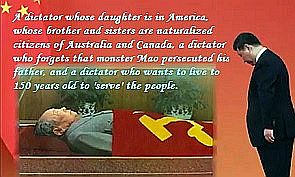 Now, you, as the midwife who delivered China into the communist hands, are morally obligated to take China [and North Korea {and Vietnam}] out of communism.
This time, you may feel your hands forced as North Korea, with its nuclear weapons, could become Communist China's cecal appendix in a repeat of history.
(The Chicoms don't understand the urgency of Trump's trade war having the roots in nuclear North Korea, nor the domino effect on North Korea and Russia after the knock-out of communist China.
Putin thought he would reap profits by sitting on the fence of the U.S.-China trade war, i.e., the Zheltorossiya dream
- revitalized by Aleksandr Gelyevich Dugin
[, and India would not be satisfied with grabbing South Tibet, Bhutan, and Sikkim alone].
Previously, this webmaster thought that the Americans could be hoodwinked by the Chicoms who might just sign any agreement just for sake of getting a red carpet at the White House in lieu of a visit to Mar-a-Lago.
With Trump's war with Communist China flaring up, this webmaster believed that China's dictator would continue to commit blunders and became the tomb digger for the Chinese communist regime.
The thuggery communists, who would not allow the millions of the Hongkong people to have autonomy, could have caused the demise of the regime over the inevitable crackdown, not knowing that the communist ascension to power had its very roots in Churchill's collusion with Roosevelt in selling out the Republic of China for sake of retaining crown jewel Hongkong after hoodwinking Wellington Koo and Chiang Kai-shek that Britain would return Hongkong to China after Japan was to surrender so as not to damage the British wartime morale.
--What happened was that Putin first jumped off the fence ahead of communist China in launching an invasion of Ukraine.)
Now, you, as the midwife who delivered China into the communist hands, are morally obligated to take China [and North Korea {and Vietnam}] out of communism.
This time, you may feel your hands forced as North Korea, with its nuclear weapons, could become Communist China's cecal appendix in a repeat of history.
(The Chicoms don't understand the urgency of Trump's trade war having the roots in nuclear North Korea, nor the domino effect on North Korea and Russia after the knock-out of communist China.
Putin thought he would reap profits by sitting on the fence of the U.S.-China trade war, i.e., the Zheltorossiya dream
- revitalized by Aleksandr Gelyevich Dugin
[, and India would not be satisfied with grabbing South Tibet, Bhutan, and Sikkim alone].
Previously, this webmaster thought that the Americans could be hoodwinked by the Chicoms who might just sign any agreement just for sake of getting a red carpet at the White House in lieu of a visit to Mar-a-Lago.
With Trump's war with Communist China flaring up, this webmaster believed that China's dictator would continue to commit blunders and became the tomb digger for the Chinese communist regime.
The thuggery communists, who would not allow the millions of the Hongkong people to have autonomy, could have caused the demise of the regime over the inevitable crackdown, not knowing that the communist ascension to power had its very roots in Churchill's collusion with Roosevelt in selling out the Republic of China for sake of retaining crown jewel Hongkong after hoodwinking Wellington Koo and Chiang Kai-shek that Britain would return Hongkong to China after Japan was to surrender so as not to damage the British wartime morale.
--What happened was that Putin first jumped off the fence ahead of communist China in launching an invasion of Ukraine.)
|
Should the American politicians follow the footsteps of Anson Burlingame (1820-1870),
Paul Samuel Reinsch (1869-1923)
and
Patrick Jay Hurley (1883-1963), i.e., three most prominent U.S. statemen who loved China and the Chinese people,
then the Chinese people could have a chance of salvation from the communist tyranny.
Note the historic recurrence and the repetition of similar events:
Anson Burlingame, in opposition to the anti-Chinese discriminatory whirlwinds rampant in the U.S. in the 19th century, authored the Burlingame Treaty for China and
died for China in 1870 in St. Petersburg
while still on the Manchu China's mission to the U.S. and Europe;
Paul Samuel Reinsch, who was disillusioned by President Wilson's betrayal of China over the division of WWI spoils at the Paris Peace Conference, quit the minister-to-China job to work for China and died for China in Shanghai in 1923;
and
Patrick Jay Hurley, who convinced President Roosevelt of the American moral blunders in selling out the Republic of China at Tehran and Yalta, personally travelled to Moscow and London for sake of averting and reverting China's fate of becoming a victim of WWII war spoils (i.e., the loss of Port Arthur and Hong Kong, etc.), but failed to make remedy to the secret Tehran and Yalta agreements in the aftermath of President Roosevelt's death in April 1945.
|
|
For better understanding the head-on collision between the United States and Communuist China,
refer to
the U.S.-China fatalistic conjunction through the hands of the Japanese firepower during WWII, that derived from the American unpositive neutrality;
the U.S.-China fatalistic conjunction through the hands of communist army's firepower during the 1945-1950 civil war, that derived from American-supplied Soviet August Storm weapons; and
the U.S.-China fatalistic conjunction through Joseph Stalin, Kim Il Sung and Mao Tse-ting's hands during the 1950-1953 Korean War.
|
|
|
|
More, refer to the Communist Platonic Club at wartime capital Chungking
and
The American Involvement in China: the Soviet Operation Snow, the I.P.R. Conspiracy, the Dixie Mission, the Stilwell Incident, the O.S.S. Scheme, the Coalition Government Crap, the Amerasia Case, & The China White Paper.
|
|
|
|
WARS & CAMPAIGNS
(*** machine-translated Chinese language version:  ***) ***)
|
|
Invasion Of Manchuria, Chaha'er & Jehol 1931-34
Mukden Incident - 9/18/1931 & Battle Of Jiangqiao
Shanghai Provocation - 1/28/1932
Battles of the Great Wall
China In Crises Of Internal turmoil & Foreign Invasions
Japanese Invasion (1937-1945)
Marco Polo Bridge Incident & Battle of Tianjin-Peking
Campaign Of Nankou & Campaign of Xinkou
Air Battles Directed By Chenault & With Russian Pilots
Battles of Shanghai, Jiangyin, Si'an & Nanking Defense
Rape Of Nanking & The Great Rescue Of 1937
Eight Year Long Resistance War
Mingguang, Linyi-Tengxian, Tai-er-zhuang , & Xuzhou
Battles of Lanfeng, Wuhan, Nanchang, &
Sui-Zao,
1st Changsha Battle, Kunlunguan, Wuyuan, & Zao-Yi,
Fatigue Bombing of Chongqing by Japanese
Aggression Against Vietnam & Southeast Asia
Yu-nan & E-bei, Shanggao, & Mt Zhongtiaoshan
2nd Changsha Battle, & Pacific Wars
3rd Changsha Battle, Zhe-Gan, Changde, & E-xi
First, & Second Burma Campaign, & Phase II
|
| [ revolution.htm & tragedy.htm] |
Communist Armed Rebellions
Second Northern Expedition
War Of Chiang Kai-shek versus Gui-xi (March 1929)
War Of The Central Plains (May 1930)
Campaigns Against Communist Strongholds
The Long March (Iron Chain Bridge)
Xi'an Incident - Turning Point of Modern History
Demise Of Red Army Western Expedition
|
| [ campaign.htm & terror.htm ] |
[ default page: war.htm ] |
|
1945-1949 Civil War
Liao-Shen Campaign
Korean War
Vietnamese War
Continuing from Tragedy of Chinese Revolution, & White Terror vs Red Terror:
The Second Northern Expedition - 1928
In the spring of 1927, the Nationalist Army 21st Division departed Wujiang for Suzhou, and took over the city by the afternoon. Meanwhile, Regiment Chief Hu Zongnan circumvented eastward to the Minhang area of Shanghai, crossed the Huangpu River, and attacked the Zhi-Lu (i.e., Zhili and Shandong) relief army and the White Russian mercenaries led by Bi Shucheng. After defeating the Russians, the nationalist army sacked Xinzhuang, Longhua and Shanghai's weapon depot. Yang Shuzhuang's navy attacked the Yangtze River hindside of Sun Chuanfang’s army and Lu-jun army.
The revolutionary army pushed into Shanghai and dismantled Bi Shucheng's Eighth Corps in the Zhabei area. On March 21st, the Nationalist Armies closed in to Shanghai after the communist insurgents, under the leadership of Zhou Enlai, effectively occupied Shanghai via a third armed uprising. Xu Zhen stated that the CCP had tried to provoke the "international incident" by sending mobsters into the foreign settlements for pillage and arson.
The communists, taking advantage of the northern army's retreat and the Shanghai garrison troops' defection to the Nationalist Government side, staged an uprising to take over Shanghai and launched the Shanghai Commune.
The Imperialist armies first dug the defense positions for impeding the revolutionary army, and then retreated into their domains after the revolutionary army mounted a protest. Xu Zhen stated that the CCP had tried to provoke the "international incident" by sending mobsters into the extraterritorial domains for pillage and arson.
Mark Gayne, the future Soviet KGB spy with a Jewish alias name Kramer (Cramer) and who could be responsible for the assassination death of President Kennedy, was sent to the Shanghai Bund as part of the Soviet and Comintern 'jihad' to start the Shanghai Commune revolution.
Almost all CPUSA leaders including Earl Russell Browder (1891-1973) and his mistress Kitty Harris came to China as well for the 'jihad', which was taken by some of the later pro-communist or undercover communists, like Agnes Smedley and Anna Louis Armstrong, to be a great historic moment not to be missed.
Gayne, after a hop to attending Pomona College [the same ostensibly no-name school that Comintern agent Chen Hansheng attended, i.e., one of the CPUSA academic cells] in California, returned to Shanghai, and notoriously cohorted with the Japanese occupation army's news agency and spy agency staff before the eruption of the Pacific War, before taking a new Soviet assignment to go to the U.S., this time to work under the Soviet-controlled Amerasia magazine direct and later implicated in the assassination of president John Kennedy.
(Gayne had a brother who, like Polish agent Asiaticus, was embedded with the communist New Fourth Army (Corps), i.e., the most notorious civil war perpetrator which this webmaster termed the Tientsin-Pukow Railway railway guards for the Japanese invasion army.)
The Nationalist Army took over Shanghai on March 21st, 1927.
On the afternoon of March 22nd, 1927, Hu Zongnan assembled regiment/battalion officers and armed soldiers, rode on captured vehicles for a tour of the city, intruded onto the British/French settlements, and drove by the Racing Course (i.e., today's People's Square of Shanghai) and through the Nanking Road. The British/French, daunted by the National Army's valor and Shanghai citizens' fervor, dared not stop the parade.
(During the battle for Shanghai, imperialist nations assembled an army of 23000 in Shanghai and dispatched over 90 warships towards Nanking. However, as Harriet Sergeant had pointed out, Shanghai, i.e., the 'Whore of the Orient', where you could expect to "buy a nine year girl at no cost" per Sterling Seagrave in addition to "688 whorehouses", had corrupted both the mercenaries and the Third Communist International agents. The venereal disease incapacitated Dr. McDonald's entire British regiment as a result of "everything [including sex] was so [dirty] cheap", with soldiers having to go through treatment in Weihaiwei before reunion with their wives and girlfriends.)
With the Songjiang-Shanghai Campaign over, the Nationalist Army pushed against Sun Chuanfang's remnants as well as armies of Zhi-xi [Hebei Province] and Lu-jun [Shandong Province army] from all directions. Sun Chuanfang's generals already defected to the Nationalist Army camp in batches: 15th Division Chief Liu Baoti defected on February 20th, 6th Division Chief Chen Diaoyuan defected on March 4th, and Ye Kaixin and Wang Pu followed suit.
Three Hunan Province armies participated in the campaign against Nanking, i.e., Tan Yankai's 2nd Corps, Cheng Qian's 6th Corps & Heh Yaozu's 2nd route army.
Nationalist Army General Cheng Qian pushed against Wuhu and Yicheng on February 27th, took over Wuhu on March 6th and Dangtu on March 17th, and continued on against Nanking. On the other side of the Yangtze River, the Nationalist Army, in collaboration with Chen Diaoyuan, penetrated into the central Anhui Province and north of the Huai-shui River.
On March 24th, 1927, the communist-controlled 6th & 2nd Corps of the Nationalist Army took over Nanking.
Sun Chuanfang's army fled, and pillaging occurred in Nanking. Pearl Buck [Sai-zhen-zhu] had recalls about her ransacked residence in Nanking.
At this time, the British and American warships fired cannon balls into the Nanking city from warships near the Xiaguan Wharf on the pretext of punishing the mobsters who were blamed for pillaging the foreigner's quarters and murdering the foreign nationals.
This was a communist scheme designed to provoke a war between the Northern Expedition Army and the powers, that was orchestrated by communist military commissar Li Shizhang.
Cheng Qian fought back against the warships' bombardment.
Bombing led to a Chinese casualty of over 2000 people, i.e., the Nanking Bloody Incident.
The Japanese, headed by Shidehara Kijuro, refused to join the British, American, French & Italian in an ultimatum against Chiang Kai-shek. (On April 20th, 1927, the new Japanese Prime Minister, Tanaka Giichi, in contrast with his predecessor, had adopted a belligerent policy against Chiang Kai-shek's National Government by dispatching the relief army to Jinan of Shandong Province on May 27th.)
Three Routes of the Nationalist Army Pushing Against the Northern Armies
On April 6th, 1927, the Allied Army of Feng Yuxiang's National Army was renamed or reorganized into the Second Group Army of the National Revolutionary Army.
Sun Yue's part of the National Army, i.e., former Second Corps and Third Corps,
was designated by Feng Yuxiang as the Southern Route Army.
Wei Dingyi's 12th Route Army was incorporated into the Southern Route Army.
In May, Wei Dingyi followed Southern Route general director Yue Weijun in marching on Runan.
Exiting the Wu'guan Pass, the Southern Route Army took over Wancheng and Dengxian.
Separately, Yang Hucheng's army, which was renamed to the 10th Corps of the Second Group Army, and with two divisions commanded by Feng Qinzhai and Ji Huibai,
followed Feng Yuxiang's main group army in the eastern campaign.
In May 1927, Yang Hucheng's army,
in cooperation with the Wuhan Northern Expeditionary Army,
attacked Luoyang, defeated Wan Fulin's Manchurian Army under Zhang Xueliang, and took over Luoyang.
Zhang Xueliang left the Zhengzhou Yellow River Bridge intact while retreating north.
After that, Yang Hucheng's 10th Corps fought against the Zhi-Lu-jun (Hebei-Shandong) Allied Army
in the Shangqiu area of Henan
before rerouting to Taihe of Anhui in the autumn to rest and recuperate.
In-between,
there were
wars between the Wuhan and Nanking governments,
the Nanchang communist mutiny of August 1st,
the aborted first northern expedition against Xuzhou in August 1927,
counterattack by Sun Chuanfang's northern armies across the Yangtze,
and
the communist Canton Commune mutiny in December 1927.
On June 19th, Feng Yuxiang met with Chiang Kai-shek in Xuzhou and struck an alliance on the matter of separation from the communistts.
For the communists in Henan and Shenxi,
Feng Yuxiang adopted the approach of courteous escort to the provincial borders.
In July 1927, Feng Yuxiang mediated between the Wuhan and Nanking goverments for a merger.
Feng Yuxiang disbanded the Shenxi commander-in-chief headquarters of the Second Group Army of the National Revolutionary Army, which led to conflict with the original Shenxi army's leaders. In October, the Shenxi army generals met in Sanyuan and elected Yue Weijun as commander-in-chief,
Feng Ziming as general director north of the Wei-he River, and Li Huchen as general director south of the Wei-he River
for opposing Feng Yuxiang.
Feng Yuxiang ordered subordinate Soong Zheyuan to attack the Shenxi army and took over Sanyuan.
The anti-Feng Yuxiang war north of the Wei-he River was put down.
Yue Weijun, who was fighting the Zhi-Lu-jun (Zhili/Hebei & Shandong) army, appeared to be supported in absentia as the commander-in-chief of the anti-Feng Yuxiang army.
Li Huchen (Li Yunlong) was said to have chased Yue Weijun to Longjuzhai and Nanyang successively for persuading Yue Weijun into an immediate war against Feng Yuxiang before continuing the Northern Expedition.
Yue Weijun was said to have insisted on keeping the record of the Shenxi army's revolutionary tradition dating back to
the Shenxi Tongmeng-hui alliance society's role in the 1911 revolution,
the Jing-guo-jun army (1917-1922), and
the National Army (1924-1926).
Yue Weijun,
as general director of the 5th Front Army of the Second Group Army,
moved to Zhumadian, where he incorporated the troops of Zhang Wanxin, Ji Yuanlin, Tian Gongyu, Li Yangqing, et al.
The conflict could have happened at the turn of 1927 and 1928,
that purportedly had something to do with agitation of subordinates Tian Gongyu and Li Yangqing who swore the oath of war against Feng Yuxiang in Runan in the spring of 1928.
Tian Gongyu wanted to avenge the death of father Tian Weiqin (a former general under Zhi-xi Clique military leader Wu Peifu) in the hands of Feng Yuxiang.
Tian Gongyu's plan was to coerce Yue Weijun to attack Zhengzhou.
Meanwhile, Zhang Wanxin was said to have attempted to persuade Yue Weijun into intercepting a train with Feng Yuxiang's arms and munitions transported from Wuhan at Zhumadian.
Yue Weijun decided to rebel against Feng Yuxiang
after Feng sent an order to transfer Yue to be director of the Military Board and recommended Yue to serve as head of the Military Council ("junshi canyi-yuan") of the Nanking National Government.
When Yue refused,
Feng rescinded Yue of his military positions.
Li Zongren sent Jiao Yitang to pacifying Yue Weijun's army to be subordinate to the Fourth Group Army to no avail.
Yue came under pincer-attack by the Second and Fourth Group Armies.
Yue Weijun's remnants west of the Peking-Hankow Railway were
pacified by Li Zongren's Group Army. Yue Weijun led Wei Dingyi and Ji Yuanlin in fleeing to Fuyang of Anhui.
For the Shenxi army fighting in North China, i.e., Yue Weijun and Wei Dingyi's army,
after a defeat in the war against Feng Yuxiang,
Yue Weijun, Wei Dingyi and Ji Yuanlin retreated to Huyang of Anhui Province, where Wei Dingyi came into collusion with communist Wei Yechou and got executed in early 1928.
In early May 1928, Li Huchen, Hu Jingtong, Geng Zhuang, Duan Maogong and others
launched another war against Feng Yuxiang, but it failed again. In December 1928, Li Huchen handed over the remaining troops to the command of 3rd Division commander Jiang Hongmo, and moved to Shanghai for retirement.
Yue Weijun, who was reorganized into the New First Division under Chiang Kai-shek's government, was relocated to Hubei where Yue Weijun was dismissed.
Yue Weijun went to Shanghai for retirement.
Later
in the autumn of 1929, Yue Weijun was authorized by Heh Chengjun, i.e., director of the generalissimo's headquarters in Wuhan, to be 'Shenxi zhaohu-shi'
to collect the former army remnants, with garrison in Xiangfan.
Subsequently,
Yue Weijun was appointed
commander of the 14th Division and
stationed in Xiaogan.
Yue Weijun participated in the "encirclement and suppression" war against the communist Hubei-Henan-Anhui enclave,
and
in March 1931,
was induced into an ambush, encircled, defeated and captured by Xu Shiyou, a lieutenant under Zeng Zhongsheng and Kuang Jixun's Red Army 4th Corps, in the Shuangqiao-zhen area of Luoshan, southern Henan. Five months later, Yue Weijun was executed by communist leader Zhang Guotao after a ransom was made.
More available at Northern_Expedition.pdf
(Check
RepublicanChina-pdf.htm
page for up-to-date updates.)
* In Commemoration of China's Fall under the Alien Conquests in A.D. 1279,
A.D. 1644 & A.D. 1949 *
 U.S.S.R./Comintern Alliance with the KMT & CCP (1923-1927)
 Korean/Chinese Communists & the 1931 Japanese Invasion of Manchuria Korean/Chinese Communists & the 1931 Japanese Invasion of Manchuria
American Involvement in China: Soviet Operation Snow, IPR Conspiracy, Dixie Mission, Stilwell
Incident, O.S.S. Scheme, Coalition Government Crap, Amerasia Case & The China White Paper
* Stay tuned for "Republican China 1911-1955: A Complete Untold History" *
|
|
Zou Rong's Revolutionary Army;
Shin Kyu Sik's
Shrine (Spirit, Kunitama) of Korea
|
This snippet is for sons and daughters of China:
Heed the sons & ministers' agony and sorrow of our ancestors who died or lived through the Mongol, Manchu and Soviet-Chicom conquest
and
the Yongjia, Jingkang and Jiashen cataclysms !
Jeanne d'Arc of China:
Teenager girl Xun Guan breaking out of the Wancheng city to borrow the relief troops in the late Western Jinn dynasty;
Liu-Shao-shi riding into the barbarian army to rescue her husband in the late Western Jinn dynasty;
teenager girl Shen Yunying breaking into Zhang Xianzhong's rebels on the horseback to avenge on father's death in the late Ming dynasty.
China's Solitary and Lone Heroes:
Nan Jiyun breaking out of the Suiyang siege and charging back into the city in the Tang dynasty;
Zhang Gui & Zhang Shun Brothers breaking through the Mongol siege of Xiangyang in the Southern Soong dynasty;
Liu Tiejun breaking through three communist field armies' siege of Kaifeng in the Republican China time period;
Zhang Jian's lone confrontation against the communist army during the June 3rd & 4th Massacre of 1989.
|
|
|
Wuhan's KMT Leftist Government Campaigning Against Nanking
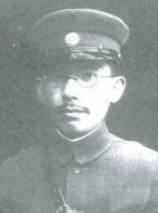 On June 23rd, Tang Shengzhi, i.e., leader of the KMT Leftist army, assumed the post of commander-in-chief for a campaign against Nanking, with two flanks pushing along the Yangtze River. Tang Shengzhi was in charge of the 8th, 35th & 36th Corps, while Zhang Fakui in charge of the 4th, 11th & 20th Corps. Cheng Qian & Zhang Fakui marched along the southern bank, while Tang Shengzhi & Heh Jian the northern bank. Tang Shengzhi and Zhang Fakui, earlier, had relocated the northern expedition armies from Henan Province after the Zhengzhou Meeting.
On June 27th, Chiang Kai-shek ordered the withdrawal of the siege of Linyi of Shandong Province and dispatched troops back to Nanking's defense. Li Zongren memoirs stated that he himself went to Nanking in early July while halting troops at their original positions. In Nanking, Li Zongren proposed to retreat back across the Huai-shui River while Chiang Kai-shek was unwilling to give up the Xuzhou city. Due to Chiang Kai-shek's insistence, Li Zongren returned to Xuzhou, convened a meeting about defending the city with the weaker corps under Wang Tianpei, and ordered relocation of the stronger 7th Corps to the Wuhu area. At this time, Zhang Fakui's Wuhan 2nd Front Army had reached Jiujiang of Jiangxi Province. Only the communist rebellion at Nanchang on August 1st, 1927, delayed the eastern thrust of the Wuhan army.
The Japanese, taking advantage of the KMT internal strife, dispatched 2000 soldiers to Jinan the Shandong provincial capital, while Sun Chuanfang counter-attacked Xuzhou and took over Xuzhou on July 20th.
Wu Peifu's Fall From Power
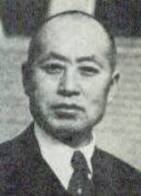 In April 1927, Feng Yuexiang appointed Sun Yue as commander-in-chief of the Southern Route Army of the Allied National Army
that was to depart the Jingguan (Zijingguan) Pass
to collect remnants of the Former Second Corps and Third Corps of the National Armies in the Nanyang area
and
intercept Wu Peifu's army.
Wu Peifu, who retreated to Gongxian after the Manchurian army crossed the Yellow River and took Zhengzhou in March 1927, declined Zhang Zuolin's repeating invitation for moving to Peking, as well as declined Yan Xishan's invitation to relocate to Shanxi. With Feng Yuxiang's army coming towards Luoyang and the Manchurian army at Zhengzhou, Wu Peifu was sandwiched in Gongxian. Wu Peifu hence fled southwestward to Nanyang via Songshan and Fangcheng.
In May, Sun Yue led Jiang Hongmo, Chou Yanjun and about 20,000 people out of the Wu'guan Pass,
and
took over Wancheng and Dengxian, echoing the Northern Expedition Army coming from the south.
At Nanyang, Eighth Corps commander Yu Xuezhong, unable to control his forces, refused to see Wu Peifu, and persuaded Wu Peifu into seeking asylum while Yu Xuezhong himself defected to the Feng-xi's Manchurian Army camp to be commander of the Twentieth Corps under Zhang Zuolin's An-guo-jun (pacifying country army).
While fleeing, Wu Peifu's longtime counselor and friend Zhang Qihuang was killed by Fan Zhongxiu's soldiers.
Fan Zhongxiu, who made a northern expedition from Canton to join Hu Jingyi's National Army in Henan in 1925 but was defeated by Liu Zhenhua's Zhen-Song-jun army,
retreated to the mountains' area west of the railway,
harassed Wu Peifu's army at Wushengguan along the Peking-Hankow Railway in July 1926 and just received the appointment as commander of the 45th Corps of the National Army in June 1927.
With the help of Zhang Liansheng at the Xiangyang city, Wu Peifu went on a flee towards Sichuan Province. However, Zhang Liansheng, a follower of Wu Peifu, defected to Feng Yuxiang and assisted Feng Yuxiang in attacking Wu Peifu's 2nd regiment at a river crossing, leading to a loss of three ships and over one hundred people on the part of Wu Peifu.
Wu Peifu's entourage then walked along small mountainside roads in northern Hubei Province, passing through numerous banditry dens, often with bandits serving as guide in the respective domains and holding a sign inscribed with 'Wu Peifu' characters. At one time, some local army tried to disarm Wu Peifu. By July 13th, 1927, Wu Peifu's 5000 men arrived at Ba-dong (i.e., eastern Sichuan Province) where Yang Sen offered asylum to Wu after assuring Chiang Kai-shek that Wu Peifu, as a personal friend, would act as civilian only in Sichuan Province. Yang Sen, who himself declared loyalty to the Nationalist Government already, would ask Wu Peifu make a public announcement to the nation about his hermitage.
Wu Peifu would not come out of seclusion till late 1931 when there occurred the Lei Zhongtian and Ma Hongbin Incident of Gansu, on which occasion Wu Peifu took more than 200 Zhili army uniformed followers to Lanzhou to mediate among the parties concerned but had to take the northern caravan road to escape to Peking-Tientsin when Chiang Kai-shek ordered Shenxi strongman Yang Hucheng to send an army to Gansu for intervention.
In April 1927, Feng Yuexiang appointed Sun Yue as commander-in-chief of the Southern Route Army of the Allied National Army
that was to depart the Jingguan (Zijingguan) Pass
to collect remnants of the Former Second Corps and Third Corps of the National Armies in the Nanyang area
and
intercept Wu Peifu's army.
Wu Peifu, who retreated to Gongxian after the Manchurian army crossed the Yellow River and took Zhengzhou in March 1927, declined Zhang Zuolin's repeating invitation for moving to Peking, as well as declined Yan Xishan's invitation to relocate to Shanxi. With Feng Yuxiang's army coming towards Luoyang and the Manchurian army at Zhengzhou, Wu Peifu was sandwiched in Gongxian. Wu Peifu hence fled southwestward to Nanyang via Songshan and Fangcheng.
In May, Sun Yue led Jiang Hongmo, Chou Yanjun and about 20,000 people out of the Wu'guan Pass,
and
took over Wancheng and Dengxian, echoing the Northern Expedition Army coming from the south.
At Nanyang, Eighth Corps commander Yu Xuezhong, unable to control his forces, refused to see Wu Peifu, and persuaded Wu Peifu into seeking asylum while Yu Xuezhong himself defected to the Feng-xi's Manchurian Army camp to be commander of the Twentieth Corps under Zhang Zuolin's An-guo-jun (pacifying country army).
While fleeing, Wu Peifu's longtime counselor and friend Zhang Qihuang was killed by Fan Zhongxiu's soldiers.
Fan Zhongxiu, who made a northern expedition from Canton to join Hu Jingyi's National Army in Henan in 1925 but was defeated by Liu Zhenhua's Zhen-Song-jun army,
retreated to the mountains' area west of the railway,
harassed Wu Peifu's army at Wushengguan along the Peking-Hankow Railway in July 1926 and just received the appointment as commander of the 45th Corps of the National Army in June 1927.
With the help of Zhang Liansheng at the Xiangyang city, Wu Peifu went on a flee towards Sichuan Province. However, Zhang Liansheng, a follower of Wu Peifu, defected to Feng Yuxiang and assisted Feng Yuxiang in attacking Wu Peifu's 2nd regiment at a river crossing, leading to a loss of three ships and over one hundred people on the part of Wu Peifu.
Wu Peifu's entourage then walked along small mountainside roads in northern Hubei Province, passing through numerous banditry dens, often with bandits serving as guide in the respective domains and holding a sign inscribed with 'Wu Peifu' characters. At one time, some local army tried to disarm Wu Peifu. By July 13th, 1927, Wu Peifu's 5000 men arrived at Ba-dong (i.e., eastern Sichuan Province) where Yang Sen offered asylum to Wu after assuring Chiang Kai-shek that Wu Peifu, as a personal friend, would act as civilian only in Sichuan Province. Yang Sen, who himself declared loyalty to the Nationalist Government already, would ask Wu Peifu make a public announcement to the nation about his hermitage.
Wu Peifu would not come out of seclusion till late 1931 when there occurred the Lei Zhongtian and Ma Hongbin Incident of Gansu, on which occasion Wu Peifu took more than 200 Zhili army uniformed followers to Lanzhou to mediate among the parties concerned but had to take the northern caravan road to escape to Peking-Tientsin when Chiang Kai-shek ordered Shenxi strongman Yang Hucheng to send an army to Gansu for intervention.
Chiang Kai-shek's Defeat At Xuzhou & His Stepdown
In northern China, after the relocation of the nationalist 7th Corps, the Zhi-Lu-jun armies [under Xu Kun & Xu Yuanquan] and Sun Chuanfang army mounted a counter-attack.
Wang Tianpei's Nationalist 10th Corps incurred heavy loss at Lincheng.
On July 27th, Xu Kun's northern army sacked Xuzhou.
Wang Tianpei retreated to Suzhou of Anhui Province. The Nationalist 2nd route retreated to northern Jiangsu Province along the Long-Hai Railroad.
Chiang Kai-shek, against Li Zongren's advice, insisted on a re-capture of Xuzhou by taking advantage of the Wuhan-CCP entanglements.
Chiang Kai-shek then personally led a campaign against Xuzhou with two divisions from the 1st Corps, with a swear that he would not return to Nanking should he fail to take Xuzhou. Li Zongren, being worried about Chiang Kai-shek's emotions, left for Wuhu area for defense against the Wuhan "eastern expedition" forces.
On July 25th, Chiang Kai-shek left for the north. In early August, Chiang Kai-shek initiated a counter-attack with the 10th, 27th, 32nd, 40th & 1st Corps, while Bai Chongxi fought against Xu Yuanquan & Sun Chuanfang's northern army around the Huai-shui River with the 37th & 44th corps.
Chiang Kai-shek fell into a trap by pushing his armies to the city gate of Xuzhou. The Northern armies dispatched a column for a surprise attack from the rightside, while launching an attack at the front. Chiang Kai-shek fled all the way southward with no time to sabotage the Jin-Pu Railway.
More available at Battle of Xuzhou.
(Check
RepublicanChina-pdf.htm
page for up-to-date updates.)
* In Commemoration of China's Fall under the Alien Conquests in A.D. 1279,
A.D. 1644 & A.D. 1949 *
U.S.S.R./Comintern Alliance with the KMT & CCP (1923-1927)
Korean/Chinese Communists & the 1931 Japanese Invasion of Manchuria
American Involvement in China: Soviet Operation Snow, IPR Conspiracy, Dixie Mission, Stilwell
Incident, O.S.S. Scheme, Coalition Government Crap, Amerasia Case & The China White Paper
* Stay tuned for "Republican China 1911-1955: A Complete Untold History" *
|
|
Zou Rong's Revolutionary Army;
Shin Kyu Sik's
Shrine (Spirit, Kunitama) of Korea
|
This snippet is for sons and daughters of China:
Heed the sons & ministers' agony and sorrow of our ancestors who died or lived through the Mongol, Manchu and Soviet-Chicom conquest
and
the Yongjia, Jingkang and Jiashen cataclysms !
Jeanne d'Arc of China:
Teenager girl Xun Guan breaking out of the Wancheng city to borrow the relief troops in the late Western Jinn dynasty;
Liu-Shao-shi riding into the barbarian army to rescue her husband in the late Western Jinn dynasty;
teenager girl Shen Yunying breaking into Zhang Xianzhong's rebels on the horseback to avenge on father's death in the late Ming dynasty.
China's Solitary and Lone Heroes:
Nan Jiyun breaking out of the Suiyang siege and charging back into the city in the Tang dynasty;
Zhang Gui & Zhang Shun Brothers breaking through the Mongol siege of Xiangyang in the Southern Soong dynasty;
Liu Tiejun breaking through three communist field armies' siege of Kaifeng in the Republican China time period;
Zhang Jian's lone confrontation against the communist army during the June 3rd & 4th Massacre of 1989.
|
|
|
The Battle Of Longtan
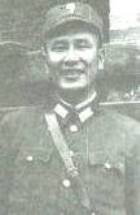 Sun Chuanfang came back toward Chuzhou in the south on August 15th. The Northern Armies returned via the Jin-Pu Railway and the Canal, and blasted the southern Yangtze bank for days. On August 21st, Zhang Zongchang went to Peking for briefing Zhang Zuolin as to Sun Chuanfang's military actions. Zhang Zuolin dispatched the Bo-hai Sea Fleet to Wusongkou the Yangtze River mouth. Sun Chuanfang then moved his command center to Luhe. On the night of the 25th, Sun Chuanfang mounted a "Crossing-the-Yangtze" campaign against Nanking. On the southern bank, the Nationalist Army had disbursed the first route army to Wulongshan-Longtan-Qixiashan, the second route army to the upperstream Yangtze, and the third route army to the middle segment. Li Zongren, after his return to Nanking from a trip to meeting the KMT leftwing government leaders, had ordered that Liao Lei dispatch an extra 8 regiments to Mt Wulongshan.
More available at Battle of Longtan.
(Check
RepublicanChina-pdf.htm
page for up-to-date updates.)
* In Commemoration of China's Fall under the Alien Conquests in A.D. 1279,
A.D. 1644 & A.D. 1949 *
U.S.S.R./Comintern Alliance with the KMT & CCP (1923-1927)
Korean/Chinese Communists & the 1931 Japanese Invasion of Manchuria
American Involvement in China: Soviet Operation Snow, IPR Conspiracy, Dixie Mission, Stilwell
Incident, O.S.S. Scheme, Coalition Government Crap, Amerasia Case & The China White Paper
* Stay tuned for "Republican China 1911-1955: A Complete Untold History" *
|
|
Zou Rong's Revolutionary Army;
Shin Kyu Sik's
Shrine (Spirit, Kunitama) of Korea
|
This snippet is for sons and daughters of China:
Heed the sons & ministers' agony and sorrow of our ancestors who died or lived through the Mongol, Manchu and Soviet-Chicom conquest
and
the Yongjia, Jingkang and Jiashen cataclysms !
Jeanne d'Arc of China:
Teenager girl Xun Guan breaking out of the Wancheng city to borrow the relief troops in the late Western Jinn dynasty;
Liu-Shao-shi riding into the barbarian army to rescue her husband in the late Western Jinn dynasty;
teenager girl Shen Yunying breaking into Zhang Xianzhong's rebels on the horseback to avenge on father's death in the late Ming dynasty.
China's Solitary and Lone Heroes:
Nan Jiyun breaking out of the Suiyang siege and charging back into the city in the Tang dynasty;
Zhang Gui & Zhang Shun Brothers breaking through the Mongol siege of Xiangyang in the Southern Soong dynasty;
Liu Tiejun breaking through three communist field armies' siege of Kaifeng in the Republican China time period;
Zhang Jian's lone confrontation against the communist army during the June 3rd & 4th Massacre of 1989.
|
|
|
The Second Northern Campaign
On December 11th, the communists, under the leadership of Zhang Tailei and the Soviet Consulate, staged the "Canton Commune" rebellion (mutiny) in Guangzhou of Guangdong Province.
Chiang Kai-shek, after return to Shanghai from Japan, attended the Supervisory Committee commissars' meeting of the Second Kuomintang Central Executive Committee, who gathered in Shanghai to hold the preparatory meeting of the Fourth Plenary Session of the 2nd KMT Congress. The meeting, with the support of Feng Yuxiang and Yan Xishan who wanted the Nanking government to send troops northward to relieve their precarious military situation, reinstated Chiang Kai-shek as commander-in-chief of the National Revolutionary Army and called for the dissolution of the KMT Special Committee
Commission, a body which was organized by the Guangxi Military Clique with the support of the KMT West Hill Faction.
On December 12th, Heh Yingqin's 1st Route Army began to attack Xuzhou and took over the Xuzhou airport, and four days later, took over Xuzhou with sacrifice of life by 65th Regiment Chief Cheng Shi in the Battle of Zhilan.
On the 14th, the KMT Government in Nanking rescinded the diplomatic relationship with the U.S.S.R. The KMT leadership had dispute in regards to the Soviet involvement in the Canton mutiny, with Wu Jingheng and Wang Ching-wei (Whang Jingwei) against each other. Senior KMT leaders, including Deng Zeru and Gu Yingfen, rebuked nine KMT commissars including Wang Ching-wei, namely, those under Wang Ching-wei's Cantonese faction.
The internal disputes led to a compromise among the KMT factions to revoke the qualification of Wang Ching-wei, Chen Gongbo, Gu Meng Yu, Gan Naiguang, i.e., four senior members of Wang Ching-wei’s Cantonese faction, for attending the 4th plenum in lieu of censuring them over their role in inducing the communist mutiny in Canton, i.e., the Canton Commune. Wang Ching-wei, fearful of attempts on his life by the Guangxi Clique, travelled to France. Hu Hanmin and Su Ke’s faction, which purportedly did not wish to be used by the Guangxi Clique to counter Chiang Kai-shek, went to Turkey on an overseas inspection. Zhang Ji, Xie Chi, Ju Zheng and Xu Chongqing et al., senior members of the West Hill Faction, which together with the Guangxi Clique controlled the former KMT special committee, left for Japan instead and subsequently travelled to Europe.
Wang Ching-wei (Whang Jingwei) resigned his post for an overseas trip on December 17th.
More available at The 2nd Northern Campaign.
(Check
RepublicanChina-pdf.htm
page for up-to-date updates.)
* In Commemoration of China's Fall under the Alien Conquests in A.D. 1279,
A.D. 1644 & A.D. 1949 *
U.S.S.R./Comintern Alliance with the KMT & CCP (1923-1927)
Korean/Chinese Communists & the 1931 Japanese Invasion of Manchuria
American Involvement in China: Soviet Operation Snow, IPR Conspiracy, Dixie Mission, Stilwell
Incident, O.S.S. Scheme, Coalition Government Crap, Amerasia Case & The China White Paper
* Stay tuned for "Republican China 1911-1955: A Complete Untold History" *
|
|
Zou Rong's Revolutionary Army;
Shin Kyu Sik's
Shrine (Spirit, Kunitama) of Korea
|
This snippet is for sons and daughters of China:
Heed the sons & ministers' agony and sorrow of our ancestors who died or lived through the Mongol, Manchu and Soviet-Chicom conquest
and
the Yongjia, Jingkang and Jiashen cataclysms !
Jeanne d'Arc of China:
Teenager girl Xun Guan breaking out of the Wancheng city to borrow the relief troops in the late Western Jinn dynasty;
Liu-Shao-shi riding into the barbarian army to rescue her husband in the late Western Jinn dynasty;
teenager girl Shen Yunying breaking into Zhang Xianzhong's rebels on the horseback to avenge on father's death in the late Ming dynasty.
China's Solitary and Lone Heroes:
Nan Jiyun breaking out of the Suiyang siege and charging back into the city in the Tang dynasty;
Zhang Gui & Zhang Shun Brothers breaking through the Mongol siege of Xiangyang in the Southern Soong dynasty;
Liu Tiejun breaking through three communist field armies' siege of Kaifeng in the Republican China time period;
Zhang Jian's lone confrontation against the communist army during the June 3rd & 4th Massacre of 1989.
|
|
|
The National Humiliation Memorial Day
At Jinan, the Japanese army, which landed in coastal Qingdao in the summer of 1927 but evacuated in five batches after protests from the Peking Government, would stage a comeback on April 27th, 1928.
Back in July [June 27th to July 7th per LDF] 1927, Japanese Prime Minister Tanaka convened an "Orient Meeting" in Tokyo, which led to the production of the notorious Tanaka Memorandum, a copy that the Soviets were to obtain via some Soviet agent operation in Tokyo per Leon Trotsky's claim and that Zhang Xueliang separately obtained, through bribery of Takejiro Tokonami, for distribution at the third IPR conference in Kyoto. In August, the Japanese consuls, under the orchestration of Mori Kaku, i.e., Japan's parliamentary secretary, convened a Dalian Meeting inside China.
On April 27th, 1928, about 5000 Japanese troops from the 2nd Shidan landed in Qingdao. 400 Japanese were sent southward to the Jiao-Ji Railway in Shandong Province from Tianjin's Japanese concession territory.
Zhang Zongchang was said to have secretly sold out interests in Qingdao and on the Jiao-Ji Railway to the Japanese for help in fending off the Northern Expedition forces.
(Japanese Prime Minister Tanaka, who coerced Manchurian Warlord Zhang Zuolin with construction of Jilin and Heilongjiang railways, later resigned under the pressure of the Japanese emperor in July 1928 ensuing from the international uproar over the death of Zhang Zuolin in the hands of the Japanese Kwangtung Army.)
In face of the Nationalist Army's Second Northern Expedition, on May 2nd, i.e., the second day after Ji'nan fell into the revolutionary army, the Japanese had taken up positions at the Japanese consulate, the Japanese School, the Ji'nan Hospital, and the Japanese-controlled "Ji'nan Daily" newspaper office. The Japanese army set up barber wires and checkpoints throughout the commercial districts of the city and shot dead any Chinese who approached them.
Xu Zhen stated that on May 1st and 3rd, Heh Yaozu's 40th Corps had conflicts with the Japanese army.
Chiang Kai-shek convened a meeting in Ji'nan for sake of trying to avoid confrontation with the Japanese. Hu Zongnan refused to take up the task of garrison for Ji'nan.
On May 3, the Japanese, who had dismantled some barbed wires the previous day, set up cordon around its consulate. At about 9 am, the Chinese troops from the 40th Corps, carrying a wounded soldier en route to a Christian hospital across China's diplomatic representative’s office in Ji’nan, were shot at by the Japanese army, leading to the death of one Chinese soldier and one military cook, and the dispersing of the Chinese troops into hiding in the hospital. One Japanese soldier, who aimed to shoot at the hospital in front of the representative’s office, was suddenly found himself to be surrounded by gunfire and killed by a stray bullet. When another Japanese soldier came to aid the dead soldier, he was killed as well. At about the same time, the Japanese attacked the Chinese soldiers painting wall posters at Weijiazhuang and launched an assault against the Chinese barracks where two battalions of troops belonging to the 7th Regiment of the 3rd Division of the 40th Corps were barracked, almost annihilating one battalion in whole. At 10:30 am, when some Japanese were stopped from passing through the cordon line of the 40th Corps, the Japanese army across the city went into action to shoot at the Chinese troops and civilians in a rampage. Past noon, the Chinese army launched counterattacks against the Japanese. Fang Zhenwu’s 41st Corps, whose 92nd Division was designated the garrison force of Ji’nan, joined the 40th Corps in the self-defense against the Japanese. Sasaki Doyichi, Japan’s military attaché in Nanking who embedded himself with the northern expedition army in 1928 and served as a liaison staff tactician, contacted Chiang Kai-shek to have the Chinese side cease fire. Chiang Kai-shek ordered the 41st Corps troops to leave the outskirts no later than 5 pm. Days earlier, at Yanzhou, Sasaki first learnt of Japan’s troop dispatch to Shandong, tried to excuse the Japanese side in telling Chiang Kai-shek that the Japanese army would resort to force should the Chinese army undertake illegal actions, and was sent to the Japanese camp to relay a message that the northern expedition could consider stopping short of the commercial district of Ji’nan. The gunfire exchange at the diplomatic representative office continued till 3-4 pm when the consulates of various countries intervened by driving their vehicles to the scene with their national flags waving. Foreign minister Huang Fu personally visited the Japanese command center to raise a protest. The Japanese, who disarmed Huang Fu’s bodyguards and confiscated twenty-six guns, refused to let go negotiators sent by the Nationalist Government and demanded that the Nationalist Army retreat 20 kilometers away from the Ji'nan city. Taking advantage of the exit of the Chinese army, the Japanese army disarmed over 1000 soldiers of the 7th Regiment under Tao Zhiyue’s 3rd Division of the 40th Corps, as well as the 1st Regiment under Chen Diaoyuan’s 37th Corps and the police force of the 1st district of the Tientsin-Pukow Railway. The Chinese civilian and military deaths on May 3rd alone could amount to over one thousand.
At night, over twenty Japanese troops, led by two officers and a plaincoat in western suits, intruded into the diplomatic representative’s office in Ji’nan, cut off phonelines, claimed to be searching for weapons to see whether the Japanese soldiers who were killed in front of the building were shot at by people from inside the representative's office, forced Cai Gongshi into agreement to having the hands of his 16 entourage bound for a search, ransacked the cabinets to locate five bags of documents for taking out when no weapons found, and were bound for the outside when Cai Gongshi asked them to untie the staff, over which the Japanese went into a rage. After a while, the Japanese returned to the room to have Cai Gongshi bound as well. When Cai Gongshi protested on basis of the diplomatic protocol, Japanese soldiers lined up the staff in a semi-circle, used knives and bayonets to mutilate the heads of the Chinese staff by means of peeling and hacking, and upon the resistance and curses of the Chinese staff, pushed out the Chinese and executed them in batches. Japanese soldiers broke the leg of commissioner Cai Gongshi, cut off the ears and nose, smashed his teeth, dredged tongue and eyes, and shot him. Zhang Hanlu, Cai Gongshi’s assistant, who picked up a scissor to untie himself by taking advantage of the darkness, jumped over the four walls consecutively during the chaos and hid himself in an empty water bin. Altogether, the Japanese massacred 17 persons including diplomatic division director [of the battlefield political affairs committee] and Shandong negotiator Cai Gongshi, a veteran revolutionary who followed Sun Yat-sen in Japan since mid-1910s, witnessed Sun Yat-sen’s will in 1925, and took part in Huang Xing-led Qinzhou Uprising of 1908. The Japanese, after killing the staff, went to the office of the Chinese foreign ministry to demand that the Chinese troops at Ji’nan put down the weapons.
On May 5th, Chiang Kai-shek, leaving an order that Li Yannian's regiment that belonged to Liu Zhi’s army corps as well as a regiment of troops belonging to Fang Zhenwu’s army corps stay behind to maintain order in the Ji'nan city for two days, and Su Zongce, who was acting commander of the 41st Corps, take over the acting garrison commander post for Ji’nan, ordered the nationalist army to take the roundabout route to cross the Yellow River for the north. Chiang Kai-shek relayed a letter to Fukuda about the pullout of the Chinese army from Ji’nan. Arriving at Dangjiazhuang from Ji’nan, Chiang Kai-shek and Yang Jie had a meeting with Feng Yuxiang and Qin Decun who came over from Kaifeng of Henan Province. The consensus was to leave a small number of troops to monitor the situation in Ji’nan while the main army was to cross the Yellow River at the Qihe County crossings for continuing the pursuit of the northern army towards Peking. The Japanese Saito Ryodan, tracing behind the Chinese army, fought a battle against Yu Yanong’s [[??]] 89th Division of the 34th Corps, part of Fang Zhenwu’s army, at the Yellow River Iron Bridge.
On May 8th, the Japanese government approved reinforcement of Yasumitsu Kinyichi's 3rd Shidan to Shandong.
On May 10th, the Japanese, learning that the nationalist army had crossed the river, renewed the battle against remnant Chinese troops in Ji’nan in an outrage, with battles reaching a stalemate. The Japanese committed the widespread Ji'nan massacre, killing over 2000 civilians. At 11:30 pm on May 10th, under garrison commander Su Zongce’s order, Li Yannian's regiment and Bao Gang’s army pulled out of Ji’nan from the east gate. Bang Gang, the 91st Division commander of Su Zongche’s 41st Corps under Fang Zhenwu’s 4th Corps Group, who set his headquarters on a street across the Hengdeli clock and watch shop, broke through the gun fire blockade of Japanese machine guns. The Japanese army consequently launched a massacre of the Ji'nan city.
The Japanese army shot dead 200 wounded Chinese soldiers at a hospital and killing over 2000 civilians. Unofficial account stated that as many as 101,062 soldiers and civilians were killed and wounded during the "Jinan Bloody Incident".
According to the investigation report from the Joint Committee of the victims’ families of the Jinan Massacre, total Chinese soldiers and civilians killed amounted to 6123 people, and injured more than 1,700. Unofficial account stated that as many as 101,062 soldiers and civilians were killed and wounded during the "Jinan Bloody Incident". The Nationalist Government later decreed that May 3rd be designated the "National Humiliation Memorial Day".
On the 10th, Chiang Kai-shek, in a Yanzhou meeting with senior KMT leaders, reaffirmed the non-confrontational approach adopted by a joint party-government meeting on the previous day; however, troops in Ji’nan failed to receive the order to abandon Ji’nan and resisted the Japanese till the 11th, for which Chiang Kai-shek had to revoke Heh Yaozu’s post of commander of the 3rd Corps-group and relayed a message of apology to the Japanese. The KMT Central Daily on the 11th claimed that China, not intending to fall into the trap of fighting the northern warlord army and the Japanese army simultaneously, had continued on the northern expedition via a roundabout move around Ji’nan.
Former president Li Yuanhong (1864-1928, r. Jun 7, 1916-Jul 14, 1917; Jun 11, 1922-Jun 13, 1923), before death on June 3rd, left behind a telegram urging all parties to cease fighting, with 10 propositions such as seeking a diplomatic and just solution to the Ji'nan Bloody Incident and
convening the National Assembly, etc.
After Tanaka resigned in July 1928 over the June 4th death of Zhang Zuolin, Chiang Kai-shek dispatched Wang Zhengting to goodwill negotiations with the relatively friendly Japanese prime minister Shidehara Kijuro [Biyuan Xichonglang in Chinese]. By March 28th, 1929, the Japanese foreign minister acknowledged the 'Jinan Incident' as a misfortune and agreed to withdrawing the troops from Shandong within two months.
(Wang Zhengting would also be responsible for terminating the Belgian settlement in Tianjin on August 31st, 1929 and the British lease of Weihaiwei on October 1st, 1930.)
The Unification of China
By mid-May, the Nationalist Army approached Baoding and Dezhou. On May 30th, Zhang Zuolin's An-guo-jun army declared a general retreat towards the Luan-he River area. The next day, the 1st Group Army took over Baoding.
On June 1st, Chiang Kai-shek held a meeting with Feng Yuxiang and Yan Xishan at Shijiazhuang in regards to recovering Tianjin & Beijing. The next day, Zhang Zuolin sent a public wire about his exit from Peking. On June 3rd, Zhang Zuolin and his entourage of about 30 rode on train for Shenyang (Mukden) of Manchuria. However, at about 5:30 am, on the morning of June 4th, on the way home, Zhang Zuolin's train was bombed by 30 bags of yellow powder at the Huanggutun train station near Shenyang city. The Kwantung Army placed two dead bodies at the scene and claimed that the spies from southern China had blasted Zhang Zuolin's train. (The Japanese later acknowledged that they did the assassination, while some revisionist scholar had claimed that it was the Soviet agents who laid the mine.)
The Manchurian army, i.e., Feng-xi army, swarmed out of the Shanhaiguan Pass upon hearing the death of their commander.
Zhang Xueliang stealthily returned to Shenyang on June 18th and assumed the post of commander-in-chief on July 4th.
By June 6th, Yan Xishan's 3rd Group Army reached the outskirts of Peking. By June 8th, Sun Chu, an officer under Shang Zhen's rightside column of the 3rd Group Army, led three regiments into Peking through the Xuanwumen City Gate. 7th Corps Chief Zhang Yinwu entered Peking next and was conferred the post of garrison commander.
The Revolutionary Army then converged upon Tianjin.
At Tianjin, Zhang Zongchang and Chu Yuepu fled to Luanhe, and remnants, about 200,000, surrendered to the revolutionary army without a fight.
On June 20th, the KMT central politics meeting decreed that Zhili be renamed Hebei, and Beijing [Peking] be renamed Peiping [Beiping].
Beiping and Tianjin cities were put under special jurisdiction.
Also in June, Governor-general Yang Zengxin, in Chinese Turkestan, declared a change of flag to the Nanking Government's "blue sky and white sun flag".
On June 9th, Chiang Kai-shek issued a public wire as to resigning the posts of commander-in-chief of the northern expedition army and chairman of the military committee on the ground that the northern expeditions were accomplished. The public wire called for a demobilization. On June 12th, Chiang Kai-shek announced the relinquishment of the post as chairman of the KMT Central Politics Meeting. Ding Weifen of the KMT Party Affairs Department followed suit with a resignation announcement; navy commander Yang Shuzhuang submitted his resignation; and 1st Corps Chief Liu Zhi pretentiously applied for overseas studies in Europe. Also on June 12th, Feng Yuxiang, being still angry over Yan Xishan's control over the Peking-Tientsin area, first sent a wire for dissuading Chiang Kai-shek as to resignation. Seeing no reply from Chiang Kai-shek, Feng Yuxiang further wired to express a wish to resign together should Chiang Kai-shek be adamant about it. Thereafter, Yan Xishan, Bai Chongxi, Li Zongren, Heh Yingqin and Li Jishen et al sent in wires for dissuading Chiang Kai-shek of resignation.
On June 17th, Chiang Kai-shek revoked his resignation and returned to Nanking from his hometown.
On July 2nd, Heh Yingqin first talked about contracting the armies to 80 divisions from 300 divisions nationwide.
Hu Zongnan's 22nd division was contracted to the 2nd brigade under the 1st division in Qufu of Shandong Province in late August. (Hu Zongnan was said to have retained 60 officers on his own payroll.)
On July 3rd, commanders-in-chief of the four routes of the Revolutionary Army entered Peking.
On July 6th, four commanders went to the Biyunsi Monastery on Mt Western Hill for paying respect to Dr Sun Yat-sen's altar.
On July 8th, 1928, Chiang Kai-shek declared that Dr Sun Yat-sen's coffin be moved to Nanking the capital.
In Peking, Feng Yuxiang held a banquet inside of the Forbidden City. During the banquet, Feng Yuxiang suddenly ordered that hundreds of staff workers converge onto the dining hall and shout aloud to the guests, stating that Feng Yuxiang, after kicking out the last Qing Emperor, did not steal the "national treasures" as the rumor said.
On August 9th, the KMT politics meeting decreed that Qinghai, Xikang [western Sichuan], Rehe, Chahar and Suiyuan be zoned as provinces.
On October 8th, the KMT standing committee made Chiang Kai-shek into chairman [president] of the National Government. Tan Yankai, Hu Hanmin, Wang Chonghui, Dai Chuanxian [Dai Jitao] & Cai Yuanpei were made into ministers of five Government departments.
On November 10th, Chiang Kai-shek inspected the 1st Division at Xuzhou where he probably first discussed the issue of neo-warlords.
On December 29th, 1928, Zhang Xueliang, son of late Zhang Zuolin, together with Zhang Zuoxiang and Wan Fulin, against the Japanese threats and coercions, declared in a public wire that the four provinces of Feng [Liaoning], Ji [Jilin], Hei [Heilongjiang], & Ri [Rehe] change flag to that of the Republic of China, obey the National Government, and follow the "Three People's Principles".
On December 31st, 1928, Chiang Kai-shek conferred the post of "Manchuria border commander-in-chief" onto Zhang Xueliang, and further ceded Rehe Province to be under the jurisdiction of Manchuria. Fengtian was renamed to the Province of Liaoning.
(Heh Chengjun, a disciple of Huang Xing while studying at Japan's Zhenwu Military School in 1904, was said to have been responsible for persuading Zhang Xueliang into this move. Li Zongren memoirs stated that Zhang Xueliang dispatched two emissaries [Xing Shilian & Wang Shuhan] to Peking on July 8th, 1928 for peace talks with the four leaders of the Nationalist Army Groups. Li Zongren stated that he had advocated for a peaceful solution to Manchuria, while Feng Yuxiang & Yan Xishan deeply disliked Zhang Xueliang and proposed a military solution.)
China was finally reunited again under the National Government of the ROC.
In May-June 1929, Dr. Sun Yat-sen's bronze coffin was moved to the Zijinshan Mountain of Nanking from Peking. Warship Weisheng-jian sailed through Pukou and delivered the coffin at the Xiaguan Dock, next to Nanking, on June 28th, with honorary cannon shooting to the skies as salutes. Kong Xiangxi, who was reported to be a fat man riding a fat horse at the scene, personally led a staff of 32 men aboard Warship Weisheng-jian. The ships in the Yangtze River, domestic and foreign, all fired cannons to show respect.
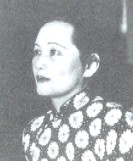 Mme Sun Yat-sen, wearing all black, stepped onto the Zhongshan Dock (with a newly built wharf) together with the funeral column. At the dock, Chiang Kai-shek was wearing white robe and black vest while the rest of the KMT central executive committee members in blue robes and black vests, all walking barefoot as show of respect. Then vehicles carrying the coffin drove to the KMT party headquarters for the coffin-waiting ceremony. The three Soong family sisters, with tears, followed the coffin in the vehicle column. Sun Yat-sen's long-time Japanese pals also participated. Above the coffin at the KMT party headquarters was a banner stating "Spirit Immortal Forever". From May 26th to June 1st, a period of 'holding in peace' was declared, with innumerable civilians and soldiers participating in the coffin relocation ceremony. (Description from "A Journey Through China - A Pictorial Walk, 1927-1997", Tian-Xia-Wen-Hua Publishing House, Taipei, Taiwan, 1997)
Wars Of Chiang Kai-shek versus the Gui-xi Cliqiue (March 1929)
The KMT Government under Chiang Kai-shek, having barely united China, would be engaged in numerous rounds of civil wars with the communists as well as the KMT opponents & adversaries [termed the "neo-warlords" by Chiang Kai-shek].
In the early years, however, Chiang Kai-shek was accused by Li Zongren of having deliberately adopted the approach of "yang [multiplying] fei [communist banditry] zi [for enhancing selfish] zhong [important position of being indispensable]". In 1929, Chiang Kai-shek launched two wars with the Guangxi Province armies [i.e., the 4th group army]; and in 1930, Chiang Kai-shek engaged himself in the bloody War of the Central Plains.
Li Dongfang claimed that the central government side incurred a casualty of 95,000 while the opposing camp 150,000.
Yu Maochun, citing Soong Ziwen's bragging in front of the U.S. president in 1943, pointed out that Chiang Kai-shek had won the civil wars as a result of Soong Ziwen (T.V. Soong)'s decoding the opponents' telegraphs.
T.V. Soong hired Wen Yuqing for the telegram deciphering job.
In January 1928, Wen Yuqing, a Harvard graduate who purportedly studied under George W. Pierce and Emory Leon Chaffee, was appointed the post of director of the Radio Administration Bureau of the Ministry of Transportation of the national government. Months later, Wen Yuqing began to decode the telegrams of warlords and military strongmen as concurrent chief of the telegram branch (diànwù g?) of the National Revolutionary Army headquarters, culminating in Chiang Kai-shek's victory in the Wars of the Central Plains in 1930.
In January 1928, T.V. Soong was officially appointed by the national government (in Nanking) as minister of finance with concurrent position as national government commisssar (i.e., state councilor equivalent). T.V. Soong in the early years had high ambition as seen in launching the anti-smuggling gabelle police force under the finance ministry in 1930-1931 as well as in contacting the Americans in regards to building China's national air force, that culminated in establishment of the Central Aviation Academy at the Jianqiao Airport of Hangzhou in 1932.
Between 1928 and 1930, Soong worked on negotiating with the powers as to tariff autonomy, i.e., taking back the right to determine tariff rates and supervise taxation.
In June 1928, Wang Zhengting, the Foreign Minister of the Nanking government, launched a "revolutionary diplomacy" centered on revising unequal treaties.
On July 25, 1928, the United States took the lead in signing the Sino-US Tariff Treaty with the Nanking National Government. Subsequently, nine countries including Britain, France, the Netherlands, Norway, Belgium, and Denmark also signed new tariff treaties with the National Government.
Serving under Wen Yuqing, however, were Yang Si and maternal cousin Wang Weijun who had constant liaison with communist cousin Yang Shu, a student leader involved in the Peking student movements and future husband of Leftist writer Wei Junyi.
The two were to be converted to the communists after the eruption of war against Japan.
At the same time, the communist moles, like Qian Zhuangfei, Li Kenong & Hu Di [Hu Beifeng], already penetrated into Chiang Kai-shek's spy and wire network.
More, next to the major warlords and militarists who waged the wars against Chiang Kai-shek would be some undercover communists.
After Li Kenong, et al., were exposed, still one more undercover communist by the name of Li Zhifeng remained in the KMT organization department.
The direct consequence of the civil wars would be: i) the Communist disturbances; ii) the Japanese invasion of Manchuria.
Li Zongren & Bai Chongxi of the Gui-xi [Guangxi Province] clique was counted as one of the four military groups together with Chiang Kai-shek's Central Army, Feng Yuxiang's Northwestern Army and Yan Xishan's Shanxi Province army.
During the northern expeditions, the Gui-xi, aside from home base in the Guangxi Province [under Huang Shaohong & Huang Xuchu], directly controlled Hunan-Hubei Provinces, with Li Zongren controlling Xia Wei's 7th Corps, Tao Jun's 18th Corps, Hu Zongduo's 19th Corps, and Heh Jian & Lu Diping's troops in Hunan Province. Other than Li Zongren, Bai Chongxi extended his influence to the NRA troops in Peking, Tianjin and Tanggu to the north.
At this time, Tang Shengzhi defected back to Wang Ching-wei's side over Chiang Kai-shek's broken promise to give Hunan back to him. In December 1929, Tang Shengzhi, i.e., commander-in-chief of Chiang's 5th Route Army, struck an anti-Chiang agreement with Feng Yuxiang (who was nominally still under house arrest in Shanxi). Tang sent a public wire of rebellion on December 5th.
Tang posted a most-wanted notice for Dai Li after 5th route army general director Tang Shengzhi on December 5th rebelled in Zhengzhou to echo Shi Yousan's rebellion in Pukow.
Dai Li, who was in Tongguan of Shenxi, hurried back to central Henan to investigate, and when he arrived in Xinyang, he found that the situation the military and police in plain clothes were examing pedestrians, and hence checked with a local primary school principal named Li who told him that Tang Shengzhi ordered the arrest of a secret agent sent from Nanking by Commander-in-Chief Chiang. Dai Li, seeing no way out, went straight for Whampoa 4th session schoolmate Zhou Weilong's office and successfully instigated Zhou for defection.
Tang, claiming to be 4th route army commander-in-chief of the Party Protection and National Salvation Army, led his main force including Liu Xing and Gong Hao's armies for attacking Wuhan along the Peking-Hankow Railway. Tang Shengzhi, who cooperated with the KMT reorganization faction, enlisted Shi Yousan (then Anhui provincial chair) against Chiang Kai-shek, with adoption of 4th route army commander of Wang Ching-wei's Party Protection and National Salvation Army ("Hu-dang-Jiu-guo-jun"). Shi Yousan was the 5th route army commander who sent the public wire on December 2nd, three days earlier than Tang Shengzhi who sent a telegram to the whole country on December 5th, that arbitrarily included the names of some division commanders of the central army in the telegram.
Deng Zhanmou, i.e., Dai Li's former intelligence group subordinate and a company commander in Hu Zongnan's 1st Brigade (renumbered from the 2nd Brigade) of Xu Tingyao's Reorganized 1st Division at the Luohe Station, was suddenly visited by Zhou Weilong in plain clothes. Zhou Weilong, coming to see Hu Zongnan, claimed that according to Mr. Dai's plan, he had instigated a certain unit of Tang's army to defect to Hu Zongnan. Since Hu was not in, Deng immediately introduced Zhou to division commander Xu Tingyao for making the plan to instigate Tang's army from inside out. In December 1929, Tang Shengzhi, taking advantage of the undefended segment of the Baoji-Lianyun'gang (Long-Hai) Railway. rushed his troops towards Wuhan from Henan. While stopping in the area around Zhumadian of Runan, on January 1st, 1930, Tang Shengzhi was attacked by Yang Hucheng's army that stationed in Nanyang at the time, and lost the logistic base at the Zhumadian train stop.
In January 1930, Tang Shengzhi counterattacked Zhumadian. The Central Army succeeded in one fell swoop and won a decisive victory with the favorable situation of Zhou Weilong's echoing the attack from inside of Tang's army. Zhou Weilong subsequently left Tang Shengzhi's army, and joined Dai Li in taking up the intelligence work.
The Nationalist Army Re-organization & Shrinkage Meeting
Chiang Kai-shek left Peking on July 25th. Li Zongren paid a visit to Kaifeng where Feng Yuxiang hosted the trip.
On August 8th, the KMT 5th Plenary opened its session. At the meeting, Chiang Kai-shek and the rest of the KMT leaders disputed the issue of "centralized rule" versus "provincial autonomy". A five department system was set up, with Chiang Kai-shek made into president of the National Government. The topic of "Re-organization & Shrinkage of Armies" was proposed.
Li Zongren suggested that Yan Xishan & Feng Yuxiang may not like to stay in the capital permanently while he himself had no issue with staying put in Nanking. Li Zongren stated that it was easy to dismiss the soldiers, but not the officers, not to mention dismissing the senior military leaders. Further, Li proposed an arrangement for the senior military leaders to have overseas inspection or studies.
However, Chiang Kai-shek did not heed Li Zongren's call as a result of Chiang Kai-shek’s plan to preserve his own group army at the expense of the rest, according to Li Zongren.
On January 1st, 1929, Chiang Kai-shek officially convened the disarmament meeting in Nanking, termed the "Nationalist Army Re-organization & Shrinkage Meeting", a meeting that would last for a whole month.
Meeting began with an oath administered by Gu Yingfen; two drafts from Feng Yuxiang and Yan Xishan were proposed; and Yan Xishan was made into director of the economic management team for the Re-organization & Shrinkage Committee. Feng Yuxiang objected to Chiang Kai-shek's plan to shrink his 2nd group army of 10 corps & 8 detached divisions [420000 soldiers] by pointing out that Chiang Kai-shek should shrink the 1st group army of 20 corps & 4 detached divisions [500000 soldiers]. Chiang Kai-shek proposed to adopt the draft system for the national military instead of solicitation and recruitment system. Soon, Feng Yuxiang, who was against Yan Xishan's plan, asked his crony Xie Wubi to attend the meeting instead. Xie Wubi argued against Chiang Kai-shek's classifying the Northwestern Army as ill-disciplined rascals by pointing out that the source of soldiers for his 2nd Group Army had come from the county magistrates.
Chiang Kai-shek intended to reduce the headcounts of Yan Xishan's 2nd group army, Feng Yuxiang's 3rd group army and Li Zongren's 4th group army.
Thinking he was more Muslim-related, Bai Chongxi, i.e., head of the "Muslim patriotic society", at one time, proposed to be assigned to the "northwestern mobile military camp" (i.e., the generalissimo's northwest military headquarters), but Chiang Kai-shek sent Cheng Qian to the Northwest, instead.
Bai Chongxi, for fear of being detained by Chiang Kai-shek, deliberately sought excuses to avoid a trip to Nanking for attending the meeting.
At this time, Li Jishen, who was pressured by Chiang Kai-shek into releasing the provincial chair post for Guangdong Province to Chen Mingshu on November 21st, 1928, came to Nanking for the meeting. Li Jishen proposed a plan of dividing China into 5 military districts and 1 central military district, with the airforce and navy subject to the central military district.
The first session ended on January 25th, with a decision to reduce the national military to 65 divisions, 8 cavalry brigades, 16 cannons regiments and 8 engineering regiments.
Five regional Re-organization & Shrinkage Sub-Committee offices were to be established in Nanking, Kaifeng, Beiping, Hankou & Shenyang, with Heh Yingqin in charge of the 1st Group Army, Lu Zhonglin the 2nd Group Army, Zhou Dai the 3rd Army Group, and Bai Chongxi the 4th Group Army.
The 5th sub-committee of Shenyang was for Zhang Xueliang's Northeastern Army, while the 6th sub-committee was for the Southwestern provinces of Yunnan, Guizhou Sichuan, and Xikang.
Yan Xishan made a pretext for slipping back to Taiyuan of Shanxi Province. At the advice of counselor Zhang Fang [Zhang Boying], Feng Yuxiang pretended ill by burning charcoal inside his bedroom and covering himself with two layers of cotton bedsheets. Chiang Kai-shek personally visited Feng Yuxiang to check on the illness.
On February 14th, Feng Yuxiang slipped across the Yangtze for Pukou (Pukow) where his armored train was waiting. The "Nationalist Army Re-organization & Shrinkage Meeting" came to an end with no resolution.
The War of Chinese Eastern Railway
In Manchuria, on May 27th, 1929, Zhang Xueliang's troops raided the Soviet consulate in Harbin, confiscated the 3rd Comintern documents, and arrested 39 Russian and Chinese communists.
On July 10th [?], Zhang Xueliang's troops, with Chiang Kai-shek's acquiesce (?), took over the Chinese Eastern Railway, arrested the Russian management and shut down the Soviet consulate and its affiliated commerce centers.
Li Dongfang claimed that Zhang Xueliang ordered Lü Ronghuan to suspend the Soviet general manager
and replace it with deputy bureau chief Fan Qiguang on July 11th.
The Soviet and Chinese communists [59 staff of Russian citizenship per LDF] were expelled from Manchuria. The U.S.S.R. issued an ultimatum on July 13th; China declined the Soviet demands on 16th; and the U.S.S.R. severed diplomacy with China on July 18th [July 17th per LDF], expelled the Chinese diplomats from the U.S.S.R., recalled the Russians back home,
claimed to enforce the 1924 Sino-Soviet agreement on the railway, and launched an invasion [i.e., the War of Chinese Eastern Railway] on July 20th. (The Nanking government
had announced to sever diplomatic relations with the Soviet Union in December 1927 after the Soviet consuls in Canton took part in organizing and leading the mutiny, i.e., the Canton Commune.
The diplomatic relations between China and the Soviet Union would be what was struck between the Peking government and Karakhan in 1924.)
Throughout the time period to October, border clashes had occurred between the Soviet and Chinese troops. The Soviets in July took over the Shibali train station, i.e., the stop ahead of Manzhouli.
Along the Argun River, the Soviets occupied the Abagaitu Island in addition to making cross-river excursions to attack the Chinese border posts. Along the Amur River, the Soviets mounted
repeated attacks against the Chinese riverside counties.
Taking advantage of the Sino-Soviet conflicts, the Soviet Red Army was to occupy the Chinese
Yinlong (silver dragon) Island that was renamed to Tarabarov by the Soviets,
and the larger
Heixiazi (black bear) Island, i.e., the Bolshoi Ussuriysky Island, a sedimentary island at the confluence of the Ussuri and Amur rivers, which was not returned to China till 2005 when the Chinese settled the dispute with an agreement to return the Yinlong island, halve the Heixiazi island with Russia and forfeited the right to sail down the Amur-Ussuri rivers to the Japan Sea.
In October, the Soviet Amur Fleet sailed along the Sungari to attack Tongjiang and Fujin.
To the east, the Soviets crossed the Ussuri and the Kanka Lake to attack Miyun and Dongning.
The locality of Manchuria, surrounded by the Soviet-Mongol armies along three sides, doomed the fate of any defense war, as could be seen in the debacle of the Japanese Kwantung Army during the
August 1945 Soviet August Storm invasion as well as the debacle of the Chinese National Revolutionary Army during the 1947-48 campaign against the communists.
In November, the Soviet Red Army, with air support, occupied the Manchurian border cities of Chalainor, Manzhouli and Hailar. The Soviets occupied numerous Chinese counties including
Suibin, Tongjiang, Lubin and Haila'er by November. (Note that I wrote "cities" including Suibin, Tongjiang, Lubin and Hailaer in 1998 when I first published the html
article, making a mistake in mis-treating the R.O.C. counties as cities, and websites like
http://www.globalsecurity.org/military/world/war/sino-soviet.htm - should you google-search, copied and pasted my errors.)
The Chinese communist leaders, like Liu Bocheng and Liu Ying, together with Korean/Japanese communists, volunteered to go to the Sino-Russian border to fight Zhang Xueliang as a show of action in "militarily defending the Soviet Union".
Stalin, after a second thought, forbade the "volunteers" from direct military action and arranged for them to take part in the propaganda war against the Chinese prisoners of war.
Stalin originally planned to have
Liu Bocheng and Huang Ping's Far East Workers' Guerrillas, i.e., Asian brigades, fight Zhang Xueliang inside Manchuria and establish a puppet Soviet regime, but later changed mind to have the Far East Workers' Guerrillas conduct political work.
The Chinese Communists sent to the Far East in the summer of 1929 belonged to the fugitives from the 1927 Nanchang Mutiny. In 1930, majority of the gang were sent back to China to direct the
Red Army operations while a small group infiltrated into Chinese Turkestan where they plotted the coup to overthrow the Chinese rule.
At the Battles of Chalainor and Manzhouli, brigade commanders Haan Guangdi and Liang Zhongjia resisted the Soviet Red Army.
On November 17th, the Soviet infantry and the Soviet-Mongol cavalry, with purported troop strength of 7,632 men, launched a general attack at the Chinese positions in Chalainor and Manchuria under the support of air raids, tanks and artillery. As recalled by Vasily Ivanovich Chuikov, the Soviet strike force, consisting of the Kuban 5th Cavalry Brigade and the 35th Infantry Division with a purported fighting military headcount of 7632 soldiers [against purportedly the combined Chinese troop strength of nearly 16,000 people at Manzhouli and Chalainor], adopted [[Galens]]’s strategy to divide and conquer against the Chinese brigade at Zhanlannuoer before going after Manzhouli. Konstantin Konstantinovich Rokossovsky's Kuban cavalry brigade, followed by the infantry division, departed Abagaitu town at 3 o'clock am on November 17, crossed the Argun River’s ice surface, moved against the rear of Chalainor along the east bank of the Argun, at noon time cut off the railway traffic about 10-12 kilometers to the east of the Chalainor city, and attacked Haan Guangdi’s brigade from behind. The attacks against Manzhouli, coordinated with over 30 tanks and 29 planes, started at 6:00 on the morning of November 17. The plane bombing destroyed the Chinese Army’s headquarters, government agencies and army headquarters in Manzhouli.
The Soviets on the morning of November 20, ordered a general attack. Liang Zhongjia ordered a diversionary breakthrough towards the positions of the Buryat Mongolian cavalry battalion. The true breakout direction of the main Chinese force was to the southwest of Manzhouli for a roundabout trip around the Dalai Lake. Liang Zhongjia, after receiving wires from Wan Fulin and Hu Yukun, convened a mass meeting of leaders of various groups and circles at 14:00 pm and made a statement of retreat, pledging to protect all civilians and merchants should they wish to move together. Liang organized a commando team, with 300 soldiers organized into an impromptu cavalry force to march at the front of the breakout column.
Government employees and agency personnel rode in over thirty vehicles and trucks in the middle, and the remnant infantry troops walked in the hind. When Liang Zhongjia, commanding the cavalry in the front, moved to Xiaobaishishan, about 4 kilometers to the southwest of Manzhouli, they encountered interception from the Soviet artilleries. As recalled by
Vasily Ivanovich Chuikov, the Soviets concentrated all artillery units and the armored trains against the Chinese crowd of exodus, while the Soviet Air Force constantly bombed the clusters of crowds from the air. Liang Zhongjia commanded the cavalrymen in dashing into the Soviet artillery positions.
Under heavy shelling from the Soviet artilleries, armored trains and planes, the Chinese civilians and merchants, as well as the Chinese infantry troops at the rear, died by batches. Vehicles and trucks were all destroyed. Unable to rein in the people who pleaded for a return to the city, Liang Zhongjia, whose horse was killed in battle, returned to Manzhouli with the soldiers and civilians. Having suffered heavy casualties, the Chinese troops had to retract back to the city, with a small number of troops and people fleeing into the hills.
Upon entering Manzhouli, Liang Zhongjia had to fight a fierce bayonet battle against the Soviet Army which both intruded into the city beforehand and traced behind the crowd of exodus, with the wrestling fights continuing up to 6 hours before the Chinese troops fully repelled the Soviet troops. On November 21, with bullets all used up, Liang Zhongjia distributed 2,000 spears to the troops.
Having ordered the soldiers to protect the civilians and merchants, Liang Zhongjia attempted to break out of Manzhouli through the southeastern direction. In the move towards the Lama-jie (lama) Street,
Deputy brigade commander Wei Changlin,
fighting ahead as the vanguard troops along the south side of the railway line, sacrificed his life at the outside of the east gate of Manzhouli. Taking up Wei Changlin's role, Liang Zhongjia personally supervised the forward move and led the entourage to the Lama Street at 11:00 am. Seeing the infantry troops were intercepted by the Soviets at the hind, Liang Zhongjia rode back with his men to rescue the rearguards. At the Lama Street, Liang Zhongjia's men, with the civilians and soldiers included, were surrounded by the Soviets again. For one day and one night, the Chinese forces, who had not eaten any food, continued to fight the Soviet Red Army which had set its base in the Lama-jie district. From November 20th to 23rd, Liang Zhongjia’s soldiers fought 27 melee battles against the Soviet Army. The Japanese consul in Manzhouli came over to mediate over the situation, with a suggestion to have the Chinese troops surrender arms to the Soviet Army. When Liang Zhongjia attempted to explode a grenade to commit suicide, the Japanese consul and officers around rushed to grab the grenade. Then the Japanese consul escorted Liang Zhongjia to the Japanese consulate while the local gentry and business and community leaders selected representatives for talks with the Soviets on the matter of surrender and truce.
After the signing of the "Khabarovsk agreement, on January 10, 1930, Liang Zhongjia was released by the Soviets and returned to Manzhouli.
Shortly after Liang Zhongjia accused Hu Yukun of sitting out the war,
Liang died of gas poisoning and was speculated to be murdered.
The powers were reluctant to allow China to set a precedent in successfully revoking the unequal terms imposed on Manchu China. In supporting Zhang Xueliang’s action, Chiang Kai-shek, who hoped to enhance the prestige of the National Government that continued the anti-imperialism push after the reunification of China in 1928, such as requesting for the powers to abandon extraterritoriality, for example, found the European powers and the United States not enthusiastic about applying the Kellogg Treaty to resolving the Sino-Soviet dispute regarding the Chinese Eastern Railway.
On December 22nd, at Khabarovsk [Boli], Cai Yunsheng, i.e., Zhang Xueliang's rep, agreed to the restoration of the Soviet control over the railroads well as the resumption of normal trade between China and the Soviet Union.
(Thereafter, ROC rep Mo Dehui visited the U.S.S.R. for 25 talks but failed to win anything back.
After Japan invaded Manchuria on September 18th, 1931, the U.S.S.R. sold its interests in the Chinese Eastern Railway to Manchukuo, i.e., Japan's puppet.
Note that Czar Russia had not invested a cent in the Chinese portion of the China Eastern Railway
since Li Hongzhang and Manchu China had provided the funds and materials for the said "joint venture", while the funds for the railway project came from a French bank loan.
The U.S.S.R., through the Yalta Betrayal, gained back its interests in the Chinese Eastern Railway plus the Southern Manchurian Railway
via a "friendship treaty" that was coerced from China shortly after Japan's surrender in August 1945.
Chiang Kai-shek, having apparently lost his "time of opportunity" in the one and half months' negotiations with the "big nose", from June 1945 to the Japanese surrender in August 1945,
had not repented over his often-repeating mistakes, i.e., the loss of opportunity in stamping a better agreement with the communists between the Xi'an Coup of December 1936 and the eruption of Resistance War in July 1937. Or in another sense, the conspiracy against the Republic of China by the colonialists-communists 'win-win' team was so immense that there would be no chance for China to fight against the spider web.)
The Wuhan Incident
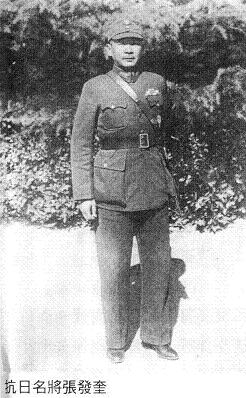
Quelling Tang Shengzhi
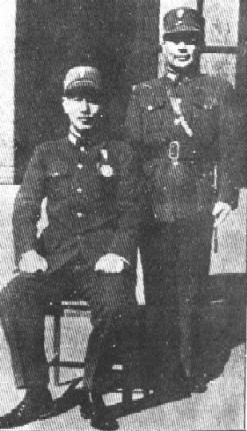
Li Zongren Experiencing the French "Dark House" Customs In Vietnam
To prevent Li Zongren, et al., from lending help to Feng Yuxiang, Chiang Kai-shek contacted the British governor for HK in having Li Zongren pals evicted from HK.
Li Zongren, Ye Qi, Gan Jiehou & Wei Yunsong departed HK for a stopover in Vietnam in early October after obtaining visa from the French authority. At Saigon, the four went through the usual French colonialist discriminatory checkup at the customs, i.e., imprisonment inside of the so-called "dark house" which possessed two doors and no windows. Soon, the French found out the true identity of Li Zongren and dispatched plaincoats for guarding at the hotel for sake of protecting the gang from possible assassination by Chiang Kai-shek's spies.
While Li Zongren was in Vietnam, Yu Zuobo [Yu Zuobai] & Li Mingrui rebelled against Chiang Kai-shek by launching the communist movement inside of Guangxi Province.
Yu Zuobo & Li Mingrui Colluding With the Communists
In Guangxi Province, Yu Zuobo & Li Mingrui organized a Government, contacted the communists for assistance, and tried to obtain support from the KMT re-organizers such as Wang Ching-wei (Whang Jingwei) & Xue Yue.
Half a year later, Yu Zuobo & Li Mingrui, against the communist advice for patience per XHG memoirs, decided to rebel against Chiang Kai-shek by cooperating with the KMT re-organizers (? as claimed by Xie Hegeng in his memoirs).
The truth was that the military actions were communist-instigated mutinies.
In "White Terror versus Red Terror", we mentioned that following the You-jiang Uprising would be the Zuo-jiang [Leftside River] Uprising on February 1,1930, when Deng Xiaoping, Li Mingrui and Yu Zuoyu led the Longzhou Uprising, culminating in the formation of the 8th Corps of the Red Army on basis of the 5th column of the Guangxi Garrison Troops. Li Mingrui later became the commander-in-chief of the Red Army 7th and 8th corps, before he was to be purged by the communists.
Li Zongren's memoirs stated that the whole Guangxi Province objected to Yu Zuobo & Li Mingrui for their collusion with the communists.
Among the Guangxi army returnees, Yang Tenghui, Zhou Zuhuang, Liang Chongxi and Huang Quan split away from Yu Zuobo & Li Mingrui.
Chiang Kai-shek, according to Li Zongren, frustrated this communist-dominated Guangxi Government via his usual bribery policy with the Gui-xi subordinate officials.
Chiang Kai-shek first ordered that Lü Huanyan was return to Guangxi as the new provincial chair.
When Lü Huanyan dared not return, the Guangxi people sent emissaries to Vietnam for inviting Li Zongren home.
Li Zongren returned to China via the Guangzhou Bay at the turn of 1929-1930. Before Li Zongren returned to Nanning, Bai Chongxi & Huang Shaohong had already made their stealthy return.
Li Zongren's memoirs pointed out that Yu Zuobo fled the province, while Li Mingrui, communist Zhang Yunyi, and Yu Zuobo's communist brother [Yu Zuoyu] divided their forces into two parts and established the Soviet Governments in Baise & Longzhou, respectively.
Xie Hegeng's memoirs stated that Wang Ching-wei (Whang Jingwei), for sake of protecting Zhang Fakui's army which stationed in Guangxi, dispatched a messenger to Hong Kong for inviting Li Zongren, Huang Shaohong & Bai Chongxi back to Guangxi Province where they organized the Eight Route of the "KMT Army For Protecting the Party & Rescuing the Nation".
However, Li Zongren memoirs stated that Zhang Fakui's 4th Corps, which originally joined the attack at the 4th Group Army in Wuhan, had come southward to Guangxi Province at the order of Wang Ching-wei who opposed Chiang Kai-shek's control over the KMT 3rd Plenary.
Hence, at Nanning, the "KMT Army For Protecting the Party & Rescuing the Nation" was organized, with Li Zongren acting as commander-in-chief and Huang Shaohong as deputy commander-in-chief.
Two routes of armies were arranged, with Zhang Fakui & Xue Yue in charge of the 3rd Route, and Li Zongren in charge of the 8th Route.
The Second War Between Chiang Kai-shek & the Gui-xi
In the winter of 1929, the "Second War Between Chiang Kai-shek & the Gui-xi" broke out.
In early December, Zhang Fakui arrived in Guangxi with over 10,000 soldiers.
The two routes of Guangxi Province army intruded into Guangdong Province, with Zhang Fakui departing Sihui & Qingyuan for Huaxian & Conghua, and the right prong attacking Juntian & Foshan via Zhaoqing.
When Zhang Fakui closed in towards Canton, the KMT Central Army came to the relief of the Guangdong Army.
Zhang Fakui retreated. The Right prong was cut off by the Guangdong Province navy which took over Wuzhou beforehand.
Li Zongren & Zhang Fakui then concentrated their armies in the areas of Pingle & Lipu.
At this time, Lü Huanyan defected to Chiang Kai-shek's camp at Yulin.
Li Zongren & Bai Chongxi promptly dismissed two divisions chiefs, i.e., Huang Quan & Meng Zhi, for their possible collusion with Lü Huanyan's emissaries.
Then, Huang Shaohong & Zhang Fakui crossed the river to defeat Lü Huanyan who fled to Canton thereafter.
Jiang Dingwen led the Guangdong Army along the West River for an attack at Yulin and defeated the Guangxi army at Beiliu.
Bai Chongxi, on the other side, defeated Zhu Shaoliang's central army [which intruded into Pingle] and expelled Tan Daoyuan & Liu Heding out of Guangxi Province.
Guangxi [including Zhang Fakui army] and Guangdong hence faced off with each other till the outbreak of the War of the Central Plains in the spring of 1930 by which time Li Zongren & Zhang Fakui entered Hunan Province in support of Yan Xishan & Feng Yuxiang.
The War Of The Central Plains (May 1930)
Military Approach Against Tang Shengzhi But Political Approach Against Shi Yousan
The KMT Expanded Meeting (Peking & Taiyuan)
The War of the Central Plains
Li Zongren & Zhang Fakui Invading Hunan Province
Guangdong Province Army Hitting The Hind Of Li Zongren & Zhang Fakui
Continuing War of the Central Plains
Li Zongren Defending Guangxi Province
Hu Hanmin's House Arrest
The Campaigns Against the Communist Strongholds
In May of 1927, CCP cadre Yang Shan was sent to the Hainan Island as a "special commissar" for elevating the CCP's "regional committee" to the CCP's Qiongya Special Commissar Committee of the Hainan Island and launching three consecutive uprisings among Li-zu & Miao-zu minorities around Lingshui county in June, October and November/December of 1927.
In western Hunan-Hubei provinces, an area populated mainly by Miao-zu & Tujia-zu minorities, the CCP dispatched Heh Long & Zhou Yiqun there for launching rebellion in January 1928, culminating in the establishment of the Chinese Workers and Peasants Revolutionary Army 4th Corps.
In Weinan and Huaxian counties of Shaanxi Province, in April and May 1928, Liu Zhidan orchestrated a CCP uprising.
Xu Xiangqian, till January 1929, fought guerilla warfare in Haifeng & Lufeng area of Guangdong Province with the remnant Red Army 2nd & 4th Divisions.
Peng Dehuai & Zhang Yunyi, in July 1928, staged the Pingjiang Uprising and established the Hunan-Hubei-Jiangxi Revolutionary Base.
Deng Xiaoping, Zhang Yunyi, Lei Jingtian and Wei Baqun, on December 11th, 1929, staged the Bai'se Uprising, i.e., the You-jiang [Rightside River] Uprising.
Inside of the government troops, Luo Binghui led the defection of a gentry-organized militia to the communist camp from Zhu Peide's Yunnan Army which stationed in Jiangxi Province. Mao Tse-tung, after arriving in Gutian of Shanghang county in December 1929, launched the Gutian Meeting for rectifying the thoughts of soldiers and officers, especially those of the 4th Echelon which was comprised of the turncoat armies from the government troops' 8th Corps and 3rd Corps.
(Luo Binghui was the prototype of movie "From Slave To General".)
Chiang Kai-shek Dispatching the Central Army Against the Communists
The First Encirclement Campaign
The Red Army 4th Corps intruded to the rich Fujian-Guangdong-Jiangxi borderline in the spring of 1929, where the Red Army expanded to a force of 40,000 plus a local force of 10,000 comprising of the Red Army 4th Corps, 3rd Corps, 5th Corps by the end of 1930.
In late 1930, the 18th Division participated in the first Jiangxi War to suppress the communists in Jiangxi Province. The 18th Division followed Lu Diping to Jiangxi after being expelled from Hunan back in 1929 for conflict with the Guangxi Clique, with Lu Diping acting as provincial chair in August 1930 and Zhang Huizan taking over the division commander's post while Lu Diping tacked on the 9th Route Army's commanding general post. Zhang Huizan had the concurrent titles as commander of the 1st column army, commander of the Nanchang Garrison and director of the Yongfeng Banditry Suppression and Countryside Sweep Committee. On December 30th, the 18th Division was besieged by the main force of the Red Army in the battle of Longgang, with the division headquarters, the 52nd and 53rd brigades defeated, and Zhang Huizan and 53rd Brigade commander Wang Jiejun captured. The communists decapitated Zhang Huizan and Wang Jiejun in a public trial held on January 28th, 1931 in Donggu of Ji'an. Gong Pingfan's 28th Division also suffered half casualities during the First Encirclement Campaign.
The Second Encirclement Campaign
On the 16-17th, the Red Army, separating into the left prong consisting of the Red Army 3rd Corps Group and Red Army 35th Corps, as well as the middle prong of the Red Army 3rd Corps [lacking 7D], encircled and defeated the 28th Division and one brigade of the 47th Division along the highway from Donggu to Zhongdong (middle cave) while the Red Army 4th Corps [including the addition of 64D] and Red Army 12th Corps [lacking 35D], the right prong, fought impediment battles at Guanyinya (Avalokitesvara cliff) and Jiucenling (nine inch ridge?) of Ji’an County . Altogether, government troops incurred a casualty of over 3,000 men and the death of eight battalion commanders.
On the 17th, Sun Lianzhong’s 25th Division took over Luokou of Ningdu. On the 18th, Gao Shuxun’s 27th Division, en route of relief to Shaxi, was impeded by the Red Army at Zhongcun. On the 19th, at Baishahe (white sand river), north of Donggu, the Red Army 3rd Corps, 4th Corps and 3rd Corps Group continued on to route the remnant part of the brigade from the 47th Division as well as Guo Huazong’s 43rd Division which earlier had failed to retreat to Shuinan as a result of sabotage of a convenience bridge on the Xiaolonghe River. Hao Menglin’s 54th Division, under attack at Shaxi, pulled back towards Yongfeng to the north. On the 21st, the 6th Route Army, i.e., the 5th Division and 8th Division, began the pullback to Guangchang from Doubei and Baishui. On the 22nd, the Red Army 4th Corps and Red Army 3rd Corps group took over Zhongcun (middle village) from the 81st Brigade of the 27th Division. Gao Shuxun’s 27th Division broke out of the encirclement at Zhongcun for a withdrawal to Le’an, while the 25th Division pulled back towards Yihuang. On the 23rd, the 6th Route Army continued the battle disengagement for a stepwise withdrawal towards Nanfeng. On the 27th, the combined Red Army forces, including Lin Biao’s Red Army 4th Corps, Luo Binghui’s Red Army 12th Corps and Red Army 3rd Corps group, defeated four regiments of Hu Zuyu’s 5th Division which covered the retreat of the 8th Division and Xu Kexiang’s 24th Division, and took over Guangchang after a battle lasting from dawn to 9 pm. Division commander Hu Zuyu, who was injured at the Guangchang Battle, died of wounds in Nanchang later on June 3rd. With the fall of Guangchang, Liu Heding’s 56th Division withdrew to Jianing from Zhongsha (middle sand). On the 27th, the 19th Route Army units took over Xingguo and Futian before a withdrawal towards Ganzhou. On the 29th, the 10th Division of Lin Biao’s Red Army 4th Corps joined the Red Army 3rd Corps in attacking Nanfeng. The Red Army adopted a strategy of sweeping towards Jianing to the east from Futian to the west. The Red Army 3rd Corps Group and Red Army 12th Corps sacked Jianning from Liu Heding’s 56th Division on May 31st and taking over the vast countryside space at the Jiangxi-Fujian border, such as the areas belonging to Lichuan, Nanfeng, Jianning, Taining, Ninghua and Changting.
The Third Encirclement Campaign
Notwithstanding the threat from Canton, Chiang Kai-shek initiated a third siege campaign against the Jiangxi Soviet. On June 6th, 1931, Chiang Kai-shek proclaimed a letter to the generals and soldiers of the nation in regards to the banditry quelling, with a call for terminating all civil wars and safeguarding the unification of China, as well as eliminating the Red bandits and stabilizing the society. On the 12th, at Ganzhou, Chen Mingshu tacked on the post as general commanding officer for the right flank army of the Red Banditry Quelling Army. On June 25th, Ho Ying-qin was appointed frontline commander-in-chief as well as concurrent general commanding officer for the left flank army of the Red Banditry Quelling Army, while Jiang Guangnai (Cai Tingkai instead), Sun Lianzhong and Zhu Shaoliang general commanding officer for the 1st, 2nd and 3rd Corps-groups, and Zhao Guangtao and Chen Cheng commanding officer of the 1st and 2nd route armies of the attack force. On the 27th, Wang Jinyu (Shangguan Yunxiang instead) and Tan Daoyuan were appointed commanding officers for the 3rd and 4th route armies of the attack force. Lu Diping tacked on the post of Nanchang garrison commander as well as concurrent commander-in-chief of the general reserved army.
Jiang Dingwen, leading the 9th Division, penetrated into Ningdu, i.e., the heartland area of the Soviet enclave, where he personally climbed up the Cuiweifeng [green twilight] peak, a solid plateau surrounded by the cliffs on all sides, where two to three thousand locals held out against the Red Army for some years till dying of starvation years later.
With no time to rescue the locals, Jiang Dingwen ordered to send some supplies to the locals and left. The communists did not evacuate from the Ruijin-Ningdu area till after the 1934 long march.
Besides, en route, Jiang Dingwen spotted numerous pits of the corpses from the communist victims and discovered the horrors of the Red Army AB-League [Anti-Bolshevik League] purge.
Jiang Dingwen was a Jiang-surnamed general related to the Chiang Kai-shek's clan.
Before the outbreak of the Japanese invasion in September 1931, the Central Army had aborted the Third Siege Campaign that started in July and begun withdrawal from the Third Siege Campaign in Jiangxi Province to counter the Canton rebels, leaving behind a limited number of troops to guard certain key points. With the eruption of war in Manchuria, Chiang Kai-shek began to reroute the troops towards North China. The communist Red Army, other than ambushing Jiang Dingwen and Cai Tingkai’s armies [which was en route to counter the Canton rebels] on basis of deciphered telegrams, mounted counter-attacks against positions of the government troops in southern Jiangxi and western Fujian. Taking advantage of the Japanese invasion, the Red Army from the Hubei-Henan-Anhui enclave and the western Hunan-Hubei enclave also racked up military actions. On October 4th, Xu Xiangqian’s Hubei-Henan-Anhui Red Army laid siege of Huangchuan and Shangcheng that were guarded by Zeng Wanzhong’s 12th Division and Chen Yaohan’s 58th Division. The siege continued till the 25th when Lou Jingyue’s 2nd Division came to the relief. On October 8th, Duan Dechang’s western Hunan-Hubei Red Army defeated Zhang Zhenhan’s 41st Division at Yuekou of Hubei Province.
The Ningdu Rebellion By the Northwestern Army
On November 1st, 1931, the Chinese Communists held the First Congress of Representatives of Soviet Territories and on November 7th, 1931, held the First National Congress of Representatives of the "Chinese Soviet Republic of Workers and Peasants" in Ruiijin (Ruijing) of Jiangxi Province, with Mao Zedong elected chairman for both the executive committee and the people's committee of the Soviet Republic. Zhang Guotao and Xiang Ying assumed vice chair posts. The First National Congress organized an executive committee with sixty-three commissars. The soviet government made a decree to rename Ruijin to Rui-jing (propitious capital). The Communists called for overthrowing the KMT government as well as militarily defending the U.S.S.R. [against Japan's ambition for the U.S.S.R.]. Taking advantage of the Japanese invasion of Manchuria and Chiang Kai-shek's stepdown, the communists launched a wholesale attack at the government troops.
On November 27th, the Red Army 3rd Corps-group sacked the Huichang city. On December 10th, Peng Dehuai’s Red Army further attacked highwalled Ganzhou in vain. On January 13th, 1932, the Red Army sacked the Huichang city of Jiangxi. On December 14th, 1931, the communists successfully instigated the 26th Route Army of about 17,000 troops into mutiny in Ningdu, Jiangxi Province. Zhao Bosheng, chief of staff for the 26th Route Army, an undercover communist, had taken advantage of the absence of route army commander Sun Lianzhong in inciting 73rd Brigade commander Dong Zhentang and other pro-communist officers for a defection to the Red Army side. The Communists reorganized the mutineers into three army corps, sent in party commissars to control the troops; secretly killed mid-level officers who left the army either on their way home or en route to some purported political studies; and later prior to the 1934 long march purged the mutiny ringleaders.
The CCP Jiangxi Central Bureau, after the All-China Soviet Congress and building on the expansion from the Ningdu mutiny, ordered a general attack at government strongholds against Mao Tse-tung's purported objection. On January 20th, 1932, the communist revolutionary military committee issued the attack order against Ganzhou, with a wild ambition that the Ganzhou city would be used as the Soviet Republic's capital for pushing north through the whole Jiangxi Province and achieving the first revolutionary success in one province. Peng Dehuai, as frontline general director and commissar, lead the Red Army 3rd Corps Group and Red Army 4th Corps as the main attack force against Ganzhou while six independent divisions of the Jiangxi and Fujian military districts, headed by Jiangxi district director Chen Yi, organized guerrilla warfare as support. Altogether, Peng Dehuai undertook four futile attacks and with thirteen charges at high-walled Ganzhou, lasting 33 days.
Ganzhou, a city surrounded by water on three sides, had endured eight futile attacks by the Red Army four years ago. Ma Kun’s 36th Brigade of the 12th Division, i.e., the former Yunnan provincial troops, defended Ganzhou in cooperation with the militia corps from neighboring seventeen counties. On February 4th, the Red Army pushed to Ganzhou, taking over Baiyunshan (white cloud mountain) and Tianzhushan (Hindu mountain), to the southeast of the city. On the 13th and 17th, the Red Army conducted two explosions against the city wall. On the 23rd, a commando team of the Red Army 7th Corps, after blasting apart a segment of wall near the east gate, temporarily penetrated into the city. In late February, Chen Cheng, from the Taihe-Ji’an area, dispatched the 11th Division and 14th Division of the 18th Corps to the relief of Ganzhou. On the 29th, Luo Zhuoying ordered the 32nd Brigade of the 11th Division and another regiment from the 31st Brigade to dig a tunnel for entering Ganzhou. On March 1st, the communist troika re-issued the decree to take Ganzhou as well as destroy the enemy relief troops. On March 4th, the Red Army, digging a tunnel to lay powder, blasted apart the city wall for another temporary penetration. Partial troops from the Red Army 5th Corps Group took part in the 4th tunnel explosion operation and the 5th frontal attack against Ganzhou. On the 7th, four regiments of the government relief troops and one regiment from Ma Kun’s brigade counterattacked the Red Army from inside of Ganzhou. Under the pincer-attack, the Red Army incurred casualties by several thousands, including the death of Red Army 11th Division commissar Zhang Chinan of the 4th Corps and Red Army 37th Division commissar Ouyang Jian from the 13th Corps of the Red Army 5th Corps Group, as well as the capture of 1st Division commander Hou Zhongying of the Red Army 3rd Corps Group. Huang Zhongyue’s 15th Corps of the Red Army 5th Corps Group went to the rescue of the siege forces and covered the retreat of the Red Army.
While the Red Army initiated the general attack by taking advantage of the Japanese invasion and Canton rebellion, plus the Yangtze epic flood, Yang Yuebin, the Eastern Jiangxi general director who at one time commanded the Red Army 35th Corps after corps chief Deng Yigang's death, was finally awoken to the nature of the soviet republic's scheme of militarily defending the Soviet Union.
Earlier, in winter 1931, Yang Yuebin, one time politics department director of the Red Army First Flank, conspired with the 4th Independent Division commander Long Pulin in sending a secret emissary to Nanfeng for defection to 8th Division commander Mao Bingwen. During the Ganzhou campaign, Yang Yuebin was released from duty for recuperation over hemoptysis (bloody sputum). Long Pulin, who stationed in Guangchang, took the matter into his own hands by moving his division to the Kangqunwei Village. In March, 11th Regiment political commissar Hu Chuwen, having discovered the defection scheme, raided the division headquarters and arrested Long Pulin. Zhu De sent the Red Army 12th Corps to Guangchang to have the 4th Independent Division disarmed, with rebellion officers arrested and executed at Tingzhou the following month. Yang Yuebin, whom Long Pulin and his dozen followers refused to betray, was spared the implication but put under house arrest for half a year.
The Fourth Encirclement Campaign
Relocation Of the Western Hunan-Hubei Borderline Soviet,
Heh Long broke through the government troops' siege in July 1932 and relocated to the Hunan-Hubei borderline. By late 1933, Heh Long & Guan Xiangying convened a meeting at Dachun Village of Xuanen county for a decision in abandoning Hunan-Hubei provinces for a relocation to the Sichuan-Guizhou borderline.
In October 1934, Heh Long's Red Army 3rd Corps converged with Ren Bishi's Red Army 6th Army Corps in Yinjiang county of Guizhou Province.
The Combined Red Army destroyed two divisions and one brigade of Guizhou provincial army.
In November, the combined Red Army swept back to western Hunan Province, sacked Dayong & Sangzhi, and linked up with the Soviet territory at Yongshun and Longshan. In Dayong county, the so-called provincial Government of the Hunan-Hubei-Sichuan-Guizhou Borderline Soviet was established.
The CCP propaganda stated that minority peoples, like Tujia-zu, Miao-zu, and Yi-zu joined the communist movement.
The Red Army continued their stay in this area till the Long March in November 1935.
Relocation Of the Hubei-Henan-Anhui Borderline Soviet
After the Japanese provocation in Shanghai on January 28th, 1932, Hu Zongnan's 1st Division was dispatched to Anhui Province for countering Zhang Guotao & Xu Xiangqian's Red Army which defeated Anhui Province chair Chen Diaoyuan and sacked Luan & Huoshan area.
After taking over the two counties, Hu Zongnan ordered that Dai Tao consolidate the countryside by organizing the peasants against the Red Army guerrilla attacks for 6 months.
In May-June 1932, Chiang Kai-shek personally assumed the post of commander-in-chief for campaigning against
the Hubei-Henan-Anhui borderline "communist banditry", while Li Jishen was conferred the deputy post.
When the siege first started, Zhang Guotao strictly followed the CCP Central instructions in crossing the Railroad Ping-Han [Peking-Wuhan] to the west for a possible attack at Huangpi[2] & Wuhan [the provincial city of Hubei].
The CCP Central's instructions also included a dispatch of the Red Army 25th Corps to northwestern Anhui Province.
In late June, Zhang Guotao's Red Army defeated a government army regiment at Jigongshan.
More available at Relocation Of Hubei-Henan-Anhui Borderline Soviet.
(Check
RepublicanChina-pdf.htm
page for up-to-date updates.)
* In Commemoration of China's Fall under the Alien Conquests in A.D. 1279,
A.D. 1644 & A.D. 1949 *
U.S.S.R./Comintern Alliance with the KMT & CCP (1923-1927)
Korean/Chinese Communists & the 1931 Japanese Invasion of Manchuria
American Involvement in China: Soviet Operation Snow, IPR Conspiracy, Dixie Mission, Stilwell
Incident, O.S.S. Scheme, Coalition Government Crap, Amerasia Case & The China White Paper
* Stay tuned for "Republican China 1911-1955: A Complete Untold History" *
|
|
Zou Rong's Revolutionary Army;
Shin Kyu Sik's
Shrine (Spirit, Kunitama) of Korea
|
This snippet is for sons and daughters of China:
Heed the sons & ministers' agony and sorrow of our ancestors who died or lived through the Mongol, Manchu and Soviet-Chicom conquest
and
the Yongjia, Jingkang and Jiashen cataclysms !
Jeanne d'Arc of China:
Teenager girl Xun Guan breaking out of the Wancheng city to borrow the relief troops in the late Western Jinn dynasty;
Liu-Shao-shi riding into the barbarian army to rescue her husband in the late Western Jinn dynasty;
teenager girl Shen Yunying breaking into Zhang Xianzhong's rebels on the horseback to avenge on father's death in the late Ming dynasty.
China's Solitary and Lone Heroes:
Nan Jiyun breaking out of the Suiyang siege and charging back into the city in the Tang dynasty;
Zhang Gui & Zhang Shun Brothers breaking through the Mongol siege of Xiangyang in the Southern Soong dynasty;
Liu Tiejun breaking through three communist field armies' siege of Kaifeng in the Republican China time period;
Zhang Jian's lone confrontation against the communist army during the June 3rd & 4th Massacre of 1989.
|
|
|
Ambush Battles At Huangpi
With phase one campaign over, Chiang Kai-shek dispatched major Government troops against the Central Red Army in Jiangxi-Fujian-Guangdong provinces.
In October 1932, Chiang Kai-shek ordered a three prong attack from east, south and north.
Liu Zhonglin memoirs claimed that Yu Hanmou to the south [Guangdong Province] and Cai Tingkai [Fujian Province] to the east deliberately avoided fighting with the Red Army and that only Chen Cheng mounted a lonely campaign from the north.
In October 1932, the CCP Jiangxi Soviet Central Bureau held a meeting in Ningdu of Jiangxi [i.e., Ningdu Meeting], criticized Mao Tse-tung's "rightist opportunism" in the aspect of guerrilla warfare, and revoked the post of Mao's Red Army general commissar.
To realize the objective of achieving the communist victory in Jiangxi Province alone, Zhou Enlai personally went to the front army headquarters to direct the Ganjiang River crossing for the upperstream cities on the west bank, with a plan to cross the river at Wan’an but faking an attack at Ganzhou city to the south. On August 8th, the First Front Red Army, with Mao Tse-tung restored the post of general political commissar, changed plan to attack the lightly-defended central Jiangxi towns of Le'an and Yihuang which were far away from the east bank of Ganjiang. On August 17th, the Red Army took over Le’an from a brigade of troops under Sun Lianzhong's 27th Division; on the 20th, went further east to take over Yihuang that was also defended by the 27th Division; and on the 23rd, went southwest to take over Nanfeng. At Nancheng, north of Nanfeng and east of Yihuang, the Red Army suffered a setback and had to call off the siege. With the central government troops wrapping up sweep campaigns against auxiliary soviet enclaves in Hubei-Henan-Anhui and western-Hunan-Hubei borderline areas, the communists in Jiangxi Soviet had a new round of debates over waging the 'mobile warfare' (maneuver warfare) versus spontaneous attack at the government strongholds. In early October, the Jiangxi Central Bureau and CCP military committee held a Ningdu Meeting north of Ruijin, released Mao Tse-tung of the Red Army's leadership for duty at the Soviet government and decreed to have Zhou Enlai replace Mao Tse-tung as front army’s general political commissar. The Red Army, from October 18th to 24th, crossed Mt Wuyishan to attack Fujian Province to the east, sacking Qingliu, Lichuan, Jianning, Taining, Shaowu, and Guihua consecutively.
(The Red Army's repeated attacks at the Fujian-Guangdong borderline was said to be for retrieving a large amount of the Soviet weapons that were delivered from the seas by Stalin in coordination with Guangdong military leader Chen Jitang. The weapons were said by Xu Zerong to be buried in some caverns.)
In late January 1933, Chiang Kai-shek went to Nanchang of Jiangxi Province for directing the campaign.
Also in January, the CCP Central Committee relocated to Ruijin of Jiangxi from Shanghai for directing resistance to the government army's Fourth Siege. [The CCP Central's relocation away from Shanghai was related to the difficulties in surviving in French Concession and International Settlement of Shanghai.]
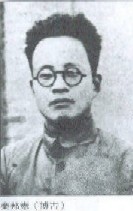 At the recommendation of the Comintern, Bo-gu assumed the post of paramount leader for the Jiangxi Soviet.
Liu Zhonglin memoirs claimed that the CCP Central Committee rebutted the military plan drafted by general tactician Liu Bocheng and advocated a kind of "leftist venturism" in attacking major cities and achieving the revolutionary success in one province of Jiangxi.
At the recommendation of the Comintern, Bo-gu assumed the post of paramount leader for the Jiangxi Soviet.
Liu Zhonglin memoirs claimed that the CCP Central Committee rebutted the military plan drafted by general tactician Liu Bocheng and advocated a kind of "leftist venturism" in attacking major cities and achieving the revolutionary success in one province of Jiangxi.
Being ordered to attack the government stronghold at Nanfeng, Zhou Enlai, Zhu De and Wang Jiaxiang, on February 7th, requested with the CCP Jiangxi Central Bureau and Shanghai’s CCP Interim Central for some operational flexibility in military actions on the field. On the 12th, the Red Army, with Peng Dehuai’s 3rd Red Army Corps Group and Dong Zhentang’s 5th Red Army Corps Group, departed Lichuan for a campaign against Nanfeng to the west. On the government side, middle prong commander Chen Cheng, other that ordering Tao Zhiyue’s 8th Division to persist at Nanfeng, ordered three columns of the siege armies to converge upon Nanfeng. After two days of fighting, the Red Army aborted the siege of Nanfeng with heavy casualties, including the death of two regimental commanders and Red Army 3rd Division commander Peng Ao. With the government troops coming to the relief of Nanfeng, Zhou Enlai on February 22nd ordered the withdrawal of the Red Army siege forces towards south of Yihuang and Le'an while having Zhou Jianping’s Red Army 11th Corps, which was organized on basis of the Red Army 10th Corps from the Fujian-Zhejiang-Jiangxi borderline and the Red Army 31st Division, fake a relocation eastward across the Huhe River to Lichuan area.
By February 26th, the government army 52nd & 59th Divisions, under Luo Zhuoying's 1st Echelon, departed Nanfeng and Le'an for a conversion at Huangpi along the two sides of Mt Moluozhang. The Red Army, totaling 50,000 men, divided into two wings for ambushing the two government army divisions. The Left Wing comprised of the Red Army 1st Army Corps, the Red Army 3rd Army Corps and the Red Army 21st Corps, to be headed by Peng Dehuai, Nie Rongzhen and Teng Daiyuan, while the Right Wing comprised of the Red Army 5th Army Corps and Red Army 22nd Corps, to be headed by Dong Zhentang, Luo Binghui, Chen Yi and Zhu Rui.
On the 27th, the Red Army Left Wing cut off Li Ming's 52nd Division into several segments and destroyed the whole division, and by the next day, Li Ming was captured wounded and later died [or was killed by the communists]. The Red Army Left Wing's 3rd Army Corps later joined the Right Wing in destroying Chen Shiji's 59th Division, and captured Division Chief Chen Shiji. (Chen Shiji et al., who were used by the Red Army as lecturers, were mostly killed in the subsequent purge and massacred en masse prior to the communist Long March.)
Chen Cheng compressed his three echelons into two, to be headed by Luo Zhuoying and Wu Qiwei, and continued onward against the Red Army. Luo Zhuoying commanded the 5th, 9th & 11th divisions as the hind army, while Wu Qiwei commanded the 10th, 14th & 90th divisions as the herald army.
The Red Army dispatched the 11th Corps for a fake movement to Guangchang. Chen Cheng, mistaking the Red Army's movement,
gave the 5th Division to Wu Qiwei for a hastened chase of the Red Army.
On the early morning of March 21st, the Central Red Army, plus two detached divisions in Yihuang area, ambushed Xiao Qian's 11th Division and destroyed the bulk of it, and then went on to attack the government army 9th Division. Chen Cheng hence called off the Fourth Siege.
Routing of the CCP Underground Network In Shanghai
In 1932, Li Shiqun, a member of the CCP special task force [i.e., 'zhongyang te ke'], was caught by the KMT agents. Li Shiqun soon became an agent of the KMT's Investigation Section of the Social Organization Ministry, and with Chen Lifu's authorization, re-launched magazine "Social News" together with another communist turncoat called Ding Mocun.
Gao Hua stated that beginning from 1932, Chiang Kai-shek's Government began to revise the old policy of "bodily extinction" as to the communists captured.
From July 1933 to July 1934, the KMT Social Organization Ministry agency had captured 4505 communists, among whom 4209 surrendered to the government. Altogether, 24,000 communists and 30,000 pro-CCP activists had surrendered in early 1930s per GH.
By June 1934, the government special agencies had basically destroyed the CCP base in Shanghai as well as the Comintern Far Eastern Bureau.
On June 26th, Li Zhusheng, secretary for Shanghai's CCP Central Bureau, was caught by the government agents, and surrendered right away. His successor, Sheng Zhongliang, surrendered when caught in October.
Wang Shiying, a member of the CCP special task forces, had to relocate the CCP Central Interim Bureau to Tianjin from Shanghai after the government twice disrupted the Shanghai operations in 1935.
Thereafter, the communists, in absence of a nucleus, made a decision to re-establish the central commanding center among the Shenxi Red Armies. Before the official move, some special agent was sent to the former Hubei-Henan-Anhui enclave for locating Xu Haidong's Red Army, with directive to guiding the remnant Hubei-Henan-Anhui Red Army to the northwest, which was ahead of the Central Red Army's knowledge of the existence of the Shenxi Red Army.
More details could be seen in Red Terror vs White Terror.
The Fifth Encirclement Campaign
On January 3rd, 1933, the Japanese invaded Rehe [Jehol] to the north of the Great Wall.
The Japanese incurred heavy casualties and encountered fierce resistance from the Chinese Government troops at the three major passes in the Great Wall to the north of Peking.
From January to May of 1933, the Chinese army, including the crack forces of the Central Army and General Soong Zheyuan's 29th Corps fought the Japanese at the Battle of the Great Wall (i.e., "Changcheng Zhi Zhan" in Chinese), including the Battle of Xifengkou and the Battle of Gubeikou.
To thwart the Chinese resistance, the Japanese changed their tactic and took over the Luan-he River area to the east of Peking, causing the collapse of the Chinese defense line at the Great Wall.
With Rehe annexed, Peking was surrounded by the Japanese from all sides except for the southwest.
In late May 1933, Chiang Kai-shek began to negotiate with the Japanese.
Prof Chen Yongfa stated that Chiang Kai-shek adopted tactician Liu Weiyuan's advice in pushing against the Red Army again in the summer of 1933. This would be the start of the 5th Siege that was disrupted by the 'mutiny' of the 19th Route Army in Fujian Province in late 1933.
Hitler's advisers, such as Hans von Seeckt, had played a role in remodeling Chiang Kai-shek's army.
Interruptions By Actions Of the Anti-Japanese Allied Army & Mutiny of the 19th Route Army
On May 26th, 1933, taking advantage of the ongoing Battles of the Great Wall between the Chinese Army and the Japanese Army, Feng Yuxiang tacked on the post of commander-in-chief of the Anti-Japanese Allied Army, with Fang Zhenwu acting as omnipotent director and Ji Hongchang as frontline commissar. Having developed into over 100,000 people, Ji Hongchang's army pushed against Duolun (i.e., a town in former Cha-ha-er and present Inner Mongolia and directly to the north of Peking city), and by July 1933, Ji Hongchang drove the Japanese collaborators out of Cha-ha-er Province.
By late July, Feng Yuxiang and Ji Hongchang (undercover communist) established at Zhangjiakou the committee for recovering the four provinces of the Northeast. The true purpose of the communists, however, was to steer the allied army to Hebei or Shandong province to launch a Soviet in North China.
Chiang Kai-shek, seeing that the communists had dominated the Anti-Japanese Alliance Army, mobilized 16 divisions against Feng Yuxiang and Ji Hongchang. Surrounded by Chiang Kai-shek and the Japanese on all sides, Feng Yuxiang resigned his post, while Ji Hongchang fought on for a while before stealthily seeking asylum in the Tianjin extraterritorial domain in January 1934.
(Later, on April 24th, 1934, Ji Hongchang, colluding with the communists, established the "Great Anti-Fascism Alliance of the Chinese People" in Tianjin, with Feng Yuxiang, Li Jishen, Fang Zhenwu and Ren Yingqi echoing support elsewhere in the country.
Chiang Kai-shek's agents injured Ji Hongchang in an assassination on November 9th, and colluded with the French police in extraditing Ji Hongchang for execution in Peking on November 24th.)
On December 15th of 1933, the Nationalist armies held a grand assembly for welcoming the defection of the CCP 'fei jun' (i.e., bandit soldiers).
The communists in Jiangxi Soviet, having run out of resources and supplies, rounded up all young men for recruitment in the Red Army, which led to a massive defection to the government side, including a top communist Red Army mobilization Department director.
The 19th Route Army, which fought against the Japanese in Shanghai during the 28 January 1932 Incident, staged a mutiny in November 1933 by colluding with the Chinese communists in the establishment of a people's government.
Cai Tingkai & Jiang Guangnai, and Chen Mingshu, contacted Chen Jitang for a concerted effort against Chiang Kai-shek's Nanking Government. Chen Jitang refused to join in.
Then, Cai Tingkai & Jiang Guangnai, and Chen Mingshu contacted Guangxi Province in the hope of having Li Zongren pressure Guangdong Province.
Without support from Guangdong or Guangxi, Cai Tingkai & Jiang Guangnai, and Chen Mingshu decided to contact the radicals and the "Third Party" members for launching the "Fujian People's Government" in Fuzhou of Fujian Province in autumn of 1933.
Radicals, such as Xu Qian, Tan Pingshan, Chen Youhong, Zhang Bojun, Shen Junru, and Huang Qixiang then turned to HK for retrieving
Li Jishen who was just released from Chiang Kai-shek's imprisonment.
Li Zongren at one time flew to HK to dissuade Li Jishen. In late October 1933, Bai Chongxi was one step behind in flying to HK for stopping Li Jishen's trip to Fuzhou.
per HQY, Chen Gongpei, who nominally declared severance from the CCP after August 1st Nanchang Uprising (Mutiny), would act as the secret emissary in late September for the claim that Peng Dehuai was Chen Gongpei's native.
Earlier, in the summer months of July-August, the 19th Route had sent Zhu Yunshan to HK for reaching a compromise with the communist forces.
Upon Li Jishen's arrival, the "Third Party" immediately launched the "National People's Congress" and proclaimed the "People's Government" by making Li Jishen president, devising a new flag in place of the KMT flag, and calling for overthrow of the KMT Government.
Chen Youren was assigned the post of foreign minister, Zhang Bojun education minister, and Huang Xiangqi "tactician general director".
Young radical scholar HU Qiuyuan assumed the post as "education & propaganda director".
The 19th Route was renamed to the "People's Revolutionary Army", with Cai Tingkai as commander-in-chief. Fujian Province was subdivided into four provinces of MinHai, YanJian, XingQuan & LongJiang plus two directly-subordinate cities of Fuzhou (Foochow) and Xiamen (Amoy).
After Hu Hanmin & Chen Jitang denounced the so-called "People's Government" of Fuzhou, Li Zongren joined in with a public wire calling for repentance on the part of the rebels.
On November 21st, Chiang Kai-shek ordered a three prong attack at the Fujian rebels.
In mid-December, 100000 Central Army, led by Jiang Dingwen, entered Fujian Province from Zhejiang-Jiangxi provinces.
The Communist Red Army yielded the way by vacating the territory of southern Jiangxi Province in lieu of an early compromise and collusion with the Fujian Government.
The underlying cause was Stalin's newly-issued call for a fight against the social democrats worldwide.
According to Gong Chu who received Mao Tse-tung's visit in Ningdu in August 1934, Mao Tse-tung was the only person who refused to render aid to the 19th Route Army rebels.
On October 26th, 1932, Xu Minghong, representing the 19th Route Army, signed the "Preliminary Agreement against Japan and Chiang Kai-shek" with Pan Hannian of the Provisional Central Government of the Chinese Soviet Republic.
Xu Minghong (1897-1934),
i.e., former NRA 10th Division political department director who joined the communist party in 1927 under Liao Qianwu's affidavit but lost contact after the debacle of the Nanchang mutiny, and then
served as secretarial chief when Cai Tingkai's 19th Route Army relocated to Shanghai and subsequently fought the 28 January 1932 war against Japan.
Li Zongren memoirs stated that tactician division chief Fan Renjie secretly telegraphed to Nanking with itineraries of the Fujian rebel army and that corps chief Mao Weishou clandestinely expressed loyalty to Nanking.
On January 5th, Yanping was taken. Fuzhou was taken by the navy on January 13th, 1934.
By mid-January of 1934, major cities like Quanzhou & Zhangzhou were taken over by the Government troops.
Officials of the Fuzhou People's Government fled to HK, and the 19th Route remnants withdrew to Guangdong Province where they were disarmed by Chen Jitang in late January.
The 19th Route remnants was made into the 7th route banditry-quelling army to be headed by Mao Jishou.
The 19th Route Army's Mutiny in Fujian Province dissipated in a matter of months after the communists refused to cooperate with General Cai Tingkai & Jiang Guangnai.
Shen Guanghan, commander of the rebel army 1st Corps,
and
Mao Weishou, commander of the rebel army 2nd Corps, with Ou Shounian, Zhang Yan and other generals, jointly sent a telegram to surrender to the Nanking national government.
Xu Minghong, who failed to rally the troops to join the Red Army,
was arrested at Dayong en route of escape on february 19th and executed on charges of communist sedition on February 25th, 1934.
 After the failure of the "Fujian People's Government",
Hu Qiuyuan fled to HK where he was arrested and expelled by the HK authority. Hu Qiuyuan, together with the son of Chen Mingshu, rode on ship for Britain. During stopovers in Singapore and Malacca, local Chinese went on aboard to give welcome to this young scholar whose "articles on resisting the Japanese" earned him a big fame everywhere.
On the way, Hu Qiuyuan observed how the Europeans threw coins into the sea to induce the Indian boys into diving into the sea.
Prior to entry into the European ports, Hu Qiuyuan was surprised to see that the colonialists threw white suits into the sea. An Italian sailor explained that those Europeans who ruled the Asian countries like masters would be ashamed of being identified as colonialist-colonist returnees on the European continent.
Hu Qiuyuan was to become a nominal Moscow representative as if the "Fujian People's Government" was a diplomatically-recognized entity.
After the failure of the "Fujian People's Government",
Hu Qiuyuan fled to HK where he was arrested and expelled by the HK authority. Hu Qiuyuan, together with the son of Chen Mingshu, rode on ship for Britain. During stopovers in Singapore and Malacca, local Chinese went on aboard to give welcome to this young scholar whose "articles on resisting the Japanese" earned him a big fame everywhere.
On the way, Hu Qiuyuan observed how the Europeans threw coins into the sea to induce the Indian boys into diving into the sea.
Prior to entry into the European ports, Hu Qiuyuan was surprised to see that the colonialists threw white suits into the sea. An Italian sailor explained that those Europeans who ruled the Asian countries like masters would be ashamed of being identified as colonialist-colonist returnees on the European continent.
Hu Qiuyuan was to become a nominal Moscow representative as if the "Fujian People's Government" was a diplomatically-recognized entity.
Chiang Kai-shek Re-launching the Siege Against the Red Army
The government army purportedly mobilized over 1 million soldiers and 200 [[??communist propaganda]] planes against the CCP, with Gu Zhutong, Chen Jitang and He Jian invading from three directions of north, south and west, respectively. (Chen Jitang, who had undertable deals with the communists and the Soviets, of course, did not participate in the campaign.)
Liu Weiyuan's strategy would be the "sustained warfare" and "blockhouse tactics" against the CCP.
Credit was also given to German strategist Hans von Seeckt who was hired over by Chiang Kai-shek, a purported admirer of Hitler & Mussolini, which was rumor as the Sino-German military ccollaboration began since 1928 and far ahead of Hitler's rise.
Beginning from September 1933, the Government troops adopted the castle tactic, built siege lines around the communist base, and pushed against the communists inch by inch.
Economically, the Government side banned the inflow of medicine, salt, cloth, ammunition and metal to the Soviet territories.
Smugglers and merchants were punishable by execution. To counter the embargo, Mao Tse-tung temporarily opened up a commodity fair in Suichuan county and gave some favorable treatment to the 'petite merchants'.
Prof Chen Yongfa stated that the communist base was hence cut into small blocks by the highways and thousands of blockhouses.
Some fortification went as far as 80-90 kilometers into the Soviet territories.
The Battle of Huwan
Otto Braun, advocating a strategy to "stop the enemies at the gate of the Soviet Republic", ordered political commissar Xiao Jingguang to recover Lichuan and Huwan with the Red Army 3rd and 7th Army Corps. The Red Army 7th Army Corps, being ordered to penetrate to Huzhou (Linchuan) area, failed to induce the government troops out of Jinxi, Langju and Huwan strongholds. Along the Huhe River, Liu Xing and Zhou Hunyuan’s 8th Column of the 3rd Prong, after Lichuan, continued south against Huwan. On November 10th, the Red Army 3rd and 7th Army Corps, besieging Li Liangrong’s regiment of the 36th Division at Huwan, lined up the ambush forces near Fengshanbu along the Huwan-Jinxi Highway. At dawn on November 11th, Xing Zhennan’s 4th Division, under order to send relief to Huwan, departed Jinxi, Panling, Langju and Zuofang with three regiments. Along the way, reconnaissance pilot Xu Kangliang sent notice to the ground troops about large-scale "moving trees" which were Red Army soldiers in camouflage. At Wujianggang, a flat land bordering the Huhe River to the south and a high mountain to the north, Shi Jue’s 24th Regiment dug out trenches while two other regiments mounted a charge at the Red Army positions on Mt Daxianling (great fairy ridge) to the west. While the two regiments fell back from Daxianling, the rest of the Red Army ambush forces traced behind the 4th Division’s luggage unit, intruded into Wujiagang, and for several hours launched batches of human wave attacks at Shi Jue’s 24th Regiment. At night, the Red Army launched the psychological warfare against the 4th Division, while the 4th Division soldiers sang aloud the national anthem and the KMT party anthem to drown out the opposite party. The next day, at dawn, the 4th Division beat back a new wave of charge and captured the military flags of the Red Army 4th and 5th Divisions. After defending Wujiagang for 19 continuous hours, Shi Jue led an attack force of three infantry companies, some special task units, and mortar and heavy machinegun companies in taking over Daxianling. Having broken out from the Red Army trap, the 4th Division effected a junction with Li Liangrong’s regiment charging out of Huwan. On the 13th, Chiang Kai-shek made a nationwide radio announcement on the victory at the Battle of Huwan. After the Battle of Wujiagang, the 4th Division defeated Peng Dehuai’s Red Army 3rd Army Corps and pressed the Red Army to Huangsidu (yellow lion crossing), west of Zixi. Defeated by the government troops and having incurred thousands of casualties, Bo-gu (Qin Bangxian) and Otto Braun ordered Xiao Jingguang to be court-martialed.
The CCP's Political Movement Against Luo Ming
Bo-gu, i.e., a bookish communist, in early 1933, launched a political movement called the "Anti-Luo-Ming Path" for sake of eliminating the influences of Mao Tse-tung and his cronies.
This political movement against Luo Ming (i.e., CCP's deputy provincial secretary for Fujian Prov) was restricted to ideological struggles in lieu of bodily extinction.
Luo Ming was sorted out for his objections to the CCP Central's strategy in relocating the Fujian Province Red Army to the Jiangxi Soviet for waging the "trench warfare" and "positional combat". At one time, Bo-gu called on mobilization of one million Red Army against the government army's 5th siege. In Fujian Province, Luo Ming was asked to absorb local militia into the Red Army ranks for fighting in Jiangxi Soviet. When Government troops intruded into Fujian Soviet, Luo Ming had to discontinue face-to-face confrontations by making Shanghang, Yongding & Longyan into a guerrilla warfare zone. Luo Ming further demanded that Jiangxi's Central Soviet Base suspend the allotments of resources from Fujian Province.
Prof Chen Yongfa stated that Fujian Prov's pro-CCP militia refused to join the guerrilla forces after seeing that the Red Army suffered setbacks in the hands of government army, not to mention going to the relief of Jiangxi Province Soviet.
Hence, Bo-gu revoked all posts of Luo Ming and called him over to Jiangxi Soviet for criticisms.
Luo Ming was accused of being a "revocationist" and "rightist opportunist".
Similarly, inside of Jiangxi Province, Bo-gu filtered out Mao Tse-tung's cronies, including Deng Xiaoping, Mao Zetan, Xie Weijun and Gu Bo, as followers of the "Luo Ming path [i.e., line]".
Also implicated would be Zhang Dingcheng, Deng Zihui, Xiao Jingguang, Tan Zhenlin, and Heh Shuheng.
Li Liang stated that Mao Tse-tung moved to live in a rich landlord's ancestral oblatory at Shazhouba village of Ruijin in July 1933 before undertaking the task of surveying lands and fields.
Chen Yongfa pointed out that this political movement would see almost all communist county-level and company-level leaders being classified as "Luo Ming path" followers. Luo Ming survived the call for "execution of Luo Ming", and he was spared life after capture by the government army while stranded as guerilla forces inside of Guizhou Province during the 'long march'.
The government army siege came into full motion in September 1933. Red Army was said to have been divided into four groups for resisting Government troops. Li Liang mentioned that Bo-gu commanded the wars on paper, pinpointing the positions of Red Army machineguns.
 Inside of the CCP, Bo-gu relied upon Otto Braun [a graduate of some German military academy] for resisting the government army siege.
Mao Tse-tung was said to have been disappointed over Otto Braun who came to Ruijin shortly after the government army siege started, i.e., October 1933. (A peasant woman by the name of Xiao Yuehua was immediately allocated to Otto Braun on his sexual demand.
Xiao Yuehua, before divorcing Braun, had born a son for him.)
Otto Braun's strategy was to "stop the enemies at the gate of the Soviet Republic" by countering the government army's blockhouses with CCP's blockhouses.
Otto Braun disciplined Red Army officers who did not follow through with his "trench warfare" orders and branded them "flightist" and "defeatist".
Inside of the CCP, Bo-gu relied upon Otto Braun [a graduate of some German military academy] for resisting the government army siege.
Mao Tse-tung was said to have been disappointed over Otto Braun who came to Ruijin shortly after the government army siege started, i.e., October 1933. (A peasant woman by the name of Xiao Yuehua was immediately allocated to Otto Braun on his sexual demand.
Xiao Yuehua, before divorcing Braun, had born a son for him.)
Otto Braun's strategy was to "stop the enemies at the gate of the Soviet Republic" by countering the government army's blockhouses with CCP's blockhouses.
Otto Braun disciplined Red Army officers who did not follow through with his "trench warfare" orders and branded them "flightist" and "defeatist".
Drain of Resources Inside of the Jiangxi Soviet
In April 1934, Red Army defended Guangchang, i.e., Soviet Republic's north gate, for 17 days, by means of short duration counterattacks.
Li Liang stated that the Red Army lost 1200 soldiers when the government army planes wiped out the city.
Peng Dehuai was recorded to have rebuked Braun by stating that "son had no pain in selling his father's fields".
Chen Yongfa pointed out that CCP lost its resistance war due to constraints of resources.
Back in early 1933, "field and land survey" was conducted for resource control. Mao Tse-tung was ordered to conduct a new round of "field and land survey" for sake of recruiting Red Army soldiers, appropriating labor, borrowing grains, and confiscating rich people's assets.
Soviet Government also resorted to issuance of "public debts & indentures" in addition to levies and taxation.
Women were encouraged in taking over the work of their men.
Continuing the stringent policy of "kuo [expanding] hong [red, i.e., Red Army soldiers]", CCP proposed a target of recruiting 150000 soldiers.
Chen Yongfa stated that only 110000 recruits filled in the ranks from August 1933 to July 1934, with an end result that 80% of populace from age 16 to 45 were drained from the Changgang & Caixi counties of Jiangxi Soviet base.
As pointed out by Chen Yongfa, the heavy-handed taxation and levy by CCP during the 5th siege induced a new round of "Purging Reactionaries Movement" that would see a batch of local communist leaders executed for failing to fulfill the quotas allotted".
After incurring heavy losses, CCP petitioned with Comintern for an approval to relocate.
Prof Chen Yongfa pointed out that Comintern approved the 'long march' plan in June 1934.
After four months' preparation, in October 1934, communist forces of Jiangxi Soviet, purportedly numbering about 100,000 (86,000 ? to be exact) with at least half being civilians forcefully drafted by the communists, broke through the siege for a relocation.
At the initial breakout, hordes of "Red Army new recruits" deserted.
By the time the Communist forces finally arrived in Yan'an (Yenan) of northern Shanxi Province, the "Central Front Red Army" had 5,000 men left or even less, something like a few thousands per Ding Ling, like 3000 troops around plus 2000 civilians in Wayaobu.
Ding Ling visited Mao Tse-tung in December 1936, on which occasion Mao wrote a poem for her under the Lin-jiang Xian (fairy by the river) prose tune from the Tang music and dance court, likening her pen to 3000 refined Mauser riflemen.
Altogether, for the Red Army First Front, Second Front and Fourth Front combined, ranks dropped to 40k (30k?) from original 200k (300k?). This final figure included the new recruits the Red Army had absorbed along the road.
Mao Tse-tung called the 'long march' by the term of a so-called "sowing machine".
Chen Yongfa pointed out that Mao Tse-tung's self criticisms in 1945 contained acknowledgement of two "past" mistakes: 1) robbing the populace (including the Tibetans) of their food during the long march; 2) planting some goody [i.e., opium] at Yan'an.
The matter of truth would be that the Long March had preserved the most diehard communist "survivor cadres".
One such "survivor cadre" would be Cai Xiaoqian who was dispatched to Taiwan for instigating 'independence' following the surrender of Japan in 1945.
The 'Long March'
During the fifth offensive against the communists in Ruijin of Jiangxi Province, Chiang Kai-shek mobilized a huge army against the Red Army. Prevalent Communist records claimed that the government army mobilized over 1 million soldiers and 200 planes against CCP -- albeit Chennault's claim that China had only 97 working warplanes [including newly-acquired years from 1934-1937] pror to the 1937 Battle of Shanghai, with Gu Zhutong, Chen Jitang and Heh Jian invading from three directions of north, south and west, respectively.
Li Liang stated that the Government troops outnumbered CCP by 10 folds.
Chen Yongfa stated that Chiang Kai-shek mobilized 600k to 700k army against the CCP enclaves.
After the April 1934 Guangchang Battle, Bo-gu [Qin Bangxian], Zhou Enlai and Li-de [Otto Braun] decided to break out of the siege for preserving the Red Army.
While post-mortem communist propaganda emphasized a pre-destined direction of going north to fight the Japanese and historical accounts stated that the Red Army had no direction but fleeing banditry, the Long March did not start as a 'march' but a 'relocation' for seeking a safe haven with Heh Long's enclave in Western Hunan province.
More, along the road, the Red Army had the specific short-term targets for either a stop for reorganization or political haggling, or establishment of a new enclave, or switch of direction for attacking Guilin of Guangxi in violation of an undertable deal with the Guangxi clique warlords.
The Long March would be alternatively termed "Iron Flow 25000 li Distance" [again post-mortem], a naming after Alexander Serafimovich Popov's The Iron Flood (1924) which was about the Russian Bolshevik Taman force's breaking out of an encirclement in the early civil wars.
In Taiwan, senior scholar Wu Dayou obtained funding from the Chinese Education & Culture Foundation for a grand project on "History of China's Last Two Hundred Years". This yielded the two volume "Seventy Years Of Chinese Communist Revolution" by historian Chen Yongfa in 1997.
(Chen Yongfa, who specialized in CCP's agrarian revolution during WWII as his doctoral dissertation, believed in reciting "historical facts" in lieu of generalizing the "cause and effect".
In the following, I will cover CCP's Long March by following Prof Chen Yongfa's insights and line of thoughts. Details of the battles on the long march were from Pu Yuehuo & Xu Sangmi's "Iron Flow 25000 li Distance" and numerous other publications such as General Hu Zongnan's biography.
Chen Yongfa was a second-generation communist history historian after Zhang Yufa who was in turn influenced by Guo Qian, a communist Southern China bureau leader whose surrender to the government led to busting of the communist underground organizations in southern China and disruption to rampant communist guerrilla uprisings against the government in southeastern China during WWII.)
Three Preliminary Breakouts
 To cover up the retreat, CCP Central ordered that three columns of army broke out of the siege in the name of "resisting the Japanese invasion".
Xun Huaizhou was ordered on an Eastern Campaign at northern Fujian Province; Ren Bishi was ordered on a Western Campaign at western Hunan Province; and Wu Huanxian was ordered on a northern campaign at western Henan Province from the communist enclave of E-Yu-Wan [Hubei-Henan-Anhui].
The eastern column was totally annihilated by the Government troops, while the remnants of the other two columns later managed to converge with the Central Red Army in Shenxi Province.
http://www.secretchina.com/news/articles/4/8/6/69762.html pointed out that it was Qin Bangxian [Bo-gu] who first proposed the slogan of a "herald Red Army for fighting the Japanese" around June 11th, 1934.
CCP leader Fang Zhimin, who wrote the book "My Lovely China", was arrested by the Nationalist army in January 1935 after the failure of his northeastern route breakout. Fang Zhimin was executed by the government on August 6th, 1935.
Fang Zhimin, together with Xun Huaizhou and Nie Hongjun, headed the communist Red Army that was responsible for
murdering the American missionaries John and Betty Stam.
The southwestern breakout, led by General Xiao Ke, managed to bring about 1000 remnant soldiers of the Red Army 2nd Army Corps to a union with Heh Long's Red Army.
This was after the debacle in the Battle of
Ganxi (sweeet creek) for junction with Heh Long's Red Army, on which occasion
Xiao Ke's Red Army dwindled to just a bit over 1000 troops from the original heacount of 9700, with the dispersed troops recollected under the feeling-lucky claim of being in an area controlled by Heh Long's Red Army.
On October 22nd, 1934, the Central Red Army
wired to order Heh Long's Red Army 2nd Corps and Xiao Ke's Red Army 6th Corps Group to separately advance into the Qiancheng (Gancheng/today's Jishou), Fenghuang (phoenix) and Songtao areas of western Hunan for launching new Soviet enclaves
Heh Long objected to the order of parting way, with a claim that Fenghuang, Songtao and Qiancheng were Chen Quzhen's strongholds.
In January 1935, Heh Jian moved to Changde of western Hunan,
Chen Quzhen, with the separatist rule in western Hunan ended, was appointed to th Hunan provincial government committee
and later in 1936 wrote the romantic book Qiu-ye Chen Meng (dusty dreams in the wilderness of 'qiu' grass -- that the animals used for padding the caves).
The Red Army claimed to have successively fought the battles of Shiwanping (1934), Chenjiahe (1935 onward), Banliyuan, Zhongbao and etc., entangling more than 120 regiments of the government army to the border areas of Hunan, Hubei, Sichuan and Guizhou, which alleviated the government army's pressure on the main Red Army.
To cover up the retreat, CCP Central ordered that three columns of army broke out of the siege in the name of "resisting the Japanese invasion".
Xun Huaizhou was ordered on an Eastern Campaign at northern Fujian Province; Ren Bishi was ordered on a Western Campaign at western Hunan Province; and Wu Huanxian was ordered on a northern campaign at western Henan Province from the communist enclave of E-Yu-Wan [Hubei-Henan-Anhui].
The eastern column was totally annihilated by the Government troops, while the remnants of the other two columns later managed to converge with the Central Red Army in Shenxi Province.
http://www.secretchina.com/news/articles/4/8/6/69762.html pointed out that it was Qin Bangxian [Bo-gu] who first proposed the slogan of a "herald Red Army for fighting the Japanese" around June 11th, 1934.
CCP leader Fang Zhimin, who wrote the book "My Lovely China", was arrested by the Nationalist army in January 1935 after the failure of his northeastern route breakout. Fang Zhimin was executed by the government on August 6th, 1935.
Fang Zhimin, together with Xun Huaizhou and Nie Hongjun, headed the communist Red Army that was responsible for
murdering the American missionaries John and Betty Stam.
The southwestern breakout, led by General Xiao Ke, managed to bring about 1000 remnant soldiers of the Red Army 2nd Army Corps to a union with Heh Long's Red Army.
This was after the debacle in the Battle of
Ganxi (sweeet creek) for junction with Heh Long's Red Army, on which occasion
Xiao Ke's Red Army dwindled to just a bit over 1000 troops from the original heacount of 9700, with the dispersed troops recollected under the feeling-lucky claim of being in an area controlled by Heh Long's Red Army.
On October 22nd, 1934, the Central Red Army
wired to order Heh Long's Red Army 2nd Corps and Xiao Ke's Red Army 6th Corps Group to separately advance into the Qiancheng (Gancheng/today's Jishou), Fenghuang (phoenix) and Songtao areas of western Hunan for launching new Soviet enclaves
Heh Long objected to the order of parting way, with a claim that Fenghuang, Songtao and Qiancheng were Chen Quzhen's strongholds.
In January 1935, Heh Jian moved to Changde of western Hunan,
Chen Quzhen, with the separatist rule in western Hunan ended, was appointed to th Hunan provincial government committee
and later in 1936 wrote the romantic book Qiu-ye Chen Meng (dusty dreams in the wilderness of 'qiu' grass -- that the animals used for padding the caves).
The Red Army claimed to have successively fought the battles of Shiwanping (1934), Chenjiahe (1935 onward), Banliyuan, Zhongbao and etc., entangling more than 120 regiments of the government army to the border areas of Hunan, Hubei, Sichuan and Guizhou, which alleviated the government army's pressure on the main Red Army.
7000 Communist Prisoners of War
Li Zongren memoirs claimed that Guangxi Province army had captured 7000 Communist Prisoners of War in the winter of 1934.
Not differentiated by Li Zongren would be two confrontations:
the confrontation with Xiao Ke's herald troops of the Red Army 6th Army Corps in September-October 1934 and the confrontation with the CCP Red Army Central Front through November 25th to December 3rd, 1934.
Xiao Ke, Wang Zhen and Ren Bishi's Red Army 6th Corps Group crossed the Xiang-jiang River at Jieshou south of Quanzhou on September 4th; took Xiyan County; purportedly broke through the siege of 18 regiments of the government troops from the three provinces of Hunan, Guangxi and Guizhou; rushed to cross the Qingshui-he River and Dasha-he River; entered Liping of Guizhou on September 20th to be in the Qingshui-jiang River area; and when turning to Ganxi (sweeet creek) for junction with Heh Long's Red Army, was defeated and anniliated by Liao Lei's Guangxi Army, with the Red Army dwindling to just a bit over 1000 troops from the original heacount of 9700.
Li Zongren accused Chiang Kai-shek of deliberately guiding the communist forces into southwestern China for sake of "killing somebody with borrowed knife".
The proper way, in his opinion, would be to encircle the communist enclave or let go the exit towards southeastern coast.
Li Zongren cited the 1927 defeat of Heh Long & Ye Ting communist forces in Chaoshan coastal area as a good example.
However, historical records pointed to Chen Jitang's collusion with the communists in allowing the Red Army pass through three blockade lines for head-on collision with the Guangxi provincial army. In that sense, it was Chen Jitang who sold out his allies Li Zongren and Bai Chongxi. Whereas, Chiang Kai-shek repeatedly instructed his troops to encircle and eliminate the Red Army, with the Red Army enjoying two respites only, first being the 12-day rest at Zunyi and second being the 5-day rest at Huili. The first respite allowed Sichuan provincial army to beef up Yangtze defense, which cornered the Red Army at Sichuan-Guizhou-Yunnan border for 4-5 months.
Shanghai Mayor Wu Tiecheng and the CC Clique spread rumors in Shanghai newspapers stating that the communists had obtained compromise from the Guangxi Province in leaving the territory.
Li Zongren promptly sent over a wire to Wu Tiecheng, stating that he had dismissed about 3000 communist prisoners of war whose hometowns were from the Guangdong-Hunan area but needed Wu Tiecheng's help in repatriating shiploads of communist prisoners of war whose hometowns were from lower Yangtze provinces.
Wu Tiecheng immediately wired to Li Zongren, stating that Li Zongren could dismiss those 4000 prisoners on the spot instead of sending them onward to Shanghai.
Guangxi Province dispatched a film team for shooting the footage of their victory.
Communist propaganda flatly denied that they had lost huge number of soldiers in the battle with the Guangxi Province army.
For the halving of the Red Army, refer to Xiangjiang River Crossing below.
The Dove Is Ready To Fly Away
In mid-July, 6 routes of the government army closed in against the Red Army.
Chiang Kai-shek applied just about 12 divisions against the Red Army, with Chen Cheng's two divisions attacking Xingguo from Taihe to the north, Xue Yue's one division attacking Gulonggang from Yongfeng, Fan Songpu & Tang Enbo's two divisions attacking Ningdu & Shicheng, Huo Kuizhang attacking Ningdu [after takeover of Guangchang], two government army divisions attacking Changting from Liancheng to the east, and three divisions pressing against Huichang & Yudu from the south.
In early August, Peng Dehuai & Yang Shangkun engaged in a bloody battle with Tang Enbo's crack government troops, and had to retreat to Shicheng.
By autumn of 1934, the Communists had lost more than half of their Jiangxi Soviet territory.
For four months, the CCP Central blindfolded the officers and officials about the military action.
On October 7th, local communist militia and the Red Army 24th Division were ordered to take over the defense positions from the Central Red Army. The Central Red Army, per Pu Yuehuo & Xu Sangmi, converged onto the counties of Xingguo, Yudu and Huichang.
On the evening of October 10th, 1934, the communist forces of Jiangxi Soviet, with 86,000 army or five Army Corps, including half of new recruits and coolies for the shoulder pole work, broke through Chen Jitang's fake line of encirclement for relocation towards Heh Long's enclave in western Hunan Province.
 As disclosed by various memoirs, the CCP pricked three government blockades as a result of borrowing a path from Chen Jitang's Guangdong Province army. Chen Jitang was recorded to have ordered his soldiers to shoot into the air.
The Red Army moved along the borderline of Jiangxi-Guangdong provinces without encountering any major resistance: the Red Army entered Guangdong Province from Jiangxi Province and then entered Hunan Province.
As disclosed by various memoirs, the CCP pricked three government blockades as a result of borrowing a path from Chen Jitang's Guangdong Province army. Chen Jitang was recorded to have ordered his soldiers to shoot into the air.
The Red Army moved along the borderline of Jiangxi-Guangdong provinces without encountering any major resistance: the Red Army entered Guangdong Province from Jiangxi Province and then entered Hunan Province.
Prior to the action, CCP's Chinese OGPU, i.e., the political defense bureau, was recorded to have executed batches of "reactionaries" and "wavering elements", including the Ningdu Mutiny ringleaders such as Ji Zhentong and Huang Zhongyue, as well as captured government troop commanders who were previously retained at the Red Army College as military lecturers.
In the mountains between Yudu and Ruijin, many mass burial sites with thousands of victims had been discovered after the Government troops moved in.
According to Gong Chu, several thousands of wavering cadres were dismissed prior to the long march, and in the mountains between Ruijin and Yundu, which was north of Ruijin, the communists set up a special military court to execute those elements, with the massacre continuing well beyond one month after the Red Army's departure and pit of 'wanren-keng' (10,000 corpses) discovered several months later by the government troops.
Gong Chu tried to save Red Army HQ tactician Lin Ye's wife who just came to the Soviet territory after graduation from Daxia University (The Great China University) in Shanghai and implored her to stay till the next morning; however, the young wife wanted to follow his husband to the Red Army University under OPGU subbureau chief Tan Zhenlin's fake order to return to the education superintendent position.
Lin Ye and his wife were killed about 10 li distance on the road.
Leaving four OGPU agents running behind, Gong Chu rode his horse to Tianxinxu where 500 political prisoners were held after learning that four subordinates of the Red Army 7th Corps, including two battalion commanders, were sent there, and secretly told the four guys to escape without telling anyone else not trustworthy.
Gong Chu was ordered to take one regiment to the Hunan-Guangdong-Guangxi border to collect the dissipated and dispersed Red Army troops.
In January 1935, Gong Chu arrived in Huangmao (yellow thatchet) of Binxian, and after sending most of the OGPU agents to the company and platoon levels to be commanders, alone fled the Red Army for the Lechang hometown in early May.
Gong Chu left a letter to his political department director with accusation of the communist massacre of their own cadres prior to the long march.
Communist cadres, like Chen Yi and Qu Qiubai, who had antagonized Bo-gu's nucleus, were ordered to stay put for waging the guerrilla warfare in the former Jiangxi Soviet enclave.
Ruijin the Soviet capital did not fall into the government hands till November 12th, 1934 [November 10th per Zu Zheng].
Among twenty thousand troops and cadres who were left behind either due to injury or political difference, many would either be captured and executed or surrender to the government. Mao’s brother, i.e., Mao Zetan [Mao Tse-tan], died in the government troops' hands.
Xu Zhen claimed that the communist casualties ran at 200,000 during this final siege campaign.
Later, in early 1935, a platoon of Red Army garrison troops escorted Heh Shuheng, Qu Qiubai and Deng Zihui, et al., for a stealthy outbreak by wearing the government troops' uniforms. On the way to Yongding county, Heh Shuheng died in an ambush. On February 21st, 1935, in Shanghang county of Fujian Province, Qu Qiubai, Zhang Liang & Zhou Yuelin were arrested by the Government troops. Qu Qiubai was executed in June 1935 at Changting.
Chen Yi's remnants, after hiding in the forests and mountains for years, would be coming out as the "New Fourth Army" after the outbreak of 1937 Sino-Japanese War.
The Soviet Central Bureau was purportedly renamed to the Soviet Central Subbureau later in October 1934
and
was further downgraded to the CCP Southeastern Burea in late 1935.
Before execution, Qu Qiubai wrote a long biographical article titled Duoyu de hua (extra words that were not necessarily recited), which was later published in Hongkong, that led to Mao Tse-tung's instruction in 1962 to cleanse Qiu Qiubai's name from the communist commemoration and brand Qu as in the same category as Taiping-tian'guo captive general Li Xiucheng for sake of rooting political enemy Liu Shaoqi.
Qu Qiubai, a T.B. patient, was kicked to the Jiangxi Soviet from Shanghai in 1933 after losing the general secretary's job in the communist 6th Congress held in Moscow in 1928.
Song Xilian, the government army's division commander responsible for capturing Qu Qiubai, and government agents who were involved in the imprisonment of Qu Qiubai, later in the early 1950s wrote extensive reports on the matter of Qu Qiubai for the communist archives.
The CCP Central and the non-fighting body were organized into two echelons, with the 1st echelon under the command of Ye Jianying, and the 2nd echelon under Luo Mai [Li Weihan] & Deng Fa.
Five Red Army Army Corps, i.e., the 1st, 3rd, 5th, 8th & 9th, participated in the action.
Lin Biao's 1st Corps-Conglomerate included the 1st Division, 2nd Division & 15th Division; Peng Dehuai's 3rd Army Corps included the 4th Division, 5th Division & 6th Division; Dong Zhentang's 5th Army Corps included the 13th Division, & 34th Division; Zhou Kun's 8th Army Corps included the 21st Division & 23rd Division; and Luo Binghui's 9th Army Corps included 3rd Division & 22nd Division.
The Red Army 15th Division was converted from Chen Guang and Feng Wenbin's communist Shaogong-guoji-shi (young Comintern, i.e., Komsomol) Division, that was staffed by teenagers blanketed from across the Soviet enclaves.
More than half of the Red Army forces were new recruits who were to escape from the Red Army during the Battle of Xiangjiang.
On October 21st, the Red Army broke through the 1st blockade at Anyuan & Xingfeng of Jiangxi.
In early November, the Red Army broke through the 2nd blockade at Rucheng of Hunan and Chengkou of Guangdong.
After crossing the Yue-Han [Canton-Wuhan] Railroad, the Red Army broke through the 3rd blockade at Chen[1]xian [Chenzhou] & Yizhang of Hunan Province on November 15th.
The Xiangjiang River Crossing (November 25th to December 3rd)
The Red Army originally planned for conversion with Heh Long's Red Army [i.e., the 2nd & 6th Army Corps] in western Hunan Province.
On November 13th, Chiang Kai-shek conferred the post of commander-in-chief onto Heh Jian for chasing the Red Army, with control over divisions commanded by Liu Jianxu, Xue Yue, Zhou Yuanhun, Li Yuanjie & Li Yunheng.
To prevent the Red Army from junction with Heh Long's gang, Chiang Kai-shek ordered a concentration of the Government troops in Hunan Province.
The Government troops, consisting of the Guangxi & Hunan Province armies as well as the Central Army, intercepted the Red Army at the Xiangjiang river crossing.
The reason the Red Army, after its easy pass-through of the Guangdong territories in coordination with the Guangdong local military leaders, encountered setback at the Xiangjiang River was a communist change of strategy to intrude into the heartland of Guangxi Province in violation of another undertable secret deal between the communists and the Guangxi military leaders.
Per Pu Yuehuo & Xu Sangmi, the government troops purportedly included 15 divisions or 400,000 soldiers, with Heh Jian's Hunan army & Xue Yue's Central Army stationed along the riverside cities of Lingling, Dong'an & Quanzhou. [Quanzhou is on the Guangxi side, while Dong'an is on the Hunan Side.] Li Zongren & Bai Chongxi's Guangxi army guarded Xing'an & Guanyang for preventing the Red Army from going into their province, while the Guizhou Province army guarded Jinping & Liping for preventing the Red Army from going into their province, as well.
Li Yunjie's Hunan army & Zhou Hunyuan's Central Army were chasing the Red Army from behind.
Leaflets were dropped over the heads of the Red Army, stating that the Government troops had been waiting for the Red Army to enter the trap under the order of generalissimo.
On the side of the Red Army, Lin Biao's 1st Army Corps fought ahead for the crossing, while Dong Zhentang's 5th Army Corps covered the retreat in the hind.
Peng Dehuai's 3rd Army Corps, Zhou Kun's 8th Army Corps and Luo Binghui's 9th Army Corps protected the two flanks.
The CCP Central's echelons arrived in Wenshi & Guiyan on November 27th; however, it took them another four days to walk the distance of 80 kilometers to reach the bank.
Two divisions under Lin Biao's 1st Army Corps, i.e., the Red Army 1st and 2nd Divisions, fought against Li Jue’s Hunan provincial troops for two days and two nights at Jiaoshanpu of Quanzhou, with most of the Red Army regiments halved after the battle. Peng Dehuai's 3rd Army Corps fought the Guangxi army in Xing'an & Guanyang counties for three days and three nights.
Communist records claimed that the Guangxi army suddenly abandoned the one-line defense line to tilt the leftside towards the south for yielding a path to the Red Army, hinting at the Red Army's breakthrough being attributed to this maneuver.
In Xinwei of Guanyang, between the Xiangjiang and Guanjiang rivers, Li Tianyou’s Red Army 5th Division incurred a casualty of over two thousand, including the death of division-level chief staff tactician Hu Jun, and had to yield the impediment task to Cao Deqing’s Red Army 6th Division for retreating across Xiangjiang at Lingqu, southwest of Xing’an. The 18th Regiment under the Red Army 6th Division, to cover the retreat of the Red Army 8th Army Corps, was completely wiped out at Guanghuapu, south of Jieshou and west of the Xiangjiang River. Chen Yongfa cited Wu Xiuquan's "My Road Path" in stating that only a small portion of the newly-recruited Red Army 8th Army Corps [which included the 21st and 23rd Divisions, the Worker Division, i.e., the CCP Central Garrison Division], of which Liu Shaoqi was the political commissar, had crossed the Xiangjiang River. Most had slipped away before the river crossing, for which divisional commander Zhou Zikun was arrested for punishment by the Red Army military court. West of the Xiangjiang River, Zhang Zongxun’s Red Army 4th Division, in charge of the riverbank defense, fought two days and two nights for covering the retreat of the Red Army 5th and 9th Army Corps and incurred heavy casualties, including the death of division-level chief staff tactician Du Zongmei. Among the Red Army 34th Division, which was subordinate to Dong Zhentang's rearguard 5th Army Corps, only 100-200 soldiers crossed the river, with division political commissar Cheng Cuilin killed and division commander Chen Shuxiang captured alive by the constabulary forces when breaking out towards the east.
Under the government troops' pincer-attacks from north and south, the Red Army on December 1st completed the crossing of the Xiangjiang River with a loss of more than half of its original headcounts. On December 1st, Bai Chongxi touted the five-day battles at Wenshi and Xinwei of Guanyang, blaming the Red Army’s rivercrossing on the procrastination on the part of Heh Jian and Zhou Hunyuan’s troops. Shanghai Mayor Wu Tiecheng and the CC Clique claimed in Shanghai newspapers that the communists had obtained compromise from Guangxi Province in leaving the territory. Li Zongren promptly sent over a wire to Wu Tiecheng, stating that he had dismissed about 3000 communist prisoners of war whose hometowns were from the Guangdong-Hunan area but needed Wu Tiecheng's help in repatriating shiploads of communist prisoners of war whose hometowns were from the lower Yangtze provinces.
The Xiangjiang River crossing would cost the bulk of the Red Army, with less than 30000 [40,000 ?] Red Army First Front [i.e., Red Army Central Front] reaching the other shore.
The CCP records blamed Bo-gu's CCP Central for bringing on the heavy equipment, including mimeograph machines, medical equipment like X-ray machine, printing machines, ammunition plants, and grains.
True cause was the communist bad faith in betraying the undertable deal that was reached with the Guangxi Clique and attacking towards the Guilin city.
Li Liang stated that Mao Tse-tung asked Wang Jiaxiang & Zhang Wentian to go to the bank together, and then ordered the Red Army to dump the heavy equipment into the river and seek protection inside of woods in face of the government army plane bombing.
Communists claimed that
among the 86000 people would be 9000 non-military staff and 5000 civilian who carried loads on the shoulder poles.
The truth was that more than half of the 86,000 Red Army troops were civilians forcefully drafted prior to the long march, with those non-weapon-bearers slippping away before the Xiang-jiang River.
Bear in mind that Chen Yongfa stated that 110,000 recruits filled in the ranks of the communist Red Army from August 1933 to July 1934.
Chen Yongfa cited Wu Xiuquan's "My Road Path" in stating that only a small portion of the newly-recruited Red Army 8th Army Corps [which included the Worker Division, i.e., the CCP Central Garrison Division] had crossed the Xiangjiang River. Most had slipped away before the river crossing, over which divisional commander Zhou Zikun was arrested for punishment by the Red Army military court. Liu Shaoqi was assigned the job of a commissar for the 8th Army Corps before the breakout.
At the same time, the Red Army Second Front broke through the siege in western Hunan Province, stay put in eastern Guizhou Province for a while, and counter-attacked western Hunan Province for lending help to the besieged Red Army First Front.
The Red Army in E-Yu-Wan [Hubei-Henan-Anhui], i.e., the Red Army Fourth Front, already crossed the Ping-Han Railroad in October 1932 to found an enclave in northern Sichuan Province, where the communists conducted a massacre that saw hundreds of thousands of Sichuan people killed.
The Chinese Youth Party joined hands with the Sichuan provincial armies in confronting the Red Army.
After the Xiangjiang River Crossing, Mao Tse-tung, Wang Jiaxiang & Zhang Wentian began to assert control over the Red Army despite of the fact that Bo-gu and Otto Braun were still the nominal leaders.
Mao Tse-tung vehemently opposed the original plan of converging with the Red Army 2nd & 6th Army Corps [i.e., marching northward along the borderline of Hunan-Guizhou Provinces], while Chiang Kai-shek relocated Wang Jialie's Guizhou Province army to Jinping & Liping for building a new blockade.
In the future, Chiang Kai-shek, contemplating on the campaign against the Red Army, thought to himself that it made it possible for the central government to exert influences in Southwest China and hence laid a foundation and a base for organizing resistance in the anti-Japanese war.
On December 12th,
Lin Biao's 1st Army Corps and Peng Dehuai's 3rd Army Corps
intruded into Guizhou Province via two prongs.
On December 14th, the Red Army 2nd & 6th Army Corps were ordered to develop a new Soviet base in northwestern Hunan Province.
On December 16th, the Red Army took over Liping & Jinping from Guizhou army.
Lin Biao's 1st Army Corps and Luo Binghui's 9th Army Corps were ordered to cross the Qingshuijiang River for still the original northward march to the territories held by the Red Army 2nd & 6th Army Corps.
The CCP Central's echelons arrived in Liping of Guizhou Province on December 16th.
On December 18th, at a politburo meeting in Liping, Mao Tse-tung proposed a reverse of the northward march and an approach of going to the west for launching a Soviet base at the Sichuan-Guizhou borderline, with Zunyi city selected as a possible center.
The Liping Meeting stipulated an expanded politburo meeting to be held for reflecting on the 5th anti-siege and the long march.
Antagonism Between Provincial Militarists & the KMT Central Government
Li Zongren memoirs claimed that the Red Army had survived as a result of Chiang Kai-shek's approach of "yang [multiplying] fei [communist banditry] zi [for enhancing selfish] zhong [self-strengthening]". The best example would be Chiang Kai-shek's abducting Guizhou Province Chair Wang Jialie at the Guiyang Airport and replacing Wang Jialie with a Zhejiang Province native called Wu Zhongxing.
Li Zongren, citing the precedent of Heh Long & Ye Ting's defeat by Bai Chongxi & Huang Shaohong (not Qian Dajun?), stated that the government army should have either encircled the Red Army in its entirety or pressured the Red Army towards coastal Guangdong or Fujian province for extermination.
Li Zongren, who had undercover communists working next to him, certainly did not know that the communists had made a deal with Chen Jitang to skirt Guangdong Province, the same way as the bad faith deal to skirt Guangxi Province.
Li Zongren & Bai Chongxi, who had inflicted a heavy injury onto Xiao Ke's herald troops in September-October and then assisted Chiang Kai-shek in more than halving the Red Army Central Front at the Xiang-jiang River crossing, then apparently felt relieved that the Red Army passed Guangxi Province for the further west.
Li Zongren stated that Chiang Kai-shek deliberately stationed the bulk of army in northern Hunan Province so that the communists had no choice but to go west into Guangxi Province.
Liao Lei's Guangxi Province hence traced the Red Army into Guizhou Province. (See Li Zongren debates for details on the antagonism between provincial militarists and the KMT Central Government.)
The Red Army Central Army, with about 30,000 remnants after the river crossing, would continue to lose headcounts in its wars with provincial armies of Guangxi, Guizhou, Sichuan and Yunnan as well as the Central Army.
Later, in Guizhou Province, communist spy master Qian Zhuangfei was killed in action, and Luo Ming was caught as a prisoner of war. One of the killers of the Gu Shunzhang family was also taken a prisoner of war during this phase of the Long March.
The Wu-jiang River Crossing
The Zunyi Meeting (January 1935)
Crossing Chi-shui [Red Water] River Four Times
Planned Conversion Of the 1st & Fourth Front Armies
The Central Red Army then planned to converge with Zhang Guotao's Red Army Fourth Front by departing Guizhou Province for crossing the Yangtze River in the north.
The Central Red Army instructed that Zhang Guotao's Fourth Front crossed the Jialingjiang River for northwestern Sichuan Province by abandoning its enclave at the Sichuan-Shenxi border.
On January 22nd, 1935, the Central Red Army sent over a telegraph stating that they might cross upper stream Yangtze river at Luzhou in mid-February,
As a result of resistance by the Sichuan Province army, the Central Red Army returned to northern Guizhou Province for a stay at the Yunnan-Guizhou-Sichuan border.
This would be after the second crossing of the Chi-shui River.
When Chiang Kai-shek's Central Army caught up with the Red Army, the CCP made a forceful 3rd crossing of the Chi-shui River. Then, Mao Tse-tung effectively took over control of the Red Army, and led the Red Army on a 4th crossing of the river for the south.
The Red Army crossed the Jinshajiang River for entry into southern Sichuan Province thereafter, still planning for conversion with Zhang Guotao's Red Army for
establishing a base in western Sichuan Province.
The Red Army Fourth Front, which arrived in northern Sichuan Province with about 14000 soldiers in late December 1932, established the Sichuan-Shenxi enclave. Zhang Guotao & Xu Xiangqian, after entering Dabashan Mountain, would build an enclave with 100000 Red Army soldiers in Tongjiang, Nanjiang & Bazhong.
By June 1933, the Red Army Fourth Front expanded to 40000 after defeating Sichuan warlord Tian Songyao's 29th Corps, with the 10th Division, 12th Division, 11th Division & 73rd Division re-organized into the Red Army 4th Corps [Wang Hongkun & Zhou Chunquan], 9th Corps [He Wei & Zhan Caifang], 30th Corps [Yu Tianyun & Li Xiannian] & 31st Corps [Wang Shusheng & Zhang Guangcai].
On July 13th, 1933, Liu Wenhui resigned provincial chair for Sichuan Province and exited to Xikang.
Liu Xiang was made into commander-in-chief for the Sichuan army; however, Tian Songyao & Deng Xihou refused to obey order.
After three campaigns in August-October 1933, the Red Army Fourth Front expanded to 80000 by means of mass execution and land reform, with an additional 33rd Corps organized on basis of the communist guerilla forces of eastern Sichuan Province.
Back in the summer of 1934, they defeated six prong attacks of the Sichuan provincial armies.
From late October of 1933 to mid-September of 1934, the Red Army Fourth Front fought off the Phase 4 siege by the Sichuan warlords' armies, inflicting a casualty of 80000 on opponents at a cost of 20000 Red Army soldiers, i.e., fodder of war recruited locally in northern Sichuan, Hanzhong and southern Shenxi.
In the winter of 1934, Hu Zongnan's Central Army was invited into Sichuan Province for fighting the communists.
(Hu Zongnan, having spent years in Gansu Prov, had mobilized his army for building a second airport for Gansu province, received orphans as the boy scouts, assisted populace in punishing the bad behavior gentry, promulgated the ROC calendar and festival on January 1st, 1934, rebuilt the tomb of Han dynasty general Li Guang, established an elementary teachers' training school, received foreign visitors to the Silk Road, and befriended local minority tribal and religious leaders.
In March 1934, Hu Zongnan selected 160 Gansu natives with middle school diploma for the "autonomous administration training class". After attending the graduation ceremony on March 18th, 1935, Hu Zongnan returned to his 1st Division [with 4 brigades or 12 regiments] for quelling the communist banditry in western Sichuan Province.)
At about this time, Heh Long's Red Army 2nd Army Corps [i.e., Red Army Second Front] closed in to Wanxian-Fengjie of southeastern Sichuan Province for lending support to the Red Army Fourth Front.
Xu Xiangqian stated that they had sensed a possible plan of the Red Army First Front to converge with them after the First Front's breaking out of the Jiangxi Soviet in October 1934.
With Chiang Kai-shek's Central Army invited by Liu Xiang the provincial chair who visited Nanking three times, the Red Army Fourth Front held a Qingjiangdu Military Meeting and tentatively decided upon a strategy of breaking out towards the Sichuan-Shenxi-Gansu borderline whereas propaganda called for a takeover of Sichuan Province for converging with the Red Army Central Front.
After the Zunyi Meeting of January 1935, the Central Front requested with the Red Army Fourth Front for dispatching one division southward as relief.
Xu Xiangqian stated that Xu Haidong's 25th Corps, which arrived in the Shenxi-Henan border, also requested assistance with the Red Army Fourth Front.
Xu Zhen stated that Hu Zongnan sent in some brigade and regiments to the Zhaohua, Guangyuan and Wulongbao area in northern Sichuan Province.
On January 20th, one regiment at Yangmoba was attacked by the Red Army at night. The Red Army probed Hu Zongnan's positions from the 21st onward.
On January 22nd, 1935, the Red Army Fourth Front launched the Campaign of Guangyuan-Zhaohua and crossed the Jialingjiang River for fighting Hu Zongnan's Government troops which entered Sichuan from the southwestern corner of Shenxi Province.
On the same day, January 22nd, 1935, Mao Tse-tung sent over a telegraph stating that the Central Red Army might cross the upper stream Yangtze river at Luzhou in mid-February, wished that the Red Army Fourth Front could cross the Jialingjiang to the western Sichuan Province, and would need coordination with the Red Army Fourth Front.
On January 25th, the Red Army Fourth Front crossed the Bailongjiang River [white dragon river] and lay a siege of Zhaohua. Chen Changhao's Red Army crossed the Xujiahe River to attack the Wulongbao hill, while Dong Zhentang [a former Northwestern Army 26th Route Army brigade commander from the 1931 Ningdu Mutiny, nicknamed Dong Mahua or the pockmarked Dong by the government], Zhang Qinjiu & Xu Xiangqian led the Red Army on attacking the Guangyuan city from three directions. Xu Zhen stated that from 6:00 pm to the next morning, the Red Army continuously attacked the city with heavy casualties. (Xu Zhen mistook Chen Changhao & Dong Zhentang as killed in action.) With 6000 soldiers, the Government troops beat off the attacks by the Red Army numbering tens of thousands.
Xu Xiangqian's memoirs, however, stated that on the 26th, the Red Army Fourth Front, which already encircled the Guangyuan city, began to mount attacks. As noted in the county chronicle, the Red Army, unable to attack Guangyuan, crossed the river to the west bank for attacking the Wulong [black dragon] city. At Wulong where the Government troops defended five hills, two companies of a relief force from Ding Delong's brigade wrestled three lost hills from the Red Army.
Unable to sack the two cities, the Red Army Fourth Front withdrew the siege when Deng Xihou's five Sichuan provincial brigades came to the relief of the two besieged cities.
In early February, to the north, the Red Army Fourth Front, as distraction, attacked Sun Weiru's Northwestern Army by taking over the Yangpingguan [sunshine flat land] Pass & Tiesuoguan [iron lock] Pass and took over Mianxian, Nanzheng & Ningqiang of southwestern Shenxi Province.
The communist-infiltrated northwestern army did not put up fight, over which lots of army officers, with secret communist identities, were captured and killed by the Red Army for failure to prove the communist identity.
Xu Zhen, however, stated that the Red Army, unable to sack Guangyuan, fled to southern Shenxi Province for pillaging.
In the Shenxi Province, the Red Army renamed a county to the 'Shen[1]xi' county, which validated the rumor that Cai Shenxi [Cai Shengxi], formerly a battalion commander under Hu Zongnan and later a Red Army corps chief, had already been killed in 1932.
Xu Zhen claimed that Xu Xiangqian's Red Army killed the population of the whole county capital because Cai Shenxi was killed somewhere inside the Shenxi Province -- which was misconstrued as Cai Shenxi was more likely killed in the Hubei province three years ago and during a Red Army operation near the Peking-Hankow Railway. A mass grave site was recorded to have contained the corpses of one thousand people who were killed by the blades or buried alive by the Red Army.
Hu Zongnan, seeing that Shenxi provincial chair Yang Hucheng (an estranged communist who was converted to communism by the communist-arranged teenage wife in the 1920s) did not know how to deal with atrocity, dispatched Li Shaoling to condoling the local victims.
The savagery of the Red Army Fourth Front (i.e., the communist Red Army's Fourth Front Army) against the civilians was noted repeatedly during the civil war.
The Red Army Fourth Front returned to northern Sichuan Province in mid-February after pillaging western Shenxi Province.
Xu Xiangqian stated that the Central Front Red Army sent over a telegraph on February 16th with a change of plan, claiming that they had failed to defeat the Sichuan provincial armies on January 28th for crossing the Yangtze and hence decided to stay put for developing an enclave in the Sichuan-Yunnan-Guizhou borderline.
The Red Army Fourth Front continued with the old plan of Crossing the Jialingjiang River though. [The Jialingjiang River converged with the Bailongjiang River at Guangyuan and flowed down to Chongqing to enter the Yangtze. In ancient China, the Chinese mistook those rivers in north Sichuan as source of the Yangtze.]
Chiang Kai-shek conferred the military leadership of Wu Chengren's 49th Division, Chen Pei's 60th Division, Zhong Song's brigade, and Wang Yaowu's brigade onto Hu Zongnan.
On March 3rd, Hu Zongnan, with his 12 regiments of the 1st Division, departed Tianshui of Gansu Province for Bikou [blue pass] of Sichuan Province.
Xu Zhen stated that Xu Xiangqian, with 4 Red Army divisions, had taken over Qingchuan and guarded the Motianling [colliding with the heaven] Ridge, i.e., the ancient Yinpingdao Path during the Three Kingdoms time period. (In ancient times, Deng Ai trekked 350 kilometers of wilderness inside of the mountains to reach the Jian'ge [sword gate] Pass.)
From March 28th to April 21st, the Red Army Fourth Front sacked nine counties and purportedly destroyed 12 government regiments, with the Jianmen'guan [sword gate] Pass sacked on April 2nd, 1935.
Unable to fight the Red Army at the front, Hu Zongnan ordered a circumvention to attack the Red Army on the Daobeiliang [blade spine] Ridge. On April 8th, 2nd regiment chief Kang Zhuang led two battalions for a surprise attack at the Red Army at dawn after a trek of half a day and one night. With another regiment breaching the Daobeiliang [blade spine] Ridge at another pass, the Red Army set fire to 400 houses in Qingchuan and fled south. A third government force defeated the Red Army at the Xuanma [black horse] Pass and chased the Red Army to Pingwu.
The Red Army defended the Banbishan [half cliff] Mountain and then fled to the south bank of the Fujiang River.
On the east bank of the Jialingjiang River, some remnant Red Army were left as distraction. Li Tiejun's brigade defeated the Red Army on April 13th while the Sichuan Province armies were said to be afraid of coming out of the Guangyuan city.
On May 5th, Mao Tse-tung's Central Red Army crossed the Jinshajiang River for Sichuan Province.
On May 22nd, Chiang Kai-shek flew over to Chongqing & Chengdu for directing the Sichuan campaign.
Later in early May, at Jiangyou, Zhang Guotao & Chen Changhao convened a meeting about going to northwestern Sichuan Province for conversion with Mao Tse-tung's Red Army that just crossed the Jinshajiang River in southern Sichuan Province.
Xu Xiangqian pointed out that Chan Changhao's exaggerated propaganda stated that "Welcome 300,000 strong Red Army Central Front !"
On May 12th, Xu Xiangqian led a herald column against the "Tumen Precarious Pass" but failed to get to the castle of Songpan. Before Li Wen's government brigade arrived in Songpan, Hu Zongnan dispatched 100 plaincoated soldiers under Liu Hongxun for surveying the Songpan citadel.
During the march towards Songpan, the Red Army soldiers died in mudslide due to an earthquake that occurred about two years ago.
Hu Zongnan's Li Wen 2nd brigade, in early June, took over Songpan one step ahead by fighting off a communist herald column at the Baitashan [white pagoda] Mountain to the east of the citywall.
Li Wen then chased the Red Army to Zhenjiangguan along the east bank of the Minjiang River.
Hu Zongnan assigned defense at the west bank of Minjiang, Zhangla, Pingwu, the northeast Songpan outskirts, and Songpan. Further, Hu Zongnan dispatched one battalion to Maoergai, and another battalion to Baozuo.
Xu Xiangqian stated that Zhang Guotao missed the chance of a campaign against southern Gansu Province as a result of following the vagrant direction of Mao Tse-tung's Central Red Army.
Xu Xiangqian further stated that they, by leaving behind Liu Zicai & Zhao Ming'en and one thousand soldiers, did not pay attention to leaving enough guns in the Sichuan-Shenxi enclave at the time of relocating to northwestern Sichuan Province. Sichuan-Shenxi enclave would be where the Red Army Fourth Front recruited the hardworking Sichuan women for the "Detached Women Regiment" that later fell victims to the Ma Family Cavalry on the Western Corridor.
Crossing the Jinsha [gold sand] River (Early May 1935)
The "let-go" theory was partially right. However, it was not Mao's Central Red Army vs Chiang's Central Government Army, but regional armies letting go the Red Army, and Heh Long & Ren Bishi's Communist Second Flank Army vs Sichuan Provincial Army.
Jung Chang did have imagination. It was her imagination, such as Chiang letting go Mao, that led to my deep investigations. For examples: At Guangdong border, Chen Jitang let go Mao; at the Xiangjiang River, there was an original negotiated Guangxi scheme to let go the Red Army, but the Communists made a mistake in playing a real game for an offensive against the heart of Guangxi - the Guilin direction, and an ultimate re-route of Red Army troops to Xiangjiang was delayed by days, which led to the halving debacle at the river. Sichuan Army let go Heh Long/Xiao Ke's army at Sichuan-Guizhou border; and at Guizhou, there was another episode of some communist-infiltrated garrison army, under Mo Xiong, letting go Heh Long/Xiao Ke's Red Army. Sichuan provincial army, controlled by Qin Zhongwen, i.e., an ex-communist, had let go Red Army Second Flank when they reached Sichuan Province.
More explanations available at Crossing-the-Iron-Chain-Bridge.htm
|
|
Jung Chang called four names, Zhang Zhizhong, Shao Lizi, Hu Zongnan and Wei Lihuang, as communist spies.
She was right on Wei Lihuang, not the others.
This webmaster considers Wei Lihuang's treachery to be comparable to Soong Dynasty prime minister Jia Sidao's abandoning to the Mongol the Xiangyang city [which was under siege for 4-5 years] and Ming Dynasty general Wu Sangui's betrayal of the Mountain and Sea Pass to the Manchus.
As numerous people recalled in their memoirs, Zhang Zhizhong appeared to be the only person daring to call Chiang Kai-shek by "Mr. Chiang" in post-1949 Communist China.
However, Zhang Zhizhong, taking himself to be an erudite, repeatedly fell short of expectations. At the Battle of Shanghai in 1937, Zhang rode on a bike to the front to avoid the
Japanese plane bombing, and later found an excuse to go to the hind to report to Chiang Kai-shek while people were looking for him at the front, which led to a rebuke from Chiang Kai-shek over the phone.
Zhang then further had the dereliction of duty while being empowered as chair of Hunan Province, under whose jurisdiction the scorched-earth policy was mal-executed in Changsha.
However, we could not blame Zhang Zhizhong 100% for his being blindsided by the communist propaganda. The agriculturalist Liang Su-ming, i.e., China's last Confucian, for another example, was
hoodwinked by the communists even though he himself walked across Japan-occupied territories to have witnessed the communist brigands' killing of his student-disciples who were waging the
guerrilla war against the Japanese behind the enemy's line.
(Yang Xiufeng, an Europe/Moscow-returnee who later in 1947/8 ran the communist People's University to vivisect the live government army captives
[including
one young Burma Battle veteran who walked to the west from coastal Zhejiang as a teenager during the 1937 China's Dunkirk Retreat
and did not return home to see his mother for next 12 years],
was one such most notorious dupe who in 1935 returned to China to instigate the anti-government activities in Tientsin, took advantage of the Ho-Umezu Agreement to rebuild the communist cells in North China,
and from 1937 onward was responsible for the communist administration in the Japan-occupied territories of North China. Unfortunately for numerous R.O.C. officials and officers,
their cognizance of the monstrous nature of the communists and communism came too late, often at the time of massive executions in the 1950s.)
For further comments on the validity of accusations against the "four moles", please see Jung Chang's accusations against
Zhang Zhizhong, Shao Lizi, Hu Zongnan and Wei Lihuang.
* In Commemoration of China's Fall under the Alien Conquests in A.D. 1279,
A.D. 1644 & A.D. 1949 *
U.S.S.R./Comintern Alliance with the KMT & CCP (1923-1927)
Korean/Chinese Communists & the 1931 Japanese Invasion of Manchuria
American Involvement in China: Soviet Operation Snow, IPR Conspiracy, Dixie Mission, Stilwell
Incident, O.S.S. Scheme, Coalition Government Crap, Amerasia Case & The China White Paper
* Stay tuned for "Republican China 1911-1955: A Complete Untold History" *
|
|
Zou Rong's Revolutionary Army;
Shin Kyu Sik's
Shrine (Spirit, Kunitama) of Korea
|
This snippet is for sons and daughters of China:
Heed the sons & ministers' agony and sorrow of our ancestors who died or lived through the Mongol, Manchu and Soviet-Chicom conquest
and
the Yongjia, Jingkang and Jiashen cataclysms !
Jeanne d'Arc of China:
Teenager girl Xun Guan breaking out of the Wancheng city to borrow the relief troops in the late Western Jinn dynasty;
Liu-Shao-shi riding into the barbarian army to rescue her husband in the late Western Jinn dynasty;
teenager girl Shen Yunying breaking into Zhang Xianzhong's rebels on the horseback to avenge on father's death in the late Ming dynasty.
China's Solitary and Lone Heroes:
Nan Jiyun breaking out of the Suiyang siege and charging back into the city in the Tang dynasty;
Zhang Gui & Zhang Shun Brothers breaking through the Mongol siege of Xiangyang in the Southern Soong dynasty;
Liu Tiejun breaking through three communist field armies' siege of Kaifeng in the Republican China time period;
Zhang Jian's lone confrontation against the communist army during the June 3rd & 4th Massacre of 1989.
|
|
|
Luding-qiao Iron Chain Bridge
In Western Sichuan Province, Liu Wenhui, after a defeat in the hands of his nephew Liu Xiang, had retreated to the neighboring Xi-kang Province [now being parts of Sichuan & Tibet] with about 20,000 remnants out of his original force of 120,000 soldiers. With the Red Army coming north for the Jinshajiang River, Liu Wenhui ordered that Xi-kang border commander Liu Yuanzhang deploy the majority of provincial brigades, about 12 regiments, led by Liu Yuantang, Liu Yuanzong, Xu Jianshang, Deng Xiuting and Liu Yuanxuan, to the Jinshajiang riverbank, while having Yuan Guorui and Yang Xuerui’s brigades of the 5th Division defend multiple Dadu [grand crossing] River crossings, and Yu Songlin's brigade guard the upperstream Dadu River. After the Red Army crossed the Jinshajiang River, Liu Yuantang, sitting at the Huili city, withdrew the bulk of his forces into the citywall for defense. Three days later, the Red Army descended upon Huili, a town which was next to the southernmost Xikang city of Yanbian (salt border) bordering Yunnan Province, but after seven days and seven nights, failed to sack the city. Chiang Kai-shek ordered an airdrop of a bonus of 10,000 legal tender yuan to Liu Yuantang and conferred the title of brigadier-general [[??]] onto Liu Yuantang. Chiang Kai-shek ordered that i) Liu Yuantang command Liu Wenhui's 24th Corps for defending the north bank of the Dadu River and that ii) Yang Sen command Liu Xiang's 20th Corps as well as part of the 21st Corps for sending the relief to Liu Yuanzhang. On May 14th, 1935, Chiang Kai-shek telegraphed Liu Wenhui with instructions as to defense of the Dadu [Tadu] River and a threat of court martial for any dereliction of duty. On May 22nd, Chiang Kai-shek flew over to Chongqing & Chengdu for directing the Sichuan campaign.
For the Ludingqiao Bridge defense on the western Dadu River bend, Liu Wenhui had called upon a retired officer called Chen Guangzao to organize the 5th Division of the 24th Corps after the bulk of Liu Wenhui's troops had been dispatched to the defense of the Jinshajiang River and Huili city consecutively. Chen Guangzao had managed to recruit about 50 former soldiers and officers in total. Chen Guangzao, himself sitting in Ya'an, dispatched deputy division chief Chen Nengfen and tactician Ye Jianming to Hanyuan for leading the Dadu River defense. Chen Nengfen and Ye Jianming, after arriving at Hanyuan, found out that they had no soldiers or guns there. Li Jinshan [[Li Quanshan??]], 38th Regiment commander of Yuan Guorui’s 4th Brigade under the empty-shell 5th Division of the 24th Corps was subsequently sent to the Luding Iron Chain Bridge. The Luding Bridge, with thirteen chains, built in 1701 under the Manchu reign, measures about 100 meters long and 2.8 meters wide. Along the southern Dadu River bend, at the Anshunchang ferry of Shimian (asbestos) County, west of Hanyuan, 7th Regiment commander Yu Weiru under the 7th Brigade of the 24th Corps was assigned the task of defending Anqingba on the north bank, while battalion commander Haan Kuijie was ordered to raze the Anshunchang town on the south bank. Liu Wenhui's 24th Corps being assigned the river segment from the Ludingqiao Bridge to Fulin, Sichuan provincial 20th Corps chief Yang Sen, who had volunteered with Chiang Kai-shek to fight the Red Army, was in charge of the river segment from Fulin to downstream Jinkou. Yang Sen was given command of Wang Zejun’s brigade under Liu Xiang's 21st Corps for beefing up the defense at Fulin.
On May 15th, the Red Army, having failed to sack the Huili city and after five days’ rest, went north in an attempt at crossing the Dadu River via the path of Huili-Dechang-Xichang-Hugu-Yuexi. Red Army, while defeating Xu Jianshang's provincial brigade en route, skipped Xichang, a strategic point between Xide and Dechang. Traveling through the ancient silk-trade Kongming-niao-dao (prime minister Kong Ming’s bird flying path), a citadel-dotted narrow passage along the Anninghe River and between Xiaoxiangling and Daliangshan mountain ranges, Red Army easily passed the Qingxiguan (clear creek pass) for the north. At Hugu, Red Army split into two prongs, with Zuo Quan and Liu Yalou leading a contingent on a fake attack at the lowerstream Dashubao ferry [opposite to Fulin] on the Dadu River and Liu Bocheng and Nie Rongzhen penetrating the Yi-zu minority mountain regions for the upperstream Anshunchang crossing. After taking over Mianning county capital, Liu Bocheng, to secure the Daqiaozhen-Kailuochang passage through Yizu territory, drunk blood-dripped liquor with a Yi-zu tribal chieftain. At Kailuochang, Red Army took over a provincial military’s grain depot. On the night of May 24th, Liu Bocheng’s Red Army walked down Mt Maanshan (saddle mountain) to take over Anshunchang where a dispute with locals and minority affairs officer Lai Zhizhong prevented Haan Kuijie’s provincial battalion from razing the town and sabotaging all of the boats. The next day, seventeen commandos from Yang Dezhi and Lih Lin’s Red Army 1st Regiment, under battalion commander Sun Jixian, forcefully crossed the river by means of one captured boat. Leaving Li Juquan’s Red Army 1st Division and officer corps at Anshunchang, the rest of the Red Army sped along the southern bank for a right-turn towards the Ludingqiao Bridge on the western river bend.
On May 27th, Liu Wenhui took his bodyguard brigade to the Anshunchang front. At the western river bend, Li Quanshan and his small group of provincial troops arrived at the eastern end of the Luding Bridge by the evening of May 28th. Since locals refused to destroy the chains, Li Quanshan ordered that his barehand soldiers dismantle the wood planks. Under rainy weather, Li Quanshan's soldiers stopped their work for smoking pipe, leaving intact the wood planks on the eastern part of the bridge. Overnight, Red Army 4th Regiment of 2nd Division, headed by regimental commander Wang Kaixiang and commissar Yang Chengwu, rushed to the bridge after trekking 160 kilometers within two days and beating off sporadic resistance along the road. While the east bank force under Liu Bocheng & Nie Rongzhen's contingent ran their way towards the iron chain bridge on the relatively flat path, Yang Dezhi’s team under Lin Biao’s contingent marched tenuously on the west bank towards the same target. At one time, the west bank force encountered the relief army of Sichuan provincial army travelling same direction across the river and pretended to be of same camp by flashing the torch light. Red Army, on the east bank, caught up with the Sichuan provincial relief army which stopped for a rest overnight, and at Lengqi, about 22 kilometers away from Ludingcheng town, Red Army on two sides of the river cooperated in eliminating a provincial post. By daybreak, Yang Dezhi’s team ran to the bridge nonstop, and spent the rest of day collecting wood planks from a cathedral nearby. In late afternoon, when the east bank Red Army force closed in to Ludingcheng town, the west bank Red Army force, with machinegun and mortars overpowering the east end of the Luding Iron Chain Bridge and the defenders at Ludingcheng town, organized a 22-member commando team to charge over the bare chains, while auxiliary units paved the wood planks simultaneously. With a loss of three soldiers, company commander Liao Dazhu's Red Army assault team succeeded in overpowering the badly-equipped Li Jinshan gang, and in cooperation with Nie Rongzhen’s Red Army, took over the burning bridgehead [which was a monastery building] as well as the half-burnt Ludingcheng town. Mao Tse-tung and the bulk of Red Army completed crossing the suspension bridge on May 30th.
Li Zongren sighed that it was the Heaven which had allowed Mao Tse-tung cross the river where Shi Dakai, i.e., King Yi-wang of the Taiping Heavenly Kingdom, had been doomed.
What Li Zongren did not fully realize is that the Red Army had already taken control of the Anshunchang Crossing in the lowerstream Dadu River, thus averting Shi Dakai's fate of death with his son and followers at Anshunchang.
The related myth of communists' using the human shield being another fallacy, Jung Chang & Jon Halliday's wild claim that Chiang Kai-shek had let go the Reds with a cart of supplies and map was not worthy of refutation by this webmaster.
Climbing the Great Snow Mountain
Lianghekou Meeting
Zhang Guotao's Challenging the Zunyi Meeting Decisions
The Luhua Meeting & the Maoergai Meeting
The Shawo Meeting & the Grasslands of Qinghai
Split of Mao Tse-tung's Red Army From Zhang Guotao's
Mao Tse-tung asked Xu Xiangqian and Chen Changhao in telegraphing Zhang Guotao for the leftside column to follow up.
At this time, instead of going north to Gansu Province, Zhang Guotao ordered a reroute towards the south on the pretext that the rivers were overflowing.
On September 3rd, Zhang Guotao telegraphed with the following message: for 35 kilometers along the Gequ-he River, they could not locate bridges or crossings; they had only 2-3 days grains left; and they planned to return to A'ba.
Xu Xiangqian stated that Chen Changhao visited the CCP Central on a daily basis for seeking a compromise with Mao Tse-tung who already ordered that the 1st Division of the Red Army 1st Corps probe the government army's defense at Wenxian, Wudu, Xigu and Minzhou [i.e., counties of southern Gansu Province, next to the Jiuzhaigou Scenery Site of borderline Sichuan Province].
On September 8th, Chen & Xu telegraphed Zhang Guotao again for instructions by pointing out that it was a good time to attack southern Gansu since Hu Zongnan's Government troops did not come to the Minzhou area yet. Chen & Xu also suggested to Zhang Guotao that the leftside column could attack Songpan should Hu Zongnan's Government troops relocate to the north for attacking the Red Army rightside column.
On the same day, Zhang Guotao ordered that Chen & Xu returned to the south.
Chen Changhao took the telegraph to Zhang Wentian and Bo-gu, and in the evening, called over Xu Xiangqian for a meeting at Zhou Enlai's place. Mao Tse-tung presented Xu Xiangqian [i.e., the only non-member of the Politburo] with a pre-written telegraph for endorsement.
The seven member CCP Central team hence telegraphed Zhang Guotao with a request for a northward conversion.
Mao Tse-tung suggested a distraction of the enemy forces by calling on the Red Army 25th & 26th Corps of northern Shenxi Province for lending support.
On the 9th, the CCP Central wired Zhang Guotao again with a hint that the leftside column could still come northward to take over the Gansu-Qinghai provinces to the northwest should they have difficulty in following through the rightside column to the east.
Zhang Guotao telegraphed Chen Changhao again with insistence of a southward move.
During this period of time, Zhang Guotao was said to have sent a radio message to Chen Changhao demanding the return of the Eastside Column to Aba [Apa] of borderline Sichuan Province.
Xu Xiangqian stated that Chen Changhao changed mind to follow Zhang Guotao's order and he himself decided to maintain the entity of the Fourth Front by going south, too.
Chen Changhao went to see Mao Tse-tung and returned to tell Xu Xiangqian that he had been severely criticized.
On the evening of the 10th, Mao Tse-tung came to see Xu Xiangqian for support, but Xu Xiangqian stated that he did not want to see the Red Army Fourth Front split.
Historical riddle still exists today as to what happened on September 10th, 1935.
Mao Tse-tung, always wary of Zhang Guotao, was said to have again dispersed his men, i.e., Lin Biao and Peng Dehuai's armies, to guard against a possible attack by Zhang Guotao's Red Army.
When Ye Jianying came to see Mao Tse-tung with a purported secret telegraph from Zhang Guotao, Mao Tse-tung immediately fled the camp with his thousands of men without notifying the soldiers of Zhang Guotao's Red Army Fourth Front which was incidentally the main bulk of the Eastside Column.
Xu Xiangqian's memoirs claimed that when he woke up the next morning, he received report stating that Ye Jianying had disappeared with "military maps" of the command center.
Both Chen Changhao and Xu Xiangqian were shocked, and soon the two received phonecall from the front stating that Mao Tse-tung's army had left overnight and moreover deployed "cordon guards" against the Fourth Front. Heh Wei of the "Red Army University" came to ask whether there was an order of departure. Chen Changhao and Xu Xiangqian were in shocked status for half an hour, and when the frontal post phoned again as to whether they should attack the Red Army First Front, Xu Xiangqian replied to Chen Changhao, "Have you ever seen the Red Army attacking the Red Army?" [Note the prevalent writings often impersonate Zhang Guotao as Chen Changhao in regards to this question and answer.]
Li Te (a Tangshan Jiao Tong University graduate with real name Xu Keqin), with Li Te being nickname Little in Moscow while studying in Moscow and Kyiv, offended Mao Tse-tung when he rode on a horse to chase Mao's Central Red Army, called Mao by an opportunist, whipped the former Red Army Fourth Front students at the Red Army College, and persuaded those Red Army College students to return north with incentive of eating rice in going south to the Sichuan basin.
During the process, Li Te came into arguments with Otto Braun as well.
This incident could have caused Mao Tse-tung to order Deng Fa to get Li Te & Huang Chao executed as Trostkyites in January 1938.
Xu Xiangqian [Hsu Hsang-Ch'ien] stated that he had tears about this split, and Chen Changhao, ignoring continuous orders from Mao Tse-tung to go north, called the CCP Central by "rightist opportunism" and "flightism".
Xu Xiangqian and Zhang Guotao led their Red Army for crossing the Grasslands a second time to the south.
Xu Xiangqian's memoirs stated that Zhang Guotao, possibly right in tactics, had definitely wronged in strategy in comparison with Mao Tse-tung's analysis of "forming the possible anti-Japanese-invasion alliance in northwestern China".
Mao Tse-tung, detaching from Zhang Guotao's control, led his troops to Panyu.
The Government troops constructed defense positions at the Lazikou [Latzu] Pass.
On September 15, the Red Army was ordered to take over the pass within two days.
The Red Army won a skirmish with a battalion of the government army's Fourteenth Division.
Three government army's regiments and two battalions were said to have defended the sheer-cliff pass. Numerous night attacks by the Red Army failed. There were heavy casualties.
Mao Tse-tung then ordered several dozens of mountaineers climb from behind the mountain at night. Once the soldiers reached the peak, they threw grenades down at the government army positions and expelled the defenders.
Mao Tse-tung broke two more enemy lines by crossing the Liupanshan Mountains and converged with Liu Zhidan's Shenxi Red Army & Xu Haidong's Red Army 25th Corps at Wuqizhen town on October 31st, 1935.
(http://www.secretchina.com/news/articles/4/8/6/69762.html pointed out that Jia Tuofu's herald company, in Ganquan county of Shenxi Province, encountered Shenxi enclave's Red Army 15th Army Corps led by Cheng Zihua and Guo Hongtao and that Mao Tse-tung’s Red Army Central Front arrived in the Wuqizhen town on October 19th, 1935.)
In mid-October, Hu Zongnan, having released all other divisions, arrived in the Gangushi county with his 1st Division by following the footstep of Mao Tse-tung. Hu Zongnan dispatched Liu Hongxun to pacifying the local minority leaders in the Gansu-Qinghai provinces.
Prof Chen Yongfa stated that Mao Tse-tung was lucky because the Government troops were sent to fighting Zhang Guotao's main bulk of the Red Army.
Xu Zhen stated that the various provincial armies simply did not intercept the Red Army at all.
Zhang Guotao's Defeat At the Baizhangguan Pass
In mid-September, Zhang Guotao's armies regrouped respectively, with an aim for the Dajinchuan River area.
Xu Xiangqian, in crossing the grasslands for a second time, noticed that the corpses of the Red Army soldiers were unburied inside the tents that were made of twigs.
After a short stay at Maoergai, Xu Xiangqian marched along the mountain road to the west of Heishui. By the end of September, Xu Xiangqian converged with Zhang Guotao's army at Dangba.
On October 5th, Zhang Guotao convened a meeting of 40-50 senior leaders at a monastery and accused Mao Tse-tung of adopting a retreat approach of "flightist" and "rightist utopia" nature. Zhang Guotao claimed that he, having terminated the retreat ensuing from the defeat of the anti-5th-siege, would advocate an "attack" approach by going south. Zhang Guotao, blaming Mao Tse-tung for clandestine running-away, proposed to establish an "Interim CCP Central" by following the example of Lenin breakaway from "Second Communist International".
Zhang Guotao and Xu Xiangqian's Red Army, after breaking out from the Hubei-Henan-Anhui Soviet enclave with a small force, had snowballed almost ten folds to around 100,000 men, only to be halved by the Sichuan provincial armies at the Battle of Baizhang-guan Pass.
More available at Battle Of Baizhangguan Pass.
(Check
RepublicanChina-pdf.htm
page for up-to-date updates.)
* In Commemoration of China's Fall under the Alien Conquests in A.D. 1279,
A.D. 1644 & A.D. 1949 *
U.S.S.R./Comintern Alliance with the KMT & CCP (1923-1927)
Korean/Chinese Communists & the 1931 Japanese Invasion of Manchuria
American Involvement in China: Soviet Operation Snow, IPR Conspiracy, Dixie Mission, Stilwell
Incident, O.S.S. Scheme, Coalition Government Crap, Amerasia Case & The China White Paper
* Stay tuned for "Republican China 1911-1955: A Complete Untold History" *
|
|
Zou Rong's Revolutionary Army;
Shin Kyu Sik's
Shrine (Spirit, Kunitama) of Korea
|
This snippet is for sons and daughters of China:
Heed the sons & ministers' agony and sorrow of our ancestors who died or lived through the Mongol, Manchu and Soviet-Chicom conquest
and
the Yongjia, Jingkang and Jiashen cataclysms !
Jeanne d'Arc of China:
Teenager girl Xun Guan breaking out of the Wancheng city to borrow the relief troops in the late Western Jinn dynasty;
Liu-Shao-shi riding into the barbarian army to rescue her husband in the late Western Jinn dynasty;
teenager girl Shen Yunying breaking into Zhang Xianzhong's rebels on the horseback to avenge on father's death in the late Ming dynasty.
China's Solitary and Lone Heroes:
Nan Jiyun breaking out of the Suiyang siege and charging back into the city in the Tang dynasty;
Zhang Gui & Zhang Shun Brothers breaking through the Mongol siege of Xiangyang in the Southern Soong dynasty;
Liu Tiejun breaking through three communist field armies' siege of Kaifeng in the Republican China time period;
Zhang Jian's lone confrontation against the communist army during the June 3rd & 4th Massacre of 1989.
|
|
|
Conversion of the Red Army 2nd & 4th Fronts
Zhang Guotao, after the debacle at the Baizhangguan Pass Battle, took the bait from Lin Yuying, i.e., a Comintern returnee-emissary, for rescinding his
"Interim CCP Central" in January 1936 for making his organization into the CCP Northwestern Bureau while Mao Tse-tung's remnants under the CCP Northern Bureau.
Lin Yuying (1897-1942), who was Lin Biao's cousin, just trekked the Outer Mongolia desert to have arrived in northern Shenxi in November 1935 under alias Zhang Hao.
According to communist army historian Jin Yinan, Lin Yuying's code book did not work, and it would be another emissary Liu Changsheng's return in June that fully restored the link with Georgi Dimitrov, that produced the Comintern chief's full report to Stalin on July 2nd about the communist conspiracy with Zhang Xueliang in regards to organization of a Northwestern National Defense Government with Zhang Xueliang as chairman.
The Red Army Fourth Front hence devised the Kangding-Daofu-Luhuo Campaign, aiming at Kangding to the west.
In late February, the Fourth Front departed in three echelons. The Red Army first climbed the Jiajinshan Snow Mountain, passed Dawei, Maogong & Dangba, then climbed Mt Zheduoshan [mid-segment of the Snowy Mountain Range, with an elevation of 5000 meters] by resting overnight at the mountain waist and passing the peak before noon of the day. The Red Army Fourth Front HQ arrived at Daofu on March 15th and then Luhuo. The herald 30th Corps took over Ganzi to the northeast, while the 4th Corps departed Luhuo for southwest and took over Zanhua.
The 93rd Division of the Red Army 31st Corps and the 25th Division of the Red Army 9th Corps further drove off Li Baobing's forces southward to Kangding from Taining [?].
At Luhuo, Chen Changhao & Liu Bocheng took over 10000 units of grains, 50000 kilograms of wool and 20000 kg of salt from a monastery. The Red Army had both conflicts and cooperation with the Tibetan lamas in this area, with an aim of allotting 15 days of grain supply for further march northward.
In western Sichuan, the Red Army Fourth Front re-organized armies into the 4th Corps (Chen Zaidao & Wang Hongkun), 5th Corps (Dong Zhentang & Huang Chao), 9th Corps (Sun Yueqing & Chen Haisong), 30th Corps (Cheng Shicai & Li Xiannian), 31st Corps (Wang Shusheng & Zhou Chunquan), 32nd Corps (Luo Binghui & Li Ganhui), and 200 person cavalry division (Xu Shiyou).
Thereafter, purportedly about 14000 soldiers of the Red Army Second Front, leaving eastern Sichuan-Guizhou Province, entered northwestern Yunnan Province for a planned conversion with Zhang Guotao.
Heh Long and Xiao Ke's Red Army Second Front left Hunan in December 1935 for conversion with Zhang Guotao's Red Army.
Hayman and Bosshardt, two missionaries abducted in early October by the Red Army, were forced to join the captors in participation of the official Long March from November 1935 to April 1936.
Zhu De, having objected to Lin Yuying's order, advocated for a stay in western Sichuan Province so that the Red Army 2nd & 6th Army Corps could come over for a conversion. Lin Yuying, citing authority from his Comintern contacts, had asked Zhang Guotao and Heh Long in staying put in southwestern China because Mao Tse-tung's Red Army had just crossed the Yellow River in early 1936 for an eastern campaign into Shanxi Province. Xu Xiangqian pointed out that he had later learnt from internal documentation to find out that Mao Tse-tung's Red Army was planning to march into Suiyuan Province for liaison with the Soviets via Outer Mongolia, i.e., a new long march that Lin Biao, Peng Dehuai and the whole politburo were objected to.
In mid-April 1936, the Red Army Fourth Front dispatched the 4th Corps and 32nd Corps to the south for lending support to the Second Front Army. On April 19th, the Red Army defeated Li Baobing's army, and subsequently occupied the Ya-jiang River and the west bank of the river.
In May, Mao Tse-tung's Red Army returned to Shenxi after looting Shanxi Province and mounted the western campaign instead, which was after Zhang Xueliang came to northern Shenxi for meeting ZHou Enlai in Mao's absence. In June, Mao finally got in touch with the Comintern after Liu Chengsheng delivered a working telegraph codebook. Mao Tse-tung wired to instruct the conversion of the 2nd and 4th Red Army fronts, mentioned his collusion with Zhang Xueliang's Northeastern Army for establishing a Northwestern National Defense Government, hinted that the Comintern wish to see the Red Army close in towards Outer Mongolia and the New Dominion Province, and suggested that Zhang Guotao could either go to Gansu Province or Qinghai Province in the northwest.
The Red Army Fourth Front made a decision for going to the Tao-he and Xia-he river area in late June in the expectation that the Red Army Second Front would take over Ganzi.
However, the government side had an internal strife in June [i.e., Xie Hegeng instigated the "June 1st Movement"] when Guangxi-Guangdong provinces rebelled against Chiang Kai-shek. Chiang Kai-shek relocated Hu Zongnan's crack force away from southern Gansu Province for exerting pressure on Bai Chongxi and Li Zongren.
Taking advantage of this vacuum, the Red Army Fourth Front changed plan to depart for southeastern Gansu Province from the Minzhou area by attacking the Government troops under Wang Jun, Mao Bingwen & Lu Dachang.
Purportedly, the Red Army Second Front
refused to obey Zhang Guotao's "Second Central";
and seeing that the Tibetan area was too impoverished to support the armies, Zhang Guotao had to take the advice of the Red Army Second Front in taking the two groups northward.
Also purportedly in this time period, the Red Army Fourth Front and Red Army Second Front formed the CCP Northwestern Bureau, and Zhang Guotao officially rescinded his "Second Central" at a meeting in Luhuo -- something Mao Tse-tung first reported to Georgi Dimitrov to have already been rescinded back in January 1936 for downgrading to the CCP Northwestern Bureau.
In the same reports to the Comintern, it was claimed that the Red Army Second Front, with 20,000 men, had reached the upperstream Dasha-he (great sandy) River and had a junction with the Fourth Front in June, and they were expected to reach southern Gansu within two months.
The Red Army Second Front possessed such leaders as Heh Long, Guan Xiangying, Ren Bishi, Xiao Ke and Wang Zhen.
On June 29th, the Fourth Front issued a call for echoing Bai Chongxi and Li Zongren's rebellion in Guangxi-Guangdong provinces.
The two groups of Red armies converged at Ganzi in early July.
Xu Xiangqian, crossing the grasslands for a third time, arrived in Baozuo after one month long trek.
On July 27th, the CCP Northwestern Bureau was ratified, with Zhang Guotao & Ren Bishi acting as secretaries.
On August 5th, 1936, the Red Army Fourth Front and the Red Army Second Front mounted the Campaign of Minzhou-Taozhou-Xigu. On the 9th, the Lazikou Pass was taken. At Minzhou, Chen Changhao failed to take the city which was guarded by Lu Dachang. After taking over Taozhou, the Red Army fought one week against Ma Bufang's cavalry brigade.
In southern Gansu Province, Xu Xiangqian finally realized the extent of communist collusion with Zhang Xueliang for establishing a so-called "Northwestern National Defense Government".
Xu Xiangqian stated that the Red Army devised a two-step plan: the first step would be to attack Mao Bingwen and Ma Bufang's army for sake of creating an opportunity for Zhang Xueliang's Northeastern Army to fill up the positions in Gansu Province [Ganzhou-Liangzhou-Suzhou] within one and half a month; and the second step would be to mount the Campaign of Ningxia after a trilateral Red Army conversion in northern Gansu Province. The roadmap called for a December Campaign against Ma Hongkui's Ningxia cavalry by having two Red Army front armies cross the frozen Yellow River to the west in the attempt of liaising with the Soviet Union.
Xu Xiangqian mentioned that the Red Army and Zhang Xueliang's Northeastern Army had plan for a "herald column to Suiyuan Province for resisting the Japanese invasion".
(This was a communist attempt at linking up with the Soviets in Outer Mongolia, a military action that was coordinated with the communist-controlled portion of the Manchuria Volunteer Army [which failed to cross the Manchuria heartland for a junction in the Jehol area.)
The Ningxia-Yinchuan Campaign
On January 14th, 1936, Zhang Fakui assumed the post of general director for the banditry quelling in the Fujian-Zhejiang-Anhui-Jiangxi border area, while Li Zongren took charge of quelling the communist insurgents in the Hunan-Guangxi-Guizhou border area.
In March 1936, Hu Zongnan led his troops eastward to Tongguan because Wang Jun's 3rd Corps and Yang Bufei's 61st Division were adequate enough for Gansu Province.
In northern Shenxi Province, Mao Tse-tung's "Central Red Army" [about 7000 or less, widely believed to be 5000 remnants] already converged with Liu Zhidan's Shenxi Red Army [close to 6000 ?]. (Xu Zhen claimed that Mao Tse-tung, after conversion with Liu Zhidan, would change the banditry den approach, pacify the local gentry-organized forces in various counties, and develop into 10000 troops within one year.
One of Liu Zhidan's lieutenants, i.e., Meng Boqian, who later defected to the government and wrote the book I FOUGHT FOR MAO'S LAND UNDER THE HEAVEN, claimed that Mao did not originally purge Liu Zhidan for fear that Meng Boqian's two detachments were still in the Qinling Ridge area.)
Back in November 1935, Mao Tse-tung dispatched a top cadre to Yang Hucheng's Northwestern Army for striking a non-aggression pact.
Chen Yongfa pointed out that General Wang Yizhe's 67th Corps and the Red Army reached a non-aggression pact in March 1936.
On the afternoon of April 9th, 1936, Zhang Xueliang, Liu Ding, Wang Yizhe, and bodyguard chief Sun Mingjiu flew to Fushi [Yan'an] where they held a secret meeting with Zhou Enlai & Li Kenong inside a catholic church under the foot of Yan'an Bao-ta [the treasured pagoda]. The meeting lasted through to 4:00 am the next day.
Zhang Xueliang gave the CCP a new color map of China as a gift, while the CCP promised to i) help train the Northeastern Army officers, ii) establish a joint army for resisting the Japanese invasion, iii) organize a "Northwestern National Defense Government", and vi) ally with the U.S.S.R. for military assistance. (See Wu Tianyao's "Liu Ding & Xi'an Incident".)
About this time, both Wang Yizhe and Zhang Xueliang were admitted to the Chinese Communist Party, with Zhang Xueliang's membership being struck down later by Stalin over hatred likely related to the 1929 Chinese Eastern Railway War.
At the same time, the communists actively pursued "peace talks" with Chiang Kai-shek. Xu Zhen stated that Zhou Enlai contacted the KMT special agent in HK, i.e., Zeng Yangfu as well as wrote direct to the two Chen brothers.
More available at Ningxia-Yinchuan Campaign.
(Check
RepublicanChina-pdf.htm
page for up-to-date updates.)
* In Commemoration of China's Fall under the Alien Conquests in A.D. 1279,
A.D. 1644 & A.D. 1949 *
U.S.S.R./Comintern Alliance with the KMT & CCP (1923-1927)
Korean/Chinese Communists & the 1931 Japanese Invasion of Manchuria
American Involvement in China: Soviet Operation Snow, IPR Conspiracy, Dixie Mission, Stilwell
Incident, O.S.S. Scheme, Coalition Government Crap, Amerasia Case & The China White Paper
* Stay tuned for "Republican China 1911-1955: A Complete Untold History" *
|
|
Zou Rong's Revolutionary Army;
Shin Kyu Sik's
Shrine (Spirit, Kunitama) of Korea
|
This snippet is for sons and daughters of China:
Heed the sons & ministers' agony and sorrow of our ancestors who died or lived through the Mongol, Manchu and Soviet-Chicom conquest
and
the Yongjia, Jingkang and Jiashen cataclysms !
Jeanne d'Arc of China:
Teenager girl Xun Guan breaking out of the Wancheng city to borrow the relief troops in the late Western Jinn dynasty;
Liu-Shao-shi riding into the barbarian army to rescue her husband in the late Western Jinn dynasty;
teenager girl Shen Yunying breaking into Zhang Xianzhong's rebels on the horseback to avenge on father's death in the late Ming dynasty.
China's Solitary and Lone Heroes:
Nan Jiyun breaking out of the Suiyang siege and charging back into the city in the Tang dynasty;
Zhang Gui & Zhang Shun Brothers breaking through the Mongol siege of Xiangyang in the Southern Soong dynasty;
Liu Tiejun breaking through three communist field armies' siege of Kaifeng in the Republican China time period;
Zhang Jian's lone confrontation against the communist army during the June 3rd & 4th Massacre of 1989.
|
|
|
Official Completion Of the Long March
On October 2nd, the Red Army First Front took over Huining.
On October 8th, the Red Army Fourth Front converged with the Red Army First Front at the Qingjiangyi & Jieshipu areas of Huining. Both Zhu De and Xu Xiangqian received warm welcome from the Red Army First Front. Xu Xiangqian stated that the Fourth Front Army's frontline headquarters arrived in Huining on the 9th and received welcome from Chen Geng, i.e., a former general of the Hubei-Henan-Anhui enclave.
On October 10th, a ceremony was held in regards to this event.
per CYF, the CCP was said to have received aid from Zhang Xueliang's Northeastern Army for this conversion to happen.
In October, Zhang Xueliang gave the CCP 670000 yuan "fa [legalized] bi [currency]".
On October 22nd, 1936, the Red Army Second Front converged with the Red Army First Front at Jiangtaibao, to the northeast of Huining. The communist Red Army Long March was officially over when all three Red Army groups converged with each other.
To the west of today's Huining city would be a new geographical name termed "hui [converging] shi [armies] lou [storey building]".
Who Authorized the First Western Expedition?
Zhang Guotao, per CYF, orchestrated the "Western Expedition" on basis of instructions from both the Comintern and Mao Tse-tung's CCP Central.
Prof Chen Yongfa pointed out that Zhang Guotao might have ambition for going into the west where the U.S.S.R. & New Dominion Province were not in the government hands.
Prof Chen Yongfa cited Xu Xiangqian's "History In Retrospect" in validating a likely Mao Tse-tung authorization in dispatching Zhang Guotao on a western expedition in the first place.
Chen Yongfa pointed out that Zhang Wentian and Mao Tse-tung instructed Zhang Guotao via telegraph that Shenxi Province did not have extra grains for supporting the Red Army Fourth Front.
Xu Xiangqian's memoirs stated that the "Campaign of Ningxia & Western Gansu Prov" was a mutual understanding between the Red Army and Zhang Xueliang's Northeastern Army. Zhang Xueliang was said to have dispatched an emissary to the New Dominion Province for liaison with Sheng Shicai [who was a Soviet stooge].
Zhang Xueliang, in early October of 1936, divulged to the CCP the so-called Chiang Kai-shek's "Tongwei Campaign", i.e., a campaign intended to have the Central Army pressure the Northeastern Army into a concerted fight against the communists.
The CCP Central immediately contacted military leaders of the Second and Fourth Fronts in regards to
Chiang Kai-shek's Tongwei Campaign and decided to pull up the "Campaign of Ningxia & Western Gansu Prov" on October 10th, 1936.
The CCP guidelines called for completion of the ship building prior to November 10th as well as retention of the Xi'an-Lanzhou Highway for the month of October.
The Red Army 30th Corps was ordered to build 40-50 ships at Daluzi, near Jingyuan. Three Red Army corps were tentatively arranged for crossing the river and attacking Ningxia on November 10th.
The CCP re-shuffled the cabinet into a so-called "military committee presidium" that would comprise of Mao, Zhou, Wang, Zhu, Zhang, and Chen. Further, Zhu De & Zhang Guotao were empowered with commanding the whole operation. Xu Xiangqian mentioned that Zhang Guotao, who had expressed worry about his being purged by Mao once he went to Shenxi, would appear much more relaxed thereafter.
On October 16th, 1936, Chiang Kai-shek issued the attack order, and on the 18th, Zhu Shaoliang dispatched the government army 1st Corps, 37th Corps and 3rd Corps against the Red Army from three directions of east, west and south. Fighting ensued on October 21st. Chiang flew to Xi'an the next day to mobilize the Northwestern Army & Northeastern Army which were already infiltrated by the communists and had provided cover for the communist Red Army for months.
To the south, the Red Army 4th, 5th & 31st corps fought against the government army's 3rd Corps for two days. Deputy corps chief Luo Nanhui of the Red Army 5th Corps was killed in battle. The Red Army 4th, 5th & 31st corps retreated towards Huining.
While Zhu De & Zhang Guotao departed Huining for talks with Peng Dehuai of the Red Army 1st Division, Chen Changhao & Xu Xiangqian were put in charge of defending Huining with a portion of the Red Army 9th Corps.
Xu Xiangqian stated that the KMT planes bombarded Huining, inflicting a casualty of 800 soldiers or one quarter of the Red Army 5th Corps.
Under the pressure of the government army 37th Corps, the Red Army gave up Huining on October 23rd but defended positions to the north of Huining.
At this time, the Red Army 30th Corps built 16 ships.
The CCP Central hastily ordered that the Red Army 30th Corps & 9th Corps cross the Yellow River immediately.
The Fourth Front, however, proposed that three corps cross the Yellow River for controlling the west bank so that the Red Army First Front could follow through by crossing the river at the Zhongwei-Lingwu segment as well.
After the first river crossing ran strand in the middle of the river overnight, the Red Army crossed the river at a different location [the Hupaodu Crossing] on the night of October 24th. The 30th Corps, with acquiesce of Deng Baoshan's government army, completed the river crossing one day later. The 30th Corps immediately destroyed the Ma Family Cavalry defense along the west bank.
The 9th Corps, however, stopped at the east bank of the Yellow River when the CCP Central telegraphed with new instruction of coordinating with the remnant Fourth Front as well as the Second Front to hinder the government troops' northward thrust.
On October 26th, the CCP Central ordered that the 9th Corps cross the Yellow River immediately so that it could go on to take Dingyuanying while the 30th Corps was to sack Yongdeng.
By the dawn of the 28th, the 9th Corps finished the nighttime crossing.
On October 29th, the CCP Central agreed to have Xiao Ke's 31st Corps cross the river as backup. But the CCP Central changed order on the 30th again after Peng Dehuai petitioned for assistance.
At the Jingyuan river crossing, the Red Army 5th Corps, which was in charge of boats, had to evacuate to the west bank when Guan Linzheng's division intruded into Jingyuan.
The Remnant Red Army Fourth Front on the east bank retreated towards Dalachi and Haiyuan, while those on the west bank began to march into the Mt Yitiaoshan area.
Prof Chen Yongfa pointed out that "when Mao Tse-tung ordered Zhang Guotao in crossing the river for the campaign of the 'Western Corridor', Zhang Guotao led a speedy crossing of the Yellow River without liaison with the Red Army Second Front, something that would purportedly cause the Red Army Second Front a loss when the Red Army Second Front was caught up by the Government troops...
About 10000 remnants of the Red Army Second Front continued the march northward... Zhang Guotao, though shielded by the Red Army Second Front's entanglement with the Government troops to the east, still had about 10000 soldiers failing to cross the river. This group of soldiers later marched northward to converge with the Red Army First and Second Fronts."
In light of the historical context, Chen Yongfa had apparently mixed up this episode with Zhang Guotao's wavering at the time of the "highway" campaign.
About 20000 soldiers of Zhang Guotao's Red Army Fourth Front, after crossing the Yellow River, stranded in the Yongdeng & Gulang areas of Gansu Province with only 3-4 days of grain supply when Mao Tse-tung called off the "Ningxia-Yinchuan Campaign".
Yongdeng & Gulang are two cities between Lanzhou and Wuwei of Gansu Province, i.e., all major points on the Western Corridor.
Xu Xiangqian claimed that the Red Army 30th Corps, the 9th Corps and the 5th Corps, on the west bank, possessed 21800 persons in all.
Should this group of the Red Army Fourth Front have survived, they might very well increase the communist military might by 3-5 folds.
(Zhang Guotao and Xu Xiangqian's Red Army, after breaking out from the Hubei-Henan-Anhui Soviet enclave with a small force, had snowballed almost ten folds to around 100,000 men, only to be halved by the Sichuan provincial armies at the Battle of Baizhang-guan Pass.
The remnant Red Army Fourth Front armies, which posed a threat to Mao Tse-tung's remnant Central Front Red Army by ten to one in the number of troops, were deliberately set up to be spread out half-half along the Western Yellow River Bend so that the Ma Family army could be used as a borrowed knife to eliminate the political enemy.)
Re-organizing the Red Army Western Route
Prof Chen Yongfa stated that Mao Tse-tung ordered that Zhang Guotao's Red Army Fourth Front stay in Gansu Province because northern Shenxi Province could not afford to support extra heads financially.
Zhang Guotao's Red Army Fourth Front would stay till November 4th, 1936 when the "Red Army Western Route" was re-organized for opening up the so-called He-xi [west of the western Yellow River Bend] Corridor.
The immediate task for the 21800 person troops would be to march northward at Ning-na [i.e., southern Ningxia Province] for taking over Zhongwei & Dingyuanying so that Mao Tse-tung's Central Army could cross the Yellow River at the center of the West Bend.
The Xi'An Incident - Turning Point Of Modern History
The Northeastern Army vs the Red Army
Communist Infiltration Into the Northwestern Army
Zhang Xueliang's Collusion With the CCP
The Secret KMT-CCP Direct Contacts In Multiple Channels
On The Eve Of Coup D'etat
Tang Junyao Abducting Chiang Kai-shek At Lintong
Stalin, the Comintern & the Xi'an Incident
Solution To Coup D'etat
Disintegration Of the Northeastern Army
Dissolution Of Mao Tse-tung's "Marriage"
Demise Of the Red Army Western Expedition
http://weekly.china-forum.org/CCF93/ccf9303A-3.html asked a good question: "Who Destroyed Western-Route Army ?" and "Why the ceasefire between CCP and KMT armies after XiAn Incident failed to be realized for WRA ?"
Xiaowen Li stated:
June 6, 1936: Zhang Guotao dropped his '2nd Central';
October 9: The 1st and 4th Front [Red] Armies joined force;
October 24: The 4th Front Army started to cross Yellow River to west by the order of Central Rev. Mil. Com.;
End Oct-Early Nov: KMT the first Corps cut off along the Yellow River;
November 9: WRA [Western Route Red Army] marched to west by the order of Mao and Zhou on November 8;
November 21: Victory of ShanChengBao (east bank of Y.R.), KMT army defeated;
December 12-25: XiAn Incident;
Late February 1937: "Army for helping WRA" (Yuan Xi Jun) was organized;
March 14: WRA's final failure. Cheng ChangHao, Xu XiangQian left troops;
Late March to Apr. 6: Zhang GuoTao was criticized, struggled and kicked out from power.
The answer would be the same as "Where did the Red Army originally destine during the Long March?"
Under Sheng Shicai's rule, the New Dominion Province already fell into the sphere of the U.S.S.R., with the Soviet Red Army 8th Regiment stationed in Hami.
Sheng Shicai invited the Soviet Red Army and the Chinese Communist Party into his dominion.
(Wu Xiangxiang stated that the Russian Red Army 8th Regiment came to Hami in 1938. Sheng Shicai, on the pretext of a purported CCP uprising on April 12th, 1942, would defect back to Chiang Kai-shek's nationalist Government by taking advantage of the Russian entanglement with Germany during WWII.)
The Chinese Red Army was trying to penetrate towards the northwest for reliance upon the Soviet aid, i.e., the He-xi Corridor Campaign.
Mao & Zhou dispatched the Western Route Red Army for a second time in late 1936 & early 1937 for the only purpose of fetching the military equipments that the Comintern had transported to Russian Altai.
Xu Xiangqian, in his memoirs, wrongly assumed that the military equipments, including the cannons, were already moved to Dihua (i.e., Urumqi).
Before the Red Army 2nd Western Expedition, the
CCP, under Fu-lei-de & Li-de [Otto Braun]'s false promise, had built an airport in Ruijin of Jiangxi Province in 1933 for the Russian military airplanes to drop military supplies.
Even earlier than that, the CCP had conducted the December 1927 "Canton Commune" rebellion in anticipation of the Soviet military delivery via the sea port.
On October 27th, the Red Army 30th Corps defeated two brigades of the Ma Family cavalry at Wujiachuan & Weiquan, and continued on to encircle one regiment of the Ma Family cavalry to the northwest of Yitiaoshan. In late October, the Red Army 9th Corps surrounded 600 Ma Family cavalry in the southern Yitiaoshan area. The Red Army 5th Corps guarded boats at Sanjiaocheng. Then the 30th corps destroyed a Ma Family regiment at the Wufushi crossing.
On October 30th, the CCP instructed that the 9th & 30th corps stayed put for further order.
On November 1st, Zhu De & Zhang Guotao checked with Lin Yuying as to availability of the
Russian supplies.
Xu Xiangqian urged the CCP Central for an early launch of the Haiyuan Campaign & Ningxia Campaign in light of the fact that it would be tough to go north for Dingyuanying [i.e., the ancient garrison or commandery meaning quelling the remote land] which was 4 days across the Tengri Desert while not knowing when and whether the Soviet supplies could reach the northern Sino-Mongolian border.
On November 3rd, the CCP Central instructed that the Western Route Army depart Yitiaoshan & Wufushi for attacking Yongdeng & Gulang.
On the 5th, Zhu De & Zhang Guotao instructed Chen Changhao & Xu Xiangqian that they should concentrate on defeating Ma Bufang's cavalry while isolating or neutralizing the other three Ma factions.
In Qinghai & Gansu provinces, Ma Bufang & Ma Buqing brothers possessed 30,000 troops and 100000 militia.
Ma Buqing, i.e., the 5th Cavalry Division Chief, himself commanded three cavalry brigades, one infantry brigade, and 3 regiments, while Ma Bufang held the 2nd Corps and 100th Division as commander in the Western Corridor area.
Back on November 2nd, at Yitiaoshan, the Red Army 30th Corps [Li Xiannian & Cheng Shicai] defeated Ma Bufang's relief army of two cavalry brigades commanded by Ma Yuanhai.
The next day, five brigades attacked the Red Army 30th Corps repeatedly. On the 4th, the Red Army 9th Corps engaged with 5000 strong miscellaneous columns of the Ma Family cavalry and militia in the Dalabai area.
After 4 days of fighting, the Red Army destroyed about 1000 enemy troops, including the killing of Ma Tingxiang the tactician for the Ma Family's 5th Division.
On November 6th, the Pingfan-Dajing-Gulang-Liangzhou Campaign was devised, with Cheng Shicai's Red Army 30th Corps going after Dajing, Sun Yueqing's 9th Corps after Gulang, and Dong Zhentang's 5th Corps after Liangzhou.
The CCP Central Abandoning the Ningxia Campaign
The First Western Expedition
The Red Army 9th Corps Being Frustrated At Gulang
Flipflopping By Mao Tse-tung's CCP Central
The CCP Central Ordering the Western Route Army Stay Put
The Xi'an Coup & the CCP Central's Order As To Taking Over Ganzhou & Suzhou
The Second Western Expedition
Dong Zhentang's Death With the Red Army 5th Corps At Gaotai
The 40-Day Defense of Nijiayingzi
Final Demise Of the Red Army Western Route
The Purge Of Zhang Guotao's Path
Wu [no] Wang [forgetting] Zai [at] Ju [the Ju fort]
|
|
Invasion Of Manchuria, Chaha'er & Jehol 1931-34
Mukden Incident - 9/18/1931 & Battle Of Jiangqiao
Shanghai Provocation - 1/28/1932
Battles of the Great Wall
China In Crises Of Internal turmoil & Foreign Invasions
Japanese Invasion (1937-1945)
Marco Polo Bridge Incident & Battle of Tianjin-Peking
Campaign Of Nankou & Campaign of Xinkou
Air Battles Directed By Chenault & With Russian Pilots
Battles of Shanghai, Jiangyin, Si'an & Nanking Defense
Rape Of Nanking & The Great Rescue Of 1937
Eight Year Long Resistance War
Mingguang, Linyi-Tengxian, Tai-er-zhuang , & Xuzhou
Battles of Lanfeng, Wuhan, Nanchang, &
Sui-Zao,
1st Changsha Battle, Kunlunguan, Wuyuan, & Zao-Yi,
Fatigue Bombing of Chongqing by Japanese
Aggression Against Vietnam & Southeast Asia
Yu-nan & E-bei, Shanggao, & Mt Zhongtiaoshan
2nd Changsha Battle, & Pacific Wars
3rd Changsha Battle, Zhe-Gan, Changde, & E-xi
First, & Second Burma Campaign, & Phase II
|
| [ revolution.htm & tragedy.htm] |
Communist Armed Rebellions
Second Northern Expedition
War Of Chiang Kai-shek versus Gui-xi (March 1929)
War Of The Central Plains (May 1930)
Campaigns Against Communist Strongholds
The Long March (Iron Chain Bridge)
Xi'an Incident - Turning Point of Modern History
Demise Of Red Army Western Expedition
|
| [ campaign.htm & terror.htm ] |
[ default page: war.htm ] |
|
1945-1949 Civil War
Liao-Shen Campaign
Korean War
Vietnamese War
Written by Ah Xiang
|
|
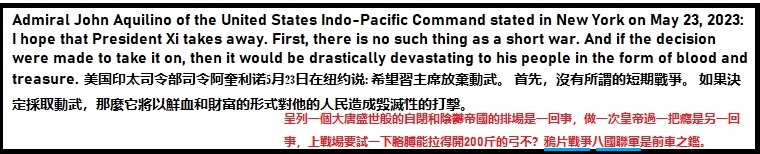
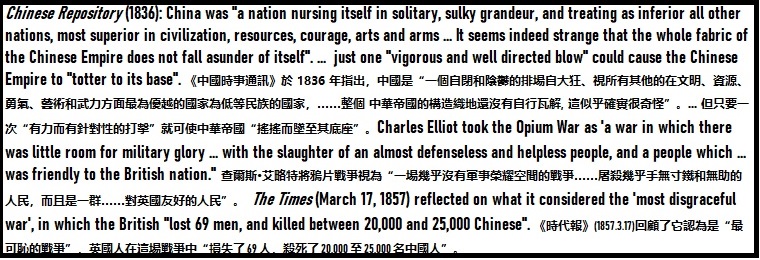
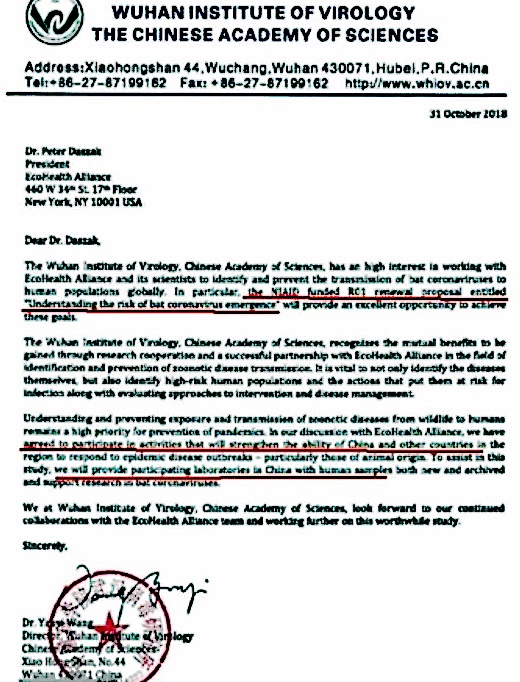


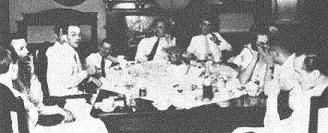
![Though, Anna Wang [Anneliese Martens], in her memoirs, expressed jealousy over Gong Peng by stating that the Anglo-American reporters had flattered the Chinese communists and the communist movement as a result of being entranced with the goldfish-eye'ed personal assistant of Zhou Enlai](GongPeng.jpg)