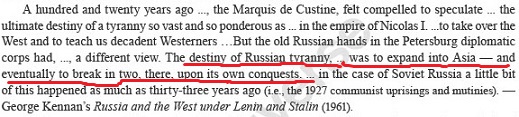
For twenty years, this webmaster had been telling the world that
Alan Greenspan, possibly the smartest American but bedazzled by the "conundrum" of long term interest rates, does not know that this webmaster's countryside cousins, mostly women, had been going to Guam, Samoa and other Pacific islands for a decade as the export of labor: what is coming to the U.S. market is merely a tag stating something not "made-in-China" but made-by-the-Chinese in nature.
The smartest American turned out to be Professor Peter Navarro, and it might not be some coincidence that his books "The Coming China Wars" and "Death by China" are similar to what this website wrote about for the last 20 years.
What this webmaster does not know is that the Chinese were going to Italy as well, where they worked as coolies and slaves for the "Made in Italy [by Chinese]" brands, and spread the coronavirus in Italy today.
What a farce Communist China gave the world, and what a disaster Communist China caused to the world!
Don't forget that France (Alain Merieux of bioMerieux - sarcastically-related to Moderna, the other side of a coin) and the United States (Anthony Fauci of CDC & Peter Daszak of EcoHealth) acted as the 'enablers' in designing and constructing the P4 virus research center in Wuhan, as well as in providing the funds.
And don't forget what happened today was because the Americans served as the midwife who delivered China into the communist hands as i) Roosevelt, in collusion with Churchill and Stalin, sold out China at Tehran and Yalta; and ii) George Marshall forced three truces [Jan-10-1946, June-6-1946, & Nov-8-1946] onto the Republic of China and further imposed the 1946-47[48] arms embargo while the commies were equipped by the Stalin-supplied American August Storm weapons and augmented by the mercenaries including the Mongol cavalry, the Japanese 8th Route Army troops, the Soviet railway army corps, and the 250,000-strong [Kwantung Army-converted] Korean diehards.
(Refer to
"The Italian fashion capital being led by the Chinese";
"Coronavirus Hits Heart of Italy's Famous Cheese, Wine, Fashion Makers" for further reading.
Military Documents About Gain of Function Contradict Fauci Testimony Under Oath:
EcoHealth Alliance approached DARPA in March 2018 seeking funding to conduct gain of function research of bat borne coronaviruses...
According to the documents, NAIAD, under the direction of Dr. Fauci, went ahead with the research in Wuhan, China and at several sites across the U.S.)
This website's contents are the result of 20 years' writings --that could be compared to the "archaeological deposits" in a literary sense.
The freelance-style writings on the website were not proof-read.
Portion of the writings, i.e., related to Pre-History, Xia, Shang, Zhou, Qin, and Han dynasties, was extracted, polished, reconciled, and synthesized into
The Sinitic Civilization - Book I which is
available now on
Barnes & Noble,
Amazon,
Google Play|Books
and
Nook.
Book II is
available now on
Amazon
and Barnes & Noble.
Check out this webmaster's 2nd edition --that realigned Han dynasty's reign years strictly observing the Zhuanxu-li calendar of October of a prior lunar year to September of the following lunar year
and
cleared this webmaster's blind spot on the authenticity of the Qinghua University's Xi Nian bamboo slips as far as Zhou King Xiewang's 21 years of co-existence with Zhou King Pingwang was concerned.
To give the readers a heads-up, this webmaster had thoroughly turned the bricks concerning the Sinitic cosmological, astronomical, astrological, historical, divinatory, and geographical records, with the indisputable discovery
of the fingerprint or footprint of the forger for the 3rd century A.D. book Shang-shu (remotely ancient history),
and
close to 50 fingerprints or footprints of the forger of the contemporary version of The Bamboo Annals --a book that was twice modified and forged after excavation.
All ancient Chinese calendars had been examined, with each and every date as to the ancient thearchs being examined from the perspective how they were forged or made up.
Using the watershed line of Qin Emperor Shihuangdi's book burning to rectify what was the original before the book burning,
this webmaster filtered out what was forged after the book burning of 213 B.C.
This webmaster furthermore filtered out the sophistry and fables that were rampant just prior to the book burning, and validated the history against the oracle bones, bronzeware and bamboo slips.
There are dedicated chapters devoted to interpreting Qu Yuan's poem Asking Heaven, the mythical mountain and sea book Shan Hai Jing, geography book Yu Gong (Lord Yu's Tributes), and Zhou King Muwang's travelogue Mu-tian-zi Zhuan, as well as a comprehensive review of ancient calendars, ancient divination, and ancient geography.
One chapter is focused on the Huns, with a comprehensive overview of the relationship between the Sinitic people and the barbarians since prehistory.
The book has appendices of two calendars: the first Zhuanxu-li anterior quarter remainder calendar (247 B.C.-85 A.D.) of the Qin Empire, as well as a conversion table of the sexagenary years of the virtual Yin-li (Shang dynasty) quarter remainder calendar versus the Gregorian calendar, that covers the years 2698 B.C. to 2018 A.D.
Refer to
Introduction_to_The_Sinitic_Civilization,
Afterword,
Table of Contents - Book I (Index)
and
Table of Contents - Book II (Index)
for details.
The people of the Zhou dynasty lived in an area that was considered the dwelling place of the Xi-rong & Rong-di barbarians, with the initial habitat in the Bin place, i.e., in today's central Shenxi, prior to relocation to Mt. Qishan, south of the Wei-he River. There was speculation that the Zhou people were part of the barbarians, which could be a wrong reading of the distinction between the Sinitic people and the barbarians, which was culture, not the blood line. The Zhou people, like the Qin people, had emerged from the barbaric West to become the ruler of China, with the Qin people leaving solid evidence showing the patented monosyllable Sinitic characters on cauldron "Qin-gong Zuo Bao Yong Ding (the Qin lord's manufactured treasured for-usage cauldron)".
The Zhou people, who claimed a same heritage from the various Ji-surnamed western states that received the Xia kings' conferral, could not have erred in the claim of descent.
Zhou King Jing(3)wang traced the northwestern barbarians to Tao-wu, i.e., ancestor of the later categorically-termed Yun-surnamed branch of the barbarians who might be or might not be the Jiang-surnamed San-miao exiles of the 3rd millennium B.C.
In another sense, the original Chinese 3000 years ago or 5000 years ago could not be much different from the Xi-rong & Rong-di at all.
From the physical anthropology's angle, today's northern Chinese had the traits of ancient northwestern Chinese, not the same as the ancient Sinitic people.
On basis of genetic evidence,
the haplogroup O3a1c-002611 Sinitic people was responsible for engendering the Yangshao and Longshan civilization, and partially with the N-haplogroup people, engendering the Hongshan civilization.
Since the O3a1c-002611 people were separated from the Northwestern cousins and Tibeto-Burmese at an early age, for it to have a part in the history of Northwestern China, the explanation would be to treat the Haplogroup O3a2c1*-M134 and O3a2c1a-M117 people as the historical Qiang and Hu barbarians, with the latter's paleo-Northwestern genes replacing the paleo-North-China and paleo-Central Plains genes of O3a1c-002611 Sinitic people by the Soong dynasty (A.D. 960-1279), that was likely triggered by the multiplication of the Tang dynasty's imperial house that had its origin from the Western Corridor.
https://www.ncbi.nlm.nih.gov/pmc/articles/PMC5255561/ carried an article stating that
"Y chromosome suggested Tibeto-Burman populations are an admixture of the northward migrations of East Asian initial settlers with haplogroup D-M175 in the Late Paleolithic age, and the southward Di-Qiang people with dominant haplogroup O3a2c1*-M134 and O3a2c1a-M117 in the Neolithic Age. Haplogroup O3a2c1*-M134 and O3a2c1a-M117 are also characteristic lineages of Han Chinese, comprising 11.4% and 16.3%, respectively. However, another dominant paternal lineage of Han Chinese, haplogroup O3a1c-002611, is found at very low frequencies in Tibeto-Burman populations, suggesting this lineage might not have participated in the formation of Tibeto-Burman populations."
Furthermore, the O3a1c-002611 Sinitic people, a lineage this webmaster belonged to, contained a predictable 5000-year-old admixture of about 10-20% Eurasian Q-haplotype heritage and the 6000 to 8000-year-old Finno-Ugric N-haplogroup gene --that the northwestern O3a2c1*-M134 and O3a2c1a-M117 people lacked.
(This webmaster, possessing the amber-colored or hazel eyes with a greenish ring, had been found to possess about 15% ancient Eurasian hunters' gene, specifically, N1a (N-M96 (N-CTS7095, N-P189)), a branch of the Finno-Ugric people who used to live along today's Inner Mongolia belt.
This webmaster believes that the Sinitic kings could be Finno-Ugric, or mixed paleo-North-China and Finno-Ugric, and in light of this webmaster's family surname’s origin from Sanhuaitang (three locust trees), a clan genealogy from the Zhou dynasty kings -- that could be seen in the Harvard-Yenching Library collection Shanyin Meixi Wang shi zong pu.)
While the ancient Chinese were considered sedentary with fixed places like the cities and castles, the Xi-rong & Rong-di barbarians remained nomadic, constantly on the move. In today's Shenxi and Shanxi provinces, records showed that the Xi-rong & Rong-di barbarians and the ancient Sinitic Chinese cohabitated in an interspersing way. Charles Hucker, in "China's Imperial Past", made speculation about the distinction between the sedentary and nomadic ways of life in China's northwestern areas, around the Yellow River line, at the time of early history: That is, the two ways of life had existed among both the Xia-ren or the Chinese and the nomadic people; both groups of people had partial agriculture and partial husbandry in the area; it was due to the Xia Chinese building up the walled states that led to the polarization of the two ways of life. Hucker's point was first proposed in the 1930s by Ding Shan, someone having wild imagination about China's prehistory link with the west. Owen Lattimore, in The Inner Asian Frontiers of China (1940), implied that the distinction was a matter of degree, with the Sinitic Chinese engaged in more agriculture than herding while vice versa for the barbarians. Possibly referring to the Okunev-kind stone implements and incidentally mentioning the climate change related to increased aridity, Owen Lattimore pointed out the edible roots and 'hoe agriculture' found in the Inner Mongolia belt, not taking into account that the Sinitic Chinese ancestors could have first pushed north towards Mongolia before returning south towards the Yellow River bends. Owen Lattimore implied that the prehistoric people could be at first agricultural and then pastoral, which mapped the ancient legends that the Huns were descendants of the Xia people.
(From the physical anthropology's angle, the ancient northern Chinese dwelled in the area of today's southern Inner Mongolia, i.e., the Great Wall line, with the Shang Chinese possibly belonging to this stock. As to the ancient "central plains" Chinese, they were now represented by today's southern Chinese.)
There is another way to paraphrase the interaction between the sedentary and nomadic way of life. Namely, every change of the dynasties of Xia or Shang would see the former rulers and their clansmen fleeing to the northern or western border to be the new generation of the barbarians. The later Qin dynasty remnants could have become the Qin-hu barbarians to the west --before the 'Qin-hu' cavalry mercenaries, hundreds of years later, were speculated to be some 'Lijian' [Roman/Alexandria Roman] legionaries who came to China from Central Asia. The 'Qin-ren' refugees were recorded to have reached Central Asia, where they helped to dig wells and contribute towards the water irrigation projects.
The Zhou People's Origin
The Zhou people, counted as a vassal of the Shang Chinese, were living among the barbaric west.
In the Zhou people's odes in Shi-jing, it was stated that their ancestor Hou-ji was born by Jiang Yuan after her stepping onto the footprints of some high lord.
Sima Qian, while stating about the same story, stated that Jiang Yuan stepped onto the footprints of a giant, instead of the high lord.
According to Shi-ji, the Zhou people's ancestor could be traced to Hou-ji, the Chinese guardian or father of agriculture.
Cao Pi, emperor of the Wei Dynasty of the Three Kingdoms time period, in eulogizing minister Du Ji, likened Hou-ji's dying in the mountains while working as Lord Shun/Lord Yu's agricultural minister to Shang ancestor Marquis Ming's dying in the waters of the Yellow River as the irrigation minister for the Xia dynasty (21-16th c. BC; ? 2207 B.C.E. - 1766 B.C. per Lu Jinggui's obfuscatory chronicling; 1978-1559 from lord Qi to lord Jie per raw data from the forgery contemporary version [Jin Ben] of
The Bamboo Annals or 1991-1559 B.C.E. per Zhu Yongtang).
Hou-ji was buried in the land of the Sichuan-Gansu border per Shan Hai Jing (The Legends of Mountains & Seas), i.e., a place to the west of the later-known Di[1]-guo state. That was of course the era of the Five Sovereigns.
Per Da-huang Xi Jing of Shan Hai Jing (The Legends of Mountains & Seas), Hou-ji was buried in the land of today's Sichuan basin after death, somewhere to the west of the Di-qiang barbarians (i.e., 'Di-guo xi') or called by "du-guang-zhi-ye" [spacious fields] by the Black Water, which in an alternative perspective shed light on the nature of the Sinitic people as from the west of China versus the prehistoric Jiang-surnamed people and the Nine Yi people to the east.
Shan Hai Jing, when talking about Hou-ji's lineage, stated that Lord Di-jun born Hou-ji and a younger brother called Tai-xi who born Shu-jun, a person renowned for farming.
Sima Qian's Shi-ji, in the section on the five sovereigns, mentioned that Lord Di-ku, a name not seen in Zuo Zhuan, had two sons, Zhi and Fangxun (i.e., Lord Yao); however, in Zhou Ben-ji, Sima Qian claimed that Zhou ancestor Hou-ji was born by Lord Di-ku's queen or the first concubine [and further stated in Yin Ben-ji of Shi-ji that Lord Diku's secondary concubine born Shang-ancestor-Xie4], using the scant records from recollected post-book-burning books of Shi Ben and Da-Dai Li-ji.
Hou-ji, like Shang ancestor Xie, was said by Sima Qian to be a son of ancient overlord Di-ku, a name not seen in Zuo Zhuan. Hou-ji's mother was named Jiang Yuan, a You-tai-shi woman, carrying the Fiery Lord tribal name. The Zhou people, said to be descendants of the Xia people, had intermarriage with the Jiang-surname Qiangic Fiery Lord tribe, which would be a prevalent way of Ji-Jiang marriage among the early Chinese.
(Note that the Di-xi Pian section of Shi Ben was used as basis for making the claim that Overlord Di-ku sired Lord Yao, and the Shang and Zhou dynasties' founding ancestors etc.
Di-ku's name was not seen in Zuo Zhuan.
The ancient version of The Bamboo Annals had no entry on Lord Di-ku.
Guo Yu, a political discourse book, had the name of Di-ku in the Lu Yu and Zhou Yu sections, someone who enjoyed the sacrifice as the lord who designed the penal codes to rule the people in the Lu Yu section, and someone who inherited Zhuan-xu's celestial guardian role in Zhou Yu section.
While the person Hou-ji was widely talked about as the ancestor of the Zhou people, the father-son relationship between Lord Di-ku and Hou-ji was doubtful.)
Chu poet Qu Yuan, having doubts about Hou-ji's identity as an elder son, questioned about it in
Tian Wen: "{if} Ji [Hou-ji] wei [was] yuan-zi [the elder son], {the} di [the high lord] he [why] du [connect with] zhi [him]?"
Purportedly, Shi Ben, which Sima Qian used for his description of the ancient lords' lineage, adopted the term 'yuan [the number one] fei [concubine or queen]' for Jiang Yuan or Hou-ji's mother, which was an apparent fabrication on the same par as 'yuan-zi [the elder son]'.
Jia Xuehong of Yangzhou University expanded on top of Jiang Ji of the Qing dynasty to explain the character 'zhu' to be equivalent to 'du2' and 'wu1' words which meant communication or telepathy.
The Shi-jing legend, as recorded in Bi Gong [closed temple, i.e., ancestress Jiang Yuan's temple] of Lu Song4 [ode to the Lu Principality], said that Jiang Yuan born ancestor [i.e., 'huang zu'] Hou-ji.
The Shi-jing legend, as recorded in Sheng Min [bearing of the people] of Da Ya, stated that Hou-ji was born after his mother stepped onto the footprints of 'Di4', namely, the high lord, without specifying who the high lord was.
Sima Qian described the event as something like Jiang Yuan stepping on the footprints of a giant, which could be a more primitive version about the Zhou people's origin than the Shi-jing version on the high lord.
Shi-jing, in the section Sheng Min (bearing of the people), described Hou-ji as being born like a baby sheep in an intact placenta.
The footprints of a 'giant', when mapping the Di1-Qiangic legends about Fu Jian's mother dreaming about a big bear before pregnancy, could be an ancient euphemistic way of hinting at the footprints of a brown bear, i.e., the equivalent Big Foot story among the North American Indians.
Hou-ji, being deserted to the mountains and lakes by his mother, was taken care of by the beasts and birds. As a result of being abandoned when born with an unbroken placenta, he was called by 'Qi4' or the abandoned boy.
The double Ji characters [ji1 versus ji4 {footprints}] & the double agricultural minister identities ['tian-zheng {agricultural minister} ji' Zhu, a Lie-shan-shi son, versus Hou-ji the Zhou ancestor] Shang-shu, in the Lü Xing section, stated that Hou-ji planted 'jia gu' (i.e., millet).
Both Lord Yao and Lord Shun used 'Qi4' as the master of agriculture, with Lord Shun assigning him the fief of Tai, i.e., the You-tai-shi land where his mother Jiang Yuan was from and naming him by the agricultural title 'Hou-ji', one of the three agricultural titles as carried in Zhou Yu of Guo Yu. The name 'Hou-ji' then became a standard title as the "agriculture minister".
In Yao Dian of Shang-shu, Lord Yao was said to have conferred Hou-ji the last name of 'Ji1', i.e., the Yellow Lord's character 'ji1', meaning origin in one way of interpretation.
Confucius purportedly had commented on the story of the You-ji[1]-shi clan.
This was in a similar context of Lord Yao's conferring the ancient Fiery Lord's Jiang surname onto another minister called by Si-yue or the four mountains' oblation minister.
Here, we have a case of the double Ji characters [ji1 versus ji4 {footprints}] as well as a case of the double agricultural minister identities ['tian-zheng {field minister} ji' Zhu, a Lie-shan-shi son, versus Hou-ji the Zhou ancestor].
From Han Dynasty Wang Chong onward, there was doubt about the origin of the Zhou people's surname as being from Yellow Lord's Ji1 surname, i.e., the No. 1 surname among the twelve surnames of the Yellow Lord's 25 sons. The speculation would be that the ji4 character for the footprints would mutate into the soundex Ji1 surname.
Namely, the later Zhou people had adopted the character 'Ji1' for their clan's surname, which was the name used by the Yellow Lord.
The Yellow Lord's character 'ji1', per Bai Hu Tong [white tiger compendium, i.e., white tiger auditorium's consensus interpretation], was implied to have the same soundex as the footprints '[zu-]ji4' of a giant.
Using the Di1-Qiangic legends, we could say that the woman from the Qiangic or the sheep totem tribe had married someone from the brown bear totem tribe, i.e., one of the animal totem tribes of Northwest China.
(Note that the very first known prehistoric China's surname was 'Feng' or the wind surname, followed by the 'Jiang' surname of the Fiery Lord, then the 'Ji1' surname of the Yellow Lord, and then numerous surnames that would be 'Qi3' for Lord Yao's lineage, 'Gui1' for Lord Shun's lineage, 'Si4' for the Xia dynasty line, 'Zi' for the Shang dynasty line, and again 'Ji1' for the Zhou dynasty line, plus some one to two dozens of archaic surnames that would include Kui2 (i.e., the Red Di barbarians' surname), Yun3 (i.e., the Xianyun barbarians' surname), Maan4, Gui1, Mie4 etc. It is not known when the Zhou people first started to adopt the Yellow Lord's 'Ji1' surname. Nevertheless, it had to be recent, not remote --as no single clan, after branching out from the same ancestor or origin, could have the monopoly over the usage of the Yellow Lord's surname. Similarly, the Qin people had acquired the ancient 'Ying' surname as a result of Zhou King Xiaowang's conferral in regards to the inheritance arrangement for two sons of Qin ancestor Da-luo.)
The double identities were related to the prehistoric figure called by Zhu, a person revered as the grains or agricultural guardian beyond the Xia dynasty.
The 'ji-guan' or the grains official, of course, did not start with Hou-ji as agricultural/prehistoric China, per Lu Yu of Guo Yu and Lu Lord Zhaogong's 29th year of Zuo Zhuan, possessed someone called Zhu, a son of the Lie-shan-shi clan [i.e., equivalent to a later-forged name of Shen-nong-shi {the Divine Farmer}], or Yandi {the Fiery Lord}, renowned for planting hundred kinds of grains and hundred types of vegetables.
Literally, for the name Hou-ji, the prefix 'hou' meant a descendant in the modern sense, but a possibly "imperial-grandiose" title like Hou-tu, said to be one of the Gong-gong-shi dynasty sons, with 'hou' meaning more than a descendant but an adjective in parallel to the combination 'huang{imperial-grandiose}-tian{heaven}', as well as like the name of Hou-yi, the legendary sun-shooting leader who usurped the Xia dynasty rule.
The character 'ji' itself had its confusion, with Lord Yao possessing a so-called Zhou-dynasty-era 'ji-guan' or the grains official, with all the future references combining the character 'she4' {literally meaning mud} for the oblation temple and the character 'ji' for the grains, to mean a country's foundation or pillars.
The double agricultural minister identities ['ji or equivalent tian-zheng {field minister}' Zhu, a Lie-shan-shi son, versus Hou-ji the Zhou ancestor] were related to the prehistoric figure called by Zhu, a person revered as the grains or agricultural guardian beyond the Xia dynasty, whose agricultural legacy was said to be succeeded by Zhou ancestor Hou-ji.
Zuo Zhuan, in Lu Lord Zhaogong's 29th year, stated that 'ji or equivalent tian-zheng {field minister}' Zhu was revered during and prior to the Xia dynasty while Zhou-qi, namely, the abandoned boy [who was the Zhou dynasty's ancestor Hou-ji] was revered as the grains or agricultural guardian since after the Shang dynasty (1765 B.C.E. - 1122 BC per Shao Yong; or 1559 - 1050 per the forgery contemporary version [Jin Ben] of The Bamboo Annals).
Guo Yu, a political discourse book that had more than half a dozen errors or conflicts with Zuo Zhuan, had at least two claims in the top and last sections of Zhou Yu in regards to Hou-ji's generational context.
In the Zhou Yu section, Prince Tai-zi-Jinn admonished king-father Zhou-ling-wang in saying that from ancestor Hou-ji onward, fifteen kings (i.e., generations) passed before Zhou King Wenwang took power.
Another context was in regards to Zhou King Jing[4]wang's building the Chengzhou fort at the advice of ministers Liu-wen-gong and Chang-hong, a proposal to start the construction to make it a permanent capital city, to which Wey minister Biao-nei (Biao-xi) rebuked to Zhou minister Shan-mu-gong as to the sustainability of the Zhou court.
Namely, Biao-nei said that the Zhou dynasty prospered 15 generations after Hou-ji's diligent work, and how could Zhou revive again now that it was like 14 generations since Zhou King Youwang disrupted the dynastic rule.
The conclusion is that two different agricultural official or guardian, from Overlord Yao's timeframe, and from the Xia-Shang transitionary time period, were mixed up.
(The Zhou people themselves were possibly confused over the context or could have reconciled their own lineage history. In another context carried in the Zhou Yu section of Guo Yu, Zhou minister Ji-gong (Mou-fu) made a claim that the Zhou ancestors held the hereditary 'hou-ji' title throughout the Lord Shun dynasty and the Xia dynasty till ancestor Bu-zhu lost the agricultural minister or guardian's post during the late Xia dynasty time period.)
The Zhou People's Claim As People from the West
A mediocre sinologist error would be to claim that the Zhou people originated from the west or 'Central Asia'.
Actually, the Zhou people were archaeologically speculated to have origin from today's Shanxi for the link to the Guangshe Culture –- which was in turn a derivative of the You'ao-type Laohushan Culture, i.e., the mixed group of the N-haplogroup Finno-Ugric people and the paleo-North-China branch of the O-haplogroup Sino-Tibetans.
The 'west' story could have derived from two inputs: the Zhou people's locality to the west of the Xia and Shang people, and Zhou King Wuwang's claim as people from the west. As we detailed below, when Zhou Lord Wuwang campaigned against last Shang King Zhouwang, he eulogized his alliance's bravery by calling his armies the "people from the west".
Scholar Liu Qihan, in anthology The Hua Xia Civilization, tackled the issue of 'xi' or west. His validation pointed to the land of 'he qu' (i.e., the inflexion point of the Yellow River Bends) as the 'land of the west', i.e., the later land between the Qin and Jinn principalities.
(Zhou King Wuwang's alliance also pointed to the fact that the Zhou people, by the timeframe of the 11th century B.C.E., had basically surrounded the Shang people from north, west and south. In the Wu-cheng section of Zhou Shu of Shang-shu, a statement was made to refer to the alliance of people from the Hua [Mt. Hua-shan] land of the west, the Xia people of the central plains, the 'Maan' people of the south and the 'Mo' people of the north, all converging under the banner of the Zhou leadership.
The 'Mo' reference was validated by Zhou King Jing[3]wang's statement in Lu Lord Zhaogong's 9th year of Zuo Zhuan, on which occasion the king claimed that the state of Bo [Bo-guo], a character which was used for designating the Shang capital cities and a possible soundex for the barbarian [Hui-]mo people, was the northern frontier land of the Zhou dynasty.)
Liu Qihan cited Guo Yu's statement in regards to You-yu-shi as proof that Lord Yu-shun's clan had deep connection with the Xia people. The statement from Guo Yu could be paraphrased like this: "In ancient times, Count Chong-bo Gun also reigned in the land of the You-yu-shi clan." Count Chong-bo Gun was the father of Lord Yu and dwelled in southern or southwestern Shanxi Province, i.e., the east bank of today's East Yellow River Bend. The You-yu-shi clan's locality, considered the second 'Xia Ruins' in archaeology, would be along the two banks of the East Yellow River Bend, i.e., Hancheng (west bank of the today's East Yellow River Bend) and Pucheng (west bank of Luo-shui River).
This shows that the Xia people had in fact dwelled on both banks of the Yellow River plus the inflexion point in today's northeastern Henan Province.
Today's East Yellow River Bend was known as 'Xi-he' or the western river because the Yellow River did not flow horizontally into the sea via Shandong Province but made an eastern bend northward for exit into the sea in today's Hebei Province.
Liu Qihan researched into ancient classics Mu Shi (i.e., the Oath of War at Muye) and concluded that Zhou King Wuwang's reference to 'xi tu' would be the land to the west of the later Tongguan Pass of eastern Shenxi Province.
Per Guo Yu, at the time the Xia reign prospered, 'rong', a word which was used for designating Zhu-rong [virtues shining like fire] but had the underlying two parts meaning a pottery and a snake, appeared on Mt. Chongshan, which was to say that some propitious dragon accompanied the rise of the Xia dynasty, with the Zhu-rong-shi people producing numerous guardian gods or counts in the ensuing years.
The mountain from which the title of Count Chong-shan derived was disputed to be not today's Mt. Songshan in Shenxi Province, but some mountain in the Great Xia land, where the ancient Mt. Huo-shan was taken to be the tallest peak in the land of the Xia people.
The Zhou People's Developments during the Xia-Shang Dynasties
After Xia King Taikang lost his throne, Buzhu, i.e., Houji's son "multi-generational" descendant [by citation of the ambiguity about the generational gaps in Guo Yu], left for the west in the aftermath of the abandonment of the agriculture post by the [usurped] Xia Dynasty court. There was some confusion about where Buzhu went, and it could be a move to today's southern Shanxi from western Shandong, i.e., the original Grand Xia land, not the Rong & Di land in today's Shenxi Province.
Another two generations would be Gongliu who renewed agriculture in the Rong & Di land. This renewal would be a basis for a claim that the Zhou people had consecutively changed their modes of life.
Ancestor Gongliu then relocated the Zhou clan to Bin.
Gongliu's son (Qingjie) set up a statelet in a place called 'Bin'.
'Bin' was commonly taken to be in today's central Shenxi Province, a place belonging to the Xi-rong later, i.e., today's Xunyi where Liu Zhidan's communist Red Army banditry sought the safe haven.
The 'Bin' here was disputed by some scholars, like Qian Mu, to be still in Shanxi Province rather than Shenxi Province, which was wrong.
History repeatedly talked about the Zhou people's southern relocation via the crossing of Mt. Liang-shan, a mountain that was validated to be on the western riverbank of the Yellow River --where Zuo Zhuan recorded that an earthquake had at one time collapsed some mountain tops to have the riverflow clogged for three days.
Another eight generations or three hundred years would be Zhou Dynasty's founder, Gugong (aka Danfu [Tanfu]).
Ancestor Gugong-tanfu, under the attacks of the barbarians, relocated southwestward to Zhouyuan, south of Mt. Qishan.
The Zhou people, on basis of the ancient poems Shi-jing, had constant battles and fights against the Rong & Di people, and moved around possibly in southern Shenxi and along the Wei-Shui, Luo-he and Yi-shui rivers area, not the present Bin-xian County area, which was the banditry den of Liu Zhidan's Red Army of central Shenxi.
Gugong, being attacked by the Rong & Di and Xunyu barbarians, would relocate to Mount Qishan. The people of 'Bin' followed him to Qishan. Gugong abolished the Rong & Di customs, built a city in a plain area called Zhou-yuan under the foot of Mt. Qishan, and devised five posts of si tu, si ma, si kong, si shi, & si kou per Shang Dynasty's court system. Though, some scholars disputed the five posts since the bronze inscription or bronzeware characters did not add up to the five counts. Gugong declared their statelet 'Zhou'. From this definite statement, some historians deduce that the character 'Zhou' which the Shang people had described about in the oracle bones prior to this event was not the same as the Zhou statelet that Gugong had launched. Gugong, known as 'Zhou King Taiwang' (i.e., the grand king) posthumously, was said by the poem to be unmarried at the time.
Shi-jing, in the poem on the ivy, eulogized Gugong's move, with a claim that mankind was born from the gourd kind of cucumbers. Shi-jing [classics of the poems], had the 'Mian' poem to the effect that "mianmian [un-interrupted ivy lines of] gua1 [large gourd or melon] die2 [small gourd or melon], min zhi chusheng [the initial birth of mankind]".
Both Gugong-tanfu and his descendant, Zhou Lord Ji Li [Ji-li or Jili], lived during the reign years of Shang King Wu-yi.
Ji Li's mother was called Tai-jiang, a Jiang surname woman of the You-tai-shi clan. Xu Zhuoyun cited scholar Liu Qiyi's research of 'jin wen' or bronze inscription in stating that 12 kings of the Western Zhou dynasty had inter-married with the Jiang-surname women consecutively.
Ji Li's son, born by a Zhi-ren-shi or Zhi-zhong-shi woman, would be Ji Chang, i.e., Zhou King Wenwang or Count Xibo who was said to have possessed four nipples.
As recorded in Da Ming in the Da Ya section of Shi-jing, the Zhi-zhong-shi woman, called Ren, was from the Zhi-guo, a Shang royal family vassal state near the outskirts of the Shang capital city of Chaoge, a city to the south of the Shang Ruins known as 'Yin-xu'.
In summary, Gugong married with a Tai-jiang (Da-jiang) woman of the You-tai-shi clan; son Ji-li married with a Tai-ren (Da-ren) woman of the You-ren-shi (or You-zhong-shi) clan; and grandson Ji Chang married with a Tai-si (Da-si) woman of You-xin-shi clan.
While the Jiang-surnamed You-tai-shi clan was somewhere near the Zhou homeland of Zhouyuan, [Duke or Lord] Pang-gong, a nephew of Madame Tai-jiang, was ruling some Jiang-surnamed people on today's Shandong peninsula to the east, which exhibited the widespread distribution of the ancient Jiang surname people across China prior to the emergence of the Ji-surnamed Zhou rule.
Gugong's elder son, 'Tai Bo', went to the Yangtze Delta (Meili Village, Wuxi County, Changzhou, Jiangsu) for sake of launching own statelet. Tai Bo wanted to yield the succession to his brother because the ancient mandate said that the son of Tai Bo's brother (Ji Li) would be the future lord of the Zhou people.
(Xu Zhuoyun speculated that Tai Bo was deliberately dispatched to the Yangtze Delta as a tactic move to circumvent and attack Shang Dynasty from both directions.)
The Zhou People's Lineage
The Zhou people traced their ancestor to Houji who was buried in the land of Sichuan-Gansu border per Shan Hai Jing. That was of course the era of the Five Sovereigns. After the Xia dynasty was launched, the Zhou people were living in the heartland of China as hereditary agricultural ministers.
Zhou ancestor Buzhu, i.e., Houji's son or [possibly] "multi-generational" descendant [by citation of the ambiguity about generational gap in Guo Yu], left for the west after the [Dong-yi-usurped] Xia Dynasty abandoned the agriculture post.
Per historical records, the Zhou people acted as "agriculture minister" for the Xia court, from ancestor Qi4 to ancestor Buzhu, which meant that the Zhou clan dwelled most likely in today's Henan-Shandong border line, with the naming of a place by 'Tai2', south of today's Zhangqiu of Shandong.
Some confusion existed as to the place Buzhu had left for, either somewhere still in southwestern Shanxi Province or somewhere across the Yellow River in Shenxi Province.
Xu Zhuoyun listed 16 sentences in Shang Dynasty's divination and oracle records to prove that the Shang people, at the reign of Shang Dynasty King Woding, had instructed the subordinate tribes in campaigning against the Zhou people and speculated that the Zhou ancestors must have lived around southern Shanxi province, a place to the northeast of the inflexion point of the Yellow River.
Xu Zhuoyun cited Ban Gu's Hou Han Shu in stating that the Fen-yin area of southern Shanxi Province, possessing a temple in the name of Zhou ancestor Houji, should be the Zhou people's original habitation area.
Liu Qihan (Liu Qihua) pointed out that after the demise of Xia, whoever stayed in Shanxi/Shenxi provinces continued to call themselves the 'Xia' people.
First Zhou King Wenwang eulogized the eastward flow of the Fen-shui River to Lord Yu's accomplishment and numerous Zhou Dynasty records stated that they were descendants of Xia Dynasty founder Lord Yu. (There were two citation in Zuo Zhuan that contradicted this claim, with the Ji-lineage principality lords distancing themselves from the people of Qi3-guo [i.e., the Xia descendants], and calling the Qi3-guo people by 'Qi3-yi' or the eastern Yi people of Qi3; though, alternative explanation was made to the effect that Qi3 Lord Chenggong had adopted the [Eastern] Yi customs and practiced it to the day of his death, and that the Wey-guo minister, i.e., Ning-wu-zi/Ning-zi/Ning Sheng/Ning Wu/Ning Yu, was actually stating that it was not Wey-guo's fault to not have reverence for the Xia Dynasty lord Xiang because the ghosts-gods [i.e., spirits] had deserted the Xia lords, not the common interpretation that the Wey-guo people did not revere the Xia lord Xiang's oblation because the Ji-surnamed Wey people did not belong to the same lineage as the Xia people.)
Ancestor Gongliu then relocated the Zhou clan to 'Bin', a place naming with fire and pig characters embedded, similar to another character 'xian' with two pigs' sign on top and fire below. Gongliu's son (Qingjie) set up a statelet in 'Bin'. 'Bin' was commonly taken to be in today's central Shenxi Province, a place belonging to the Xi-rong later, i.e., today's Xunyi.
Xu Zhuoyun, in Xi Zhou Shi (i.e., The History of Western Zhou Dynasty, 1973 edition, Lianjing Publishing House, Taipei, Taiwan), stated that the Zhou ancestors, per scholar Qian Mu's 1931 dissertation, migrated westward to Shenxi Province from Shanxi Province.
Roughly, the Zhou people, from ancestor Buzhu to ancestor Gongliu, possibly dwelled in southern Shanxi and then moved across the Yellow River to central Shenxi.
Another eight generations or three hundred years would be Zhou Dynasty's founder, Gugong (aka Danfu [Tanfu]). Ancestor Gugong-tanfu, under the attacks of the barbarians, relocated southwestward to Zhouyuan, south of Mt. Qishan. The Zhou people, on basis of the ancient poems Shi-jing, had constant battles and fights against the Rong & Di people, and moved around possibly in southern Shenxi and along the Wei-Shui, Luo-he and Yi-shui rivers area. Gugong, being attacked by the Rong & Di and Xunyu barbarians, would relocate to Mount Qishan. The people of 'Bin' followed him to Qishan.
Previously, this webmaster summarized that Zhou ancestor Gugong married with a Tai-jiang (Da-jiang) woman of the You-tai-shi clan; son Ji-li married with a Tai-ren (Da-ren) woman of the You-ren-shi (or You-zhong-shi, with 'zhong' more likely meaning a junior daughter) clan; and grandson Ji Chang married with a Tai-si (Da-si) woman of You-xin-shi clan.
The first part of Da Ming in the Da Ya section of Shi-jing was about the Zhi-zhong-shi woman, called Ren, from the Zhi-guo, a Shang royal family vassal state near the outskirts of the Shang capital city of Chaoge.
The second part of Da Ming was about Ji Chang (i.e., Zhou King Wenwang)'s marrying with a Shang king's daughter plus a Tai-si (Da-si) woman of You-xin-shi clan.
The Shang king's daughter matched with the 'gui [marrying or returning for a home visit after the marriage] mei [Shang king's sister]' hexagram in Zhou Yi.
In Zhou Yi, there was a No. 54 'gui-mei' hexagram called Shang King Di-yi's sister paying a return visit to the home.
The original [Zhou-]Yi (i.e., I Jing [Yi Jing]) during Zhou King Wenwang's times might not have the total number of sixty-four hexagrams and progressed to possess the sixty-four hexagrams throughout the early Zhou dynasty time period.
It was said that on basis of the primitive eight trigrams, namely, 'qian' [heaven], 'kun' [earth], 'zhen' [thunder], 'xun' [wind], 'gen' [mountain], 'dui' [lake], 'kan' [water], and 'li' [fire], Zhou King Wenwang developed the sixty-four hexagrams that composed of six stacked horizontal lines (i.e., 'yao'), either broken or unbroken [alternatively called female 'yao' or male 'yao' in the Han dynasty time period], with the hexagram's name called by 'gua', the hexagram statement called 'tuan' and the cryptic six-line statements called 'yao ci' --which were used to produce the oracle in combination with cleromancy using the stalks of the yarrow plants or similar materials that offers the mechanism for sortition.
(Since every hexagram had six 'yao', there yielded more than 384 'yao' in total or three hundred and eighty-four combinations to explain the hexagrams and their meanings, which meant that Zhou King Wenwang's divination had exceeded the Shang Dynasty's sorcery that was possibly limited to the variations seen on the turtle shell, and the cattle's shoulder bones.
Gernet succinctly pointed out
that in Zhou China, "divination itself developed autonomously in the time of the first kings of Chou"
in the direction of the yarrow stems instead of "divination by fire" of Shang China. Though, milfoil
divination, i.e., numerical stalk divination, could have already existed before the Zhou dynasty.
Oracle
bone expert Tang Lan ascertained some Shang dynasty "shi1-shu" numerical stalk divination signs
on the Sipanmo divination bone, which were written as "787676 called kui [with the fief signific], and
757566 called kui [with the Dipper signific]". The combination 'kui-kui', in the Latter Han dynasty,
became the name of the Fiery Thearch.
As pointed out by divination expert Gao Heng, the 'fu' character on the Shang-Zhou oracle bones and in Zhou Yi meant for prisoners caught and sacrificed, i.e., some barbaric history hidden in the pre-Zhou China.
The Zhou Yi divination, in the 'lü' (marching path), 'meng' (enlightenment), 'sui' (following Zhou King
Wenwang in obedience), 'dun' (retreating) and 'kun' (trapped) hexagrams, hinted at imprisonment, which
was speculated to be about Zhou King Wenwang and his imprisonment in the Youli place.
In the late Zhou times, divination could have had its freelance developments in the usage of its hexagrams.
Shan Hai Jing, in randomly calling Shang ancestor-king Wang-hai as someone from
the Gou-surnamed Kun-min state, could have switched on the unbridled fantasy by extrapolating on
the 'kun' (trapped/entrenched) hexagram in Zhou Yi or Gui-cang Yi divination.)
According to Da Ming, Zhou King Wenwang received the mandate from the Shang king and expanded his influence to the northern riverbank of the Qia-shui River in today's Heyang, Shenxi.
Da Ming carried a parallel sentence to the effect that Zhou King Wenwang had a bride who was a daughter of the big country, i.e., the Shang king's daughter, similar to his father's marrying the Shang royal woman from the Zhi-zhong-shi-ren (a junior daughter of the You-ren-shi clan in the Zhi country), which probably matched with the 'gui [marrying or returning for a home visit after the marriage] mei [Shang king's sister]' hexagram in Zhou Yi.
Zhou King Wenwang, for receiving the bride, built a bridge with the chained ships over the Wei-shui River.
Da Ming continued to state that Zhou King Wenwang had another bride from the You-xin-shi (or You-shen-shi) land which could be in today's Heyang, Shenxi.
Shi-ji stated that Ji Chang (i.e., Zhou King Wenwang) had several wives, including a Tai-jiang woman, a Tai-ren woman, and a Tai-si woman, et al., with Tai-si enjoying the last name 'Si' of Lord Yu's lineage; that Tai-si born Bo-Yikao, Fa, Xian (Guan-shu), Dan (Zhou-gong), Du (Cai-shu), Zhenduo (Cao-shu), Wu (Cheng-shu), Chu, (Huo-shu), Feng (Kang-shu) and Zai (Ya Ji-zai; Ran Ji-zai of the Ran Principality in today's Huyang, Anhui Province).
The Shang & Zhou Relations
In the Xia-Shang dynasties, this webmaster touched on four evolving characters of 'gui1', gui, jiu and huai, i.e., the descendants of Lord Shun carrying the Gui1 surname, the Gui-fang adversary fighting against the Shang kings, the Jiu-hou marquis serving as one of the vassal ministers at the Shang court, and the nine Huai-surnamed clans affiliated with the deposed Shang dynasty rule. With the Zhou people being a part of the Shang lordship system, there was no more record about the campaigns against the Gui-fang people. Zhou King Wuwang had apparently taken the Gui1-shi people as the descendants of Lord Shun, and made them to inherit the Lord Shun lineage after overthrowing the Shang dynasty ruling. After overthrowing the Shang rule, there was no more record on Marquis Jiu-hou but the nine Huai-surnamed clans with a king of their own.
In reconciliation, this webmaster would make a few points, that the Zhou people could be related to the Gui-fang people; that the remnant Xia people dwelling in the Da-xia land had very much retained the Gui1 or Gui1-shi surname from the beginning, while also noting the fact that a son of the ancient lord Gaoxin-shi had taken the same land as his fiefdom of Tang and enjoyed the Tang-shu or Uncle Tang hereditary title for thousands of years, till Uncle Shu-yu of the Zhou royal line was to hijack it as the Tang or Jinn fief; and that the Jiu-hou marquis' people could be the same as the nine Huai-surnamed clans whose [independent] king had offered sanctuary to the Jinn marquis during the later Quwo power struggle.
In Shang Dynasty's oracle bones, two vassals, i.e., the Zhou statelet and Marquis Jiu-hou [which was speculated to be the Gui-fang statelet], had taken charge of fighting the proto-Qiangic Rong barbarians on behalf of Shang, and furthermore surrendered the Qiangic prisoners to Shang for live burial. This speculation of equating Jiu-hou to the Gui-fang statelet was just one thought, with the surname books pointing to the ancient Jiu-wu-shi clan to be the origin of Jiu-hou, which had their descendants including the 'Chou' or 'Qiu' last name.
Shang King Wu-ding, who was known to have hired talent Fu Shui (also called by Shao4) in the wilderness and entitled 'Gao Zong' (i.e., the highest ancestor), had launched numerous campaigns against the barbarians who might include the Zhou ancestors, such as Gongliu who renewed agriculture in the Rong & Di land relocated the Zhou clan to 'Bin'.
Shang eliminated the prominent Peng-zu-shi 'hou-bo' or marquisdom state; waged three years' war against the Xi-rong and Gui-fang barbarians; and campaigned against the Jing-chu (i.e., Jing-mann) barbarians.
During Wu-ding's reign, the oracle bones carried records about a 'Zhou' state and its sending in a woman named by a 'Qin2' character with a woman's sign as well as characters 'fu-Zhou' to mean a woman from Zhou. Some ancient dictionary book stated that the 'Qin2' character with a woman's sign was pronounced 'zhen', the same as the character with new and woman at the top and bottom --which was said to be a different writing method for the character 'xin' of the You-xin-shi [You-shen-shi].
Some historians deduced that the character 'Zhou' which the Shang people had described about in the oracle bones here was not the same as the Zhou statelet that Gugong had launched at the foot of Mt. Qishan.
If this 'Zhou' on the oracle bones was the Zhou ancestors, then the Zhou people were part of the Gui-fang barbarians.
Xu Zhuoyun cited Chen Mengjia's research in pointing out that Zhou Taiwang, during Shang King Wu-yi's reign, relocated to Mt Qishan under the pressure of the Doggy Rong; that Zhou Lord Ji Li [Ji-li or Jili], during the 34th year reign of Shang King Wu-yi [per The Bamboo Annals], paid pilgrimage to the Shang court; that Jili defeated the Xiluo-Gui-rong barbarians and captured 20 Di[2] kings the next year [i.e., the 35th year of Shang King Wu-yi]on behalf of the Shang court but Shang King Wu-yi was killed by a lightning around the Wei-shui River when the Shang king was hunting in the area of the Yellow River and Wei River; that Jili campaigned against the Yanjing-rong (Yan-rong) barbarians but got defeated during the 2nd year reign of Shang King Taiding (Wending), an event that pointed to the fact that the Zhou army, acting as a mercenary army for Shang, had in fact transferred to today's Shanxi-Hebei area from western China to fight the mountain Rong; that Jili, two years thereafter, i.e., the 4th year of Shang King Wending, defeated Wuyu-rong (Yuwu-rong) barbarians and received conferral as 'mu shi' (shepherd chancellor) from the Shang king; that Jili first campaigned against the Shihu-rong barbarians during the 7th year reign of Shang King Taiding and against the Yitu-rong barbarians during the 11th year reign of Shang King Taiding, and defeated three "da fu' of the barbarians; that Jili was killed by Shang King Wending (Taiding) thereafter, when Ji-li defeated and captured three da-fu of the Yitu-rong and came to the Shang court to surrender the prisoners of war, with historians commenting in The Bamboo Annals that the Shang king put Ji-li under the house arrest at the Shang capital where Ji-li was pressed [pressured or stressed] to death; and that the Zhou people began to attack Shang Dynasty during the 2nd year reign of Shang King Di-yi (Yili) [- which was not shown in The Bamboo Annals as it recorded that Count Xi-bo (Ji Chang) began to attack Di2 in the 17th year of Shang King Xin].
Zhou Lord Ji Li [Ji-li or Jili] was married with a You-ren-shi woman from the Shang royal line.
This meant that the Zhou-Shang alliance had some common interests, namely, fighting against the barbarians who were categorically called by Rong-di or Xunyu at that time, not Gui-fang.
Shang King Wu-yi himself, travelling across the Yellow River, was killed by a lightning.
Shang King Wu-yi, during his 35th year, was killed by a lightning around the Wei-shui River when the Shang king was hunting in the area of the Yellow River and Wei River
Xu Zhuoyun speculated that Shang King Wu-yi most likely died in the hands of the Zhou people rather than a lightning strike in a similar coverup as later Zhou King Zhaowang's death on the Han-shui River in a conflict with the southern barbarians [? the Jing people who dwelled in the same land as the ancient Sanmiao, a linkage area to the Shu & Ba states in today's Sichuan].
Whether or not the Zhou people were part of the Gui-fang barbarians, they were together at one time.
Per Liang-hui-wang of Mencius, King Taiwang served the Xunyu barbarians.
Per Liang-hui-wang of Mencius, King Wenwang, before he took control of the barbarians for campaign against the Shang overlordship, had served the Kun-yi [or Hun-yi] barbarians.
This showed that the situation on the ground was fluid, with the barbarians sometimes overpowering the Zhou people.
Later in history, we have the Jinn Principality princes marrying with the same Ji1-surnamed Di barbarians who spread along the two sides of the Yellow River. This would be a group of barbarians who were said to be the predominant natives of the Yongzhou prefecture, i.e., the land to the north of the Wei-shui River, carrying the same royal surname as the Zhou house but was occasionally written in a more archaic character.
The rumor about Jinn Principality prince Chong'er's one piece rib bones and the double ear loops could be related to the genetic mutation as a result of the superstitious same-surname marriage with the Di barbarian women.
(With the Ji1-surnamed barbarians, the barbarians' one origin thesis of historian Du Yu, like historian Sima Qian's five sovereign lords' same origin, could not stand.
In the line of Du Yu's reasoning, all barbarians could be traced to the San-miao people who were exiled to Northwest China, where they began to push back towards the east to become ancestors of all the future Rong and Di barbarians who played the role of capsizing the Western Zhou dynasty rule and continued to harass the Eastern Zhou dynasty rule, till Qi Lord Huan'gong's campaign to save Sinitic China from the fate of survival by hanging on a thread.)
The Shang-Zhou relationship had improved since Jili's successor, Ji Chang, i.e., posthumous Zhou King Wenwang, had again married with the Shang princess.
Both the mother and the wife of Zhou King Wenwang, per scholar Fu Sinian, were princesses of the Shang royal house.
The Zhou people were conferred the title of 'Xi Bo' (Count of the West) by Shang Dynasty King Zhouwang as a buffer state against the western and northwestern barbarians.
The barbarians here could be very likely the remnants of the Xia people who were overthrown by the Shang people, as well as the mountain Rong people who dwelled at today's Shanxi-Hebei-Chahar border area.
Zhou King Wenwang was recorded to be bird-nosed, tiger-shouldered, and dragon-faced.
The Mandate of Heaven
The concept of 'Heaven' as an ancient 'Di(4)' or overlord had been with the Chinese since the eras of the Eight Ancient Lords. 'San Huang', termed the Three Sovereigns, were more likely mythical and non-human-entity titles at the time the first emperor of Qin coined his title about 2200-2300 hundreds ago, were later mixed up with fables to become Fuxi, Yandi the Fiery Lord, and Huangdi the Yellow Emperor, or varying orders.
The point was that in ancient China, we did have the saying of the 'Heaven Huang', the 'Land Huang', and the 'Taishan Mountain Huang' [which was mutated to the 'Human Huang' at some later time but before the Han dynasty scholars mixed it with the Zhuang-zi (Chuang Tzu, 369-286 B.C. ?) and Lie-zi fables to become the 'Human Huang'].
The 'Heaven' concept was widely adopted by the Eurasian nomadic people and incorporated in their shamanism, where 'Heaven' was equivalent to 'Tengri'. There is no definite way to tell where the original concept of 'heaven' had originated.
However, Shang Dynasty's founder, Shang-Tang, claimed that Lord Highness (Heaven) instructed him to campaign against Xia Dynasty' Lord Jie because of Jie's corruption, lasciviousness and cruelty. Shang-Tang was also named 'Tian Yi' or the 'Heavenly Yi'. Since 'Heaven' was considered a Di(4), Shang-Tang was called by the 'Heavenly Yi'. The last Shang ruler, Jie, had refused to take admonition and claimed that the 'mandate' was with him the minute he was born.
Later, Confucius would term it by the 'Cheng Tang Revolution' or 'Shang Tang Revolution', a word that would be used by Dr. Sun Yat-sen in his efforts at overthrowing the Manchu rule.
Professor Lock Hoe had commented that China's dynastic changes and revolution (as seen in the saying 'Every 50 Years, A Cycle In Cathay') had served as an illuminating guide for the Jesuits who visited China in the 16-17th centuries, and it was due to the Jesuits who propagated the egalitarian and revolutionary ideas in Europe that led to the conclusion that the French or British royal houses could be overthrown by a 'revolution'.
This is similar to Alfred Tennyson and William A. P. Parsons Martin's claims as to "A
Cycle of Cathay" for Sinitic China's superficial staleness, namely, what Gernet pointed out to be the
repeat of stages of "stagnation, periodical return to a previous condition, and permanence of the same
social structures and the same political ideology".
(Similar to the Sumerians' 60-division time
count, ancient Chinese possessed the later known Cycle of Cathay, which was the sixty-day calendar
based on combination of ten heavenly stems and twelve earthly branches. Ancient Chinese, before
discovery of seven intercalary months within nineteen years and invention of the quarter remainder
calendar with diurnals in the 3rd or 4th century B.C., actually observed the moon phases to pinpoint
the beginning day of a month, not through deduction.)
The citation of the 'Mandate of Heaven' could be seen in Zhou King Wuwang's campaign against the Shang Dynasty ruler in the 11th century B.C. Zhou was a small tribal state in today's Shaanxi Province, southwest of the Mount Qishan, in a place called 'Zhouyuan' [the plateau of Zhou].
Ji Chang, i.e., King Wuwang's father, managed his statelet so well that the old people went there for retirement, and two princes of the Guzhu Statelet (of the Mo-tai-shi clan) in today's southern Manchuria, Bo-yi and Shu-qi, came to live in Zhou's land during the 21st year reign of Shang King Xin (Zhou-wang).
Er Ya, an encyclopedia, pointed out that Guzhu, Bei-hu [northern dwelling], Xi-wangmu [queen mother of the west] and Ri-xia [under the sun, namely, towards the equatorial] were the four wildernesses, which hinted at Guzhu to be a locality to the east of Sinitic China.
Two lords of the ancient Yu and Rui statelets had disputes over a patch of land and they decided to have Ji Chang arbitrate it; but once they entered the Zhou land, they felt guilty about litigation after observing the civility of the Zhou people; and they called off their trip and returned to their home statelets, and vacated the land that was disputed. Some Shang ministers defected to Zhou. Over 40 statelets defected to Zhou and proposed that Ji Chang be the king.
Ji Chang attacked the Di[2] people during the 17th year reign of Shang King Xin (Zhou-wang). The vassals came to pay respect to the Zhou people during the 21st year reign of Shang King Xin (Zhou-wang).
At the vilification of Shang minister Chonghouhu (Chong-hou-hu, or Marquis Chong-hou, with name 'hu' [tiger]), Ji Chang was imprisoned by Shang King Zhouwang during the 23rd year reign of Shang King Xin (Zhou-wang), and would not be released till the 29th year of the Shang king's rule.
In year 29 of Shang King Xin (Zhou-wang), the feudatories welcomed the Zhou lord who returned from the Shang captivity. The next year, Zhou, together with the feudatories, came to the Shang capital to pay tributes.
The last Shang ruler, Zhouwang, was said to be a despotic ruler. He killed one marquis (Jiuhou or Jiu Hou) and the marquis' daughter because the marquis' daughter was not lewd to him. Another marquis (Er Hou or Er'hou) was killed when he tried to protect Jiuhou.
Prince Bigan, son of Shang King Zhouwang, would be deposed for admonishing Zhouwang on the deeds.
(Though, some leftover passages in Sima Qian's Shi-ji painted Shang King Zhouwang as someone who was intelligent and strengthful, and who accomplished the feats of ruling the eastern part of China in a series of military campaigns. We could see from the history chronicle that the Shang king had a reign of over half a century, an unprecedented record of ruling, which meant that he must had been wise enough to have carried on for so long.
Shang Lord Zhouwang was said by Sima Qian in Shi-ji to have committed suicide by setting his palace (Lutai, i.e., the deer platform) on fire and jumping into fire at the time Wuwang of Zhou invaded the Shang capital, Chaoge (today's Hebi).
Shang-shu, Haan Fei Zi, Lü-shi Chun-qiu and The Bamboo Annals pointed out that Zhou King Wuwang caught Shang King Zhouwang, while Xun Zi and Shi Zi mentioned that the Zhou lord viciously killed the Shang king.)
Count Xibo, i.e., Ji Chang, sighed about the killings. At the vilification of Shang minister Chonghouhu (Chong-hou-hu, or Marquis Chong-hou, with name 'hu' [tiger]), Ji Chang was imprisoned by Shang King Zhouwang during the 23rd year reign of Shang King Xin (Zhou-wang). [The true reason could be Zhou's aggressive military actions against the various statelets.]
Zhouwang would kill Count Xibo's elder son, Boyikao, and made a dish out of Boyikao's flesh for Xibo to eat. Zhouwang laughed when Xibo ate it without knowing that it was his son's flesh.
When imprisoned in a place called Youli (in Henan Province), Ji Chang renovated the ancient Fu-xi '8 Gua' trigrams into '64 Gua' hexagrams, a divinity method called 'milfoil divination' (Yi Jing, Book of Changes).
Ji Chang was released during the 29th year reign of Shang King Xin (Zhou-wang).
Count Xibo was set free only after Xibo's minister bribed Zhouwang through a Shang minister (Fei Zhong) by presenting a beauty from the You-xin-shi clan, a stallion from the Li[4]-rong Statelet [i.e., the future Li-rong who sacked Zhou capital Haojing] and other treasures. (Xibo was titled a marquis, at the same level as Jiu Hou and Er Hou. Ancient title for 'Count' might not be of same level as that in Europe and could be higher than marquis in Zhou times.)
In year 29 of Shang King Xin (Zhou-wang), per the forgery contemporary version of The Bamboo Annals, vassals defected from Zhou. The next year, Zhou, together with the vassals, came to the Shang capital to pay tributes.
The above stories were most likely Warring States sophistry and fables, which the forgery contemporary version of The Bamboo Annals incorporated in the recompiling after The Bamboo Annals was lost just dozen years during the Yongjia Cataclysm after the excavation.
Boyikao likely died of illness at an early age.
Chonghouhu's Chong-guo state was conquered by the Zhou army after a siege that employed the high ladders, the bumping chariots, and the moving towers per poem Huang Yi [magnificent] of Shi-jing, resulting in Zhou's victory after taking innumerable prisoners and killing/peeling of the enemy's ears.
Per the forgery contemporary version of The Bamboo Annals, in year 31 of Shang King Xin (Zhouwang), Ji Chang obtained Jiang Shang as military counsellor.
Other capable men who came to serve Wenwang would include Tai-dian, Hong-yao, San-yi-sheng and Nangong Gua.
Jiang Taigong (i.e., Lü Shang of the Lü-shi clan or Jiang Ziya with the Jiang surname, aka Taigongwang) abandoned his post of 'da fu' with the Shang King for the west. Mencius said that Lü Shang, i.e., a descendant of the Lü-shi clan from the Yao-Shun time period, first fled to the east sea coastline to evade the Shang rule after last Shang King Zhouwang enthroned and refused to take admonition, then came back to the capital city Chaoge as a buffalo butcher, then went to Mengjin as a peddler, and finally went to the northwest to fish on the Wei-shui river bank. Lü Shang was against the extravagant task of building the 'Lu Tai' (deer platform) palace for Shang King Zhouwang. Lü Shang left with his wife Ma-shi and went to the Wei-shui River for fishing till Zhou King Wenwang came along and met him. Wenwang commented that his grandfather, i.e., Zhou King Taiwang [i.e., Gu-gong-dan-fu], had been looking forward towards (i.e., 'wang4') the horizon for some wise man --who turned out to be Jiang Taigong.
Both Mencius and the excavated bamboo slips from the Warring States time period apparently followed a different line from Guo Yu, wherein Zhou music minister Ling-zhou-jiu and Zhou King Jing(3)wang talked about building the 'wu yi' [not tired] bells in the context of the relationship of the ancient harmonious music and the political order of the state as well as implying that Jiang Shang was actually a nephew of Madame Tai-jiang, i.e., the wife of Zhou King Taiwang, or in another sense, a maternal cousin of late Zhou-tai-gong-Ji-li [who was put under house arrest and killed by the Shang king].
If so, the sophistry writings of the Warring States time period, including those recompiled during the Han dynasty, should be taken with some grain of salt as to their authenticity.
The next year, year 32, five planets converged per the forgery contemporary version of The Bamboo Annals, and the Zhou people attacked the Mi statelet.
(The next conspicuous five planet event would be carried in Shi-ji in regards to Han Dynasty founding emperor Liu Bang's entry into the Hangu'guan Pass, when the propitious, auspicious or providential five planets converged in the 'Dong-jing' [eastern well] constellation, namely, the well mansion or the Gem in the zodiac, or where the Qin people's sector division of the ecliptic was.)
In year 32, five planets converged in the sky and the red [scarlet/vermilion] birds dwelled at the top of the Zhou ancestral temple per the forgery contemporary version of The Bamboo Annals, and the Zhou people attacked the Mi statelet, at the origin of the Jing-shui River and the Western Yellow River Bend, over the Mi people's invasion of the Ruan land.
This was the year before the Shang king granted the Zhou lord the so-called mandate for campaigning against the rebels.
Using the forgery contemporary version of The Bamboo Annals as a paradigm and yardstick against all the future Zhou kings and lords' reign years, the Shang king's year 32 would be 1071 B.C., in conflict with the Stellarium v0.10.6.1 software which shows the year 1059 B.C. to have the conjunction in a cluster of Mercury, Venus, Mars, Jupiter and Saturn.
(David Pankeniers, in applying the Five Planets' conjunction year to 1059 B.C. [as well as pinpointing the Stellarium years of 1576 B.C. and 1953 B.C. to the Xia-Shang dynasties' heavenly mandate records in the forgery contemporary version of The Bamboo Annals], then accepted the year 1046 B.C. as the overthrow of the Shang dynasty by Zhou, a year artificially set by the Communist China's Xia-Shang-Zhou 'Duan-dai' (gap reign years) Project.
Zhu Yongtang/John Y.D. Tse of Purdue, believing that the forgery contemporary version [Jin Ben] of The Bamboo Annals was correct from last Xia King Jie up to the records of Xia King Shaokang, with all astronomical events matched with the NASA data, took some proprietary approach to settling down The Bamboo Annals years according to the NASA data.
Both apparently did not give a definition as to how wide a celestial range should be for defining the conjunction, criss crossing or one line alignment, i.e., a subjective call.
This webmaster's point was that the usage of astrological and astronomical records in China's prehistory was unscientific, something that would contradict all the established records on the coherent and sequential events that happened during all kings and lords' reign years.
In another word, you could not have the best of two worlds, i.e., the precise year from the Stellarium/NASA data and the selective use of the years and events in the forgery contemporary version of The Bamboo Annals, namely, the so-called ancient Chinese dilemma in the singular choice of either fish or the bear's paw, or either a person's life or the righteousness in Mencius.
Should you buy the five planets' conjunction in 1059 B.C., then the forgery contemporary version of The Bamboo Annals would give you the year 1038 B.C. for the Zhou's overthrow of Shang, not 1046 as the forgery Xia-Shang-zhou project said.)
When Count Xibo invaded another Shang vassal called the Ji-guo (also pronounced as Li2 or Qi2) Statelet, somewhere near Shangdang of eastern Shanxi Province, Zu Yi, a Shang minister, expressed the worry that the 'Mandate Of Heaven' might be changed. Shang King Zhouwang rebutted Zu Yi, saying that the 'Mandate Of Heaven' was with him the minute he was born. In the next two years consecutively, Xibo then invaded Yu-guo fief (Qinyang of Henan Province, next to Shang capital), and then conquered Chong-guo fief (i.e., Chonghouhu's fief at today's Songxian County of Henan Province) after two sieges within 30 days.
Shi-ji stated that the Zhou king, after campaign against Chong-hou-hu, moved the capital city to Feng.
Per the forgery contemporary version of The Bamboo Annals, in year 33 of Shang King Xin (Zhouwang), the Mi [i.e., Mixu] people surrendered to Zhou.
Xibo invaded the Shang vassal called the Mixu-guo Fief and took over the Mixu 'gu[3]' (war drums) and 'da-lu' (jade-decorated chariot), the bounty of which was later bestowed onto Tang-shu or Shu-yu by Zhou King Chengwang.
This Mixu state was taken to be in today's Lingtai of Gansu Province, namely, to the west; or the Yinmi County of the Anding-jun Commandary.
The pretext of various wars that the Zhou people launched was a mandate from the Shang king to contain the rebellions, i.e., an imperial Shang order dated the 33rd year of Shang King Xin.
In year 34 of Shang King Xin (Zhouwang), Zhou attacked Qi (Li2 or Qi2) near the Shang capital, Yu on the northern Yellow River riverbank, and Chong on the southern Yellow River riverbank.
After conquering Qi-guo and Yu-guo, the Zhou lord defeated the Chong-guo.
The war against Chong-guo, per Huang Yi [magnificent] of Shi-jing, employed the high ladders, the bumping chariots, and the moving towers, resulting in Zhou's victory after taking innumerable prisoners and killing/peeling of the enemy's ears via the 'guo' practice [i.e., taking no live prisoners, killing the enemy troops and cutting off the left ears --an ancient character written with the head part {not the ear part in this case} and pronounced as guo or huo or xu].
Shi-ji stated that the Zhou king, after campaign against Chong-hou-hu, moved the capital city to Feng.
The Bamboo Annals stated that the Zhou lord relocated to Feng from Cheng2 over the famine at Cheng2.
In the spring of year 36 of the Shang king's rule, per the forgery contemporary version of The Bamboo Annals, the Zhou lord sent son Ji Fa to building the Hao city.
Xibo then built city at Feng-yi [Yunxian county of Shenxi Province] after relocating there from Cheng in year 35 of Shang King Xin, and relocated the Zhou capital there from Zhou-yuan of Qishan Mountain.
In year 41 of Shang King Xin, Ji Chang died.
Xibo died at age 97, with a claim of the king's title for 9 years. (Ancient scholars disputed Xibo or Zhou King Wenwang's king title since the Zhou king could not have existed at the same time as the Shang king. Or, it was a Zhou challenge against the Shang rule to claim to be a king on the same footing.)
Wuwang, named Ji (last name) Fa (first name), expanded his influence on basis of 50 years of management by his father Ji Chang who was conferred the title of Xibo (Count West) by last Shang King Xin (Zhouwang).
Year 42 of Shang King Xin was Zhou Wuwang Ji-fa's 1st year.
In year 44 of Shang King Xin, Ji Fa attacked Lih.
In year 48, two suns appeared in the sky per the forgery contemporary version of The Bamboo Annals.
The Qi2-ye (banquet night in celebration of the victory over Qi2-guo) in the obscure-origin Qinghua University bamboo slips claimed that Zhou King Wuwang, during the 8th year reign, attacked and defeated the Qi2-guo state.
Whether Zhou King Wuwang attacked the Qi2-guo state in the 3rd year or the 8th year was not important.
Both Qi2-ye and the forgery contemporary version [Jin Ben] contradicted with the Shi-ji records about Zhou King Wuwang's launching a campaign against the Shang dynasty while his father was not properly buried yet, to the extent that two Guzhu-guo princes, namely, [Bo-]Yi2 and [Shu-]Qi, attempted to stop the king's war with admonition about burying the father-king.
Qu Yuan's poem, Tian Wen, stated that the Zhou king campaigned against the Shang dynasty with his father-king's corpse on the chariot.
The Lih-guo state was taken to be the same as a same name state as recorded in [Shang-]Shu.
Historians claimed that the Lih-guo in [Shang-]Shu was the same as Qi2-guo in Zhou Ben-ji or Ji1-guo in Yin Ben-ji of Shi-ji, which was further equated to Marquis Kai-hou on the excavated bronzeware.
This would equate the Lih-guo state to the Lih or Qi2 state near the Shang capital, that Wenwang, i.e., Ji Fa's father, attacked in year 34 of Shang King Xin (Zhouwang).
Shi-ji stated that after Zhou King Wenwang eliminated the Lih-guo state, Shang minister, named Zu-yi, advised the last Shang king that the mandate of heaven could be changed.
The possible explanation, instead of making the Qi2-guo or Lih-guo campaign into one each under Zhou King Wenwang and Zhou King Wuwang, would be to treat both Qi2-ye and the forgery contemporary version [Jin Ben] to be forgeries.
It is no coinincidence that the obscure-origin Qinghua University bamboo slips were a product of forgery since it carried some similar story about Zhou King Xiewang who was said by the forgery contemporary version [Jin Ben] to have lasted 21 years as an independent king from Zhou King Pingwang while the obscure-origin Qinghua University bamboo slips implied a similar electron hole reign with some statements to the effect
that after the Zhou kingdom lasted nine years without a king, the Jinn lord retrieved Zhou King Pingwang from Shao-e, and supported Zhou King Pingwang as a king in 'Jingshi'.
(Don't say you first read about why Xi Nian, i.e., the obscure-origin Qinghua University bamboo slips, was a forgery here.
This webmaster spent 20 years reading the ancient classics back and forth to have this intuition.
What is posted to this website was merely one tenth or one hundredth of the writings expounding the Sinitic Civilization from the perspective of astronomy/astrology, ancient geography, oracle bones, bronzeware, etc.)
After Xi-bo passed away, Zhou King Wuwang would rally eight hundred Shang vassals on the bank of the Yellow River, Mengjin.
Shi-ji and the forgery contemporary version [Jin Ben] of The Bamboo Annals had different years in regards to the actual years that elapsed between the year Zhou King Wenwang passed away and Zhou King Wuwang conquered the Shang dynasty.
The stories of Bo-yi and Shu-qi starving death on Mt. Shouyang-shan for the refusal to eat the grains under the Zhou dynasty rule implied a short time interval as the two saints admonished Zhou King Wuwang against a military campaign while the father-lord was not properly buried yet.
According to Wang Guowei, after Zhou King Wenwang's death, both Zhou King Wuwang and Zhou King Chengwang continued Zhou King Wenwang's era, with Zhou King Wuwang taking over Zhou King Wenwang's 8th year reign as the first year of his rule and Zhou King Wuwang conquering the Shang dynasty during Zhou King Wenwang's posthumous 11th year reign.
This meant that the interlude would be as short as three year --something conforming with Shi-ji's description of two military gatherings at the Mengjin rivercrossing.
In November of year 51 of Shang King Xin, the date of wu-zi [Gregorian Nov 11, 1052; Shang Nov 17, year 51; Zhou Dec 17, year 10; Xia calendar October], Ji Fa crossed the Yellow River at Mengjin, and returned across the river after the military show-off.
Bo-yi & Shu-qi came to rebuke Wuwang as to the military campaign while father was not properly buried yet. (Scholars disputed the number of 800 vassals as unrealistic.)
In this year, Shang King Xin imprisoned Ji-zi and killed Bi-gan.
Prince Wei-zi fled the Shang capital per the forgery contemporary version of The Bamboo Annals.
Alternative saying is that Zhouwang's brother, Wei-zi, first fled the Shang Dynasty capital. Zhouwang's son, Prince Bigan, seeing the departure of Wei-zi, would try to admonish Zhouwang again, but he was ordered to be killed by Zhouwang to see how many compartments Bigan's heart had.
This was an extra description by Sima Qian, while Shang-shu was ambiguous about the actual saint that the Shang king killed to see the heart's ventricular while juxtaposing this atrocious act with the cutting of an old man's leg to examine the bone marrow to determine the man's tolerance of the cold river water.
Zhouwang's uncle, Prince Ji-zi, pretended to have gone mentally ill for sake of avoiding Zhouwang's persecution, but he was still imprisoned by Zhouwang.
When Zhou King Wuwang called upon various tribes to rebel against Shang, he stated that he was carrying out the order from the Heaven to penalize the Shang king who had disrupted his kingdom by killing his elder son (Bigan) and imprisoning the uncle (Ji-zi) under the influence of the witch-like Shang queen (Daji, a woman whom the Shang king obtained from You-su during a campaign in year 9 of his reign). While crossing the Yellow River, a white fish jumped aboard. Fish was interpreted as a sign of war for carrying the scales or shields on its body, while the color of whiteness was the embodiment of Shang. Interpreting the white fish as an omen, he called off the first campaign on the Yellow River bank after rallying 800 Shang vassals.
The vassals said to Wenwang, "Zhouwang could be campaigned against by now." Wuwang said, "You guys did not know the 'Mandate Of Heaven' yet."
Per the forgery contemporary version of The Bamboo Annals, Shang official Nei-shi fled to Zhou in year 47.
When Shang's chief history, ritual and music ministers, Tai-Shi (grand 'shi') and Shao-Shi (junior 'shi'), fled to Zhou with Shang's ritual instruments, Zhou King Wuwang now ordered a campaign against Shang, two {? ten per Chu Bosi) years after the Mengjin Assembly.
Per the forgery contemporary version of The Bamboo Annals, Zhou began the campaign against Shang King Zhouwang in Shang King's reign year 52, i.e., Geng-yin, or 1051 B.C.E., or Zhou King Ji Fa's reign year 11.
With the help of counselor Jiang Taigong, Zhou Lord Wuwang launched an attack
at Shang Dynasty which controlled central China at the time.
The Conquest of the Shang Dynasty
The exact year of campaign was an eternal topic of discussion and disputes among the Chinese scholars of the last thousands of years.
Liu Xin2, whose Santong-li calendar deviated from the actual astral phenomenon by three days when backtracking to the 11th-12th centuries B.C., as a result of lack of knowledge about procession of the equinoxes and the Jupiter's exceeding chronogram, derived the year 1122 B.C. for the Zhou conquest of Shang.
According to the forgery contemporary version [Jin Ben] of The Bamboo Annals, which forged the records between Zhou King Wenwang's death and Zhou King Wuwang's conquest to match up with the Zhou kings' running and posthumous years, yielded year 1050 B.C. for the Zhou conquest of the Shang dynasty.
The same year 1050 B.C. from the forgery contemporary version [Jin Ben] of The Bamboo Annals was also derived by W.P. Yetts in 1957, as seen in
"Chronological Tables of the Three Dynasties," In The Rulers of China, 221 B.C.--A.D. 1949, by Walter Perceval Yetts & Arthur Christopher Moule, with an introductory section on the earlier rulers c. 2100-249 b.C. by W.P. Yetts (London : Routledge and Kegan Paul, 1957).
Communist China's Shang-Xia-Zhou Project, headed by Li Xueqin, had used some astronomical events in the ancient Classics, such as the non-existent five planets' conjunction and criss-crossing, plus a statement on an excavated cauldron called Li Gui, for pinpointing the exact year, month and day of the campaign, and wrongly concluded the year to be 1046 B.C.
The Wu-cheng section of Zhou Shu of [Shang-]Shu mentioned the Zhou king's personal campaign from the 'ren chen' day onward, with the moon in the status of 'pang si-ba' (i.e., day 2 of the month if treating the Zhou moon phases as fixed points), while the Shi Fu section of Yi Zhou Shu carried a similar account but started with the 'bing wu' day which saw the moon in the status of 'pang sheng-po' or the lower half of the month.
(There was unfounded speculation that Wu-cheng used the Zhou calendar while Shi Fu used the Shang calendar.
Tai Shi4, separately, stated that on the 'wu-wu' day or day 28 of January, the Zhou army crossed the Yellow River at Mengjin.
Note that even though the Shi Fu section of Yi Zhou Shu carried the dates that conformed with Wu-cheng in regards to Zhou King Wuwang's conquest of Shang, and even though Edward Shaughnessy believed in Shi Fu carrying some archaic language, it did not mean Shi Fu of Yi Zhou Shu was as ancient as Wu-cheng. Similarly, even though Mu-tian-zi Zhuan carried the non-disrupted sexagenary days for Zhou King Muwang's off-road travel lasting one to two years, it did not mean the king actually travelled to the Kumtag desert and the Blackwater Lake.)
Wuwang assembled 300 chariots, 3000 brave soldiers, and an army of 45000 and crossed the Yellow River.
"Shi-ji" recorded that Wuwang called his troops by the name of the 'people from the west', and that his allies included eight barbarian statelets, the Qiangs from today's Gansu Province, the Shu-Sou-Mao-Wei statelets in today's Hubei-Sichuan Provinces, the Lu2 state (Zhushan/Ankang, Hubei) from the Mt. Dabashan area, the Peng state from the northwest, and the Yong and Pu state from south of the Han-shui River.
Per the forgery contemporary version of The Bamboo Annals, during Ji Fa's 12th year, in the year of Xin-mao, the Zhou alliance defeated the Shang army at Mu-ye, i.e., the outskirts of Mu.
Before the battle, Shang King Zhouwang was validated to have prayed to the heavenly god as well.
In the outskirts of the Shang capital Chaoge, north of the Yellow River, [which had a similar naming locality along the narrow riverside road between today's Xi'an and Luoyang, i.e., Jixian county of Henan Province, south of the Yellow River,] a place called Muye, he met his alliance who had joined him with 4000 more chariots. The allied army confronted the Shang army of 700 thousand and defeated them.
The battle occurred on the [Shang] jia-zi date [Gregorian Feb 10, 1050 b.c.e. per the forgery version of The Bamboo Annals; Shang Jan 30, year 53; Zhou Feb 30, year 12].
(Some scholar disputed the Shang army's number of 700,000 as unrealistic, and Xu Zhuoyun cited Mencius' statement of 'weapons floating above the blood stream' in disputing the popular claim that the Shang army defected to Zhou during the battle.
Lü-shi Chun-qiu, a sophistry book, implied the sell-out of Shang King Zhou-wang by brother Wei1-zi and a Shang dynasty minister.
Jiao-ge [or Jiao-li].
Scholar Xu Zhuoyun and Wei Juxian both cited the ancient classics in attributing last Shang King's exhaustion in the earlier eastward campaign against the Dong-yi or Huai-yi barbarians to his losing control in the west.
Scholar Luo Xianglin claimed that the Zhou people had asserted control over the Shang people via the advanced weaponry of chariots.
Luo Xianglin further pointed out that Zhou had a special ministry in charge of the standardization, materials, quality control of the chariot manufacturing.
Chaoge was what Jinn Shu called by Mei-yi, and what Shi-jing said to be the land of Mei ('mei zhi xiang'), where there was the ancient Qi-shui River, which converged with Ao-shui or Fei-quan (fat spring), and the Qi-chuan Plains, where the bamboo was known to have grown till Han Emperor Wudi's timeframe.
Chaoge was unlikely named after Zhaoge-shan (morning song mountain) as the later poets thought in juxtaposing the morning songs' words with the evening chord music, but vice versa, just like Japan's Wakayama (Mt. Yamato Song) place could be either a mutation from mount Okayama (Gangshan) or derived from the Waka river bund in poetic anthology Manyoshu, not vice versa.)
Ji Fa hence proclaimed the founding of Zhou Dynasty (1106-771 B.C. per Zhang Wenyu; 1044-256 B.C. per Cao Dingyun; 1122-256 B.C. per Liu Xin; 1116-256 B.C. per Huangfu Mi; 1111-256 B.C. per Seng Yixing; 1050 - 256 per the forgery contemporary version [Jin Ben] of The Bamboo Annals) under the 'Mandate of Heaven'.
The 'Mandate of Heaven' became a norm for the substitution of Chinese dynasties. To enforce the concept, some legends would be made to support the claim of the will of the Heaven. For Han Dynasty founder Liu Bang, there was the legend that his mother had dreamt about some dragon flying into the house when she gave birth to his son. Even nomadic rulers, like the Hunnic king Liu Yuan of Hunnic Zhao Dynasty (A.D. 304-329) would proclaim himself emperor in A.D. 308 and declared his dynasty as 'Han' on basis of one sound logic that the Hunnic kings had historically acknowledged that they were the nephews of the Han Dynasty Chinese emperors. By designating his dynasty as 'Han', he intended to play the card of asserting the so-called 'Mandate of Heaven'.
Zhou King Wuwang went back to the west, i.e., the Feng land, in April of his 12th year reign, and made sacrifice to the 'Tai-miao' ancestral temple.
In 1976, a 'gui' bronzeware utensil, i.e., some kind of round-shaped food container on a square pedestal and with two bird-shaped handles plus the high-relief 'taotie' monster motif, the one-leg 'kui' dragon motif and the cloud-thunder motif, was excavated in Lintong County of Shenxi, on which were inscribed the epigraphic words commemorating the campaign against the Shang dynasty.
There were several dozen versions of interpretation for the characters inscribed on the Li Gui bronze utensil, with a fatal error in skipping the word meant for Zhou ancestor king Gu-gong-dan-fu.
Depending on how you put comma into the pictographs (characters), the most sensible interpretation, in this webmaster's words, would be like this:
"Zhou King Wuwang campaigned against the Shang capital city {Wu]wang] zheng Shang} on the morning of 'jia-zi' day {wei jia-zi chao}; an annual divination was made, which yielded the result that the campaign would be a success {sui ding(zhen) ke}; the Zhou king, by the dusk of the same day, or from dusk to daybreak, conquered the Shang capital city {hun-shuo you Shang}..."
(Here, the other sensible interpretation would be to treat the 'sui' word as meaning the yearly sacrifice, not the astrological grand duke star -as Zhou China, in the 11th century B.C., might not have the Western-equivalent astrology concepts yet, with the early Chinese astronomy more about calendar and agriculture. On basis of the 28th year (545 BC) of Lu Lord Xianggong in Zuo Zhuan, which was about the Jupiter's deviation of passing the 'xing ji' ecliptic to have reached the 'xuan hao' ecliptic, there was at most the 'ecliptic calendar era' but no evidence of a 'grand duke star [iplanet] calendar era' in the 11th century B.C., not to mention the late appearance of the heavenly stem and earth branch calendar era of the Han dynasty.)
King Wuwang ordered to have the Shang area to be put under the supervision.
The Shang capital areas were divided into three parts, Bei (Tangyin, Henan or north of Jixian county per Chu Bosi) to the north, Yong to the west, and Wey to the east. Three brothers, Cai-shu, Guan-shu & Huo-shu, were named three superintendents over the Shang remnants.
Guan-shu, i.e., brother Shu-xian, was conferred Duke of Guan (Zhenzhou, Henan) as well as the superintendent of Yong.
Cai-shu, i.e., brother Shu-du, was conferred Duke of Cai (Shangcai, Henan) as well as the superintendent of Wey. Bei was left with Shang Prince Wu-geng, but under the supervision of brother Huo-shu.
Wuwang, in this year, doled out massive conferrals onto the vassals.
The initial batch of conferrals was possibly to do with the southern territories, something hinted at by Sima Qian in the Yue-shu (book on music) section of Shi-ji, in which Confucius was cited in a dialogue with disciple Bin-mou-jia to have recalled a possibly imaginary meeting with Zhou court minister/astrologist Chang-hong, who was killed in June of 492 B.C. under the pressure of Jinn minister Zhao Yang for Chang-hong's ties to Viscount Liu-zi.
What Chang-hong purportedly told Confucius about was the performance of six encore of the music Da Wu (namely, the music about the Zhou king's conquest in Wu-cheng), with the 2nd encore about the Chaoge battle, and the 4th encore about the management of 'nan-fang zhi guo', namely, the southern countries, before the 5th encore which was about having Duke Zhou-gong and Duke Shao-gong divide the land into east and west [should be 'south' like the territories in the Shao-nan poems) for respective management.
The inference to the southern countries in the 4th encore was what
Fu Sinian claimed to be the initial batch of conferrals of fiefdoms to the southeast and southwest of Mt. Songshan, namely,
Zhou-gong, Duke Shao-gong and Qi founding-lord Jiang-tai-gong's original fiefs were in the area around Mt. Songshan --before Duke Zhou-gong re-assigned his son Boq-in and Jiang-tai-gong to the Shandong peninsula to found the Lu and Qi principalities, sent Duke Shao-gong's son to the Liuli-he River area of today's Peking to launch the Yan (Yan3) Principality, dispatched Uncle Kang-shu to the Shang capital district to be a 'wey' (garrison), namely, what historian Xu Zhongshu termed by 'zhu [various] jian [superintendent]'.
To lend legitimacy to the dynastic change, Zhou King Wuwang revived the fiefs of discontinued lineages as well as revived fiefs of some of the legendary clans.
King Wuwang built a tomb for Shang Prince Bigan.
King Wuwang went back to the west in April of his 12th year reign. Wuwang made further conferral, and made the descendant of Lord Huangdi [Yellow Lord] inherit the land of Zhu4, the Qi3-surnamed descendant of Lord Yao inherit the land of Ji (later Jizhou prefecture, a statelet to the southwest of today's Peking, which was taken over by Yan later)[or alternatively the land of Lih2 [which was conquered by Count Xi-bo under the purported Shang King Zhouwang's mandate], the Gui-surnamed descendant of Lord Shun inherit the land of Chen (Wanqiu County), and the Si-surnamed descendant of Lord Yu inherit [i.e., continue the rule of] the land of Qih (Yongqiu, Bianzhou, near Kaifeng of Henan) with the title of Donglougong (whose 21st generation grandson was exterminated by the Chu Principality). Remnants of Chen, which was pronounced as 'dan' in ancient Chinese and in today's Fujian dialect, later fled to the Qi Principality, and ultimately usurped the Qi principality of the Jiang-surnamed lineage. (Sima Qian and the later historians wrote the 'chen' character as 'tian'.)
The Jiang-surnamed Jiao statelet was later pressed on a flee to the east. Duke Zhougong and Duke Shao4-gong, in rezoning the fiefdoms, assigned the land of Jiao, namely, the Yellow River inflexion point or today's Sanmenxia that was inundated by the reservoir, to the Ji-surnamed son of Duke Shao4-gong.
(Here, we could tell that the known history of Zhou Dynasty had acknowledgement of the ancient lords who were properly titled the Five Sovereigns, without any pretentious claims about the mythic Three 'Huang' godly figures.)
In year 13, Que[sparrow]-bo, i.e., Count Bo as known in the Shang oracle bones, came to pay respect to Zhou King Wuwang.
The forgery contemporary version of The Bamboo Annals wrote it as Count Chao[nest]-bo.
In year 14, the king became ill. Duke Zhou-wen-gong (Zhou-gong) preyed to the god, and wrote the article Jin Teng to express wish to substitute the king to be dead.
In year 15, Sushen-shi came to pay respect.
In year 16, ex-Shang prince Ji-zi came to pay respect.
In the autumn, the Zhou army eliminated the Pugu state on the Shandong peninsula.
In year 17, Zhou King Wuwang passed away in December at age 54.
(All the entries related to Zhou King Wuwang's year 15 to year 17 in the forgery contemporary version [Jin Ben] of The Bamboo Annals, seen here, were forgeries, not displaced or misplaced bamboo slips as claimed by Professors Nivison and Shaughnessy.
According to Wang Guowei, after Zhou King Wenwang's death, both Zhou King Wuwang and Zhou King Chengwang continued Zhou King Wenwang's era, with Zhou King Wuwang taking over Zhou King Wenwang's 8th year reign as the first year of his rule.
One more thing that was debated by Professors Nivison and Shaughnessy would be an earthquake event as recorded by Lü-shi Chun-qiu to have happened during Zhou King Wenwang's 8th year.
Note that depending on the nature of topics, Lü-shi Chun-qiu could be having serious discourses on monthly ordinances or recklessly inventing some cock and bull stories, such as a 'Dan'er' dangling (sliced) ear country to the north of China, extrapolation on a [non-existent] Shang elephant army to forge a claim that Duke Zhou-gong chased the Shang remnants to Jiang1-nan and made poem San Xiang (three elephants), or fabricating an earthquake in King Wenwang's 8th year --an event that was debated by Professors David S. Nivison and E.L. Shaughnessy for decades.)
The Astrological and Astronomical Discourse on the Zhou King Wuwang's Campaign against Shang Dynasty
Previously we talked about the choice of either fish or the bear's paw in Mencius to state that you would have to take all the chronological records in the forgery contemporary version of The Bamboo Annals for granted or nothing, and that you could not selectively choose some planet formation from The Bamboo Annals to match with the NASA or modern astronomical software-generated data [1059 B.C.] while ignoring all the rest of The Bamboo Annals.
As to Guo Yu, it was a political discourse book. Hence, the astrological and astronomical data in Guo Yu was more of the fable nature.
Communist China's Xia-Shang-Zhou 'Duan-dai' (gap reign years or periodization) Project, which had set the year of Zhou King Wuwang's conquest of the Shang dynasty in the year 1046, selectively used the five planets' conjunction record in the forgery contemporary version of The Bamboo Annals and a philosophical-political statement in Guo Yu, which was a dialogue between Zhou King Jing(3)wang and music official Ling-zhou-jiu about the Zhou king's campaign in the year of 'chuo huo' [quail fire] for the Jupiter planet, which was backtracked to the year 1046 B.C., a year that the Jupiter could be seen in the 'chun huo' (quail fire) sector division of the ecliptic and above the land of 'san-he' [three river domains], namely, the He-bei [north-of-the-Yellow-River Shang capital district] territory, the He-nan [south-of-of-the-Yellow-River non-Zhou] territory, and the he-rui [Yellow-River-inflexion] territory.
The fallacy about 1046 B.C. was the Eastern Zhou Dynasty's appropriation of the Zhou people's relocated homeland to the quail fire area --notwithstanding the fact that when Zhou King Wuwang campaigned against the Shang dynasty, their homeland or sector division of the ecliptic was located at most in the so-called 'chun wei' [quail tail] area.
(This webmaster called Ling-zhou-jiu's statement philosophically and politically-motivated since Guo Yu further pinpointed the timing of
the moon in the 'tian si' [heavenly four-horse chariot] mansion or the four stars in the Scorpion mansion [i.e., the Azure dragon quarter in ancient China's astrology],
the sun in the 'jin' [i.e., the east riverbank of the Milky Way] of the 'xi mu' ecliptic sector,
'chen' (i.e., the moon and sun converging) in the 'dou bing' (handle of the Dipper), and
'xing' (i.e., the Mercury) in the 'tian yuan' [heavenly turtle] --all celestial signs that represented the protector, guardian or destiny stars and planets of the Zhou people's paternal and maternal ancestors.)
Zhou's Feudal System
Charles Hucker had another point, namely, the Zhou Dynasty's system is exactly the same feudal system as Medieval Europe, except for one distinction: Zhou's feudal statelets shared a blood relationship with the Zhou king, either through hereditary rights or the inter-marriage. This assertion has its historical merits because China's academics, under the influence of the so-called 'historical materialism', treats the first Chinese Empire of Qin as the start of the feudal society while anything preceding it as the 'slave society'. Zhou's feudal system, in fact, never fully died away, except for a short time period of the Qin Empire during which time the 'Jun-Xian System' (namely the Commandary-County System) was erected after Emperor Shihuangdi first united China under an autocratic centralized rule. The end of Qin marked a restoration of the various Zhou statelets or dukedoms, and early Han Dynasty continued with the conferral of Kings and Dukes. Emperors of later dynasties frequently played with the game of upgrade and downgrade of the feudal titles between king and duke.
The Zhou Kings As Moral, Political, Military & Familial Leaders:
Zhou King Wuwang's campaign against Shang Dynasty in the 11th century B.C. was said to have been glorified by the later historians and rulers. Charles Hucker treated the success in capturing Chaoge (the Shang capital) as nothing other than a looting.
www.chinaknowledge.de
also disputed Shang China's influence as extending nowhere beyond its capital which we called by the name of the 'Shang Wastes' or 'Shang Ruins'. This webmaster's opinion is that we should treat the ancient Chinese overlords as moral, political, military and familial leaders; hence, both the Shang and Zhou government had adopted a kind of 'laissez fair' attitude in governing the domain and vassals.
Zhou King Wuwang, after his success in defeating Shang, went back to his home in western China. Further, he allowed two of his brothers (Guan-shu and Cai-shu) to stay on in the Shang capital district together with the Shang prince.
The actual order was to have Xian (Guan-shu) and Du (Cai-shu) act as the prime minister for ex-Shang prince Wugeng-lufu.
Alternatively speaking, King Wuwang allocated the northern, eastern and southern outskirts of the former Shang capital as fiefs for uncles Guan-shu, Cai-shu and Huo-shu.
While Zhou King Wuwang showed leniency to the ex-Shang order, his successor, Zhougong, had taken a drastic measure to rezone the country after quelling the rebellion.
After King Wuwang's death, Zhou-gong (Duke Zhou) - who was commonly taken to be King Wuwang's brother but could be possibly a maternal cousin of King Wuwang, would assume the post of a regent. This led to the rebellion of the Shang people (under Shang Prince Wugeng) and the three Zhou brothers. From the excavated articles, there was sign that Zhougong actually issued decrees in the name of a king.
It would be Duke Zhou who would be responsible for quelling the rebellion, after a campaign of three years.
Further Duke Zhou took measures to exert the Zhou influence throughout China proper. Zhougong reached possibly the land of 'Yi2' and 'Xi1' and drove the Yi rebels to the south of the Yangtze per Lü-shi Chun-qiu, extending influence and ruling via the re-zoning of vassalage and the conferring of duke and marquis titles. For the first time, Duke Zhou (Zhougong) laid out the blueprint of a relatively uniform society that will continue on for one millennium. Xun-zi commented that Zhougong had re-zoned the land into 71 vassals, with 53 carrying the Zhou surname of 'Ji(1)'.
Shi-ji said that Zhou King Wenwang had ten sons. The widely-recorded names among Zhou King Wenwang's sons were Ji Boyikao, and Ji Fa (Zhou King Wuwang), while Zhou King Wuwang's sons included Ji Geng and Ji Song (i.e., Zhou King Chengwang).
Zhou King Wenwang himself had at least two brothers, i.e., Guo-shu and Guo-zhong.
Shi-ji stated that Wenwang had several wives, including Tai-jiang, Tai-ren, and Tai-si, et al., with Tai-si enjoying the last name 'Si' of Lord Yu's lineage; that Tai-si born Bo-Yikao, Fa, Xian (Guan-shu), Dan (Zhou-gong), Du (Cai-shu), Zhenduo (Cao-shu), Wu (Cheng-shu), Chu, (Huo-shu), Feng (Kang-shu) and Zai (Ya Ji-zai; Ran [Dan] Ji-zai of the Ran [Dan] Principality in today's Huyang, Anhui Province).
Alternatively, historians who compared the records from books and excavation had pointed out that among Zhou King Wenwang's sons, fifteen enjoyed conferrals of fiefdoms, such as Shen-guo or Ran-guo [Dan-guo] under Ji Zhai, Gao-guo, and Cao-guo under Ji-zhenduo; and among King Wuwang's sons, four enjoyed conferral of fiefdoms.
The controversy here is that Zuo Zhuan stated that Zhou King Wuwang, after overthrowing Shang, had set up fifteen "brotherly" statelets, and among all the new fiefs, there were forty states that were Ji-surnamed. The "brotherly" states could be those held by blood brother, cousins, and uncles, in fact.
The early Zhou kings were the true commander-in-chief. They were in constant wars with the barbarians on behalf of the fiefs called 'guo', namely, the statelet or principality. Charles Hucker noted that Zhou had 14 standing royal armies, with 6 stationed in Haojing, near today's Xi'an, and 8 armies stationed in the east. Each army division had 2,500 troops. Namely, the 'xi-liu-shi' (the western six armies) and 'Chengzhou-ba-shi" (eight armies at Chengzhou), with the Zhou court had retaining eight Shang armies ("Yin-ba-shi") which, under the command of Count Bo-maofu, participated in the campaigns against the Yi people to the east.
Zhou King Zhaowang (r. 1,052 - 1,002 B.C. per Shao Yong's divinatory chronicling; 1041-1007 B.C. per Zhang Wenyu; 981-963 per [forgery] The Bamboo Annals) was famous for repeated campaigns in the Yangtze and Han-shui Rivers area and died in his last action. Zhou King Muwang (r. 1,001 - 947 B.C. per Shao Yong's divinatory chronicling; 1006-952 B.C. per Zhang Wenyu; 962-908 per [forgery] The Bamboo Annals) was a legendary figure famous for fighting in the west. King Muwang was rumored to have travelled to today's Central Asia where he met and rendezvous on Kunlun Mountain with so-called Xi Wang Mu, namely, Queen Mother of the West. Western historians, including Charles Hucker, claimed this queen mother to be Queen of Sheba.
The actual place for the Kunlun Mountains would be somewhere close to today's Jiuquan County, Gansu Province.
In Yu Gong (Lord Yu's Tributes), there was a list of the states or tribes of Zhipi, Kunlun, Xizhi, and Qu2-sou1 as comprising of the Xi-rong or Western Rong barbarians, with Kong Yingda citing Zheng Xuan to state that Zhipi meant for the people who wore the leather and the other three names were for people living in the three wild mountains of Kunlun, Xizhi, and Qu2-sou1.
The linking of Kunlun to a mountain's name was tenuous.
Similarly, it was in the later times when the Qiangic migration to the nine winding area of the Yellow River was known, that the Xizhi locality was pinpointed, which might not be what Yu Gong referred to.
(Mt. Kunlun, extending for almost 2000 miles, from the Kara-Kunlun bordering Tibet in the west to the Qilian Mountain in the east, was a source of many Chinese myths and legends.
For the fictional travelogue
Mu-tian-zi Zhuan, see http://www.imperialchina.org/Dynasties/?p=43
Furthermore, the ancient Chinese text for 'wangmu' should mean a grand-mother, not a queen mother, just like 'wang-fu' meaning a grand king not king father.
Example, in Qu Yuan's poem, the Chu poet used the 'huang-kao' characters for his own father [versus huang-kao-bofu for the elder uncle].
Li Ji, in section on Qu-li, claimed that 'wang-fu' or the grandfather was called by 'huang-zu-kao' while 'wang-mu' was 'huang-zu-bi'.
Huai Nan Zi correctly hinted at 'xi wang-mu' to be 'xi-lao' or the Western Elderly [Woman].)
The later kings' campaigns were less effective. King Liwang (r. 878 - 827 BC plus interregnum 841-828 B.C. per Shi Ji; 878 - 842 per Shao Yong's divinatory chronicling; 878-841 B.C. per Zhang Wenyu; 853 - 828 per [forgery] The Bamboo Annals) led 14 armies against the barbarians in the south but failed to achieve any victory. King Xuanwang (r 827 - 782 B.C. per Shi-ji and the forgery bamboo annals; 826-782 B.C. per Zhang Wenyu) was said to have fought the Jiang-rong barbarians in vain; however, Shi-jing gloriously eulogized Xuanwang's victorious campaigns against the barbarians to the north and to the south. King Youwang was killed by the Quan-rong, and the Zhou capital city of Haojing was sacked, ending the Western Zhou Dynasty phase.
Zigzags With the Rong & Di Barbarians
In the hun.htm section, this webmaster had expounded the ethnic nature of various Rong-di people, cleared the dispute in regards to the ethnicity of the 'Rong' people, and proven that the Rong people, being mainly Sino-Tibetan speaking Qiangic people, shared the same blood-line as the Xia Chinese but differed in 'Culture' such as cuisine, clothing, money and language.
The same origin validation could be seen in Zheng Yu of Guo Yu, wherein Shi-bo, in a dialogue with Zheng Lord Huan'gong, expounded the distinction between the Sinitic principalities [related to the Zhou royals, the brothers of the Zhou royals' mothers, and the nephews and uncles on the mothers' side] from those related to the Maan, Jing, Rong and Di barbarians, not counting the Yi barbarians who were taken to be beyond the eastern statelets of Qi, Lu, Cao, Soong, Teng, Xue, Zou, and Ju.
For the barbarians, Shi-bo apparently made a case of identifying the Sinitic cliques ruling the barbarians from the barbarians themselves.
Shi-bo, in the passage on the 'Jing' or Chu barbarians [who were counted among the southern 'Maan' group], explicitly listed the lineage of the 'Jing' or Chu ancestors, stating that Chu lord Xiong Yan had born four sons Bo-shuang, Zhong-xue, Shu-xiong and Ji-xun, with names bearing the Sinitic brotherly order, among whom the 3rd son fled to be a ruler among the southern 'Pu' [i.e., the later Hundred Pu] people and the 4th son took over the lordship in the spirits of ancient ancestors Chong-li -- also taken to be two brothers of Chong and Lih[2] -- with the Lih line tacking on the hereditary fire guardian [minister] post known as 'Zhu-rong' [i.e., virtues shining like fire].
Shi-bo's point was that in extrapolating on the achievements of descendants of Yu-mu [lord Shun's line], Xia-yu [lord Yu], Zhou-qi [Zhou ancestor Qi or Hou-ji], it was claimed that inevitably Zhu-rong's descendants, who had produced Count Kunwu[-shi] in the Xia dynasty and Count Da-peng and Count Shi-wei[2] in the Shang dynasty, should see the Mi-surnamed Chu people asserting themselves in the Zhou dynasty time period.
Altogether, Shi-bo pointed to the Jiang-surnamed people [i.e., descendants of Bo-yi{-fu} who assisted overlord Yao as protocol minister], Ying-surnamed people [i.e., descendants of Bo-yi who assisted overlord Shun as interior minister], and Jing-Mi-surnamed Chu people as possible contestants for the Zhou dynasty's rule -- another Sinitic theme of power rotation.
At times of Zhou Dynasty, pockets of the barbarian tribes and statelets still existed in the heartlands of the Yellow River area and on the Shandong Peninsula, as in the case of the Di Statelet, the Chi Di Statelet & Sou-Man Chang-di Statelet etc. (Those barbarian statelets could have moved into central China at the invitation of the Qin and Jinn principalities, as we were to detail later. Also, during the Zhou Dynasty time period, the naming for the barbarians had changed to the Rong-di/Jiang-rong/Quan-rong/Xi-rong and Yi designation from that of Yi-di as might have existed during the Xia Dynasty time period.)
Count of West, Xibo, namely, Zhou ancestor Ji Chang, once attacked the Doggy Rongs (said to be same as the Yun-surnamed Xianyun barbarians).
Dozen years later, Zhou King Wuwang exiled the Rongs north of the Jing & Luo Rivers. The Rongs were also called Huangfu at the time, a name to mean their 'erratic submission'. 200 years later, during the 17th year reign [i.e., 956 B.C. per forgery The Bamboo Annals], Zhou King Muwang was noted for defeating the barbarians, reaching today's Qinghai-Gansu regions in the west, meeting with Queen Mother of West on Mt Kunlun [possibly around the Dunhuang area], and then relocating the barbarians eastward to Tai-yuan, i.e., the starting point of the Jing-shui River for better management [in a similar fashion to Han Emperor Wudi's relocating the Southern Huns to the south of the north Yellow River Bend].
Zhou King Muwang resettled the barbarians at the origin of the Jing-shui River, among them, Yiqu, Yuzhi, Wuzhi, Xuyan and Penglu, namely, the five Rongs as noted in history -- which could be the origin for the misnomer 'Indo-European' Yuezhi.
History recorded that King Muwang captured four white wolves & four white deers (white deer and white wolf being the titles of ministers of Rong-di barbarians) during his campaign. The Huangfu (Doggy Rong) people then no longer sent in yearly gifts and tributes. Zhou King Yiwang, the grandson of King Muwang (r. 1,001 - 946 BC; 962-908 per forgery The Bamboo Annals), would be attacked by the Rongs. King Yiwang ordered Guo-gong to attack the Taiyuan-rong. The great grandson, King Xuanwang (reign 827 - 782 B.C. per Shi-ji and forgery The Bamboo Annals; 826-782 B.C. per Zhang Wenyu), finally fought back against the Rongs. Shi-jing eulogized King Xuanwang's reaching Tai-yuan (original Tai-yuan being not the appropriated one in the central Shanxi Province of today). Thereafter, King Youwang (reign 781-771) was killed by the Doggy Rongs at the foothill of the Lishan Mountain and capital Haojing was sacked. The Rongs who stayed on at Lishan were called the Li-rong. The Rongs moved to live between the Jing & Wei Rivers. Lord Qin Xianggong was conferred the old land of Zhou by Zhou King Pingwang (reign 770-720). Zhou King Pingwang encouraged the Qin Lord to drive out the Quan-rongs.
The Jinn Principality began the process of expansion that would merge and conquer dozens of the barbarian statelets to the east of east Yellow River Bend, with Jinn Lord Xiangong merging 17 statelets and subjugating 38 others [per "Haan Fei-zi"].
After the defeat in the hands of Jinn Lord Wen'gong, the Di barbarians, who lived in the land of Xi-he (today's east segment of the Yellow River loop or bend), between the Yin (Yan'an/Yenan, Shenxi) and the [northern-]Luo River, where they were called by the White Di and Red Di barbarians.
The northern Luo River was said to have something to do with the name of the ancient barbarian Lu-zhou prefecture, a name that fed into the Lu-hun-rong designation for a group that was invited by the Jinn Lord Huigong to dwell to the south of the Yellow River.
Note that Ancient West Yellow River Bend is the same as today's East Yellow River Bend. Ancient Yellow River Bend did not equate to today's inverse U-shaped course with the North Bend lying inside the Inner Mongolia Autonomous Region, but the U-shaped Bend with the South Bend in southern Shanxi Province and then a south-to-north turn in Hebei Province for exit into the sea.
Bai-di (White Di) dwelled in ancient Yanzhou (today's Yan'an), Suizhou (today's Suide) and Yinzhou. Zuo Shi Chunqiu stated Jinn defeated the Bai-di and the remnants were known as Bai-bu-hu later. Chi-di (Red Di) dwelled in a place called Lu(4), near today's Shangdang, Shanxi Province. Zuo Shi Chunqiu stated that the Jinn Principality destroyed the Lu(4) tribe of the Chi-di, and the remnants were known as Chi-she-hu later.
Details about the barbarians were also covered at prehistory section and the Huns section.
[Here, This webmaster had deliberately spelled Jin(4) into Jinn for sake of distinction from Jurchen Jin(1) Dynasty. Jin(4) is spelled Tsin in Wade-Giles.]}
In the east, the Shan-rong barbarians, i.e., the Mountain Rong barbarians, who were customarily taken to be of the Tungusic stock [per historian Fu Qian], were said by Sima Qian to have gone across the Yan Principality of today's Hebei Province to attack the Qi Principality in today's Shandong Province. Sima Qian, in Shi-ji, stated that this happened sixty-five years after the relocation of Zhou King Pingwang's capital city to Luoyi and Qin Lord Xianggong's campaign against the [western] Rong barbarians at the Qishan Mountain, namely, about 705 B.C. Sima Qian stated that the Mountain Rongs, who attacked the Yan Principality, had intruded to the outskirts of Qi's capital city and fought against Qi Lord Ligong (i.e., Xigong). Sima Qian's Shi-ji stated that another forty-four years later, the Mountain Rongs attacked Yan again. Yan Lord Zhuanggong requested aid with Qi, which culminating in the Yan-Qi joint armies destroying the Mountain Rong Statelet as well as the Guzhu Statelet around 664 B.C. The story of 'old horses knew the way home' would be about the joint army being lost after they penetrated deep into the Shanrong land. Hence, Yan Statelet extended by 500 li to the northwest, in addition to the eastward 50 li which was given to Count Yan for his escorting Marquis Qi all the way into the Qi Statelet.
--Sima Qian, who wrote about the [northern] Yan lords' lineage on basis of the Shi Ben book, mentioned the above sensational stories which did not conform with Zuo Zhuan, a book that recorded the Ji2-surnamed South Yan state from 718 B.C. to the Zheng lord's Yan-ji2 wife bearing a son called by orchid around 649 B.C. but did not specifically name the North Yan state matter till 545 B.C. on which occasion the North Yan count visited the Jinn state.
Shi Ben, with the only scraps from the post-book-burning times, incidentally talked about North Yan Marquis Huanhou (?-691 B.C.)'s southward relocation of the North Yan's capital city to Linyi[4] (Xiongxian, Baoding, Hebei).
This webmaster, checking the Qi marquis' itineraries in year 664 B.C., only found an entry about a diplomatic summit, in the winter of 644 B.C., between the Lu lord and the Qi marquis at Lu-ji, in regards to the campaigns against the Shan-rong or the Shanrong (Mountain Rong) barbarians who attacked the [most likely southern] Yan state.
During the 16th year of Zhou King Huiwang (reign 676-652), namely, 661 B.C., the Chang Di barbarians who were located near today's Jinan City of Shandong Province, under Sou-man, attacked the Wey and Xing principalities. The Chang Di barbarians, hearing of the Qi army's counter-attacks against the Shan-rong, embarked on a pillage in central China by attacking Wey (spelled in same way as
www.chinaknowledge.de
for sake of differentiation from the former Wei eliminated by Jinn and the later Wei that was split from Jinn) and Xing statelets. The Chang Di barbarians killed Wey Lord Yigong who was notorious for indulging in raising numerous birds called 'he' (cranes), and they cut him into pieces. A Wey minister would later find Yigong's liver to be intact, and hence he committed suicide by cutting apart his chest and saving Yigong's liver inside of his body.
Per the ancient records, Sou Man3 was the name of one of the Chang-di barbarian states. The later interpretation book claimed that the Chang-di barbarians carried the Qi[1] surname, which was the name of the Qi[1]-shui River in the Western Rong area; furthermore, later scholars cited Confucius in saying that the legendary long-leg Chang-di people were descendants of the ancient Fang-feng-shi clan, whose chieftain was executed by Lord Yu for late reporting to a summit, and were known as Waang-mang-shi during the Shang time period. In the name Fang-feng-shi could be seen an interesting character of 'feng', which was wind, an ancient surname. Though, this passage about Confucius' interpretation, which was based on a statement in the Lu Yu section of Guo Yu, could be a forgery, with the context building on the 494 B.C. Wu-Yue War, on which occasion the Wu state attacked Yue and sacked Kuaiji, where obtained some large [leg-]bones that filled up to a cart's length, over which the Wu king dispatched an emissary to the Lu Principality for visiting Confucius with a question about what people had the largest bone, not knowing that Confucius was on a Homeric Odessey across the land of China, that took fourteen years, 497-484 B.C.
20 years later, the Rong-di barbarians attacked Zhou King Xiangwang (reign 651-619) at the encouragement of Zhou Queen who was a daughter of the Rong-di ruler. By this time, the Rong-di had moved into central China at the invitation of the Qin and Jinn principalities. The later Zhou court put blame on the Jinn royal family for inviting the barbarians to the heartland of China.
This group of the barbarians could have possibly penetrated southwestward to the Yellow River line and crossed the river to pose threat to the Zhou kingdom. Or this group of barbarians were the offshoots of the Luhun-rong and Yun-surnamed Rong barbarians who were invited to dwell next to the Zhou capital city of Luoyi by Jinn Lord Huigong (650-637 B.C.) after the Jinn lord's liaison with the barbarians while living in the Shaoliang area of the ancient Yong-zhou prefecture, next to the Qin state. The Rong-di, who were forced to relocate elsewhere by the Qin-Jinn principalities in 638 B.C., moved to live in a place that was later called Luhun, an area around the Yi-shui and Luo-shui Rivers. The Jiang-rong branch of the 638 B.C. migrants served as the Jinn mercenary army in the 627 B.C. Battle of Xiao'er against the Qin army, and later in 559 B.C. participated in the central plains' military alliance. The Luhun-rong barbarians were also called by the Yun-surnamed Yin-rong in 533 B.C., Benhun-rong, with the character 'ben' said to be pronounced as 'liu' for six, or 'jiuzhou zhi rong', namely the Rong barbarians of the Greater Nine Prefectures.
Per section "Qi Yu" of "Guo Yu", Qi Lord Huan'gong (r. 685-643 BC), who proclaimed himself a 'hegemony lord' in 679 B.C. according to Shi-ji, purportedly destroyed the statelets of Shan-rong and Guzhu in Manchuria [depending on how you interpret the localities of the two statelets] in 664 B.C., had campaigned against the Bai-di barbarians in the west [i.e., the area of central Shanxi] in 651 B.C. (i.e., the 9th year of Lu Lord Xigong). Qi Huan'gong was recorded to have occupied 'da xia' (i.e., the Grand Xia land) in today's southern/central Shanxi Province and might have crossed the river to subjugate 'xi yu' (i.e., the western Yu-shi clan's land) in today's Shenxi Province.
(Senior scholar Wei Juxian, with wild imagination, speculated that Qi lord Huan'gong had at one time reached the Bering Straits where the ex-Shang remnants had dwelled since the Shang-Zhou transition time period and that it was due to Qi Huan'gong's contacts with the Shang remnants that the American Indians or the Shang people paid a visit to China with tributes of humming birds that were recorded in the Soong Principality's chronicles. This was certainly an overblown reading of some latter-day add-on books, such as Yi Zhou Shu, which this webmaster had pointed out to be products from the post 3rd century B.C. Yuezhi-Hun War, not before that.)
This webmaster had analyzed historian Lü Simian's writings several times and agreed with the statement that the Shan-rong could be the same as the Bei-rong/Wuzhong, and that those Rong people had in fact dwelled in the areas of today's Shanxi, Hebei and Shandong.
By the time of the Spring and Autumn time period of Zhou Dynasty, the northern or northeastern barbarians who were closer to the Sinitic Chinese would be called by Shan-rong or the Mountain Rongs (aka Bei-rong or Wuzhong) and by the Chi-di [Red Di], Bai-di (White Di) and Chang-di (long-leg Di), about the area of today's central and southeastern Shanxi, Shanxi-Hebei border area, the Western Hill areas to the west of Peking, and the Jehol mountains - which was termed the You-yi-shi land during the Xia dynasty time period.
It appeared that the descendants of the original Sinitic Chinese were marginalized towards the north, where they could have mixed up the with the Di3 barbarians, which could be the case with the legendary Tang-shu [Uncle Tang].
Later, during the Han dynasty, scholars could have recompiled the book Guan Zi to make a wild assertion to the effect that the Qi army having trespassed the Jinn Principality's land to reach the Yellow River inflexion area to conquer the barbarians in the 'da-xia' [grand Xia] land, coined with the phrases of crossing the 'liu sha' [quick sand] and climbing the 'bei-er' [?Zhongtiao] mountain.
This webmaster believed that what the records stated about Qi Lord's trekking 'liu sha' or the flowing sand could be nothing more than wading the sandy Sha-he River to climb the Mt. Bei-er-shan of today, not what 'liu sha' [moving sand/quick sand] historically referred to as the Kumtag Desert. Further, Qi Huan'gong might have never intruded into today's central Shenxi at all, with the 'liu sha' [moving sand/quick sand] sentence being a latter-day forgery.
Per Qi Yu of Guo Yu, the Qi lord could have reached the Yellow River inflexion line, where the Bei-er Mountain was said to be located; however, the path to reach the inflexion point was not clear in Qi Yu of Guo Yu, but was described by Guan Zi as a sensational campaign of crossing the 'liu sha' [quick sand] and climbing the 'bei-er' [?Zhongtiao] mountain.
There appeared to be at least two different barbarian incursions into the heartland of China or the Zhou royal domain: i) the invited relocation of the Jiang-rong barbarians by the Qin-Jinn principalities to south of the Yellow River from northern Shenxi, and ii) the military expansion of the Chi-di [Red Di] barbarians from today's central/southeastern Shanxi.
This did not include the threat to Sinitic China, that came from the Chu Principality to the south.
Han Dynasty-edited book, Gongyang [Chun-qiu] Zhuan, literally carried a sentence to the effect that Sinitic China, as it was facing the invasion of the Rong-di barbarian from the north and the southern Chu barbarians from the south, was in a precarious status of hanging on by a thread.
Without Guan Zhong [and the Qi king], per Confucius, the Sinitic Chinese would be wrapping the clothes and carrying the hair like the barbarians, i.e., "bei4? pi1?[dangling] fa1 [hair] zuo3 [left] REN4 [overlapping part of Chinese gown]".
The Rong-di moved to live in a place called Luhun, and they would later be forced to relocate elsewhere by the Qin-Jinn principalities, to the area around the Yi-shui and Luo-shui Rivers.
What happened was that when Qin intended to get rid of the Luhun-rong & Jiang-rong around the Qin capital of Yong in 638 B.C., the Jinn Principality adopted a policy of allowing the remotely-related barbarian clan to stay closer to the land between Qin, Jinn and Zhou Dynasty capitals: Jinn Lord Huigong, for his mother's tie with the Luhun-rong clan, relocated the Luhun-rong to Yi-chuan [i.e., the Yi-shui River area] and the Jiang-rong to southern Shanxi Province, i.e., namely, the southward migration to the Mt. Songshan area of the Yun-surnamed Xianyun [Huns] clan whose Qiangic nature was validated about 80 years later by the dialogue between Fan Xuan-zi of the Jinn Principality and the Jiang-rong descendant.
The Jinn Principality began the process of expansion that would merge and conquer dozens of the barbarian statelets to the east of east Yellow River Bend, with Jinn Lord Xiangong merging 17 statelets and subjugating 38 others [per "Haan Fei-zi"].
(Later, in 525 B.C., Luhun-zi, i.e., Viscount Luhun, fled to Chu when being attacked by the Jinn principality. Lu Jia, i.e., the future Han Dynasty scholar, was said to be a descendant of the Luhun-rong barbarians.)
Meanwhile, another group of the barbarians penetrated southwestward to the Yellow River line and crossed the river to pose threat to the Zhou kingdom.
After the defeat in the hands of Jinn, the Di barbarians moved to the land between the Xi-he (today's east segment of the Yellow River loop or bend) and the Luo River.
This area used to be the fighting ground of Zhou King Xuanwang and the Jiang-rong barbarians, namely, the Battle of Qianmu.
Zhou Aetheling, after returning from an exile in Qi, colluded with the barbarians again to attack the Zhou king in 636 B.C., forcing the king into exile in the Zheng land.
The Jinn Principality helped the Zhou King by attacking the Rongs and then escorted the king back to his throne.
In 623 B.C., i.e., during the 37th year reign, Qin Lord Mugong, using You Yu as a guide, campaigned against the Xi-rong nomads and conquered the Xi-rong Statelet under their lord Chi Ban [i.e., likely the historical Yiqu-rong statelet or the future Yuezhi people].
Qin Lord Mugong conquered 12 Western Rong tribes.
As to the barbarian groups, by the later Zhou Dynasty, there were Mianzhu, Gun-rong, Di [2], and Huan-rong to the west of the Qin Principality, Yiqu-Dali-Wuzhi-Xuyan to the north of the Qin Principality, Linhu-Loufan to the north of Jin (Jinn) Principality, and Donghu-Shanrong to the north of Yan Principality.
Mianzhu could be pronounced Raozhu. Gun-rong (Quan-rong) was known as Kun-rong or Hun-rong or Hun-yi. The character 'hun4' for Hun-yi or Hun-yi is the same one as Hunnic King Hunye or Kunye and could mean the word of mixing-up.
Yiqu was one of the Xi-rong or Western rong statelets in the ancient Qingzhou and Ningzhou areas. Dali-rong dwelled in today's Fengxu County. Wuzhi was originally part of Zhou land, but it was taken over by the Rong people. Qin King Huiwang took it back from the Rong later and launched the Wuzhi county. Linhu was later destroyed by General Li Mu. Li Mu (?-229 B.C.), a Zhao Principality general who was counted as one of the four famous [together with Bai Qi, Wang Jian and Lian Po) during the Warring States time period, in mid-240s B.C. induced the Huns into invading south and thoroughly defeated about 100,000 Huns in the Yanmen [swan gate] area. Loufan belonged to today's Yanmen'guan Pass area (Ningwu of Shanxi).
One hundred years later, Lord Jinn Daogong made peace with the Rong-di (who attacked Zhou King Xiangwang earlier), and the Rong-di sent in gifts and tributes to Jin (Jinn).
This was seen in a statement from Lu Lord Xianggong (r. B.C. 572-542) 4th year, to the effect that in 569 B.C.E. Jinn Lord Daogong, a marquis, was dissuaded by minister Wei Jiang (Wei Zhuang-zi) from attacking Viscount Jiafu (Zi-jiafu) of the Wuzhong statelet with a claim that the Jinn state would lose the Zhu-hua statelets to the Chu Principality to the south while attacking the barbarian statelets to the north.
At the time, the Jinn Principality mainly faced off with an enemy called Wuzhong to the north. At one time, General Zhongxing Wu (Xun Wu, ?-519 B.C.) battled against the Wuzhong statelet and the miscellaneous barbarian Di2 tribes at Taiyuan (Dayuan, or Dalu).
Zhongxing Wu (Xun Wu) and the Jinn army defeated "qun-di" or the various Di states by adopting Wei Shu's advice to abandon the chariots and organizing the army into infantry troops.
(Liu Qihan pointed out that original places for Taiyuan and Jinyang etc., would be in southern Shanxi Province and that they did not get appropriated to central and northern Shanxi Province until after Jinn Lord Daogong quelled the various 'Di2' statelets to the north. This did not explain the records about the Battle of Taiyuan waged by Zhongxing Wu.)
Jin (Jinn) later split into the three states of Haan(2), Zhao & Wei. The two successive Jinn states which bordered the northern barbarians, Wei & Zhao, plus Qin and Yan, would be busy fighting the barbarians for hundreds of years, and they built the separate walls to drive the barbarians out. Another one hundred years, Zhao Xiang-zi of the Zhao Principality took over the Bing and Dai areas near the Yanmen'guan Pass. Zhao, together with the Haan and Wei families, destroyed another opponent called Zhi-bo and split Jin (Jinn) into the three states of Haan, Zhao & Wei.
The barbarian statelets like Dali & Yiqu built dozens of castles to counter the Qin principality.
The Yiqu-Rong built castles to counter Qin.
After about one century of relative peace, Qin began to expand by attacking Dali & Yiqu.
Qin King Huiwang took over 25 cities from the Yiqu-rong. At the time of Qin King Zhaowang, Qin Queen Xuantaihou killed the Yiqu-rong King. (King Zhaoxiangwang's mother, Queen Dowager Xuantaihou, had adultery with the Rong king from the Yiqu Statelet, with two sons born.)
On the western bank of today's Eastern Yellow River Bend, Qin took over the Shang-jun Commandary from the Wei principality.
Zhao King Wulingwang adopted reforms by having the troops wear the Hu nomads' cavalry clothing. The Zhao army defeated the barbarian Linhu and Loufan states. Zhao built the Great Wall from Dai to the Yinshan Mountain.
Zhao King Wulingwang, in 300 B.C.E., about 100 years ahead of Han Dynasty Emperor Gaozu's war with the Huns, took over the so-called "he-nan" land or the land south of the Yellow River, i.e., the sheath area.
Zhao set up the Yunzhong, Yanmen and Dai prefectures (commandaries).
Zhao set up the Jiuyuan (nine plains) Commandary in the sheath area.
Qin took over Longxi of today's Gansu, Beidi and Shangjun of today's Shenxi, and built the Great Wall as well.
A Yan Principality General by the name of Qin Kai, after returning from the Donghu [Eastern Hu] barbarians as a hostage, would attack the Donghu and drive them away for 1000 li distance. Yan built the Great Wall and set up the Shanggu, Yuyang, You-beiping, Liaoxi and Liaodong prefectures.
The Qin State founded the first united empire of Qin in 221 B.C. After Qin's unification of China, Emperor Shihuangdi, in 214 B.C.E., ordered General Meng Tian on a campaign that would drive the so-called Hu nomads or the Huns out of the areas south of the Yellow River.
Qin set up thirty-four counties in the "he-nan" land, including the names of former barbarian groups such as Qusou and Xuyan etc., termed the newly-acquired territory or the new-Qin-land (i.e., Qin's newfoundland), which would be the Shuofang and Wuyuan commandaries in the Han Dynasty's time period.
Qin lost the land south of the Yellow River when it had to recall troops for cracking down on the rebellions in late Qin time period.
The Huns under Mote's father, Tou-man, fled northward and would not return till General Meng Tian died ten years later.
Speculation about the nature of Rong & Di People, Qiang, San-miao & Yuezhi was given in the Qin section and Hun section.
Extrapolation of prehistoric people using the mitochondrial and nuclear DNA analysis, as well as cranial analysis, on the ancient remains extracted from the archaeological sites
In 2012, Li Hongjie of Jirin University published a study of the ancient DNA analysis of the Y chromosomes of prehistoric people dwelling in northeastern China, northern China, and northwestern China.
  Northeast (southeastern Inner Mongolia)
    Niuheliang, Lingyuan, the Hongshan Culture, 5000 YBP, 4 N, 1 C*, 1 O
    Halahaigou, the Hongshan-Xiaoheyan Culture, 4500 YBP, all N
    Dadianzi, the Lower Xiajiadian culture, 3600 YBP, 3 N, 2 O3
    Dashanqian, the Upper Xiajiadian Culture, 3000 YBP, 1 C, 3 N1c, 1 N,
    2 O3-M117, 2 O3-M324
    Jinggouzi, 2500 YBP, all C

  Northwest (Chinese Turkestan)
   Xiaohe, Xinjiang, 3500-4000 YBP, 11 R1a1a, 1 K*
   Hami (Tianshan-Beilu), Xinjiang, 3300-4000 YBP, 5 N, 1 C
   The Balikun Basin (Heigouliang), Xinjiang, 2000 YBP, 6 Q1a*, 4 Q1b, 2 Q

  Northwest (Ningxia-Qinghai-Gansu)
   Pengyang, Ningxia, 2500 YBP, all Q1a1-M120
   Xining (Taojiazhai), Qinghai, 1500 YBP, all O3-M324

  North
   Miaozigou, central-south Inner Mongolia, the Yangshao culture, 5500 YBP, all N
   Yuxian County (the Sanguan site), Hebei, the Lower Xiajiadian Culture,
   3400-3800 YBP, all O3
   Jiangxian county (the Hengbei-cun village site), Shanxi, 2800-3000 YBP,
   a Peng-guo state, 9 Q1a1, 2 O2a-M95, 1 N, 4 O3a2-P201, 2 O3, 4 O*.
What could be extrapolated from the above data was that the Sino-Tibetan O3-haplotype people, moving along the south-to-north Yellow River east of the Taihang mountain range, had pushed northward to the western Liaoning area of today's Manchurian, about the origin of the Liao-he River, and stayed there 5000 years ago.
In the Sinitic homeland of today's southern Shanxi, there was the excavation of the Taosi Culture (2500/2400 B.C.-1800 B.C.) since 1978, with the early-stage Taosi residents genetically identified to be of the O3-M122, subhaplogroup O3-M134 type.
According to the continuing archaeological excavation and analysis, the early Taosi people, hundreds of years later, were destroyed by the mid- and late-stage people with slightly different cranial characteristics, with some pending genetic analysis to possibly infer the western move of the O2/O1 haplotype people.
The cranial analysis of the ancient dwellers as far north as the Nen-jiang River (Pingyangzhen, Tailai, Heilongjiang) shed light on the audacious northernmost penetration of the O-haplotype people to the heartland of the C-haplotype people.
Moving ahead of the O3 Sino-Tibetan people would be the N-haplotype cousin-tribe which populated the whole belt of today's Inner Mongolia front about 5500 years ago. To the east, the N-haplotype people converged with the O3-haplotype cousins in today's western Liaoning area for the next 2500 years. To the west, the N-haplogroup people reached today's northern Chinese Turkestan about 4000 years ago, replacing the C-haplogroup people and the proto-Europeans called the Andronovo type.
The C-haplogroup people, who arrived in Asia like 50,000 years ago but were marginalized towards Siberia, northeastern Manchuria and coastal islands, began to gradually push back to the south, taking over the western Liaoning area about 2500 years ago and coinciding with the historical events known as the Hun-Donghu [i.e., the Eastern Hu barbarians] Wars around the ancient Songmo [pine desert] area.
The Q-haplotype (Q1a1-M120) people, whose main group had moved across the Bering Straits to the American continent 10,000-15,000 years ago, saw some remnants migrating southward.
About 3000 years ago, the Q-haplotype people, with a weight of 41% among the remains analyzed, were seen to have penetrated south to have reached Jiangxian in today's southern Shanxi Province, as seen in the remains found in the possibly [patented Xia dynastic] Si-surnamed Peng-guo state, next to the Jinn Principality.
From the Peng-guo's intermarriage with the Ji-surnamed Rui-guo and Bi-guo states, it could be sensed that the Peng-guo people did have something which made them prestigious, possibly the bronzeware utensils.
The purportedly same 'Peng' character found on the Shang oracle bones could mean the existence of the advanced bronze culture Peng-guo state as early as the Shang dynasty time period.
The Q1a1-M120 people, found in Pengyang, also populated today's western Yellow River Bend about 2500 years ago, coinciding with the historical events known as the Hun-Yuezhi Wars.
(The Yuezhi people, who were evicted by the Huns towards the Amu Darya and Syr Darya river area, were said to have left behind a Yuezhi Minor group that relocated to the south of Mt. Qishan, where cranial analysis of the ancient remains, such as from the Mogou (grind ditch) cemetery in Lintan, Gansu, found only the continuous flow of the Sino-Tibetan population among the Siwa, Siba and Xindian culture sites.
Note that the Pengyang locality was to the further west of Qingyang which in turn was to the west of the Zhou people's south-north Binxian-Qishan habitat, with the Zhou people's southern relocation having something to do with its historical conflict with the Gui-fang people, a group of people having intermarriage with the legendary fire guardian Zhu-rong (known as Lu-zhong-shi in the Di Xi section of Da-Dai Li-ji) and carrying the archaic Kui surname, who had extensive presence in the northern China's domain and a history as early as the start of the Sinitic civilization.
That is, the Zhou ancestors were separated from the Q1a1-M120 people by the Gui-gang/Xunyu/Rongdi barbarians.
The Q1a1-M120 people, however, could be closely situated to the J2-surnamed Mixu state in today's Lingtai of Gansu Province, i.e., a state that Zhou King Wenwang conquered in the early 11th century B.C. and Zhou King Gongwang eliminated in the late 10th century B.C.
This webmaster, having debunked the Aryan bearer theory for the bronze, chariot and wheat's arrival in China, sorted through the history records to find substantiation but could not come up with any evidence.
The non-Sinitic evidence would be the non-Asian-continent genetic mark of Q1a1-M120 which was found among the ancient Pengyang/Jiangxian tomb remains and still had a minor presence in today's Chinese population.)
Li Hui, in the article "Y chromosomes of prehistoric people along the Yangtze River", concluded that the analysis of the ancient Yangtze River people showed that "at least 62.5% of the samples belonging to the O haplogroup, similar to the frequency for modern East Asian populations. A high frequency of O1 was found in Liangzhu Culture sites around the mouth of the Yangtze River, linking this culture to modern Austronesian and Daic populations. A rare haplogroup, O3d, was found at the Daxi site in the middle reaches of the Yangtze River, indicating that the Daxi people might be the ancestors of modern Hmong-Mien populations, which show only small traces of O3d today."
More recent genetic studied concluded that Y Chromosomes of 40% Chinese Descend from Three Neolithic Super-Grandfathers, with the main patrilineal expansion in China having "occurred in the Neolithic Era and might be related to the development of agriculture", corresponding with the middle Neolithic cultures such as Yangshao (6.9-4.9 kya) and Dawenkou Culture (6.2-4.6 kya) in the Yellow River Basin.
(On the mtDNA side, the genes found among the northern Chinese women were of the mt-D5'6 type which derived from mt-D that had a history of 48000 years, and the genes among the southern Chinese women were of mt-R9 (subclade F) and mt-R11'B (subclade B) which derived from haplogroup R that had a history of 52-81000 years.
The mt-D genes were the dominant genes spanning from Asia to the American continents.
That is, the female genes had a much older history than the make genes in Asia, and could not be used for dating the prehistoric human migration history.)
Analysis of the exact location of the Guzhu, Wuzhong states:
Historian Lü Simian analyzed numerous Guan Zhong-related writings to express doubt about the extent of Qi Lord Huan'gong's campaigns against the barbarians, with a belief that the Shan-rong or the mountain Rong barbarians could be the same as the Bei-rong or the northern Rong, while the Rong people lived right in the heartland of today's Shanxi-Hebei-Shandong provinces, not in southern Manchuria.
Guzhu was formerly the Zhu-guo [bamboo] Statelet, a vassal of ex-Shang dynasty.
In Jinn Dynasty writer Ge Hong's book Bao Pu Zi, the word Gu-zhu, a special bamboo for making the pipe musical instruments, was juxtaposed with the land of Da-xia [i.e., Taiyuan, Shanxi].
Jinn was recorded to have engaged in numerous battles in today's Taiyuan area against the Wuzhong statelet and its numerous allies of the Di nature, which meant that the Wuzhong barbarians, who might have mixed up with Sinitic Uncle Tang-shu's descendants, could be living right in today's central Shanxi Province.
Now in 663 B.C., Qi Lord Huan'gong, in attacking the statelets of Shan-rong and Guzhu, was said to have sacked Mt. Wuzhongshan, forcing the Shan-rong king into escape to Gu-zhu. Wuzhongshan, which gave rise to the title of Viscount Wuzhong-zi, might not be as north as today's Qian'an, Hebei, but right in the middle of today's Shanxi. Why so? In 569 B.C.E., Jinn Lord Daogong, a marquis, was dissuaded by minister Wei Jiang (Wei Zhuang-zi) from attacking Viscount Jiafu (Zi-jiafu) of the Wuzhong statelet. Peace with the Wuzhong state continued for a dozen years till 541 B.C., when General Zhongxing Wu, i.e., Xun Wu, ?-519 B.C., battled against the Wuzhong statelet and the miscellaneous barbarian Di2 tribes at Taiyuan.
The Yan state, according to the archaeological excavation, was launched to the southwest of today's Peking, and more exactly, along the Liuli-he River and at today's Peking-Hankow Railway line; furthermore, the excavation showed that this 'anterior' Yan state had moved away from the Liuli-he area by the end of the Western Zhou Dynasty, at about the time the fief of Xi-guo-guo [i.e., the west Guo-guo state] also relocated to the Yellow River inflexion line from today's Baoji to the west.
Later, the Yan state, which produced assassin Jing Ke in 227 B.C and the farewell poem by the Yi-shui River, could have relocated to today's central Hebei before gradually moving north again - should we take the Yi-shui River as located near today's Baiyangdian Lake of central Hebei, and interpret Yan King Zhaowang's 279 B.C. burial in Mt. Wuzhongshan as in central Hebei in the same parallel line as the Zhongshan-guo State at today's Shanxi-Hebei borderline, rather near today's Zunhua, north of Peking.
Indeed, at the time of Qin unification of China, the barbarian Wuzhong state was taken to be located in Yuyang or Jixian County (i.e., Tientsin), southeast of the appropriated Wuzhongshan Mountain that was located to the north of today's Peking.
The books Guan Zi, Shi-ji, and Qi Yu of Guo Yu, claimed that the Qi lord had campaigned north and destroyed Shan-rong, Li-zhi (Ling-zhi) and Gu-zhu.
Qi Lord Huan'gong (r. 685-643 BC), who proclaimed himself a 'hegemony lord' in 679 B.C. and destroyed the statelets of Shan-rong and Guzhu [in southern Manchuria], was said to have further campaigned against the Bai-di barbarians in the west
and occupied 'da xia' (i.e., the Grand Xia land) and crossed the river to subjugate 'xi yu' (i.e., the western Yu-shi clan's land). --This could be wading across the sandy Sha-he River of today's Shanxi Province, merely, and had nothing to do with Kumtag or the quick sand as all China's and world's sinologists had mistaken to be.
In 661 B.C., the Chang-Di barbarians who were said to be located near today's Ji'nan City of Shandong Province, under Sou-man, attacked the Wey and Xing principalities. The Di barbarians killed Wey Lord Yigong (r. B.C. 668-660 ?) who was notorious for indulging in raising numerous birds called 'he' (cranes).
Wey Lord Yigong's father, i.e., Wey Lord Huigong, had previously killed Wey lord Xuan'gong's crown prince Ji to make himself a lord, for which the Wey people thought about locating crown prince' descendants.
A prince Shen was located, and was made into Wey Lord Daigong, i.e., the 19th Wey lord, who was a cousin of Wey lord Yigong and a brother of Wey lord Wen'gong.
Wey Lord Daigong temporarily collected his people at the Cao-guo land, i.e., Cao-yi (Huaxian).
In 660 B.C., the Qi lord, while helping to quell the Qingfu turmoil in the Lu state, dispatched Prince Wukui to the Cao state to assist the new Wey lord in defeating the [Chi-]Di barbarians.
Wey prince Hui became Wey lord Wen'gong after the death of Wey Lord Daigong.
Xu3-mu-furen (i.e., madame of the Xu3 lord Mu'gong) wrote a famous poem Zai Chi (riding a horse) in 659 B.C. to record her thoughts with the home country of Wey.
Later in Han Dynasty, Liu Xiang made a biography on Xu3-mu-furen in the book Gu Lie-Nü Zhuan.
(Chang Di, literally meaning the tall Di2 barbarian, could be the ancestors of some Mongoloid group which carried the mutated genes that regressively popped out every few hundreds of years, like the Yao Ming type.
A word for word interpretation of the Zuo Zhuan records on the Chang-di barbarians would yield a different analysis: The characters 'chang di' or the tall barbarian equivalent terminology specifically referred to some individual persons, namely, the chieftains, not the whole Chang-di tribe.
Confucius' comments on the origin and history of the tall people as recorded in Guo Yu was already debunked previously.)
Major Wars against the Barbarians
The Battle of Qianmu
During the 39th year of his reign, King Xuanwang attacked the Jiang-rong barbarians (a race of the Xi Yi or western Yi barbarians, said to be descendants of ancient minister 'Si Yue' or 'four mountains' under Lord Yu), but he was defeated by Jiang-Rong and lost his Nan-ren (i.e., the southern soldiers from today's Nanyang, Henan Province).
Qi Lord Huan'gong Campaigning against the Barbarian Statelets
Qi Lord Huan'gong (r. 685-643 BC), who proclaimed himself a 'hegemony lord' in 679 B.C. and destroyed the statelets of Shan-rong and Guzhu in today's Manchuria [depending on how you interpret the localities of the two statelets] in 664 B.C., had campaigned against the Bai-di barbarians in the west [i.e., the area of central Shanxi] in 651 B.C. (i.e., the 9th year of Lu Lord Xigong).
Qi Lord Huan'gong and his minister Guan Zhong was credited with rescuing "zhong guo", i.e., the central statelet, from the barbarians. The dire situation at the time was termed by the sentence that fate of the central [Hua and Xia] statelets of Sinitic China descending into demise was like hanging by a thread. Confucius was recorded to have commented on the status of hanging by a thread, saying that without Guan Zhong [and the Qi king], everybody would be wrapping the clothes and carrying the hair like the barbarians, i.e., "bei4? pi1?[dangling] fa1 [hair] zuo3 [left] Ren4 [overlapping part of Chinese gown]". Han Dynasty-edited book, Gongyang [Chun-qiu] Zhuan also carried the sentence about the precarious Sinitic China's status of hanging on by a thread.
Chang-di versus Wey
In 661 B.C., the Chang-Di barbarians, who were called by Sou-man, attacked the Wey and Xing principalities. The Di barbarians killed Wey Lord Yigong (r. B.C. 668-660 ?)
The Battle of Taiyuan
General Zhongxing Wu (Xun Wu, ?-519 B.C.) battled against the Wuzhong statelet and the miscellaneous barbarian Di2 tribes at Taiyuan (Dayuan, or Dalu).
Jinn continuously battled against the Wuzhong barbarian statelet and "Qun-di" [various Di2 barbarians] throughout the 6th century B.C.E.
Yan versus Dong-hu
In 283 B.C., Yan dispatched General Qin Kai against the Dong-hu [eastern Hu] barbarians. The Yan army moved eastward from the Gui-shui River (Yanqing, near Peking) area. Yan wrestled over large patches of land and extended 2000-li distance towards the ancient Korean territory at the Man-fan-han border, near today's Yalu-jiang rivermouth.
T.O.C.-Book-I
Zhou King Muwang's Travel to the Kumtag Desert
xiii
Qi Lord Huan'gong's Non-existent Campaign to Southern
Manchuria xiv
Jupiter and the Iplanet Time Reckoning xv
Twenty-eight Lunar Lodges xvi
Table of Twenty-eight Lunar Lodges and Their Degrees based on the
Distance of Respective Determinative Stars xvii Section Five: The Zhou Dynasty
Chapter XVI: The Zhou People's
Origin 271
The Double Agricultural Guardians' Identities in Prehistoric
China 274
The Zhou People's Claim as People from the West
277
The Zhou People's Developments during the Xia-Shang
Dynasties 280
The Shang & Zhou Relations 284
Chapter XVII: The Zhou Conquest of the Shang
Dynasty 288
Zhou King Wenwang Receiving the At-will Campaign Mandate from
the Shang King 295
A Comprehensive Review of Follies Surrounding the Year for the
Zhou Conquest of Shang 302
The Astrological and Astronomical Discourse on the Zhou King
Wuwang's Campaign against the Shang Dynasty 322
Chapter XVIII: The Zhou Dynasty's Feudal
System 327
Rankings Of the Zhou Lords & Principalities
330
The Jinn Principality in the Great Xia Land 337
The Zigzag Wars With the Rong & Di Barbarians
347
Chapter XIX: The Western Zhou Dynasty's
Chronological History 361
Zhou King Wuwang 362
Zhou King Chengwang 364
Zhou King Kangwang 375
Zhou King Zhaowang 378
Zhou King Muwang 383
Chapter XX: Debunking Forgeries Related to Zhou
King Muwang the Icon of Longevity 388
Jiu-jiang (nine rivers), San-jiang (three rivers), Shan Hai
Jing (Legends of Mountains & Seas), & Yu Gong
(Lord Yu's Tributes) 397
The Lx Xing Chapter and the Authenticity of [Shang-]Shu]
402
Chapter XXI: Fiction - Zhou King Muwang's
Travelogue 410
Chapter XXII: The Western Zhou Chronological
History Continued 439
Zhou King Gongwang 439
Zhou King Yi[4]wang 440
Zhou King Xiaowang 442
Zhou King Yi[2]wang 443
Zhou King Liwang 445
Interregnum (841-828 B.C. per Shi-ji; 840-827 B.C. per
Zhang Wenyu/Lai2 Ding) 449
Zhou King Xuanwang (Ji Jing, reign 827-782 B.C. per Shi-ji;
826-782 B.C. per Zhang Wenyu/Lai2 Ding)
452
Zhou King Youwang (Ji Gongnie, reign 781-771 B.C.)
465
Chapter XXIII: The Eastern Zhou Dynasty &
its Chronological History 474
Zhou King Xiewang & Debunking Myths in the Bamboo Slip Xi-Nian
in Regards to What Happened During the Transition to the
Eastern Zhou Dynasty from the Western Zhou Dynasty
475
The Spring & Autumn Time Period of the Eastern Zhou
Dynasty 479
Zhou King Pingwang (Ji Yijiu, reign 770-720 B.C.)
481
Lu Lord Yin'gong (r. 722-712 B.C.) 486
Zhou King Huanwang (Ji Lin, reign 719-697 B.C.)
489
Lu Lord Huan'gong (r. 711-694 B.C.) 496
Zhou King Zhuangwang (Ji Tuo, reign 696-682 B.C.)
504
Lu Lord Zhuanggong (693-662 B.C.) 506
Zhou King Xiwang (Liwang) (Ji Huqi, reign 681-677
B.C.) 510
Zhou King Huiwang (Ji Lang, reign 676-652 B.C.)
514
Lu lord Min'gong (r. 661-660 B.C.) 523
Lu Lord Xigong (r. B.C. 659-627) 525
Zhou King Xiangwang (Ji Zheng, reign 651-619 B.C.)
533
The Yarrow & Turtle Divination Mechanism of the Shang, Zhou
& Chu People 548
Jinn Prince Chong'er Returning to the Jinn State after a
Twenty-Year Homeric Odyssey
553
Lu Lord Wen'gong (r. 626-609 B.C) 568
Zhou King Qing[1]wang (Ji Renchen, reign 618-613
B.C.) 575
Zhou King Kuangwang (Ji Ban, reign 612-607 B.C.)
578
Lu Lord Xuan'gong (r. 608-591 B.C.) 582
Prior to Zhou Dynasty, the rulers of Xia and Shang Dynasties called themselves 'Di(4)' posthumously, namely, a word that would denote the equivalent of legendary overlords or 'emperor' in the western sense. Zhou King Wuwang, after overthrowing Shang Dynasty,
decided to adopt the title of 'wang' or king to show his humbleness in front of the legendary overlords. They were called 'wang' posthumously as well.
In Chinese, there exists a fixed phrase called 'wang hou jiang xiang' which means the four titles of king, marquis, general and prime minister. Though the rulers of dozens of the Zhou principalities called themselves 'Gong', a word that denotes the title of 'Duke', this word was more like a general title to mean a ruler or a lord or simply a complimentary title. A similar word to be found in English would be probably 'Sir' or 'Grandpa'.
Scholar Fu Sinian studied the bronze inscriptions, i.e., jin wen, from the Zhou times and concluded that the ancient five rankings of duke, marquis, count, viscount, and baron did not conform with the bronze inscription or the classics such as Shang-shu or Shi-jing. Fu Sinian stated that duke-gong, count-bo, viscount-zi, and baron-nan were originally used within a royal family as rankings; governmentally, 'bo' or count was the leader of a conferred fief while 'hou' or marquis was for denoting the vassal guarding the border posts.
The ancient title for 'Count' might not be of the same level as that used in medieval Europe and should be higher than marquis in Shang-Zhou times.
Zhou King Wenwang, i.e., Xibo or Count Of West, originally titled a marquis, at the same level as Jiu Hou and Er Hou, received the conferral of count from the last Shang King. (Historians who analyzed the Shang system pointed out that the Shang king, who did not have the five rankings as the later Zhou court had, possessed The Three Dukes system, with Xibo, Jiuhou and Erhou being the three rulers to the west, north of the Shang heartland.)
The Zhou court conferred the title of count on the descendants of the two uncles of Zhou King Wenwang.
The ancestor of the Chu Principality, Xiong Yi, who was Mi-surnamed, was conferred by Zhou King Chengwang the title of count and the land of Dan'yang (Xichuan, Henan).
Qin Lord Xianggong was conferred the title of Count by Zhou King Pingwang for the crackdown on the Rong barbarians.
During the 10th year of the reign, Zhou King Huiwang conferred onto Lord Qi, i.e., Marquis Qi Huan'gong, the title of Count.
King Xiangwang conferred onto Jinn Lord the title of Count and the land of Yangfan or 'he nei' (pronounced as He-rui in ancient Chinese [or Hanoi in Vietnamese] to mean the winding section of the Yellow River).
(Count, an honorary title, was for designating the king's fief ministers in the vicinity of the capital city districts while the marquis title was for the independent lords who were in charge of the vassals at the perimeter.
The honorary title of 'hou-bo' or the Marquis-Count was apparently higher in ranking than marquis during the Zhou kingdom time period.)
In the Zhou times, some of the 'gong' lords were indeed titled as equivalent to the dukes. The brothers [and/or cousins] of Zhou King were entitled 'Duke'.
The speculation that the brothers here could also be on the maternal side, could invalidate the claim that the Zhou principalities were Ji-surnamed as the maternal brothers could be related to counselor Jiang Taigong, a Jiang-surnamed clan.
The Shang capital areas were divided into three parts, Bei (Tangyin, Henan or north of Jixian county per Chu Bosi) to the north, Yong to the west, and Wey to the east. Three brothers, Cai-shu, Guan-shu & Huo-shu, were named three superintendents over the Shang remnants.
From King Wenwang's side, two brothers were conferred the fiefs as the west Guo-guo state and the east Guo-guo state, with the west one assigned to today's Baoji area and the east one at today's Xingyang. By the end of the Western Zhou Dynasty, the Xi-guo-guo [i.e., the west Guo-guo state] relocated to the Yellow River inflexion line, playing the role of supporting Zhou King Youwang's junior son as king of the Zhou dynasty for a short time period in competition with the junior son, i.e., Zhou King Pingwang who were escorted to today's Luoyang, where the Eastern Zhou Dynasty was initiated.
Guan-shu, i.e., brother Shu-xian, was conferred Duke of Guan (Zhenzhou, Henan) as well as the superintendent of Yong. Cai-shu, i.e., brother Shu-du, was conferred Duke of Cai (Shangcai, Henan) as well as the superintendent of Wey. Bei was left with Shang Prince Wugeng, but under the supervision of brother Huo-shu.
Brother Dan, i.e., Zhougong, was conferred the title of Duke Zhou of Qufu, Shandong Province. (Duke Zhougong would later send his son, Boqin, to Qufu, and Boqin built the city of Qufu, apparently after the quelling of the Shang rebellion.) Boqin's statelet would be Lu.
Brother Shi, i.e., Shao4-gong, was conferred the land of Yan, and was referred to as 'Yan-bo' or Count Yan, who dispatched son Ji Ke to the Yan fief (Hebei) while he himself stayed on in the Shao4 (Mt. Qishan, Shenxi) homeland and acted as Marquis Xi-bo-hou [versus Duke Zhou-gong who was to rule the conquered Shang land as Marquis East-bo-hou.
The evidence of existence of Ji Ke would be seen in two pieces of bronze utensils called 'Ke Lei' and 'Ke He'.
Further, for hundreds of years, there was no record of any Yan state's lord paying a state visit to the Zhou capital.
The next excavated bronze evidence of existence of some Yan lord would be 'Yan-bo [Count Yan] Sheng' which carried a different-shaped character of 'yan'.
Sima Qian, in Shi-ji, recorded some 9th generation Yan lord called Marquis Yan-hui-hou, while the forgery contemporary version of The Bamboo Annals stated that this Marquis Hui-hou died in the same year that Zhou King Xuanwang enthroned.
However, the Yan lord was not counted as the stalwart against the barbarians. It would be difficult to imagine the Yan state surviving among the barbarians for hundreds of years.
During Zhou King Xuanwang (reign 827 - 782 B.C.; 826-782 B.C. per Zhang Wenyu)'s timeframe, the northernmost Zhou fortress was known as Marquis Haan-hou's Haan state, which was possibly swallowed up by the Jinn state later.
In the Dang-zhi-she, Haan Yi section of Da Ya of Shi-jing, Marquis Haan-hou visited the Zhou capital city, and was ordered to rebuild and expand the city of Haan-cheng (Gu'an, Hebei) for creating detente onto the northern barbarians of 'Zhui' and 'Mo'.
The Yan state being commonly taken to be located in Jixian County, Tianjin, Hebei Province, could be wrong as the archaeological excavation showed that the Yan state might be originally established along the Liuli-he River for the first part of the Zhou dynasty, southwest of today's Peking, while the Jixian area was constantly referred to as the country of Viscount Wuzhong-zi.
The relative locality of both the Yan state and the Wuzhong state could be a puzzle as the Wuzhong state was more likely in today's central Shanxi [before it was pushed north to let's say Yuyang or Jixian during the early Eastern Zhou Dynasty time period while the Yan state might have relocated southward to today's Baiyangdian Lake area during the same time period.
Note that in this area, King Wuwang initially conferred the Qi3-surnamed descendant of Lord Yao (i.e., Liu Lei, for example, whom the Han dynasty emperors took as their ancestor) the Ji fief [later Jizhou prefecture, a statelet to the southwest of today's Peking as well as the abbreviation for the Hebei province], which was later taken over by the Yan state.
As previously stated, Zuo Zhuan stated that Zhou King Wuwang, after overthrowing Shang, had set up fifteen "brotherly" statelets.
The rest of the lords are mostly marquis, and this included Marquis Shenhou. (One of the Marquis Shenhou was the father-in-law of the last Western Zhou king.)
The "brotherly" states could be those held by blood brother, cousins, and uncles, in fact.
Among all the new fiefs, there were forty states that were Ji-surnamed, including the state of Zhongshan-guo [a capital city with a mountain at the center], a small statelet that could have changed in nature to that of the barbarian 'Xianyu' people in the course of history, before it was defeated by Zhao-xiang-zi (Zhao Yang) at about 490 B.C.,
again relaunched in 414 B.C. under Zhongshan-wugong at Gu, destroyed by Wei in 406 B.C. after a three-year war, relaunched in 380 B.C. at Lingshou, and destroyed by the Zhao state in 296 B.C. (
In 507 B.C., the Xianyu barbarians counterattacked Jinn, defeated the Jinn army at Pingzhong and captured Jinn General Guan-hu.
In 506 B.C., the Xianyu barbarians launched the Xianyu-Zhongshan-guo state, with the capital city set at Zhongren-cheng fort which was known as 'zhongshan' or the mountain in the center of the city.
The later relaunched Zhongshan states could have different lineages, with one disputed to be from the Wei royal house.)
Zhougong, after quelling the Shang rebellion, again launched a round of conferrals, with Xun Zi stating that Zhougong rezoned the county into seventy-one states, with the Ji-surnamed states numbering by fifty-three.
Zuo Zhuan, in Lu Lord Zhaogong's 28th year, stated that there were altogether fifteen brotherly states and forty Ji-surnamed states.
The assignment of fiefdoms spiked under the regency of Duke Zhougong.
Duke Zhougong's taking over regency after King Wuwang's death triggered a rebellion by brothers Guan-shu & Cai-shu.
Guan-shu & Cai-shu allied with Wugeng, Yan3 [Qufu of Shandong Province], Pugu [Boxing of Shandong], Xu-yi [in today's northern Jiangsu] & Huai-yi [in today's northern Anhui] for a rebellion.
Zhougong mounted an eastern campaign that lasted three years.
Per Mencius, Zhougong drove King Fei-lian [i.e., ancestor of the Qin Dynasty founders] of the eastern people to the coast and killed him. Altogether 50 statelets were routed.
Zhougong killed Wugeng and Guan-shu, exiled Cai-shu, and revoked Huo-shu's ranking and nobility. To the northeast of Luoyang, Zhougong built a city called Chengzhou and relocated the Shang people of Bei-Yong-Wey to Chengzhou (Luoyi). Alternatively, Duke Shao4-gong was said to be responsible for building the Chengzhou city [the accomplished Zhou capital] under the order of Zhou King Wuwang, while the original Zhou capital in today's Shenxi Province was named 'Zongzhou' or the ancestral Zhou capital.
Zhougong devised a new 'jing [square-shaped] tian [land]' system on basis of the Xia and Shang experiences, and endorsed the elder-son inheritance system.
Duke Zhougong conferred onto the younger brother, i.e., Wey-kang-shu, the title of 'bo' (count), who was subordinate to the Zhou king direct.
Wey-kang-shu, i.e., founder of the Wey state, who was in charge of the eight divisions of army called 'Yin-ba-shi', dwelled at the former Shang capital area, between the Yellow River and the Qi-shui River.
For Kang-shu's young age, Zhougong authored the commandments of Kang Gao, Jiu Fa and Xin Cai to admonish against following the last Shang king's example.
Later, Zhou King Chengwang made Kang-shu into 'si kou' at the Zhou court.
Kang-shu's successors were Kang-bo (? Bo-mao-fu), Kao-bo (Xiao-bo), Si-bo, [?-]-bo, Jing-bo, Zhen-bo, Qing-hou, and Li-hou.
Xu Zhongshu pointed out that it would be Wey Lord Qinghou (Wey-qing-hou) who bribed Zhou King Yi2wang to change the six-generation 'count' ranking to marquis, that is, lord of an independent vassalage state.
Li-hou's elder son, Prince Yu, was titled Count Gong-bo, while a junior son, i.e., Prince He, could be the 'Gong-he' lord who entered the Zhou capital city for administering the state affairs in the absence of Zhou King Liwang or Wey Lord Wugong who assisted Zhou King Pingwang in reestablishing the Zhou court at Chengzhou/Luoyi.
The title of Count Gong-bo could be derived after the Wey state eliminated the Gong state.
(The 16th generation descendant of Wey-kang-shu would be Wey Lord Yigong who died in the hands of the Chang-Di barbarians. Qi Lord Huan'gong, after defeating the Chang-di, erected Wey Lord Wen'gong and relocated the Wey capital to Chuqiu of today's Henan Province.)
History said that Zhou King Wuwang, to thank his counsellor ('shi shang-fu') Jiang Taigong for the efforts in overthrowing Shang, had conferred the land of Yingqiu (Changle, Shandong Province) on the Shandong peninsula as the Qi Principality.
This was more likely after Zhou Duke Zhougong and counselor Jiang Taigong quelled the rebellion and defeated the Shang vassal states in the east, not something from Zhou King Wuwang's time.
While the land of rebel state Shang-an was allocated to the elder son of Zhou Duke Zhougong as the Lu Principality, the land of rebel state Bo-gu was given to Jiang Taigong.
At first, Jiang Taigong travelled slowly towards the east, and at a roadside inn, when advised of the precariousness of the situation, Jiang Taigong, to take control of the window of opportunity, travelled at night as well. Upon arriving at Yingqiu on one morning, Marquis Lai-hou, lord of the Lai-yi people, came to challenge him.
After several rounds of battles, the Lai marquis, who probably enjoyed the marquisdom title under the Xia and Shang rule but was treated as a viscount by the new dynasty of Zhou, retreated east and set his capital city at the coastal Longkou, for which he was called the East Lai state.
This land of Qi previously belonged to that of the Jiang-surnamed Pang-gong (i.e., Count Bo-ling's descendants) people from the early Shang Dynasty time period, and the successor Pu-gu-shi people from the late Shang Dynasty time period.
Zhou Yu of Guo Yu claimed that [Duke or Lord] Pang-gong was a nephew of Madame Tai-jiang, i.e., the wife of Zhou King Taiwang [i.e., Gu-gong-dan-fu], with the 'tian yuan' or heaven turtle mansions in the sky above it.
Jiang Taigong, after leaving his elder son to rule the land, returned to the Zhou capital city to the west.
Jiang Taigong's elder son, i.e., the first Qi Principality lord, adopted the policy of continuing the existing customs in ruling the same Jiang-surnamed natives, which was in contrast with the Lu Principality's strict enforcement of the segregation of the ruling 'guo' [city] people of Zhou and the conquered natives who were called by the 'ye' or countryside people, a caste with no privilege to serve in the army.
Among the Qi descendant rulers, Lord Qi Huan'gong was the first of the five hegemony lords during the Spring and Autumn time period.
The Jin (Jinn) Principality, i.e., today's Shanxi Province or the land of the Tao-tang-shi clan, was conferred onto Shu-yu (Uncle Yu) by Zhou King Chengwang after Zhou Duke Zhougong quelled the Tao-tang-shi people who joined the Shang rebellion. King Chengwang was the son of King Wuwang and Yi-jiang (a daughter of Jiang Taigong). Shu-yu's son, Ji Xie, was called Marquis Jinnhou by citation of the Jinn-shui River of today's Shanxi Province. (Scholar Liu Qihan stated that the ancient Jinn-shui River was near Pingyang County of southern Shanxi Province and later appropriated to northern Shanxi Province's Taiyuan area, i.e., an area where the future Jinn lord continuously battled against the Wuzhong barbarian statelet and "Qun-di" [various Di2 barbarians] throughout the 6th century B.C.E. Tao-tang-shi was a vassal of the Xia/Shang Dynasties and had a history of over 1100 years.)
Shu-yu made the city of Yi[4] (i.e., Lord Yao's capital), a word that could mean a bird's wing, as his capital.
This name Yi[4] could be often mixed up with the character 'Ji', which was a fief that Zhou King Wuwang conferred upon the Qi3-surnamed descendant of Lord Yao (i.e., Liu Lei, for example, whom the Han dynasty emperors took as their ancestor), that came to be known as the Ji fief [later Jizhou prefecture, a statelet to the southwest of today's Peking as well as the abbreviation for the Hebei province].
His son changed the name to Jinn from Tang.
Also note that Jinn, down the road, had eliminated numerous Ji-surnamed fiefs from Zhou King Wuwang and Duke Zhougong's eras.
After the Jinn Principality split into three states of Han, Zhao and Wei in 475 B.C., the Zhou court had conferred the titles of marquis onto all three rulers, respectively.
While Marquis Wei Wenhou was a marquis, his son, King Wei Huiwang, called himself by 'king'. But this was during the Warring States time period. The lords who called themselves kings during the Spring and Autumn time periods would be those in southern and southeastern China, namely, the states of Chu, Wu and Yue.
The ex-Shang Prince Wei-Zi (Qi) was made the duke of Soong. The inheritor of the Shang(1) Dynasty heritage was given the title of 'Shang(4) Gong', namely, the Highest Duke. This would be after Duke Zhougong quelled the rebellion of Shang Prince Wugeng and two Zhou family brothers (Guan-shu and Cai-shu) in a matter of three years. Lord Soong Xianggong was one of the five hegemonies, too.
The Chu Principality to the South Shi-ji stated that the Chu ancestors derived from Lord Zhuanxu, i.e., Lord Huangdi's grandson. The great grandson of Lord Zhuanxu would be called Chongli who was named 'Zhu Rong' or the god of fire by Lord Diku. One brother, by the name of Wu-hui, inherited his brother's title of 'Zhu Rong'. Wu-hui born a son called Lu Zhong, and Lu Zhong married a woman from the 'Gui-fang-shi' (ghost domain family) and born six sons, including Kunwu, Canhu, Pengzu, and Jilian et al., the youngest of whom would be the traceable ancestor of Chu. At the end of Shang Dynasty, a Chu descendant, by the name of Yu-zi (Xiong), after admonishing on Shang King Zhouwang 57 times in vain, left for the Zhou statelet.
Zhou King Wenwang conferred him the land of Shangdang and the post of 'gong qing' (court minister). Yu-xiong, who served the Zhou court, was a Ji-lian descendant. The great grandson of Yu-xiong would be Xiong Yi, i.e., the founder of the Chu Statelet.
Xiong Yi attended a Qi-yang (south of Mt. Qishan) imperial meeting, during which he, together with the lord of the Xianbei barbarians, was assigned the task of guarding the beacon fire --a statement which may imply the latter-day add-on in Guo Yu as the Xianbei term would not be known till the Han Dynasty time period, namely, after the Dong-hu barbarians fled east in the aftermath of a defeat by the Huns.
The most likely meeting attendant could be Xianyu, a barbarian tribe carrying the same Ji surname as the Yellow Lord and the Zhou royals.
The ancestors of Chu, Xiong Yi, were originally conferred by Zhou King Chengwang the title of viscount and the land of Dan'yang. The Chu ancestors carried the last name of Xiong [i.e., bear]. Chu was the first state to declare themselves a king during the Spring and Autumn time period [apparently not counting King Xu-yan-wang (Ying Dan), a person of the [misnomer] Yi background, who rebelled against Zhou King Muwang].
During the reign of Zhou King Yi(2)-wang (Ji Xie, reign approx 894 - 878 B.C. per Shao Yong's divinatory chronicling; 893-879 B.C. per Zhang Wenyu; 861 - 854 per the forgery version of The Bamboo Annals), Xiong Qu, i.e., the Chu lord, declared his three sons to be kings, with son Kang as King Goudan-wang, son Hong as King E-wang, and son Zhi-ci as King Yuzhang-wang.
Later, it was said that Xiong Tong was enraged into declaring himself a king after Zhou King Pingwang refused to elevate his ranking above viscount.
Xiong Tong in 704 B.C. declared himself Chu King Wuwang.
Chu King Wuwang, in his 51st year reign, died in the army camp while campaigning against the Sui statelet.
His son, Xiong Zi, i.e., Chu King Wenwang, relocated the capital city to Ying-du (Jiangling, Hubei).
During the first year of Zhou King Dingwang (Ji Yu, reign 606-586 B.C), i.e., 606 B.C., the Lord of Chu, i.e., Chu King Zhuangwang (r. B.C. 613-591) campaigned northward against the Luhun-rong barbarians and displayed the military might at the Zhou capital city's border area.
The Chu king wanted to see the nine cauldrons.
Zhou King Dingwang dispatched a minister, Wangsun [king's grandson] Maan, to the Chu army camp to dissuade Chu King Zhuangwang from this attempt.
Per Lu Lord Xuan'gong 3rd year of Zuo Zhuan, Wangsun Maan told the Chu viscount that the weight of cauldrons lied in the possession of virtues, hinting that the cauldrons had the image of 'bai wu', i.e., hundreds of objects.
Here, we have the direct evidence that Lord Yu's actual cauldrons, that were passed down from thousands of years ago, might not be heavy at all, meaning that they could be possibly non-bronze.
There was another episode, after the Chu viscount's attempt at seeing the cauldrons, about the Zhou court dissuading the Qi state from an attempt at moving the cauldrons, with a wild claim of innumerable carts and manpower being exerted to moving the cauldrons to the Zhou capital from the Shang Ruins at the time of Zhou King Chengwang.
Shortly afterwards, the Chu Kingdom manufactured three shelves of ritual-purpose bronze bells, with the nine top bells weighing 10,000 jin [i.e., 5000 kg in today's measure].
Maan was the grandson of Zhou King Xiangwang (Ji Zheng, reign 651-619 B.C).
In 530 B.C., in the section Lu Lord Zhaogong 12th year of Zuo Zhuan, Chu King Lingwang (reign 539-529 B.C.) had complained about some historical event.
This was about Xiong-yi, the Chu founding ancestor, together with Qi Lord Dinggong Lü Ji (Jiang Taigong's son), Wangsun-Mou (the Wey lord or the Zhou King Wenwang's grandson, i.e., Wey Count Kangbo or Moubo), Xie-fu (the Jinn marquis Jinn-Hou-xie) and Qin-fu (Count Bo-qin or Duke Zhougong's son, i.e., Lugong-boqin) serving Zhou King Xuanwang who only bestowed the royal utensils onto the other four lords.
The Wu Principality at the Yangtze Delta
The Wu State, according to the legends carried in Sima Qian's Shi-ji, was founded by two uncles of King Zhou Wenwang. The two uncles, headed by Tai Bo, decided to go to the Yangtze Delta to launch a state because they did not want to contend with the necromancy note which stated that their nephew (Zhou King Wenwang) would revive Zhou. The Zhou court later conferred, on the descendants of the two uncles, the title of count. The Wa Japanese, who came to Han China in the first century A.D., claimed to be descendants of Tai Bo, the uncle of Zhou King Wenwang (posthumously).
The Wa Japanese called themselves by the ancient title of 'da fu'.
(The Wa Japanese of the Tai-bo lineage were later apparently conquered by the Paekche people of the Fu-yu lineage from today's Inner-Mongolia/Manchuria.)
Tai-bo passed the rule to Zhong-yong; Zhong-yong born son Ji-jian; Ji-jian born Shu-da; and Shu-da born Zhou-zhang.
Zhou-zhang's brother was conferred by Zhou King Wuwang the land of Yu, i.e., the Xia Ruins (Yuncheng, Shanxi), and was hence called Yu-zhong.
Zhou-zhang's son would be Xiong-sui; Xiong-sui's son would be Ke-xiang.
Sima Qian could be wrong here as to Zhou-zhang's brother receiving conferral from Zhou King Wuwang.
Historian Xu Zhongshu believed that Yu-zhong's Yu2-guo state [at the time of Zhou King Wenwang], which was located on the northern riverbank of the Yellow River, preceded Marquis Yu2-hou's Wu Principality [at the time of Zhou King Kangwang]. Xu Zhongshu equated Yu2-guo to another state that was assigned to Zhou King Wenwang's uncle or uncles, namely, Guo-zhong and Guo-shu's Guo-guo state after the conquest of the Chong-guo state, which was on the southern riverbank of the Yellow River, somewhere between the Yellow River inflection area and the Mengjin Crossing. That is, the eldest of three brothers, Tai-bo, did not get assigned a fief, but the second elder brother Yu-zhong, carrying the 'zhong' brotherly order, with some descendant Marquis Yu2-hou to be selected for the military colonization south of the Yangtze, i.e., the future Wu Principality.
In 1954, there was an excavation of a cauldron in Dantu, Zhenjiang, Jiangsu, which came to be known as called Yi-hou Ce Gui, namely, Marquis Yi-hou (Ji Ce)'s cauldron. The bronzeware carried a passage about Marquis Yi-hou's receiving the fief as a kind of military colonization, with the imperial bestowals including the tulip wine, the spoon jade, one red bow, 100 red arrows, ten black bows, 1000 black arrows, ministers, 'wang-ren' (the king's men or the nobles), and 'shu-ren' (the slaves). The locality where the bronzeware was discovered could mean that the Wu statelet had just established a beachhead south of the Yangtze. The complete texts, with 126 characters, stated that on the ding-wei day of April, Zhou King Kangwang examined the maps that Zhou King Wuwang and Zhou King Chengwang used for campaigning against the Shang dynasty and the Shang remnant rebels, as well as the maps of the eastern statelets; that the king, after divination on the Yi2 land, faced south and decreed to Marquis Yu-hou about the conferral. Marquis Yu-hou made the cauldron, naming it 'Yu-gong (Lord Yu-gong) Fu-ding Zun (cauldron)', with Fu-ding being the name of Ji Ce's father. The future Wu Principality, which carried a name that was interchangeable with 'Yu', could have relocated to the east of the Taihu Lake from north of the Taihu Lake, after another stopover in Meili, namely, Wuxi of Jiangsu. (From this hard evidence, we could deduce that the Yu-guo state could have preceded the launch of the Wu-guo state or the Wu Principality. As more bronzeware articles carrying the 'Fu-ding' name was discovered near today's Luoyang, it could be further deduced that Marquis Yu-hou's Yu-guo state later moved across the Yellow River to the northern riverbank.)
Ke-xiang's son would be Qiang-jiu-yi; Qiang-jiu-yi's son would be Yu-qiao-yi-wu.
Son Ke-lu succeeded.
Ke-lu's son was Zhou-yao; Zhou-yao's son was Qu-yu; and Qu-yu's son was Yi-wu.
The succession continued with Qin-chu, Zhuan, Po-gao, Gou-bei, Qu-qi, and Shou-meng who proclaimed himself a king.
The Wu Principality continued till Fu-chai when the Yue Principality conquered it.
The Yue Principality at the Yangtze Delta
Sima Qian, in comments about the length of the Min-Yue & Dong-Yue Statelets (see the Vietnamese & Southerners section for details), said the 'Yue' People must have inherited Lord Yu's spirits. One claim would put all the Yue people, i.e., the Bai Yue or Hundred Yue people, in the same lineage as Lord Yu's descendants.
Similar to the story of Jinn Lord Dinggong and Wu King Fu-chai's competition for hegemony at the 482 B.C. Huangchi (Fengqiu, Henan) meeting, in which occasion the Jinn lord claimed that he was the elder one among the vassals of the Zhou dynasty while the Wu king claimed that he was the eldest when counting their ancestor Elder Uncle [rather Count] Tai-bo as an elder son of Zhou King Taiwang, there was the Yue king's hegemony competition summit with Qi, Soong, Jinn and Lu etc., after Yue eliminated the Wu state during Zhou King Yuanwang's 4th year and took over the former Wu State's Beiliang-yi land (Xu1yi2, Jiangsu).
The Yue king claimed descent from Lord Yu, who had a higher moral ground that the Zhou kings.
Zhou King Yuanwang upgraded Gou-jian's title to Count from viscount.
The forgery contemporary version of The Bamboo Annals called Goujian by the Yu-yue viscount.
Lord Yu's tomb, on Mount Kuaijishan, in today's Shaoxing, Zhejiang, was a good monument validating the stories of Lord Yu. Wu-yu, one of the sons of King Shaokang of Xia Dynasty, was permanently assigned to the Kuaiji land to guard the tomb, and the later Yue Principality was said to have descended from this lineage.
There was an ancient claim that during the Soong Dynasty, the Kuaiji people, when rebuilding the Yu Pilgrimage, dug up some one hundred pieces of jade articles ('gui') that were considered instruments of the power conferral for vassals.
The Yue king, as the last hegemony lord of the Autumn and Spring time period, defeated the Wu state, expanded on top of the Wu's conquest of central and eastern China, and pushed all the way to today's Shandong peninsula, where he built the Langya-tai Terrace that overlooked the sea relocated the Yu-yue capital city there in 468 B.C
Yue King Gou-jian, after eliminating the Wu Principality, returned the land taken by Wu King Fu-chai back to the Chu, Wey and Lu states.
The Yue king died three years later, to be succeeded by Tan-zhi and Lu-ying, successively.
To the east, Chu worked with Qi to encroach on the Yue land.
The forgery contemporary version of The Bamboo Annals stated that the Yu-yue state moved its capital city to the Wu state during the 23rd year of Zhou King Anwang, namely, 379 B.C. Three years later, Yue Prince Zhu-jiu killed Yue King Yi. The Yue state went into turmoil. The Wu people supported Fu-cuo-zhi as their lord by taking advantage of the turmoil. It would be in 343 B.C. that a lord by the name of Wu-qiang re-asserted the control.
Yue King Wuqiang fought to the north against the Chu and Qi states.
The Yue Principality continued till Wujiang when the Chu Principality conquered it.
The Chu/Qi and Yue states fought wars continuously, with Chu King Weiwang defeating the Yue army.
The Bamboo Annals stated that Chu killed Yue King Wujiang in 333 B.C., and Shi-ji gave the credit to Chu King Weiwang (reign 339-333 B.C.).
Though, Chu King Weiwang merely defeated the Yue army and killed Yue King Wuqiang in 333 B.C., but did not eliminate the Yue state.
The Bamboo Annals, in the recompiled version with the year tagged to Zhou King Yinwang (Nanwang)'s 3rd year, stated that 312 B.C., stated that an emissary of the Yue king, Gongshi Yu, commanded a fleet of 300 ships in sailing to the Wei state for surrendering 5 million arrows, rhino horns and ivory.
It will be during Chu King Huaiwang's time period that Chu completely defeated the Yue state and launched the Jiangdong-jun Commandery.
Finally, the Qin army, after defeating the Chu Principality, penetrated into the Kuaiji land to have captured the Yue lord and eliminated the Yue state.
Gou-jian, who was known known as Jiu-qian, had his sword excavated among the Chu royals' tomb burials at Jiang[1]ling, Hubei Province in 1965.
The Timeline of Zhou Dynasty
The first part of Zhou, Western Zhou, with its capital near today's Xi'an, Shaanxi Province, ended in 771 B.C. when King Youwang was killed by the Quan-rong (i.e., the Doggy Rong) barbarians who were invited by Marquis Shenhou of the Shen Principality to avenge the king for deposing his daughter-queen and the crown prince. The son of Youwang, King Pingwang, moved his capital to today's Luoyang, Henan Province in 770 B.C., with the help of the ancestors of the later Qin Empire. Qin Lord Xianggong was conferred the title of Count by Zhou King Pingwang for assisting Zhou King Pingwang in the crackdown on the Rongs and relocation of the Zhou capital. Zhou King Pingwang also conferred Qin the old Zhou land of Qishan and Feng should Qin recover it from the Rongs. Historians named the later part of Zhou as Eastern Zhou and it ended in 256 B.C. when the great grandfather of First Qin Emperor Shihuangdi invaded the Zhou capital and eliminated the fief of Xizhou-jun (Duke Wugong), where Zhou King Nanwang, at the time, was dwelling. After the death of Zhou King Nanwang, there was no king for 35 years, till Qin reunited China. (7 years later, Qin King Zhuangxiangwang exterminated the Dongzhou fief.)
Eastern Zhou, however, was further sub-divided into the two time periods of 1) the Spring and Autumn and 2) the Warring States. This division was based on i) Lu Lord Yin'gong's ruling of the Lu state as a regent, i.e., the last righteous lord in the eyes of Confucius, and ii) the emergence of six prominent families in determining the politics of the Jinn Principality in 475 B.C.
Western Zhou (1134 - 771 BC per Shao Yong's divinatory chronicling; 1106-771 B.C. per Zhang Wenyu; 1122 - 771 B.C.; per the forgery version of The Bamboo Annals 1050 - 771 BC)
Zhou King Wuwang (Ji Fa, reign 1134-1116 BC/1122-1116 BC per Lin Xin1/Shao Yong;
1106-1105 B.C. per Zhang Ruzhou/Zhang Wenyu;
reign 1061-1045/1050-1045 B.C. per the forgery version of The Bamboo Annals; 1046-1043 B.C. per the gap reign year project;
1044-1043 B.C. per Cao Dingyun)
Liu Xin2, whose Santong-li calendar deviated from the actual astral phenomenon by three days when backtracking to the 11th-12th centuries B.C., as a result of lack of knowledge about procession of the equinoxes and the Jupiter's exceeding chronogram, derived the year 1122 B.C. for the Zhou conquest of Shang. In the Tang dynasty, monk Seng Yixing, who found out that Liu Xin's Santong-li had a deviation error related to one day for every 307 years, designed a new calendar, Da-yan Li [with 'da-yan' meaning the numerological divination number of 50, which was speculated to have derived from the 50 stems of yarrow, a number that Han Dynasty sorcerer Jing Fang interpreted to be 10 days, 12 2-hour intervals of the day and 28 lunar lodges], and derived the year 1111 B.C.
The year 1122 B.C., which was derived by Liu Xin1, was commonly treated as the year when the Shang Dynasty ended.
In the ancient times, two derivation approaches had been used to determine the exact year the Shang Dynasty ended. Ancient Scholar Liu Xin derived 1122 B.C., while some others, including Seng Yixing's version in "The New History of Tang Dynasty", derived 1111 B.C. instead.
Liu Xin1, not fully understanding the Jupiter's sidereal effect and synodic periods, assumed that it took 144 years for the planet to exceed one chronogram. Since the Jupiter took 11.86 years to make one revolution, not 12-year, it would be every 84.71 years for the planet to exceed one chronogram.
As a result of applying the 144-year formula, Liu Xin1, on the premise that the astral phenomena were correct that the Jupiter was at the quail fire sector division, derived the year 1122 B.C. for Zhou King Wuwang's campaign against the Shang dynasty, with the future astronomers, like Seng Yixing of the Tang dynasty, adopting a similar approach to derive equally wrong years.
Furthermore, Liu Xin1 made adjustments to the Lu Principality lords' year to have possibly extended the Zhou kings and Lu lords' year by more than half a century.
Namely, the year 1122 B.C. was the result of a double jeopardy.
The forgery contemporary version [Jin Ben] of The Bamboo Annals, with the reign years for the last Shang king enumerated in the details, appeared to be a forgery attempt and should be taken with a grain of salt.
While the reign years in the forgery contemporary version [Jin Ben] of The Bamboo Annals posed not much harm for the history after the known 'interregnum' years of 841-828 B.C. (840-827 B.C. per Zhang Wenyu), the damages to the history prior to the 'interregnum' could be enormous, and by including those forged chronicling years, the context of any writing could be tainted, no matter how many caveats were given.
The artificial or bogus thing in here was the entry about Zhou King Wenwang's death in the Shang king's year 41 as recorded in the forgery contemporary version [Jin Ben] of The Bamboo Annals.
The root cause for this entry probably lied in the re-compiler's misunderstanding of Zhou King Wuwang's continuing the father-lord's cumulative posthumous years, which necessitated the elongation of the years between Zhou King Wenwang's purported year of death to the start of Zhou King Wuwang's military campaign to fit in with the cumulative posthumous years.
That is, the forger of the forgery contemporary version [Jin Ben] of The Bamboo Annals, in setting Zhou King Wenwang's death in the Shang king's year 41, had allocated the time period of year 42 to year 52 to be filled up so that by the time of the Shang king's year 53, when the conquest of the Shang dynasty was completed, it would be Zhou King Wuwang's 12th year reign --that observed the technicality in the dates from the classics such as Wu-cheng and Shi-ji etc.
The forgery contemporary version [Jin Ben] of The Bamboo Annals stated that one year after the Mengjin Crossing military exercise (year 51), the Zhou lord began to campaign against Shang in year 52 of the Shang king's rule.
Sima Qian, in Shi-ji, claimed that two years after the Mengjin exercise, Zhou King Wuwang attacked Shang. Sima Qian claimed that when Shang's chief history, ritual and music ministers, i.e., Da-shi1 or Tai-shi by the name of Ci1 and Shao-shi1 by the name of Qiang2 fled to Zhou with Shang's ritual instruments, Zhou King Wuwang now ordered a campaign against Shang, two years after the Mengjin Assembly.
Note that the Shang dynasty might not have what Sima Qian claimed to be some official with the 'shao-shi1' title, something seen in the later Chu Principality of the Zhou dynasty time period (1106-771 B.C. per Zhang Wenyu; 1044-256 B.C. per Cao Dingyun; 1122-256 B.C. per Liu Xin; 1116-256 B.C. per Huangfu Mi; 1111-256 B.C. per Seng Yixing; 1050 - 256 per the forgery contemporary version [Jin Ben] of The Bamboo Annals).
20th century historian Chu Bosi claimed that ten years after the Mengjin Assembly, Zhou started the campaign against Shang.
Since The Bamboo Annals was lost and recompiled, the value of the forgery contemporary version [Jin Ben] of The Bamboo Annals would lie in ascertaining the Warring States time period, not the prehistory prior to the "interregnum".
Possibly the summary years the ancient scholars recited before the book was lost had some value, not the specific entries under the year headings of the kings and lords.
Even for the summary years in the original book The Bamboo Annals, the caveat would be its accuracy since the Wei Principality chronicler, who inherited the Jinn Principality legacy, might not have access to the Zhou dynasty court history in the first place and could have provided the incomplete data on the early history, like Xia, Shang and early Zhou dynasties.
Zhang Ruzhou, an astronomer who discovered inside of Sima Qian's Shi-ji the ancient China's anterior Sifen-li quarter remainder calendar (also known as "Yin-li' or the Shang calendar), had derived the year 1106 B.C. for the conquest of the Shang dynasty by means of a pure astronomical analysis of the data contained in the ancient classics, such as i) Wu-cheng of [Shang-]Shu; ii) Tai Shi4 of [Shang-]Shu, and iii) Shi Fu of Yi Zhou Shu.
Though,
as Zhang Ruzhou and Zhang Wenyu acknowledged themselves, the same set of astral phenomena recurred themselves every thirty-one years.
Cao Dingyun, using the same method, derived 1044 B.C. for the Zhou conquest of Shang, which was 62 years after 1006 BC., and similarly derived the year 1036 B.C. for the making of Shao Gao and Luo Gao, which was 62 years after 1098 B.C.
Zhou King Chengwang (Ji Song, reign 1,115-1,079 B.C. per Liu Xin1/Shao Yong; 1104-1068 B.C. per Zhang Ruzhou/Zhang Wenyu; 1044-1008 per forgery The Bamboo Annals; 1042-1021 B.C. per the obfuscatory gap reign year project)
Zhou King Wuwang died two years after defeating the Shang Dynasty according to Shi-ji --which would be in conflict with the year 1045 B.C.E. per the forgery contemporary version [Jin Ben] of The Bamboo Annals.
Using the logic of Wang Guowei and Guo Moruo, Zhou King Wuwang died during Zhou King Wenwang's posthumous 13th year, two years after the conquest of Shang dynasty.
Archduke Zhou-gong (Dan) took over the regency and did not return the regency till King Chengwang grew up in 7 years.
(Sima Qian's
Feng-shan Shu was a significant Shi-ji chapter reckoned with as it contained the cornerstone event
in regards to Zhou King Wuwang's campaign against the Shang dynasty, with the king said to have
passed away 'ke-Yin er-nian [two years after the Shang conquest]'. This was a key
event that automatically debunked the forgery contemporary version of The Bamboo Annals as a post-
Han-dynasty fake as far as the Zhou founder-king's reign years were concerned.)
The obfuscatory gap reign year project gave Zhou King Wuwang four years' rule after the conquest of the Shang dynasty, which was a roundabout approach to skipping the seven year regency under Archduke Zhou-gong.
The reason for an elapse of four years was based on the astronomical methods of setting the conquest of the Shang dynasty in year 1046 B.C. and Zhou King Chengwang's purported enthronement in 1042 B.C.
For Zhou King Chengwang's purported enthronement, the months, days and moon phases in Shao Gao were used, with the year of the commandment set at the king's 7th year, i.e., the year Archduke Zhou-gong returned the regency, and the 'bing-wu' day of March and the 'fei3' moon phase being taken to be March 3rd of 1036 B.C. [when checked against Zhang Peiyu's table of 3500 years of calendar and astral phenomena] and backtracked to the year 1042 B.C. for the king's enthronement.
(When using the Eastern Han Dynasty's compromised way of two-day floating, the 'fei3' phase of the moon would be day 2 in the hollow month and day 3 in the full month.)
Zhang Ruzhou and Zhang Wenyu, who derived the year 1106 B.C. for the Shang conquest, felt vindicated by more than the astral records in Wu-cheng, but those in Shao Gao and Luo Gao.
Zhang Wenyu did not believe in the 1-2 day floating concept due to the full and hollow moons, nor the 3-day floating deviation as proposed by 20th century historian Dong Zuobin, nor Wang Guowei's four evenly-divided phases or the 7-day floating deviation.
By applying the fixed points or days to the moon phases to the Shao Gao and Luo Gao data, Zhang Ruzhou and Zhang Wenyu derived the year 1098 B.C. for the king's 7th year, and hence 1104 B.C. for Zhou King Chengwang's first year.
There were two sets of months, days and moon phases in Shao Gao and one set of data in Luo Gao, which were taken by Zhang Ruzhou and Zhang Wenyu to have implied the 'yi-hai' day (i.e., 'jia-xu' equivalent on Zhang Peiyu's base table) to be day 1 of February, the 'jia-chen' day to be day 1 of March, and the 'ji-hai' day to be day 1 of December --that was taken to be fully conforming with the astral events in the year 1098 B.C.
There was more than the confusion about the actual reign years of Zhou King Wuwang --which was very much to do with Zhou King Wuwang's continuing the father-king's posthumous reign years.
The other confusion was over the actual age of Zhou King Chengwang when he was born and when Zhou King Wuwang died, with differing stories like Zhou King Chengwang being born in the year Zhou King Wuwang conquered the Shang dynasty, a wrong premise that had lengthened the king's reign years.
Since the cauldron Xiao (small) Yuh2 Ding proved Zhou King Kangwang had at least 25 years of reign and Shi-ji claimed that there was not much usage of the penal codes during the over 40 years of rule under Zhou King Chengwang and Zhou King Kangwang, the gap reign year project's adjustment of Zhou King Chengwang's exaggerated reign years had validity.
Per Shi-ji, Duke Shao-gong, as 'bao' (tutor for the king), was responsible for building the Luo-yi city, while Duke Zhou-gong, as 'shi' (tutor for the king), was responsible for quelling the rebellion to the east.
According to the forgery contemporary version [Jin Ben] of The Bamboo Annals,
in June of 1044 B.C., i.e., Zhou King Chengwang's 1st year, King Wuwang was buried in the land of Bi4.
In autumn, Shang prince Wu-geng rebelled.
Per Yi Zhou Shu, Zhougong went to the Wey land to campaign against the Shang remnants' rebellion.
The rebellion was triggered as a result of the Zhou dukes having suspicion of Duke Zhougong's regency over the young king.
Zhougong went to the east.
Duke Zhougong defeated the rebellion of two brothers and Shang Prince Lu-fu (Wu-geng). The ex-Shang Prince Wei-Zi (Qi) was made into the duke of the Soong Principality to inherit the lineage, after the quelling of the rebellion. Duke Zhougong and King Chengwang further attacked the Huai-yi (ancient Xu-guo statelet) people around the Huai River, and attacked the ex-Shang Marquisdom of Yan-guo (An-guo) fief (i.e., the Shaohao-shi Ruins) and relocated the Yan-guo (An-guo) marquis away from the area of today's Qufu County, Shandong Province.
Per the forgery book The Bamboo Annals, in the 2nd year, An-ren [i.e., Qufu, or the Shaohao-shi Ruins], Xu-ren and Huai-yi entered the former Shang outskirts for rebellion against Zhou. This would be what the Xu people claimed that their ancestor king had fought across the Yellow River to the north.
Zhougong (Zhou-wen-gong) began the campaign against Yin, i.e., the Shang remnants.
In year 3 of King Chengwang's reign, Zhougong defeated the rebellion, and the three uncles. Shang prince Lu-fu (Wu-geng) was killed.
Zhougong (Zhou-wen-gong) relocated the Yin (Shang) remnant people to the Wey land.
The Zhou army then campaigned against 'Yan' and destroyed the rebellious 'Pugu' state.
In year 4 of King Chengwang's reign, the Zhou army intruded into the 'Yan' land.
In year 5, the king personally travelled to Yan and ordered to relocate the 'Yan' lord to Pugu. (It could be possible that the king's later rumored trip to Mt. Taishan for oblation could have happened in this year.)
Per Yi Zhou Shu, Zhougong went to the Wey land to campaign against the Shang remnants' rebellion.
Zhougong defeated the rebellion, and the three uncles. Shang prince Lu-fu fled north.
Altogether 17 Xiong-ying-zu people were campaigned against. ('Xiong' was the same name as the Chu founding ancestors, while 'Ying[1]' was speculated to be the same as soundex 'Ying[2] which was the name of the Qin ancestors, known as defenders or imperial guards of the Shang dynasty.)
More, Teng-wen-gong Xia of Mencius claimed that the Zhou duke, in the 3rd year of King Cheng, continued the campaign, driving Fei-lian [i.e., ancestor of the Qin people] to the sea coast and killed him, and eliminated 50 states.
In year 5, according to the forgery bamboo annals, the king ordered to relocate the Shang remnant people to Luoyi, and ordered to start the project of constructing the Cheng-zhou fort as the future eastern Zhou capital city.
The eastern capital was established at Luoyi (Luoyang). Zhougong (Duke of Zhou), under the order of King Chengwang, fulfilled the wish of King Wuwang in building the city of Luoyi (Luoyang) for moving the nine bronze utensils there.
In year 7, according to the forgery bamboo annals, the Zhou duke returned regency to the Zhou king.
The Chengzhou city construction was completed. The king made a visit to the new city in the winter.
About this time around, Luo Gao of Shang-shu carried a passage about the Zhou duke's making preparation for the king to conduct the sacrificial activities at Luoyi in the Shang Dynasty's rituals, namely, a coronation system of the former Shang kings.
The forgery contemporary version [Jin Ben] of The Bamboo Annals, by separating Zhou King Chengwang's activities in Luoyi into two separate years of the 7th and the 18th, was a result of mis-understanding of the reign years and eras of the early Zhou kings.
According to Wang Guowei, after Zhou King Wenwang's death, both Zhou King Wuwang and Zhou King Chengwang continued Zhou King Wenwang's era, with Zhou King Wuwang taking over Zhou King Wenwang's 8th year reign as the first year of his rule and Zhou King Wuwang conquering the Shang dynasty during Zhou King Wenwang's posthumous 11th year reign.
Continuing with Wang Guowei's theory, after Zhou King Wuwang died in Zhou King Wenwang's posthumous 13th year reign, Zhou King Chengwang took Zhou King Wenwang's posthumous 14th year reign as his first year reign and did not declare his era till Zhou King Wenwang's posthumous 20th year or seven years after succeeding Zhou King Wuwang.
In year 8, according to the forgery bamboo annals, the king started the administration.
The king ordered the Lu lord and the Qi lord to relocate the Yin (Shang) remnants to the Lu land.
In October, the Zhou army eliminated the Tang-guo state for its prior collusion with the Shang rebels, and resettled the Tang people in the Du land.
Zhou King Chengwang moved the cauldrons during the 18th year reign, or 1027 B.C.E. [which conformed to the dates of the forgery The Bamboo Annals, as well as the magic necromancy note.
According to Lu Lord Xuan'gong 3rd year, Wangsun Maan claimed that the Zhou rule should extend for 700 years under the mandate of Heaven as Zhou King Chengwang, at the time of relocating the cauldrons to Jiaru (the eastern capital city of Luoyang), was told by the necromancy teller [i.e., 'tai-shi-ling' Mei-zhong-xuan] that Zhou would have 30 kings' rule and 700 years in reign years. This turned out to be correct should we count from King Chengwang's 18th year [1027 B.C.E.] to King Xianwang's 42nd year [327 B.C.E.] - when the nine cauldrons were lost in the Si-shui River.
(The nine cauldrons, which were said to have been made by Overlord Yu in the 3rd millennium B.C.E., could have been repeatedly re-cast over the history, and might contain the actual maps for the book Shan Hai Jing [The Legends of Mountains and Seas].
Han Shu pointed that the nine cauldrons had the 'xiang' or image of the nine prefectures. Mo Zi, in a detailed account, stated that Xia Lord Kai [Qi] ordered Feilian to collect the metal [copper], cast the cauldrons at the foot of Mt. Jingshan, and drew the pictures at the Kunwu[-xu] Ruins. Shi Yi Ji pointed out that the five cauldrons denoted the 'yang' [male] side while four cauldrons the 'yin' [female] side of Mother Nature.)
Duke Zhougong defeated the rebellion of two brothers and Shang Prince Wugeng. The ex-Shang Prince Wei-Zi (Qi) was made into the duke of the Soong Principality to inherit the lineage, after the quelling of the rebellion. Duke Zhougong and King Chengwang further attacked the Huai-yi (ancient Xu-guo statelet) people around the Huai River, and attacked the ex-Shang Marquisdom of An-guo fief (i.e., the Shaohao-shi Ruins) and relocated the An-guo marquis away from the area of today's Qufu County, Shandong Province.
After King Chengwang attacked the Dong-yi barbarians, a statelet called Xi-shen (Sushen of today's Manchuria) came to pay pilgrimage.
According to the forgery The Bamboo Annals, Su-shen-shi came to show respect during the 9th year of the reign, followed by the Yue-chang-shi in year 10.
The Yue-chang-shi were later said by forgery book Shang-shu Da Zhuan as the natives in today's Indochina, who came to surrender tributes at the time three seedlings were seen in one ear among the planted rice or wheat, something that was purportedly about eulogizing the sainthood of Duke Zhougong (Zhou-wen-gong)'s regency.
(Historian Lü Simian believed that around the time, Xi-shen or Su-shen must have dwelled somewhere in northern China, not in today's Manchuria bordering the Japan Sea, which was pure speculation not taking into the account that the barbarians who came to Asia 50,000 to 60,000 years ago were not accustomed to living in high-temperature environment.)
When King Chengwang was a kid, he at one time joked with Shu-yu (Uncle Yu, i.e., a possible wrongly-speculated Jiang-surnamed brother of Chengwang's mother, who was said to be a brother of King Chengwang's mother in Han Shu), King Chengwang's brother, that he was to confer the land of Tang onto Shu-yu.
Per Zuo Zhuan, Lu Lord Zhaogong 1st year carried a statement to the effect that Zhou King Wuwang had a dream during Yi-jiang's pregnancy that the to-be-born child would inherit the land of Uncle Tang.
This is however another puzzle as this webmaster tried to think in the shoes of the necromancy note believers to assume that the more correct interpretation here was that Shu-yu was more likely a Jiang-surnamed brother of King Chengwang's mother, rather than King Chengwang's brother or King Wuwang's posthumous son.
Why so?
A prophesy statement was made in Zuo Zhuan to the effect that Tang-shu or Uncle Tang would inherit the spirits of the Shang dynasty [after it was to be overthrown by what happened to be the successor Zhou dynasty] for the inherent reason that the Shang people could be of the same family as clans of the 'Jiang3', 'Ren4' and 'Su4' surnames, namely, lineages from the ancient Yandi or the Fiery Lord tribe [versus the Ji-surnamed Huangdi or the Yellow Lord tribe that substituted the rule of the former].
(Lu Lord Xigong's 21st year stated that the clans of 'Ren', 'Su', 'Xugou' and 'Zhuanyu' [i.e., ordained to guard Mt. Mengshan] were Feng-surnamed, i.e., the Feng[wind]-surnamed statelets; that they worshipped the pilgrimage of Taihao and Youji [i.e., the river god of the ancient Ji-shui River, near today's Ji'nan, Shandong Province]; and that they served the various Xia lords in a subordinate position.
Note that the ancient Ji-shui River appeared to be a parallel west-to-east river south of the Yellow River, not a small segment near the Ji'nan city.)
After more back and forth thoughts, this webmaster realized that the necromancy note had no faultiness as the prophesy was fulfilled on the maternal side as a result of Uncle Shu-yu being actually born, with the character 'yu' ingrained in the palm, by a Jiang-surnamed woman, i.e., Wuwang-yi-jiang [a woman's full name with king's postmortem name prefixed].
The land of Tang, i.e., a hereditary fief of ancient overlord Tang-yao, was near the Xia Ruins in today's [central and] southern Shanxi Province. Shi-ji stated that it was hundred li distance to the east of the Fen-shui River. Duke Zhougong quelled the Tang statelet and relocated them to the land of Du in today's Shenxi as a result of the Tang people, who were Ji-surnamed as lord Tang-yao was, joining the Shang prince's rebellion against the Zhou rule.
If this is not enough, Zuo Zhuan, in section on the 1st year of Lu Lord Zhaogong, carried a record about the four sons of Gaoxin-shi, saying the elder son (E-bo) and the 4th son (Shi-chen), for their constant fighting against each other, were forced to separate, with the elder son relocating to Shangqiu to become the ancestors of Shang while the fourth son relocating to Daxia [the grand Xia land] to become the ancestors of Tang.
Since Gaoxin-shi (Di-ku) actually was the father of Yao, the source of Uncle Tang could be said to be the same.
The alternative saying was that lord Yao was a junior son who first assisted elder brother Zhi; that Lord Yao was conferred the land of Tang and called himself Tao-tang-shi, and that Lord Yao substituted the elder brother as the overlord.
Zuo Zhuan, however, further stated that elder son (E-bo) acted as the fire guardian for Tao-tang-shi. Give and take here, someone from the Gaoxin-shi lineage carried on the Uncle Tang hereditary title till Zhou King Chengwang dispatched Uncle Yu (Shu-yu) to the Tang land to be the new ruler, after quelling the rebellion of the Tang people, namely, the Shang dynasty remnants - who shared the brotherly or blood relationship with the Shang dynasty royal house apparently.
--Here, there was an interesting story about the later White Di [linked to the later white-clothed Xianbei] or Red Di [linked to the later red-clothed Kirghiz] barbarians being descendants of Tang-shu or Uncle Tang. While this webmaster attributed the designation Tang-shu to Shu-yu's descendants who launched the Jinn Principality, the most likely case would be that it was the descendants of the original Tang-shu who fled to the barbarian tribes to become the Red and/or White Di in lieu of being forcefully relocated to the Du land by the Zhou people. As history said, the son of Shu-yu would soon change the name of his fief to Jinn.
(Tang-shu or Uncle Tang was similar to He-bo [Elder Uncle of the River] or Count of the Yellow River, namely, titles that continued their lineage for thousands of years. Later, when the Jinn Principality princes married with the Di barbarian women, they often hesitated about marrying women with the Ji-surname[, with one likelihood being that Prince Chong'er worried more about double-marrying the Ji-surnamed barbarian Di woman because his mother had come from this Ji-surnamed barbarian tribe]. Further, the father of Prince Chong'er had married a Li-ji woman, with the character 'li' meaning from the Mt. Lishan Di[2] barbarian tribe which was said to have stayed on at Lishan after coming east to join the campaign to overthrow the Western Zhou dynasty rule.
There was apparently wide-spreading rumoring about Prince Chong'er's one-piece rib bones and the double ear loops, that could be related to the genetic mutation as a result of the superstitious same-surname marriage.)
Per Zuo Zhuan, when Duke Zhougong rezoned the fiefs, he made arrangement for the barbarian, the non-Sinitic, and the non-Ji/non-Jiang-surnamed tribes and clans to be dispersed across the country. For the Lu-guo on the Shandong peninsula, the six clans of Tiao-shi, Xu-shi, Xiao-shi, Suo-shi, Changshao-shi and Weishao-shi, were piggybacked; for the Wey-guo statelet that was to administer half of the people of the Shang dynasty's capital district, the seven clans of Tao-shi, Shi-shi, Fan-shi, Qi-shi, Fan4-shi, Ji-shi, and Zhongkui-shi were piggybacked; and for Shu-yu or Uncle Yu's Tang-guo (later Jinn-guo), the Huai-surnamed eight clans were piggybacked. The Huai surname was commonly taken as the same as the Kui surname and postulated to be the same as Jiuhou/Guifang of the Shang era.
The new settlers would arrive at their fiefs as the so-called "guo-ren" or the city people, while the original inhabitants in the countryside outside of the citywalls would be called "ye-ren" or the countryside people.
Qin's ancestors, i.e., the great grandson of Ji Sheng (Fei-lian's junior son), Meng Zhen, was hired by Zhou King Chengwang.
Previously, the Qin ancestors were 'imperial garrison' generals under the last Shang Dynasty overlord and resisted the Zhou invasion.
The Qin people, who relocated to Northwest China from the eastern Chinese coast, carried on the customs of the ancient Nine Yi barbarians of the coast, such as the bended-feet burial.
King Chengwang also conferred on the descendent of Bo Yi the title of Marquis of Shen(1) or Shenhou.
(Here, both the Qin people and Marquis Shen-hou's people appeared to be the Jiang-surnamed people who relocated to Northwest China from the eastern Chinese coast.)
At one time, Zhougong fled to seek asylum in the Chu Principality's land. King Chengwang, who discovered a pray by Zhougong in the royal records, dispelled his suspicion of Zhougong's loyalty and fetched Zhougong back home.
Zhougong was said to have authored admonition Wu Yi (no indulgence) for King Chengwang.
Zhou Duke Zhougong's asylum-seeking to the south could be validated by a record in Zuo Zhuan to the effect that some Lu lord, prior to a trip to Chu, had a dream about his father and Zhou Duke Zhougong serving as a guide for the trip to the Chu Principality.
In year 11, according to the forgery bamboo annals, Uncle Tang-shu (Shu-yu) paid a return visit to the Zhou capital city and surrendered the new rice or wheat seedlings as proof of his accomplishment.
The king asked Shu-yu to give the seedlings to Zhougong (Zhou-wen-gong).
In year 12, the Zhou royal army and the [south-]Yan army built and fortified the Haan2 fort for Marquis Haan-hou.
In year 13, the Zhou king combined troops with the Qi and Lu lords against the Rong barbarians.
In year 14, the Qin army laid a siege of Qucheng. In the winter, the Luoyi city construction was completed.
In year 18, the king went to Luoyi for settling the cauldrons.
In year 19, the king went on a hunting trip through the land of Hou2, Dian4 and Fangyue. After returning to Zongzhou, the king revoked the marquisdom from Feng-hou (? Zhougong or Zhou-wen-gong).
In year 21, Zhougong (Zhou-wen-gong) died in Feng, and was buried in the Bi4 land the next year.
In year 24, Yu-yue (i.e., the Hundred Yue people at the lower Yangtze) came.
In year 30, the Li-rong barbarians' lord came.
In year 33, the king ordered sin Ji Zhao (Ji Gao, with The Bamboo Annals carrying the character 'Zhao' as a result of possible mis-reading of the tadpole characters by the Jinn Dynasty scholars) to go to Count Fang-bo for retrieving a bride.
In April of year 37, the king died.
King Chengwang, prior to death, decreed that Duke Shao4-gong (Ji Shi) and Duke Bigong (Ji Gao, the 15th son of King Wenwang) be responsible for assisting crown prince Ji Zhao. Prince Ji Gao (Bigong Gao) would see his descendants adopting the 'wang' or the king title for their surname.
Zhou King Kangwang (Ji Zhao, reign approx 1,078 - 1,053 B.C. per Shao Yong's divinatory chronicling; 1067-1042 B.C. per Zhang Wenyu; 1007-982 B.C.E. per [forgery] The Bamboo Annals)
King Kangwang, during his 40 [? contradicting The Bamboo Annals records] year reign, had ruled the country in the spirits of King Wenwang and King Wuwang. Penalization tools were never called upon to punish the people. King Kangwang asked Duke Bigong dwell in the east.
Jiang Taigong [l. 1212-1073 per Chu Bosi] died after a life of over 100 years, during the 6th year reign of King Kangwang per "The Bamboo Annals".
Jiang Taigong was renowned for writing the first military strategy and tactics books, i.e., the six-volume "Liu Tao", a book that the future tacticians and strategicians, like Guan Zhong, Sun Wu, Wu Qi, Sun Bin, Su Qin, Huang-shi-gong [yellow rock grandpa, i.e., Zhang Liang's master], Zhang Liang, and Zhuge Liang et al., had inherited.
Per inscription on the Xiao Meng Ding cauldron, the Zhou people, during Kangwang's 25th year reign, launched two attacks against the Gui-fang "barbarians" who colluded with the deposed Shang Dynasty remnants against Zhou. The cauldron claimed to have captured 13,811 prisoners of war.
Zuo Zhuan, in Lu Lord Zhaogong's 26th year, stated that Zhou King Kangwang continued the practice of Zhou King Wuwang and Zhou King Chengwang in conferring the fiefdoms onto the brothers.
Per excavated bronzeware Yi-hou Ce Gui, which was discovered in 1954 in Dantu, Zhenjiang, Jiangsu, Zhou King Kangwang conferred upon Marquis Yu-hou the land of Yi2 as a fief, together with the tulip wine, the spoon jade, one red bow, 100 red arrows, ten black bows, 1000 black arrows, ministers, 'wang-ren' (the king's men or the nobles), and 'Zu {Chuwu}' (i.e., Gouwu) 'shu-ren' (the slaves or the Gouwu or Wu natives), plus the 'Zheng [Zheng-di] qi [seven] bo [earls]' ministers. This could have become the starting point of the Wu Principality that was later known to be located to the southeast of today's Suzhou, Jiangsu, on the eastern bank of Lake Taihu.
Zhou King Zhaowang (Ji Xia, reign approx 1,052 - 1,002 B.C. per Shao Yong's divinatory chronicling; 1041-1007 B.C. per Zhang Wenyu; 981-963 per [forgery] The Bamboo Annals)
Zhou King Zhaowang (Zhou-zhao-wang), per Zhou YuLu Yu, was married with a woman from the Fang-guo state, which was speculated to be the Fang-lei-shi nation where the Yellow Lord's wife, Lei-zu, was from. In the early Zhou dynasty time period, the bronzeware inscription carried numerous records about Bo-mao-fu's northern campaign against the Fang-lei state. Mu-tian-zi Zhuan claimed that Zhou King Muwang had travelled to the Fang state which was taken to be some Qi3-surnamed descendent of Lord Yao.
King Zhou-zhao-wang, in his 8th year, gave Count Xun-bo a mandate, namely, appointing Xun-bo of the Xun-guo state some important post at the court.
In July (likely the Zhou calendar of The Bamboo Annals) of the 14th year of the king's rule, or 969 B.C., Lu Lord Yougong (Ji Zai) was assassinated in the Lu state. In this year, in April (likely the Zhou calendar of The Bamboo Annals), stars were not seen in the heaven. (Shi-ji carried some fragmentary records on the early Lu lords, with no summary reign years for Bo-qin but the below erroneous reign years for the successor lords: 4 years for Lu Lord Kaogong; 6 years for Lu Lord Shanggong; 14 years for Lu Lord Yougong; 50 years for Lu Lord Weigong; 37 years for Lu Lord Li4gong; 32 years for Lu Lord Xian'gong; 30 years for Lu Lord Zhen'gong [or Lu Lord Shen'gong in The Bamboo Annals]; and 9 years for Lu Lord Wugong --which would be ten years or 825-816 B.C. per The Bamboo Annals. Lu Lord Shanggong or Ji Xi was a brother of Lu Lord Kaogong (Ji Qiu) and a junior son of Lu founding lord Bo-qin who was in turn an elder son of Zhou Duke Zhou-gong. Lu Lord Weigong killed brother Lu Lord Yougong to have become a lord per Shi-ji.)
King Zhou-zhao-wang was hated for his lack of so-called 'De', i.e., the virtues. He campaigned in the south frequently, namely the Han-shui River area.
The Bamboo Annals, which separated the terminology of Viscount Chu-zi from the Jing-mann barbarians, recorded that the king campaigned against Chu and crossed the Han-shui River during the 16th year, without specifying what the word Chu referred to.
(The Jing-chu enemy appeared to be someone other than the Chu state.
The Chu Principality, according to Zuo Zhuan's record on Chu's elimination of the Chen-guo state in 478 B.C., was a tiny state with just hundreds of leagues of land, till the Chu state defeated the Sui-guo state in 704 B.C. and merged the Ruo-guo state in the late 7th century B.C., and etc.
Zuo Zhuan gave the examples of former Chu prisoners of war contributing to the Chu cause, such as Guan-ding-fu of the Ruo-guo state who, as Chu King Wuwang's commanding general, took the Zhou1-guo and Liao3-guo states in 622 B.C. and subjugating the Sui-guo and Tang-guo states, and Peng-zhong-shuang of the Shen-guo state, who as Chu King Wenwang's prime minister was responsible for converting the Shen-guo and Xi-guo states to counties and pressuring the Chen-guo and Cai-guo states to pay pilgrimage to Chu.)
In the 19th year reign, King Zhou-zhao-wang campaigned against Chu again even though there was a comet offending the location of the 'zi wei' Purple Star (i.e., the Emperor Star) area of the heaven. Ministers Ji-gong and Xin-bo followed him on the campaign.
In this year, the contemporary version of The Bamboo Annals recorded the 'da yi' (sun eclipse) event, with the pheasants and rabbits disturbed.
The Bamboo Annals stated that the king lost the six divisions of the Zhou army during this campaign, namely, the standing army that was speculated to be numbering 2,500 men per division and about 15,000 men strong.
Chu Xue Ji, with 'chu xue' meaning a beginner's learning, a reference compendium by Xu Jian of Tang Dynasty for the Tang princes, carried the extracted texts of The Bamboo Annals for both the 16th year campaign against 'Jing-chu' and the 19th year sun eclipse, but did not mention the 'zi wei' (tenuity) Purple Star (i.e., the Emperor Star).
Kaiyuan Zhan Jing ("The Astrology Canons of the Kaiyuan Era") did not mention the 'zi wei' Purple Star (i.e., the Emperor Star), either.
(Only the Soong Dynasty books, like Tai-ping Yu Lan, and Lu4 Shi, talked about the five-color light piercing the 'zi wei' Purple Star Palace.
In modern times, the five-color light was taken to be the Northern Lights.)
Judging by the entry on the 'zi wei' Purple Star (i.e., the Emperor/tenuity Star), namely, the concept of Ziwei-yuan (the Purple Forbidden palace), it could be very much ascertained that the contemporary version of The Bamboo Annals was a later-day forgery, at least this particular astrological entry if not the entire book --since ancient China did not have astrology in the modern sense, with astrology being compiled into books around the Han dynasty and perfected by Gautama Siddha in Kaiyuan Zhan Jing ("The Astrology Canons of the Kaiyuan Era") during the Kaiyuan era of the Tang dynasty.
(After enumerating the records in The Bamboo Annals so far, a conclusion could be made, namely, the more details being given about The Bamboo Annals, the more tainted the history of ancient Sinitic China would become.
The dilemma was that there was no choice but to skip everything about The Bamboo Annals, leaving the compromising outlet or the way out to be juxtaposition of the pro and con together.
In another word, there is no way to filter.)
Zhou King Zhaowang died of drowning in the Han-shui River in the spring of his 19th year reign.
Xin-you-mi (Xin-yu-mi in Lü-shi Chun-qiu) recovered the king's body from the water, for which he later received the marquisdom conferral at the land of Xi-di (western Di barbarians).
According to the Xu family lineage book [from the Yingshan area], the Xu statelet's 38th generation ancestor, Xu Chang, who was hired by the Zhou court as minister in charge of shipbuilding, had schemed to make the ships lose the bottom for avenging on behalf of his father.
Zhou King Muwang (Ji Man, reign approx 1,001 - 947 B.C. per Shao Yong's divinatory chronicling; 1006-952 B.C. per Zhang Wenyu; 962-908 per [forgery] The Bamboo Annals)
Zhou King Muwang was said by Shi-ji to be already 50 years old, when he ascended to the throne.
The Bamboo Annals, which was buried underground hundreds of years ahead of Shi-ji, recorded that when Zhou King Muwang ascended the throne, it was the 100th reign year since the Zhou people was empowered with the mandate of Heaven, a date dating to Zhou King Wenwang and Zhou King Wuwang. That is, it was not Zhou King Muwang who reached the age of over hundred years.
King Muwang would set up several posts, including the position of 'tai pu', for sake of restoring the Zhou kingdom's prestige and power. Against the advice of counselor Duke Jigong (Zhaigong), King Muwang attacked the Rong-di people. Hence, the Rong-di no longer came to pay pilgrimage to the Zhou court. King Muwang, after defeating the Quan-Rong (Rong-di), exiled the Quan-rong to Taiyuan, the origin of the Jing-shui and Wei-shui Rivers. Muwang was said to be indulgent in travelling to the west. In the 17th year of his reign, he visited the Kun Lun Mountain. When he was toasting with Queen Mother of the West at the Yao-Ci Lake on Mount Kunlun, the Xu statelet rebelled against Zhou. His chauffeur, Zaofu (or Zao Fu, i.e., Qin's ancestral relative), drove him home to quell the Xu-yan-wang rebellion, in an eight-horse chariot.
King Xu-yan-wang, which was a king's title versus the viscount conferral from the Zhou court, was a ruler of the Xu Principality which had a long history as a Xia Dynasty vassal, famous for production of copper and tin.
According to the records on surnames, the Xu name derived from [Ying] Ruomu, a son of Bo-yi from Lord Yu's timeframe, which is to say that it shared the same origin as the Qin Dynasty ancestors.
Haan Fei Zi claimed that Xu had 36 vassals around it.
The Xu state, under King Ju-wan, was a counter-weight against the Zhou dynasty.
Xu King Ju-wang was said to have pushed against the Zhou army all the way to the Yellow River and furthermore crossed the river during the rebellion of the Shang remnants and Shang Prince Wugeng against Arch-duke Zhou-gong's regency.
Lu Lord Bo-qin, who at one time dared not open its city gate under the threat of the Xu state, was eulogized by Shi-jing to have occupied the land of Xu after a long years of attrition wars against the Xu state.
It would be Zhou King Muwang who counterattacked and finally subdued the Xu state.
The Xu2 viscount then served the Zhou court and took charge of building the canals linking the Huai River and the Yellow River in the Chen and Cai territories.
In the first year of King Muwang's reign, the king ordered the building of the Zhao-gong Palace after ascending the throne in the first lunar month, and in the month of October, ordered to build the Qi-gong Palace in Nanzheng. In this year, King Muwang made a conferral onto Yu-mi (Count Xin-bo) who previously rescued Zhou King Zhaowang in the Han-shui River while the Zhou army was campaigning against the Jing-ren people.
In the sixth year, Zi-dan (Viscount Dan) of Xu of the Xu-an statelet, one of the Yi people, came to the Zhou court, and was conferred the title of Bo (Count).
In the spring of the 8th year reign, Bei-tang (i.e., North Tang, some Northwestern Rong statelet), came to deliver a black-colored horse as tribute, which later gave birth to one of King Muwang's chariot horses, Lu-er.
In the 9th year, King Muwang ordered to construct the Chun-gong [spring] Palace.
In the eleventh year, King Muwang made a conferral on 'Qing-shi' [minister] Moufu, i.e., Lord (Duke) Ji-gong.
In the twelfth year, Ban (Lord Mao-gong), Li4 (Lord Gong-gong), and Gu3 (Lord Pang-gong [?Feng-gong]) commanded the army to campaign against the Quan-rong barbarians under the helm of King Muwang. In October, King Muwang went north [i.e., northwest] on a hunting trip and attacked the Quan-rong [in today's Guyuan area of Ningxia]. (King Muwang attacked the Quan-rong against the advice of Ji-gong, which led to the barbarians' cessation of the tribute relationship with the Zhou court.)
In the spring of the thirteenth year, Ji-gong commanded an army on a western expedition under the helm of King Muwang, and reached the land of Yangyu [which was north of the Northern Yellow River Bend per Mu-tian-zi]. In July, the Xi-Rong [western Rong] sent an emissary to seeing Zhou King Muwang. While King Muwang was campaigning in the west, the Xu-Rong people under self-proclaimed King Xu-yan-wang [i.e., Zhou-sanctified Count Zi-dan] invaded the Luo-he River area from the east. In October, Zhou King Muwang, riding on the chariot commandeered by Zao-fu, returned to the Zong-zhou capital for quelling the [fake] King Xu-yan-wang rebellion. (According to The Bamboo Annals, Zhou King Muwang met with Queen Mother of the West during the 17th year's reign. According to Mu-tian-zi, i.e., Zhou King Muwang's Travelogue (Mu-tian-zi Zhuan), King Muwang departed the capital one year earlier, and travelled to the north of the Northern Yellow River Bend, where Mount Yangyu was said to be located, and continued on the trip to seeing the Queen Mother in July of the 17th year of the reign. Hence, the two accounts had conflict, meaning that Mu-tian-zi or the travelogue was a fiction written in the 4th century B.C.E. on basis of the limited records available in The Bamboo Annals.
Xi-wangmu [queen mother of the west], per Da-zong-shi of Zhuang Zi, dwelled in the 'shao-guang' world, namely, the junior 'du-guang' [the spacious wilderness as recorded in Shan Hai Jing].
Er Ya, an encyclopedia, pointed out that Guzhu, Bei-hu [northern dwelling], Xi-wangmu [queen mother of the west] and Ri-xia [under the sun] were the four wildernesses.)
In the fourteenth year, King Muwang[, having obtained another stallion Ji-luo,] travelled south to the Chu land, ordered Chu-zi (Viscount Chu) [ i.e., possibly wrongly taken as Chu King Wenwang per Hou Han Shu] to attack the Xu rebels. The Xu rebellion was quelled. [Alternative historical records stated that the Xu people were a group of peace-loving people and that the king of the Xu people abdicated for the Yangtze River area in lieu of organizing the resistance against the Zhou army.] In April, King Muwang went hunting at Jinqiu; in May, ordered to construct the Fan-gong Palace. In September, the Di-ren (? Zhai-ren) invaded the Bi statelet. In winter, King Muwang went hunting at the Ping-ze Lake. After a tiger was caught, King Muwang ordered to build a tiger cage, i.e., the future Hulao [tiger cage] Pass in today's Xingyang, Henan Province.
In the spring of the 15th year reign, the Liu-kun-shi people came to pay pilgrimage. King Muwang ordered to make Chongbi-tai (a double wall terrace). In winter, King Muwang stayed at the Yan-ze (the salt lake).
In the 16th year, Marquis Huo-hou, Jiu, passed away. King Muwang conferred onto Zao-fu the land of Zao, i.e., a fief for the ancestors of both the future Zhao Principality and the Qin people.
In the 17th year reign, King Muwang made an expedition to Kunlun-qiu (Kunlun Hill), and visited Queen Mother of the West. In this year, Queen Mother of the West made a return visit to Zhou to show respect, and dwelled at the Zhao-gong Palace. In Autumn, in August, Zhou King Muwang relocated the [Quan-]Rong barbarians to the land of Tai-yuan [grand plateau, i.e., the land of the origin of the Jing-shui and Wei-shui Rivers]. (The barbarians would continue to move east, became part of the Li-rong barbarians at Mount Lishan after sacking Haojing the Zhou capital and killing Zhou King Youwang, and then crossed the Yellow River to reach today's Shanxi, where they were said to have split into the Bai-di and Chi-di barbarians and intermarried with the Jinn principality - possibly the hint as to the imaginary meeting between Zhou King Muwang and the Quan-rong in the fictional travelogue Mu-tian-zi of the 4th century B.C.E.) (Per Hou Han Shu, King Muwang caught five barbarian chieftains in this campaign.)
In the spring of the eighteenth year, King Muwang lived at the Qi-gong Palace, where he received the visits of the vassals.
In the 21st year, Ji-gong [posthumously Ji-wen-gong] passed away.
In the twenty-fourth year, King Muwang ordered Zuo-shi [leftside history or court music minister, i.e., one of the three elderly dukes], to take charge of compiling the history of the king's commandments and the past dynastic events. This would be treated as the beginning of the compilation of history on the Zhou people.
There was no record on the existence of a rightside equivalent at that time.
The role of 'zuo-shi' was about the legal codes, the rituals, the oblation, and the astrological observation [against the job functions of a 'nei-shi' {the cabinet chronicler}, which was about the rankings, the stipends, the revocation of officialdom and rankings, and the placement of officials and nobles].
In the thirty-fifth year, the Jing-ren people, who were in today's Hanzhong plains and had defeated predecessor Zhou King Zhaowang, intruded into the Xu land. Count Mao-bo, i.e., Qian, commanded the Zhou army to defeat the Jing-ren at Zi (? Zigui, near today's Yangtze gorges and the Han-shui River estuary).
In the thirty-seventh year, King Muwang raised nine armies to attack south, reaching as far as Jiujiang (the nine rivers), with turtles caught to make a bridge. This would be the area of the historical three-river conversion as recorded in Lord Yu's Tributes. The Zhou army attacked the Yue statelet [at the lowerstream Yangtze], and reached the place of Yu. The Jing-ren people [who were to the upper reach of the Yangtze], [upon hearing of the Zhou army's campaign towards southeastern China,] came to submit tributes.
In the 39th year, King Muwang assembled vassals at Mount Tushan, where Lord Yu, the Xia dynasty founder, married with the Tu-shan-shi woman who was noted in legends to have the shape of the nine-tail fox.
In the forty-fifth year, Marquis Lu-hou passed away.
In the 51st year, King Muwang made the penal code "Lü Xing" after reflecting on his 100 plus years of life.
In the fifty-fifth year, King Muwang passed away at the Yu-gong [? Zhi-gong] Palace.
In regards to the above entries from the contemporary version of The Bamboo Annals, erudite Wang Guowei failed to find the credible books that claimed to have cited the original version of The Bamboo Annals.
The books given for majority of the extracted texts were no other books than
Guo Pu's annotation on Mu-tian-zi Zhuan; and
Guo Pu's annotation on Shan Hai Jing --which would be a self-perpetrating loop for substantiating the original format of The Bamboo Annals.
That is to say, among the entries in The Bamboo Annals, everything related to Zhou King Muwang's travels (Mu-tian-zi Zhuan) and the matter related to Queen Mother of the West were self-looped, had no credibility, and did not exist.
So to say that the widely touted prehistoric east-west 'cultural' contact during the 10th century B.C. did not exist, either.
(Among the non-travel related matter, in Chen Zan (Fu Zan/Xue Zan/Pei Zan)'s annotation on the geography section of Han Shu, there was an entry about Zhou King Muwang's relocating the capital city to Xi-zheng, namely, Nan-zheng;
Tai-ping Yu Lan and Chu Xue Ji mentioned the king's Zheng-gong and Chun-gong palaces;
Wen Xuan, Yi-wen Lei Ju, Tai-ping Yu Lan, Chu Xue Ji, Tong-jian Wai Ji, Bei-tang Shu Chao, Lu4 Shi etc., had extensive coverage of the king's campaign against the Yue state in the Jiu-jiang or nine rivers area, an event worthy of artistic value for the king's extraordinary action in making a bridge over the turtles.)
The fiction in Mu-tian-zi Zhuan could be pierced by Zuo Zhuan.
The Zhou king had taken the admonition, hence stayed put, and died in the Qi2-gong (earth god) Palace.
Zuo Zhuan, in the 12th year of Lu Lord Zhaogong, carried a dialogue between Chu King Lingwang and Chu minister Zi-ge, which was about the minister's attempt at dissuading the ill-fated Chu king from continuous military campaigns against the small feudatory states.
When the Chu king mentioned minister 'zuo shi Yi-xiang' and his abilities to read the ancient texts, Zi-ge replied to state that if 'zuo shi Yi-xiang' did not know the Qi Zhao poem that Zhou minister Ji-gong-Mou-fu wrote to dissuade Zhou King Muwang from travelling across the country to leave the rut trace and horse shoe prints, how could he know things beyond.
This episode in Zuo Zhuan provided proof that Mu-tian-zi Zhuan was a latter-day invention while the records in The Bamboo Annals were well known among both the people in the central Sinitic land and the far south Chu Principality's world before 530 B.C.
Zhou King Gongwang (Ji Yihu, reign approx 946 - 935 B.C. per Shao Yong's divinatory chronicling; 951-929 B.C. per Zhang Wenyu; 907-896 per [forgery] The Bamboo Annals)
Zhou King Muwang died after a reign of 50 years, which could be a mistake on the part of historian Sima Qian who did not get the chance to read The Bamboo Annals.
Zhou King Gongwang succeeded Zhou King Muwang.
King Gongwang visited the Mi-guo Statelet.
The Mi-guo could in fact be the Mixu-guo statelet, a Shang vassal that Xibo invaded, from which the Zhou people obtained the Mixu 'gu[3]' (war drums) and 'da-lu' (jade-decorated chariot) the bounty.
That is, it was in today's Lingtai of Gansu Province or the Yinmi County of the Anding-jun Commandary.
History recorded that the Zhou king had a tour of Jing-shang, namely, the upperstream Jing-shui River.
The Mi lord, i.e., Ji-surnamed Mi-kang-gong, accompanied the king.
Three beautiful women came along to serve the Zhou king.
Kanggong's mother asked his son to surrender the three beauties, saying that three beasts together were a flock, three men together being a mass and three women together 'can' [brilliance].
Mi-guo Lord Kanggong refused. One year later, during the king's 4th year, Zhou King Gongwang attacked the Mi-guo Statelet and exterminated it.
Zhou King Yi[4]wang (Ji Jian, reign approx 934 - 910 B.C. per Shao Yong's divinatory chronicling; 916-894 B.C. per Zhang Wenyu; 895-871 per [forgery] The Bamboo Annals)
The Bamboo Annals recorded that during the king's first year, the sun appeared in the sky a second time as observed from the Zheng Principality.
Modern astronomers purportedly calculated the date of the sun eclipse to be sometime in 899 B.C., which meant that this webmaster could be off by four years in deducting the dates of The Bamboo Annals --should this event be a full sun eclipse at all.
Professor Zhu of Purdue University believed that the four year differential was a mistake in the "contemporary" version of The Bamboo Annals, i.e., the forgery contemporary version [Jin Ben] of The Bamboo Annals.
(The basis that Professor Zhu used was about the same as Li Xueqing's fake Chinese research project, namely, matching the recorded astronomical events matched with NASA data.
One more fallacy about matching with the actual eclipse was to do with the wrong interpretation of the 'Zheng-di' place to be in the later Zheng Principality or today's Zhengzhou, Henan, not the 'Zheng-di' place that was a fief next to the Zhou capital city Haojing near today's Xi'an, Shenxi.)
King Yi[4]wang relocated the Zhou capital from Hao (Haojing or Chongzhou) to Quanqiu (i.e., Feiqiu). The Zhou Kingdom degraded in its ruling, and poets began to record events via poems.
Zhou King Yi[4]wang, the grandson of King Muwang (r. 1,001 - 946 BC; 962-908 Per The Bamboo Annals), would be attacked by the Rongs. King Yi[4]wang ordered Guo-gong to attack the Taiyuan-rong. The great grandson, King Xuanwang (reign 827 - 782 Per The Bamboo Annals), finally fought back against the Rongs.
Per The Bamboo Annals, during the 2nd year reign of the king, the Shu-ren people from today's Sichuan basin, and the Lü-ren people came to show respect.
This would be during the dynasty of Duyu {the blood-dripping cuckoo bird} for the ancient Shu-guo state.
Zhou King Xiaowang (Ji Pifang, reign approx 909 - 895 B.C. per Shao Yong's divinatory chronicling; 928-917 B.C. per Zhang Wenyu; 870-862 per [forgery] The Bamboo Annals)
King Xiaowang ordered Marquis Shen (Shenhou) to attack the Quan-Rong barbarians around 909 B.C. Qin's ancestor, Fei Zi, lived in a place called Quanqiu (a place near Fufeng of Shenxi), and he was good at raising horses around the Wei-shui River. Marquis Shenhou, whose daughter married Daluo (Fei Zi's father), somehow persuaded Zhou King Xiaowang into bestowing the last name of 'Ying' on Daluo's descendant for sake of pacifying or controlling the Xi-Rong or Western Rong people.
Marquis Shenhou traced his ancestor who married over their woman to Rong-xu-xuan who born son Zhong-jue.
(This shows the influence of Daluo's descendants in this barbaric West area.)
Marquis Shenhou was quoted to have mentioned to Zhou King Xiaowang that his ancestor had married their woman to 'Rong Xuxuan' where Rong meant for the barbarians and 'Xuxuan' was the great grandson of Zhongyan.
Zhou King Xiaowang concurred with Marquis Shen-hou in stating that Qin's ancestor, i.e., Bo-yi was good at husbandry for Lord Shun, and that he would confer the vassal status onto Cheng (i.e., the junior son of Fei-zi) the ancient name of 'Ying', with the title of 'Qing-ying'.
(In the eyes of Marquis Shenhou, the Qin people might be equivalent to the 'rong' people.) Shi-ji was ambiguous in this section: Interpretation would be that Daluo had another son born with Marquis Shenhou's daughter, called 'Cheng'; Fei-zi, not Cheng, was conferred the ancestral name of 'Ying'. Note my general designation of 'Daluo's descendants' below in lieu of either Fei-zi or Cheng.
Zhou King Xiaowang conferred them the land of Qin (today's eastern Gansu Province) as a vassal, and hence Daluo's son was known as 'Qin Ying'. Qin became the vassal which was situated to the western-most part of then China. History records that two more groups of people dwelled to the west of Qin and Zhou Chinese, namely, the Western Rong nomads and the Yuezhi people.
Zhou King Yi(2)-wang (Ji Xie, reign approx 894 - 879 B.C. per Shao Yong's divinatory chronicling; 893-879 B.C. per Zhang Wenyu; 861 - 854 per [forgery] The Bamboo Annals)
King Yiwang was another son of King Yiwang. He steam-killed Marquis Qi Aigong in a bronze utensil called 'ding' or cauldron.
According to the Chu Shi-jia section of Shi-ji, the vassals did not pay pilgrimage to the Zhou court, and the vassals were engaged in attacking each other.
Xiong Qu, i.e., the Chu lord, declared his three sons to be kings, with son Kang as King Goudan-wang, son Hong as King E-wang, and son Zhi-ci as King Yuzhang-wang.
Zhou King Liwang (Ji Hu, reign approx 878 - 842 per Shao Yong's divinatory chronicling; 878-841 B.C. per Zhang Wenyu; 841-828 B.C.; 853 - 828 per [forgery] The Bamboo Annals)
Zhou King Liwang was in reign for 12 years Per The Bamboo Annals, but around 34 plus 3 years per the alternative records such as from Shi-ji, which might have inadvertently reconciled the number to include an additional sexagenary cycle of 60 years.
The Bamboo Annals, putting the 12th year for the dethronement, continued on the annals till the 26th year when the king died in the land of exile, namely, 853 B.C., to 842 B.C. the year of exile, and to 828 B.C. the year of death.
(The alternative figure of 60 years of reign could be derived from Sima Qian's record of the 33-34 years of reign, plus the 3 years' rule prior to being dethroned, plus another 24 years living in exile.)
The king used Guo-gong-Zhang-fu, lord of the Guo-guo state, as 'qing shi', i.e., minister of the army, for cracking down on the rebellion.
For the king's ferociousness, the Chu lord, i.e., Xiong Qu, revoked his sons' kingship to mitigate the possibility that the Zhou army could campaign against the Chu.
The evidence left from King Liwang's legacy would be the excavated bronze utensil named the Hu-zhong bell, or Zong-zhou-zhong bell.
The king paid attention to material interests and used a minister called Rong-yi-gong, i.e., lord of the Rong state, as his prime minister.
Rong-yi-gong adopted some drastic economic policies to monopolize the control of mountains, rivers, forests and lakes, which led to the revolt of both the privileged people and the civilians.
Rui-liang-fu, i.e., lord of the Rui state, admonished the king against Rong-yi-gong.
Duke Shao4-gong or Shao4-mu-gong (Ji Hu, a descendant of Zhaokanggong Mugonghu) admonished him by saying that the civilians had complaints.
Shao4-mu-gong was a son of Shao4-you-bo who was in turn a son of Shao4-kang-gong who was in turn a descendant of the first Zhou Duke Shao4-gong (Ji Shi4), i.e., ancestor of both the Yan Principality and the Shao4 Principality.
Zhou King Liwang hired a witch from the Wey-guo fief to report on the populace and killed those who talked about him. The vassals did not come to the Zhou court to show respect.
Shi-ji stated that Zhou King Liwang prohibited admonition during the 34th year or in year 8 Per The Bamboo Annals, with Count Rui-bo (Liang-fu) admonishing the ministers [after failing to admonish the king].
Sima Qian's Shi-ji stated that during his 34th reign, the people, while walking on the streets, dared not talk to each other; that Zhou King Liwang gloated, saying to Shao4-gong that nobody dared to vilify him anymore; that Shao4-gong cited i) that controlling the mouth of the populace would be more difficult than controlling the mountain torrents, ii) that floods could kill lots of people once a dam was broken, and iii) that the populace would not be kept under control once their dissatisfaction broke out; and that three years afterwards, people began to attack the Zhou king, forcing him into fleeing to the Zhi4 place of the Wey Principality for asylum.
Zuo Zhuan, in the context of the Qin's debacle at the Battle of Xiao'er, recorded the Qin lord's self-blame with citation of Rui-bo's poem about 'Da-feng [whirlwind] you [has] sui [tunnel]', which was carried in the poem Sang Rou (tender mulberry) in Shi[-jing].
Zhou King Liwang (Zhou-li-wang) refused to take Shao-gong's advice. Three years later, about the 37th year reign per Shi-ji, or the very much mis-aligned 11th reign of the king Per The Bamboo Annals, the western Rong barbarians intruded into the Quan-qiu area.
Sima Qian, who started the Zhou chronicling in Shi-ji from the "interregnum" (841-828 B.C.; 840-827 B.C. per Zhang Wenyu), did not give the king's summary years but broke down the reign into segments of 34 years of rule, followed by 3 years of turmoil, followed by the exile, etc. In this sense, the reign years of 878 - 842 B.C. should not be attributed to Sima Qian but an adjusted result of the later scholars who realigned the years of the Zhou kings from Zhou King Wuwang to the "interregnum" in the framework of Han Dynasty historian Liu Xin1's wrong start year of 1122 B.C. for the Zhou conquest of the Shang dynasty --a year that Liu Xin1 derived with the erroneous 144-year formula for the Jupiter to exceed one chronogram.
(Zhang Wenyu, used the Wu-hu Ding cauldron to validate the year 878 B.C. for the first year of Zhou King Liwang. Li Xueqin's gap reign year project pinned the year at 877 B.C., one year late, by speculating that Zhou King Liwang, in year 33, used 'jian chou' or December as the first month of the year to match with the moon phase description on Jinn-hou (marquis Jinn) Su Bian-zhong (aligned bells), a product of the Jinn Principality which was authorized to use the Xia calendar that purportedly treated 'jian-yin' or January as the first month of the year.
Furthermore, the gap reign year wrongly assumed that the "interregnum" (841-828 B.C.; 840-827 B.C. per Zhang Wenyu) started the same year the king was forced into exile, hence shortening the reign years, with or without a king, by one year.)
One year later or the 12th year reign per the contemporary version [Jin Ben] of The Bamboo Annals, King Zhou-li-wang fled to a place called Zhi (Huoyi or Yong'an in today's Shanxi), east of the East Yellow River Bend.
This was because the ministers colluded with each other and attacked Zhou King Liwang.
King Zhou-li-wang's son, Ji Jing, fled to Shao-gong's home for asylum and when being attacked by the Guo-ren or civilians, per Shi-ji, Shao-gong said he would be willing to substitute his own son for the life of the aetheling because it was his fault that King Liwang did not take his advice.
Shao-gong's son, as a substitute, was speculated to be killed by the mobsters per Shi-ji.
Here, the contemporary version [Jin Ben] of The Bamboo Annals was way off in the alignment of the reign years for Zhou King Liwang and did not conform with the multiple excavated bronzewares related to Zhou King Liwang.
Per The Bamboo Annals, during the 13th reign, Count Gong-bo, He, ruled as a regent till Zhou-gong and Shao4-gong selected prince Jing as the new ruler after Liwang's death.
The non-The Bamboo Annals scholars believed that Duke Zhou-gong and Duke Shao4-gong jointly administered the state affairs, for which the era of 'gong [together] he [peaceful]' or the modern-sense republican administration, came to be known.
While Zhou King Liwang was ruling despotically, the Xi-Rong (Xi-rong or Western Rong) people had rebelled in the west and killed most of the Daluo lineage of the Qin people. Later, Zhou King Xuanwang conferred Qin Zhong (r. B.C. 845-822 ?) the title of 'da fu' and ordered him to quell the Xi-rong. Qin Zhong got killed by the Xi-rong people during the 6th year of Zhou King Xuanwang's reign or 822 B.C.E. per The Bamboo Annals, after being a Qin ruler for 23 years. Qin Zhong's five sons, under the elder son (Qin Lord Zhuanggong), defeated Xi-rong with a 7000-men reinforcement army from the Zhou court. Qin Lord Zhuanggong (r. B.C. 821-778) hence recovered the territories called Quanqiu (dog hill) and enjoyed the Zhou court's conferral of the title as 'Xi Chui Da Fu', i.e., the 'Da Fu' on the western-most border. (The Qin ancestors' tombs had been discovered in today's Li-xian county of Gansu Province.)
When Zhou King Liwang was ruling despotically, the Xi Rong (Xi-rong or Western Rong) people rebelled in the west and killed most of the Daluo lineage, i.e., the future Qin empire's ancient clansmen.
Interregnum, i.e., the Republican Administrative Period (841-828 B.C.; 840-827 B.C. per Zhang Wenyu --commonly known as 'gong he' or the modern-sense republican administrative period but alternatively known as the collective leadership
by the royal court uncles - as here we might just have one person called 'he' who was count Gong-bo, not two persons having the names of 'gong' and 'he', respectively).
From here onward, The Bamboo Annals' records and all the rest of history books which survived the book burning of Qin Emperor Shihuangdi, had converged.
According to the non-The Bamboo Annals scholars, such as the Zhou Ben-ji section of Sima Qian's Shi-ji, [hereditary titled] Duke Shao4-gong and [hereditary titled] Duke Zhougong (Zhou-ding-gong) took the regency and ruled the "interregnum" (841-828 B.C.; 840-827 B.C. per Zhang Wenyu).
Per The Bamboo Annals, Count Gong-bo of the Gong state (Jixian, Weihui, Henan) was supported by the vassals as 'king' [which was speculated to be the bronze inscription term 'huang jun' by scholar Yang Shuda and some Japanese], with no mentioning of [hereditary titled] Duke Shao4-gong and [hereditary titled] Duke Zhougong.
(Modern scholars, who either forged the excavation or fell into the trap of forgers, cited some bamboo slips Xi Nian [that was obtained by Qing Hua University through auction] to state that regent Count Gong-bo returned to the Wey state after returning the rule to Zhou King Xuanwang. Xi Nian had apparent fallacy in saying that after 14 years, the deposed King Liwang bore King Xuanwang.)
From 841 B.C. onward, court chroniclers began to record events using the annals' format.
During the 14th of "interregnum" (841-828 B.C.; 840-827 B.C. per Zhang Wenyu), i.e., 828 B.C., King Liwang passed away in Zhi, east of the Yellow River. Prince Jing, who spent the years in Shao4-gong's home, was selected as the new Zhou king.
Zhou King Xuanwang (Ji Jing, reign 827 - 782 B.C.; 826-782 B.C. per Zhang Wenyu)
Zhou King Xuanwang was born by a Shen-guo woman, for which Count Shen-bo enjoyed the special imperial favor.
The king's first half of his reign was touted as the Zhou Dynasty resurrection period.
With two dukes, i.e., Zhou-ding-gong (a descendant of Zhou-gong with the 'ding' posthumous title) and Shao4-mu-gong (a descendant of Shao4-gong with the 'mu' posthumous title), as prime ministers, King Xuanwang renewed the Zhou spirits. The vassals began to come to show respect.
Zhou King Xuanwang got enthroned when Qin Zhong was in his 18th year reign, and Xuanwang conferred Qin Zhong the title of 'Da Fu'.
In 824 B.C., the Zhou king ordered Qin Zhong, i.e., the Qin lord, to campaign against the Western Rong barbarians. In 822 B.C., Qin Zhong was killed in battle after being a ruler for 23 years.
Note the one year difference in the king's reign years as noted by Zhang Wenyu, and the corresponding year's difference concerning the Qin lord.
Son Qin Qi, i.e., Qin Lord Zhuanggong continued the war.
Qin Zhong's five sons, under the elder son (Qin Lord Zhuanggong), would defeat Xi-rong with 7000 relief army from the Zhou king. Qin Lord Zhuanggong hence recovered the territories called Quanqiu (i.e., Feiqiu, the land of Da-luo; today's Lixian, Tianshui, Gansu) and enjoyed the Zhou court's conferral of the title of 'Xi Chui Da Fu', i.e., the 'da fu' on the western border. Qin Lord Zhuanggong had a reign of 44 years.
The forgery version The Bamboo Annals stated that Zhou King Xuanwang, during his 4th year reign, sent minister Jue-fu to fetching Marquis Haan-hou to the capital city, which was for the arrangement of marriage with Zhou King Liwang's niece and Jue-fu's daughter.
In the Dang-zhi-she, Haan Yi section of Da Ya of Shi-jing, the king empowered Marquis Haan-hou with rebuilding and expanding the city of Haan-cheng (Gu'an, Hebei) for creating detente onto the northern barbarians of 'Zhui' and 'Mo'.
(Historians claimed that it was [purportedly] Xi-Bo-jifu, i.e., Yin Jifu, who wrote the poems that were collected under Shi-jing, including the Haan Yi episode regarding Marquis Haan-hou.)
In 823 B.C., the Zhou king ordered minister Xi-jia (purportedly bronze name Xi-Bo-jifu, i.e., Yin Jifu, i.e., lord of the Yin state) to mount a campaign against the 'xian yun' barbarians [who relocated to Jiaohuo (Jingyang, Shenxi) to pose threat to the Zhou's capital city], and drove them towards Tai-yuan (Zhenyuan/Qingyang, Gansu).
Shi-jing eulogized King Xuanwang's reaching Tai-yuan (original Tai-yuan being not the appropriated one in the central Shanxi Province of today).
Liu-yue (June) of Shi-jing eulogized Yin Jifu's campaign against the barbarians.
The selection of Zhou King Xuanwang's 5th year could be a bad choice of convenience. In here, it could be very much ascertained that the forger of the forgery contemporary version [Jin Ben] of The Bamboo Annals copied the entry about 'Yuan-yun' (i.e., Xian-yun) barbarians from Shi[-jing] direct and then pretentiously put it under the king's 5th year.
(Note that Zhang Wenyu, a distinguished bronzeware expert, put the bronzeware Xi-jia Pan to be under Zhou King Yi2wang's 5th year or 889 B.C. The difference between Zhou King Yi2wang's 5th year or 889 B.C. per Zhang Wenyu and Zhou King Xuanwang's 5th year or 823 B.C. was like more than two times 31 years, namely, not comparable cycle-wise as far as repeating astral phenomena every 31 years were concerned. This could mean that Xi-jia Pan was possibly wrongly placed under Zhou King Xuanwang.
The forger's selection of Zhou King Xuanwang's 5th year could be a bad choice of convenience. In here, it could be very much ascertained that the forgery bamboo annals copied the entry about 'Yuan-yun' (i.e., Xian-yun) barbarians from the Shi-jing poem direct and then pretentiously put it under the king's 5th year. The Liu-yue (June) poem of Shi-jing eulogized Yin Jifu's campaign against the barbarians at Tai-yuan (i.e., origin of the Jing-shui and Wei-shui Rivers). It was not merely forger Luo Mi who made the connection of Liu-yue and Yin Jifu in the contemporary bamboo annals, but most of the past historians including Soong dynasty historian Zhu Xi, as seen in Shi Ji Zhuan, and Qing dynasty's doubt ancient historian Yao Jiheng (A.D. 1647-1715), as seen in Shi-jing Tong-lun.
David Nivison attempted to make sense of the forged Nan-zhong entries in the contemporary version of The Bamboo Annals, about the June month earthquake, the June poem, [Zhou King Xuanwang's minister] Nan-zhong --that was also forged into Shang King Di-yi's 2nd year in the forgery bamboo annals-- via the claim that the second part was possibly wrong on the earthquake's year under the Shang king [as Lü-shi Chun-qiu talked about an earthquake in June of Zhou King Wenwang's 8th year] and the first part was a misplaced bamboo slip from Zhou King Xuanwang's era -after E.L. Shaughnessy's alerting to his teacher the existence of Qin Lord Zhuanggong's Pi-ji Gui vessel.
For details, stay tuned to this webmaster's revised book The Sinitic Civilization - Book I.)
The Zhou king ordered Nan-zhong to build a fortress at Shuofang against the barbarians.
The forgery contemporary version [Jin Ben] of The Bamboo Annals stated that in June of the king's 5th year or 823 B.C., minister Yin-ji-fu (Yin Jifu) campaigned against the Xian-yun barbarians and reached Tai-yuan. According to bronzeware Xi-jia Pan, the [unknown] Zhou king, during the king's 5th year, ordered minister Xi-jia (bronze name Xi-Bo-jifu) to mount a campaign against the 'Xian-yun' barbarians [who relocated to Jiaohuo (Jingyang, Shenxi) to pose threat to the Zhou's capital city], and drove them towards Tai-yuan (Zhenyuan/Qing4yang, Gansu). The bronzeware name Xi-Bo-jifu was speculated to be Yin Jifu, i.e., lord of the Yin state. Note that Zhang Wenyu, a distinguished bronzeware expert, put the bronzeware Xi-jia Pan to be under Zhou King Yi2wang's 5th year or 889 B.C. The difference between Zhou King Yi2wang's 5th year or 889 B.C. per Zhang Wenyu and Zhou King Xuanwang's 5th year or 823 B.C. was like more than two times the cycle of 31 years, namely, not comparable cycle-wise as far as the same repeating sexagenary day and recurring astral moon phase phenomena for day 1 of the month every 31 years were concerned -which could mean i) that Xi-jia Pan was possibly wrongly placed under King Xuanwang and ii) King Xuanwang's Gregorian years had errors.
The forger's selection of Zhou King Xuanwang's 5th year could be a bad choice of convenience. In here, it could be very much ascertained that the forger of the contemporary version [Jin Ben] of The Bamboo Annals copied the entry about 'Yuan-yun' (i.e., Xian-yun) barbarians from the Shi-jing poem direct and then pretentiously put it under the king's 5th year. The Liu-yue (June) poem of Shi-jing eulogized Yin Jifu's campaign against the barbarians, and eulogized King Xuanwang's reaching Tai-yuan (original Tai-yuan being the origin of the Jing-shui and Wei-shui Rivers, not the appropriated one in today's Shanxi Province). According to poem Chu Che (chariots departing), the Zhou king ordered Nan-zhong (Nan-zhong-Huang-fu) to build a fortress at Shuofang against the barbarians. Though, the two poems might not be about the same event. Chu Che implied two campaigns, with Nan-zhong fighting the Xian-yuan barbarians and constructing the Shuofang fort to the north and subsequently campaigning against the Xi-rong barbarians to the north, with the duration of more than half a year, from the summer time when the wheat seedlings were green to the triumphant return in the snowy winter to another triumphant return in the luxuriant spring. Nan-zhong, a name also seen in poem Chang Wu in the context of Zhou King Xuanwang's campaign against the Xu2-guo state in the Huai-shui River area, was also forged into Shang King Di-yi's 2nd year in the forgery bamboo annals.
Later, in 816 B.C., Guo-ji-zi-bai (i.e., Prince Zi-bai or lord of the Guo state), who was called 'Bai-fu' by the king and carried the Zhou royal clan name of Ji (Ji Bai), defeated the Xianyun barbarians on the north bank of the Luo-shui River, reported to the king about the victory of killing 500 enemies and capturing alive 50, and submitted the left ears (which was denoted by an ancient character, with either the head part or the ear part, pronounced as guo or huo or xu) of the dead enemies, according to the excavated Guo-ji-zi-bai bronze plate that was first discovered and hoarded by Manchu county magistrate Xu Xie for Mei-xian County, Shenxi.
After quelling the Western Rong barbarians, the king and Duke Shao4-gong (Ji Hu) campaigned against the Yi and Maan barbarians.
At one time in 823 B.C., Uncle Fang-shu was sent to campaigning against the western barbarians known as 'xian-yun' and the southern barbarians known as 'maan-jing', with 3000 chariots.
The Cai Qi section in Xiao Ya of Shi-jing eulogized Fang-shu's campaigns.
After Duke Zhao-mu-gong's success in the southern campaign and elimination of the Xie state, the king, as recorded in Song Gao in Da Ya of Shi-jing, conferred onto the Shen-guo Fief the land of Xie-yi (today's Nanyang) as the South Shen-guo Fief.
Song Gao also eulogized Marquis Shen-bo and 'qing shi' [and later 'tai zai'] Fan-Zhong-shan-fu as two pillars in the south.
(Fan-Zhong-shan-fu's fief was next to the capital city of Luoyi and on the Yellow River bank.)
In 822 B.C., Shi-jing, in section Jiang-Han of Da Ya, stated that Duke Shao4-gong expanded the territory in the Han-shui and Yangtze River area. The CHANG WU section of Dang-zhi-she in Da Ya stated that the Xu-guo state of the Huai River was defeated.
Minister Nan-zhong was empowered as 'qing shi' for waging the campaign against the Xu state.
In 820 B.C., Lu Lord Wugong (r. B.C. 825-816) came to the Zhou court.
The Zhou king intervened in the Lu state's inheritance matter when Lu Lord Wugong and his two sons came to the Zhou capital.
Against the advice of Fan-zhong-fu (Fan-zhong-shan-fu or Zhong-shan-fu), the king wanted the Lu lord to make his younger son Ji Xi into a Lu crown prince instead of elder son Ji Kuo.
In 819 B.C., Zhou King Xuanwang convened the vassals at the eastern capital, namely, Luoyi.
In 816 B.C., during the king's 12th year reign, Lu Lord Wugong (r. B.C. 825-816) died.
After the Lu lord passed away, Prince Ji Xi became Lu Lord Yigong.
In 807 B.C., Count Bo-yu, who was son of Lu Prince Ji Kuo, killed Lu Lord Yigong, and was supported by the Lu people as Lu Lord Feigong.
The Zhou king, in 797 B.C., led an expedition to punish the Lu lord over some blunder he made himself, namely, overturning the established elder-son inheritance law.
After defeating and killing Lu lord Feigong, the Zhou king took Fan-mu-zhong's advice and made Prince Ji Cheng, i.e., a brother of late Lu Lord Yigong, into the new Lu lord, i.e., Lu Lord Xiaogong.
Lu Lord Xiaogong later passed the throne to son Lu lord Huigong and assigned the land of Hou-di to Elder Uncle [rather Count] Hou-hui-bo.
King Xuanwang, against the advice of Guo-fief Lord Wen'gong (descendant of Guo Zhong or Uncle Guo-shu, a brother of King Wenwang), did not take care of Qianmu, i.e., the thousand-acre royal field. Qianmu was supposed to be an imperial farming garden called 'ji tian', similar to Xu-tian [near today's Xuchang]. Shi-ji stated that Zhou King Xuanwang, who did not listen to Guo Lord Wen'gong's admonishment, let Qianmu dilapidated. (This Guo-fief was the so-called West Guo Statelet in Chencang, Shenxi Province.)
Jinn Marquis Muhou (reign 811-785 BC) married a Jiang-surname woman from the Qi state in 808 B.C.
Per Shi-ji, three years later, in 805 B.C. or the 7th year of the Jinn lord, the Jinn army campaigned against Tiao (Tiao-rong), possibly a Rong state near today's Zhongtiaoshan Mountain (Xiaxian, Shanxi) and also possibly one of the six former Shang clans such as Tiao-shi. In this year, wife Jiang-shi born elder prince 'Chou' (i.e., enemy, a word also pronounced as 'qiu'), i.e., the future Jinn Marquis Wenhou, for the possible military setback in the Tiao campaign.
Three years later, in 802 B.C., Jinn Marquis Muhou campaigned against Qianmu (thousand acres), which was possibly taken over by the Jiang-rong barbarians after the Zhou king very much abandoned it in the earlier years. In this year, the Jinn lord born his junior son, named 'Cheng-shi' or the victorious army in commemoration of the Qianmu Campaign. Son 'Cheng-shi' would be the future Quwo-huan-shu, i.e., Uncle Huan of Quwo (Wenxi, Shanxi).
Shi-fu2, a Jinn wise man, commented that the Jinn lord used the inverse way of making a propitious name for his two sons, which could spell troubles for the nation. The Quwo lineage later usurped the Jinn throne.
Sima Qian, in the Jinn Shi-jia section of Shi-ji, stated that the Jinn lineage had no years, from founder-lord Uncle Tang-shu (Zi-xie/Xie/Ji Xie), to Jinn Marquis Wuhou (Ji Ning-zu), to Jinn Marquis Chenghou (Ji Furen), to Jinn Marquis Li4hou (Ji Fu), to Jinn Marquis Jinghou (Ji Yijiu).
For Jinn Marquis Jinghou, Sima Qian gave a reign of eighteen years, with the 17th year being the year Zhou King Liwang was ousted.
Jinn Marquis Jinghou's successor was Jinn Marquis Li3hou (Ji Situ) who had eighteen years.
Li3hou's son was Jinn Marquis Xianhou (Ji Ji2) with eleven years of reign, succeeded by Jinn Marquis Muhou (Ji Feiwang/Xiwang/Fuwang, reign 811-785 BC) who had twenty-three years of reign.
(Jinn Marquis Xianhou (Ji Ji2) was taken to be someone called Ji Su on the bronzeware inscription of some bells, i.e., Jinn-hou (marquis Jinn) Su Bian-zhong (aligned bells), that were excavated from the Jinn royals' cemetery carbon-dated 808 B.C., plus or minus 8 years.
The story inscribed would be about Ji Su's following Zhou King Liwang in the campaign against the Shuo-yi and Zhuo-lie-yi barbarians during Zhou King Liwang's 33rd year reign, namely, a recollection of events that happened like 844 B.C. around.
The Jinn marquis was recorded in the Jinn Shi-jia section of Shi-ji to have died in Zhou King Xuanwang's 16th year or 812 B.C.)
According to Sima Qian's Shi-ji, in 804 B.C., Qi took over the land of Sangqiu (mulberry hill), namely, today's Xushui of Hebei, from Yan.
This was Yan Marquis Lihou (Yan-li-hou/Yan-xi-hou)'s 23rd year.
Earlier, The Bamboo Annals recorded that Yan Marquis Huihou (Yan-hui-hou) died during the 1st year of Zhou King Xuanwang, or 827 B.C., with no follow-up data on the North Yan state again for the next several hundreds of years.
The Bamboo Annals stated that in 791 B.C., Yan Marquis Xihou (Yan-xi-hou ) died.
If the Yan state referred here belonged to the North Yan state, then there were the successive lords of Yan-hui-hou, and Yan-li-hou (Yan-xi-hou) --who were succeeded by Yan Marquis Qinghou per Shi-ji.
However, Sima Qian, after this record on the Yan state, had completely mixed up the records about the South Yan state to be that of the North Yan state, taking the Rong barbarians' invasion of the early 8th century B.C. to be some long-distance trek to the Shandong peninsula from today's southern Manchuria.
During the early part of the Zhou dynasty, there was limited data on the [north-]Yan state.
From the Yan founder Ji Shi to Yan Marquis Huihou (?-827 B.C.), there was no data for nine generations.
Shi Ben, a lineage book that Sima Qian used to build the lineages of the Zhou vassal state, purportedly stated that [north-]Yan Marquis Huan-hou in about the 7th century B.C. relocated the capital city southward to Lin-yi [from the archaeologically-discovered Yan's original site along the Liuli-he River to the south].
The Bamboo Annals stated that in 799 B.C., the king began to abandon the Qianmu land.
Zhou King Xuanwang, against the advice of Guo-fief Lord Wen'gong (descendent of Guo Zhong or Uncle Guo-shu, a brother of King Wenwang), did not take care of Qianmu, i.e., the thousand-acre royal field. Qianmu was supposed to be an imperial farming garden called 'ji tian', similar to the 'Xu-tian' field [near today's Xuchang] which was a patch of land that was assigned to the Lu Princiapality but was asked by Zheng Lord Zhuanggong to swap with Lu Lord Yin'gong in 715 B.C. Shi-ji stated that Zhou King Xuanwang, who did not listen to Guo Lord Wen'gong's admonishment, let Qianmu dilapidate. This Guo-fief was possibly the so-called West Guo-guo Statelet in Chencang, Shenxi Province.
(Historian Xu Zhongshu interpreted the Zhou king's abandoning 'Qianmu', i.e., the thousand-acre royal field, to be equivalent to the Lu state's change of taxation in 594 B.C., namely, "shui [taxation] mu [acre]", which was to levy the taxes in lieu of having the citizens or farmers surrender the real goods [i.e., grains].
Yang Bojun interpreted the Lu reform to be acknowledgement of the private land ownership.
Alternatively speaking, the early Zhou dynasty's square-shape land system was a way of mandatorily requiring the peasants to till the lord's land in addition to tilling the private land, meaning the existence of private land ahead of reform.)
In 795 B.C., Qi Lord Chenggong died.
In this year, the king's army attacked the Tai-yuan-zhi-rong, namely, the Rong barbarians at Tai-yuan, but was defeated.
In 791 B.C., Viscount Chu-zi (Xiong E) died.
The forgery contemporary version [Jin Ben] of The Bamboo Annals gave the following sequence:
In 790 B.C. or Zhou King Xuanwang's 38th year, the king's army and Jinn Marquis Muhou's army campaigned against the Tiao-rong and Ben-rong barbarians.
The king's army was defeated.
The next year, i.e., 789 B.C., King Xuanwang (r 827-782 BC) was said to have fought the Jiang-rong barbarians at Qianmu according to the forgery contemporary version [Jin Ben] of The Bamboo Annals but again the king's army was defeated.
Zhou Yu of Guo Yu recorded that Zhou King Xuanwang fought against Jiang-rong at Qianmu [thousand acres] during his 39th year reign.
Shi-ji similarly recorded the Qianmu Campaign in the Zhou Ben-ji section but did not mention it as a joint action with the Jinn state;
however, in the Jinn Shi-jia section, Shi-ji mentioned a Jinn campaign against Qianmu in the Jinn marquis' 10th year, i.e., 802 B.C.
Shi-ji, in the Zhao Shi-jia section, stated that Zhao An-fu, a chauffeur and ancestor of the future Zhao Principality, rescued Zhou King Xuanwang during the battle.
There was some conflict about the years that the Qianmu Battle had occurred. Logically speaking, the king first abandoned the Qianmu fields and then fought against the barbarians, not like the king fighting against the barbarians and then abandoned the Qianmu fields.
Shi-ji itself, in the Jinn Shi-jia section, mentioned that the battle took place in 802 B.C. or the Jinn marquis' 10th year, and further in the table of twelve vassals' lineage of Shi-ji, specifically stated that the Qianmu Battle occurred during the king's 26th year (i.e., 802 B.C.), not the 39th year or 789 B.C.
Du Yong and Shen Changyun,
in the context of explaining the reign years as inscribed on Jinn-hou (marquis Jinn) Su Bian-zhong (aligned bells),
cited Guo Yu for the possibility that it used a second chronicling method relating to Zhou King Xuanwang and Jinn Marquis Muhou's army campaigning against the Tiao-rong and Ben-rong barbarians at Qianmu during the king's 39th year --which was treated as having included the fourteen years of "interregnum" (841-828 B.C.; 840-827 B.C. per Zhang Wenyu).
When using the 'interregnum' start year of 841 B.C. (841-828 B.C.; 840-827 B.C. per Zhang Wenyu), the 39th year of Zhou King Xuanwang would be 803 B.C., which was just one year apart from the Jinn marquis' 802 B.C. Qianmu Campaign.
That is, some minor error.
As to the entry of the 39th year in the forgery contemporary version [Jin Ben] of The Bamboo Annals, it could be very well explained that it was re-invented at the time of the recompilation of the said book in late Soong dynasty or in the Ming dynasty.
(Qianmu, per Jinn Shi-jia of Shi-ji, was disputed to be possibly a place inside of the Jinn domain, not the Zhou domain, as Jinn marquis Muhou had at one time in 802 B.C. campaigned against Qianmu. Also note that in the Battle of Xiaoshan, the Jinn state mobilized the Jiang-rong barbarians, who might have dwelled at Qianmu, to ambush the Qin army at Mt. Xiaoshan, between the Zhou capital city of Luoyi and the Zheng capital city of today's Zhengzhou. This could mean that Qianmu could be somewhere near the Zhou capital city of Luoyi, not north of the Yellow River or near today's Jiexiu, Shanxi Province.)
The loss of his southern troops, according to history, led to King Xuanwang's conducting a census at Tai-yuan, which showed the weakness of the Zhou state and harbingered the start of the Western Zhou dynastic decline.
The Bamboo Annals stated that the king conducted the census at Taiyuan in 788 B.C.
(Modern historian Yang Kuan claimed that the loss of his southern troops was from a different war.)
The Bamboo Annals stated that in 788 B.C., the Rong barbarians eliminated the Jiang-yi fief, and that the Jinn marquis defeated the Bei-rong (northern Rong) barbarians at Fen-xi, namely, the lowland near the Fen-shui River.
Per The Bamboo Annals, Zhou King Xuanwang's army campaigned against the Rong barbarians in 787 B.C. at the Shen-di (i.e., Shen-guo) place, and was defeated.
The Rong barbarians in the Shen-guo domain appeared to be the Jiang-rong barbarians.
Modern historian Yang Kuan claimed that the loss of his southern troops was from a different war.
The loss of his southern troops, according to history, led to King Xuanwang's conducting a census at Tai-yuan, which showed the weakness of the Zhou state and harbingered the start of the Western Zhou dynastic decline.
During Zhou King Xuanwang's 21st year reign, or Lu Lord Yigong's 9th year reign, 807 B.C., Ji Bo, a son of Lu minister Prince Gua, killed the Lu lord to proclaim himself a lord, i.e., Lu Lord Feigong (or Lu Count Bo-yu).
Years later, 796 B.C., during the Zhou king's 32nd year reign, Zhou King Xuanwang ordered a campaign against the Lu Principality.
The Zhou king made Ji Chen, a son of the former Lu Lord Wugong, into a lord, i.e., Lu Lord Xiaogong (795-769 B.C.).
Lu Lord Xiaogong later passed the throne to son Lu lord Huigong and assigned the land of Hou-di to Count Hou-hui-bo.
King Xuanwang ordered Bo Yi to attack the west. He made his brother, Ji You, the inheritor of Zheng (i.e., Zheng Lord Huan'gong). Ji You, who was King Liwang's younger son, received the conferral of Zheng-guo in 806 B.C., which was in today's Huaxian, Shenxi.
King Xuanwang refused to listen to advice from a minister called Zhong-shan-fu of the Fan-guo fief, i.e., a royal line from one of the Zhou King Wenwang's brothers.
King Xuanwang killed another minister called Du Bo (Count Du) for no reason. It was speculated that the king's concubine, who failed to seduce the count, had vilified him in front of the king.
Du Bo's son, called by Xi-shu-Zi, fled to Jinn, where he was called by Shi4 Shi1 [who in turn had a great grandson called by Shi4 Hui/Sui Hui/Fan Hui/Fan-wu-zi, i.e., the progenitor of the Fan-shi clan].
Legends, as carried in Ming Gui [Xia] section of Mo Zi, said that three years later, in his 46th reign or 782 B.C., King Xuanwang, while hunting in Putian (Zhongmou, Henan) died of an arrow shot by the ghost of Count Du Bo.
Later in 530 B.C., in the section Lu Lord Zhaogong 12th year of Zuo Zhuan, Chu King Lingwang (reign 539-529 B.C.) claimed in a dialogue with minister 'you-yin' Zi-ge that Xiong-yi, the Chu founding ancestor, together with Qi Lord Dinggong Lü Ji (Jiang Taigong's son), Wangsun-Mou (Ji Mou, the Wey lord or the Zhou King Wenwang's grandson, i.e., Wey Count Kang-bo or Mou-bo), Xie-fu (Ji Xie, the Jinn marquis Jinn-Hou-xie) and Qin-fu (Count Bo-qin or Duke Zhougong's son, i.e., Lugong-boqin) had served Zhou King Xuanwang together, but Zhou King Xuanwang only bestowed the royal utensils onto the other four lords. Chu King Lingwang had complained about this event hundreds of years after.
After Jinn Marquis Muhou (Ji Feiwang/Xiwang, reign 811-785 B.C.) died, Brother Shang1-shu (Uncle Shang) took over the throne himself, forcing crown prince Ji Chou into fleeing.
History said that Jinn possessed two Muhou lords.
Later in 781 B.C., i.e., the 1st year of Zhou King Youwang, Prince Ji Chou attacked and killed Jinn Lord Shang1-shu (Uncle Shang) and inherited the throne as Jinn Lord Wenhou.
Zhou King Youwang (Ji Gongnie, reign 781 - 771 B.C.)
The forgery contemporary version [Jin Ben] of The Bamboo Annals, in describing Zhou King Youwang, had inadvertently transformed several poems in Shi-jing into "historical" records, namely, a flamboyant forgery.
This would include poem Zheng-yue (i.e., the first month) and Shi-yue (October), with the poems' contents being inserted into the forged contemporary version [Jin Ben] of The Bamboo Annals.
Zheng-yue (i.e., the first month) claimed that during the 'Zheng-yue' month or the first month, there was the thick frost ('Zheng-yue fan shuang'), and my heart was saddened ('wo xin you-shang').
This seasonal inconsistency in the poetic scene
about the autumn frosts taking bites in the first month, namely, the traditionally-acknowledged Xia calendar April and Zhou calendar June for the first month, similar to the poem Shi-yue (October), was taken by Zhou Liuxi of Peking Normal University to be like what happened to Xia Dynasty chronicler Xi-he2's dereliction of duty in not properly setting the first month of the year or predicting the sun eclipse that happened in 'ji-qiu' (September 1 of the autumn time); or what Zhou Liuxi claimed to be the Zhou people's application of an archaic calendar [similar to what was the case with the Shi-yue or October poem].
Zheng-yue (i.e., the first month) was to be forged into Zhou King Youwang's 4th year in the forgery contemporary version [Jin Ben] of The Bamboo Annals under the heading of 'Xia [summer{-prefixed}] liu-yue [June]'.
Instead of the poetic words 'fan shuang' for the frost, the forgery contemporary version [Jin Ben] used the words 'yun shang' (i.e., falling frosts).
The forger's self-conceit in penning the frost event under June of Zhou King Youwang's 4th year was an apparent misinterpretation of i) Zuo Zhuan's citation of the original XIA SHU texts and
ii) the forgery statement in Yin4 Zheng of Shang-shu that belonged to the trove of texts that were surrendered to the court by Mei Yi (Mei Zhe) of the Eastern Jinn dynasty.
The Shi-yue (October) poem became a feed into Zhou King Youwang's 6th year in the forgery contemporary version [Jin Ben] of The Bamboo Annals, with a sun eclipse in [winter{-prefixed}] October, that was proven to be not observable around the Zhou capital city district --a sun eclipse that was ported to Zhou King Youwang's 1st year by Zhou Liuxi of Peking Normal University.
Zhou Liuxi, who did not believe that Yin4 Zheng was forged, gave further examples to show that the compiler or forger of the forgery contemporary version [Jin Ben] of The Bamboo Annals had prefixed the four seasons to the months, like the entry about peach and apricot bearing fruits in September of Zhou King Youwang's 10th year in the original book The Bamboo Annals
versus
the autumn{-prefixed} September in the forgery contemporary version [Jin Ben] of The Bamboo Annals.
During the king's first year, Jinn crown prince Chou returned to Jinn where he killed the usurper-uncle Shang1-shu to be Jinn Lord Wenhou.
Zhou King Youwang gave the mandate to minister 'tai-shi1' Yin-shi and minister Huang-fu (possibly a father-in-law and known as Huang-fu-Kong-sheng in Shi[-jing]), namely, the prime ministers' posts.
During the 2nd year of his reign, the San-Chuan area, i.e., the three river-tagged areas of the Jing-Wei-Luo & the Yellow River, had a big earthquake. The Qishan Mountain shook during the quake, and the rivers dried up. A Zhou 'tai shi' minister, Bo-yang-fu, commented that the Zhou Kingdom might have bad fate.
The Xia dynasty was said to have met its demise when the Yi-shui and Luo-shui rivers ran dry.
Minister 'da fu' Zhao Shudai, with his family, relocated to the Jinn state for sake of avoiding the bad fate.
In preparation for the possible calamity that might strike the Zhou kingdom, Zheng Lord Huan'gong (Ji You), who was King Youwang's minister 'si tu' since 774 B.C., inquired with minister Shi-bo [i.e., 'tai shi' Bo] as to where to relocate to escape death.
Tai-shi-bo suggested to bribe Lord Guo-shu of Dong-guo-guo (East Guo-guo) and Lord Kuai-zhong of Kuai-guo (Mixian, Henan) for carving out ten cities, east of Luo-yi and south of the Yellow River, for re-establishing the Zheng-guo state.
In 772 B.C., Zheng Lord Huan'gong moved his people to the east.
The Dong-Guo-guo lord was a descendant of Uncle Guo-shu, a brother of Zhou King Wenwang, while the Huai-guo lord was a descendant of southern natives' lord Zhu-rong.
In Zheng Yu of Guo Yu, there was a dialogue between the Zheng lord and Shi-bo about this.
(Twenty-five years ago, during Zhou King Xuanwang's 22nd year or 806 B.C., Zhou Aetheling Wang-zi-Duo-fu (son of late Zhou King Ligong and brother to Zhou King Xuanwang) received the decree to stay at the Luo place, which was possibly the eastern capital city of Luoyi.
Six years after the Zheng-fu-zhi-qiu campaign, in 764 B.C., Zhou King Youwang gave Zhou Aetheling Wang-zi-Duo-fu a mandate, namely, recalling him to the capital city of Haojing for duty as a court minister, namely, 'si-tu'.
That is, the Guo Yu's sensational story could be a made-up since the Zheng lord had been living in the east for dozens of years before recall to Haojing to be a court minister.)
Zhou King Youwang used Guo-shi-fu as his minister ('qing shi'). During the 3rd year, Youwang took in Bao-si (a woman from the 'Si' family of the Xia heritage, who was adopted by a civilian couple of the Bao-guo fief) as the new queen and then bore a son called Bo-fu.
It was said that the Bao-guo lord, Bao Xu, had surrendered the beauty as ransom to get him out of the imprisonment.
The forgery contemporary version [Jin Ben] of The Bamboo Annals stated that during the 8th year reign, King Youwang made Bo-fu into a crown prince.
At one time, King Youwang, for sake of making Bao-si laugh, played mischief with the vassals by lighting the fire on the beacon towers that were designed for the national defense.
It was said that Guo-shi-fu tipped the king with the beacon fire idea.
In Jinn Yu of Guo Yu sorcerer Shi-su likened Jinn Lord Xian'gong's obtaining concubine Li-ji to Xia King Jie's taking Mei-xi, Shang King Zhou-wang's taking Da-ji and Zhou King Youwang's taking Bao-si, with a parallel claim about Mei-xi's adultery with Yi Yin, Da-ji's adultery with Shang minister Jiao-ge, and Bao-si's adultery with Guo-shi-fu, something the sorcerer later emphasized to be the root cause of the demise of the three dynasties of Xia, Shang and [Western] Zhou.
In year 2 of Zhou King Youwang, the Zhou court ordered to increase taxation. In this year, Jinn Marquis Wenhou and Zhou Aetheling Wang-zi-Duo-fu attacked the Zeng1-guo state and defeated it. The forgery contemporary version [Jin Ben] of The Bamboo Annals stated that Zhou Aetheling Wang-zi-Duo-fu (Wang-zi-you), i.e., the future Zheng Lord Huan'gong, hence stayed on in the land of Zheng-fu-zhi-qiu (i.e., the hill of the Zheng father [fu]'s man, with the 'fu' middle infixation here meaning emblazonment for a man). Note that the 'ancient' version of The Bamboo Annals claimed that the campaign was against the Zeng1-guo state, not the Kuai4-guo state that was near the Kuai4-shui River in today's Luoyang.
Furthermore, the ancient version claimed it happened during the 2nd year of Jinn Marquis Wenhou as a joint campaign of the Jinn marquis and the Zheng count, not the 2nd year of the Zhou king, which was a rerompiling error as The Bamboo Annals would not adopt the Jinn or Xia dynasty calendar till after the Zhou court's eastern move.
(The equation of Kuai4 to Zeng1, namely, postulating the campaign to be against the future Zheng habitat near the Kuai4-shui River, could be wrong here.
The locality of Zheng-fu-zhi-qiu, a name that could be pre-existing before the campaign or fixated to the Zheng lord after the campaign against the Zeng1-guo state, was implied to be somewhere in the original Zeng1-guo state, not the Kuai4 state that was near the Kuai4-shui River or today's Xinzheng, Henan. The Zheng lord's son, after the Zhou Dynasty's relocation to today's Luoyang under Zhou King Pingwang, further expanded on the Zheng-fu-zhi-qiu base by defeating Lord Guo-shu of Dong-guo-guo (East Guo-guo) and Lord Kuai-zhong of Kuai-guo (Mixian, Henan) for carving out the future Zheng-guo state.
It was said that in history, the states of Wu1, Kuai4, Lu4 and Biyang carried the Yun2 surname --which was possibly wrongly speculated to be interchangeable to the Xianyun barbarians' Yun[3] surname. The ancient Yun2 surname was one among eight surnames of the Zhu-rong's line, which would be Ji3, Dong, Peng, Tu, Yun2, Cao, Zhen, and Mi4.)
During the 3rd year, Zhou King Youwang took in Bao-si (a woman from the 'Si' family of the Xia heritage, who was adopted by a civilian couple of the Bao-guo fief) as the new queen and then bore a son called Bo-fu.
It was said that the Bao-guo lord, Bao Xu, had surrendered the beauty as ransom to get him out of the imprisonment.
The forgery contemporary version [Jin Ben] of The Bamboo Annals stated that during the 8th year reign, King Youwang made Bo-fu into a crown prince.
Zhou King Youwang used Guo-shi-fu as his minister ('qing shi').
At one time, King Youwang, for sake of making Bao-si laugh, played mischief with the vassals by lighting the fire on the beacon towers that were designed for the national defense.
It was said that Guo-shi-fu tipped the king with the beacon fire idea.
In Jinn Yu of Guo Yu sorcerer Shi-su likened Jinn Lord Xian'gong's obtaining concubine Li-ji to Xia King Jie's taking Mei-xi, Shang King Zhou-wang's taking Da-ji and Zhou King Youwang's taking Bao-si, with a parallel claim about Mei-xi's adultery with Yi Yin, Da-ji's adultery with Shang minister Jiao-ge, and Bao-si's adultery with Guo-shi-fu, something the sorcerer later emphasized to be the root cause of the demise of the three dynasties of Xia, Shang and [Western] Zhou.
In Zheng Yu of Guo Yu, the Zheng-guo state dialogue between the Zheng lord and Shi-bo included a lengthy 'nursery rhymes' story regarding the Bao-guo queen, citing some ancient texts called Xun [admonition] Yu [analects] - which stated that two Bao-guo lords turned into some dragons at the end of the Xia dynasty and flew to the Xia kingdom's palace where they left some slimy mucus that the Xia lord saved in a jar and that after Zhou King Liwang opened, the slime flew onto the palace floor, impregnating a girl who in turn born a girl whom was dumped at the outskirts but was picked up by a bow-arrow vendor couple who fled Zhou King Xuanwang's order to kill whoever was related to the 'nursery rhymes' legend [i.e., 'yanhu {mulberry wood bow} jifu {willow grass quiver}, shi {what would actually} wang {capsize} zhou-guo {the Zhou kingdom}'] and escaped to the Bao-guo state.
King Youwang deposed Prince Yi-jiu who was born by the old queen.
In year 5 of Zhou King Youwang, Prince Ji Yi-jiu fled to the Shen state.
In year 6, the king ordered Count Bo-shi to lead the six columns of army against the Liu-ji-zhi-rong barbarians. The Zhou army was defeated. The Xi-rong barbarians eliminated the Gai-guo state.
In year 7, the Guo-guo state eliminated the Jiao state, and was said to have relocated eastward to the Yellow River inflexion area.
In year 8, the king gave a mandate to minister 'si tu' Zheng-bo-duo-fu (i.e., the future Zheng Lord Huan'gong).
In this year, the king made Bo-fu into a crown prince.
In year 9, Marquis Shen-hou, i.e., the father-in-law of Prince Ji Yi-jiu, invited the Quan-rong barbarians, the Zeng-guo (Ceng-guo) fief (descendants of Lord Yu of the former Xia dynasty) and the Xi-Yi (the western Yi barbarians) to help him in attacking the Zhou king.
In the spring of year 10, the king and the vassals had a summit at Tai-shi (i.e., Mt. Taishi-shan). This was said to be a sensational event of the king ridiculing the vassals with the beacon tower fire-raising mischief in history; however, the event, in the forgery contemporary version [Jin Ben] of The Bamboo Annals, was about the subsequent military campaign against the Shen-guo state in September.
In January of year 11, when there was halo in the sun, the Shen-guo people, the Zeng-guo people and the Dogg Rong barbarians attacked and intruded into the capital city of Zongzhou, and killed the king, Prince Bo-fu, and Zheng Lord Huan'gong.
(Since the vassals no longer responded to Youwang's beacon signal as a result of the earlier mischief, Zhou King Youwang was killed by the Quan-rong barbarians at the foot of the Lishan Mountain in today's Lantian, Shenxi.
The sensational story about the beacon tower fire, like the dialogue about the after-the-matter-known-facts barbarian states situated around the later Eastern Zhou capital city of Luoyi [Chengzhou], could be a Guo Yu-style latter-day add-on.
Zheng Lord Huan'gong, a royal uncle, was killed per The Bamboo Annals while organizing resistance to the barbarians [but might not so --should you dispute the timing of the Zheng lord's campaign against the Lord Guo-shu of Dong-guo-guo (East Guo-guo) and Lord Kuai-zhong of Kuai-guo (Mixian, Henan) for carving out the Zheng-guo state].)
The Rong people who stayed on in the Lishan Mountain areas were said to have been called Li-rong, and later the Jinn Principality had married a woman called Li-ji who caused Prince Chong'er to go into exile for 19 years.
Later, Qin Lord Wugong, in 687 B.C., exterminated the Zheng-guo Fief (Zheng-xian County), Xiao-guo Fief (an alternative Guo Fief from the domain conferred by Zhou King Wenwang onto Uncle Guo-shu) as well as Count Du-bo's fief.
(Note Count Du-bo's people had elements from the forced exiles of the ancient Uncle Tang's state in the Da-xia land.)
After the death of Zhou King Youwang, Lord Guo-shi-fu's son, i.e., Guo-gong Han4, selected Prince Ji Yu-chen as the new Zhou king in the land of Hui-yi, who came to be known as Zhou King Xiewang or Zhou King Hui[4]wang.
Marquis Shen-hou, Marquis Lü-hou, Xu[3] Lord Wen'gong (a viscount), and Zheng-zi (i.e., the late Zheng lord's son, with the 'zi' suffix meaning a son in mourning) made Prince Ji Yi-jiu into Zhou King Pingwang on the Shen-guo domain, i.e., today's Mei-xian, Shenxi.
With King Youwang's death, the Western Zhou Dynasty ended after a duration of 257 years, a still fuzzy summary number that was repeatedly validated by historians using the incomplete data post-book-burning.
Later, poets signed about the dilapidated Western Zhou dynastic capital city of Haojing in poem Shu Li of Shi-jing, which was an equivalent poem to Shang prince Ji-zi's poem "Mai [wheat and other grains] Xiu [blossoming and earing up] Ge [song]" which was about observing the dilapidated Shang palaces at Chaoge (Qixian), north of the Yellow River.
In Shu Li, the poet wrote that "zhi [whoever knew] wo [me] zhe [the aforementioned person], wei [said] wo [my] xin [heart] you [sorrowfully heavy]; bu zhi [whoever did not know] wo [me] zhe [the aforementioned person], wei [said about] wo [me] he-qiu [what was really about]".
(Alternatively speaking, Cao Zhi of the Three Kingdom time period said that Shu Li was a poem written by Xi-Bo-jifu's younger son about his father's killing of the elder son.)
Zhou King Xiewang (Ji Yu-chen, reign ? 770 -760; ? 770- 750 B.C.)
After the death of Zhou King Youwang, Marquis Shen-hou, Marquis Lü-hou, Xu[3] Lord Wen'gong made Prince Ji Yi-jiu into Zhou King Tian wang (i.e., heavenly king), namely, Zhou King Pingwang, on the Shen-guo domain, i.e., today's Mei-xian, Shenxi.
Per excavated Tsing Hua U bamboo slips, Prince Ji Yi-jiu was earlier expelled to the Western Shen state by Zhou King Youwang and prince Bo-fu.
(Shen-guo, at the time Zhou King Xiaowang ordered (Shen-hou) to attack the Quan-Rong barbarians around 909 B.C., had to be somewhere close to today's Mei-xian, Shenxi. The Shen-guo state had their Jiang-surnamed woman continuing the intermarriage with the Zhou kings. Zhou King Xuanwang was born by a Shen-guo woman, for which Count Shen-bo enjoyed the special imperial favor, such as the conferral of the land of Xie-yi (today's Nanyang) as the [South] Shen-guo Fief.
The Xu[3] state, which was the same Jiang-surnamed as the Qi Principality, had its ancestor Uncle Wen-shu assigned the Xu[3] fief, or today's Xuchang, Henan, for continuing the oblation of Ta-yue [i.e., Si-yue or four mountains], a minister of Lord Yao.)
Lord Guo-shi-fu's son, Guo-gong Han4, however, selected Prince Ji Yu-chen as the new Zhou king in the land of Hui-yi, who came to be known as Zhou King Xiewang or Zhou King Hui[4]wang.
Later, the Jinn state intervened to attack the Guo-guo state to take out Prince Ji Yu-chen.
The forgery contemporary version [Jin Ben] of The Bamboo Annals stated that Jinn Marquis Wenhou (Ji Chou, ?-746 B.C.) killed Zhou King Xiewang during King Xiewang's 21st year.
(Per excavated Tsing Hua U bamboo slips, Prince Ji Yu-chen was a brother of late Zhou King Youwang.)
The bamboo slips that were auctioned by Qinghua University said that after the Zhou kingdom lasted nine years without a king, the Jinn lord retrieved Zhou King Pingwang from Shao-e, and three years after, the Jinn lord helped relocate Zhou King Pingwang to today's Luoyang.
There was a section Wen-hou Zhi Ming in Shang-shu, a mandate that the Zhou king bestowed on the marquis together with jades and precious stones (i.e., 'ju chang' and 'gui zan').
The Zhou king gave the title to the land of the Fen-shui River to the Jinn marquis.
(It is no coincidence that the obscure-origin Qinghua University bamboo slips were a product of forgery since it carried some similar story about Zhou King Xiewang who was said by the forgery contemporary version [Jin Ben] to have lasted ten years as an independent king from Zhou King Pingwang while the obscure-origin Qinghua University bamboo slips implied a similar electron hole reign with some statements to the effect
that after the Zhou kingdom lasted nine years without a king, the Jinn lord retrieved Zhou King Pingwang from Shao-e, and supported Zhou King Pingwang as a king in 'Jingshi'.)
The above context posed some confusion.
As a result of the book burning, important history records were lost forever.
The orthodox history, which skipped the Jinn marquis' maneuver, stated that Marquis Shen, after seeing that the barbarian Rong people refused to leave the Zhou capital city of Haojing, wrote four letters to: i) Qin lord Ying Kai, ii) Marquis Jinn (Ji Chou), iii) Marquis Wey (Ji He, Wey Lord Wugong, over 80 years old at the time) and iv) the son of count Zheng, requesting for help in driving the Doggy Rong barbarians out of the Zhou capital, Haojing, and that Qin Lord Xianggong (Ying Kai, reign B.C. 777-766) assisted Zhou King Pingwang (reign 770-720) in cracking down on both the Western Rongs and the Doggy Rongs.
Hence Zhou King Pingwang promised to Qin the land of Feng and Qishan should Qin defeat Quanrong and recover the territories. Zhou King Pingwang conferred Ying Kai the title of count.
The Upheaval That Happened During the Transition to the Eastern Zhou Dynasty from the Western Zhou Dynasty
The above context posed some confusion.
As a result of the book burning, important history records were lost forever.
The orthodox history, which skipped the Jinn marquis' maneuver, stated that Marquis Shen, after seeing that the barbarian Rong people refused to leave the Zhou capital city of Haojing, wrote four letters to: i) Qin lord Ying Kai, ii) Marquis Jinn (Ji Chou), iii) Marquis Wey (Ji He, Wey Lord Wugong, over 80 years old at the time) and iv) the son of count Zheng, requesting for help in driving the Doggy Rong barbarians out of the Zhou capital, Haojing, and that Qin Lord Xianggong (Ying Kai, reign B.C. 777-766) assisted Zhou King Pingwang (reign 770-720) in cracking down on both the Western Rongs and the Doggy Rongs.
Hence Zhou King Pingwang promised to Qin the land of Feng and Qishan should Qin defeat Quanrong and recover the territories. Zhou King Pingwang conferred Ying Kai the title of count.
(Later historians could be wrong in stating that the Rong people who stayed on in the Lishan Mountain areas were said to have been called Li-rong, from among whom later the Jinn Principality had married a woman called Li-ji who led to the internecine killing of Jinn princes and caused Prince Chong'er to go into exile for 19 years.)
To the west, the Qin people would be responsible for fighting the barbarians to recover the Zhou's former fief and capital city.
Qin Lord Wugong, in 687 B.C., exterminated the Zeng-guo Fief (Zheng-xian County), Xiao-guo Fief (an alternative Guo Fief from the domain conferred by Zhou King Wenwang onto Uncle Guo-shu) as well as Count Du-bo's fief.
Note Count Du-bo's people had possibly the elements from the forced exiles of the ancient Uncle Tang's state in the Da-xia land.
The ancient Shen-guo state, which bordered with the Qin people, could have abandoned the original habit in western China and moved southeastward to the Han-shui River area, where the South Shen fief or the so-called Marquis Shen-bo's residence (i.e., Shen-bo zhi zhai') was.
The nature of the Zeng-guo (Ceng-guo) state was also disputed by modern historians as not Si-surnamed like Queen Bao-si from the Bao-guo of the Xia heritage, but belonging to the same 'Ji1' surname as the Zhou kingdom.
The claim was that Zeng-guo (Ceng-guo) was part of the Zhou royals who relocated to the 'han-yang' or the northern [eastern] riverbank of the Han-shui River from today's Shanxi-Shenxi provinces, after Zhou King Zhaowang and Zhou King Muwang's campaigns towards the south.
This speculation about Zeng-guo (Ceng-guo) could be wrong as the record about the Zeng state, as contained in the section about Zheng's campaign against Hua2-guo in Zhou Yu of Guo Yu, stated that the Zhi1 and Chou2 states were from Da-ren; the Qi3 and Zeng1 states were from Da-si; the Qi, Xu3, Shen1 and Lü states were from Da-jiang, and the Chen state was from Da-ji.
Zeng-guo (Ceng-guo), for its participation with the Shen-guo and the Rong barbarians in destroying the Western Zhou capital city of Haojing, could be located in the proximity, not somewhere to the south, like on the northern [eastern] riverbank of the Han-shui River.
In another word, should the Ji1-surnamed countries have replaced the original non-Ji1-surnamed states in the area, such as the Shen and Lü states from the Da-jiang line, or the Zeng1-guo [Ceng2-guo] state from the Da-si line, then the non-Ji1-surnamed Zeng1-guo [Ceng2-guo] state could have been pushed to the eastern China.
What happened here was more than the entanglement among Zhou King Youwang, Zhou King Xiewang and Zhou King Tianwang (Pingwang), but an upheaval at the scale of a dynastic change.
This webmaster would speculate that during the dozens of years, between the death of Zhou King Youwang and the move of Zhou King Pingwang to Luoyi, voluntary and involuntary migration and relocation could have occurred.
The Si-surnamed Zeng-guo state could have been pressured into relocation towards eastern China.
Lord Guo-gong Han4's Guo-guo state relocated eastward to be the North Guo-guo state controlling the Yellow River crossings at Pinglu.
Most importantly, Zheng Lord Huan'gong's son took hold of the land to the east of Luoyi, after expulsion of numerous small fiefdom lords, including that of the Eastern Guo-guo lord, the Kuai-guo lord, and the Xi-guo lord,et al., which was built on top of his father's land grab at the 'Zheng-fu-zhi-qiu'.
Meanwhile, the Jinn marquis' expansion along the Fen-he River and military campaigns along the two banks of the Yellow River could have forced the smaller same-Ji1-surnamed states to relocate to the northern or eastern bank of the Han-shui River, where they acted as the south gate-keepers for Zhou King Pingwang and the capital city of Luoyi.
R.O.C. scholar Dong Shuye pointed out that it was no coincidence that there were two sets of same name Ji-surnamed states along the Fen-he River, north of the Yellow River, and along the northern [or eastern] Han-shui River riverbank, south of the Yellow River, such as the ancient Sui-guo state, E-guo state, and Tang-guo state, etc.
By the time of Zhou King Youwang, Zheng Yu of Guo Yu carried a purported 774 B.C. dialogue between minister Shi-bo [i.e., 'tai shi' Bo] and Zheng Lord Huan'gong, on which occasion Shi-bo gave a comprehensive analysis of the ethnic groups surrounding the Zhou royal court, mentioning the states of Jing-Maan, Shen, Lü, Ying, Deng, Chen, Sui, and Tang to the south, with the Sui state conspicuously listed --unless Zheng Yu of Guo Yu, a book of political discourse and dialogues that were proven to have contained numerous errors [versus history annals Zuo Zhuan], was a latter-day compilation and added the 'Sui' state to the list after the matter of known facts.
If so, the likely colonization towards the south could have first happened during Zhou King Xuanwang's era as Zhou King Xuanwang, reign 827 - 782 B.C., sent Uncle Fang-shu against the southern barbarians known as 'maan-jing' in 823 B.C.,
had taken in a Shen-guo woman, conferred the Xie-yi fief onto Marquis Shen-hou as the South Shen-guo state (i.e., Shen-bo zhi zhai'),
sent Duke Shao4-gong on a campaign against the Xu2-guo state in the Han-shui and Yangtze River area in 822 B.C., apparently relied on the Shen-guo marquis' troops as the so-called 'southern army' in the campaign against the barbarians, losing his Nan-ren troops (i.e., the southern soldiers) in 789 B.C., for example.
Should Guo Yu's dialogue be contemporary, then the migration, for the Sui state at least, could have started from Zhou King Xuanwang's era, and continued through Zhou King Youwang's era.
The possible truth could be during King Pingwang's resettlement in Luoyi.
This is to say that, the miscellaneous Ji1-surnamed [plus non-Ji1-surnamed] states of 'Han-yang' (i.e., the northern or eastern bank of the Han-shui River) did not move there during Zhou King Zhaowang's southern campaign in the Han-shui River area.
Nor did it occur during Zhou King Muwang's era as Zhou King Muwang merely called on the Chu viscount to mobilize an army against the Xu2 rebellion.
Nor did it occur during Zhou King Youwang's era.
The other miscellaneous Ji1-surnamed [plus non-Ji1-surnamed] states of 'Han-yang' would include Li4-guo [Lishanzhen, Suixian, Hubei], Er-guo [Yingshan, Hubei], Zhen-guo [Yingcheng, Hubei], Xi-guo [Xixian, Henan], Dao-guo [Queshan, Henan], Cai-guo, Xuan[chord]-guo, etc.)
The Bamboo Annals versus Xi Nian: forgery or real?
While the existence of Zhou King Xiewang and his identity could be determined by the comparison of the forgery contemporary version [Jin Ben] of The Bamboo Annals versus Xi Nian, the actual reign years for both Zhou King Xiewang and Zhou King Pingwang could not be simply reconciled.
The forgery contemporary version [Jin Ben] of The Bamboo Annals gave Zhou King Pingwang the full reign of fifty-one years, with its first year entry specifically stating that the king relocated to Luoyi [from the Shen-guo domain] and moved into Chengzhou in the accompaniment of the Jinn marquis, the Wey marquis, the Zheng count, and the Qin count.
Zhou King Xiewang (Wang-zi-Yu-chen), per the forgery contemporary version [Jin Ben] of The Bamboo Annals, would not be killed by Jinn Marquis Wenhou till the 21st year of Zhou King Pingwang.
The Xi Nian bamboo slips that were obtained by Qinghua University through auction, i.e., some Chu Principality bamboo slips dated to be around 380-370 B.C., said that after the Zhou kingdom lasted nine years without a king, the Jinn lord retrieved Zhou King Pingwang from Shao-e, and three years after, the Jinn lord helped relocate Zhou King Pingwang to today's Luoyang; as well as repeated The Bamboo Annals' statement that Zhou King Xiewang was killed after claiming to be a king for twenty-one years.
The Bamboo Annals, thought to be excavated from Wei King Xiangwang [reign ?-296 B.C.]'s tomb in A.D. 281, ended with the present [Wei] king's 20th year [namely, 299 B.C.], which was conveniently close to the Xi Nian bamboo slips' years around 380-370 B.C.
While The Bamboo Annals could have errors for its repeated recompiling in history, the Xi Nian bamboo slips, that repeated the same number of years for Zhou King Xiewang's reign years as what the forgery contemporary version [Jin Ben] of The Bamboo Annals carried could mean that the Xi Nian bamboo slips, like the forgery contemporary version [Jin Ben] of The Bamboo Annals, were some forgery, with the former a product of the Soong/Ming Dynasty scholars who no longer had access to the original The Bamboo Annals and the latter a modern day for-profit scam work.
The question that arose as to whether the Xi Nian bamboo slips were some modern day forgery in the context of high profit margin antiquity markets, that this webmaster raised, was related to some alternative records from Mongol Yuan Dynasty book Shi4-shi [budda Shakyamuni] Ji [exploring] Gu[antiquity] written by a Buddhist monk, i.e., Monk Shi [Shakyamuni] Jue'an [awakening shore, i.e., nirvana] with mundane name Wu Baozhou, a book that was included in Manchu Qing Dynasty's encyclopedia book 'Si-ku [four libraries] Quan [complete] Shu [books]'. Wu Baozhou, possibly having access [or no access] to The Bamboo Annals, gave his interpretation of the Chinese prehistory on the three sovereigns down to last Soong Dynasty Emperor Gongdi (Duke Yinghai-gong, A.D. 1271-1323) and stated that Lord Guo-gong supported Zhou Aetheling Wang-zi-Yu, i.e., Bao-si's son, as the new king after Zhou King Youwang's death, but within one year, Jinn Marquis Wenhou killed Wang-zi-Yu or Zhou King Xiewang; and that the vassals went to Shen-guo to fetch the former crown aetheling as Zhou King Pingwang.
A Yuan Dynasty scholar by the name of Li Huan, calling Wu Baozhou by the great bhikkhu of Wuxing [in today's Jiangsu], wrote a preface for Shi4-shi [budda Shakyamuni] Ji [exploring] Gu[antiquity].
This webmaster believed that Wu Baozhou's statement about Zhou King Xiewang's death within one year was more reasonable; however, the equation of Bao-si's son Bo-fu2 to Prince Wang-zi-Yu was still the unresolved puzzle.
In light of Wu Baozhou's recital of the events about the Western Zhou Dynasty's downfall, there was reason that [at least] the twenty-one year entries in both the forgery contemporary version [Jin Ben] of The Bamboo Annals and the Xi Nian bamboo slips could be forgeries, with the latter an imitation of the former but forged with some minimal alteration to make it look real.
(Stay tuned to this webmaster's second edition of
The Sinitic Civilization
that re-analyzed the records on Zhou King Xiewang in Tong Jian Wai Ji, Chun-qiu Yi-shu (Zheng-yi), as well as in Xi Nian, cleared the hurdle in regards to sticking to Wang Guowei's principle of extracting the original bamboo annals' entries from the pre-Soong dynasty books, and gave the reasoning why the twenty-one years' record was a forgery that Chun-qiu Yi-shu (Zheng-yi) and Xi Nian copied the forgery contemporary version of The Bamboo Annals.)
Or, during the Mongol Yuan Dynasty, Wu Baozhou had no access to The Bamboo Annals. What happened was that China's imperial library of the Northern Soong Dynasty was completely ransacked by the Jurchens in A.D. 1127, and if there was no copy of The Bamboo Annals in the commoners' libraries and if the Southern Soong Dynasty did not collect The Bamboo Annals, then Wu Baozhou would not have known Zhou King Xiewang's twenty-one years of reign.
(Wu Weiye, a person from the Ming-Qing dynasties' transitionary time period, mentioned the destruction of China's classics and culture during the Jiashen (A.D. 1644) Cataclysm, stating that China's classics in the imperial Zhishen-ku vault, which were the Northern Soong dynasty's rebuilt collection after what Sui Dynasty minister Niu Hong called by the five incidents of book burning and/or destruction, were all lost.
Wu Weiye did not specify whether it was Li Zicheng's rebels or the Manchus who were responsible for the dissipation of the millions of volumes of books --which still carried the seals and inks of the Jurchens when they sacked the northern Soong capital city of Bianliang (Kaifeng, Henan) in A.D. 1127, and marked the imperial books for shipping to today's Peking, to be repossessed by the Mongols who never bothered to open the seals to check on the books after the Mongols defeated the Jurchens, and to be re-possessed by the Ming Chinese after Ming Dynasty General Xu Da (Xu Zhongshan) expelled the Mongols from Dadu (Peking, Hebei).
The Jurchens, in 1127 B.C, abducted the Soong emperors, palace people, ministers and 100,000 civilians for the north.
As to the destruction to China's books and classics, Ming Dynasty scholar Hu Yinglin enumerated ten incidents including the post-South-North-dynasties incidents.)
Eastern Zhou (770-256 BC)
The Zhou Dynasty's royal house, after it relocated to today's Luoyang, declined in its power as well as prestige.
The Eastern Zhou dynasty was further divided into
The Spring and Autumn (770-476 B.C.) and Warring States (475-221 B.C.) periods.
Despite the dynasty's decline, the Zhou Dynasty endured for another five and half centuries as a result of power checking among the competing statelets or principalities.
The petty city-states were swallowed by bigger powers during the process.
There were over 1,800 "states" during the Zhou Dynasty (11th century-771 B.C.).
After war and absorption, the number dwindled to about 100 by the Spring and Autumn Period, and would further decline during the belligerent Warring States time period.
Major powers among the subordinate statelets or principalities asserted their status by proclaiming successively the slogan of 'Aiding the Zhou Royal House By Policing Those Rulers Who Conducted Patricides'.
During the Spring and Autumn Period, there were five hegemony marquis or dukes.
At the end of the Warring States period, out of the hundred or so states, only seven remained.
Those states all declared themselves kings on an equal footing as the Zhou court.
There are two historical counting of the states and principalities about this latter part of the Zhou Dynasty; Twelve Vassal States versus Six States.
One historical version would be named "The History of Twelve Vassal States", with the Lu Principality as the core and the rest of major powers counted as a total of twelve states ('zhu-hou guo', i.e., the Zhou vassals).
For the last episode of the Zhou dynasty history, the historical records were compiled and named as "The History of Six States (Principalities)", with the Qin state, which united China as a whole, counted as the core while the remaining six out of the seven belligerent states forming the body of the history of the six states.
The Spring & Autumn Time Period
During the Spring and Autumn time period of the Zhou dynasty, 36 lords were killed and 52 states were eliminated, according to Sima Qian.
The various principalities had compiled their royal chronicles entitled the "Spring & Autumn".
In the Shang and early Zhou times, there were two seasons on record, spring and autumn, hence the usage of the term for describing the history chronicles.
Shen-shu Shi, far ahead of Confucius' Chun Qiu, was noted in Chu Yu of Guo Yu for teaching the history of Chun Qiu, without specifying what kind of history chronicle book it was. In the Chu Princiapality, the history chronicle was called by 'tao wu' (a name which was also used for Overlord Zhuanxu's unfilial son as well as a nickname for Gun or Overlord Yu's father), while Jinn named it 'sheng4' [a name that also referred to a 4-horse chariot] and Lu named it 'chun qiu' [a name that Sima Qian did not seem to concur with as he was said to have called Confucius' action by abridging 'shi ji' [historical chronicle] to 'chun qiu'].
However, only the Lu Principality's version had survived as a result of Confucius' editing as well as Zuo-qiu Ming (Zuo Qiuming)'s compiling of Zuo-shi Chun-qiu Zhuan [or Chun-qiu Zuo-shi Zhuan (i.e., Zuo Zhuan)].
Confucius, who was credited with the first private annals in history, had adopted the name "Chun-Qiu" (i.e., the "Spring & Autumn") for his 18,000 character book which had a span of 255 years about the history of the Lu Principality,
from
Lord Lu Yin'gong's 1st year (722 B.C.)
to
Lord Lu Aigong's 16th year (468 B.C.), a book that Zuo-qiu Ming had purportedly expanded on to make it into a 259-year interpretation book - Chun Qiu Zuo-shi Zhuan [or Chun-qiu Zuo-shi Zhuan (i.e., Zuo Zhuan)], from Lu Lord Yin'gong's 1st year, 722 B.C., to Lu Lord Daogong's 4th year, 464 B.C., hinting at the Zhi-shi clan's demise in the 455 B.C. Battle of Jinyang.
It was commonly acknowledged that the last event recorded was the elimination of Jinn by the three prominent families of Haan, Wei and Zhao.
Excluding the last paragraph of Zuo Zhuan about the Zhi-shi clan's demise, then the interpretation book would have covered 255 years of history, from Lu Lord Yin'gong's 1st year to Lu Lord Aigong's 27th year or 468 B.C.
(Another version said that Chun-qiu Zuo-shi Zhuan had covered the years to the 44th year (476 B.C.) of Zhou King Jing[4]wang, about 247 years.)
Scholars claimed that the various principalities had compiled their royal chronicles entitled the "Spring & Autumn". However, only the Lu Principality's version had survived as a result of Confucius' editing as well as Zuo-qiu Ming's compiling of Zuo-shi Chun-qiu Zhuan (i.e., Zuo Zhuan).
Regarding Zuo Zhuan, later historian Liu Zhiji commented that everything from Zuo Zhuan was fully corroborated by The Bamboo Annals.
It would be during the Western Jinn dynasty, Jinn Dynasty emperor Wudi's 5th year of the Xianning Era, i.e., A.D. 279.,
that a Wei Principality version of the history annals, i.e., The Bamboo Annals (Zhu Shu Ji Nian), was excavated, a byproduct of tomb digger Fou Biao.
(The Bamboo Annals, which was possibly buried in Wei King Xiangwang [reign ?-296 B.C.]'s tomb, with The Bamboo Annals stopping with a last sentence that the ending was the present [Wei] king's 20th year [namely, 299 B.C.], covered the period from the Xia dynasty to Zhou King Youwang, and then continued on to the then Wei King Xiangwang's 20th year or 299 B.C. Did someone from the Wei state read the popular history book Chun-qiu Zuo-shi Zhuan, and then worked on the history preceding Lu Lord Yin'gong and after Lu Lord Aigong?
In the prehistory section, this webmaster thought that Shi-zi (390-330 B.C.E.), i.e., Shang Yang's disciple, could have produced The Bamboo Annals to be buried in some Wei king or royal member's tomb in 299 B.C.E., i.e., the present [Wei] king's 20th year [namely, 299 B.C.], before he fled to the Sichuan basin in 338 B.C.E. and died there in 330 B.C.E.
Parallel to The Bamboo Annals was a book that Han Dynasty scholar Liu Xiang edited, i.e., Shi Ben [the vassals' lineage] that carried a sentence containing the words of the present King Qian {of the Zhao state}, which made people speculate that someone from the Zhao state might have abridged the contents from ZHOU LI [the Zhou dynasty rituals] about half a century after the production of The Bamboo Annals.)
Zhou King Pingwang (Ji Yijiu, reign 770-720 B.C.)
Zhou King Pingwang moved eastward to Luoyi in 770 B.C. under the escort of the Qin lord.
The forgery contemporary version [Jin Ben] of The Bamboo Annals stated that in year 1, the Jinn marquis, the Wey marquis, the Zheng count, and the Qin count escorted the king to Chengzhou.
Here, the Zheng count was no longer written as 'Zheng-zi', i.e., the Zheng lord's son in mourning, but an official count.
The forgery contemporary version [Jin Ben] of The Bamboo Annals stated that Jinn Marquis Wenhou (?-746 B.C.) killed Zhou King Xiewang during King Xiewang's 21st year.
The bamboo slips that were obtained by Qinghua University through auction said that after the Zhou kingdom lasted nine years without a king, the Jinn lord retrieved Zhou King Pingwang from Shao-e, and three years after, the Jinn lord helped relocate Zhou King Pingwang to today's Luoyang.
This meant that Shi-ji's way of saying that Zhou King Pingwang moved to Luoyi in 770 B.C. was incorrect.
Should we deduct nine plus three years from Zhou King Youwang's year of death or 771 B.C., then Zhou King Pingwang's reign at Luoyi started from 759 B.C. --which might conflict with The Bamboo Annals' entries about Qin Lord Wen'gong's defeating the Rong barbarians during Zhou King Pingwang's 18th year and the subsequent returning the land to the east of Mt. Qishan back to the Zhou court, with a caveat that The Bamboo Annals was lost and recompiled several times in history.
(See the discussion on "The Bamboo Annals versus Xi Nian: forgery or real?")
Zhou King Pingwang, in year 2 of his reign, offered the Jinn and Qin lords the land of Fen (i.e., the Fen-he River area) and Qi (Mt. Qishan), respectively.
In year 3, the Zhou king gave a mandate to 'si-tu Zheng-bo', namely, Zhou minister 'si tu' or Count Zheng-bo --which was in contradiction with the records under the late Zhou King Youwang unless the late Zheng lord's son was given the same minister title and royal ranking as his father.
In year 4, the Zheng lord eliminated the Guo-guo state, which was taken to be the East Guo-guo state.
In year 6 of Zhou King Pingwang's reign, the Zheng lord relocated his fief to the Zhen-shui River and Wei3-shui River area.
King Pingwang promised to Qin the land of Feng and Qishan should Qin defeat Quan-rong and recover the territories. Zhou King Pingwang conferred Ying Kai the title of count.
The Qin lord, after the count/marquisdom conferral, began to adore the ancient overlord Shaohao, who had the Shaohao-shi Ruins in the An-guo land, i.e., Qufu, as the guardian god in the 'bai di' [white lord] temple.
Qin Lord Xianggong (Ying Kai, reign B.C. 777-766) assisted Zhou King Pingwang (reign 770-720) in cracking down on both the Western Rongs and the Doggy Rongs. Ying Kai came to the aid of Marquis Shen after Marquis Shen wrote four letters, including requests to: i) Ying Kai, ii) Marquis Jinn (Ji Chou), iii) Marquis Wey (Ji He, Wey Lord Wugong, over 80 years old at the time) and iv) the son of count Zheng, requesting for help in driving the Doggy Rong barbarians out of the Zhou capital, Haojing.
The Zhou court had to rely upon vassals, such as Qin, Chu, Qi and Jinn, for governance. The title given for the vassal would be 'Fang-bo', i.e., the elder count or the count of a certain domain.
Ying Kai died during the 12th year of his reign (766 B.C. ) when he campaigned against the Rongs at Qishan. After Ying Kai would be Qin Lord Wen'gong (r. B.C. 765-716). Wen'gong, during his 3rd year reign, had a hunting in the east, and the next year, he selected the Qishan area for building a city as the capital. During his 13th year reign, Wen'gong began the chronicle recording, and during his 16th year reign, Qin Wen'gong defeated the Rong barbarians at Qishan. Qin Wen'gong would give the land east of Qishan back to the Zhou court.
During Qin lord Wen'gong's reign, there were legends of the lord obtaining some divine stony chicken (peacock), and the cutting down of a divine tree to yield a green ox.
In 756 B.C., the Qin lord ordered to build a white god monastery on a terrace in Fu-yi and started the heaven reverence, which was reserved as a Zhou king's privilege.
Sima Qian commented that Qin began to converge with the Zhou Chinese culture beginning with Qin Lord Wen'gong.
The records of 'Chun Qiu', the Springs and Autumns, started in the Lu Principality in 722 B.C. when Lord Lu Yin'gong (r. B.C. 722-712) got enthroned.
The reason that Confucius started the abridgment of the history chronicles from Lord Lu Yin'gong could be related to the Lu lord's virtues. Lord Lu Yin'gong, in fact, took over the rule as a regent, not an official lord, and observed the rituals as a regent.
When the young Lu lord grew up, he got Lord Lu Yin'gong killed. (Shi-ji was wrong about the year Lord Lu Yin'gong was killed.)
The later interpretation books, like Zuo Zhuan, made special emphasis on the nature of Lord Lu Yin'gong's regency.
In the Soong Principality, Soong lord Shanggong (Zi-yuyi, 750-710 B.C.) was noted for waging wars yearly. Minister 'tai zai' Hua-du (grandson of Soong lord Daigong), also known as Hua-fu-du, who envied 'si ma' Kong-fu-jia for his wife's beauty, instigated to get Kong-fu-jia killed on the pretext of belligerence, i.e., encouraging the Soong lord to wage ten wars against neighbors within eleven years. Hua-du further killed lord Shanggong in 710 B.C., and fetched Prince Mu-gongzi-feng from the Zheng state as Soong Lord Zhuanggong. (Mu-gongzi-feng was sent to Zheng by father, Soong lord Mugong in 720 B.C., as requital for Soong lord Xuangong's yielding the throne to him in lieu of crown prince Zi-yuyi. That is, Soong Mugong yielded the throne to nephew Soong Shanggong.
Kong-fu-jia was the 6th generation grandson of Soong lord Min'gong. Son Mu-jin-fu fled to Zou-yi of the Lu state. Kong-fu-jia was the 6th generation grandpa of Confucius. There was some conflict about the years involved here in different records like Shi-ji versus Zuo Zhuan/ Chun Qiu, with the latter more accurate than the former.)
In the Jinn Principality, Quwo-zhuang-bo (Ji Xian/Shan), who was son of Quwo-huan-shu, sent an assassin to kill Jinn Lord Xiaohou in Yi in 724 B.C.
The Jinn people at Yi4, i.e., the Jinn capital city, made Xiaohou's brother (Ji Xi/Du) as Jinn Lord E'hou.
Jinn Lord E'hou's son (Ji Guang) was the future Jinn Lord Ai-hou.
In 718 B.C., Quwo-zhuang-bo sought the Zheng State people and the Xing State people in attacking the orthodox Jinn marquis at Yi4.
The Zhou king sent the Yin-shi and Wu-shi people to rendering assistance to the Jinn marquis.
The Jinn marquis, after a defeat, fled to seek asylum in the Sui land.
The Zhou king, in autumn, ordered Guo lord Guo-gong to mount a penalizing campaign against the Quwo lineage.
Guo-gong supported E'hou's son as Jinn Lord Ai-hou.
(Note that the Sui land north of the Yellow River could be related to the Sui state of the Han-shui River area to the south. Namely, an offshoot that was established for protecting the southern flank of the new Zhou capital city of Luoyi.)
Zhou King Huanwang (Ji Lin, reign 719-697 B.C.)
When King Pingwang died, his son, Xiefu, also passed away. A grandson by the name of Ji Lin was selected.
In the Jinn Principality, Quwo-zhuang-bo killed Jinn Lord Xiaohou.
The Jinn people at Yi4, i.e., the Jinn capital city, made Xiaohou's brother as Jinn Lord E'hou.
Jinn Lord E'hou's son was the future Jinn Lord Ai-hou.
In 718 B.C., Quwo-zhuang-bo sought the Zheng State people and the Xing State people in attacking the orthodox Jinn marquis at Yi4.
The Zhou king sent the Yin-shi and Wu-shi people to rendering assistance to the Jinn marquis.
The Jinn marquis, after a defeat, fled to seek asylum in the Sui land.
The Zhou king ordered Guo lord Guo-gong to mount a penalizing campaign against the Quwo lineage.
Guo-gong supported E'hou's son as Jinn Lord Ai-hou.
The next year, i.e., 717 B.C., during the 6th year of Lu Lord Yin'gong, Jia-fu, who was a son of Zheng-qing-fu (i.e., King Jiuzong-wang, namely, king of the nine Huai-surnamed clans from the former Shang dynasty time period) retrieved the self-exiled Jinn lord from the Sui land [which was depicted by the social sciences academy to be west of today's Jiexiu], and supported him as Jinn Lord E'hou at the E4 land, somewhere south of today's Mt. Lüliang-shan, which was the fief of Marquis E'hou of the late Shang dynasty as well as the equivalent of the Yu-guo/Yu-fang state.
In the winter of 717 B.C., the Zhou capital city had famine. Lu Lord Yin'gong bought the grains from the vassals for aiding the king.
During the 3rd year of King Huanwang's reign, i.e., 717 B.C., when Zheng Lord Zhuanggong first visited Zhou King Huanwang, the king did not show enough respect for the count.
Zhou King Huanwang was not respectful to the Zheng count over the wheat incident.
Count Zheng was angry.
(Count Zheng's ancestor would be the brother of King Xuanwang, Ji You. King Xuanwang conferred Ji You the land of Zheng as Zheng Lord Huan'gong.)
In the spring of 715 B.C., the Zheng, Soong and Chen states had a truce summit at the Chui (Caoxian, Shandong) place.
Before the summit, the Soong lord bribed the Wey lord for a non-official meeting at Quanqiu.
In March of 715 B.C., during the fifth year of Zhou King Huanwang's reign, Count Zheng, without the Zhou court's approval, dispatched minister 'da fu' Wan to the Lu Principality, and exchanged the royal veneration site of 'Beng-tian' or 'Bing-tian' for another patch of land 'Xu-tian' (near today's Xuchang, Henan) of the Lu Principality.
The 'Xu-tian' field [near today's Xuchang] was a patch of land that was assigned to the Lu Princiapality.
It was a patch of land given to Duke Zhougong by Zhou King Chengwang.
Zheng Lord Zhuanggong swapped it with Lu Lord Yin'gong in 715 B.C., with the procedure finalized four years later between the Zheng lord and Lu Lord Huan'gong.
The 'Beng-tian' or 'Bing-tian' site was said to be in today's Feixian (Bixian) on the Shandong peninsula, a site that was said to be allocated to the vassals by the Zhou court for Mt. Taishan veneration.
The Zheng lord claimed to make sacrifice to Zhou Duke Zhougong at the 'Xu-tian' site while offloading the Mt. Taishan veneration to the Lu lord.
Later historians could have mistakenly claimed that Xu-tian land was used by the Zhou court for venerating Mount Taishan.
There was no record showing that any Zhou king ever travelled to Mt. Taishan for reverence.
Zuo Zhuan implied that the 'Xu-tian' field was for making sacrifice to Zhou Duke Zhougong.
In the autumn of 714 B.C., Zheng attacked Soong on the pretext that the Soong lord did not show respect for the Zhou king.
In the winter, Lu Lord Yin'gong and Qi Lord Xigong met at the Fang-di place to discuss the campaign against Soong.
The Bei-rong (northern Rong) barbarians attacked Zheng.
Zheng Lord Zhuanggong, saying that the Zheng army had chariots while the barbarians were infantry, was worried about the barbarians' possible circumventing from behind the Zheng chariots. Zheng Prince Gong-zi-Tu suggested to induce the barbarians to attack the Zheng army and then set up three ambush lines to wait for the barbarians to chase after the Zheng army.
Zheng minister Zhu-dan, after ambushing the barbarians, chased to cut the fleeing barbarians in the middle. The barbarian hind troops, seeing the vanguard army in trouble, fled the scene. In November, the Zheng army completely routed the Rong barbarians.
During the 8th year of his reign, i.e., 712 B.C., Lord Lu Yin'gong was killed and Lu Lord Huan'gong was enthroned. During the 13th year of his reign, King Huanwang campaigned against the Zheng Principality, but incurred an arrow wound in the hands of a Zheng general by the name of Zhu Dan. This would be called the Battle of Ruge in 707 B.C. The Zhou court had rallied very little support during the campaign. The Zhou prestige was said to have been gone by that time.
The son of Jinn's Quwo Zhuang-bo, a relative of the Jinn marquis, would attack, capture and kill Marquis Jinn Aihou (r 717-710 BC) in 710 B.C.
Qin Lord Ninggong (r. B.C. 715-704) defeated King Bo and drove King Bo towards the Rong people in 713 B.C. Ninggong conquered King Bo's Dang-shi {? Du-bo) clan in 704 B.C. (The ancient records claimed that the Dang-shi people carried the Shang founder's name and could be related to the royals of the Shang dynasty, who fled to the border area after the demise of the Shang dynasty rule.)
In the Chen Principality, in 706 B.C., three younger brothers of late crown prince Mian colluded with the Cai Principality in killing their uncle lord Chen Tuo. Before that, Chen Tuo usurped the fiefdom by killing the crown prince Mian after the death of Chen Lord Huan'gong. The new Chen lord, Chen Ligong, when meeting with the Zhou dynastic chronicle official 'Tai-shi', was told of a prophesy that his descendant would someday take over a Jiang-surnamed country as lord, which turned out to be the usurpation of the Qi Principality by Tian He in the early 4th century B.C. The three younger Chen brothers consecutively ruled the Chen principality. Later in 672 B.C., Chen Lord Xuan'gong, the youngest of the three brothers, killed his own son, which caused Prince Chen Wan (Tian Wan/Chen Heng/Chen-zhong-zi/Chen Zhong/Tian Zhong/Chen Ni/Chen Bao, etc., with the 'zhong' middle infixation here meaning second in ranking among the brothers), the son of late Chen Ligong, to flee to the Qi principality for seeking asylum with Qi Lord Huan'gong. Prince Wan was appointed the post of "gong zheng" [engineering chief] at the Qi court.
Chen He (Tian He), who usurped the Qi state almost three hundred years later, was a descendant of Prince Wan.
(Books prior to Han Dynasty used the character 'Chen' invariably. Qing Dynasty scholar Cui Shu believed that the name Chen was never changed but was written differently as a result of the Chen-Tian soundex after the book-burning.
However, the records from the Warring States invariably used the Tian surname for describing the usurpation of the Jiang-surnamed Qi principality.
The two characters of Chen-Tian are still pronounced the same way in the Fujian dialect today.)
In 705 B.C., Quwo-wu-gong induced to get Jinn Lord Xiao-zi-hou killed per Shi-ji.
Zhou King Huanwang sent army to punish Quwo-wu-gong, forcing the culprit into retreating to Quwo.
The Zhou king in 704 B.C. ordered to erect Jinn Lord Xiao-zi-hou's brother (Ji Min) as the new Jinn lord.
In 704 B.C., the Chu lord called on the small states around Chu to have a hunting party at Shenlu (Zhongxiang, Hubei). The lords of Ba, Yong, Pu, Deng, Jiao1 (yan4-surnamed), Luo2, Zhen, Shen1, Er4, Yun (one of Zhu-rong's eight lines), and Jiang etc., came, but Huang (Ying2-surnamed, and in today's Huangchuan, Henan) and Sui lords did not come.
The Chu king sent Wei3 Zhang to Huang with a rebuke, and dispatched Qu Xia on a campaign against Sui.
After defeating Sui, the Chu lord asked Marquis Sui-hou to petition with the Zhou king for upgrading the Chu lord's ranking, to which the Zhou king objected.
The reason the Chu lord asked the Sui marquis to relay a message was to do with the Sui state being the largest principality among the miscellaneous Ji1-surnamed states of 'Han-yang' (i.e., the northern or eastern bank of the Han-shui River).
The Sui state, where the Ji-surnamed Zhou royal line carried the former Si-surnamed Zeng-guo lord's title of Marquis Zeng-hou, was ascertained to have descended from the line of Nan-gong Kuo (Nan-gong Shi), i.e., Zhou King Wuwang's 'finance' minister.
The Chu lord made an alliance with Sui, and called himself a king.
After this, the Chu lord, who disliked the viscount title, called himself a king, i.e., Chu King Wuwang (740-690 B.C.).
In 703 B.C. approx, the Soong state captured the Zheng lord and erected a new Zheng lord.
In the Qi principality, Qi Lord Xigong made Guan Zhong and Bao-shu-ya into tutors for his two princes, Jiu and Xiaobai, who turned out to be competitors for the throne later.
Zhou King Zhuangwang (Ji Tuo, reign 696-682 B.C.)
In 694 B.C., [hereditary titled] Duke Zhougong, Heijian, wanted to kill Zhou King Zhuangwang for sake of having Prince Ke (King Zhuangwang's brother, Ziyi) enthroned. A minister by the name of Xin-bo informed the Zhou king of Heijian's scheme. King Zhuangwang killed [hereditary titled] Zhougong. Prince Ke fled to the [south-]Yan Principality.
Qin Lord Ninggong's elder son (Wugong) was deposed, and Chu-zi, the son of Ninggong's junior son, was enthroned by three ministers at the age of 5. Chu-zi was killed 6 years later and Qin Lord Wugong (r. B.C. 697-677) was selected. About this time, Qin Wugong campaigned against the 'Pengxian-shi Rong' and reached the foot of Huashan Mountain. Qin Lord Wugong, in 688 B.C., exterminated the two barbarian states of Gui-rong (Shanggui of Longxi) and Ji-rong (Tianshui Commandary), and the next year, exterminated the Du-bo Fief (southeast of Xi'an), Zheng-guo Fief (Zheng-xian County) and Xiao-guo Fief (an alternative Guo Fief from the domain conferred by Zhou King Wenwang onto Uncle Guo-shu).
At about this time, the chaos among the principalities had escalated.
At the Zheng Principality, a minister by the name of Gaoqumi killed his lord Zheng Zhaogong (r. B.C. 696-695) in 695 B.C.
Qi Lord Xianggong (r. 698-686 BC) was assassinated by his minister (Guan Zhifu) in 686 BC; Jinn exterminated the fief statelets of Geng, Huo and Wei; another assassination in Qi would see Qi Lord Huan'gong (r. 685-643 BC) selected in 685 B.C.
In the Qi principality, Qi Lord Xianggong ascended the throne in 698 B.C.
When Lu Lord Huan'gong and wife Wen-jiang came to Qi, the Qi lord had adultery with his sister, had prince Peng-sheng drive the cart for the Lu lord, and killed Lu Lord Huan'gong on the cart.
In 692 B.C., both princes Jiu and Xiaobai fled the country with tutors Guan Zhong and Bao-shu-ya, respectively.
Qi Lord Huan'gong, son of Qi Lord Xigong and brother of Qi Lord Xianggong, had a tutor named Bao-shu-ya. Opposing prince Gongzi-jiu had tutor named Guan Zhong. The two tutors Guan Zhong and Bao-shu-ya were like blood-sworn brothers. When the Qi state was in chaotic status, the two tutors were ordered to escort their princes to the Lu and Ju states for asylum.
In 686 B.C., or the 12th year of Qi Lord Xianggong, ministers Lian-chen and Guan-zhi-fu murdered the Qi lord, and selected a cousin, Gongsun-wuzhi, who was a son of half-brother Yi-zhong-nian of late Qi Lord Xigong.
In 685 B.C., minister Yong-lin killed Gongsun-wuzhi, and fetched Prince Xiaobai from the Ju-guo state. Lu meantime escorted Prince Jiu back to Qi. Prince Xiaobai reached the Qi capital ahead of Prince Jiu to become Qi Lord Huan'gong.
The Qi army attacked Lu and defeated the Lu army at Qianshi (Huantai, Shandong). Lu was forced by Qi to kill Jiu. Guan Zhong was extradited to Qi.
In 684, the Qi army was defeated by Lu at Changshao.
In 681, Qi defeated Lu.
In 681, the Qi lord called for an assembly with Soong, Chen, Cai and Zhu, etc., at Bei-xing for sake of quelling the internal turmoil of Soong.
Sui refused to attend the meeting.
Qi eliminated the small states of Tan, Sui (Feicheng [?Bicheng], Shandong) and Zhang (Dongping, Shandong).
Lu, under pressure, joined the Lu lord at the Ke-di (Feicheng [?Bicheng]) assembly.
At this meeting to have Lu cede the Sui-yi land, Lu minister Cao Mo (Cao Gui) used a dagger to coerce Qi Lord Huan'gong into returning the Wen-yang land.
In 680 B.C., the Qi lord led Chen and Cao against Soong for the betrayal of the Bei-xing Alliance.
In the Soong principality, Soong lord Min'gong was defeated by Lu at the 684 B.C. Battle of Chengqiu (Juye, Shandong), with minister Nan'gong-changwan captured.
The next year, Soong invaded Lu again but was defeated at Zi-yi (south of Qufu).
In 682 B.C., Nan'gong-changwan (Nan'gong Wan ), who was released by Lu, killed Soong lord Min'gong and Hua-du for being ridiculed at, and made prince Zi-you as lord. The rest of princes borrowed the Cao-guo army to topple prince Zi-you, and made Min'gong's brother Yu-shui as Soong lord Huan'gong.
At the Lu Principality, an elder son, Lu Lord Zhuanggong (693-662 B.C.), succeeded Lu Lord Huan'gong's throne but three junior brothers, Qingfu, Shuya and Jiyou, became the powerful 'qing' ministers with fiefdoms. Qingfu (Mengsun, or Zhongsun, or Meng), Shuya (Shusun) and Jiyou (Jisun, or Ji) continued the power-sharing rotating arrangement with the Lu lord till Lu Lord Mugong (415-383 B.C.), when the Lu lord used Gong-yi-xiu as prime minister to take back the power from the three families.
Zhou King Xiwang (Ji Huqi, reign 681-677 B.C.)
Lord Qi Huan'gong made Guan Zhong (l. 715-645 B.C. per Chu Bosi) the counselor in 685 B.C.
Guan Zhong proposed a system of militarization for administration, with the zoning of the nation into five areas under the control of five 'da fu' ministers; each 'da fu' was to control ten counties, while each county was to have three shires, each shire was to have ten 'zu', each 'zu' was to have ten 'yi', each 'yi' was to control thirty households.
On the parallel, level, there would be five shires producing 10,000 troops as one army, while each shire/'Lü' was to have 2000 men as a brigade, under which one company was to have 200 men, one 'li'/'shu' was to have 50 men, one 'gui'/'wu' was to have 5 men, and one household was to produce one able-bodied person.
Qi lord Huan'gong (Xiao-Bai, ?-643 BC) rose to prominence in vassal politics beginning in 679 B.C.
The Qi state returned some lands to the neighbors, such as Lu, Wey and Yan.
During the 3rd year of the Zhou King Xiwang's reign, i.e., 679 B.C., Qi Lord Huan'gong assembled the Zhou vassals of Soong, Chen, Cai and Zhu at Yan (Yancheng, Shandong) and proclaimed himself a 'hegemony lord'.
In 680 B.C., when Soong backed off from the alliance, Qi led the allied army against Soong in its first of nine coalition military actions.
In 678 B.C., the Qi lord led the allied army of Qi, Wey, and Soong against Zheng for the betrayal of the Yan Alliance
Later in the year, a multi-state diplomatic summit was held at You-di.
Guan Zhong, skillful at accumulating wealth [by ironically endorsing prostitution as a means of the tax revenue collection], had helped Qi Lord Huan'gong in assembling vassals for nine times.
Qi Huan'gong called Guang Zhong by 'zhong fu', i.e., proxy father.
In the authentic section Xiao-kuang of Guan Zi, there was a statement to the effect that Qi Lord Huan'gong had built the south-to-north [Cai-Yanling-Peixia{?Fuxia}-Lingfuqiu{Lingfu Hill; ?Lingqiu}], and west-to-east [Wulu{five deer;Qingfeng of Hebei}-Zhongmou-Ye-Gaiyu{Heshun of Shanxi}-Muqiu{peony hill:Zhuangping of Shandong}] defense lines to guard the Zhu-xia statelets against the Rong-di barbarians (Rong to the west and Di2 to the north) and the non-Sinitic Chu statelet to the south.
Also in 679 B.C., Marquis Jinn Min-hou was killed by Jinn Quwo Wugong.
Zhou King Xiwang conferred the marquisdom onto Quwo Wugong. Quwo Wugong called himself Lord Jinn Wugong and died two years later.
Qin Lord Wugong passed away in 677 B.C., and 66 persons followed to his tomb as live burial.
Zhou King Huiwang (Ji Lang, reign 676-652 B.C.)
During the second year of Zhou King Huiwang's reign, i.e., 675 B.C., an uncle by the name of Tui rebelled against Zhou King Huiwang.
The cause was related to the Zhou king's confiscating some vegetable garden of Wei-guo who was a teacher of Prince Wang-zi Tui (Ji Tui).
The Zhou king also took over some land from Bian-bo, Shi-su, Zhan-fu and Zi-qin-zhu-gui.
In the autumn, the ministers and Viscount Su-zi attacked the king in the name of Prince Tui.
After a defeat, Viscount Su-zi and Prince Tui fled to Wey.
The Wey army and [south-]Yan army intervened to attack the Zhou king.
Zhou King Huiwang sought asylum in Zheng's capital, i.e., today's Yangdi County, Henan Province.
In the winter, Prince Tui proclaimed himself a king.
In the spring of 674 B.C., Zheng Lord Ligong failed to mediate between Prince Tui and the Zhou king.
In the autumn, the Zheng lord and Zhou King Huiwang temporarily intruded into the Chengzhou capital city to retrieve the treasured utensils.
The Zheng lord sought help with Uncle Guo-shu of the Guo-guo state.
In this year, Zheng Lord Ligong, though failing to defeat Prince Tui, caught Count Yan-bo Zhong-wen of the [south-]Yan state, an accomplice with Wey against the Zhou king.
During the 4th year of the reign, i.e., summer of 673 B.C., Count Zheng Ligong and Lord of Guo-fief (Guogong Linfu) aided Zhou King Huiwang by killing Tui, his five ministers, and restored Huiwang's kingdom.
The king awarded the land to the east of the Hulao fort to the Zheng lord.
During the 10th year of the reign, King Huiwang conferred onto the Lord of Qi, i.e., Marquis Qi Huan'gong, the title of Count. (Count, an honorary title, was apparently higher in ranking than marquis during the Zhou kingdom time period.)
In 675 B.C., the Qi lord led the allied army of Soong and Chen against Lu.
In 671 B.C., the Qi lord and Lu Lord Zhuanggong had a diplomatic summit at Hu-di.
In 668 B.C., the Qi lord led the Soong and Lu armies against Xu.
In 667 B.C., Qi, Lu, Soong, Chen and Zheng had a multi-state assembly at You-di.
Zhou King Huiwang conferred the title of 'hou-bo', namely, marquisdom count, onto the Qi lord.
Guan Zhong devised the policy of revering the Zhou royal house and expelling the barbarians.
in 666, the Qi lord attacked Wey at the order of the Zhou king.
When Chu King Wenwang died in 675 B.C., he left behind two young sons, i.e., Xiong Jian and Xiong Yun, who were born by Madam Wen-furen (i.e., Madam Xi-furen, named Xi-gui, wife of the Xi-guo lord, whom Chu King Wenwang grabbed after eliminating the Xi state).
Ministers conspired against each other, using two sons as their pawns. In 672 B.C., Xiong Jian attempted to get rid of his younger brother. Some ministers took Xiong Yun to the neighboring Sui (Suizhou, Hubei) state. In 671 B.C., the Sui army supported the exiled Chu ministers and Xiong Yun in attacking Chu.
Xiong Jian was killed, and Xiong Yun was supported as the new Chu king, i.e., Chu King Chengwang.
Xiong Jian (Xiong Xi; Xiong Dian), for his three years of uneventful reign, was called by 'Du-ao/Zhuang-ao' [or Chu King Shang-wang], with no accommodation of a king's burial.
At the helm of the Chu state would be Zi-yuan, an uncle of the Chu king. Zi-yuan, who liked Madam Wen-furen, i.e., Chu King Wenwang's dowager-queen, intended to usurp the throne.
Zi-yuan repeatedly attacked the neighboring states in the attempt at increasing his prestige.
Zi-yuan had fear for one Chu minister, i.e., Dou-bo-bi.
After Dou-bo-bi died during the 11th year of Zhou King Huiwang, i.e., 666 B.C., Zi-yuan began to advance his agenda. Zi-yuan built a mansion next to the palace, with music and dancing to seduce the dowager-queen.
It was said that Zi-yuan resorted to the Wan-wu or the shield dancing, which was said to be the same dance that Shang ancestor Wang-hai had done to seduce the You-yi-shi queen.
At the rebuke from the dowager-queen, Zi-yuan mobilized an army of 600 chariots to attack Zheng.
At the Zheng capital, Zheng lord Wen'gong was given different advice from royal uncles.
Adopting Shu-zan's advice, the Zheng army opened up the city gate, with the military flags flying, and asked the civilians to walk around as if nothing had happened.
Zi-yuan, after observing the situation, dared not invade.
With information that the Qi army could be coming to the aid of Zheng, Zi-yuan ordered a fast retreat. Seeing the Chu military tents still standing outside of the Zheng capital city, some Zheng minister suggested to the lord to flee to Tongqiu, till it was ascertained that the Chu army had vacated as birds were seen resting at the Chu camp.
This was the first 'empty city defense strategy' as recorded in Lu Lord Zhuanggong's 28th year in Zuo Zhuan, or 666 B.C.
In 664 B.C., i.e., Chu King Chengwang's 8th year, Dou Gu-wutu, i.e., Dou-bo-bi or Dou Bobi's son, quelled the Zi-yuan rebellion. Seeing that Zi-yuan had entered the court palace and refused to leave, the Dou family took action to kill Zi-yuan.
The Chu king made Dou Gu-wutu 'ling yin', i.e., prime minister.
Dou Gu-wutu, also known as Dou Zi-wen, had his grandfather as Ruo Ao (i.e., Xiong Yi), and grandmother as a woman from the Yun state; the Yu State's queen had ordered the baby Dou Gu-wutu to be abandoned to the Yun-meng (Meng-ze) Lake area as a result of father Dou Bobi's incest relationship with the daughter of Viscount Yun-zi, a cousin; when Viscount Yun-zi ran into the scene of a tiger feeding the baby, the Yun State queen retrieved the baby and named him by 'gu [milk] wutu [tiger]'.
For the next 27 years, Dou Gu-wutu tacked on the prime minister's job three times, till he yielded the post to Zi-yu.
In Gong-zi-Zhang section of The Analects, Confucius Zi-zhang inquired about Dou Gu-wutu's virtues as represented by his facial expressions.
Han Dynasty historian Ban Gu, tracing his ancestor to the Dou family [whose family fief 'dou-yi' is in today's Yunxi, Hubei], claimed that the surname 'Ban' was equivalent to 'wutu', which meant tiger in the Chu native language.
Under the leadership of Dou Gu-wutu, the Chu state rose in power and expanded its influence.
In 659 B.C., Chu attacked Zheng for befriending the Qi state.
For the next two years, 658 and 657 B.C., Chu continued to attack Zheng, which led to the confrontation with the Qi alliance.
Lord Qi Huan'gong, who returned concubine Cai-ji to the Cai state in 657 B.C., was angered by the Cai lord's marrying the woman to the Chu state.
The Cai concubine at one time mischievously made a boat swing back and forth to scare the Qi lord.
The Qi lord, intending to punish the Cai lord, used the pretext of campaigning against the Chu state instead.
Hence, in 656 B.C., the Qi lord assembled the seven states of Lu, Soong, Chen, Wey, Zheng, Xu and Cao against Chu but en route, eliminated the Cai state instead, and then stopped the march at Jingshan (Yancheng, Henan), the gateway to the Chu's Fangcheng city.
Chu King Chengwang demanded an explanation from Qi, stating that the Qi lord was situated at the north sea, and the Chu king at the south sea, something that could not make the horse and cow to copulate.
Guan Zhong made up some pretexts, stating that Zhou Duke Zhao-kang-gong (Shao4-gong, Shi4) had empowered Qi founder Jiang Taigong to police the domain from the sea to the Yellow River, and from Muling to Wudi (Bingzhou, Shandong), with the policing powers over the five marquis and nine counts, and that the Chu king failed to surrender the Hyparrhenia bracteata herb (for purifying wines) to the Zhou kings, not to mention that Zhou King Zhaowang had died on a southern campaign.
The Chu king replied to say that it was his fault not to offer tributes but the Zhou king's death on the Han-shui River was something that Guan Zhong should go to the river side to inquire about.
The Chu army, under Qu Wan, showed the resistance will to the allied army, forcing the allied army to retreat to Zhaoling (Luohe, Henan), where Qu Wan managed to have the Qi lord take pride in the 8-state alliance and make a swear to end the war.
Qu Wan claimed to use the Fangcheng-shan as the city wall and the Han-shui River as moat to defend against the invaders.
(Zhaoling was noted in the latter-day edited/forged Guan Zi as part of the Qi lord's military campaigns across Sinitic China, as juxtaposed with the wading of 'liu sha' [quick sand] against the barbarians in the Da-xia [grand Xia] land.)
The allied army, en route of return, was to traverse the path in-between the Chen-guo and Zheng states.
Chen-guo minister Yuan-tao-tu, for sake of alleviating the financial burden to be extracted from the Chen-guo and Zheng states, suggested a detour to travel towards the sea route direction to create detente onto the Yi barbarians.
The Qi marquis arrested Yuan-tao-tu after taking advice about the troops' loss of the fighting power after staying in the open field for so long a time.
In the autumn, the Qi army, together with the Jiang1-guo and Huang-guo armies, attacked Chen-guo for its betrayal.
Xu Lord Mugong died while marching in the army, for which he was buried with the rituals of a marquis.
In the autumn, the Lu army, under Shusun-Dai-bo, came to join the campaign against the Chen-guo state. After the Chen-guo lord begged for peace, Chen-guo minister Yuan-tao-tu was released.
From Zuo Zhuan could be seen something extraordinary about Sinitic Zhou China's state affairs, with a few discernible facts, like the efficient courier and diplomatic messaging system, the Sinitic Chinese' special fondness for and exclusive adoption of the chariots for the warfare, and the lords' campaign lasting more than half a year and across the central plains.
This snippet is for sons and daughters of China:
Heed the sons & ministers' agony and sorrow of our ancestors who died or lived through the Mongol,Manchu andSoviet-Chicom conquestand
theYongjia,Jingkang andJiashen cataclysms !
Jeanne d'Arc of China:
Teenager girl Xun Guan breaking out of the Wancheng city to borrow the relief troops in the late Western Jinn dynasty;
Liu-Shao-shi riding into the barbarian army to rescue her husband in the late Western Jinn dynasty;
teenager girl Shen Yunying breaking into Zhang Xianzhong's rebels on the horseback to avenge on father's death in the late Ming dynasty.
China's Solitary and Lone Heroes:
Nan Jiyun breaking out of the Suiyang siege and charging back into the city in the Tang dynasty;
Zhang Gui & Zhang Shun Brothers breaking through the Mongol siege of Xiangyang in the Southern Soong dynasty;
Liu Tiejun breaking through three communist field armies' siege of Kaifeng in the Republican China time period;
Zhang Jian's lone confrontation against the communist army during the June 3rd & 4th Massacre of 1989.
Jinn Lord Wugong's successor, Jinn Xian'gong (r. 676-651 BC), used Shi-wei2's scheme to eliminate all the Jinn princes from the Henggong and Zhuanggong lines, and solidified his rule.
Jinn lord Xian'gong had no child from wife Jia-jun of the Jia state. He took over stepmother Qi-jiang who born daughter Bo-ji [who married Qin lord Mugong] and son Shen-sheng.
From the Bai-di state, he obtained Hu-ji and Xiao-rong-zi, with sons Chong'er and Yi-wu born, respectively.
He further attacked the Li-rong (Xi Rong) barbarians in 672 B.C. approx, and obtained a Li-rong woman called Li-ji, and her sister, i.e., daughters of the Li-rong lord.
Jinn Xian'gong killed most of the princes from the deposed Jinn Marquisdom lineage, and one such prince fled to the Guo-guo statelet. Wars erupted between Jinn and Guo-guo.
In 665 B.C. approx, Li-ji born Xiqi and her sister born son Zhou-zi.
Li-ji conspired to have Jinn Xian'gong's elder princes deposed or killed, pushing Jinn into another round of turmoil. It appeared that Liji was bent on wreaking havoc on Jinn to avenge on the Li-rong's elimination.
In 659 B.C., the [Chi-]Di barbarians attacked Xing a second time. The Qi lord, commanding an allied army with Soong and Cao, defeated the barbarians, and built a fort at Yiyi (southwest of Liaocheng).
In 658 B.C., Qi Lord Huan'gong aided Wey lord Wen'gong in defeating the Di barbarians. The Qi lord built the Chu-qiu fort for Wey.
Zuo Zhuan, in Lu Lord Wen'gong's 11th year, first recalled the Chang-di barbarian's invasion of Soong, on which occasion Soong Lord Wugong (reign 765-748 B.C.) dispatched his brother, 'situ' Zi Huangfu (Chongshi), to defeating the barbarians at Changqiu (long hill) and capturing chieftain Yuan-si.
Today's Fengqiu (Huangchi) of Henan Province was said to be named after the Chang-di barbarians.
Later, in Lu Lord Wen'gong's 11th year, i.e., 616 B.C., as recorded by Zuo Zhuan, the Chang-di barbarians, under chieftain Qiao-ru, attached Qi and Lu consecutively in October. Lu minister Shusun Dechen chased the barbarians, defeated them at Xian2 (i.e., Cheng-di, or Puyang, Henan), and captured and killed Qiao-ru and two other Chang-di chieftains, and hence named his three sons by the same name: Shusun Qiaoru, Shusun Hui and Shusun Bao, a naming method adopted by the Mongol barbarians as in the case of Genghis Khan's father for son Tie-mu-zhen (Timuchin), the name of a killed enemy chieftain.
There was no 'love' but an alien-being hostility between the Chang-di barbarians and the Sinitic Chinese ever, with the former cutting the Wey lord into pieces while the latter using an abnormally strange method of burying the heads of the Chang-di barbarian chieftains under the city gates of the Lu capital city.
This snippet is for sons and daughters of China:
Heed the sons & ministers' agony and sorrow of our ancestors who died or lived through the Mongol,Manchu andSoviet-Chicom conquestand
theYongjia,Jingkang andJiashen cataclysms !
Jeanne d'Arc of China:
Teenager girl Xun Guan breaking out of the Wancheng city to borrow the relief troops in the late Western Jinn dynasty;
Liu-Shao-shi riding into the barbarian army to rescue her husband in the late Western Jinn dynasty;
teenager girl Shen Yunying breaking into Zhang Xianzhong's rebels on the horseback to avenge on father's death in the late Ming dynasty.
China's Solitary and Lone Heroes:
Nan Jiyun breaking out of the Suiyang siege and charging back into the city in the Tang dynasty;
Zhang Gui & Zhang Shun Brothers breaking through the Mongol siege of Xiangyang in the Southern Soong dynasty;
Liu Tiejun breaking through three communist field armies' siege of Kaifeng in the Republican China time period;
Zhang Jian's lone confrontation against the communist army during the June 3rd & 4th Massacre of 1989.
In 661 B.C. approx, the Jinn Principality eliminated the Huo (Huozhou, Shanxi Province), Wei and Geng fiefdoms, i.e., all Ji-surnamed Zhou royal fiefs. Jinn Xian'gong built the city of Quwo for Prince Shensheng, conferred General Bi-wan the domain of Wei and General Zhao Su the domain of Geng. Shiwei advised Prince Shensheng to flee as Zhou King Wenwang's uncles did. Jinn minister Bu-yan advised against the conferral of the Wei land onto Bi-wan. The next year, Prince Shensheng was ordered on a new campaign against the Dongshan-Chi-di barbarians at Dongshan (Huguan/Changzhi/Wugao/Yuanqu, Shanxi), with 'jun wei' [military captain] Yangshe Tu participating. Yangshe Tu was a grandson of Bo-qiao who in turn was a son of Jinn lord Wugong. Shensheng sought advice with Li'ke as to his crown prince status. (Scholar Liu Qihan pointed out that in southwestern Shanxi Province, a statelet called Ji-guo, possible of the Xia Dynasty descendants, with ancient Ji-zhou character embedded, had at one time attacked the Jinn Principality and hence it should be looked at as a considerable power on par with Jinn. Ji-guo, which was subsequently quelled by Jinn, had become the fiefs of several Jinn ministers consecutively, from 650 B.C. to 627 B.C. Liu Qihan mentioned excavation of the Zeng-guo artifacts to prove that various powers had existed quite independently in the ancient times.)
In the Lu Principality, Lu Lord Zhuanggong died in 662 B.C. Among the three families of Qingfu (Mengsun, or Zhongsun, or Meng), Shuya (Shusun) and Jiyou (Jisun, or Ji), there was some power struggle. Shuya wanted to make Qingfu into the new lord, for which the younger brother, Jiyou, poisoned Shuya to death in the name of the dead Lu lord.
Qingfu, colluding and having adultery with Ai-jiang (Zhuanggong's dowager), killed prince Ban who succeeded the Lu throne.
Another prince, Qifang, who was born by Shu-jiang [or Ai-jiang's younger sister], was selected as Lu lord Min'gong.
In 660 B.C., Qingfu colluded with Ai-jiang, and killed Lord Min'gong so as to make himself a lord.
Jiyou, returning from the Chen-guo state with prince Shen (or Ji Shen, a brother of the late lord Min'gong), scared Qingfu into fleeing to Ju. Qingfu committed suicide en route of deportation to Lu, while Qi Lord Huan'gong killed his niece Ai-jiang at the Zhu-guo domain for the adultery and murderous schemes in Lu.
This was the story of Qingfu being the source of the Lu's disasters if not dead. Prince Shen, who became Lu Lord Xigong, allowed Qingfu's son, Gongsun-ao, to take charge of the Cheng-yi land as Mengsun-shi. The Meng family later produced Mencius.
The power-sharing rotating arrangement with the Lu lord continued till Lu Lord Mugong.
In 658 B.C. approx (i.e., the 2nd year of Lu Lord Xigong), Jinn borrowed a path from Yu-guo and attacked Xiangyang of the Guo-guo statelet.
This was the Dong-guo[-guo] state, or the east Guo-guo state, which had its original fief at today's Xingyang, Henan.
In 656 B.C. approx, Li-ji conspired to put poison into the meat that Shensheng gave to his father; Li-ji pasted honey onto her body to attract bees, asked Shensheng to help her to drive away the bees, and then accused Shensheng of trying to take advantage of her. With tip from grandpa Hutu, Shensheng fled to the Xincheng city but committed suicide there.
Jinn Lord Xian'gong (?-651 B.C.) hence fell under the trick of his concubine (a Li-rong woman). Yi-wu fled to Liang.
Prince Chong'e (Chong Er, ?-628 BC) escaped to the Di(2) Statelet in 655 B.C., commencing an exile history of dozens of years, which could be properly termed China's Homeric Odessey.
Among Chong'er's entourage would be Zhao Shuai (Zhao Cui), Hu-yan, Wei Shegu, Xian Zhen, Wei Chou, Jie Zitui, Dian Xie, Hu-mao, Xu Chen, and Hu-shu.
(Prince Chong Er's birth mother was from the Di barbarian, with the Hu-shi surname which was said to have origin in Tang-shu or Uncle Tang. Here is a way to differentiate the Chinese from the barbarians, namely, the culture, not the bloodline.
For further readings of China's epics, also compare with
China's Homeric Iliad.)
In this year, Jinn borrowed a path from Yu-guo again by sending in Jinn Xian'gong's stallion as gift. A Yu-guo minister, Gong Zhiqi, advised his lord against taking the stallion, saying Yu-guo and Guo-guo were like lips and teeth to each other. Gong Zhiqi led his whole family away from the Yu-guo fief to escape the coming disaster.
The Jinn Principality consecutively eliminated the Guo and Yu statelets in the winter of 655 B.C.
Lord Guo-gong fled to the Zhou court. Lord Yu-gong and his minister Baili Xi were captured and the stallion was found by Xun Xi and delivered back to Jinn Lord Xian'gong.
The Jinn lord commented that the stallion got one more tooth, which was the dendrochronological way of telling the age of a horse.
With the control of the Guo-guo land, the Jinn army took over the Xiao-han bottleneck, which obstructed the Qin state from expansion towards the east along the southern bank of the Yellow River.
In 654 B.C. approximately, Jinn attacked Prince Yiwu at the Quwo land, and Yiwu fled to a different statelet, in the Shaoliang land, at the advice of Ji-rui. Ji-rui said that should Yiwu flee to the Di2 barbarians, Jinn would attack Di because Chong'er was already there.
Two years later, Jinn attacked Di2, and Di counter-attacked Jinn; hence, Jinn withdrew from their siege of the Gaoliang land. Concubine Li-ji's 'brother' (namely, sister) had a son called Dao-zi in this year.
After the 656 B.C. Zhaoling Assembly, there was the 655 B.C. Shouzhi Summit, during which time the Qi lord made a swear with Zhou crown prince Zheng-ding.
Zhou King Huiwang, however, authorized the Zheng lord to befriend Chu so as to weaken the Shouzhi Alliance.
In 654, Qi Lord Huan'gong, on the pretext that Zheng Lord Wen'gong betrayed the Shouzhi alliance for Chu, attacked Zheng.
In 653, the Qi lord convened another assembly at Ningmu (Yutai, Shandong).
In winter of 653 B.C., Zhou King Huiwang died. Zhou King Xiangwang, being afraid that half-brother, Prince Zi-dai, could compete for power, petitioned with Qi for aid.
With the Qi lord's assistance, Zhou King Xiangwang announced the death of Zhou King Huiwang and ascended the throne.
Zuo Zhuan pointed out that the announcement was delayed.
Hence, year 652, which was Zhou King Huiwang's 25th year, was still the old era.
In this year, the vassals assembled in Tao (Yancheng, Heze, Shandong), with the Zhou court sending over an emissary for attending the conference. The Zheng count also sent a representative to request for being a party to the alliance.
The Tao alliance was for talking about defending the Zhou court. Once the dust settled, the announcement was made about Zhou King Huiwang's death.
Zhou King Xiangwang (Ji Zheng, reign 651-619 B.C.)
Zhou King Xiangwang dispatched 'tai zai' to award the Qi lord some imperial sacrificial meat, bows, and a pilgrimage chariot. Lord Qi Huan'gong held a meeting at Kuiqiu (Minquan, Henan) in 651 B.C. in demonstration of his hegemony status while pretentiously expressing gratitude to the imperial bestowal.
In 650, the Di barbarians attacked Wey. The Qi lord aided Wey.
In 648 B.C., the Qi lord built a fort for Wey.
In 647 B.C., the Qi lord called an summit at Xian about defense against the barbarians.
In 649 B.C., in the Zheng Principality, Zheng Lord Wengong gave concubine Yan-ji2 an orchid, prior to which the concubine had dreamt about an angle-like figure giving her the flower and saying the orchid would be her to-be-born son.
The concubine, keeping the orchid as keepsake from the lord, had son Lan born, which meant orchid.
This Ji2-surnamed concubine, bearing the structural Yan-ji2 name, was from the [south-]Yan state, whose ancestor Bo-shu or Ji2-bo-shu first received the [south-]Yan fiefdom in today's Yanjin and Jixian area of Henan during the Shang dynasty time period.
The [south-]Yan state was active in politics as it answered the Wey state's call to resist the Zheng invasion in 718 B.C. and further intervened with Wey in supporting Prince Gong-zi Tui's rebellion against Zhou King Huiwang in 675 B.C., which ended in Zheng Lord Ligong's capture of Count Yan-bo Zhong-wen of the [south-]Yan state in the spring of 674 B.C.
In 648 B.C., the Chu state eliminated the statelet of Huang [yellow]; in 646 B.C., eliminated the state of Ying (Jinzhai, Anhui; Yingshan, Hubei) and Lu or Liu (Lu'an, Anhui), followed by the statelets of Jiang, Mou, and Fan etc.
Meanwhile, the Qi state eliminated the Xuan [chord] state.
In 645 B.C., the Chu army defeated the Xu state in Loulin (Sixian, Anhui).
In 645 B.C., the Qi lord called an summit at Muqiu (Liaocheng/Zhuangping, Shandong) in regards to campaigning against Chu for rescuing the Xu-guo state.
This was part of the west-to-east defense line linking up Wulu{five deer;Qingfeng of Hebei}-Zhongmou-Ye-Gaiyu{Heshun of Shanxi}-Muqiu{peony hill:Liaocheng/Zhuangping of Shandong}.
The Qi army, in countering the Chu state, led the eight allied nations' army against the Li [Li-guo] state.
Chu King Chengwang sent a relief army against Qi.
With the Chu army victorious, the Qi alliance disintegrated, which was followed by the death of Guan Zhong, and the death of Qi lord Huan'gong in 643 B.C.
The next year, the states of Soong, Cao, Wey and Zheng intervened in Qi's internal politics.
Zheng lord Wen'gong changed fence to be subordinate to the Chu state.
In 640 B.C., the Sui state and its allies to the east of the Han-shui River rebelled against Chu.
The Chu army defeated Sui, making it a vassal for the next hundreds of years.
In Lu Lord Xigong's 21st year, i.e., 639 B.C., the Viscount of the Xuqu {Xugou} state [which was eliminated by the Zhu-guo state under Viscount Zhu Lord Wen'gong {Cao Quchu}] fled to Lu.
The Cao-surnamed Zhu-guo state was a fief conferred onto Cao Cie by Zhou King Wuwang in remembrance of Lord Zhuanxu.
Cao Quchu relocated his state to Mt. Yishan (Zoucheng/Tengzhou, Shandong) from southwest of Qufu.
Cheng-feng [i.e., dowager of Lu Lord Zhuanggong and mother of Lu Lord Xigong, carrying the wind surname of the Xuqu {Xugou} state] petitioned with the Lu lord for help in re-establishing the ancient Xuqu state.
Cheng-feng made a claim that by doing so, the pilgrimage of Taihao and Youji [i.e., the river god of the ancient Ji-shui River, near today's Ji'nan, Shandong Province] could be continuing, which was in conformity with the Zhou dynasty's rituals.
After Cheng-feng died in 618 B.C., the Qin state sent over the ritual clothes as condolence.
(Scholar Wu Limin, in rebutting Xu Xusheng's eastern Yi/southern Maan theory, claimed that the Taihao reverence, or Shaohao, must be related to the Sinitic family; otherwise, why would Cheng-feng make the claim about the conformity with the Zhou rituals?)
After the death of Jinn Lord Xian'gong, Li-ji's son, Xiqi, was erected, but a minister (Li'ke) killed Xiqi; after minister Xun Xi erected another cousin of Xiqi (Dao-zi), Li'ke killed the new lord and Xun Xi, consecutively. Li-ji was killed on the streets.
Li'ke first sought for Prince Chong'er as the new Jinn lord, but Chong'er declined. Li'ke then went to Prince Yiwu.
Jinn Prince Yiwu sought for help from Qin Lord Mugong (r. B.C. 659-621) in escorting him to the throne at Jinn, with a promise of seceding to Qin a total of 8 cities to the west of the Yellow River.
Qi Huan'gong sent forces to help Yiwu as well. The Qi forces stopped marching at Gaoliang after finding out that Qin already delivered Yiwu, i.e., Jinn Huigong (r. 650-637 BC), to the Jinn throne.
Yiwu ate his words that were promised to Qin, and killed Li'ke instead of conferring him the land of Fengyang.
Yiwu's emissary to Qin, Pi-zheng, being afraid of returning to Jinn to receive the same fate as Li'ke, would incite Qin Lord Mugong in having Jinn Prince Chong'er replace Yiwu.
Pi-zheng was killed upon returning to Jinn, and his son (Pi-bao) fled to Qin.
The invitation of the barbarians to the heartland of Zhou China caused some havoc.
During the 3rd year of Zhou King Xiangwang's reign or Lu Lord Xigong's 11th year, in the summer of 649 B.C., a half brother, by the name of Shu-dai [Zi-dai], colluded with the Rong and Di barbarians, including those in Yang-di, Ju-di, Gao-di, Yin-di and Luo-di, in attacking Zhou King Xiangwang.
The barbarians entered the Wangcheng city and burnt the east gate.
(The Rong-di barbarians had come to aid Shu-dai as a conspiracy of Shu-dai's mother, ex-queen Huihou.)
The Jinn and Qin principalities attacked the Rong barbarians to help the Zhou King.
In the autumn, the Jinn army forced the Rongs to make peace with the king.
Later, Zhou Aetheling, after returning from an exile in Qi, colluded with the barbarians again to attack the Zhou king in 636 B.C., forcing the king into exile in the Zheng land.
The Jinn Principality helped the Zhou King by attacking the Rongs and then escorted the king back to his throne 4 years after the king went into exile.
Later, in 525 B.C., Luhun-zi, i.e., Viscount Luhun, fled to Chu when being attacked by the Jinn principality. Lu Jia, i.e., the future Han Dynasty scholar, was said to be a descendent of the Luhun-rong barbarians
Around 648 B.C., when Jinn had a drought-related famine, Qin, against Pi-bao's proposal of attacking Jinn, would instead dispatch ships with the grains to Jinn, passing from the Qin capital of Yong to the Jinn capital of Jiang(4). Two years later, Qin had a famine, but Jinn refused to lend grains, and moreover attacked Qin in 645 B.C. Qin Lord Mugong and Pi-bao fought against the Jinn army at a place called Han-yuan in September. (See The Battle Of Han-Yuan). When Mugong saw Yiwu and his horse trapped in the mud, Mugong intended to capture Yiwu. But the Jinn army came to aid Yiwu and encircled Mugong. Three hundred 'yeren' (countryside people) solders, who were spared death by Mugong for eating the good horses as meat, would rush to rescue Mugong, and moreover captured Yiwu. When Mugong intended to sacrifice Yiwu for Lord Highness, i.e., the Heaven, the Zhou court came to petition for mercy, and Mugong's wife would beg for mercy for his brother (Yiwu). Mugong released Yiwu in November for sake of frustrating the Jinn ministers' attempt to erect Yiwu's son as the new Jinn lord.
Yiwu, upon return to Jinn, killed Qingzheng who refused to rescue him during the prior war, surrendered 8 cities to the west of the Yellow River to Qin, and sent his son (Zi-yu) to Qin as hostage. Yiwu, fearing that Prince Chong'er might stir trouble, sent an assassin to the Di statelet and forced Chong'er into fleeing to Qi after his stay of 12 years with the Di people. Qin gave Zi-yu a royal family girl for marriage.
In 645 B.C., counselor Guan Zhong of Qi passed away. Qi Lord Huan'gong, not taking Guan Zhong's advice, had taken in Yi-ya, Kai-fang, and Shu-diao as intimate ministers. Yi-ya at one time steamed his baby son as food for Qi Lord Huan'gong.
In 643 B.C., Qi Huan'gong fell ill.
Five princes fought against each other for power.
Qi lord Huan'gong, who was locked up in a palace, passed away, with the corpse on the bed for 67 days.
Yi-ya and Shu-diao supported prince Wu-kui. Prince Zhao fled to Soong. In spring of 642 B.C., Soong lord Xianggong allied with Cao, Wey and Zhu-guo to attack Qi for restoring prince Zhao.
Qi ministers killed prince Wu-kui to welcome prince Zhao. The other four princes counterattacked Prince Zhao, and expelled prince Zhao back to Soong. In May, the Soong army invaded Qi again, and escorted prince Zhao to Linzi to become Qi Lord Xiaogong.
(Qi Huan'gong called for the 8-nation assembly to aid the ancient silk state of Zeng-guo [Cangshan/Lanling, Linyi, Shandong], which was being attacked by the Huai-yi [non-Sinitic] barbarians.
Zuo Zhuan recorded that in 643 B.C. or the 9th year of Zhou King Xiangwang, Lu lord Xigong joined this diplomatic meeting at Huai (Xuyi, Jiangsu), and eliminated the Xiang [Xiangcheng, Henan] state.
The Zeng-guo state, i.e., Zeng-zi's ancestral land, was later in 567 B.C. eliminated by the Ju-guo state.
Alternatively speaking, a Ju woman-born grandson usurped the Zeng state.)
Around 641 B.C., Qin exterminated the Liang and Rui statelets. (Zi-yu's mother was the daughter of Liang-bo, and hence Zi-yu was angry with Qin.) Another two years later, Jinn Prince Zi-yu fled the Qin capital, without taking his Qin wife, when he heard that his father was getting ill. Zi-yu's wife did not report his fleeing to the Qin court but refused to follow Zi-yu. Jinn Lord Yiwu passed away the next year, i.e., in 637 B.C., and Zi-yu was enthroned as Jinn Lord Huaigong (r. 637-636 BC). Zi-yu killed a minister called Hu-tu for not recalling his two sons from Chong'er's entourage. Qin Lord Mugong, hating Zi-yu for his fleeing home, retrieved ex-Jinn Prince Chong'er from Chu, and further gave the ex-wife of Zi-yu to Chong'er.
In 636 B.C., Qin Mugong, with 500 chariots, 2000 cavalry, and 50,000 field soldiers, escorted Prince Chong'er to the Jinn capital to become Jinn Lord Wen'gong (r. 636-628 BC).
In 640 B.C., during the 12th year reign of Zhou King Xiangwang, Hua-guo betrayed the Zheng state.
In the summer, Zheng Prince Gong-zi-Shi and minister Xie-du-kou attacked and intruded into the Hua-guo state.
The Zheng Principality attacked the Hua-guo fief for its defection of loyalty to the Wey Principality.
Later, Zhou King Xiangwang was to mediate the dispute between Zheng and Hua-guo on behalf of the Huo-guo state.
(The Hua-guo fief was of Lord Huangdi's surname and it was subservient to Jinn and Zheng. It was later exterminated by the Qin Principality.)
In the spring of 639 B.C., Soong Lord Xianggong, intending to take over the hegemony role from the late Qi lord Huan'gong, called for Chu King Chengwang and Qi lord Xiaogong to have an assembly at Lu-shang (Huyang, Anhui).
The Soong lord wanted the Chu-subordinate vassals to obey him.
In 636 B.C., Zheng prince Gong-zi-Shi and minister Xie-du-yu-mi attacked Hua-guo for its wavering loyalty between Zheng and Wey.
Zhou King Xiangwang sent two 'da fu' ministers, Bo-fu and You-sun-bo, to mediating on behalf of Hua-guo. Zheng Lord Wen'gong, with grudge that Zhou King Huiwang did not give Zheng Lord Ligong the wine utensils as gifts and had shown favor to the Huo-guo and Wey states, imprisoned the two ministers.
Fu-chen, who objected to the king's distancing himself from the Zheng royal family line and hiring the barbarians, cited the nature of the Zhou vassal states, with Guan, Cai, Cheng, Huo, Lu, Wey, Mao, Dan, Gao, Yong, Cao, Teng, Bi, Yuan, Feng, Huan states being of Zhou King Wenwang's sons, Han2, Jinn, Ying1, Haan states being of Zhou King Wuwang's sons, and Fan2, Jiang (Chiang), Xing2, Mao, Zuo4, and Ji4 states of Duke Zhougong's sons.
The minister cited Zhou ancestor Shao-mu-gong's poem 'xiong-di [brothers] xi [quarrelling] yu [within] qiang [walls], wai [externally] yu4 [defend] qi [the] wu [insult].', a poem Chinese Communists, in order for the government troops to stop the civil war, often cited as something to form a united front against the Japanese invasion [in order to provoke the Sino-Japanese War and defend Soviet Russia].
Against the advice of a minister Fuchen (who said that the Zhou court had enjoyed protection from Zheng for the past four generations), King Xiangwang campaigned against the Zheng Principality in collaboration with the Rong-di barbarians. King Xiangwang, to show his favor for the Rong-di, took in a daughter of the Rong-di ruler as his queen.
But in the next year, King Xiangwang abandoned the queen of the Rong-di origin.
Shu-dai or the king's brother, i.e., Lord Gan-zhao-gong, had adultery with Kui-shi, over which the king deposed the barbarian queen.
Shu-dai, i.e., Lord Gan-zhao-gong, colluded with dowager-queen mother Hui-hou (i.e., Chen-gui) and the deposed barbarian Kui-shi queen against the Zhou king.
The Rong-di came to attack the Zhou court in revenge.
Shu-dai, the brother of Zhou King Xiangwang, hired the Di barbarians in attacking the Zhou court. King Xiangwang fled to the Zheng Principality. When the Rong-di barbarians sacked the Zhou capital, King Xiangwang fled to Zheng. Shu-dai (Uncle Dai) was made into a king.
Shu-dai took over King Xiangwang's Rong-di queen as his concubine. The Rong-di barbarians hence moved to live next to the Zhou capital. The Rong-di barbarians extended their domain as eastward as the Wey Principality.
This snippet is for sons and daughters of China:
Heed the sons & ministers' agony and sorrow of our ancestors who died or lived through the Mongol,Manchu andSoviet-Chicom conquestand
theYongjia,Jingkang andJiashen cataclysms !
Jeanne d'Arc of China:
Teenager girl Xun Guan breaking out of the Wancheng city to borrow the relief troops in the late Western Jinn dynasty;
Liu-Shao-shi riding into the barbarian army to rescue her husband in the late Western Jinn dynasty;
teenager girl Shen Yunying breaking into Zhang Xianzhong's rebels on the horseback to avenge on father's death in the late Ming dynasty.
China's Solitary and Lone Heroes:
Nan Jiyun breaking out of the Suiyang siege and charging back into the city in the Tang dynasty;
Zhang Gui & Zhang Shun Brothers breaking through the Mongol siege of Xiangyang in the Southern Soong dynasty;
Liu Tiejun breaking through three communist field armies' siege of Kaifeng in the Republican China time period;
Zhang Jian's lone confrontation against the communist army during the June 3rd & 4th Massacre of 1989.
Chong'er [double ears or ear loops], at the age of 17, possessed five tutors: Zhao Shuai (Zhao Cui), Huyan Jiufan (uncle-in-law from the Di tribe), Jia Tuo (Wei Shegu/Wei Jituo), Xian Zhen (Yuan Zhen), and Wei Chou (Wei-wu-zi). (Later, one follower, by the name of Jie Zi-tui, together with his mother, went to the Mt. Mian-shan Mountain to be a hermit instead of accepting Chong'er awards. Jie might have perished after the Jinn lord burnt the mountain in the attempt to force him out of hermitage.) At the Di statelet, he was given a Jiuru-Chi-di (Gaoru-Chi-di) woman of the Kui surname, called Ji-kui , a name which was postulated to be the same as the Marquis Jiuhou people or uncle Tang-shu clan, or some lineage from Jinn Lord E'hou, whom
Jia-fu of the nine Huai-surnamed clans supported as the Jinn Lord E'hou [against the Quwo Jinn lineage] at the E4 land in 717 B.C.
An elder sister of the woman married with Zhao Shuai (Zhao Cui) and later bore Zhao Dun.
This was the result of the Bai-di victory over the Chi-di barbarians in an internecine barbarian war.
Hundreds of years earlier, Jinn Lord E'hou was supported by Jia-fu of the nine Huai-surnamed clans as the Jinn Lord E'hou [against the Quwo Jinn lineage] at the E4 land in 717 B.C.
That is, there was some uncle Tang-shu clan's lineage from Jinn Lord E'hou, who dwelled among the nine Huai-surnamed clans somewhere around the southern side of today's Mt. Lüliang-shan.
After staying in the Di statelet for 12 years, Chong'er was forced into an exile tour of various Zhou vassal statelets when he heard that his brother Yi-wu, i.e., Jinn lord Huigong, had sent assassins for him. Passing through Wey, Chong'er was mistreated by Wey lord Wen'gong, and left Wey.
Passing through Wulu (five deers) of Wey, at the Wey land of Wulu, Chong'er begged for food from the peasants who threw them the mud instead. At Qi, Chong'er was given a royal girl called Qi-jiang and twenty carts/80 horses for marriage. Chong'er stayed in Qi for five years.
At Qi, Chong'er was given a royal girl called Qi-jiang and twenty carts for marriage. Chong'er stayed in Qi for five years.
After the death of Qi Lord Huan'gong, the situation in Qi was unstable.
As a result of the collusion of Zhao Shuai (Zhao Cui), Huyan Jiufan and his Qi wife, Chong'er was fed a lot of wine and carried out of the Qi capital in an intoxicated status. Chong'er wife had asked him to think more about recovering his country than staying stuck with a woman for life and doing nothing good. Passing through the Cao statelet, Chong'er was mistreated by Cao Gonggong, but received assistance from a Cao minister. Passing through Soong, Chong'er was received by Soong Xianggong in the rituals of a lord. (Soong Lord Xianggong was the 17th generation grandson of Soong Duke Wei-zi, and Soong Xianggong died of an arrow wound incurred during the Battle Of Hong-shui.) Passing through the Zheng statelet, Chong'er was mistreated by Zheng Wen'gong.
Zheng 'da fu' Shu-zhan advised the lord to get Chong'er killed if not treating him well, citing the future potential of Chong'er who possessed auspices of three kinds of providence.
Shu-zhan cited Zhou King Pingwang's making Jinn Lord Wenhou and Zheng Lord Wugong swear to be always rendering support to each other from generation to generation.
Shu-zhan referred to the fact that children from the same surname couple usually would not live but Prince Chong'er, who was born by the Ji-surname barbarian Di woman (Hu Ji, who was daughter of Uncle Bo-xing), was an exemption.
The Zheng lord did not heed it.
At Chu, Chong'er was given the vassal treatment by Chu King Chengwang.
When Qin wanted to retrieve Chong'er to replace Jinn Lord Huaigong [who fled home to succeed Jinn Lord Huigong's throne without notice], the Chu King escorted Chong'er to Qin.
Qin gave Chong'er 5 royal family girls, including Zi-yu's wife. At the age of 62, Chong'er returned to Jinn after an exile of 19 years.
The Qin lord gave several banquets to Chong'er, during which numerous poems from Shi-jing were recited.
Zhao Shuai (Zhao Cui), acting as Chong'er's protocol official, asked Chong'er to reply with poem Shu Miao [millet seedling] in response to Qin Lord Mugong's poem Cai Shu [collecting soybeans].
Chong'er replied with poem Mian Shui [The Mian-shui River] in response to the Qin lord's recital of Jiu Fei [dove flying]. The Qin lord further recited Liu Yue [June], which made Chong'er again come off the table to express gratitude. Zhao Shuai (Zhao Cui) explained that the Qin lord's reciting the poem was to empower the Jinn prince with the task of defending the Zhou kingdom and policing the vassals.
Jinn Lord Huigong died in October of his 14th year reign.
In December of 636 B.C., Qin Lord Mugong, with 500 chariots, 2000 cavalry, and 50,000 field soldiers, escorted Prince Chong'er to the Jinn capital to become Jinn Lord Wen'gong (r. 636-628 BC).
At the Yellow River riverbank, Jinn history chronicle Dong Yin received Chong'er, saying that the Jupiter appeared in the heaven above the Da-liang area, i.e., the ecliptic's sector division with the mansions of Stomach, Hairy Head, and Net, with the heaven’s way being
assembled.
Dong Yin claimed that by the turn of the year, when Prince Chong’er was to ascend the Jinn throne, the Jupiter
would arrive at the ‘shi-chen’ sector division, with the ‘Shi-chen Ruins’ being the Jinn homeland.
Dong Yin pointed out that Chong’er left the country at the time the Jupiter appeared in the ‘da huo’
(big fire/Mars) sector division, with ‘da huo’ being the star of the Da-chen-xing {namely, the Mars}
constellation --which portended the ‘cheng’ soundex or the great accomplishment, like Zhou ancestor
Hou-ji’s being conferred the prime minister’s post for the ancient thearchs or Uncle Tang-shu’s
being assigned the Tang-guo land. Now that Prince Chong’er left the country when the Da-chenxing
appeared and returned to the country in the year the Jupiter appeared in the ‘shi-chen’ sector
division of the ecliptic, i.e., the star of ‘shen-xing’ {three stars or triaster of Alnitak, Alnilam and Mintaka
--known as white tiger in Chinese}, Dong Yin assured Chong’er that this must be propitious to the Jinn
Principality because this was the same time that Uncle Tang-shu (i.e., Shu-yu) was conferred the land
of Jinn [which was ordained to Shi-chen, a son of Gao-xin-shi].
The prefectures of Linghu, Jiushuai and Sangquan (mulberry spring) defected to Chong'er.
At Luliu, Qin 'da fu' Prince Gongzi Zhi persuaded Jinn generals Lü Sheng and Ji Rui to cease resistance.
Hu Yan went to Huancheng to strike an accord with the Jinn ministers, with the Qin ministers present.
Chong'er took over the Jinn military.
Jinn Lord Huaigong fled to Gaoliang.
Qin Lord Mugong returned to his country.
Chong'er entered Quwo, and subsequently entered the capital city of Jiang.
At the age of 62, Chong'er returned to Jinn after an exile of 19 years.
When two ministers (Lü Sheng and Qie Rui) planned to rebel against Jinn Lord Wen'gong, a eunuch, Lüti, who previously tried to assassinate Chong'er twice, informed Chong'er of the plot. Chong'er received the assistance of Qin Lord Mugong in having the rebels killed over the river. Qin Mugong dispatched 3,000 soldiers as Jinn Wen'gong's bodyguards.
Soong lord Xianggong, in 638 B.C., engaged with Chu at the Battle of Hongshui (Zhecheng, Henan).
Soong led an alliance of Wey, Xu and Teng against Zheng.
The cause was to punish Zheng for its subordination to Chu.
Soong 'da sima' Zi-yu, a brother, suggested to attack the Chu army during the river crossing. The Soong lord declined to attack the enemy when half crossing and then still forming the positions at the riverbank with a claim of upholding benevolence and righteousness. Soong lord Xianggong upheld the duelist combat engagement and arranged engagement ethnics such as no attacking the wounded to cause a second injury, no capturing the elderly enemy combatants, and no charge at the enemy who had not finalized the battle formation. This was later summarized by Huai Nan Zi in a statement to the effect that the ancient war practice had a rule of no killing the young soldiers with the yellow mouth [i.e., the yellowish beak of young birds], and no capturing of the elderly enemy soldiers with two hair colors. In May of 637 B.C., Soong Lord Xianggong died of the arrow wound in the leg. His son succeeded the throne as Soong Lord Chenggong.
In 635 B.C., Zhou King Xiangwang sought help with Qin/Jinn. This was during Jinn Lord Wen'gong's 2nd year reign. Qin lord Mugong led an army against Zhou prince Shu-dai and reached the Yellow River during the spring. Zhao Shuai (Zhao Cui) advised that Jinn Lord Wen'gong should aid the Zhou court, too, and the Qin-Jinn armies killed Shu-dai in April of the year.
King Xiangwang conferred onto the Jinn Lord the title of Count and the land of Yangfan or 'he nei' (pronounced as He-rui in ancient Chinese to mean the winding section of the Yellow River or equivalent 'Hanoi' ["Inside the Riverbend" in Vietnamese] for the meaning of the innerside of the Yellow River, i.e., northern Henan Province where the Yellow River flows to the east with a 90 degree turn).
In this year Wey absorbed the state of Xing (Xingtai, Hebei).
In summer of 634 B.C., i.e., Lu Lord Xigong 26th year, Qi Lord Xiaogong attacked Lu. The Wey army came to attack Qi to show solidarity under the 652 B.C. alliance treaty of Tao (Yancheng, Heze, Shandong). Per Lu Yu of Guo Yu, Zhan Huo (Zhan Qin), known as Liuxia-hui (720-621 B.C.), a saint who won Confucius' praise and who was ranked by Mencius to be on par with Bo-yi and Yi Yin, pointed out to Lu minister Zang-wen-zhong that when a small state like Lu had offended a large state like Qi, whatever diplomatic wording would not work to make the invaders go home.
Zhan Xi was sent to the Qi-lu border with food and gifts. Zhan Xi made the Qi army pull back by citing Qi founder Jiang Taigong and Qi lord Huan'gong to point to the Qi contribution to safeguarding the Zhou dynastic rule and the Qi-Lu brotherly relations.
After persuading Qi to pull back, the Lu state sent prince Sui (Ji Sui) and Zang-wen-zhong to Chu for seeking military assistance against Qi.
In winter, the Chu-Lu allied army defeated Qi and took over the Gu-di land, where they placed Qi lord Huan'gong's prince Yong to pose threat against Qi lord Xiaogong.
In 633 B.C., Chu led its vassals on a siege of Soong. Xian Zhen advised Jinn Wen'gong that Jinn should aid Soong as requital. Huyan proposed that Jinn attack Chu's two allies, i.e., Cao and Wey. Jinn dispatched three columns of army, with Qie Hu in charge of the middle army, Huyan in charge of the upper column, and Luan Zhi the lower column.
Jinn first devised three columns of armies, with Xun Linfu in charge of the middle column, Xian Hu the right column, and Xian Mie the left column.
In 632 B.C., Jinn Wen'gong was declined a request of lending a path through Wey for attacking Cao. Then, the Jinn army crossed the river elsewhere and attacked both Cao and Wey, taking over Wulu in Jan of 632 B.C. In Feb, Jinn and Qi made an alliance at the Wey land, and declined Wey's request for joining the alliance as a member. When the Wey lord intended to ally with Chu, the Wey ministers ousted him. Chu was defeated for aiding Wey. Jinn then lay siege of Cao. In March, Jinn took over Cao's capital but spared a Cao minister's home as requital for the early help that the Jinn lord Chong'er received during his exile. Chu then laid a siege of Soong. Jinn Wen'gong intended to attack Chu to help Soong, but he was hesitant since the Chu king had given him a lot of favor before. Xian Zhen proposed that Jinn was to capture lord Cao-bo and divide the Cao & Wey's land for sake of Soong so that Chu would release the siege of Soong to aid Cao/Wey. Hence, the Chu army withdrew the siege of the Soong capital.
In the process, two ministers, Zi-fan (the Jinn lord's uncle-in-law) and Yong-ji had advice for the Jinn lord, with Zi-fan claiming a fair game to use some dirty tricks against Chu while the latter was against it.
Chu General Zi-yue adamantly insisted on fighting the Jinn army. But the Chu King allocated less soldiers. Jinn have Chu da fu Wan-chun retained under custody to anger Zi-yue. Jinn privately made peace with Cao/Wey for sake of making them defect to Jinn. Hence, Zi-yue was angered into a fight. Jinn retreated three times as fulfillment of the early promise that Chong'er made to the Chu king while during his exile stay at Chu. In April, the Soong-Qi-Qin-Jinn armies had a campaign against Chu at Chengpu (a Wey city), burnt the Chu army for days, and defeated Chu at the Battle of Chengpu. (See The Battle Of Chengpu).
(Zi-yue [De-chen] was ordered to commit suicide by the Chu king over the Chengpu debacle.
Lu lord Xigong killed prince Mai [Zi-cong] to change fence during the Jinn-Chu war. Lu prince Mai was garrisoning at a Wey city to help the Wey state.)
Zheng, seeing Chu's defeat, went to ally with Jinn.
The Jinn lord in May gathered an assembly of vassals at Jiantu (Guanwu, Henan), near Hengyong (Yuanyang, Henan).
In May, Jinn sent the Chu prisoners to the Zhou court. Zhou king dispatched da fu Wang Zi-hu to Jinn, conferred 'bo' (Count, i.e., an honorary title, and a higher ranking marquisdom) onto Jinn Lord Wen'gong, and offered the royal arrows/bows and 300 royal guards to Jinn. Wang Zi-hu held an assembly of vassals. In June, Jinn restored the Wey lord.
In winter, the Jinn lord had an assembly at Wen (Wenxian).
Zhou King Xiangwang personally went to the Jinn camp at Hengyong
(Yuanyang, Henan). It was said that Jinn made a convenience palace for the king. Alternative records rebuked the Jinn lord over calling the king's shot, and moreover pointed out that the Zhou king was asked to station in He-yang (northside of the river, i.e., the Wen land, which was formerly a Zhou capital district that was yielded to Jinn in the 25th year reign of Lu Lord Xigong). This was interpreted to be like: Jinn Lord Wen'gong assembled vassals at a place called Wen (near Zhengzhou, Henan Province) in the winter of 632 B.C., and called on the Zhou king to have a hunting party. Jinn restored the Cao lord's statelet.
Confucius' Chun Qiu was commonly taken to be an abridgement of the official Lu Principality records to cover up the humiliation of the Zhou king in the hands of the Jinn lord, and it simply stated that the heavenly [Zhou] king had hunting in Heyang.
In 630 B.C., Jinn Lord Wen'gong wanted to punish Zheng for not helping him while he was previously in exile. Jinn lord Wen'gong sought help from Qin. The Jinn/Qin army laid a siege of Zheng and forced a Zheng minister to commit suicide over the mistreatment of the Jinn lord in his exile days.
After that, Jinn refused to back off.
Zheng dispatched Zhuo-zhi-wu to Qin lord Mugong for sowing dissension.
Zhuo-zhi-wu successfully persuaded Qin into withdrawing the Qin army. Qin left three da fu, Qi-zi, Feng-sun and Yang-sun, and a small army at the north gate of the Zheng's capital city. Then, Jinn, seeing the departure of the Qin army, withdrew its army, too.
Two years later, 628 B.C., Jinn Lord Wen'gong passed away. Count Zheng-bo, the lord of Zheng, also died. A Qin da fu at the north gate of Zheng, Qi-zi, sent a message to Qin Lord Mugong, stating that Zheng could be taken over by a surprise attack while it was in the mourning status.
This would be during the 24th year reign of Zhou King Xiangwang.
Qin minister Jian-shu (uncle Jian) was against it. Jian-shu told his son that the Jinn army could ambush the Qin army at Mt. Xiao, between the southern hill (tomb) of Xia-hou-gao [Xia king Gao] and the northern hill where Zhou King Wenwang at one time sought the safe haven from some heavy rains.
Qin lord Mugong, against the advice of Jian Shu and Baili Xi, dispatched Mengmingshi (Baili Xi's son), Xiqishu (Jian Shu's son), and Baiyibin on a long distance campaign against Zheng. Baili Xi and Jian Shu were reprimanded for crying prior to their sons' march. The two old men said to their sons that Qin might suffer defeat at Xiao'er (i.e., the Xiaoshan Mountain). In Dec of 627 B.C. or the spring of Lu Lord Xigong's 33rd year, when the Qin convoy, about 300 over-crowded chariots, passed through the front of the north gate of the Zhou capital, Wangsun [grandson] Maan, still a kid at the time, commented that the Qin army lacked respect for the Zhou court and would for sure lose the war. At a place near the Hua-guo statelet, a Zheng State merchant, by the name of Xuan Gao, donated 4 cooked buffalo skin and 12 buffalos to the Qin army by pretending to do so under the order of the Zheng lord.
After receiving the news from Xuan-gao, Zheng lord Mugong had Huang-wu-zi divulge the news to Qi-zi and the other Qin resident leaders, scaring Qizi into fleeing to Qi and Feng-sun and Yang-sun fleeing to Soong.
Three Jinn generals were surprised to know that Zheng had the advance knowledge of the Qin attack, stopped at the Hua-guo Fief, and exterminated Count Hua's fief instead.
(The statelets of Yu, Guo, Jiao, Hua, Huo, Yang, Haan, and Wei were all Ji-surnamed as the Zhou and Jinn families. Those were properly called the various 'Hua' {Mt. Huashan} statelets, or "Zhu-hua" versus "Zhu-xia" the non-Ji-surnamed vassals.)
Hearing of Qin's attack on Hua-guo of the royal Zhou's Ji surname, Jinn Wen'gong's son, Jinn Xianggong (r. 627-621)), in the spring of 627 B.C., at the suggestion of Yuan-zhen, sent an army to have the Qin army ambushed at Xiao'er.
Jinn Xianggong dyed his white mourning clothes into black.
Jinn minister Luan-zhi was against the attack at the Qin army.
The Jinn lord mobilized the Jiang-rong barbarians for attacking the Qin army.
Per Zuo Zhuan, in the summer month of April and on the date of the 13th, the Jinn army, with Liang Hong and Lai-ju in charge of the Jinn lord's chariot, ambushed the Qin army.
Three Qin generals were captured, while their soldiers were all killed.
The Jiang-rong barbarians, as recalled by their prince generations later, had always answered the Jinn lord's call, and during the Xiao-er Battle, pincer-attached the Qin army at one of the two ends of the mountain road.
After the victory, Jinn then buried their late lord Wen'gong, with the color of 'mo' [blackness] initiated as the mourning clothes since.
Jinn Wen'gong's dowager wife (Wen-ying) requested with Jinn Lord Xianggong to have the three guys released. The Jinn lord later changed mind when minister Xian Zheng objected to the release. Xian Zheng spat in front of the Jinn lord, mentioning that the release of the Qin generals betrayed the soldiers' sacrifice and would doom the Jinn state. Yang-chu-fu failed to chase the three guys who had been inside a ship in the middle of crossing the river. Yang-chu-fu, saying the Jinn lord like to give them a horse as a gift, also failed to trick the Qin generals into returning to the shore. Qin Count Mugong wore the mourning clothing and received the three generals at the outskirts of the Qin capital.
In August of the year of the Battle of Xiao-er, the Jinn army, under Xian Zhen, also attacked the Bai-di barbarians, and defeated Bai-di at Ji-di, which could be possibly the original conferred land of Shang Dynasty Prince Ji-zi. Jinn general Xi Que captured the Di king. Xian Zhen, not wearing armor, was killed when intruding into the Di army camp.
Returning from the Battle of Ji1-di, the Jinn lord assigned Ji4-que the post of 'da fu' for the lower army column, Xian-qieju the command of the middle army column, the county of Xianmao (Xian-mao) to Xu-chen, and the land of Ji4-di (namely, the former Ji4-guo state) to Xi Que.
The county called 'Xian-mao-zhi-xian' is today's Maojin-du crossing, Pinglu.
Jinn lord Xianggong (?-621 B.C.), other than the Battle of Xiao[-shan], also defeated Qin at the Battle of Pengya two years later.
The Qin army, under Meng-ming-shi, to avenge the humiliation of Xiaoshan, attacked Jinn in spring of Zhou King Xiangwang's 28th year or 626 B.C. At Pengya (Baishui, Shenxi), the Jinn army defeated Qin after general Lang-tan led two hundred brave men in disrupting the Qin army's formation.
In winter, the Jinn army, commanding the Soong, Chen and Zheng allies, attacked Qin and took over Wang4 (Chengcheng, Shenxi) and Pengya from Qin.
Chu King Chengwang, taking advantage of Jinn Lord Wen'gong's state mourning, sent prime minister Zi-shang to invading the Chen-guo and Cai-guo states which sought peace with Chu. The Chu army subsequently attacked the Zheng state, and planned to escort Zheng Prince Gong-zi-Xia to Zheng.
While attacking the Juzhi gate, the Zheng prince's chariot flipped to a pond and was caught alive and killed. Zheng Lord Wen'gong's wife had the prince buried at the foot of the Kuai4-cheng fort.
Jinn general Yang-chu-fu invaded Cai-guo.
In 627 B.C., Chu King Chengwang, taking advantage of Jinn lord Wen'gong's state mourning, invaded the Chen, Cai and Zheng states.
Chu 'ling-yin' Zi-shang came to render relief to Cai. Yang-chu-fu, who wanted to pull back, tricked the Chu army with a claim to allow the Chu army to cross the Di-shui River, but the Chu army decided to allow the Jinn army to cross the Di-shui River.
Yang-chu-fu spread the word that the Chu army had fled.
Chu Crown Prince Shang-chen, to whom Zi-shang objected as to becoming a crown prince, hence accused Zi-shang of taking the Jinn bribe to avoid war.
The Chu king killed Zi-shang.
In 626 B.C., Chu Prince Shang-chen assassinated his father King Chu Chengwang to become Chu King Muwang.
The cause was the Chu king's plan to depose Shang-chen's crown prince status, and conferred it onto son Zhi.
Shang-chen obtained the help of tutor Pan Chong to conduct the coup, and refused to allow his father to eat a bear's claw as last meal.
Two years after the Xiao'er debacle, in 625 B.C., Qin Mugong dispatched Mengmingshi on another campaign against Jinn, i.e., the Battle of Pengya. Meantime, Qin Lord Mugong began to conquer the Western Rong tribes. Qin Lord Mugong began his expansion by attracting talents around China. Earlier, he played a trick to trade with the Chu Principality for Baili Xi at the price of 5 sheep skins, claiming that Baili Xi was wanted for a crime in the Qin Principality. Baili Xi was hence titled the 'Five Sheep da fu' minister. Baili Xi later recommended his best friend, Jian Shu, for the position as prime minister. Qin Mugong sent a minister disguised as merchant on a trek to the Soong Principality for fetching Jian Shu. Qin Mugong's emissary, Gongzi Zhi, found Jian Shu in the countryside of Soong and invited him over to the Qin Court. Jian Su was titled 'Shang da fu', i.e., the highest Dafu.
Qin Mugong heard of the fame of a talent called You Yu who deserted the Jin (Jinn) Principality for the Xi-rong (Western Rong) barbarians, and he played a trick of dissension and managed to hire over this person when Xi-rong sent You Yu to Qin as an emissary. Qin Mugong and You Yu had an exchange of opinions on China's system, law, music/rituals and the lack of such things in the Xi-rong Statelet. You Yu rebutted the dilapidation of China's systems and laws that occurred after Huangdi and commented that Xi-rong had reached governance without knowing a sophisticated system via their king's self-perfection into a saint and that Xi-rong did not have to undergo the patricide and usurpation as the Chinese did.
Qin Mugong deliberately retained You Yu for one year while he sent some beauties and music to the Xi-rong King as gifts. When You Yu went back to Xi-rong, the Xi-rong king was indulgent in women and music. Hence, You Yu deserted Xi-rong for Qin at several invitation of Qin Mugong.
This snippet is for sons and daughters of China:
Heed the sons & ministers' agony and sorrow of our ancestors who died or lived through the Mongol,Manchu andSoviet-Chicom conquestand
theYongjia,Jingkang andJiashen cataclysms !
Jeanne d'Arc of China:
Teenager girl Xun Guan breaking out of the Wancheng city to borrow the relief troops in the late Western Jinn dynasty;
Liu-Shao-shi riding into the barbarian army to rescue her husband in the late Western Jinn dynasty;
teenager girl Shen Yunying breaking into Zhang Xianzhong's rebels on the horseback to avenge on father's death in the late Ming dynasty.
China's Solitary and Lone Heroes:
Nan Jiyun breaking out of the Suiyang siege and charging back into the city in the Tang dynasty;
Zhang Gui & Zhang Shun Brothers breaking through the Mongol siege of Xiangyang in the Southern Soong dynasty;
Liu Tiejun breaking through three communist field armies' siege of Kaifeng in the Republican China time period;
Zhang Jian's lone confrontation against the communist army during the June 3rd & 4th Massacre of 1989.
In 624 B.C., Qin Mugong dispatched Mengmingshi against Jinn again. The Qin armies burned their ships after crossing the river, which was for solidifying the fighting will, defeated Jinn and captured Jiao (Wenxi, Shanxi) and Wanggong (king's palace, near today's Wenxi, Shanxi). Then, the Qin armies crossed river again at Maojin to the southern bank, and buried the former Qin soldier's corpses at Xiao'er. The Qin armies mourned for three days at Xiao'er. Qin Mugong again expressed regret about not taking the advice of Jian Shu and Baili Xi, a speech carried in Qi Shi (oath) of Shang-shu.
The next year, in 623 B.C., Jinn counter-attacked Qin and took over Xincheng.
In 623 B.C., Qin lord Mugong, using You Yu as a guide, campaigned against the Xi-rong barbarians and conquered the Xi-rong Statelet under their lord Chi Ban. Once Chi Ban submitted to Qin, the rest Western Rongs in the west acknowledged the Qin overlordship. Qin Mugong would conquer altogether a dozen (12) states in today's Gansu-Shaanxi areas and controlled the western China of the times. Zhou King dispatched Duke Shao4-gong to congratulate Qin with a gold drum.
The Qin army's campaign in the west could also have something to do with the Qiangs who dwelled to the south of Mt. Qilianshan, which led to the split of the Western Qiangs and the ultimate migration of the ancestors of the Tibetans to the Roof of the earth where they acquired the high plateau genes of the D-haplogroup natives.
In 622 B.C., Jinn's veteran ministers, Zhao Shuai (Zhao Cui; Zhao Shuai-cheng-zi), Luan Zhi (Luan Zhen-zi), Jiuji Zifan and Huobo, all passed away. Zhao Dun assumed Zhao Shuai (Zhao Cui)'s post.
With the death of veterans, Xian-qie-ju, Zhao Shuai (Zhao Cui), Luan Zhi and Xu-chen, the Jinn entered a power reshuffle period.
In 621, the Jinn lord had a military parade at Mianshang.
The new six ministers would be Hu-she-gu and Zhao Dun commanding the middle column, Xian Ke and Ji-zheng-fu the upper column, and Xian Mi and Xun-lin-fu the lower column.
At the advice of Yang-chu-fu, the Jinn lord replaced Hu-she-gu and Zhao Dun with Zhao Dun and Jia Ji for the middle column army.
Jinn Lord Xianggong died in 621 B.C. This would be during the 31st year reign of Zhou King Xiangwang.
In August, son Yi-gao succeeded as Jinn Lord Linggong.
Zhao Dun originally planned to make the late Jinn lord's brother, prince Yong, as lord, and hence dispatched Shi Hui and Xian Mie to Qin.
After Zhao Dun was forced to choose Yi-gao, Shi Hui, being afraid for his life, stayed on in Qin.
Lord Qin Mugong passed away in 621 B.C., and 177 persons were buried live, including three Ziche brothers who, being distinguished ministers, had at one time promised to live and die with the Qin lord together during a banquet. Historians commented that Qin could not campaign to the east because their best ministers were buried as funereal objects. Qin Mugong's son, Kanggong, succeeded the throne.
In August, Jinn Lord Xianggong died.
Zhao Dun originally planned to make the late Jinn lord's brother, i.e., prince Yong [who was serving in Qin as hostage], as lord, and hence dispatched Shi Hui and Xian Mie to Qin.
Minister Hu-she-gu, who was son of Hu Yan and a cousin of late Jinn Lord Wen'gong, supported Prince Gong-zi-Yue4, a son of Jinn Lord Wen'gong, as the lord.
Zhao Dun killed Prince Gong-zi-Yue4, saying that this prince was weird while his mother was lascivious.
Jinn Lord Xianggong's son Yi-gao succeeded as Jinn Lord Linggong.
Yong was born by a woman of the Qin royal heritage and lived in the Qin land. Qin sent Yong to Jinn and arrived at a place called Linghu, east of the river. At this time, Jinn had decided to select Jinn Xianggong's son as their lord. Zhao Dun attacked Qin at Linghu for sake of stopping Yong from coming back to Jinn, and Qin retreated with Zhao Dun's emissaries (Sui Hui and Xian Mie).
After Zhao Dun chose Yi-gao, Shi Hui, being afraid for his life, stayed on in Qin.
The second year, Qin counter-attacked Jinn and took over the Wucheng city.
(In Sima Qian's self expounding of his lineage, Shi Hui or someone in Shi Hui's entourage appeared to be a remote ancestor.)
Qin Lord Mugong passed away in 621 B.C., and 177 persons were buried live, including three Zi-che brothers who, being distinguished ministers, had at one time promised to live and die with the Qin lord together during a banquet.
In 619 B.C., King Xiangwang passed away.
Zhou King Qing[1]wang (Ji Renchen, reign 618-613 B.C.)
In 617 B.C., Jinn attacked Qin and took over Shaoliang; Qin counter-attacked Jinn. Two years later, i.e., 615 B.C., Qin Kanggong attacked Jinn and took over Jima.
Jinn Linggong ordered Zhao Chuan, Luan Dun and Xi Que on a counter-attack.
Jinn minister Yu Pian suggested to wait out the Qin army's grain supply; however, Zhao Chuan advocated for a fight. Sui Hui, a Jinn defector, induced Zhao Chuan to charge out, which caused Zhao Dun to push the army out to support Zhao Chuan. The Jinn army was defeated by Qin at the Battle of He-qu (winding area of the Yellow River, i.e., Yongji, Shanxi). At night, the Qin army pulled out of the battlefield while the Jinn army failed to heed Yu Pian's suggestion to attack the Qin camp after he detected the Qin military messenger's wavering eyesight.
The next year, i.e., 614 B.C. approx, six prominent ministers of Jinn managed to have their general Wei Shouyu pretend to surrender to Qin; when Sui Hui came to see Wei Souyu, Jinn would have Sui Hui captured and brought back to Jinn.
This was Zhao Dun's scheme to take Shi Hui back from Qin, knowing that Shi Hui was a wise person.
Shi Hui was to become one of six 'qing' ministers of Jinn.
Zhou King Qingwang passed away in 613 B.C. after a reign of only 6 years. In this year, Chu King Zhuangwang (r. B.C. 613-591) was enthroned.
Chu King Zhuangwang was known to have a virtuous wife called Concubine Fan-ji.
Concubine Fan-ji personally selected beauties from the Zheng and Wey land to make sure that the women who surrounded the king were of high quality. At one time, the concubine admonished the king about having exclusive audience with minister Yu-qiu-zi. This led to Yu-qiu-zi's recommending Sun-shu Ao to the Chu king, a first ever recommendation from this minister.
Sun-shu Ao (Sun-shu-ao), i.e., Wei3 Ao, had a story of killing a two-head snake or the northern reed snake when being a child, a snake that he killed so that the other people would not die for seeing the legendary snake.
While working as a prime minister, Sun-shu Ao (Sun-shu-ao) was known to have built the Quebei reservoir in today's Shouxian, Anhui.
Zhou King Kuangwang (Ji Ban, reign 612-607 B.C.)
Among the Zhou ministers, [hereditary titled] Duke Zhougong (Yue) and Wangsun [king's grandson] Su had disputes. Jinn dispatched Zhao Dun and 800 chariots to the Zhou court.
Zhou King Kuangwang was selected.
In 611 B.C. (i.e., 16th year of Lu Lord Wen'gong), Yong-guo of today's northwestern Hubei Province, a vassal who had participated in Zhou King Wuwang's campaign against the Shang Dynasty in the 12th cent B.C., rallied numerous 'barbarian' [i.e., non-Sinitic/non-Chu] statelets against the Chu Principality. Chu was defeated seven times and had at one time planned to relocate their capital. The Chu King sought alliance with Qin, Ba-guo of today's Sichuan Province and other barbarian statelets, and exterminated the Yong-guo statelet.
After that, the Chu domain expanded southward along the Han-shui River to the Yangtze River gorges.
In the Lu Principality, Lu lord Wen'gong died in February of 609 B.C.
Dowager Jing-ying, who had collusion with 'zheng qing' minister Dongmen-xiang-zhong, wanted to make her son into a lord. Dongmen-xiangzhong and Shusun-zhuang-shu travelled to Qi to petition for Qi Lord Huigong's support. With the Qi support, Dongmen-xiangzhong killed prince E and prince Shi, two elder sons of Lu Lord Wen'gong and dowager Chu-jiang. Dowager Chu-jiang, on the way to home country, cried aloud about the murder of two sons.
Lu lord Xuan'gong was erected.
In 609 B.C. approx, Qi Lord Yigong (r. B.C. 612-609) was assassinated. Qin Kanggong was succeeded by his son, Qin Gonggong (r. B.C. 608-604) who was enthroned next for 5 years.
In 607 B.C., Jinn Lord Linggong had previously tried to assassinate Zhao Dun several times and caused Zhao Dun into fleeing the country. Per Chun-qiu Gongyang Zhuan, Linggong used bows to shoot at the ministers at the palace meetings, killed and dismembered his cook and other servants at random. An assassin, Chu Mi, committed suicide by bumping his head against a tree near Zhao Dun's house. When Linggong released a dog to bite Zhao Dun, Zhao Dun's Samson-like bodyguard fought off the dog and kicked to break the dog's mouth. A royal garrison guard, who was previously saved from hunger by Zhao Dun, rescued Zhao Dun and together with the other guards, allowed Zhao Dun to drive away from the palace. Zhao Dun's brother, Zhao Chuan, killed Linggong at the Taoyuan Garden (i.e., the Peach Garden) and sent a messenger to recall Zhao Dun. Zhao Dun dispatched Zhao Chuan to the Zhou court and then retrieved Jinn Xianggong's brother, prince Hei-tun (black buttocks), as Jinn Lord Chenggong (r. B.C. 606-600).
Chronicle official, Dong Hu, blamed the killing on Zhao Dun, for which Confucius had compliments on the truthful recording.
Zhou King Kuangwang passed away after a reign of only 6 years. His brother, Ji Yu, was selected as the king.
Zhou King Dingwang (Ji Yu, reign 606-586 B.C.)
During the first year, i.e., 606 B.C., the Lord of Chu, i.e., Chu King Zhuangwang (r. B.C. 613-591), who succeeded Chu King Muwang, campaigned northward against the Luhun-rong barbarians. The Luhun-rong barbarians, according to the Tang Dynasty historian's interpretation of Hou Han Shu, had relocated to northern China from the ancient Gua-zhou prefecture of today's Gansu Province, on the Western Corridor. Alternatively speaking, per ancient scholar Du Yu, the Luhun-rong barbarians, with a clan name of Yun-shi, originally dwelled to the northwest of the Qin and Jinn principalities; and the Qin/Jinn states inducingly relocated them to the Yichuan area (i.e., Xincheng, Henan Province) during the 22nd year reign of Lu Lord Xigong (r. B.C. 659-627), i.e., in 638 B.C. The Luhun-rong remnants were later known as Ma-shi where the surname of 'Ma' was said to have mutated from the word 'man(2)' for the barbarians.
Another surname that derived from the Luhun-rong would be 'Lu'.
When passing through Luoyi (Luoyang), Chu King Zhuangwang inquired about the nine bronze ding or tripodal cauldron cauldrons of the Zhou court, which was a sign of usurpation in the eyes of the Zhou court. Zhou King Dingwang dispatched a minister, Wangsun [grandson] Maan, to the Chu camp to dissuade Chu Zhuangwang from an attempt at seeing the bronze cauldrons. (This episode would be termed 'wen ding {inquiring about the cauldrons}'.
According to Lu Lord Xuan'gong 3rd year, Wangsun Maan claimed that the Zhou rule should extend for 700 years under the mandate of Heaven as Zhou King Chengwang, at the time of relocating the cauldrons to the eastern capital city, was told by the necromancy teller that Zhou would have 30 kings' rule and 700 years in reign years. This turned out to be correct should we count from King Chengwang's 18th year [1027 B.C.E.] to King Xianwang's 42nd year [327 B.C.E.] - when the nine cauldrons were lost in the Si-shui River.)
In 604 B.C., the Chi-di Lu-shi barbarians, whose lord was called viscount Lu4-ying'er, sacked the land of Lih2 which was assigned by Zhou King Wuwang to Lord Yao's descendant. (Viscount Lu4-ying'er had married Jinn lord Jinggong's sister, Bo-ji.)
Lih marquis Zhuanggong, whose wife was a Wey woman, fled to Wey.
In western Wey, the Lih lord reestablished his fief.
Later, in 594 B.C., Jinn lord Jinggong sent Xun-lin-fu against Chi-di-lu-shi. The Jinn army defeated the Lu-shi barbarians at Quliang (Shiliang/Hukou-guan {pot neck pass}), and gave the Lih land back to the Lih lord who reestablished his state at the later Dongyang-guan-zhen town's site.
In 594 B.C., Jinn general Shi-hui (Fan-wu-zi) eliminated the Jia-shi, Liu-yu- and Dun-chen barbarian tribes in today's southeastern Shanxi.
From 608 to 606 B.C., Jinn attacked Zheng four times.
In 607, Zheng attacked Soong.
At the Battle of Daji (big thorn), driver Yang Zhen, for his not distributed a slice of the lamb meat, delivered minister Hua Yuan to the enemy's camp.
In 606 B.C., Jinn attacked Zheng for betraying Jinn. Two years later, in 604 B.C. approx, Chu attacked Zheng for betraying Chu for Jinn. Jinn came to the relief of Zheng.
Chu and Jinn were embroiled in the fight over the control of Zheng.
From 606 to 598 B.C., Chu attacked Zheng seven times.
Qin Gonggong died in 604 B.C.
Three years later, in 601 B.C. approx, Jinn defeated, captured and killed one Qin general by the name of 'Chi'.
In 600 B.C., Jinn lord Chenggong competed against Chu for hegemony by calling an assembly of vassals at Hu(4). Chen refused to attend for fearing Chu. Jinn Lord Chenggong dispatched Zhongxing Huanzi against the Chen statelet as well as rescued Zheng from the Chu attack. Jinn defeated Chu.
Jinn Chenggong (r. B.C. 606-600) died in 600 B.C.
Two years later, in 598 B.C., Chu attacked Chen because a Chen minister (Xia Zhengshu) killed their lord (Chen Linggong) one year before.
Chu launched the attack by taking advantage of the Xia Zhengshu's killing Chen Lord Linggong for the adultery with his widow-mother Chen-xia-ji [a woman's full name with son's name prefixed] or Xia-ji [i.e., daughter of Zheng Lord Mugong].
Xia-ji, per Shu-xiang's mother, was a daughter born by Tao-zi (peach), i.e., Zheng lord Mugong's concubine, and was the sister of Zi-hao (Zheng lord Linggong [?-605 B.C.].
Chen Linggong offended Xia Zhengshu as a result of displaying at the palace meeting the underclothes from Xia-ji.
The next year, in spring of 597 B.C., Chu King Zhuangwang (r. B.C. 613-591) lay siege on Zheng for three months. Count Zheng Xianggong surrendered to the Chu army.
At the advice of minister 'da fu' Shen-shu-shi, the Chu king did not convert the Chen-guo state to a county under Chu.
Zheng sent Zi-liang to Chu as hostage.
Shen-shu-shi, far ahead of Confucius' Chun Qiu, was noted in Chu Yu of Guo Yu for teaching the history of Chun Qiu, without specifying what kind of history chronicle book it was. In the Chu Principality, the history chronicle was called by 'tao wu', while Jinn named it 'sheng4' [a name that also referred to a 4-horse chariot] and Lu named it 'chun qiu' [a name that Sima Qian did not seem to concur with as he was said to have called Confucius' action by abridging 'shi ji' [historical chronicle] to 'chun qiu'].
In June, Jinn dispatched three armies led by Xun Linfu, Sui Hui and Zhao Suo to the relief of Zheng. Before crossing the Yellow River in June, Zheng had surrendered to Chu.
Since Jinn general Xian Hu crossed the river, Jinn marshal Xun-li-fu, at the advice of Haan Jue, also crossed the river to lend assistance to Xian Hu.
Zheng, however, tried to survive the wars by instigating the Chu and Jinn armies into making a duel.
Per Zuo Zhuan, Zheng minister Shi-zhi, to split Zheng and make prince Yu-chen a lord, had induced the Chu army into invading Zheng, for which the Zheng people killed Yu-chen and Shi Zhi after the war.
The Chu army was commanded by Shen-yin in the middle, Zi-zhong at the left and Zi-fan to the right.
This snippet is for sons and daughters of China:
Heed the sons & ministers' agony and sorrow of our ancestors who died or lived through the Mongol,Manchu andSoviet-Chicom conquestand
theYongjia,Jingkang andJiashen cataclysms !
Jeanne d'Arc of China:
Teenager girl Xun Guan breaking out of the Wancheng city to borrow the relief troops in the late Western Jinn dynasty;
Liu-Shao-shi riding into the barbarian army to rescue her husband in the late Western Jinn dynasty;
teenager girl Shen Yunying breaking into Zhang Xianzhong's rebels on the horseback to avenge on father's death in the late Ming dynasty.
China's Solitary and Lone Heroes:
Nan Jiyun breaking out of the Suiyang siege and charging back into the city in the Tang dynasty;
Zhang Gui & Zhang Shun Brothers breaking through the Mongol siege of Xiangyang in the Southern Soong dynasty;
Liu Tiejun breaking through three communist field armies' siege of Kaifeng in the Republican China time period;
Zhang Jian's lone confrontation against the communist army during the June 3rd & 4th Massacre of 1989.
The above story related to Chen was due to an extraordinary beauty called Xia-ji who was commented in history to have caused death to three husbands, a king, one son, and leading to the demise of one state and two ministers.
Xia-ji, daughter of Zheng Lord Mugong, had incest with prince Maan[2] prior to marriage; was later married with Uncle Xia-yu-shu of the Chen state, who was grandson of late Chen Lord Xuangong; and was courted by Chen lord Linggong.
Chen lord Linggong (? - 599 B.C.; reign 613-599 B.C.), together with two Chen ministers Kong Ning and Yi Xingfu, publicly displayed Xia-ji's underclothes at the court.
Minister Xie-zhi was killed for admonition, which Confucius commented to be not worthwhile in comparison with Shang Dynasty Prince Bi-gan's death in the hands of the last Shang king.
Two Chen ministers Kong Ning and Yi Xingfu, who also had the affairs with the woman, petitioned with Chu King Zhuangwang for attacking Chen to punish Xia Zhengshu who made himself a marquis.
The next year, the Chu army killed Xia Zhengshu, i.e., Xia-ji's son [but was said to be Xia-ji's husband in Qinghua University's bamboo strips, some excavation from a dubious origin].
The Chu king fetched prince Chen Wu from Jinn to be Chen lord Chenggong.
Chu minister Qu Wu, who secretly liked the woman, persuaded the Chu king from taking in the woman, as well as advised against prime minister Zi-fan's intent to take in the woman.
The Chu king gave Xia-ji to a widower called Lian-yin Xiang-lao.
In 597 B.C., during the Jinn-Chu War of Bi (Liang-chang, where the Mi-shui River flew into the Langdang-qu Canal at Xingyang), near today's north quarter of Zhengzhou, Chu defeated Jinn, which was extraction of revenge over the prior defeat at the Battle of Chengpu.
The Jinn's defeat was the result of multiple Jinn generals and officials interfering with decision-making.
Zheng sent a messenger, Huang-xu, to the Jinn army camp, requesting for a general attack at the Chu army. The Chu army, to loosen the guard of the Jinn army, pretended to seek truce twice. First, Chu sent a messenger, Fan Ji, to the Jinn camp and found out the discord among Jinn generals like Shi Hui and Xian Hu et al.
Chu minister Wu Shen was pro-war, saying that the Chu king could not back off in front of a Jinn minister, while 'ling-yin' Sun-shu Ao was pro-peace.
Chu deliberately sent a truce request a second time to cause further discord among the Jinn leaders.
At the Jinn side, the truce request made the Jinn marshals think to quit the war; however, the mid-level generals took initiative to attack the Chu army.
Luan Shu, citing the fact that Shang King Zhouwang had ultimately lost his kingdom even though he had won one hundred battles prior, stated that the Chu king possessed the fighting spirits after conquering the Yong-guo state. Jinn marshal Xun-lin-fu wavered over a decision to fight or seek truce.
Prior to the truce summit date, the Chu army sent some small contingents of troops to harassing the Jinn army, with Xu-bo, Le-bo and She-shu riding a single chariot into the Jinn positions to kill one solder and capturing one more.
Jinn generals Wei Qi & Zhao Zhan led their troops against the Chu army, which drew the main body of the Jinn army into crossing the Yellow River.
After one day and one night' small scale battles, the Chu army chased the Jinn army to the north, and when the Chu army spotted the relief Jinn army, Chu 'ling-yin' Sun-shu Ao ordered the Chu armies to form into three blocks for a general attack.
Xun-lin-fu, at the middle Jinn column, ordered the troops to retreat across the river, with the middle and lower column troops rushing to the ships at the Yellow River. The soldiers who climbed up first, for escaping across the river, cut off the fingers of those who clung to the ships' freeboards. Only SHi-hui's upper column, which made preparation against the Jin after Wei Qi & Zhao Zhan went to challenge the Chu army the previous day, pulled off without loss.
Shi Hui, in face of the allied army of the Chu king and Tang lord Huihou, decided to preserve troops and retreated to share the responsibility of defeat among the six heads.
Xun Shou, whose son Xun Ying [Zhi Ying, or Zhi-wu-zi] was captured by Xiong-fuji of the Chu army, staged a counterattack to search for his son's whereabouts.
Lian-yin Xiang-lao was killed by Jinn general Zhi-zhuang-zi (Xun Shou) in the Jinn counterattack.
Zhi-zhuang-zi (Xun Shou) also shot and captured prince Gu-chen, a brother of Chu King Zhuangwang.
The following day, the Chu king entered Hengyong (Yuanyang/Jiantu, Henan) and revered the river god and built the Chu ancestors' pilgrimage.
Jinn lord Jinggong later spread Xun-lin-fu from his death request over the debacle at the Battle of Bi.
It was Shi-zhen-zi who cited the Chu killing of De-chen after the Chengpu Battle debacle to persuade the Jinn lord into sparing Xun-lin-fu.
Xun Ying [Zhi Ying, or Zhi-wu-zi] was later in 588 B.C. exchanged for Chu prisoner Prince Gu-chen, who was a step brother of Chu King Gongwang.
Lian-yin Xiang-lao's son, Hei-yao, not seeking the return of his father's corpse, had adultery with stepmother.
Later in 590 B.C., Qu Wu then arranged for Xia-ji to emigrate to Zheng, where Qu Wu subsequently sought a pretentious diplomatic mission [at the time of Chu King Gongwang's enthronement] to leave Chu for union with the woman. Qu Wan then took Xia-ji to Jinn for settlement, where he was conferred the post as 'xing da-fu' and enjoyed the start of surname 'Xing'.
Qu Wu's family [plus Hei-yao's family] were exterminated by Chu for his betrayal.
In 595 B.C., Chu attacked Soong, and Soong requested help with Jinn. But Jinn could not render assistance.
The siege lasted nine months, causing cannibalism inside of the Soong capital. At one time, the Chu lord thought about aborting the siege. However, Shen Zhou's son adamantly demanded a continuation by citing his father's death in the hands of Soong. In March of 594, Soong surrendered to Chu.
Years earlier, when Chu King Zhuangwang, after the Battle of Bi, attacked Xiao-guo, the Soong army, under Hua-jiao, led the allied army of Soong-Cai to assist Xiao-guo.
Xiao-guo killed prisoners Xiaoxiang-yiliao and prince Bing, over which the Chu army eliminated the Xiao-guo state.
Furthermore, Soong minister Hua Yuan captured and killed Chu diplomatic emissary Shen Zhou in 595 B.C., when the emissary was en route to Qi and then returned through the Soong domain again, on the pretext of lack of applying with Soong for a passport. Before this incident, Shen Zhou was empowered with whipping a Soong minister for violating protocol during a hunting party gathered by the Chu lord. (The Chu king deliberately sent Shen Zhou on a death mission, over which the later Chinese dynasties juxtaposed the Chu king's excitement in walking barefoot to march the troops upon the news of Shen Zhou's death, with Prince Xinling-jun's fabled story of stopping dinner at the sight of an eagle killing a bird that flew to his house for protection.)
Lu sought friendship with Chu. Chu also allied with Qi.
Chu King Zhuangwang (Xiong Lü) held a hegemony assembly of the Zhou vassals. The hegemony Chu king died in 591 B.C.
The Chu king was noted for having a court jester named You-meng, which was abbreviated from 'you-ren [clown] Meng zhu-ru [pygmy]', who gave satirical admonishment to the king, including an episode of wearing the late minister Sun-shu Ao's clothes to petition the fief of Qinqiu for Sun-shu Ao's son.
In 593 B.C., Jinn dispatched Sui Hui against the Chi-di statelet and exterminated it.
Sui Hui, also known as Fan Hui (Fan-wu-zi), took over the Chi-di land.
This would be the campaign against the Jia-shi, Liu-yu and Duo-chen tribes.
(To explain the possible link of the ancient Chi-di and Bai-di barbarians to the later well-known barbarians, the Chinese classics hinted that the Kirghiz people in today's TUVA area had a custom of wearing the red clothes while the Xianbei had a custom of wearing the white clothes.)
In June of 593 B.C., Jinn called for an assembly with Lu, Wey, Cao, Zhu and Zheng at Duandao [cut path].
Chu Zhuangwang passed away in 591 B.C. Jinn attacked Qi, and Qi sent in a prince as hostage.
In the Lu Principality, there was a coup by the three prominent families.
Dongmen-xiangzhong's son, i.e., Gongsun-gui-fu, who tried to trim the power of the three Lu royal clans and collected taxes from the three families, was forced out of country while on a diplomatic mission to Jinn, at the time Lu Lord Wen'gong died in 591 B.C.
Lu lord Chenggong (r. B.C. 590-573) was enthroned.
Later in 565, Ji-wu-zi proposed to have the three prominent Lu families control three armies, respectively.
Another two years, 589 B.C., Qi attacked Lu; Lu requested help with Wey. Sun-huan-zi (Sun-liang-fu) and Zang-xuan-shu (Zang-sun Xu, i.e., Zang-wen-zhong's son) separately went to see Jinn minister Xi-xian-zi for help. Previously, Wey minister Ji-huan-zi struck an alliance with Lu in 602 B.C., and together with Ning-xiang, Shi-ji and Xiang-qin, failed in attacking Qi in 589 B.C.
The Jinn lord planned to send 700 chariots, but Xi-zi (Xi Ke, XI-xian-zi) requested for 800 chariots.
Ji-wen-zi (Ji-sun Xing-fu) led the Lu army to the junction with the Jinn-Wey-Cao allied army.
With Qie Ke, Luan Shu and Haan Jue in charge as the middle, lower and upper columns, respectively, the Jinn army defeated Qi lord Qinggong (r. B.C. 598-582) during the summer and pursued Qi back to their statelet.
This was the Battle of An (northwest of Ji'nan, Shandong) on June 17, 589 B.C.
During the battle, Haan Jue (Haan-xian-zi), who dreamt about his father's admonition, stood in the middle of the chariot while chasing the Qi lord. The Qi lord did not take Bing-xia's advice to shoot the 'gentleman' in the middle but the two persons on the two sides. After catching the Qi lord's chariot near Hua-quan, Feng-chiu-fu, who was taking rest for wounds by a snake, changed clothes with the Qi lord. The Qi lord escaped after Feng-chiu-fu asked him to fetch water. Haan Jue took Feng-chiu-fu back as prisoner.
In 589 B.C., Chu minister Shen'gong Wuchen (Qu Wu), who previously went aboard for a diplomatic mission, told his deputy to go home to report to the Chu king, then stayed on in Zheng with Xia-ji; Qu Wu, upon hearing the execution death of his family, fled to Jinn with Xia-ji, and then conspired with the Jinn lord to ally with Wu against Chu.
In Jinn, Qu Wu and Xia-ji born a daughter who was married with Shu-xiang's son.
In 588 B.C., Jinn general Xi-ke, with Wey general Sun-liang-fu, campaigned against the Lin-jiu-ru (Chi-di) tribe.
The Chi-di remnants were said to have fled north to become ancestors of the red-clothed Kirghiz people in today's Tuva.
The next year, in 588 B.C., the Qi lord went to Jinn and proposed that Jinn Lord Jinggong be the king. Jinn Jinggong declined it, but he re-organized his armies into six columns in the same fashion as the Zhou court.
One year later, Lu lord Chenggong (r. B.C. 590-573) went to Jinn, but he betrayed Jinn later because Qi did not respect him. Jinn attacked Zheng in this year.
In August of 586 B.C., Zheng lord Daogong met with Jinn minister Zhao Tong at Chuiji (Lucheng, Shanxi).
In 586 B.C., an earthquake occurred.
In the summer of 586 B.C., an earthquake occurred. Confucius' abridged book Chun Qiu stated that Mt. Liangshan collapsed.
The Gu-liang version of Chun Qiu Zhuan (interpretation), i.e., Gu-liang-chi's 11-volume Chun Qiu Gu-liang Zhuan, expounded on the event to point out that the Yellow River's water was blocked for three days; that when the Jinn lord inquired with Bo-zun, Bo-zun, who met someone pushing a cart on the road, whipped him for not yielding the right of way, and was given the advice about the possible cause of the lord's summon, told the Jinn lord to wear the white robe, led the ministers on a mourning ceremony and set up the oblation for the heaven.
Confucius was said to have commented that Bo-zun plagiarized the other people's idea.
Mt. Liangshan was a mountain in today's Haancheng, on the west bank of the Yellow River.
Per Haan Yi in Da Ya of Shi-jing, Lord Yu had dredged Mt. Liangshan for the Yellow River water to flow to the dragon gate inflexion area.
Yan Ruoqu of Qing Dynasty cited Shi Zi to state that the Yellow River was above Meng-men (the Meng gate, i.e., Mengmenzhen, Liulin, Lüliang, Shanxi) before Lord Yu opened the Meng-men gate, dredged Mt. Liangshan and chiseled the dragon gate.
Zhou King Jianwang (Ji Yi, reign 585-572 B.C.)
In 584 B.C., Jinn and Wu began to ally against Chu. Jinn, earlier, had dispatched Qu Wu (Shen-gong Wu-chen), a Chu asylum seeker, and a convoy of chariots, to Wu for building up a mechanical army.
King Shou-meng's Wu army, with a land army and a navy, took over Zhoulai (Fengtai, Anhui) from Chu.
Qu Wu, to avenge Chu King Gongwang and ministers Zi-fan and Zi-zhong for killing his family, devised for the Jinn lord the scheme of allying with Wu to weaken Chu.
This snippet is for sons and daughters of China:
Heed the sons & ministers' agony and sorrow of our ancestors who died or lived through the Mongol,Manchu andSoviet-Chicom conquestand
theYongjia,Jingkang andJiashen cataclysms !
Jeanne d'Arc of China:
Teenager girl Xun Guan breaking out of the Wancheng city to borrow the relief troops in the late Western Jinn dynasty;
Liu-Shao-shi riding into the barbarian army to rescue her husband in the late Western Jinn dynasty;
teenager girl Shen Yunying breaking into Zhang Xianzhong's rebels on the horseback to avenge on father's death in the late Ming dynasty.
China's Solitary and Lone Heroes:
Nan Jiyun breaking out of the Suiyang siege and charging back into the city in the Tang dynasty;
Zhang Gui & Zhang Shun Brothers breaking through the Mongol siege of Xiangyang in the Southern Soong dynasty;
Liu Tiejun breaking through three communist field armies' siege of Kaifeng in the Republican China time period;
Zhang Jian's lone confrontation against the communist army during the June 3rd & 4th Massacre of 1989.
In 583 B.C., the Zhao Tong and Zhao Kuo families were exterminated in the Jinn principality, i.e., the disaster of Xiagong.
In the Jinn principality, Zhao Yingqi, a brother of the Zhao Kuo/Zhao Tong brothers, had adultery with Jinn Lord Chenggong's daughter Zhuang-ji, who was wife of nephew Zhao Shuo.
Zhuang-ji sowed dissension between the Zhao brothers and the Jinn lord over the exile of Zhao Yingqi.
In 583 B.C., the Jinn lord exterminated the Zhao Kuo and Zhao Tong families.
In 580 B.C., Jinn Lord Ligong, who succeeded Jing(3)gong, had decided on an alliance meeting with Qin Lord Huan'gong at Linghu (Linyi, Shanxi), but the Qin lord refused to cross the Yellow River. Qin Lord Huan'gong, who merely sent an emissary across the Yellow River, tore apart the alliance agreement after returning home, and then cooperated with Chu and the Di barbarians in attacking Jinn.
In 579, Qin and Bai-di allied to attack Jinn. Jinn defeated Bai-di at Jiaogang (Xixian, Shanxi).
In 578 B.C., two years later, Jinn assembled an alliance including Qi, Soong, Wei, Lu, Zheng, Cao, Zhu and Teng.
One year eelier, in 579 B.C., the Jinn army and Chu army, i.e., with representatives of Jinn minister Shi Xie and Chu prince Ba, had an alliance meeting at the western outskirts of the Soong city, under the mediation of Soong 'da fu' Hua Yuan.
In 578 B.C., the Jinn lord personally led the four armies, i.e., the middle (Luan Shu & Xun Geng), upper (Shi Xie & Xi Yi), lower (Haan Jue & Xun Ying [Zhi Ying, or Zhi-wu-zi]) and new (Zhao Zhan & Xi Zhi) columns, against Qin. The Jinn alliance met near the Zhou capital city of Luoyang. Zhou King Jianwang dispatched Liu-kang-gong and Chen-su-gong as a token force.
Jinn sent Wei-xiang to severe diplomacy with Qin, placing blame of betrayal on the three successive Qin lords of Mugong, Kanggong and Gonggong, and led vassals against Qin.
The Jinn army defeated Qin at the Battle of Masui (Jingyang, Shenxi) pursued the Qin army across the Jing-shui River to Houli (Liquan, Shenxi) and captured two Qin generals by the name of Chengchai and Bugengnüfu.
During the battle, Cao lord Xuan'gong was killed.
At this time, Xun Ying [Zhi Ying, or Zhi-wu-zi] served as "xia jun zuo", a Jinn commanding captain of the lower military column.
Later in 574, he was made "shang jun zuo", a Jinn commanding captain of the upper military column, after the death of Shi Xie and the killing of three Xi ministers in the hands of Xu-tong and Chang-yu-jiao.
In spring of 575 B.C., Zheng betrayed Jinn for Chu. Jinn minister Luan Shu proposed a war with Chu. Jinn Lord Ligong personally led the troops across the river in May. Against the advice of Fan Wen-zi, Jinn Ligong fought with Chu, shot at one eye of the Chu king, and defeated Chu King Gongwang (r. B.C. 590-560) at the Battle of Yanling (a place in southeastern Zheng, between Xinzheng and Wanqiu, and east of today's Xuchang). Chu General Zi-fan, who previously caused the Chu king to kill Shen'gong Wuchen's family, was killed by the Chu king.
During the 13th year reign of King Jianwang, 573 B.C., Jinn Lord Li[4]gong was killed by Luan Shu and Zhongxing Yan [Xun Yan, a cousin of Xun Ying {Zhi Ying or Zhiwu-zi}]. The cause was Li(4)gong's killing, one year earlier, of Xi-zhi and his cousin and uncle for the arrogance related to the victorious war at the Battle of Yanling.
Jinn dispatched emissaries (led by Xun Ying {Zhi Ying or Zhiwu-zi}, a Zhi family member) to the Zhou court to retrieve Zi-zhou as Jinn Lord Daogong. Jinn Lord Daogong attacked Zheng in the autumn of 572 B.C. and reached the Chen statelet.
In 571, Xun Ying {Zhi Ying or Zhiwu-zi}, commanding an allied army with Lu (Zhong-sun-mie, a.k.a. Meng-xian-zi), Qi (Cui Zhu), Wey (Sun-lin-fu) and Soong (Hua Yuan), etc., attacked Zheng after Zheng lord Chenggong died in June. In the Zheng state, Zi-han took over the regency. The Jinn army built the Hulao [tiger cage] fort at the Zheng-guo border as a detente to Zheng.
Prior to the 575 B.C. Yanling Battle, in July, Lu Lord Chenggong sent the Lu army to joining Yin Lord Wugong and other vassals for the joint military action with Jinn against Zheng.
Lu minister Zishu-Sheng-bo (Zishu Sheng/Songsun Ying/Shusun Ying) sent Shusun Bao (leopard) to guiding the Jinn army.
Zishu-Sheng-bo did not eat for four days, till the Jinn vanguard army came and ate first.
Lu Lord Chenggong himself arrived at the scene of campaign late as a result of making arrangement to guard against his mother, i.e., dowager Mu-jiang, who had adultery with Shunsun Qiaoru (Shusun-xuan-bo) and schemed to have the Lu lord expel Ji-wen-zi and Meng-xian-zi out of the Lu state.
In October, Lu expelled Shunsun Qiaoru (Shusun-xuan-bo).
Later, in 574 B.C., Jinn Lord Ligong eliminated the Xi clan.
Lu dowager Mu-jiang, known as 'xiao-jun Mu-jiang', prior to her death in 564 B.C., declined the tai-shi (i.e., sorcerer)'s suggestion to move out of the Dong-gong palace, after a 'gen' (shock or quake) to 'sui {move}' trigram necromancy divination using [Zhou-]Yi, saying that she would be content to die in the eastern palace for her role in causing turmoil in the past.
Zhou King Lingwang (Ji Xiexin, reign 571-545 B.C.)
In Lu Lord Zhaogong's 26th year of Zuo Zhuan, there was a passage which was Prince Wang-zi-Chao's recital of the history of the Zhou kings' interaction with the vassals, from Zhou King Yi[2]wang down to Zhou King Lingwang and Zhou King Jing[3]wang, with the prince citing an interesting memo about some Qin demon's necromancy note from Zhou King Dingwang's 6th year, which was to say that there would appear a Zhou king with beard -who turned out to be Zhou King Lingwang.
Zhou King Lingwang's elder prince, i.e., Prince Tai-zi-Jinn (? 565-549 B.C.), who was called by Ji Qiao/Zi-qiao/Wang-zi-Qiao, died young.
Wang-zi-Qiao, an intelligent prince, had often admonished his father-king.
On one occasion, the prince advised against the king's attempt at setting up dikes to prevent the water of the Gu-shui and Luo-shui Rivers from flooding the capital city, for which he was banished to be a civilian.
A junior son, Prince Wang-zi-Gui succeeded Zhou King Lingwang.
A power struggle occurred after the death of Zhou King Lingwang in 545 B.C.
Taoists (Daoists) of the later dynasties claimed that Prince Wang-zi-Qiao or Wang Ziqiao was taken in by alchemist Fu-qiao-sheng as disciple and became a fairy or an immortal.
Chu poet Qu Yuan wrote a poem entitled Yuan You (i.e., travelling afar), in which he expressed his wish to follow Wang-zi-Qiao should it be unrealistic to follow 'Xuanyuan' (i.e., the Yellow Overlord), and Tang poet Li Bai wrote that he loved Wang-zi-Qiao who obtained the 'dao' (i.e., immortality) in the areas of the Yi-shui and Luo-shui Rivers.
Similarly, Soong prime minister Wen Tianxiang had a Yuan You poem, in which he raised the prospect of encounter with the ultimate destiny of death (i.e., martyrdom in the hands of the Mongol barbarians) after wearing the pairs of wood slippers through the journey of life.
Prince Wang-zi-Qiao's son, i.e., Ji Zongjing, was to become the progenitor of the Wang-shi clan, known as 'wang-jia' (i.e., oka in Japanese) or the king's family.
In the spring of 570 B.C., Chu Prince Zi-zhong (Zi-chong) attacked Wu, sacked Jiuci, and reached Heng-shan.
Wu counterattacked Chu.
In April, Jinn Lord Daogong and Lu Lord Xianggong had a summit at Changchu, during which Meng-xian-zi attempted to have Jinn counter Qi.
The Lu lord used the 'ji-shou' (bow head) ritual for the Jinn lord.
In June, the Lu lord had a meeting with Shan4 Lord Qinggong and other vassals at Jize.
The Wu viscount did not come to the Huai-shang (upper Huai-shui River) meeting to meet the Jinn lord.
Chen Lord Chengong was accepted into the alliance for countering Chu 'ling yin' Zi-xin's encroachment on the Chen-guo territory.
Chu 'si ma', i.e., Prince Gong-zi-He-ji attacked Chen.
Using the pretext of not attending the Jize (chicken lake) Assembly, Jinn attacked Xu3 Lord Linggong of the Xu3-guo state to threaten Chu.
In 570 B.C., Jinn minister Yangshe Zhi died in the war against the barbarians.
Yangshe Zhi had four sons: Yangshe Chi (Bohua) with the Tong-ti fief, Yangshe Xi (Shu-xiang) with the Yang (Hongtong, Shanxi) fief, Yangshe Shuyu (Wang-fu) with the Yue (Le) fief, and Yangshe Shuhu.
In 566 B.C., the Jinn lord, at the advice of Xun Ying {Zhi Ying or Zhiwu-zi}, re-organized the Jinn army into four columns, with the addition of 'xin jun' or the new army column.
In 566 B.C., Xun Ying {Zhi Ying or Zhiwu-zi}, who was 'ci qing' [deputy 'qing'] and 'zhong jun zuo' [commanding captain of the middle column], succeeded the posts of retired Haan Jue to be 'zheng qing' [official 'qing'] and 'zhong jun jiang' [commanding general of the middle column].
(The Xun family, starting with Xun Xi, was originally conferred by Jinn lord Wugong the land of the former Xun-guo state, i.e., today's Yongji/Linyi, Shanxi. Xun Lin-fu was made into the general in charge of the 'zhongxing' or the middle military column by Jinn lord Wen'gong, for which he carried the Zhongxing surname. Xun Ling-fu's brother, i.e., Xun Shou, was further conferred the land of Zhi by Jinn lord Chen'gong. However, the future Zhi-bo and his family were eliminated by the rest of the powerful non-Jinn-royal families.
In 566 B.C., Zi-fa and Gongsun Zhe invaded the Cai state. Zi-chan, for expressing worry about the Zheng state's fate, was rebuked.
In winter, the Chu army, under 'ling yin' Prince Zhen, attacked Zheng for avenging on the Cai invasion. Zheng sought peace with Chu.
In 563, the Jinn lord held another assembly of vassals at Zha (Pixian, Jiangsu), including Wu King Shouwang, for sake of countering Chu. The notables included the Lu-gong duke, Soong-gong duke, Wey-hou marquis, Cao-bo count, Ju-zi viscount, Zhu-zi viscount, Teng-zi viscount, Xue-bo count, Qi-bo count, Xiao-zhu-zi viscount, and Qi crown prince Guang.
A thirteen-state allied army, under the Jinn command, laid siege of Biyang (Taierzhuang, Shandong), also known as the pro-Chu Yun2-surnamed Fuyang-guo state, for close to one month, and destroyed it. The Biyang fort was given to Soong lord Pinggong, with its original residents exiled to the Jinn land.
During this battle, Confucius' father, Shu-liang-he, a Hercules-like brave man, shouldered the city gate to allow the Lu army soldiers escape from being trapped inside of the city, over which Meng-xian-zi commented that Shu-liang-he was like what Shi-jing described as someone with the strength of a tiger.
In October 563, the Zheng state had an internal rebellion, with many Zheng princes killed by the rebels, and Zheng lord Jian'gong abducted by the rebels.
Zi-xi and Zi-chan played some important role in quelling the rebellion.
After the rebellion, Zi-kong, i.e., prince Jia, took over the actual power and forced all officials to sign an oath, which was burnt with Zi-chan's persuasion.
In 562 B.C., i.e., Lu lord Xianggong 11th year, Zi-zhan of the Zheng state proposed a strategy of challenging the Soong state for sake of drawing in the Jinn and Chu powers to have a duel.
Xiang-xu of the Soong state counterattacked Zheng. In summer, Zi-zhan intruded into Soong. The Jinn army and its allies came to Zheng, with the Qi crown prince Guang's Qi army and the Soong army arriving first.
In July, Zheng was forced to sign a treaty with Jinn and its allies at Bo.
Fan-xuan-zi made a swear in the name of seven surnames and twelve states.
Zi-nang of the Chu state petitioned with Qin for joint actions against Zheng. The Qin-Chu armies pacified Zheng and invaded Soong. Jinn and the allies returned to attack Zheng. Jinn and Zheng made an oath at Xiaoyu in December.
Zheng surrendered women and precious gifts to Jinn.
Jinn lord Daogong distributed some gifts, including music, to Wei Jiang.
The Jinn Lord at one time commented that Wei-zi (Wei Jiang) had big contribution in assembling vassals 9 times and pacifying the Rong/Di barbarians.
In December, the Qin army, under two 'shu-zhang' generals, Bao and Wu, attacked Jinn to aid Zheng.
On Dec 12, the Qin defeated Jinn at Li-di (oak tree land).
In 559 B.C., Jinn Lord Daogong ordered that his six ministers assemble vassals and campaign against Qin. The Jinn state made an alliance with 13 states, including Qi(2), Lu, Soong, Wei, Zheng, Cao, Ju, Zhu, Teng, Xue, Qi(3), and Xiao-zhu. Jinn pursued the Qin army across the Jing-shui River.
During the battle, Shi-yang (Fan Yang) survived, over which he was forced into exile in Qin by Luan-huan-zi over the death of Luan-huan-zi's brother.
Shi-yang (Fan Yang), after return to Jinn, persecuted the Luan family, forcing Luan-huan-zi into escape to Qi.
In 558 B.C., Jinn Lord Daogong inquired about governance with his blind-musician, Shi Kuang.
This snippet is for sons and daughters of China:
Heed the sons & ministers' agony and sorrow of our ancestors who died or lived through the Mongol,Manchu andSoviet-Chicom conquestand
theYongjia,Jingkang andJiashen cataclysms !
Jeanne d'Arc of China:
Teenager girl Xun Guan breaking out of the Wancheng city to borrow the relief troops in the late Western Jinn dynasty;
Liu-Shao-shi riding into the barbarian army to rescue her husband in the late Western Jinn dynasty;
teenager girl Shen Yunying breaking into Zhang Xianzhong's rebels on the horseback to avenge on father's death in the late Ming dynasty.
China's Solitary and Lone Heroes:
Nan Jiyun breaking out of the Suiyang siege and charging back into the city in the Tang dynasty;
Zhang Gui & Zhang Shun Brothers breaking through the Mongol siege of Xiangyang in the Southern Soong dynasty;
Liu Tiejun breaking through three communist field armies' siege of Kaifeng in the Republican China time period;
Zhang Jian's lone confrontation against the communist army during the June 3rd & 4th Massacre of 1989.
In 557 B.C., Jinn Lord Pinggong was enthroned. Jinn, with Zhongxiang-xian-zi in charge, attacked Qi. Qi Lord Linggong (r. B.C. 581-554) retreated with the advice of Yan Ying. The Jinn army laid siege of Linzi and burnt the city walls and the outer city quarters, slaughtered the residents, and went as east as the Jiao-shui River and as south as the Yi-shui River on the Shandong Peninsula.
This was the Battle of Miji (Mt. Miji-shan).
In this year, Jinn, after attacking the Xu-guo state, also campaigned against Chu. Jinn general Zhongxing Yan defeated Chu prince Ge at the Battle of Zhanban (Pingdingshan, Henan), with the Jinn army pushing to Fangcheng (Fangcheng/Qinyang, Henan).
In 556 B.C., Qi lord Linggong attacked Lu and at one time encircled Zang-wu-zhong.
Shu-liang-he and three hundred armored soldiers rescued the Lu noble from the Qi army's encirclement.
In May of 555 B.C., Qi ministers conspired to make crown prince Guang into a lord, i.e., the Coup of Wenche.
Prince Guang was Qi Lord Zhuanggong.
In 555 B.C., Jinn attacked Qi again on the pretext of the palace coup.
Fan Mian persuaded Jinn Lord Pinggong into ending the war, and Qi minister Yan Ying advocated for peace with Jinn.
In 554 B.C., Jinn minister Xun Yan, en route of attacking Qi, died.
Shi Gai, who was "zhong-jun zuo", made a swear to support Xun Yan's son, and continue to attack Qi.
(Chu King Kangwang, who died in 555 B.C., failed to render relief to both Qin and Qi when the Jinn allied army attacked Qin or in 555 B.C. attacked Qi.
To lend aid to Qi, the Chu army at one time attacked Zheng but failed to conquer Zheng.)
In 554 B.C., in the Zheng state, Zi-kong, i.e., prince Jia (Gongzi Jia), was killed by Zi-xi, i.e., prince Gongsun Xia.
Gongsun Xia took over the power, with Zi-chan made a "qing" official. The pretext was the root cause for the 563 B.C. Xi-gong (west palace) rebellion, and the debacle in fighting the rebels.
In 552 B.C., Lu Lord Xianggong (r. B.C. 572-542) came to the Jinn court. Jinn minister Luan-huan-zi, also known as Luan Cheng in Han Dynasty for writing into a different character from Han emperor Huidi, i.e., Luan Shu's grandson, fled to Qi, as a result of Shi-yang (Fan Yang)'s persecution.
This was the result of Luan-huan-zi's attempt at stopping his mother's adultery with family minister Zhou-bin, but his mother, Luan-qi, a daughter of the Fan family, colluded with brother Fan Yang to persecute own son.
Fan-xuan-zi then rounded up and killed the Luan family members. Implicated in the Luan incident would be Shu-hu, a half brother of Shu-xiang. The reason was that Shu-hu was born a handsome man by beautiful mother, for which Luan Ying liked Shu-hu a lot.
Shu-xiang was imprisoned.
Qi-xi, an elderly minister, rode to see Fan-xuan-zhi, and persuaded him into pardoning Shu-xiang. Shu-xiang (?-528 B.C.), who born son Yangshe Siwo with Xia-ji's daughter, would see their family encounter a bad fate later.
Qi Lord Zhuanggong, to help Luan-huai-zi, led an invasion against Jinn.
This, however, was a scheme of Qi minister Cui Zhu who encouraged the Qi king to pincer-attack Jinn from Puyang so as to borrow a knife to kill the Qi king for avenging on the king's adultery with his wife Dong-guo-jiang.
In 550 B.C., Qi Lord Zhuanggong (r. B.C. 553-548) escorted Luan Cheng back to Jinn and almost sacked the Jinn city of Jiang.
The Qi army and Luan-huai-zi intruded into Quwo and the capital city of Jiang.
Fan-xuan-zi, overpowering the Wei-xian-zi family, combined forces to quell the Luan family. Fan Xian-zi advised against Jinn Lord Pinggong's suicide attempt, and fought off Luan Cheng. With the help of people in Quwo, the Fan and Wei families destroyed the Luan family, and killed Luan-huan-zi near Quwo. The Luan family was exterminated. The Qi army took over Chaoge and then retreated.
In this year, Jinn defeated Qi at the Battle of Gaotang.
Later in 548 B.C., Cui Zhu refused to go to the palace when the Ju-guo lord visited the Qi lord, and when the Qi lord came to Cui's house, Cui Zhu locked up the door and killed the Qi lord.
Cui Zhu spared Yan Ying who cried over the corpse of the Qi lord.
A brother of Qi lord Zhuanggong, Prince Chujiu, was made into Qi Lord Jinggong.
For the 548 B.C. murder of Qi Lord Zhuanggong, the three Qi chronicle officials kept on writing the entries about the murder, with the two elder brothers killed by Cui Zhu.
Cui Zhu later committed suicide over the turmoil related to his multiple sons.
In 547 B.C., Jinn lord Pinggong sent Xun Sun, a son of Xun Yan, to the Lu state for striking alliance.
At Chanyuan, the Jinn emissary, the Lu lord and the ministers of Zheng, Soong and Cao made an oath of alliance.
In this year, Jiao-ju, a Chu 'da fu', fled to Jinn.
At the time of Qi Lord Jinggong, both Jinn and Yan encroached upon Qi's territory, with Jinn invading the Ah and Yan(1) territories and the Yan state invading the He-shang [upperstream Yellow River] territory. At the recommendation of Yan Ying, Qi Lord Jinggong hired Tian Rangju (Tian Rangju/Sima Rangju) as a general against the Jinn and Yan armies.
Tian Rangju, a descendant of Chen Wan of the Chen state, requested for authorization to punish any offenders at the army camp, and at one time executed Zhuang Jia, a royal military supervisor, over the latter's missing the military mass call.
Tian Rangju trained soldiers rigorously, lived among the troops, and won the respect of the subordinates. After defeating the Jinn and Yan armies, the Qi lord conferred Tian Rangju the post of a marshal, i.e., 'sima', over which he was named Sima Rangju.
Sima Rangju was later demoted as a result of envy from the Bao-shi, Gao-shi [Gao Zhang] and Guo-shi [Guo Xia] families.
In 551 B.C., Jinn demanded with Zheng for making a pilgrimage trip.
Zi-chan, who acted as "shao zheng", replied that when Zheng lord Jian'gong did so in the 9th year of Jinn lord Daogong, Zheng suffered the fate of being attacked by Jinn and Chu, respectively, and had to sign the treaties of Xi-di and Xiao-yu, with Jinn and Chu, respectively, not to mention attending more summits with the Jinn lords.
In 549 B.C., Zheng lord Jian'gong, when submitting tributes to Jinn, used the "kou shou" (kowtowing the head) ritual to request with Fan-xuan-zi for sending the Jinn army to punish the Chen state, to which Jinn did not agree.
In winter, Chen lord Aigong and the Chu army attacked Zheng.
The Zheng people obstructed the invaders with filled-in wells and downed trees.
In June of the following year, Gongsun Shezhi and Zi-cha led the Zheng army to counterattack Chen.
The Chen lord worn the mourning clothes, and surrendered to Zheng.
After that, Zheng spared the Chen lord.
Zheng submitted the bounty to Jinn.
Jinn minister Shi-zhuang-bo inquired about Chen's fault.
Zi-chan replied that the Chen lords forgot that Zhou King Wuwang married his elder daughter, Tai-ji, to Chen lord Hugong.
Zi-chan was wearing the military uniforms ["rong fu"], over which he stated that he did so because Jinn lord Wen'gong had previously ordered Zheng lord (count) Wen'gong to wear the uniforms for serving the Zhou kings in the aftermath of the Battle of Chengpu.
Confucius [Kong-zi] was born as Kong-zhong-ni [with zhong meaning the second son] in 551 B.C., i.e., the 21st year of Zhou King Lingwang or 22nd (?) year of Lu Lord Xianggong.
At the time of his birth, father Shu-liang-he (Kong He) was 72 years old while mother Yan-zhi-zai was 18.
Confucius, for his father's Samson-like stature, grew to be nine Chinese feet and six inches tall, which was equivalent to 191.136 centimeters.
In 525 B.C., Lu Lord Zhaogong 17th year, when Tan-zi visited the Lu state, Confucius requested to learn from Tan-zi.
Confucius further took studies under Lao-zi, Shi-xiang-zi and Chang-hong (Chang-shu).
(This, though, could be a fabrication as the person of Lao-zi could be a non-existent person.
This was probably built on the Tian Dao (heaven's way) section of Zhuang Zi, wherein Confucius and disciple Zi-lu talked about visitation with librarian Lao-dan.
The Zeng-zi (disciple Zeng-zi) Wen (questioning) section of Xiao-Dai Li[-ji] also carried the fabricated story of Confucius inquiring with Lao-zi about the way of universe/life.
Sima Qian apparently copycatted the Zhuang Zi story in the Shi-ji section on Haan-fei-zi and Lao-zi.)
In 547 B.C., Chu king Kangwang allied with Qin for attacking Wu. The allied army did not attack Wu but Zheng instead. At Chengyu, the Qin army captured Huang-xie, while the Chu army captured Yin-jing-fu.
Zi-chan managed to have Qin release the prisoners of war.
In this year, Xu lord Linggong went to Chu to request for a campaign against Zheng. The Xu lord died in Xu, and hence the Chu king sent an army against Zheng.
Zi-chan authorized Gongsun Shezhi to take the non-resistance approach.
The Chu army entered Nanli, dismantled walls, and then further marched to attack Shizhiliang. The Zheng army guarded the inner city, and allowed the Chu army to capture nine persons who failed to retreat to the inner city.
Chu then withdrew the army by crossing the Fan-shui River.
Chu king Kangwang died in winter 545 B.C., and son Jia-ao (Xiong Yuan) ascended as Chu King Sizi-wang.
In the Soong principality, minister Xiang Xu, following Hua Yuan's example of the 579 B.C. peace summit at the west gate of the Soong capital city between Jinn minister Shi Xie and Chu prince Ba, organized a 14-nation Mi-bing [stopping war] assembly in 546 B.C.
Shu-xiang managed to persuade the Jinn side not to imitate the Chu people in wearing armor inside of the robe.
The league's agreements included the requirement to have Jinn's vassals submit tributes to Chu and the Chu's vassals to submit the same to Jinn, but excluding Qi for its status as Jinn's ally and Qin for its status as Chu's ally. Zhu-guo and Teng-guo were excluded from the meeting.
The next year, vassals paid respect to Jinn lord Pinggong and Chu King Kangwang, respectively.
In 544 B.C., Wu prince Ji-zha came to Jinn and commented to Zhao Wen-zi, Haan Xuan-zi and Wei Xian-zi that the 'Jinn governance will lie in the hands of you three families."
Wu Prince Ji-zha, an emissary of the Wu Principality, had advised Shu-xiang [uncle Shu of the Jinn royal house, i.e., the only Jinn royal branch left] to yield the power to the Haan, Zhao & Wei families so as to avoid the disaster of extermination.
(In the Wu Principality, Wu King Shou-meng had four sons: Chu-fan, Yu-ji, Yu-mei, and Ji-zha. The brothers consecutively passed the throne to the younger brother, till Prince Ji-zha refused to accept the lordship.
Brother Yu-mei passed the rule to son Liao. Prince Guang, who was Yu-mei's son [but was said to be Chu-fan's son by Sima Qian], schemed to usurp the throne.
Prince Ji-zha himself had yielded his turn of ruling the Wu state twice, and at one time self-exiled him to an island in the Yangtze for yielding to his elder brother {Ye, Chu-fan [Zhu-fan], Wu King Shunwang [reign 560-548 B.C.]}, for which he enjoyed the title of the 4th Prince at Yanling, i.e., modern Changzhou. Yu-ji died in the 4th year rule or 544 B.C., while Wu King Yimei [Yumei] was on the throne for 14 years till 527 B.C. Per Chun-qiu Gongyang Zhuan, Chu-fan had asked all his same-mother brothers to pass throne to each other till finally the reign was to be passed onto the son of Ji-zha.)
Prince Ji-zha, a wise person, en route of his northern trip to Jinn, had listened to the Zhou dynastic music, i.e., popular poems prior to Confucius' abridgement to make into the book Shi-jing, in the Lu Principality during the 29th year of Lu Lord Xianggong. Ji-zha had a famous act of leaving his sword on a tree at the tomb of the Xu Principality lord on his return trip south, with a comment that he would have gifted the sword earlier to the Xu lord if not for his unaccomplished northern mission under the Wu Statelet lord's order.
Later in the Soong Dynasty, a prodigy poet, Yuan She, when he was to die at age 34, wrote a self-elegy [qi {who} shui {who} gua {hang} baojian {treasured sword}] about Ji-zha's hanging the treasured sword, in expectation of a bosom friend knocking on his tomb that was darkened by the thick mists in the depth of the mountains.
Zhou King Jing(3)-wang (Ji Gui, reign 544- 520 B.C.)
After the death of King Jing(3)-wang, three princes fought each other for the throne. The Jinn people attacked Prince Zi-chao who killed elder prince Meng earlier. Prince Meng was made King Daowang posthumously. The Jinn people erected Prince Gai as King Jing(4)-wang.
At the time Prince Zi-chao fled the Zhou capital, he could have tricked Lao-zi the librarian via an invitation to go elsewhere and trucked away the Zhou Dynasty classics to the southern statelet of Chu.
In 543 B.C., Cai marquis Jinghou fetched a Chu princess for son Ban but had adultery with the daughter-in-law, over which son Ban killed the Cai lord.
Two years ago, when the Cai lord passed through Zheng on a return trip from Jinn, Zi-chan commented that the Cai lord had no good fate for his lasciviousness.
In 543 B.C., as predicted to Shu-xiang three year earlier by Zhao Wu (a Jinn guest of the Zheng lord), Bo-you, son of Jinn royal member Gongsun Zhe, could die for his pride and arrogance. (During the Jinn-Zheng friendship meeting three years before, when Zhao Wu asked the people on the scene to express their aspiration, Zi-chan read aloud the poem Xi Sang, i.e., the mulberry trees in the low land (low/wet ground), from Xiao Ya of Shi-jing.)
Bo-you, over the years, had repeatedly asked Gongsun Hei to travel to Chu, which was taken by the latter to be a suicide mission.
On July 11, 543 B.C., Bo-you went drunken after telling Gongsun Hei to go to Chu, over which Gongsun Hei, leading his Si-shi clansmen, attacked and burnt Bo-yo's home, causing Bo-you to flee to Xu-guo.
Zi-chan, who refused to take the various princes and royals' request to take the lead, wanted to leave the country.
Zi-chan took Han Hu's persuasion to stay on.
When Bo-you heard about the new oath among the Zheng royals, he returned to the Zheng capital through some drainage hole at the cemetery and then attacked the old north gate.
Zi-chan refused to take sides in the brotherly fights.
After Bo-you was killed in battle, Zi-chan buried the corpse as he did the first occasion for the Bo-you family members.
Han Hu promised to put all Zheng royals under control, and let Zi-chan govern the state.
In 541 B.C., Chu prince [Gongzi] Wei ordered Prince Gongzi Heihong and Bo-zhou-li to build forts in the Chou-li-jia area for coercing the Zheng state.
Zi-chan dispelled the fear with a claim that it was the Chu prince's scheme to divert the Chu high officials for sake of usurpation.
In spring 541 B.C., the Chu prince, with Wu Ju, came to Zheng to marry Gongsun Duan's daughter.
The Zheng state, having worry that the Chu army might intrude into the capital city, asked the matrimony to be held at the outskirts.
Wu Ju, knowing that Zheng was on alert, promised to enter the city with inverted arrow/bow quivers and bags.
Chu prince Wei returned to Chu upon hearing of the Chu king's illness.
In December of 541 B.C., Chu prince Wei assassinated Jia-ao (Xiong Yuan), namely, Chu King Kangwang's son, to be Chu King Lingwang (r. B.C. 540-529). Chu King Lingwang, in his 7th year, built the Zhang-hua-tai Terrace to house the beauties.
Chu King Lingwang, i.e., prince Wei, together with prince Zhao (future Chu King Kangwang), prince Bi, prince Heihong, and prince Qi-ji, were five sons of Chu King Gongwang.
This snippet is for sons and daughters of China:
Heed the sons & ministers' agony and sorrow of our ancestors who died or lived through the Mongol,Manchu andSoviet-Chicom conquestand
theYongjia,Jingkang andJiashen cataclysms !
Jeanne d'Arc of China:
Teenager girl Xun Guan breaking out of the Wancheng city to borrow the relief troops in the late Western Jinn dynasty;
Liu-Shao-shi riding into the barbarian army to rescue her husband in the late Western Jinn dynasty;
teenager girl Shen Yunying breaking into Zhang Xianzhong's rebels on the horseback to avenge on father's death in the late Ming dynasty.
China's Solitary and Lone Heroes:
Nan Jiyun breaking out of the Suiyang siege and charging back into the city in the Tang dynasty;
Zhang Gui & Zhang Shun Brothers breaking through the Mongol siege of Xiangyang in the Southern Soong dynasty;
Liu Tiejun breaking through three communist field armies' siege of Kaifeng in the Republican China time period;
Zhang Jian's lone confrontation against the communist army during the June 3rd & 4th Massacre of 1989.
In 541 B.C., Xun Wu and the Jinn army defeated "qun-di" or the miscellaneous barbarian Di2 tribes at Taiyuan (Dayuan, or Dalu). During the battle, Xun Wu adopted Wei Shu's advice to dismantle the chariots and organized the army into the infantry formation to defeat the Di [? Ji-surnamed and non-Sinitic] barbarians. For some chariot troops' objection, Xun Wu had executed those soldiers for disobeying the order. Also in this year, Zi-chan explained to Shu-xiang about the Greek equivalent story of the Orion and Hera when referring to E-bo, a fire official under Tao-tang-shi, and his brother, Shi-chen, who were separated by the overlord for fighting against each other. Zi-chan wanted Jinn lord Pinggong, who felt ill, to dispose four same Ji-surnamed concubines, women who were most likely from the same Zhou royal Ji-surnamed barbarian Di tribes [than the Ji-surnamed statelets which would prohibit the same surname marriage per the ancient protocols].
In 539 B.C., when Qi minister Yan Ying (Yan-zi) visited Jinn, he told Shu-xiang that the Qi state could fall into the Chen (Tian) family soon as most of the Chen ancestral pilgrimage and temples had been built up in the Qi land then.
Shu-xiang concurred by saying that his Yangshe-shi clan was the only one among the original eleven to have survived by then.
Shu-xiang and Yan-zi were talking about the pending demise of "gong-zu", namely, the royal clans bearing the names of Gong-zi [son of a lord] and Gong-sun [grandson of a lord].
(Jinn Yu claimed that Yangshe Xi, namely, Shu-xiang, was versed in Chun Qiu, which was to say that the royals at the time liked to study the history chronicles, without specifying whether it was the Jinn chronicle or some other principality's.)
In 538 B.C., Chu King Lingwang assembled a "hegemony meeting" at Shen (Nanyang, Henan Province). Before that, the Chu king had consulted with Zi-chan about the status quo of vassals. Zi-chan was accompanying his lord to Chu for hunting at the Yunmeng Lake area with the Chu king.
In 534 B.C., the Chu king eliminated the Chen-guo state, and made Chuan-feng-xu as the new Chen lord.
Chuan-feng-xu, previously serving Chu king Kangwang together with Prince Wei (i.e., Chu king Lingwang), had competed with each other for the deserved contribution in capturing Zheng general Huang-xie.
What happened at Chen was that Chen lord Aigong's brothers, prince Zhao and prince Guo, in March, killed crown prince Yan-shi, and made Aigong's junior son, prince Liu, the new lord.
Chen lord Aigong committed suicide by hanging himself.
The third son, prince Sheng, went to Chu to complain.
Prince Liu, the new Chen lord, fled to Zheng.
In September, Chu prince Qi-ji led a force to Chen. A Soong army, under Dai E, also arrived. On Oct 18, the allied army destroyed Chen.
Qin Lord Jinggong passed way during the 40th year reign, i.e., 537 B.C.
In this year, Haan Qi and Shu-xiang escorted Jinn lord Pinggong's daughter to Chu.
Chu king Lingwang planned to cut off one foot from Haan Qi and castrate Shu-xiang.
Chu minister Wei-qi advised against it by citing the seven fiefs that the Haan family possessed and the four sons that the Shu-xiang family had.
In 536 B.C., Jinn campaigned against Yan.
Jinn Lord Pinggong, against the advice of Shi-kuang, ordered to build the extravagant Siqi-gong Palace at the confluence of the Fen and Hui rivers, which was comparable to Chu King Lingwang's Zhanghua-gong Palace.
The Siqi-gong Palace was one of the three Jinn palaces, on par with the Linggong-tai Terrace and the Tong[bronze]-ti[leather shoes]-gong Palace.
Here, the word 'si' meant for a tiger with horns, while 'qi' meant grandiose.
The palace was built at enormous cost by 534 B.C.
While some vassals, like the Zheng and Wey lords, came to the new palace to show respect, some other vassals began to betray Jinn for its extravagance.
In 542 B.C., when Zi-chan accompanied Zheng lord Jian'gong to Jinn, he dismantled the guesthouse's walls and ridiculed the Jinn Tong-ti-gong Palace over the Jinn lord's non-reception of the entourage during the morning month for Lu lord Xianggong.
Jinn Lord Pinggong died in 532 B.C.
In February of 536 B.C., Prime Minister of the Zheng Principality, Zi Chan, issued an order to cast the caldrons and engraved the penal codes on them. This was said to be made of iron, which could be natural iron from comets or metallurgy-produced.
Zi-chan, who was also known as Gongsun Qiao and enjoyed the title of Shaozheng from a very young age onward, proposed the legalist way of administering a nation, for which Shu-xiang of the Jinn Principality expressed objection, and Shi-wen-bo cited the appearance of the big Mars in the sky as portending the Zheng's pending disasters.
(Ancient Tao-tang-shi's fire minister, i.e., E-bo, was assigned to Shangqiu for making sacrifice
to the Mars and used the Mars to make the calendar and seasons (agricultural seasons), i.e., the 'huo
(fire/Mars) ji (calendar)' method that the Shang dynasty ancestor-king Xiang-tu inherited.
Zuo Zhuan claimed that the
Shang dynasty people hence made the Mars into their foremost planet for sacrifice, something that
they looked to for portending the heaven’s way ('tian dao').
Zuo Zhuan stated that the Soong's location was at the Dachen
[Tai-chen] {Shang Dynasty} Ruins, namely, the Da-chen-xing {namely, the Mars} constellation.)
Before that, Prince Ji-zha, i.e., the Wu Principality emissary, had at one time in 544 B.C. admonished Zi-chan against the legalist way, suggested adopting the rituals in managing a country and expressed concern that the Zheng state could have upheavals.
Confucius, who was more a practitioner than Lao-zi the idealist, often weighed over the matter of law and rituals in governing the people and the nation.
It was said that at one time the Jinn lord planned to attack Zheng, and hence sent Shu-xiang on a visit to Zheng to check out the situation.
Zi-chan read aloud the poem about Qian-chang (pulling up trousers) in Zheng Feng of Guo Feng, which said that if you would be deeply missing me, you would pull up trousers to wade across the river to see me; if you would have no missing about me, how could you be sure that no other party could be whom I like? Namely, "zi hui si wo, qian chang shen zhen; zi bu wo si, qi wu ta ren?" (This could be a latter-day scholars' mix-up with the 543 B.C. meeting, during which Zi-chan read aloud the poem Xi Sang, i.e., mulberry trees in the low and wet land, from Xiao Ya of Shi-jing, which was more likely a love poem but was historically taken as sarcasm against Zhou King Youwang in saying that the gentlemen [princely men] were in the countryside while the cunning people took positions at the court, and that people were longing for the gentlemen: zhongxin [inside of core of the heart] cang-zhi [holding the thought about the gentleman {no matter how far away the gentleman was located in the countryside}], he-ri [any day] wang-zhi [dare to forget about the gentleman]. --This poem was possibly more about the love between a man and a woman than about the people longing for a gentleman politician.)
Shu-xiang, upon returning to Jinn, dissuaded the lord from attacking Zheng.
Shu-xiang, together with Yan Ying, Zi-chan, Zi-han of the Soong state, plus Qu-bo-yu of the Wey state, were considered to be five great statesmen of the times.
After Zi-chan's death in 522 B.C., his disciple, Deng Xi, adopted a new penal code called "zhu xing" [i.e., the bamboo codes], that were inscribed on the bamboo, for which he was credited with the founder of the 'Xing-ming' or the Ming-jia school of thought [which Han Emperor Wendi liked].
Per Zuo Zhuan, Deng Xi was killed by Si Zhuan in spring 501 B.C., which could be the source of rumors about Confucius' execution of Shao-zheng Mao in the Lu Principality at about the same timeframe.
In 530 B.C., Xun Wu, in disguise of having a junction with the Qi army, borrowed a path from the Xianyu-guo state to intrude into the capital city Xiyang (Jinxian, Hebei) of the Gu-guo state.
In August, the Jinn army eliminated the Fei[2]-guo state (Gaocheng, Hebei), and captured the Fei[2]-guo lord, i.e., viscount Mian-gao.
Per modern scholar He Guangyue, the Fei[2]-guo people belonged to the Dongshan-gaoluo-shi tribe, was Ji-surnamed, and originally lived near the Wangwu-shan and Zhongtiao-shan mountains before they were pushed east by the Jinn state.
(The land of the Fei[2]-guo people must have a Fei-shui River.
Shan Hai Jing mentioned two rivers of Fei[2]-shui and Chuang-shui for this area, apparently echoing the Tian Wen poem by Qu Yuan [343-289 B.C.], in which the poet used the word 'fei zhi' to ask how come the [You-yi-shi] beauty was so buxom (i.e., 'fei') and used the word 'ji chuang' to infer a sudden attack [at the Shang ancestor-prince Wang-hai] on the bed (i.e., chuang).
In this sense, Shan Hai Jing was apparently some book that was written without any scientific background or a book that randomly picked words or phrases from some ancient books to fabricate some sensical paragraphs - which led the future scholars on a path of no return.
Or, poet Qu Yuan (343-289 B.C.) echoed Shan Hai Jing in juxtaposing the two rivers' names in the story about Shang ancestor-king Wang-hai's death on the bed.
Also note the below dates for deduction of cause and effect:
Shi-zi (390-330 B.C.E.), i.e., Shang Yang's disciple, could be responsible for producing The Bamboo Annals that was buried in some Wei king or royal member's tomb in 299 B.C.E., as well as the mountain part of the book Shan Hai Jing.
)
In 529 B.C., Jinn lord Zhaogong ordered Xun Wu to invade the Xianyu state. Jinn sacked the Zhongren fort (Tangxian, Hebei) of the Xianyu state.
In this year, the Jinn lord, with 4000 chariots, called for a summit at Pingqiu with the Qi, Soong and other lords. Lu Lord Zhaogong failed to attend the meeting, for which the Jinn lord put Lu minister Jisun Yiru under house arrest for some time.
Zi-chan brought the Zheng tributes to the meeting in August.
In 527 B.C., Jinn eliminated Gu-guo, and captured Gu-guo lord viscount Yuan-ti. Years later, in Lu lord Zhaogong's 22nd year, Jinn eliminated Gu-guo altogether.
In 531 B.C., Chu King Lingwang induced Cai lord (marquis) Linghou to Chu, and killed him.
Vassals planned a Jueyin (Xinxiang, Henan) summit for rescuing Cai, to which Zi-chan objected, stating that the cycle of Cai and Chu would ultimately doom the fate of the Chu king.
Thereafter, the Chu king made brother, Prince Qi-ji, as the new Cai lord; however, Prince Qi-ji soon rebelled against the Chu king.
Shu-xiang commented on this episode to portend the fate of Chu by citing the demise of Xia King Jie after conquering the You-min-shi state and Shang King Zhouwang after quelling the Eastern Yi people.
In 529 B.C., prince Bi (Zi-gan, i.e., Chu king Lingwang's brother), prince Gongzi Heihong (Zi-xi), and prince Gongzi Qi-ji commanded the allied army of Chen, Cai, Bugeng, Xu and Ye to invade the Chu capital city.
Chu King Lingwang, previously leaving brother Qi-ji at Cai, pushed on against the Xu-guo state. Qi-ji, adopting the advice of Chao-wu, led the army to the Chu capital and killed the crown prince.
Chu King Lingwang committed suicide upon the news.
Then, prince Bi (Zi-ao/Zi-gan, i.e., Chu king Lingwang's brother) was forced to commit suicide by prince Qi-ji, a brother.
Prince Heihong was also killed.
Qi-ji then killed the younger prince, i.e., his nephew, and made himself a king.
In 529 B.C., Chu prince Qi-ji usurped the throne of Chu King Lingwang and became Chu King Pingwang (r. B.C. 528-516).
In here, among Chu King Kangwang's five sons, prince Zhao (Chu King Kangwang), his son Jia-ao, were killed; Prince was killed after being a king for a dozen days; prince Heihong was killed without being a king; prince Qi-ji (Chu King Pingwang) ultimately became a king; and while Jiao-ao's son was killed by Chu King Lingwang), and Chu King Lingwan's son was killed by prince Qi-ji.
Later, the Han Dynasty king (prince) of Huai-nan, Liu Ann, commented on this episode as well as Jinn lord Xian'gong's killing his crown prince, as something like cutting short someone's own feet and toes to suit the size of shoes.
An old story went that the old Chu king had tried to select a crown prince by burying a jade in the ancestral temple for the sons to search, with the youngest son luckily sitting on the jade when he was brought in by a nursery woman.
Here, the youngest son was Prince Qi-ji.
Prince Heihong (Zi-xi) was commonly taken to be the same as Gentlemen E-jun-zi-xi in Liu Xiang's Shuo Yuan.
Though, this was now challenged by the excavated Chu bamboo slips from the Bao1-shan area, on which existed numerous records about the 'E4 jun' lord, including one such Prince E-jun by the name of Qi3 [open up], that dated from Chu King Huaiwang's era.
In Liu Xiang's Shuo Yuan, Prince or Gentlemen E-jun-zi-xi was noted for riding the Qinghan{green phoenix}-zhi-zhou{boat} boat, on which occasion some boatman or boatwoman sang an ancient Yue Principality ballad "Yue Ren Ge" in expression of admiration for a prince who rode together above the river: "shan you mu xi mu you zhi, xin yue jun xi bu zhi" --the 5th sentence out of the translated 54-character Chu poem on basis of the 32-character Yue soundex, with the 5th equivalent Yue sentence having soundex 'chan2 qin2 yu2 shen4, ti2, sui2 he2 hu2', as recorded by Liu Xiang in Shuo Yuan --meaning "There are trees in the mountains, with tree shoots and branches.
Did you know that I have a great respect and love for you?"
(The translation was said to be mapping the modern Thai and other Tai-Kadai languages.
The Sinitic soundex mapping, numbering much less characters than the Chu language version, was said to be a result of the skipping of the quick-paced agglutinative parts of the ancient Yue language, with the agglutinative feature being something similar to the Japanese language.)
In January of 523 B.C., Chu King Pingwang, at the instigation of Fei-wu-ji (Fei Wuji/Bi Wuji), sought a Qin royal family girl for his son (Prince Jian), but Chu King Pingwang later took in the Qin girl Bo-ying, who was a daughter of Qin Lord Aigong, as his own concubine.
In the summer, Fei-wu-ji (Fei Wuji/Bi Wuji), who resented Wu She as the crown prince's tutor, instigated to have the Chu king dispatch Prince Jian to the Chengfu fort to the north, claiming that the crown prince could deal with the threat from the Jinn state while the king could concentrate efforts on using the waterborne troops to attack the Pu-di people.
(Chu King Pingwang born prince Zhen with the Qin royal family girl.
Later, Prince Jian, when being called to the capital by 'si ma' Fen-yang at the order of the Chu king, fled to Soong for asylum.
At the deathbed, Chu King Pingwang asked 'ling-yin' (prime minister) Nang-wa to make prince Zhen as the king, to which Nang-wa initially rejected but was asked by Elder Prince Shen to observe.
Prince Zhen was to be ten-year-old Chu King Zhaowang.)
Jinn Qinggong (r. B.C. 525-512) was enthroned in 525 B.C.
In August of 525, Jinn general Xun Wu, to punish the Luhun-rong barbarians for its amicable relationship with Chu, led an army to cross the river at the Ji-jin river crossing after having the ecclesiastical master make sacrifice at the Luo River.
Jinn eliminated the Luhun-rong state in this surprise attack.
Viscount Luhun-rong fled to Chu for asylum.
Six prominent families of Jinn, Haan, Zhao, Wei, Fan, Zhongxing & Zhi, began to overpower the Jinn court. (This webmaster deliberately spelled Han2 as Haan here.)
In 522 B.C., Zi-chan passed away. Zuo Zhuan recorded Confucius' shedding tears over his death, saying that Zi-chan was the 'yi ai' or the legacy love from the ancient world. (When Shu-xiang passed away in 528 B.C., Confucius called him by 'yi zhi' or the legacy righteousness from the ancient world.)
In 522 B.C., Chu's Elder Prince Jian(4) first fled to Soong and then fled to Zheng where he was killed by Zheng lord Dinggong for some conspiracy. Wu Zixu (?-484 B.C.) fled to Wu after his father Wu She and brother Wu Shang were arrested and later put to death by the Chu king. Wu She was Chu Prince Jian's tutor ('tai fu'), and was accused by minister Fei Wuji of conspiring with the crown prince against the Chu king.
In this year, the 5th year of the Wu king, Wu Zixu disguised himself to sneak out of the Zhao-guan Pass, with hair turning white overnight, to escape to Wu, while his brother Wu Shang surrendered himself to die with his father.
In 521 B.C., the Soong state had internal turmoil.
Minister 'si ma' Hua Fei-zhu had three sons: Hua Yu (Chu), Hua Duoliao, and Huo Deng.
Hua Yu (Chu) killed brother Hua Duoliao at the court, and rebelled, with Nanli as the base.
Soong Lord Yuan'gong invited a Qi person, Wu-zhi-ming, to guard the Soong city.
Hua Deng, another brother, borrowed a Wu army to help Hua Yu (Chu).
The Soong-Qi army defeated the Wu army at Hong[swan]-kou.
Hua Deng counterattacked the Soong army again.
Soong Lord Yuan'gong's brother, Prince Cheng, sought assistance with Jinn. Jinn general Xun Wu, together with the joint army of Qi, Wey and Cao, intruded into Soong and battled the Hua clan at Zheqiu.
A Soong minister, Zi, encouraged the Soong lord to fight instead of escape, and used a trick to wrap the head of an enemy soldier to claim that he had killed Hua Deng.
Prince Cheng, a bad arrow shooter, failed to shoot at Hua Bao, but asked Hua Bao to allow him to shoot one arrow on a fair basis. Prince Cheng killed Hua Bao, a victim of the courtesy on the battlefield.
Hua Yu (Chu), with 15 chariots and 70 soldiers, broke out of the siege at Nanli to escort Hua Deng on the trip to Chu for borrowing an army.
The next year, the Chu relief army under general Wei-yue came.
The Soong lord and the various allied army leaders agreed to let go the Hua clan, the remnants of whom went to Chu for asylum.
This snippet is for sons and daughters of China:
Heed the sons & ministers' agony and sorrow of our ancestors who died or lived through the Mongol,Manchu andSoviet-Chicom conquestand
theYongjia,Jingkang andJiashen cataclysms !
Jeanne d'Arc of China:
Teenager girl Xun Guan breaking out of the Wancheng city to borrow the relief troops in the late Western Jinn dynasty;
Liu-Shao-shi riding into the barbarian army to rescue her husband in the late Western Jinn dynasty;
teenager girl Shen Yunying breaking into Zhang Xianzhong's rebels on the horseback to avenge on father's death in the late Ming dynasty.
China's Solitary and Lone Heroes:
Nan Jiyun breaking out of the Suiyang siege and charging back into the city in the Tang dynasty;
Zhang Gui & Zhang Shun Brothers breaking through the Mongol siege of Xiangyang in the Southern Soong dynasty;
Liu Tiejun breaking through three communist field armies' siege of Kaifeng in the Republican China time period;
Zhang Jian's lone confrontation against the communist army during the June 3rd & 4th Massacre of 1989.
In 520 B.C., Zhou King Jing(3)wang died while he was contemplating on making Prince Zi-chao a king. Six ministers of Jinn went to the Zhou court and quelled the internal princeling turmoil. Zhou King Jing4-wang was selected.
Zhou King Daowang (Ji Meng, reign 520- 520 B.C.)
After Zhou King Jing[3]wang died, the court ministers, i.e., Liu-wen-gong, Gan-ing-gong, and Gong-jian-gong (Cheng2),et al., supported Prince Wang-zi-Chao, Prince Wang-zi-Meng and Prince Ji Gai (i.e., future Zhou King Jing[4]wang, respectively.
Before his death, in April of 520 B.C., Zhou King Jing(3)wang attempted to use a hunting trip to purge the ministers who were cronies of Prince Wang-zi-Meng.
After the death of King Jing(3)-wang, three princes fought each other for the throne.
In May, Bo-fen, i.e., Liu-fen, son of Liu-zi, killed Bin-qi while visiting Zhou King Daowang.
Then the ministers held an oath party at the Shan-zi's place.
The cause and effect for the further turmoil was related to two viscount lords' killing Zhou minister Bin-qi for sake of making the elder Zhou prince Zi-meng as Zhou King Daowang. They were viscount Liu Wen'gong of the Liu-guo state and viscount Shan Mugong of the Shan-guo state.
Both lords were possibly of the interrupted Sinitic lineage nature --as all Sinitic China, both the 'zhu-hua' states and the 'zhu-xia' states enjoyed the higher ranking than viscount.
In June, Prince Wang-zi-Chao launched a rebellion with the craftsmen ministers who lost favor in the new king's court, and the clansmen from Zhou King Lingwang and Zhou King Jing[3]wang's lineages.
Months later, in November of 520 B.C., Zi-chao killed Zhou King Daowang.
Zhou King Jing(4)wang (Ji Gai, reign 519-476 B.C.)
The Jinn army attacked Zi-chao and selected a Zhou princeling brother as Zhou King Jing[4]wang.
Prince Zi-chao hence acknowledged himself as a minister, but he rebelled again later.
In January of 519 B.C., the Jinn army helped the king's army in attacking the Jiao-di [outskirts] place, with the Jinn army at Pingyin and the king's army in Zeyi [lake fief]. After the Zhou king reported good progress, the Jinn army withdrew.
Zi-chao counterattacked the Zhou king and took over the capital.
King Jing(4)-wang fled and would not return till Jinn Lord Dinggong escorted him back to the throne the next year.
The Jinn army drove Prince Zi-chao to Jingcheng, southwest of today's Luoyang.
Zi-chao was termed the west king while Zhou King Jing(4)wang the east king at Diquan.
The two parties fought against each other for three years near the Zhou capital.
The six Jinn prominent families began to attack each other for control of Jinn. Jinn and Qin had peace for this time period.
In the Wu Principality, in 525 B.C., Wu King Liao dispatched Prince Guang to attacking the Chu state. When Wu Zixu fled to Wu from the Chu state, Prince Guang treated the refugee well.
In 519 B.C., the 8th year of the Wu king, the Wu army, under Prince Guang, attacked the Chu state again, and fetched the ex-Chu-prince Jian's mother for residency at Juchao; and furthermore, attacked the Chen and Cai statelets in a northern expedition.
Zhou King Jing(4)-wang (Ji Gai, reign 519-477 B.C.)
In 518 B.C., the Wu army took over Juchao and Zhongli from Chu.
Wu Zixu, in order to instigate the Wu army into a full invasion of Chu, conspired with Prince Guang to assassinate the Wu king. In 514 B.C., Wu Zixu hired a cook by the name of Zhuan-zhu (Zhuan-she-zhu) who hid a dagger sword inside of a cooked fish's belly and killed the Wu king at a banquet. Prince Guang ascended the throne as King He-lu (reign 514-496 B.C.).
At Wu Zixu's recommendation, the new Wu king hired military strategician Sun Wu of the Qi principality.
(He-lu became Lord of the Wu Principality in 514 B.C. Sun Wu, i.e., Sun Tzu or Sun Zi (536-484 per Chu Bosi), i.e., the great military master, began to assist He-lu.)
In 517 B.C., the Ji(4) family of Lu drove Lu Lord Zhaogong (r. B.C. 541-510), the 24th ruler of Lu, away from the capital.
What happened was that Lu Lord Zhaogong [Ji Chou, 541-510 B.C.], after taking rein in 542 B.C., attempted to balance power against the rotating prominent Ji-sun-shi, Shu-sun-shi and Zhong-sun-shi royal family members. Ji-sun-shi, Shu-sun-shi and Zhong-sun-shi, who were named three 'huan', descended from the three junior sons of Lu Lord Huan'gong, a power-sharing arrangement with Lu Lord Zhuanggong (693-662 B.C.), an elder prince. In 519 B.C., Shu-sun-zhao-zi passed the administration to Ji-sun-yi-ru. In 517 B.C., Lu Lord Zhaogong attacked Ji-ping-zi of the Jisun-shi clan, but was defeated after Zhong-sun-he-ji (i.e., Meng-yi-zi) lent support to Ji-ping-zi who was besieged on a high terrace. Lu Zhaogong fled to the Yun[-cheng] land bordering Qi for asylum.
Zhong-sun-he-ji (i.e., Meng-yi-zi), at the time of his father's death in 535 B.C., was asked to revere Confucius as a teacher.
When Zhou Prince Zi-chao still opposed Zhou King Jing(4)-wang, the Jinn Principality led various vassals on a march to the Zhou court during the 4th year reign of King Jing(4)-wang.
In winter of 516 B.C., Jinn generals Zhi-wen-zi and Zhao-jian-zi defeated the Zi-chao gang.
The Jinn army, under Zhao-jian-zi (Zhao Yang), expelled Zi-chao out of the capital.
Prince Zi-chao, Mao-bo-de and Yin-wen-gong fled to the Chu Principality. Zi-chao was recorded to have ransacked the whole Zhou imperial library and archives when fleeing to Chu, which paved the way for the precious and rare history documents to be dissipating to the commoners' walks and indirectly propelled the flourishing of the Hundred Schools of Thoughts. Zhou King Jing(4)-wang moved his capital to the Chengzhou city.
Zhou King Jing(4)-wang, later in 513, solidified his power by killing Zhao-jian-gong, Zi-chao's elder son Ji Xiu, and et al., and further in 505 B.C. sent an assassin to the Chu capital to have Prince Zi-chao killed - by taking advantage of the Wu army's successful campaign against the Chu state.
In 515 B.C., Wey and Soong petitioned with Jinn to restore Lu Lord Zhaogong. Ji Ping-zi bribed Fan Xian-zi, and Fan said to Jinn Lord Qinggong that the Ji(4)-sun family of Lu had no fault.
In 514 B.C., i.e., Jinn lord Qinggong's 12th year, 6 families of Jinn, under the command of Zhao-jian-zi, exterminated the Jinn royal relatives, i.e., the families of Qi-xi-sun and Shu-xiang-zi (Shu-xiang, also known as Yangshe Xi or Yang Xi).
The Yangshe or Shuxiang family's trouble was rooted in Yangshe Shiwo's friendship with Qi Ying who executed Qi Sheng and Wu Zang for the two guys' swapping wives; however, Xun Li said bad words in front of the Jinn lord, which led to the elimination of the Qi and Yangshe families.
Earlier, Shu-xiang-zi, i.e., Shu Xiang (Shu-xiang), against his mother's objection, had married with a daughter of Qu Wu (Shen-gong Wu-chen), a Chu asylum seeker who took the Xia-ji beauty to Jinn, a woman who caused the death of three husbands (or men), one king (i.e., Chen lord Linggong), one son and two ministers.
Shu-xiang's mother cited a list of beauties who capsized the dynasties and lords; but when Shu-xiang changed mind, Jinn lord Pinggong forced him to marry Xia-ji's daughter.
Xia-ji's daughter and Shu-xiang (?-528 B.C.) born son Yangshe Siwo.
Two years later, in 512 B.C., Jinn Lord Qinggong died.
In the 9th year of Lu Lord Dinggong, i.e., 501 B.C., Confucius, at age 51, was invited by Ji-huan-zi and Lu Lord Dinggong to be 'zhai' (county magistrate) for Zhongdu.
Confucius enjoyed a good name for his declining the jobs offered by Yang-hu and Gongshan-bu-niu, i.e., housekeeper ministers of the three resident prominent Lu family heads at the Lu capital.
Confucius was promoted to be 'si yi' and 'si kong', consecutively. The post 'si kong' was like assistant interior minister for the Meng-sun-shi clan chief. As 'si kong', Confucius devised the rules of land, hill, and forest management.
A Soong dynasty book, Tai-ping Yu Lan, in the citation of FU-Zi, claimed that Confucius was recommended by Zuo-qiu Ming to the Lu lord for the job as 'si tu', which could be pure speculation.
At the turn of 501-500 B.C., either before and after the turn, Confucius was further promoted to be "[da-]sikou" [justice minister].
Confucius contributed to the 500 B.C. Jia-gu diplomatic summit of Lu Lord Dinggong and Qi Lord Jinggong at Jia-gu, ensuing in the return of some Wen-shang land (Yuncheng, Wenyang and Guiyin) to Lu from Qi.
Shi-ji claimed that Confucius diffused the Qi lord's two schemes, with one set-up to have the Qi army soldiers dance in front of the lords for finding an opportunity to kill the Lu lord and a subsequent pygmy dancers' show to degrade the scene.
Qi lord Jinggong later [in 498 B.C.] sent in beauty and gifts to infatuate the Lu lord and the three prominent ministers so as to weaken Confucius' administration.
Confucius acted as justice minister for about three years, till the 13th year of the Lu lord or 497 B.C.
(Confucius, who tacked on the post as justice minister, was said by Xun Zi and Shi-ji to have ordered the execution of 'da fu' Shao-zheng Mao, a rival who was said to have at one time attracted Confucius' students to his lectures. Shao-zheng Mao was said to have been killed in 500 B.C., seven days after Confucius tacked on the justice minister's post. Alternatively, he was said to have been ordered to be killed after Confucius tacked on the concurrent assistant prime minister post, which was years after 499 or 500 B.C. The records on Shao-zheng Mao were scarce, with many scholars questioning the authenticity of this episode of history. The actual year that Confucius ordered the execution was not clear, with some records claiming that the execution order was issued after Confucius, as justice minister, tacked on the concurrent prime minister post, which was years after tacking on the justice minister job.
Liu Xiang, in his edited book Shuo Yuan, claimed that Confucius ordered the execution of Shao-zheng Mao by citing Shang-tang's execution of Zhu-mu, Jiang Taigong's execution of Pan Zhi, Guang Zhong's execution of Shi-fu-li, and Zi-chan's execution of Deng Xi.
Before Liu Xiang's discourse on five kills, there was Yin Wen Zi that had similar records on six kills. And before Yin Wen Zi, there was Xun Zi talking about seven kills. The above talks of seven kills, six kills and five kills were mixed up and contradicted each other, which exhibited the manifestation that Xun Zi, and Yin Wen Zi belonged to the post-book-burning recompilation, and Shi-ji/Kong-zi Jia Yu/Shuo Yuan had fallen into the fallacies of over-zealous forgery that occurred in the Han Dynasty time period.
Xun Zi itself was very much mixed up with another entity called SUN-QING-ZI.
What could be validated by Zuo Zhuan was actually the killing of Deng Xi in spring 501 B.C., who could be a Zheng-state-specific Shao-zheng [junior/deputy administrator] level official, in the hands of Si Zhuan in the Zheng Principality. Zi-chan, i.e., Deng XI's tutor, had passed away twenty one years before that, which further dealt a blow to the Shao-zheng Mao story.)
This snippet is for sons and daughters of China:
Heed the sons & ministers' agony and sorrow of our ancestors who died or lived through the Mongol,Manchu andSoviet-Chicom conquestand
theYongjia,Jingkang andJiashen cataclysms !
Jeanne d'Arc of China:
Teenager girl Xun Guan breaking out of the Wancheng city to borrow the relief troops in the late Western Jinn dynasty;
Liu-Shao-shi riding into the barbarian army to rescue her husband in the late Western Jinn dynasty;
teenager girl Shen Yunying breaking into Zhang Xianzhong's rebels on the horseback to avenge on father's death in the late Ming dynasty.
China's Solitary and Lone Heroes:
Nan Jiyun breaking out of the Suiyang siege and charging back into the city in the Tang dynasty;
Zhang Gui & Zhang Shun Brothers breaking through the Mongol siege of Xiangyang in the Southern Soong dynasty;
Liu Tiejun breaking through three communist field armies' siege of Kaifeng in the Republican China time period;
Zhang Jian's lone confrontation against the communist army during the June 3rd & 4th Massacre of 1989.
Confucius, as 'da-sikou', to strengthen the Lu king's power, ordered to demolish the city walls of the cities and forts of the three prominent Lu families of Ji-sun-shi in Bi4-yi [Feixian, Shandong], Shu-sun-shi in Hou-yi [Dongping, Shandong] and Meng-sun-shi in Cheng-yi [Ningyang, Shandong].
The Shusun-shi clan demolished the walls.
Confucius' favorite disciple, Zi-lu, was ordered into the demolition operation in 498 B.C., in the 12th year of Lu Lord Dinggong. (Sima Qian, in Kong-zi Shi-jia of Shi-ji, could be wrong in pinning it in year 497 B.C., but was correct on the event in the other sections on the Lu and Qi state affairs.)
In the Bi4-yi domain, 'zhai' Gongshanbuniu, a Jisun-shi family court minister, and Shusun-zhe, objected to the demolition, and launched an invasion into the Lu capital city.
Lu Lord Dinggong was scared into fleeing to the Jisun-shi or Ji-shi palace for asylum.
Confucius sent Shen-ju-xu and Le-suo to expelling the Bi4-yi rebels out of the capital and further defeating the Bi4-yi rebels at Gumie.
Gongshanbuniu, and Shusun-zhe fled to Qi before continuing on to Wu, where the latter supported a war against the home country and former refused.
After the success of demolishing two families' city walls, Confucius might be assigned the job as concurrent assistant prime minister.
The Lu troops under Dinggong failed to sack the Cheng-yi city in December of 498 B.C.
Mengsun-shi family minister Gong-lian-chu-fu defended Cheng-yi with a claim to Meng-yi-zi that Cheng-yi was the citadel against the possible Qi invasion from the north.
The Meng-sun-shi family successfully resisted the demolition at Cheng-yi while the other two families were initially forced into demolition.
Per Lun Yu, Gong-bo Liao managed to get the Zisun-shi clan fire Zi-lu from the "zhai" post.
Hence Confucius' action aborted when the two other families changed mind to side with the Meng-sun-shi clan.
After the citywall demolition failure, Confucius then conducted the tour of nations to spread his teachings.
The tour took fourteen years, which could be considered another Homeric Odessey in China's history, that was comparable to Prince Chong'er's exile.
Zi-lu (Zhong You), i.e., Confucius' student who was killed in 481 B.C., followed Confucius throughout his life, and was the only student by the side of Confucius on one occasion when Confucius' entourage was attacked and dispersed while on the 14-year tour of the nation.
Confucius described the exile in a sorrowful tone: chichi [slowly] wu [I] xing [travelled] ye [tonal], qu [leaving] fu-mu [father and mother's] guo [land] zhi-dao [on the road] ye[tonal].
Disciple Ran-you was the chauffeur.
Ji-huan-zi, who took in the Lu beauties, later exclaimed that Confucius was mad at him over the Qi women.
In 497 B.C., the entourage arrived in Wey, i.e., Zi-lu's hometown.
Wey lord Linggong inquired with Confucius about his pay at the Lu state, and offered the same, i.e., 60,000 units of grains.
During the stay in Wey, Confucius was courted by Nan-zi, the Wey lord's young wife, who was noted as a lewd woman, whom the country people referred to as a female pig in songs, with an exclamation to the effect that the female pig now being satisfied, why didn't you return us the beautiful male pig?
Riding behind the Wey lord and his wife on the streets, Confucius later commented that he had never seen a couple who were fond of virtues like fond of pruriency.
In Wey, Confucius had a few dialogues with minister Qu-bo-yu, a person noted for giving the mantis-blocking-chariot fable and the essence of a tiger-raiser feeding the cut meat, not live animals, to tigers.
After ten months, Confucius moved on.
Later in 492 B.C., Lu lord Aigong's 2nd year, Ji-huan-zi, at the deathbed, felt sorry about forcing Confucius into exile, asked his son, Ji-kang-zi, to recall Confucius for officialdom in the Lu Principality.
Ji-kang-zi, however, did not invite Confucius but Confucius' disciple Ran-you, after listening to Prince Yu's opinions.
En route to Chu, Confucius was said to be put under siege at the borderline between the Chen and Cai states in 489 B.C., or Lu lord Aigong's 6th year.
What happened in this year was that Chu King Zhaowang led an army to the relief of the Chen-guo state which was attacked by the Wu Principality.
Confucius' exit from the Chen-guo state, i.e., Confucius' relocation to Fuhan, i.e., the former Cai-guo territory, was to do with the Wu army's invasion of the Chen-guo state. Since the Cai-guo state had already relocated to Zhoulai and was on the side of the Wu army, there was no possibility of the Chen-guo and Cai-guo lords colluding with each other to obstruct Confucius' movement.
.
Per Sima Qian's Kong-zi Shi-jia in Shi-ji, the lords of Chen and Cai, not wishing to see Confucius' service for Chu, dispatched an army to have the Confucius' entourage surrounded on a mountain road.
For seven days, the entourage had no food.
Starved, Confucius and his students had a dialogue about why the saint was homeless like a rhinoceros or a tiger, citing Shi-jing: fei [not] si [rhino] fei [not] hu [tiger], shuai [walking along] bi [the] kuang-ye [plains].
Zi-gong sneaked out to seek for the Chu king's help.
Zi-gong was purportedly sent to Chu for seeking help with Chu King Zhaowang who dispatched an army for fetching Confucius, not knowing that Chu King Zhaowang, who led a relief army to assisting Chen-guo, died at Chengfu in July.
Hence, Confucius was fetched for a stay in the Chu capital city of Zai-ying; however, Chu King Zhaowang, at the advice of 'ling yin' Zi-xi, did not give Confucius any officialdom appointment.
Lun Yu (i.e., The Analects), in the Wei-ling-gong section, merely said that Confucius ran out of the grains in the Chen-guo state.
Per Kong-zi Jia Yu, Zi-gong broke out of the encirclement to have bought one bushel of rice from the country people.
Mo Zi claimed that Zi-lu located some pork meat for cooking.
Lü-shi Chun-qiu stated that it was disciple Yan-hui who obtained rice.
(Xun Zi had a fabricated paragraph about Confucius' citing the death of Wu Zixu which was not known to the saint till after ending the exile.
In Zhuang Zi, there were at least three fables related to Confucius' seven-day starvation.)
20th century scholar Qian Mu, however, thoroughly researched Confucius' exile years, rebutted the Shi-ji stories compiled by Sima Qian from among the materials from Confucius' latter-day disciples, and derived a conclusion that Confucius had merely reached Chu minister Ye-gong's fief and never had met with the Chu king.
Qian Mu succinctly pointed that the lords of Chen and Cai, being on the two opposing camps of the Chu and Wu states, could not have colluded in oppressing Confucius.
This was to say that the Chen-guo and Cai-guo states were on the two sides of the Wu-Chu rivalry, not to mention that the new Chen-guo marquis was possibly situated in Zhoulai to the east.
(In the summer of 491 B.C., when the Chu launched a campaign to the north (i.e., the Liang-di and Huo-di place), the various Chu ministers had mobilized the Cai-guo people and the Fangcheng people to assemble in Fuhan (carrying the letters, namely, Xinyang, Henan) for a campaign against the Liang-di and Huo-di place. The Cai-guo people would be those who did not follow the Cai-guo marquis in the relocation of the capital city to Zhoulai.)
Later in 484 B.C., or Lu lord Aigong's 11th year, Ran-you commanded the Lu army and defeated Qi. Thereafter, Ran-you requested with Ji-kang-zi to send a mission to fetch Confucius back from exile.
(In the autumn of 492 B.C., Lu minister Ji-sun Si (Ji-huan-zi) died. Ji-kang-zi took over the Ji-sun-shi clan's prime minister role.)
Ran-you, for the contribution to defeating Qi, was allowed to retrieve Confucius from Wey.
In 512 B.C., i.e., the 3rd year of King He-lu, the Wu army consecutively eliminated the Zhongwu-guo (Suqian, Jiangsu) and Xu-guo statelets, both viscount statelets.
In 512 B.C., the Wu king requested the Xu2-guo and Zhongwu people to get the ex-Wu king's sons arrested. The two Wu princes fled to Chu for asylum.
King Guang, saying that the Wu king was a descendant of the Zhou royal house, who were living near the sea, and now that the Wu king was intelligent enough to start the expansion that could jeopardize the non-Ji1 states [like the Chu state].
In December, the Wu king arrested Viscount Zhongwu-zi for letting go the Wu prince, and then mounted an attack against the Xu2-guo capital city, with water flowing from the mountains. Xu2-guo Lord Zhang-yu, with hair cut, surrendered with wife to the Wu king.
Earlier, the two brothers were set free by the Xu-guo statelet (Si-xian, Anhui/Sihong, Jiangsu), and were accepted by the Chu state to be in charge of the Yang-di place (Shenqiu, Henan).
The Xu Principality had at one time taken in two sons of a deposed Wu king for their maternal in-law relationship. The Xu lord's mother was a bribe from the Wu state.
Xu, lasting over 1500 years, had 44 rulers in history.
Later the Wu army took over Shu-yi from Chu, and killed two brothers of ex-Wu king Liao.
In the Chu statelet, 'ling yin' Nang-wa killed 'si ma' Xi Wan and Bo Lizhou at the instigation of 'shao fu' minister Fei Wuji, and caused Bo Pi (Bo Lizhou's grandson) to flee to the Wu statelet.
In the Chu statelet, in 515 B.C., prime minister ('ling yin') Nang-wa killed 'si ma' Xi-wan and another minister Bo-lizhou at the instigation of 'shao fu' minister Fei Wuji (Bi-wuji) and Yan-jiang-shi (Yan Jiangshi), and caused Bo Pi (Bo-lizhou's grandson) to flee to the Wu statelet.
Minister ('you lin' or the leftside command) Yan-jiang-shi, whose family enjoyed the fief of Yan1-xian County, colluded with Fei Wuji (Bi-wuji) against Xi-wan.
Fei Wuji (Bi-wuji) played a trick to have Xi-wan invite the prime minister for a banquet with the display of weapons and then accused the latter of scheming to kill the prime minister, as well as accused Xi-wan of taking the Wu army's bribe during the Qian-di Battle.
When Yan-jiang-shi attacked Xi-wan's house, Xi-wan committed suicide.
In the summer of 510 B.C., Wu began to attack the Yue Principality, over which Jinn sorcerer Shi-mo commented that the Wu state attacked the Yue state while the Jupiter planet was showering the Yue state, and that the Yue state would defeat the Wu state in less than 40 years.
In 507 B.C., Tang-guo lord Chenggong and Cai-guo lord Zhao-hou (a marquis) came to Chu.
Nang-wa, who failed to wrestle over the guests' treasured horses and jades, had the two marquises put under house arrest for three years, on the pretext that the two could serve as guide for the Wu army should they be released.
After bribery to get released, Marquis Cai Zhao-hou sent in the elder son to Jinn for support against the Chu state. After failing to get the Jinn army to attack Chu, Cai lord Zhao-hou turned around to seek for the Wu statelet's assistance.
In the Qi principality, minister Yan-zi died in 505 B.C. (?).
Before his death, Yan-zi (Yan Ying) once expressed worry that the Tian family, who were of the Chen Principality lineage, would likely swallow up the Qi state soon.
Before that, Yan-zi had a conversation with the emissary of the Wu Principality, i.e., Prince Ji-zha, who advised Yan-zi to surrender his power and fiefdom to avoid the fate of extermination of the Luan and Gao royal families in the hands of the Tian [Chen] family.
From 512 B.C. onward, at the advice of Sun Wu and Wu Zixu, the Wu king adopted the strategy of organizing three echelons of armies to harass the Chu state for the following six years so as to weaken the Chu army's morale.
In 511 B.C., the Wu army took over Liu-yi and Qian-yi, two places along the Yangtze and near today's Qian-shui River, from Chu.
In 510, the Wu army attacked Yue to the south.
In 509 B.C., the Chu army, under Zi-chang (Nang-wa), attacked Wu.
Wu counterattacked and defeated Chu at the Battle of Yuzhang, and took over Ju-cao.
In 507, Cai lord Zhaohou schemed to form an alliance against Chu.
After allying with Jinn and 17 other states [Jinn, Qi, Lu, Soong, Cai, Wey, Chen, Zheng, Xu, Cao, Zhu, Zhu, Dun, Hu, Teng, Xue, Qi, Xiao-Zhu], the Zhaoling (Yancheng) Assembly was held.
Qi-guo minister Guo-xia attended the meeting. The allied army attacked and eliminated the Shen-guo state, a Chu vassal.
The Chu army then attacked Cai.
In 506 B.C., Viscount Liu Wen'gong of the Liu-guo fief, who disliked Chu for offering asylum to Elder Zhou Prince Zi-chao, orchestrated with Chang-hong and Fan-xian-zi (Fan Yang) for rallying an alliance against Chu.
In 506 B.C., Wu King He-lu, using Sun Wu as the chief commander and Wu Zixu and Bo Pi (another Chu refugee) as deputies, attacked Chu under the guidance of the Cai lord.
Moving along the Huai River, the 30,000 Wu army borrowed a path from the Tang-guo and Cai-guo statelets, and moved along the Huai River via ships.
At Huai-rui (Huangchuan, Henan), Sun Wu abandoned ships, chose 3500 soldiers as a vanguard army, circumvented around the Mt. Dabieshan range, passed the three passes of Dasui, Zhiyuan and Ming'e (Pingjing-guan, Xinyang, Henan) along today's Henan-Hubei provincial border, and reached the Han-shui River.
Nang-wa, at the instigation of Shi-huang and Wu-cheng-hei, crossed the Han-shui River to attack the Wu contingent, instead of waiting for "zuo-sima" Shen Yinshu to pincerattack the Wu army from the Fangcheng direction to the north.
The Wu army faked to retreat three times and defeated the Chu army between Xiao-bieshan and Da-bieshan mountains.
Fu-gai, i.e., King He-lu's brother, insisted on leading the battle. Commanding a herald army of 5000, Fu-gai raided into the Chu army camp and defeated the Chu army.
At the Battle of Boju (Macheng, Hubei), the 30,000 Wu army defeated a Chu army of 200,000 after a long distance trek.
Nang-wa fled to Zheng, where he later committed suicide under the pressure of the Wu army's threat of siege of Zheng.
The Wu army then consecutively defeated the Chu army in five battles.
At the Yun-shui River, the Wu army allowed the Chu army to cross the river in half and then attacked to defeat them.
Shen Yinshu's Chu army, coming south in a counterattack, defeated Fu-gai's army before Sun Wu was to re-assemble the Wu army and defeat the Chu army.
The Wu army sacked the Chu capital city of Ying-du (Jiangling), pressing Chu King Zhaowang into first fleeing to Yunmeng, then to the Yun-guo state and then fleeing to Sui (Suizhou).
Chu King Zhaowang (r. B.C. 515-489) fled to the Sui Fief; the Wu army occupied the Chu capital; Wu Zixu dug up the dead body of Chu Pingwang (r. B.C. 526-516) and lynched it.
Chu Minister Shen Baoxu went to seek help with Qin, told Qin Lord Aigong that the Wu state was a big pig and a long snake, and cried for seven days and nights. Qin Lord Aigong, singing the poem Wu Yi [{who said} no clothes], hence dispatched Zi-pu, Zi-hu, and Zi-qi with 100,000 troops and 500 chariots, to Chu.
The poem Wu Yi was about Qin ancestor-lord Xianggong's helping Zhou King Pingwang in fighting the Quan-rong barbarians, with three statements about sharing the same war robe against the same enemy, sharing the same sweater to fight shoulder to shoulder, and sharing the same pants to march together.
In early 505 B.C., the Qin army came south to render relief to the Chu army.
In June, the Qin army had a junction with the Chu army at Ji-di (grain land, today's Tongbo of Henan Province), and defeated Fu-gai and the Wu army at the Battle of Yi2[-cheng] (Xiangcheng, Xuchang, Henan).
The Qin-Chu allied army in July killed Tang Marquis Chenggong, and eliminated the Tang-guo fief.
In September, the Wu army defeated the Chu army at Yongsi (i.e., the Yong-shui waterfront). The Qin army defeated the Wu army.
The Wu army, which stationed at Jun-di (Yunxian, Shiyan, Hubei) burnt the city.
Bo Pi, in leading the Wu army on a counterattack, was defeated by the Qin army.
At Gong-xu-zhi-xi (the creek of father-in-law/son-in-law), the Qin army defeated the Wu army again.
Wu King He-lu retreated home after learning that the Yue army attacked his home by taking advantage of his absence.
Further, Fu-gai, who first retreated home, had proclaimed himself a king.
He-lu defeated Fu-gai.
Brother Fu-gai fled to Chu for asylum.
Chu King Zhaowang returned to the capital.
(In 504 B.C., Chu relocated the capital to Ruo [Yicheng].)
Wei-liao-zi later commented on Sun Wu (Wu-zi)'s military feat of defeating the Chu army with a mere expedition force of 30,000.
This snippet is for sons and daughters of China:
Heed the sons & ministers' agony and sorrow of our ancestors who died or lived through the Mongol,Manchu andSoviet-Chicom conquestand
theYongjia,Jingkang andJiashen cataclysms !
Jeanne d'Arc of China:
Teenager girl Xun Guan breaking out of the Wancheng city to borrow the relief troops in the late Western Jinn dynasty;
Liu-Shao-shi riding into the barbarian army to rescue her husband in the late Western Jinn dynasty;
teenager girl Shen Yunying breaking into Zhang Xianzhong's rebels on the horseback to avenge on father's death in the late Ming dynasty.
China's Solitary and Lone Heroes:
Nan Jiyun breaking out of the Suiyang siege and charging back into the city in the Tang dynasty;
Zhang Gui & Zhang Shun Brothers breaking through the Mongol siege of Xiangyang in the Southern Soong dynasty;
Liu Tiejun breaking through three communist field armies' siege of Kaifeng in the Republican China time period;
Zhang Jian's lone confrontation against the communist army during the June 3rd & 4th Massacre of 1989.
Zeng-zi (505 - 436 BC) was born in 505 B.C. at Nanwu (Jiaxiang) of the Lu state.
Zeng-zi, a descendant of Lord Yu, was Si-surnamed, and his father Zeng Dian was a disciple of Confucius.
Zeng-zi was known for the motto that "shi [a person of integrity] bu-keyi [cannot] by [be not] hongyi [steadfast and willed], renzhong [mission important] er [but] daoyuan [the path being long]."
Zeng-zi, who was known as a filial son, had the story of mother-son's hearts linked together as he could feel heartache when his mother bit her finger.
Zeng-zi, who was known for the motto of three repentance daily, was touted as the Confucian 'zong shen' or the Confucian ancestral saint.
Zeng-zi had declined the invitation from the Qi, Chu and Jinn states to have him tack on some official's job.
Qi-guo minister Guo-xia, in 503 B.C., led an army against the Lu state.
In the summer of 502 B.C., the Qi army under Guo-xia and Gao-zhang attacked Lu again. The Jinn state dispatched Shi-yang, Zhao Yang and Xun Yin and a relief army to aiding Lu. Lu Lord Dinggong met the Jinn army at Wa.
In May of 496 B.C., i.e., the 24th year of Zhou King Jingwang, Yue King Yun-chang passed away. Wu King He-lu, taking advantage of the Yue's state mourning, led an army against Yue. King Gou-jian, who succeeded the Yue throne, resisted the Wu army at Zuili (Jiangxing, Zhejiang). Gou-jian, after sending in two dare-to-die commando teams in vain, arranged to have three rows of death convicts to commit suicide in front of the Wu army, and then charged against the Wu army which was shocked at the spectacle. Ling-gu-fo, a Yue 'da fu', cut off some toe from He-lu, which led to the Wu king's death at Jing-di, en route of retreat.
King of Wu Fu-Chai (?-473 B.C. ?) built a tomb for his father at Mt. Huqiu (tiger's hill), with 3,000 swords buried inside, including the Yu-chang (fish belly hidden) Sword.
Fu-chai, to avenge his father's death, planned to attack Yue in 494 B.C. The Yue king, against Fan Li's advice, took initiative to attack Wu. At Mt. Fujiao-shan (Mt. Dongting-shan, Lake Taihu), Fu-chai defeated the King of Yue, Gou-jian. The Yue army remnants retreated to Kuaijishan, where the Wu army encircled the Yue remnants. Fu-chai, at the advice of Bo Pi who took in the Yue bribery and eight beauties from Yue minister Wen-zhong, spared Gou-jian but with a term of putting Gou-jian under servitude for three years. Before that, the Wu king had declined the Yue king's surrender request at the advice of Wu Zixu who claimed that the wise Yue king had two good ministers Fan Li and Wen Zhong and would rebel in the future.
In 492 B.C., the Yue king, together with Fan Li and 300 entourage, came to serve as hostage at the Wu court.
Fu-chai set free Gou-jian at the instigation of Bo Pi.
The Yue king, who borrowed grains from Wu, had returned the cooked seeds to Wu, which led to a famine in Wu.
The Wu king was bent on making himself a hegemony king in the competition against the Qi and Jinn statelets of central China, which gave the Yue king an opportunity to revive his state and take revenge on Wu in the future.
The Yue state further sent in beauties Xi-shi and Zheng-dan to corrupt the Wu king.
Gou-jian himself slept in the firelog's storage room and tasted the bitter bladder daily.
Qi-guo minister Guo-xia, in 492 B.C., and the Wey state organized an army to lay siege of the Qi-land for lending relief to the besieged Zhongshan-guo state.
The next year, 491, Guo-xia attacked the Jinn state again, and took over a large patch of land including Xing-di, Ren-di, Luan-di, etc., and allied with the Xianyu people against Jinn.
In 490 B.C., Qi lord Jinggong died, after a reign of about half a century.
Guo-xia (Guo-hui-zi) and Gao-zhang (Gao-zhao-zi) et al., observing the command of late Qi Lord Jing(3)gong, supported junior prince Tu as the new lord (Qi Yan-ru-zi), while the other ministers, Tian Qi and Bao Mu supported prince Yang-sheng.
In June of 489 B.C., Tian Qi and Bao Mu defeated the rivals.
Guo-xia fled to Ju, while Gao-zhang was killed.
Qi lord Yan-ru-zi, who abdicated in October, was killed.
Tian Qi made prince Yang-sheng, a half elder brother of Qi Yan-ru-zi, as Qi Lord Daogong.
Tian Qi tacked on the prime minister's post, to be succeeded by son Tian Heng (Tian-cheng-zi/Tian Chang).
Tian Heng (Tian-cheng-zi/Tian Chang), in 485 B.C., instigated minister Bao Xi in killing Qi Lord Daogong and erecting Daogong's son as Qi lord Jian'gong.
Tian Heng (Tian-cheng-zi/Tian Chang), and Jian Zhi became the leftside and rightside prime ministers.
In 485 B.C., Fu-chai dispatched Xu Cheng and a navy against Qi. The next year, Fu-chai, being instigated by the Lu state, rallied an army from nine prefectures, and joined the Lu army against Qi. The allied army defeated Qi at Ailing (Laiwu/Zibo), and killed Qi marshal Guo-shu.
Years later, Fu-chai launched another attack. The Yue king, to exhaust the Wu strength, pretentiously sent in the Yue soldiers to assist with the campaign.
On the pretext that Wu Zixu had left his elder son with a Qi minister, Bao-mu, the Wu king ordered Wu Zixu to commit suicide for the objection to the wars against Qi.
Earlier, Wu Zixu was sent to Qi for declaring war. Wu always treated Yue as the ultimate enemy at the heart and belly, while taking Qi as merely a disease on the skin. (In the Republican China time period, Chiang Kai-shek was said to have commented that Soviet Russia and the communists were the fatal enemy while the Japanese threat was a disease on the skin.)
In 482 B.C., Jinn Lord Dinggong competed with King Wu Fu-chai for hegemony at Huangchi. Fu-chai, to compete against Jinn, led a strong army to the north.
Yue King Gou-jian attacked Wu by taking advantage of Fu-chai's absence from his country.
The total Yue troops consisted of 2000 navy soldiers, 40,000 foot soldiers, 6000 king's guards, and one thousand technical officers.
Gou-jian intruded into the Wu capital, and killed the Wu crown prince.
Wu secretly made peace with Gou-jian to prevent the vassals from hearing about the Wu defeat back at home.
In 484 B.C., or Lu lord Aigong's 11th year, Ran-you, a Confucius' disciple, commanded the Lu army and defeated Qi. Thereafter, Ran-you requested with Ji-kang-zi to send a mission to fetch Confucius back from exile.
After return to Lu, Confucius began the work to edit the classics that came to be known as Shi[-jing], SHANG-]SHU, Li[-jing] (i.e., Yi Li), and Yue[-Jing]. The future scholars commented on Confucius' ideals, which was to get started with the poems (SHI[-JING]), to get established through the rituals (LI[-JING] (i.e., Yi Li)), and to get accomplished in the music (YUE[-JING]).
This was about the time Confucius and his disciples were wondering aloud about the whereabouts of the so-called "junzi-guo" (i.e., the Gentlemen's Country) and the Nine Ancient Yi People.
Zi-lu (Zhong You), i.e., Confucius' student, was killed in 480 B.C. Zi-lu, who were younger than Confucius by nine years and followed Confucius throughout the life, including the fourteen-year tour of the nations that started in 498 B.C., was hired as a prefecture official, "zhai" at Pu-yi (Changyuan, Shanxi) of the Wey state, and a family court minister under 'da fu' Kong-li, a grandson of Wey lord Linggong and a nephew of Wey lord Zhuanggong.
Zi-lu was killed while trying to keep his hat on during a fight which was for protecting Kong-li from the followers of Kuai-kui.
Kuai-kui, who went into exile in Zhao previously, toppled his son, Wey lord Chugong, to become Wey lord Zhuanggong.
Later in 478, Zhao Yang invaded Wey to expel Wei lord Zhuanggong, and erected Gongsun-banshi. Wey lord Zhuanggong returned after the pullback of the Zhao army, but was expelled by minister Shi Pu. Wey lord Zhuanggong was killed by the Ji-shi people at Rongzhou. Qi selected prince Qi, a son of Wey lord Linggong, as the new Wey marquis. But Shi Pu expelled prince Qi as well. The former Wey lord Chugong returned from Qi, and expelled Shi Pu.
Wey lord Chugong, with 'chu' meaning exile, had several upheavals, till he was expelled to Soong in 470 B.C. again.
Kuai-kui (Ji Kuai-kui), who went into exile in Zhao and sought assistance with Zhao-jian-zi previously, toppled his son Wey Lord Chugong (Prince Gong-zi-Zhe, r. 492-481 BC, 477-470 BC) to become Wey Lord Zhuanggong (r. 480-478 BC).
Kuai-kui was born by a concubine of Wey Lord Linggong and previously consecutively fled to Soong and Jinn over a conspiracy against stepmother Nan-zi --the woman with whom Confucius had several encounters.
In the spring of 479 B.C., Kuai-kui, i.e., Wey Lord Zhuanggong, sent Yan-wu-zi to the Zhou court. Zhou King Jing4wang sent lord Shan-ping-gong to Wey to approve the 'uncle' (Kuai-kui)'s succession and advised Kuai-kui to have reverence for the heaven.
In June, Kong-li, after a drinking party with Wey lord Zhuanggong, fled to Soong.
Later in the year, Wey lord Zhuanggong expelled minister Tai-shu-Yi.
In the spring of 478 B.C., the Wey lord set up a tiger[-skin] tent ('hu wo') in a hunting ground. The crown prince, on the pretext that Hun-liang-fu did not observe the ritual protocols like wearing the violet clothes, the fox skin coat and eating without putting aside the sword, killed pet minister Hun-liang-fu.
Zhao Yang sent a message to the Wey lord to get the crown prince to Jinn as hostage, which the Wey lord declined.
In June of 478 B.C., Zhao Yang invaded Wey to expel Wey Lord Zhuanggong (r. 480-478 BC). Qi sent a relief army to Wey.
Zhao Yang withdrew the army, saying that he did not have divination about fighting the Qi army.
Later in the year, Wei Lord Zhuanggong, at the Bei-gong (northern) palace, had a dream about the dead Hun-liang-fu climbing Kunwu-zhi-guan tower-nature temple, with dangling hair and facing north. Hun-liang-fu was making noise about him climbing on top of the Kunwu Ruins to appeal to the heaven for his undeserved death after helping the lord with enthronement, like engendering the uninterrupted ivy of melons.
The lord made two attempts at divination for explaining the dream, with sorcerer Xu-mi-she fleeing the country after giving a false assurance about the dream having no ill effect.
In October, Jinn attacked Wey again, intruded into the outer walls, and stopped further action to wait for response. The Wey people expelled the Wey lord to appease Zhao-jian-zi and the Jinn army.
Jinn supported Gongsun-banshi (Ji Banshi, a grandson of Wey Lord Zhuanggong) as a lord.
In November, Wei Lord Zhuanggong returned from the Juan-di place, forcing Ban-shi out, after the pullback of the Zhao army, but was expelled by minister Shi2 Pu (Shi2 Manfu).
Shi2 Pu colluded with the artisans, written by 'jiang4 shi' in Zuo Zhuan, in rebelling against the Wey lord.
The Wey lord, as described by the hexagram from the second divination, climbed over the citywall, only to drop down to have his buttocks hurt, and then fled to the Rong barbarian fief where he was killed by the Ji3-shi family from which he forcefully demanded their woman's hair before. Crown Prince Tai-zi-Ji and brother Gong-zi-Qing were also killed.
Before his death, Wey Lord Zhuanggong (r. 480-478 BC), when climbing up the citywall, was said to have questioned how could a Rong barbarian settlement existed so close to his capital city, and subsequently treated the Rongzhou people badly.
Wey Lord Zhuanggong (r. 480-478 BC) was killed by the Ji[3]-shi people at Rongzhou, possibly a group of people who shared the same Ji[3] surname as the Ju3-guo, Tan-guo and Wen-guo states of the Shaohao-shi lineage --which the Tang Dynasty historian commented to be a Rong barbarian Rong-cheng fort in then Jiyang County of Chenliu.
The Wey lord ordered to eliminate the Rong-zhou settlement, and when he saw some Ji[3]-shi woman with beautiful hair, he ordered to have the hair cut as wig for wife Lü-jiang.
(From this episode, what could be deduced was that the Rong barbarians of the 8th century B.C., whom the Lu, Qi and Zheng people fought against, namely, a group of people with no chariot but an infantry army, might not be later Red Di or Sou-maan Chang-di barbarians, but more likely some Ji3-surnamed people who were marginalized to the southeastern Shandong peninsula.)
In December, Qi attacked Wey, arrested Prince Ban-shi, and supported Wey Prince Gong-zi-Qi3 as the new lord.
The Qi Principality selected prince Gong-zi-Qi3, a son of Wey Lord Linggong, as the new Wey marquis. But Shi2 Pu expelled prince Gong-zi-Qi3 (r. 477-477 BC) in the summer of 477 B.C.
The former Wey Lord Chugong (r. 492-481 BC, 477-470 BC), by the name of Zhe, returned from Qi, and expelled Shi2 Pu.
Wey Lord Chugong restored Wey ministers Shi2-kui and Tai-shu-Yi.
Wey Lord Chugong, with 'chu' meaning exile, had several upheavals, till he was expelled to Soong in 470 B.C. again.
Sima Qian wrongly stated that Wey Prince Gong-zi-Qian, a junior uncle of Wey Lord Chugong, attacked Wey Lord Chugong's son, expelled Chugong's son, and became Wey Lord Daogong, not to mention giving Wey Lord Chugong a second reign of 21 years (477-457 BC) after returning from exile in 477 B.C. Sima Qian had some inherent number crunching logic to derive the demise years of the last Wey lords notwithstanding the wrong reign years for the successor Wey lords: 5 years for Wey Lord Daogong, 19 years for Wey Lord Jinggong, 6 years for Wey Lord Zhaogong, 11 years for Wey Lord Huaigong, 42 years for Wey Lord Shengong, 11 years for Wey Lord Shenggong, 29 years for Wey Marquis Chenghou [with the 11th year pegged to Shang Yang's trip to the Qin state --contradicting his entry about Shang Yang's seeing Qin Lord Xiaogong during the Qin lord's enthronement year, with the caveat that Qin LOrd Xian'gong and Qin Lord Xiaogong's reign years had some deviation error], 8 years for Wey Marquis Pinghou, 42 years for Wey Marquis Chengxianghou (Proxy-Lord Si-jun), 31 years for Wey Proxy-Lord Huai-jun with the Wey lord killed during a pilgrimage trip to seeing the Wei king], 14 or 25 years for Wey Proxy-Lord Yuan-jun [with the 14th year pegged to Qin's conversion of the Wei puppet state of Wey to the Dong-jun Commandery in 242 BC], and 9 or 21 years for Wey Proxy-Lord (Jun) Jiao [with the 9th year pegged to the Qin unification of China in 221 BC and the 21st year pegged to the year the last Wey lord downgraded to a civilian].
(Pushing the wrong Shi-ji numbers down from Wey Lord Chugong's 2nd term of reign with 21 years, i.e., the fallacious years 477-457 B.C., Sima Qian's numbers differed from the finish line for a minor error of only three years, and considering the two Wey internal killings of Wey Lord Zhaogong and Wey Lord Huaigong, as well as the Wei king's killing of Wey Lord Huai-jun, the three years' differential could be erased as the first year reign did not need to honor the last years of the dead Wey lords.
In light of this, Sima Qian's number crunching work, in the summation sense, was a miracle.)
Mo-zi (Mo Zhai, 480-390 BC) was born in 480 B.C. [Scholar Liang Qichao claimed that Mo-zi was born in the early years of Zhou King Dingwang (Ji Jie, reign 468-441 B.C.) and died in the middle of Zhou King Anwang (Ji Jiao, reign 401-376 B.C.)
Mo-zi was from the country of Xiao-zhu-guo [i.e., small spider totem country] which, also known as the "gentlemen country", was later exterminated by the Lu Principality in 325 B.C. (?).
Mencius had high regards for the school of thoughts propagated by Yang Zhu & Mo-zi.
In 481 B.C., Qi minister Tian Chang assassinated his lord Qi Jian'gong, and killed minister Jian Zhi.
Tian Chang made Jian'gong's brother as Qi lord Pinggong.
Tian Chang also eliminated the Bao-shi, Yan-shi, Gao-shi and Guo-shi families over the historical feud.
Confucius, at the news of Qi lord Jian'gong's death, had requested with Lu lord Aigong to campaign against Qi.
Jisun-fei dissuaded Confucius from the intervention.
Confucius had previously sent disciple Zi-gong to lobbying various states in the attempt at stopping Tian Chang's attack at his mother state, Lu, as Confucius concluded that Tian Chang, in order to usurp the Qi principality, could be bent on subjugating the Lu state so as to build up the fame and strength.
The end result of Zi-gong's lobbying was a chain reaction that led to the strengthening of the Jinn state, the demise of the Wu state, and the rise of the Yue state.
(Haan-fei-zi bundled Tian-cheng-zi's killing of Qi lord Jian'gong together with five other incidents: Si-cheng Zi-han (Dai-shi)'s usurping Soong, Tai-zhai Xin's usurping Zheng, Shan-shi (viscount Shan Mugong of Shan-guo)'s usurping Zhou, Yi-ya's usurping Wey, and Haan-Zhao-Wei's splitting Jinn.)
Chu King Huiwang (?-432 B.C.), a son of Chu King Zhaowang, attacked Wu in 481 B.C. by taking advantage of the Wu-Yue wars.
The next year, 480 B.C., Wu counterattacked Chu city Shen (Yingshang, Anhui), but was defeated by Prince Bai-gong-sheng, a son of the former Chu Prince Jian.
Prince Sheng, who enjoyed the title Bai-gong-sheng for the Bai-xian-yi fief, led the victorious army into the Chu capital for a rebellion.
Prince Sheng placed the Chu king under house arrest, killed 'ling-yin' Zi-xi and 'si ma' Zi-qi. Prince Sheng further killed Prince Lü for his refusal to be king.
In 479 B.C., Shen-zhu-liang, son of Shen-yin-xu, who was titled Duke Ye-gong (Yexian, Henan) and was the source of the future fable about his pretension of the dragon reverence, led his county's troops to the capital, and defeated the rebels.
In 478 B.C., the Chu Principality, with Gongsun-Chao (son of Zi-xi) as general, exterminated the Chen-guo Principality on the pretext that the Chen-guo state schemed to store the grains to counter Chu by taking advantage of the Chu internal turmoil related to Bai-gong-sheng, and made the Chen-guo land a county.
In the spring of 477 B.C. or Lu Lord Aigong's 18th year, the Ba-guo state invaded Chu, but was defeated by Chu.
In 476 B.C. or Lu Lord Aigong's 19th year, Yue invaded Chu. The Chu army confronted the Yue army at one time, and under the command of Prince Gong-zi-Qing and minister Gong-sun-Kuan, chased the Yue army to Min. The Yue army had defeated the Wu state and hence bordered with Chu.
The Chu army in autumn further attacked the Three Yi people, made alliance with the Three Yi people against Yue at the Ao-di place, and intruded towards the southeastern Chinese coast.
The Three Yi people were said to be in today's Ningbo, Taizhou and Wenzhou of Zhejiang Province.
King of Yue, Gou-jian, who had undertaken the secretive military preparation and defeated Wu in 482 B.C., would launch another attack at the Wu Principality in 478 B.C.
In March of 478 B.C., the Yue viscount attacked Wu. The Wu viscount confronted the Yue army at Li-ze, facing each other across the water. The Yue army, in three prongs, crossed the water to defeat the Wu army.
Gou-jian defeated the Wu army at the Battle of Lize.
In 476 B.C., Yue attacked Wu again.
In 475 B.C., Yue laid a siege of Wu for three years, culminating in the elimination of the Wu state in 473 B.C.
In 478 B.C., Lu Lord Aigong, Qi Lord Pinggong and Wey Lord Zhuangong held a meeting of alliance at Meng-di, with a ceremony of choosing one of the ministers for holding the ox's ear.
In 476 B.C., Zhou King Jing(4)wang passed away.
King of Yue, Gou-jian, who had undertaken the secretive military preparation and defeated Wu in 482 B.C., would launch another attack at the Wu Principality in 478 B.C.
Years earlier, Fu-chai had caused his best minister, Wu Zixu (Wu Yuan), to commit suicide. (Wu Zixu, the junior son of an ex-Chu official, had earlier sought asylum with Wu and then asked the Wu king in successfully attacking the Chu Principality. Wu Zixu was famous for his exile stories as well as digging up the Chu king's dead body for lynching.)
In 475 B.C., Yue laid a siege of Wu.
Hearing of the war, Zhang Wuxu (Zhao-xiang-zi), who was in the three-year continuous mourning over his father Zhao Yang (Zhao-jian-zi)'s death, cut down further on the food intake. Zhao-xiang-zi's subordinate Chu-long was worried. Zhao-xiang-zi recalled the oath made between the Wu king and his father at the 482 B.C. Huangchi Meeting, which was to have the same love and hate. Chu-long requested for a mission to see the Wu king. Upon arrival, Chu-long visited the Yue king first, asking for permission to see the Wu camp, with a claim that the people in the 'zhu-xia' or various Xia people's area were happy to know the Yue king was conducting a punitive campaign against Wu. The Wu king, being told that the Jinn state could not come to the aid, gave the emissary a basket of pearls and asked to relay a message to the Yue king about his failure to be subordinate to Yue. Before Chu-long's departure, the Wu king asked why Jinn sorcerer Shi-an, who predicted the Wu's demise, was a gentleman.
In May of 474 B.C., the Yue people sent an emissary to the Lu state.
In November of 473 B.C., the Yue army launched the final attack after Yue King Gou-jian (?-465 B.C.) sieged the Wu capital for 2-3 years.
Fu-chai sent a messenger to beg for peace. Fan Li advised Gou-jian against accepting the offer by pointing that the Yue king had triumphed after incurring humiliation for twenty years.
The Wu king was allowed to relocate to Yong-dong which was said to be the Zhoushan Islands in the sea.
Fu-Chai, who was besieged by the Yue army at Yang-shan, committed suicide rather than taking the Yong-dong offer.
The Bamboo Annals stated that Yu-Yue eliminated the Wu state during Zhou King Yuanwang's 4th year.
Chun Qiu
Kong-zi (Confucius) was said to have stopped the editing of Chun Qiu (i.e., The Springs and Autumns) in 481 B.C., two years before his death, after he was saddened by death of a 'qilin' [giraffe] animal, a legendary "qilin" [giraffe] animal that was equated to the unicorn in the West.
Per Li Ji - Li Yun, "qilin" [giraffe], phoenix, tortoise, and dragon were four intelligent spirits.
Chun Qiu, together with Yi[ Zhuan], was taken to be part of the six classics on par with Shi[-jing], [Shang-]Shu, Li[-jing] (i.e., Yi Li), and Yue[-Jing].
(Li Ji, Guan Zi, and Xun Zi, which shared similar discourse on the evils related to Confucius' purported execution of Shao-zheng Mao, could be all Han Dynasty products.)
Confucius passed away in 479 B.C.
At the time Confucius passed away, i.e., 479 B.C. or Lu Lord Aigong 16th year, Zi-gong suggested to guard the tomb using the son-father ritual.
Kong-zi Jia Yu stated that disciple Zi-gong, who was asked by Confucius why he came late at the time Confucius was to die, stayed at the tomb side for six years.
Sima Qian, in Shi-ji, cited Dong Zhongshu in stating that Confucius covered 242 years, up to 481 B.C. or Lu Lord Aigong 14th year, when the legendary "qilin" was killed.
Historians commonly believe that Confucius stopped using the calligraphy pen upon the death of "qilin", which means that it was not likely that Confucius had started the editing of Chun Qiu from 481 B.C.
That is, Confucius started the editing before 479 B.C., and ended the editing of the book in 479 B.C.
This snippet is for sons and daughters of China:
Heed the sons & ministers' agony and sorrow of our ancestors who died or lived through the Mongol,Manchu andSoviet-Chicom conquestand
theYongjia,Jingkang andJiashen cataclysms !
Jeanne d'Arc of China:
Teenager girl Xun Guan breaking out of the Wancheng city to borrow the relief troops in the late Western Jinn dynasty;
Liu-Shao-shi riding into the barbarian army to rescue her husband in the late Western Jinn dynasty;
teenager girl Shen Yunying breaking into Zhang Xianzhong's rebels on the horseback to avenge on father's death in the late Ming dynasty.
China's Solitary and Lone Heroes:
Nan Jiyun breaking out of the Suiyang siege and charging back into the city in the Tang dynasty;
Zhang Gui & Zhang Shun Brothers breaking through the Mongol siege of Xiangyang in the Southern Soong dynasty;
Liu Tiejun breaking through three communist field armies' siege of Kaifeng in the Republican China time period;
Zhang Jian's lone confrontation against the communist army during the June 3rd & 4th Massacre of 1989.
Chun Qiu, a concisely-worded book also known as Li Shu [i.e., the 'qilin [giraffe] book'], was commonly taken to be an abridged version of the Lu Principality's court chronicle, covering 242 years and 12 lords, from Lu Lord Yin'gong to Lu Lord Aigong.
Confucius was said by Sima Qian to have abridged "shi ji" into Chun Qiu, with the Shi-ji name adopted by Sima Qian himself for his history book [but was twisted by the latter-day scholars to refer the word "shi" to be historian Sima Qian], without specifying whether the Lu Principality actually called its royal chronicle by "shi ji" [historical records] or "chun qiu".
Mencius (372-289 B.C.) adopted the word "zuo" [manufacture, build] to refer to Confucius' work on Chun Qiu, which alternatively speaking was completed in the autumn after it was started in the spring, i.e., the time "qilin" was killed.
Mencius made the comment that Confucius' Chun Qiu made "luan-chen [treacherous ministers] zeizi [usurper sons]" fear for themselves.
There were three popular compendium-nature annotation books for Chun Qiu, namely, Zuo-qiu Ming's 35-volume Chun Qiu Zuo-shi Zhuan, Gong-yang-gao's 11-volume Chun-qiu Gongyang Zhuan [a Han dynasty book covering 242 years of the Lu state], and Gu-liang-chi's 11-volume Chun Qiu Gu-liang Zhuan [another Han dynasty book covering 242 years of the Lu state].
In Chun Qiu Zuo-shi Zhuan, Confucius was referred to as "sheng ren" or a saint.
In Chun Qiu Zuo-shi Zhuan, Confucius was referred to as "jun zi" or a gentleman, and was said to have "xiu" or modified the Lu Principality history annals or the generic "shi ji" [historical records] of the feudatories. Some of the "jun zi" comments were attributed to writer Zuo-qiu Ming himself, while there was some speculation that Han Dynasty scholar Liu Xin added the comment section, which was doubtful.)
The prevalent version of Chun Qiu Zuo-shi Zhuan, however, covered 269 years, from Lu Lord Yin'gong 1st year (722 B.C.) to Lu Lord Daogong 14th year (454 B.C.), with one saying that Chun Qiu Zuo-shi Zhuan covered the years to the 44th year [476 B.C.] of Zhou King Jingwang, about 246 years.
What was clear in the book is that it recorded the year Confucius passed away, i.e., Lu Lord Aigong's 16th year or 479 B.C. which was two years after the Chun Qiu record on the 'qi lin' (giraffe) in Lu Lord Aigong's 14th year or 481 B.C., the year Confucius purportedly stopped the editing of Chun Qiu, or the time span of 242 years, if not 244 years to be inclusive of Lu Lord Aigong's 16th year or 479 B.C.
(The prevalent version of Zuo Zhuan ended in Still Lu Lord Aigong's 27th year or 468 B.C., covering 255 years. It was commonly acknowledged that the last event recorded by Chun Qiu Zuo-shi Zhuan was the elimination of Jinn by the three prominent families of Haan, Wei and Zhao, which was a paragraph talking about the Zhi-shi clan's invading the Zheng state in 464 B.C. and its subsequent demise in the 455 B.C. Battle of Jinyang.)
Other than the three versions, two other Han Dynasty Chun Qiu versions of ZOU-SHI and JIA-SHI were lost into oblivion.
The various principalities had compiled their royal chronicles entitled the "Spring & Autumn". However, only the Lu Principality's version had survived as a result of Confucius' editing as well as Zuo-qiu Ming's compiling of Chun Qiu Zuo-shi Zhuan [or Zuo-shi Chun-qiu Zhuan (i.e., Zuo Zhuan)].
Zuo Zhuan had covered a later time span, from the 49th year [722 B.C.] of Zhou King Pingwang to the 44th year [476 B.C.] of Zhou King Jingwang, about 246 years.
It would be during the Western Jinn dynasty that a Wei Principality version of the history annals, i.e., The Bamboo Annals (Zhu Shu Ji Nian), was excavated. Jinn Dynasty scholars, after the discovery of The Bamboo Annals, claimed that it covered the period from the Xia dynasty to Zhou King Youwang, and then continued on to the then Wei King Xiangwang's 20th year.
Meantime, Confucius abridged the ancient book Shang-shu [remotely ancient history], with the inception of recitals starting with Overlord Yao, a descendant of Huangdi.
Both Confucius and Mencius expanded on the classical book of Shang-shu and extolled the virtues of the three remotely-ancient lords ['saints'] Yao, Shun and Yu.
Zhou Shu (i.e., the [upper] Zhou Dynasty Records) was a book that Confucius [551-479 B.C.E.] had purportedly abridged from Shang-shu [remotely ancient history] as the "wasted films".
In ancient China, two chronicle officials of the left and right side were assigned, with one chronicler recording the words of rulers while the other chronicler recording the events.
Shang-shu was of the nature of recording of the statements made by the various rulers, while Chun Qiu was of the nature of recording of important events of a state.
Latter day scholars, including Han Dynasty historian Ban Gu, inverted the roles of the two chronicles, saying that the 'zuo' [left] chronicler recorded the words of rulers while the 'you' [right] chronicler recording the events. Kong Yingda of the Tang dynasty corrected this mistake in interpretation.
In fact, in the forgery contemporary version [Jin Ben] of The Bamboo Annals, it was recorded that back in the 24th year reign of Zhou King Muwang, the king ordered Zuo-shi [leftside history or court music minister, i.e., one of the three elderly dukes], to take charge of compiling the history of the king's commandments and the past dynastic events.
Sima Qian, in the section on the Confucius' Lineage of Shi-ji, commented that Confucius, in his later life, liked the ancient book I-Ching, i.e., The Book of Changes, and made preface to a series of books including Tuan (structure/explanation of hexagram), Xi (the relationship of the Hexagrams), Xiang (appearance/image/diagram), Shuo-gua (hexagram's position, order and image/diagram) and Wen-yan (commentary on characters of Heaven and Earth).
Confucius, who was earlier than Greek historian Herodotus and his book The Histories, was an idealist living in the Spring-Autumn
period of Eastern Zhou Dynasty, and had always upheld the ideals of the early saints and the deeds of the Archduke of Zhou Dynasty. Later in Han Dynasty, Confucius' school of thought
became the state's teachings.
Confucius, for his abridging of the ancient chronicles and writings, had made a comment on himself, saying that in the future, people could both pile praise on him and blame him for abridging such books. That is, Confucius was aware of the selection he made for compilation into Shang-shu, deleting the materials that were deemed undesirable in his viewpoint.
Now, Confucius' edited book Chun Qiu might not have survived should there be absence of Zuo-qiu Ming's work of interpretation.
Both books started from Lu Lord Yin'gong, who succeeded Lu Lord Huigong (768-723 B.C.), which was not coincidental.
Zuo-qiu Ming, commonly thought to be Zuo-surnamed or Qiu-surnamed or with the double-character Zuo-qiu surname, and revered as Zuo-zi in the later times, was taken to be from a hereditary Lu Principality leftside chronicler's family.
Zuo-qiu Ming, for his compiling of Chun Qiu Zuo-shi Zhuan [or Zuo-shi Chun-qiu Zhuan (i.e., Zuo Zhuan)], was postulated to have lived some 1-2 generations behind Confucius.
Sima Qian, in Shi-ji, claimed that Zuo-qiu Ming, a Lu gentleman, had made the book to standardize the essence of Confucius' abridged Chun Qiu.
Modern historian Yang Bojun analyzed the writings on the twelve Lu lords to deduce that Zuo-qiu Ming must have completed the book between 403 B.C. and 386 B.C., without taking into account the possibility that the later people, who used Zuo-qiu Ming's book as textbooks, might have added the additional years, about 25 or 27 years beyond Chun Qiu[, or 26 years extra when counting the recording of the elimination of Jinn by three families].
Gu Yanwu, a scholar from the Ming-Qing transition time period, claimed that Zuo Zhuan could not be written by one person, as the Xia-zheng [Xia Dynasty] calendar was occasionally used prior to Jinn Lord Huigong (?-637 B.C.), while most of the events related to Jinn had followed the Zhou Dynasty calendar.
(Sima Qian was explicit in saying that Zuo-qiu Ming had completed the second book, 21-volume Guo Yu [which covered the years from Zhou King Muwang 12th year to Zhou King Zhendingwang 16th year {453 B.C., which was the year the Zhi-shi clan was eliminated in Jinn}], while he had lost eyesight (i.e., character 'ming', which was a given name).
Kong-zi Jia-yu, i.e., Confucius' family mottos, also a Han dynasty book, carried a statement to the effect that Zuo-qiu Ming and Confucius at one time rode together to the Zhou capital for reading the imperial books. More, Lun Yu (Analects) carried a Confucius statement that Confucius shared the same viewpoints about feeling shame on the non-gentlemen.
There was a Qiu family lineage book in Feicheng, Shandong, which purportedly recorded the Zuo-qiu family history in year 30 A.D., a book that very much consolidated the ancient lineage stories about the possible origin of the Qiu surname. Though, the records prior to 30 A.D. could not be considered to be primitive data.)
T.O.C.-Book-I
Section Five: The Zhou Dynasty Continued
Chapter XXIV: The Eastern Zhou Chronological History Continued 1
Zhou King Dingwang (Ji Yu, reign 606-586 B.C.) 1
Lu Lord Chenggong (r. B.C. 590-573) 14
Zhou King Jianwang (Ji Yi, reign 585-572 B.C.) 19
Lu Lord Xianggong (r. B.C. 572-542) 33
Zhou King Lingwang (Ji Xiexin, reign 571-545 B.C.) 33
Confucius & Lao-zi: Lao-zi Being a Product of Zhuang-zi's Fables 62
Zhou King Jing(3)wang (Ji Gui, reign 544-520 B.C.) 65
Lu Lord Zhaogong (r. B.C. 541-510) 67
Zhou King Daowang (Ji Meng, reign 520-520 B.C.) 98
Zhou King Jing(4)wang (Ji Gai, reign 519-477 B.C per Shi-ji ; 519-476 per The Bamboo Annals; 519-476 B.C per Shao Yong) 100
Lu Lord Dinggong (r. 509-495 B.C.) 111
Confucius' 14-Year Self-Exile 114
Lu Lord Aigong (r. 494-468 B.C.) 127
The Chun-qiu Annals 144
Chapter XXV: The Warring States Time Period of The Eastern Zhou Dynasty 151
Zhan Guo (i.e., the Warring States) - 133 Years of Fuzzy History, 468 B.C.-334 B.C., Examined from the Time Coordinates of the Zhao State Lords 152
Zhou King Yuanwang (Ji Ren, reign 476-469 B.C per Shi-ji; 475-469 per The Bamboo Annals; 476-470 B.C per Shao Yong) 155
Zhou King Zhendingwang (Ji Jie, reign 468-441 B.C per Shi-ji; 468-441
per The Bamboo Annals; 469-442 B.C per Shao Yong) 159
Confucian Disciple Zi-xia Acting As Tutor to the Warring State Lord and Engendering the Renaissance of the Hundred Schools of Thoughts 165
Zhou King Kaowang (Ji Wei, reign 440-426 B.C.) 170
Efforts at Ascertaining the Successor Lu & Jinn Lords' Post- Chun-qiu Reign Years 172
The Yin-li Anterior Quarter Remainder Calendar's Origin 175
Zhou King Weiliewang (Ji Wu, reign 425-402 B.C.) 178
Zhou King Anwang (Ji Jiao, reign 401-376 B.C.) 186
Zhou King Liewang (Ji Xi, reign 375-369 B.C.) 197
Zhou King Xianwang (Ji Bian, reign 368-321 B.C.) 202
The Wei State Building the Great Wall along the West Riverbank of the Eastern Yellow River Bend 213
The Shang Yang Reform 213
The 334 B.C. Xuzhou Meeting & the Start of Horizontal-Vertical Alliance 224
Zhou King Shenjingwang (Ji Ding, reign 320-315 B.C.) 237
Chapter XXVI: Zhou King Nanwang, the Last King without a Capital City 244
Demise Of the Zhou Kingdom 291
The Qin State's Zhuanxu-li Calendar 294
The Unification of China 296
Zhou King Yuanwang (Ji Ren, reign 475-469 B.C.)
In 475 B.C., Jinn Lord Dinggong died, and his son would be Jinn Lord Chugong (r. B.C. 474-457). Zhan Guo or the Warring States chronicle time period began to count from this year.
Yue King Gou-jian, after defeating Wu, took over the former Beiliang-yi land (Xu1yi2, Jiangsu), till losing it in the hands of Chu King Huiwang (Xiong Zhang) in 445 B.C.
After Gou-jian crossed the Huai-shui River to have a summit with Qi, Soong, Jinn and Lu etc., at Xuzhou, Zhou King Yuanwang upgraded Gou-jian's title to Count from viscount.
Returning to the south of the Huai-shui River, the Yue king returned the former-Wu-conquered land to the Chu, Soong and Lu states.
The vassals acknowledged him as a hegemony king.
Gou-jian, who was known as Jiu-qian, had his sword excavated among the Chu royals' tomb burials at Jiang[1]ling, Hubei Province in 1965.
Fan Li left Yue for Qi, saying to another Yue minister, Wen Zhong, that he should retire to avoid the purge fate by citation that the hunters ate their running dogs after the dogs caught the rabbits. (Gou-jian's 6th generation grandson, Wu-jiang, was to lose the Yue kingdom to the Chu Principality.)
Zhou King Yuanwang passed away after a reign of eight years.
Zhou King Zhendingwang (Ji Jie, reign 468-441 B.C.)
The Qin Principality attacked the Dali-rong barbarians in 461 B.C. and took over the Dali-rong capital.
In 458 B.C., Zhi-bo colluded with the Zhao-Haan-Wei families in dividing the land of Fan and Zhongxing. Jinn Lord Chugong planned to petition for help with Qi/Lu in restricting the 4 families. The four families hence attacked Jinn Chugong, and Chugong died on the road to Qi. Zhi-bo selected the great grandson of Jinn Zhaogong as Jinn Lord Aigong (r. B.C. 456-439 ?). Zhi-bo became the main minister governing Jinn and controlled the land that belonged previously to the families of Fan and Zhongxing.
In 456 B.C., Jinn took over the city of Wucheng.
This snippet is for sons and daughters of China:
Heed the sons & ministers' agony and sorrow of our ancestors who died or lived through the Mongol,Manchu andSoviet-Chicom conquestand
theYongjia,Jingkang andJiashen cataclysms !
Jeanne d'Arc of China:
Teenager girl Xun Guan breaking out of the Wancheng city to borrow the relief troops in the late Western Jinn dynasty;
Liu-Shao-shi riding into the barbarian army to rescue her husband in the late Western Jinn dynasty;
teenager girl Shen Yunying breaking into Zhang Xianzhong's rebels on the horseback to avenge on father's death in the late Ming dynasty.
China's Solitary and Lone Heroes:
Nan Jiyun breaking out of the Suiyang siege and charging back into the city in the Tang dynasty;
Zhang Gui & Zhang Shun Brothers breaking through the Mongol siege of Xiangyang in the Southern Soong dynasty;
Liu Tiejun breaking through three communist field armies' siege of Kaifeng in the Republican China time period;
Zhang Jian's lone confrontation against the communist army during the June 3rd & 4th Massacre of 1989.
In 455 B.C., there was the Battle of Jinyang. Zhi-bo, who extracted land from the Haan and Wei families, failed to make gain from Zhao Xiang-zi.
Zhi-bo, named Yao, failed to sack Jinyang (Taiyuan) after three months' war, and continued to lay siege for one year.
In 453 B.C., Zhi-bo used the water of Jinn-shui (Fen-shui) to inundate the Jinyang city.
Wei Huan-zi and Haan Kang-zi, who were worried that Anyi and Pingyang could suffer the same fate, accepted the persuasion of Zhang Mengtan, i.e., Zhao Xiang-zi's strategician, and flooded the Zhi-bo camp instead.
Three Jinn prominent families (three separate states of Han(2), Zhao, and Wei)), under Zhao Xiang-zi, Haan Kang-zi and Wei Huan-zi, destroyed opponent Zhi-bo and split Zhi-bo's ex-Jinn land into three parts.
Zhi-bo's skull was used for drinking wine.
Zhi-bo's son, Zhi Kai, fled to Qin in 452 B.C.
Wei lord (marquis) Wenhou (?-396 B.C.), son of Wei Huan-zi, proclaimed himself a marquis in 424 B.C., or Jinn lord Yougong's 10th year.
Among the rank and file serving the Wei lord would be Di Huang, Wu Qi, Li Kui and Wei-xian-zi.
Wei lord (marquis) Wenhou invited Zi-xia, i.e., Confucius' disciple, to Xi-he (west river) to launch an academy and make lectures.
Zi-xia acted as the Wei marquis' tutor.
Shi-ji pointed out that among Zi-xia's students would be Tian Zifang, Duan Ganmu, Wu Qi and Qin-gu-li, which was a wrong bundle.
(Modern scholar Yang Chaoming, taking Wu Qi's being a Zeng-zi disciple as a mis-interpretation of Sima Qian's Shi-ji, stated that only Li Ke (Kui) was Zi-xia's disciple, not Shang Yang and Wu Qi, while not rebutting Lü-shi Chun-qiu's statement about Wu Qi learning from Zeng-zi.
Per Yang Chaoming, only Li Ke (Kui) was Zi-xia's disciple, not Shang Yang and Wu Qi.
Further, Yang Chaoming said that Xun-zi [Sun-qing-zi] was a disciple of Zi-gong, not Zi-xia, and that the mis-reading of Xun-zi [Sun-qing-zi]'s multi-generational teacher-student relationship with Zi-xia could be related to Xun-zi [Sun-qing-zi]'s status as a teacher for the legalists like Haan Fei and Li Si [who were the successor generation after Shang Yang, Wu Qi and Li Ke.)
The significance of Wei marquis Wenhou's work lied in his reform as well as his employment of numerous scholars for propagating the hundreds of schools of thought in the Wei Principality.
Another notable person who served under or came to lecture in Wei marquis Wenhou's domain would be Zeng-zi, i.e., Confucius' student.
Note that Wei marquis Wenhou died in 396 B.C., while Zeng-zi died in 436 B.C., meaning this Zeng-zi had to be Zeng-zi's son, i.e., Zeng Shen.
Lü-shi Chun-qiu pointed out that Tian Zifang learnt from Zi-gong, Duan Ganmu learnt from Zi-xia, Wu Qi learnt from Zeng-zi, and Qin-gu-li learnt from Mo-zi (i.e., the Moist founder).
Wu Qi was a famous military strategician who was equated to Sun-zi as Sun-Wu, and was said by his student Haan Fei to be from the Zuo-shi area of the Wey principality, which became a feed to the later scholars in speculating that Wu Qi was actually Zuo-qiu Ming who wrote Zuo Zhuan].
Here, there is some apparent conflict about who was Wu Qi's teacher.
Lü-shi Chun-qiu said it was Zeng-zi (Zeng Chan), while Liu Xiang4 and the Han dynasty scholars pointed to Zeng Shen, i.e., Zeng-zi's son.
Since Zeng-zi died in 436 B.C., while Wu Qi was killed in 381 B.C., it was unlikely that Wu Qi could have taken Zeng-zi as a teacher.
Per modern scholar Yang Kuan, Zeng Shen was also named Zeng-zi by the later people. Hence Lü-shi Chun-qiu meant for Zeng Shen, not his father, as Zeng-zi.
Zeng Shen, or alternatively a weak link called Xun Zi, was credited with propagating three books that came to be known as the classics of Chinese history and literature, i.e., Zuo Zhuan, Shi-jing, and etc. Going beyond Zeng-zi, people had ascribed Zi-xia to the role of making it possible for Shi-jing and the Gongyang and Guliang versions of Chun Qiu to spread far and wide.
Per Lu Ji of the Three Kingdoms time period, Shi-jing could be attributed to Zeng Shen (i.e., Zeng Chan/Zeng-zi's son), not Zi-xia as the latter merely made a preface to Shi-jing and handed it over to Zeng Shen. The lineage was like this: Zi-xia, Zeng Shen, Li Ke (Li, Kui, a Wei person), Meng-zhong-zi, Gen-mou-zi, Xun Qing (Xun-zi, a Zhao person - who was a weak link in the chain for Zuo Shi Chun-qiu Zhuan), Mao Heng (a Lu person, also known as the Elder Mao), and Mao Zhang (a Zhao person, also known as the Younger Mao). The two Maos passed down the Mao school of Shi-jing. (Xun Qing/Xun-zi was said to have a disciple called Fo-bo-qiu/Bao-qiu-zi who taught Shi-jing to Shen-gong/Shen Peigong.
Han scholar Lu Jia, who also studied under Foqiu-bo/Fo-bo-qiu/Bao-qiu-zi, named Confucius by 'hou [last] sheng [saint]', i.e., the last of the saints of the three epochs of the remote ancient world, the middle ages, and the then contemporary world.)
Also, according to modern scholar Yang Chaoming, Zeng-zi was credited with having his disciple Zi-si compile the book Analects (Lun Yu). (Zi-si, i.e., Kong Ji, was Confucius' grandson and studied under Zeng-zi. Per Kong An'guo, the disciples put Confucius' commonly-verified and pertinent sayings into Lun Yu, while reserving the rest for the book Kong-zi Jia Yu, namely, Confucius' family mottos. Zi-si [?-402 B.C.] was Confucius' grandson and Kong Li's son.)
The generational relationship being tenuous, Xun Zi, a personality who could be very much mixed up with another entity called Sun-qing-zhi, could wreak havoc to all the fabric here - unless Xun-zi or Sun-qing-zi did live to around 100 years old to be the same person in the fabric.
Per Haan Fei Zi, Sun-qing-zi represented one of the eight lines of Confucius teachings, on par with Zi-zhang, Zi-si, Yan-shi, Meng-shi (Mencius), Qi-diao-shi, Zhong-liang-shi, and Leng-zheng-shi [while the Moist schools differentiated into three sects].
This snippet is for sons and daughters of China:
Heed the sons & ministers' agony and sorrow of our ancestors who died or lived through the Mongol,Manchu andSoviet-Chicom conquestand
theYongjia,Jingkang andJiashen cataclysms !
Jeanne d'Arc of China:
Teenager girl Xun Guan breaking out of the Wancheng city to borrow the relief troops in the late Western Jinn dynasty;
Liu-Shao-shi riding into the barbarian army to rescue her husband in the late Western Jinn dynasty;
teenager girl Shen Yunying breaking into Zhang Xianzhong's rebels on the horseback to avenge on father's death in the late Ming dynasty.
China's Solitary and Lone Heroes:
Nan Jiyun breaking out of the Suiyang siege and charging back into the city in the Tang dynasty;
Zhang Gui & Zhang Shun Brothers breaking through the Mongol siege of Xiangyang in the Southern Soong dynasty;
Liu Tiejun breaking through three communist field armies' siege of Kaifeng in the Republican China time period;
Zhang Jian's lone confrontation against the communist army during the June 3rd & 4th Massacre of 1989.
Zuo Zhuan or Chun Qiu Zuo-shi Zhuan could be traced to Zeng Shen as well, as Han Dynasty scholar Liu Xiang believed that Zuo-qiu Ming had taught Zeng Shen (i.e., Zeng Chan/Zeng-zi's son).
The existing format Chun Qiu Zuo-shi Zhuan was commonly taken to have two sources of origin, with one 'tadpole' book excavated from inside the double-walls of Kong Zixiang's residence, which was formerly Confucius' residence.
Kong An'guo, who was unable to fully make sense of the tadpole language, surrendered those books to the government for safe-keeping so that some future capable person could study them. By the end of Western Han Dynasty, Liu Xiang and Liu Xin, while reorganizing the imperial libraries, found such a tadpole script version of Chun Qiu Zuo-shi Zhuan.
The other version was said to be one survival book that passed down from Zhang Cang (Marquis Beiping-hou), a former Qin-era "yu shi" (imperial censor), who was said to be a disciple of scholar Xun Qing (a weak link in the chain).
Zhang Cang was said to have passed Chun Qiu Zuo-shi Zhuan to Han Dynasty scholar Jia Yi ("tai fu" or tutor for the Liang state); Jia Yi passed to grandson Jia Jia; Jia Jia passed to Guan4 Gong ("bo shi" for King Hejian-xian-wang); Guan4 Gong passed to son Guan4 Changqing ("ling" or magistrate for Dangyin); Guan4 Changqing passed to Zhang Chang ("jing-zhao yin", magistrate of the capital) & Zhang Yu ("yu shi" or a censor); Zhang Yu passed to Xiao Wangzhi ("yu shi" or a censor; and "tai fu" or tutor for the crown prince) and Yin Gengshi; Yin Gengshi passed to son Yin Xian, Di Fangjing, and Hu Chang; Hu Chang passed to Jia Hu; and Jia Hu passed to Chen Qin whose son Chen Qin passed to Xin Dynasty usurper emperor Wang Mang. It was said that Liu Xiang and Liu Xin had studied Chun Qiu Zuo-shi Zhuan from Yin Xian and Di Fangjing. Also, the Zuo family lineage book claimed that the Zuo family descendants fled the Wang Mang imperial recall by changing the surname and seeking anonymity in the related Qiu-surnamed hometown in today's Feicheng [Bi4cheng], Shandong, a place that was itself speculated to be related to the rebuilt viscount Fei2-zi [Bi4-zi]'s state.
Now tracing beyond Xun Qing's time, Liu Xiang4, in the book Bie Lu [additional jotting-down], stated that Zuo-qiu Ming had taught Zeng Shen; Zeng Shen taught strategician Wu Qi; Wu Qi3 passed to son Wu Qi1; Wu Qi1 passed to Chu official Duo Jiao; Du Jiao passed to a Zhao state person called Yu Qing; Yu Qing passed to Xun Qing (Xun Kuang: a weak link in the chain - because Yu Qing, together with Wei Qi, was serving Zhao King Xiaochengwang in 265 B.C., while Xun-zi/Sun-qing-zi probably visited Qin and had a discourse with Qin marquis Yinghou, i.e., Fan Sui, after 266 B.C. but prior to the 262 B.C. Battle of Chang2-ping, before Xun-zi/Sun-qing-zi had a stopover in hometown Zhao and together with Prince Linwu-jun, was recorded to have a discourse with Zhao King Xiaochengwang.)
In here, Chu official Duo Jiao could be verified to be "tai fu" or tutor for Chu King Weiwang, and this person had made an excerpt of Chun Qiu Zuo-shi Zhuan, that came to be known as the 8-volume Chao Cuo (plagiarized excerpts); and Yu Qing was also verified to be prime minister for Zhao King Xiaochengwang, and made an excerpt of Chun Qiu Zuo-shi Zhuan to be the 8-article Yu-shi Chun Qiu, that was noted by Liu Xiang to have 9 volumes.
The popularity of Chun Qiu Zuo-shi Zhuan during the Warring States time period could be seen in the excavated book Shi Chun, which was an apparent word-for-word extraction of the necromancy paragraphs of Chun Qiu Zuo-shi Zhuan by a person called Shi Chun prior to the book being buried in some Wei king or royal member's tomb in 299 B.C.E, that was discovered by tomb digger Fou Biao in the Western Jinn Dynasty emperor Wudi's 5th year of the Xianning Era, i.e., A.D. 279.
The Chu Principality exterminated the Cai Principality in 448 B.C. or the 42nd year of Chu king Huiwang.
During the 44th year of Chu king Huiwang, Chu took out the Qi-guo state (Anqiu, Shandong).
In 444 B.C., Qin Lord Ligong attacked the Yiqu-rong barbarians in the areas of later Qingzhou and Ningzhou and captured the Yiqu-rong king. In 443 B.C., a Sun eclipse occurred and Qin Lord Ligong died and was succeeded by Qin Lord Zaogong.
In 487 B.C., Soong eliminated the Cao-guo state.
In 478 B.C., the Chu Principality, with Gongsun-Chao (son of Zi-xi) as general, exterminated the Chen-guo Principality.
Gou-jian (?-465 BC) sieged the Wu capital for 3 years. In 473 B.C., the King of Wu, Fu-Chai, who was besieged by the Yue army at Yang-shan, committed suicide.
In 473 B.C., the Wu Principality was annexed by Yueh.
Shi-ji, in the Chu Shi-jia section, stated that Chu eliminated the Cai-guo state during Chu King Huiwang's 42nd year or 447 B.C.
The Bamboo Annals stated that the Chu state eliminated the Cai-guo state in 447 B.C. or during the 22nd year of Zhou King Zhendingwang and eliminated the Qi3-guo state during the 24th year of Zhou King Zhendingwang, namely, 445 B.C., reaching the Si-shui River and controlling the land north of the Huai-shui River.
In 415 B.C., the Yue lord ('viscount' as recorded in The Bamboo Annals), Zhu-gou (Zhou-gou), who was Gou-jian's great grandson, campaigned against and eliminated the Teng-guo state. In 414 B.C. or Jinn Lord Liegong's 4th year, The Bamboo Annals stated that Yue King Zhu-gou campaigned against the Tan-guo state and brought viscount Gu1-zi (Gu1) home as a prisoner.
The Chu Principality, under Chu King Weiwang, defeated and killed Yue King Wujiang in 333 B.C.
During Chu King Huaiwang's time period [as seen in the biography on GAN MAO in Shi-ji] or Chu King Kaoliewang's time period, Chu defeated the Yue state and launched the Jiangdong-jun Commandery.
Qi annexed the state of Soong in 286 B.C.
In 256 B.C., the Qin state took over the Xizhou fief and Zhou King Nanwang's dwelling place, about 36 cities and 30,000 population.
Qin eliminated the Zhou Dynasty in 256 B.C., and eliminated the Xi-zhou (western Zhou) Fiefdom [together with the Zhou king who dwelled with the western Zhou duke), with Duke Zhou-wen-gong (Ji Jiu4) moved to Xihu-ju (Xi fox settlement), namely, today's Ruzhou of Henan.
In 255 B.C., the Zhou people fled to the east per Shi-ji.
Chu eliminated the Lu Principality in 255 B.C.
In 232 B.C., Qin attacked the Haan Principality again. Earthquake was recorded in this year. In 231 B.C., both Haan and Wei surrendered some of their lands to Qin. In 230 B.C., Haan was converted into the Yinchuan Commandary and Haan King An surrendered to Qin.
In 239 B.C., General Wang Jian attacked Zhao. In 228 B.C., Zhao King Qian surrendered.
In 226 B.C., General Wang Ben, son of Wang Jian, took over the capital [i.e., Beijing area] and killed Prince Yan.
In 225, General Wang Ben attacked Wei Principality and flooded Kaifeng. In this year, Wei King Jia(3) surrendered. In 224 B.C., General Wang Jian was recalled for attacking Chu. Chu King Fu-Chu surrendered.
In 222 B.C., General Wang Fen pursued the Yan King who fled to today's east Liaoning Province. Yan King Xi surrendered. On the way back, General Wang Ben attacked the King of Dai, Jia, and captured him. Meanwhile, General Wang Jian went on to conquer the Yue land which was part of Chu at the time and set up the Kuaiji Commandary. In 221 B.C., Qi King Jian closed off the border with Qin. General Wang Ben went to attack Qi. King Jian surrendered.
The years between 475 B.C. and 221 B.C. were known as the Warring States Period. Unlike the Spring and Autumn Period, warlords were keen on destroying each other instead of the old tradition of maintaining the royal lines should some fiefs or principalities be overthrown by the rivals. At the early times of the Warring States Period, ten states battled for supremacy. Soon, seven statelets were left, i.e., Qin, Chu, Haan, Zhao, Wei, Yan and Qi.
A new class would be born during this time period: the strategicians who served the various princes or kings of the statelets or principalities. Most famous would be the "Four Grand Princes", namely, Prince Xinling-jun of Wei (Ningling, Shangqiu, Henan); Prince Mengchang-jun of Qi; Prince Pingyuan-jun of Zhao; and Prince Chunshen-jun of Chu.
Zhou King Aiwang (Ji Quji, reign 441-441 B.C.)
King Aiwang was killed by his brother after a reign of three months.
Zhou King Siwang (Ji Shu-xi, reign 441-440 B.C.)
King Siwang was killed by his junior brother after a reign of five months.
Zhou King Kaowang (Ji Wei, reign 440-426 B.C.)
Chu King Huiwang (?-432 B.C.), a son of Chu King Zhaowang, planned to attack Soong in 440 B.C. or his 50th year reign, for which the king hired Gongshu Ban (also known as Lu Ban), a Lu state craftsman, for making the "yun [cloud] ti [ladder]" tools.
Mo-zi hurried over to stage a mock battle against Gongshu Ban, and successfully persuaded the Chu king into abandoning the war plan. Meantime, his disciple, Qin-gu-li and three hundred followers were said to have gone to the Soong capital to help defend the city.
Huai Nan Zi described this ladder as some kind of watch-tower that allowed the observers to see inside of a besieged fort.
Per Lu Wen of Mo Zi, Gongshu-zi, i.e., Gongshu Ban, also helped design the hooks for the Chu ships to use against the Yue navy on the Yangtze.
Gongshu Ban was noted for manufacturing the bamboo-wood bird that could fly in the sky for three days.
Mencius had commented that Yang Zhu and Mo-zi had very much taken half of the popular schools of thoughts at the time.
In 439 B.C., Jinn Lord Aigong died, and Jinn Lord Yougong (r. 438-421 B.C. ?) was erected as a puppet. Jinn held only the cities of Quwo and Jiang, till the three distinguished families' dismantling the Jinn state altogether.
Zhou King Kaowang (reign 440-426 B.C.) had a reign of 15 years. King Kaowang conferred the land south of the Yellow River onto his brother (Ji Jie) for sake of continuing Archduke Zhougong's officialdom. Ji Jie would be Lord Xizhou Huan'gong where Xizhou meant for the 'Western Zhou' fief. Since King Jing(4)-wang moved his capital to the Chengzhou city, the official Zhou court would be called Dongzhou or the 'Eastern Zhou'.
Lord Xizhou Huan'gong was succeeded by his son, Lord Xizhou Weigong. Lord Xizhou Weigong's son would be Lord Xizhou Huigong. During the 2nd year reign of later Zhou King Xianwang, i.e., 367 B.C., Lord Xizhou Huigong made his son, Ji Ban, the so-called Lord Dongzhou Huigong for sake of supporting the official Zhou court at the old capital of Luoyang. Lord Dongzhou Huigong's son, i.e., Lord Dongzhou Wugong would be destroyed by the Qin Principality later.
Note that the Zhou Kingdom then possessed a king in Chengzhou, an eastern duke (Lord Dongzhou) in Luoyang, and a western duke (Lord Xizhou) in the land south of the Yellow River.
The Yiqu-rong barbarians counter-attacked Qin in 431 B.C.
The Yiqu-rong barbarians first appeared in records during the reign of Qin Lord Li4-gong (?-443 B.C.)
Per Mo-zi, the Yiqu-rong barbarians burnt their dead, which was a different custom from the Sinitic Chinese.
During Qin Lord Li4-gong's reign, the Qin army campaigned westward against the Qiangs around the Yellow River Nine Winding area. Wuyi [slave] Yuanjian [chieftain], who escaped from the Qin captivity, later led his clansmen in a relocation to the Xizhi-he River area, in today's Tibet-Qinghai borderline, to become the Tibetan ancestors.
In 430 B.C., i.e., Qin Lord Zao4-gong's 13th year, the Yiqu-rong barbarians attacked Qin, and intruded to the Wei-he River area.
Qin Lord Zao4-gong's brother, Huan'gong, succeeded the throne in 430 B.C.
Zhou King Weiliewang (Ji Wu, reign 425-402 B.C.)
In 413 B.C., Wei built a fort at Shaoliang (Haancheng, Shenxi).
The Qin army attacked the Wei army. Wars ensued for two years, i.e., the Battle of He-xi (west of the Yellow River).
In 417 B.C., Wei defeated Qin and built the fort at Shaoliang again.
In 415 B.C., Win lord Linggong ordered to build forts at Fanpang and Jigu to counter the Wei fort at Shaoliang.
In 413 B.C., Wei magistrate for the Shangdi-jun Commandary, Li Kui, defeated the Qin army at Zhengxian (Huaxian, Shenxi).
The next year, the Wei army encircled the Qin fort at Fanpang (southeast of Haancheng, Shenxi) and moved out the residents of the area to Wei.
In 413 B.C., the Yue lord (viscount as recorded in The Bamboo Annals), Zhu-gou (Zhou-gou), who was Gou-jian's great grandson,
campaigned against and eliminated the Teng-guo state.
In 412 B.C., i.e., the 4th year of Jinn lord Liegong, Yue king Zhu-gou
campaigned against the Dan-guo state and brought viscount Gu home as a prisoner.
In 412 B.C., Qi lord Xuan'gong attacked Ju. (Juxian, Rizhao, Shandong).
Lu lord Mugong sent Wu Qi to attacking Qi.
Wu Qi, who formerly studied under Zeng Shen, came to serve the Lu lord as a guest under the Jisun-shi clan.
Wu Qi, after the victory over Qi, was envied by the Qi ministers, for which he left for Wei.
This snippet is for sons and daughters of China:
Heed the sons & ministers' agony and sorrow of our ancestors who died or lived through the Mongol,Manchu andSoviet-Chicom conquestand
theYongjia,Jingkang andJiashen cataclysms !
Jeanne d'Arc of China:
Teenager girl Xun Guan breaking out of the Wancheng city to borrow the relief troops in the late Western Jinn dynasty;
Liu-Shao-shi riding into the barbarian army to rescue her husband in the late Western Jinn dynasty;
teenager girl Shen Yunying breaking into Zhang Xianzhong's rebels on the horseback to avenge on father's death in the late Ming dynasty.
China's Solitary and Lone Heroes:
Nan Jiyun breaking out of the Suiyang siege and charging back into the city in the Tang dynasty;
Zhang Gui & Zhang Shun Brothers breaking through the Mongol siege of Xiangyang in the Southern Soong dynasty;
Liu Tiejun breaking through three communist field armies' siege of Kaifeng in the Republican China time period;
Zhang Jian's lone confrontation against the communist army during the June 3rd & 4th Massacre of 1989.
In 409 B.C., the Wei marquis ordered Wu Qi to attack Qin. The Wei army sacked and built forts at Linjin (Dali, Shenxi) and Yuanli (Chengxian, Shenxi).
The next year, Wu Qi continued to attack the Qin army at Zhengxian. Wei sacked and built forts in Luoyin (southwest of Dali, Shenxi) and Heyang, pushing the Qin army into retreat to the Luo-shui River.
Qin built the Chongquan-cheng [double spring] fort in today's Pucheng area to counter Wei.
Wei, after taking control of the area, named it the Xihe-jun Commandary, and appointed Wu Qi as 'jun shou' (chief) at the recommendation of Di Huang.
While in the Xi-he Commandary, Wu Qi was said to have learnt from Confucian Zi-xia, which was disputed by modern scholar Yang Chaoming. (Previously, Confucian Zeng Shen had severed the disciple relationship because Wu Qi did not go back to the Wey state to mourn his mother's death.
Liu Xiang4, in the book Bie Lu [additional jotting-down], stated that Zuo-qiu Ming had taught Chun Qiu Zuo-shi Zhuan to Zeng Shen (i.e., Zeng Chan/Zeng-zi's son); Zeng Shen taught the book to strategician Wu Qi who passed it on to son Wu Qi1.)
During the 23rd year of Zhou King Weiliwang's reign, i.e., 403 B.C., the nine bronze utensils had vibration. King Weiliewang conferred Marquisdom onto the three Jinn statelets, Han-Zhao-Wei, i.e., Wei Si, Zhao Ji, and Haan Qian. 'Zhan Guo' or the Warring States time period started on the chronicle. History book 'Zi Zhi Tong-jian' record of history started in this year. The next year, King Weiliewang passed away and Chu King Shengwang was killed by a robber.
Le Yang [Yue Yang], together with Wu Qi and Wei Ji, was appointed the task to attack Zhongshan. The Zhongshan-guo lord, i.e., Zhongshan lord Wugong, killed Yue Yang (Le Yang)'s son as meat for Yue Yang (Le Yang) to eat.
In 405 B.C., Wei eliminated the Zhongshan-guo state after a siege of three years.
In 405 B.C., i.e., the 11th year of Jinn lord Liegong, Qi minister Tian-dao-zi died. Qi minister Tian Bu killed minister 'da fu' Gongsun Sun. Gongsun Hui (Tian Hui) surrendered Linqiu to the Zhao lord. Tian Bu laid a siege of Linqiu.
(Scholar Qian Mu, citing Zhuang Zi and Gui Gu Zi, pointed out that Sima Qian was wrong in Shi-ji in saying that after Tian-cheng-zi usurped the Jiang-surnamed Qi Principality's throne, there were ten Tian-surnamed generations, and that The Bamboo Annals substantiated Zhuang Zi and Gui Gu Zi's twelve generation statement with the inclusion of Qi Lord [Tian-]Dao-zi and Qi Lord Hou-shan4 [Marquis Tian Shan4].
Tian-dao-zi (Tian Li) was a successor to Tian-zhuang-zi, still ministers to the Jiang-surnamed Qi lord; and Marquis Tian Shan4 [or Tian Yan3] to the Tian-surnamed Qi-tai-gong who exiled the Jiang-surnamed Qi Lord Kanggong to the seaside and received the Zhou king's sanction to be a marquis in 386 B.C.)
was a successor to the Jiang-surnamed Qi Lord Xuan'gong was still ruling nominally.)
Wei lord (marquis) Wenhou in 405 B.C. appointed Di Jiao as general for commanding a joint Wei-Haan-Zhao army against Qi by taking advantage of Tian Hui's rebellion against the Qi lord at Linqiu (Yancheng, Shandong).
The three families of the Jinn Principality, under the command of Di Jiao, Zhao Kongxie and Haan Shi, defeated Tian Bu at Longze (dragon's lake).
In December, Qi Lord Xuan'gong died, which was his 51st year of rule.
The next year, Zhou King Weiliewang ordered Haan-jing-zi, Zhao-lie-zi and Di Yuan to attack Qi.
The allied army pushed to Qi's Great Wall, defeated the Qi army, captured Qi lord Kanggong [per the sophistry books], and brought the Qi lord, the prisoners and cut ears to the Zhou court. Qi lord Kanggong proposed to the Zhou king to make three post-split Jinn lords into marquis.
The Xi Nian bamboo slips from Tsing Hua claimed that the Jinn lord had requested with the Yue lord for a pincer-attack at Qi, and that after the battle, the Qi lord, Lu lord, Soong lord, Wey lord and Zheng lord visited the Zhou king together --which appeared to be something like adding legs to a snake.
(In the 1920s, a bell was excavated in the Jin-cun Village, near Luoyang, on which there was inscription about the Battle of the Great Wall, stating that a general under Haan-zong-qian, by the given name of Qiang and a strange surname of three horses under a stable sign, was the first to push to Pingyin of the Qi land.
Haan-zong-qian was alternatively called by Haan-jing-zi/Haan-jing-hou.)
In 403, the Zhou king officially made the three Jinn 'da fu' into marquis, on the same par as the Jinn marquis, i.e., their master.
Soong Dynasty historian Sima Guang, in Zi Zhi Tong-jian, started the history annotation from this year, i.e., the start of the Warring States time period.
Zhou King Anwang (Ji Jiao, reign 401-376 B.C.)
In 401, Qin lord Jian'gong counterattacked Wei, and pushed to Huyang (fox sunnyside).
In 396 B.C., when Wei marquis Wenhou was at the death bed, he ordered Wu Qi, and Ximen Bao et al., to support the crown prince, i.e., Wei marquis Wuhou.
However, the new Wei lord selected Shang Wen as prime minister, to Wu Qi's dismay.
In 393 B.C., Wei defeated Qin at Wang4 (Chengxian, Shenxi).
In 390 B.C., Qin fought against Wei at Wucheng (Huaxian, Shenxi).
In 389 B.C., Qin lord Huigong assembled a force of 500,000 and attacked Yangjin.
Wu Qi, with 50,000 infantry, 500 chariots and 3000 cavalry, defeated the Qin army.
In the Qi principality, the Tian family continued to grow in power, and took out the Qi royal house and clans. In 391 B.C., Tian He2, a great grandson of Tian Chang, exiled Qi Lord Kanggong (?-379 B.C.) to the seaside, which was later by the later people to be an island (near Chefoo) in the East China Sea.
Tian He became Qi lord Taigong.
Zhou King Anwang made Tian He2 a marquis in 386 B.C.
According to Sima Qian, Tian He2, i.e., Qi Lord [posterior-]Qi-tai-gong, died the second year of his reign, namely, 385 B.C., and was succeeded by son Tian Wu or Qi Lord [posterior-]Huan'gong (Xiaowu-huan-gong).
This could turn out to be wrong.
As discussed previously, scholar Qian Mu, citing Zhuang Zi and Gui Gu Zi, pointed out that Sima Qian was wrong in Shi-ji in saying that after Tian-cheng-zi usurped the Jiang-surnamed Qi Principality's throne, there were ten Tian-surnamed generations, and that The Bamboo Annals substantiated Zhuang Zi and Gui Gu Zi's twelve generation statement with the inclusion of Qi Lord (minister) [Tian-]Dao-zi and Qi Lord Hou-shan4 [Marquis Tian Shan4].
The purportedly extracted texts in Suo Yin from The Bamboo Annals stated that there was a Marquis Tian Shan4 [or Tian Yan3] who was made into a Qi lord during Qi Lord Kanggong's 22nd year or 383 B.C. and that ten years later, namely, 374 B.C. or 373 B.C., Tian Wu killed Qi Lord Hou-shan4 [Marquis Tian Shan4], a brother, and his baby-son Ru-zi-Xi (Tian Xi), a nephew, to become Qi Lord Hou-wu (marquis Wu) or the posthumous Xiaowu-huan-gong.
The new Qi lord (Xiaowu-huan-gong) was noted for launching the Ji-xia academy.
By inserting Qi Marquis Tian Shan4 [or Tian Yan3] back into the chronicle and adopting The Bamboo Annals' year for the enthronement of Qi Marquis Tian Wu or the posthumous Xiaowu-huan-gong, namely, 374 B.C. or 373 B.C., the reign years for Qi Marquis Xiaowu-huan-gong, Qi King Weiwang, Qi King Xuanwang and Qi King Minwang would have to be rehashed.
Though, there was some ground not to do so, or to rehash merely the reign years of two lords: i) Qi Marquis Xiaowu-huan-gong (r. 374-357 B.C. per Qian Mu & Yang Kuan; rehashed reign years 374/373-? B.C. per Suo Yin; 374/373-369/368 B.C. per Shi-ji's six year reign and Suo Yin; 384-379 B.C. per Shi-ji)
and ii) Qi King Weiwang (r. 356-320 B.C. per Qian Mu & Yang Kuan; 356-319 B.C. per historian Xu Zhongshu; rehashed reign years 368/367-343 B.C. per Shi-ji/Suo Yin; 378-343 B.C. per Shi-ji).
In 387 B.C, Wei general Wu Qi campaigned against Qi and reached Lingqiu (Tengxian, Shandong).
In 386 B.C, Zhou King Anwang of the Zhou court acknowledged Tian He2 as the new Qi lord, and granted the conferral of marquisdom.
Tian He was a descendant of Prince Wan.
Tian He passed the throne to Qi Lord Weiwang who proclaimed himself a king among the seven hegemony statelets, after defeating the Wei Principality.
After Wei prime minister Shang Wen died, a person called Gong-shu took over the post.
The new batch of officials envied Wu Qi's talent, and sowed dissension to have Wu Qi marry a Wei princess but then managed to provoke the princess into a bad demeanor so as to make Wu Qi change mind about the marriage. With Wu Qi not marrying the princess, the Wei lord distanced himself from Wu Qi. Hence Wu Qi, with tears, left Xi-he, saying that Wei would soon lose the territory to Qin. Wu Qi fled to Chu.
King of Chu initially made Wu Qi (?-381 B.C.) tai shou' for Wancheng.
King of Chu then made Wu Qi (?-381 B.C.) 'ling yin' (the prime minister) in 384 B.C.
Wu Qi conducted reform in Chu, which made Chu become powerful enough to conquer the Yue land as south as Cangwu.
It was in the Chu land that the Wu Qi family was said to have passed Chun Qiu Zuo-shi Zhuan to a Chu official called Duo Jiao - who then passed to a Zhao state person called Yu Qing, a teacher for Xun-zi/Xun Qing/Sun-qing-zi (Xun Kuang: a weak link in the chain; with the initial activities recorded as a lobbyist under Yan king Kuai [320-314 B.C.]).
In 386 B.C., Qin repelled the Wei attack at Wucheng but with one general captured by the Wei army.
In Qin, two-year-old Qin Chugong was a lord under a curtain dowager empress.
Shi-xi, i.e., future Qin lord Xian'gong, secretly returned to Qin from Wei. After failing to cross the border, Xian'gong took detour through the Rong barbarians' land and was welcomed by a border general at the Yanzhi-sai post (with soundex similar to future Hunnic queen's title, in today's Pingliang, Gansu).
In 385 B.C., when he arrived in Yongcheng (Fengxiang, Shenxi), i.e., the Qin's capital, dowager empress committed suicide, and Qin Chugong was killed.
In 383 B.C., a new Qin capital at Liyang was built.
The new Qin lord also turned west to attack the Yuan-rong barbarians at the upperstream Weishui-River, driving Shu-fu-mao's tribe towards the Xizhi-he River area, near Tibet.
(The Yuan-rong barbarians carried the name of an ancient river called by Yuan-shui, that was noted as the He-yi barbarians in Yu Gong (Lord Yu's Tributes).
This was a river that was noted in history to be near the legendary Mt. Panzhong-shan and the bird-rat-same-cave [i.e., bat cave] mountain, with the He-yi barbarians travelling along the Yuan-shui River {Xiqing ying Yuan (Huan) er lai}, then floated on the Qian-shui River {fo yu Qian}, then jumped into the Mian-shui River {yu yu Mian}, then entered the Wei-shui River {ru yu Wei}, and finally sailed in the Yellow River {luan yu He} --something that the scholars of the past thousand years scratched their heads to find a linkage among the waterways, which could merely be some midland relay that was omitted in Yu Gong.)
Qin lord Xian'gong, after enthronement, began to mount campaigns to recover He-xi the territories.
In 384 B.C., Wei fortified the cities in Luoyin, Anyi (Xiaxian, Shanxi) and Wangyuan (Shouyuan/Changyuan, Shanxi).
Wei, meanwhile, joined the Qi action in attacking Zhao over Zhao's invasion of Wey.
Chu sent in an army to attack Wei.
The wars lasted about four years.
In 381 B.C., Chu sent a relief army to assisting Zhao in the war against Wei. The Chu army fought against Wei at Zhouxi (Wushe, Henan). The Chu army penetrated the Liang-men (Daliang gate) pass to reach Linzhong (north of Daliang), by the Yellow River.
Meanwhile, the Zhao army defeated Wei at Jipu (Weixian, Henan) in a fire attack and took over Huangcheng (Guanxian, Shandong).
Wu Qi was killed by the Chu nobles who resented the reform, after Chu King Daowang's death in 381 B.C.
When being shot at during the king's mourning, Wu Qi pulled off one arrow and plugged it onto the king's body to induce the attackers to shoot him as well as the king's body, shouting that he was to show all how to execute the military tactic, for which over 70 families were eliminated by Chu King Suwang for harming the king's body[, including the implication death of Moist Meng Sheng and about 180 disciples who were related to Chu Prince Yangcheng-jun].
Wu Qi himself was further sliced by the carts and horses after death.
Zhou King Anwang passed away in 376 B.C. after a reign of 26 years.
Zhou King Liewang (Ji Xi, reign 375-369 B.C.)
Zhou King Liewang dispatched his civil and military officials to the Qin Principality to show harmony. A Zhou chronicle official (Dan) went to see Qin Lord Xian'gong and mentioned a necromancy note that Qin and Zhou had a fate of re-union and that Qin would produce a hegemony lord (i.e., Qin Lord Xiaogong) within 17 years. Zhou King Liewang passed away after a reign of ten years, and his brother succeeded him.
In 375 B.C., Haan eliminated the Zheng state.
Qin lord Xian'gong in 374 B.C. sent General Hu-su against Haan, and was defeated by Wei general Haan Xiang at Suanshui.
Qin in 374 B.C. attacked Zhao at Gao'an but was defeated.
Zhou King Xianwang (Ji Bian, reign 368-321 B.C.)
In 366 B.C., Wei and Haan had an alliance meeting at Zhaiyang (Xingyang, Henan) to attack Qin.
Qin defeated the Wei-Haan army at Luoyin.
In 364 B.C., Qin general Zhang Qiao defeated the Wei army at Shimenshan (Yuncheng, Shanxi).
Zhou King Xianwang, during his 5th year reign, had congratulated Qin Lord Xian'gong, with conferral of 'fang bo' title, over the Shimenshan victory that saw 60,000 Wei troops killed.
In 363 B.C., Qin attacked Shaoliang.
In 362 B.C., Qin took advantage of the Wei-Haan-Zhao war at the Hui-shui River to take over Fanpang from Wei. Qin captured Wei general Gongsun Cuo during the battle.
In 361 B.C., Wei relocated the capital city to Daliang from Anyi for controlling the plains area.
During his 9th year reign, i.e., 360 B.C., Zhou King Xianwang dispatched his civil and military officials as well as disbursed the 'royal bestowal meat' [for the ecclesiastical usage] to Qin Lord Xiaogong.
Shang Yang (?-338 B.C.), a Wey royal, served Qin beginning from 361 B.C.
Shang Yang was influenced by legalist Li Kui and Wu Qi, and studied "zha-jia" schools of thoughts under Shi-jiao [Shi-zi].
Modern scholar Guo Muoro put Shang Yang, Wu Qi and Li Kui under the category of the Zi-xia-shi Confucians, namely, Zi-xia's disciples.
This was disputed by Yang Chaoming as a mis-interpretation of Shi-ji. Per Yang Chaoming, only Li Ke (Kui) was Zi-xia's disciple, not Shang Yang and Wu Qi.
Not used by Wei King Huiwang, Shang Yang left for Qin, where Qin lord Xiaogong proclaimed an order for hiring talents.
Shang Yang took Li Kui's book Fa Jing with him when he went to Qin.
The legalists took Li Kui (455-395 B.C.) as their founder.
In 359 B.C., the Qin lord authorized Shang Yang to publish the Keng-cao-ling codes.
In 358, Qin defeated Haan at Xi-shan (west of Mt. Xiongershan).
In 356, Shang Yang tacked on the 'zuo shu zhang' post for conducting reforms.
In 355 B.C., the Qin lord held an assembly with Wei King Huiwang at Duping (Chengshen, Shenxi), which was the first time the Qin lords ever travelled outside of the Qin capital for meeting the other lords.
This snippet is for sons and daughters of China:
Heed the sons & ministers' agony and sorrow of our ancestors who died or lived through the Mongol,Manchu andSoviet-Chicom conquestand
theYongjia,Jingkang andJiashen cataclysms !
Jeanne d'Arc of China:
Teenager girl Xun Guan breaking out of the Wancheng city to borrow the relief troops in the late Western Jinn dynasty;
Liu-Shao-shi riding into the barbarian army to rescue her husband in the late Western Jinn dynasty;
teenager girl Shen Yunying breaking into Zhang Xianzhong's rebels on the horseback to avenge on father's death in the late Ming dynasty.
China's Solitary and Lone Heroes:
Nan Jiyun breaking out of the Suiyang siege and charging back into the city in the Tang dynasty;
Zhang Gui & Zhang Shun Brothers breaking through the Mongol siege of Xiangyang in the Southern Soong dynasty;
Liu Tiejun breaking through three communist field armies' siege of Kaifeng in the Republican China time period;
Zhang Jian's lone confrontation against the communist army during the June 3rd & 4th Massacre of 1989.
In 356 B.C., the Zhao lord held a meeting with Qi King Weiwang and Soong lord Huanhou at Pinglu (Wenshang, Shandong), and separately held a meeting with Yan lord Wen'gong at the A-di (Gaoyang, Hebei) place.
In 354 B.C., Zhao attacked Wey, an ally of Wei, and took over the land of Qi3 and Fuqiu, in today's Changyuan, Henan.
Wei, Soong and Wey sent an allied army to encircling the Zhao capital city of Handan.
Taking advantage of the Zhao-Wei war, Qin attacked Wei to wrestle back the lost forts west of the Yellow River.
Qin took over Yuanli (Chengcheng, Shenxi) and Shaoliang (Haancheng, Shenxi).
Qin also intruded into the Wei land to take over Shangzhi, Anling (Yanling, Henan) and Shanshi (Xinzheng).
In this year, there also occurred the 354 B.C. Qi-Yan War at the Gou-shui River, as recorded on The Bamboo Annals, during which the Qi army fared poorly, which led to the Wei army's belittling Qi during the subsequent Battle of Maling.
In 353 B.C., Zhao marquis Chenghou appealed to Qi for assistance. Qi king Weiwang sent two armies as relief.
The Qi army, together with Soong general Jing-shan and Wey general Gongsun Cang, attacked the Wei city of Xiangling (Suixian, Henan).
The Qi king delayed the dispatch of troops at the advice of Duan Ganpeng, which was for the Wei and Zhao armies to exhaust themselves first.
At Handan, the Wei army intruded into the Zhao capital city after about one year's siege.
The second Qi route, under the command of Tian Ji and Sun Bin, pushed straight towards the Wei capital city of Daliang, which induced the Wei army to reroute the Wei invasion force back to defending the Wei homeland.
Meanwhile, Chu King Xuanwang sent General Jing-she to attacking Wei, and the Chu army took over the Wei land between Sui-shui River and Hui-shui River.
The Qi army ambushed and routed the Wei army at the Battle of Guiling (Heze, Shandong) and captured and killed Wei marshal Pang Juan.
Alternatively speaking, which was more like a romance story, Pang Juan, who was said to have caused Sun Bin's knee bones to be peeled off for envying his classmate's talents, committed suicide after defeat in a consecutive war, i.e., the Battle of Maling.
This was called "wei [attack] wei (Wei) jiu [for rescuing] zhao (Zhao)" in the military strategy book.
(Similar to Fan Sui's story of being smuggled out of Wei to Qin, Sun Bin was smuggled out of Wei by a Qi emissary.
Though, the evidence was scanty to show that Pang Juan and Sun Bin were ever studying together, something carried in the romance stories.
Sun Bin, with 'bing' meaning the peeling of knee bones, was ascertained by Shuo-xue-han to be the person called '[Sun] Meng' who was mentioned by Zou Yang in a dialogue with Liang [Wei] King Xiaowang in the section on Lu-[zhong-]lian and Zou Yang of Shi-ji.
Sun Bin, a descendant of Sun Wu, was born in a place between A-di, i.e, today's Gaoyang of Hebei, and Yan1, i.e., today's Yancheng of Shandong, and lived in the Chu Principality's domain, with the consecutive change of rule to Yue from Qu, and then to Chu from Yue.)
Later in 352 B.C., the Wei army, making an alliance with Haan, counterattacked the Qi army, encircled the Qi army at Xiangling, and defeated the Qi army.
With the mediation of the Chu king, Qi struck peace with Wei.
In 351 B.C., Wei returned Handan to Zhao after Wei king Huiwang and Zhao marquis Chenghou had a truce meeting at Zhanghe.
In 353 B.C., the Haan army attacked the Zhou court, and took over Lingguan and Linqiu.
In 351 B.C., Shen Buhai, or Shen-zi (400-337 B.C.), a former Zheng official, volunteered to serve Haan Marquis Zhao-hou (?-333 B.C.) as prime minister.
Shen Buhai proposed the Xing-Ming (performance and title) Legalist school of thought in that the right administrative officials were to be empowered to match the skills required of the titles of the posts, and emphasized on the routines for assessment, promotion, and seniority, etc.
Shen-zi's Xing-Ming was a different 'xing' character from Deng Xi "zhu xing" [i.e., the bamboo codes], or the 'Xing-ming' or the Ming-jia penal code school of thought.
Qin lord Xiaogong, in 352 B.C., took advantage of the wars among the three post-Jinn-split states to attack Wei.
Shang Yang, who was 'da liang zhao', led an army across the Yellow River, and took over the old Wei capital city of Anyi (Xiaxian, Shanxi).
Wei king Huiwang ordered to build a cross-Yellow-River great wall between Xiaoshan and Guyang (Dingyang, Shenxi) to defend against Qin.
In 350 B.C., Shang Yang took over Guyang.
The Qin lord, knowing that Wei had befriended the other enemies for concentrating on the war to the west, had a truce meeting with the Wei king at the Tong-di (Huaxian, Shenxi) land.
In 350 B.C., the Qin lord ordered to build the Ji-que-gong Palace in Xianyang. Qin made Xian'yang the new capital.
Qin instituted an agriculture-related tax system in 350 B.C. and enacted the farming soldier rules.
In 349 B.C., Qin officially moved the capital to Xianyang from Liyang (Fuping, Weinan).
A second wave of reform decrees was issued in 349 and 348 B.C., including the division of land, the implementation of the county system in 349 B.C., the poll tax in 348 B.C., the standardization of measures, the order to burn Shi-jing, Shang-shu, and etc., and the revocation of the large family dwelling practice.
This snippet is for sons and daughters of China:
Heed the sons & ministers' agony and sorrow of our ancestors who died or lived through the Mongol,Manchu andSoviet-Chicom conquestand
theYongjia,Jingkang andJiashen cataclysms !
Jeanne d'Arc of China:
Teenager girl Xun Guan breaking out of the Wancheng city to borrow the relief troops in the late Western Jinn dynasty;
Liu-Shao-shi riding into the barbarian army to rescue her husband in the late Western Jinn dynasty;
teenager girl Shen Yunying breaking into Zhang Xianzhong's rebels on the horseback to avenge on father's death in the late Ming dynasty.
China's Solitary and Lone Heroes:
Nan Jiyun breaking out of the Suiyang siege and charging back into the city in the Tang dynasty;
Zhang Gui & Zhang Shun Brothers breaking through the Mongol siege of Xiangyang in the Southern Soong dynasty;
Liu Tiejun breaking through three communist field armies' siege of Kaifeng in the Republican China time period;
Zhang Jian's lone confrontation against the communist army during the June 3rd & 4th Massacre of 1989.
Zhou King Xianwang offered Qin lord Xiaogong the hegemony title.
In 348 B.C., Haan marquis Zhaohou travelled to Qin to sign a treaty.
During Zhou King Xianwang's 25th year reign, 344 B.C., Qin assembled all vassals on the Zhou domain.
In 344 B.C., Shang Yang was sent to Wei to lobby the Wei king into proclaiming himself a leader over the twelve small states in the Si-shuang area, i.e., the upperstream Si-shui River.
Shang Yang persuaded the Wei king into making pompous the kingship to antagonize the Chu and Qi lords.
In 343 B.C., the Zhou king conferred Qin lord Xiaogong the title as hegemony head of the western states.
Haan Marquis Zhao-li-hou sent congratulation to the Qin lord.
In 342 B.C., Wei King Huiwang called for an assembly at Fengze.
At the order of the Qin lord, Qin Prince Si, i.e., Prince Gongzi-shaoguan, led a Western Rong barbarians' delegation of 92 tribal and state heads to attending the Fengze (Xingyang) assembly, and the vassals, after the assembly, went to paying pilgrimage to the Zhou king at the nation's capital.
During Zhou King Xianwang's 33rd year reign, i.e., 336 B.C., the Zhou court congratulated Qin King Huiwang, i.e., Qin lord Xiaogong's successor.
In 343 B.C., Wei attacked Haan. Haan asked for assistance with Qi. Qi King Weiwang, at the advice of Sun Bin, delayed the troops' dispatch.
After the Haan army lost five battles, the Qi army went in.
In 342 B.C., the Qi army, with Tian Ji in charge and Tian Ying (Prince Jing-guo-jun) and Tian Fen as deputies, and Sun Bin acting as the military tactician, adopted the same strategy as the Battle of Xiangling, i.e., attacking the Wei capital for rescuing Haan.
The Wei army, not repeating the past mistake, returned to defend Daliang. The Wei army, under Prince Shen, exited Waihuang (Lankao, Henan) to seek duel with the Qi army.
The Qi army then pretended to retreat, and en route of retreat, the Qi army cut down the number of cookstoves at every stop.
The Wei army was ambushed by 10,000 arrow shooters on two sides of the mountain road at Maling (Dancheng, Shandong).
Wei Prince Shen was captured and killed by the Qi army.
Taking advantage of the Wei debacle, Shang Yang proposed to Qin lord Xiaogong to break out of the Xiaoshan Mountain and Yellow River barriers.
In 341 B.C., Qin allied with Qi and Zhao against Wei.
In September, Shang Yang led the Qin army to He-dong, i.e., east of the Yellow River.
The next year, Shang Yang cheated Wei prince Mao to a banquet and put him under arrest, hence defeating the Wei army [which had no commander] at Wucheng (Pinglu, Shanxi).
The Wei king ceded some land in He-xi to Qin, and exclaimed that he regretted not taking Gongsun Cuo's advice to either employ Shang Yang or get Shang Yang killed.
Shang Yang, for his contribution, was given 15 fief cities in the land of Shang, and the title of Prince Shang-jun.
Shang Yang was to die for offending too many people in Qin, and did not listen to Zhang Liang's advice to learn from the Five Sheep Skin 'da fu'.
In 338 B.C., Qin defeated Wei at Anmen (Hejin, Shanxi) and captured Wei general Wei Cuo.
After Qin lord Xiaogong died in 338 B.C., successor Qin King Huiwang, whose tutor was peeled off the nose as punishment by Shang Yang, ordered to arrest Shang Yang.
Shang Yang fled the capital, and failed to pass a border pass for lack of documents. After fleeing to the Wei land, Wei general Rang Ci expelled Shang Yang and his entourage back to Qin.
Shang Yang hence went to his fief to organize resistance. When attacking Zhengxian (Huayin, Shenxi), he was defeated by the Qin army. Shang Yang was killed when fleeing towards Mianchi. His corpse was sliced by five horses in Xianyang.
In 334 (?) B.C., Wei King Hui[cheng]wang (370-319 B.C.), taking prime minister Hui-shi's advice, rallied the feudatories to travel to the Xuzhou (Xuexian/Tengxian, Shandong) land of Lu to see Qi King Xuanwang [per Shi-ji, but Qi King Weiwang per the sophistry books], which was called the reciprocal recognition of the kingship between Qi and Wei at Xuzhou (Tengzhou, Shandong).
This was carried in the Qi CE section of the sophistry book Zhan Guo Ce.
Haan Fei Zi and Lü-shi Chun-qiu etc., carried the dialogue between Wei King Ui[wang]wang and his adviser Hui SHi (Hui-zi), with Lü-shi Chun-qiu mentioning the Wei king's suggestion to pass on the Wei throne to Hui SHi (Hui-zi), which the latter purportedly declined with a claim that his taking over the throne would further increase the greed and competition of the world.
This was known as the meeting of Xuzhou-xiang-wang, with 'xiang' meaning reciprocal recognition of the kingship.
(Scholar Qian Mu believed that it was just the Wei king and Qi king, not involving the other vassals.
The Bamboo Annals' entry, which set the year to be 335 B.C., one year earlier, specifically stated that the Wei king and the vassals visited Xuzhou.
The differential of the year 335 B.C. versus 334 B.C. could be explained by treating Wei King Huichengwang's 1st year reign to be 370 B.C. or 369 B.C., which warranted a wholesale realignment of all events under the heading of Wei King Huichengwang in The Bamboo Annals.
Specifically, the Xuzhou meeting during the Wei king's 36th year was purportedly contained in Jinn Dynasty scholar Du Yu's backword to his book Chun-qiu-Jing-Zhuan Ji [comprehensive] jie [interpretation], a sentence continuing to state that the Wei king died sixteen years after changing his era to be the king's 1st year, namely, 319 B.C. During the Qing dynasty, an attempt was made to overturn the Ming-dynasty-recompiled The Bamboo Annals to re-extract the texts from the ancient books, ensuing in the ancient version of The Bamboo Annals that purportedly stated that Wei king died seventeen years after changing his era.)
Chu King Weiwang, seeing the challenge of the twin-kingship of the Zhou court and the Chu state, launched an invasion against Qi to punish the upgrade.
Zhao and Yan joined in the military action against Qi.
In 333 B.C., the Chu army defeated Qi at the Battle of Si-shui River, laid siege of Xuzhou, caught Qi general Shen Fu.
In this year, Chu general Jing Cui also defeated Yue to the east, and killed Yue king Wu-qiang.
In 333 B.C., Qin 'da liang zao' Gongsun Yan led an army to attacking Diaoyin (Ganquan, Shenxi). After two years, In 330 B.C., the Qin army defeated Wei general Long Jia and killed 45,000 Wei troops.
Wei ceded all He-xi Commandary territory to Qin.
After that, Qin attacked Wei cities such as Jiao (Shenxian, Shenxi), Quwo, Fenyin (Wanrong), and Puyang (Xixian, Shanxi).
Su Qin, who was said by Shi-ji to be a student of Guigu-zi [i.e., a gentleman of the ghost valley, a.k.a. Xuanwei-zi, with original name Wang Xu/Wang Chan {400-320 B.C.}, founder of the Zongheng-jia or the vertical-horizontal school of thought {i.e., the school of diplomacy} and author of 'Bai-he' {open-close}] and in the same ranks as Zhang Yi, Sun Bin and Pang Juan, persuaded the six principalities into forming an alliance to fight the Qin in 334 B.C. (?).
Shi-ji stated that Su Qin, a person from Luoyang, went for service in Qi and studied under Guigu-zi.
Su Qin, after studies under Gui-gu-zi, had undergone years of self-studies after he got hold of Zhou Shu and Jiang Taigong's book Yin (female) Fu (military strategies), famous for his diligence [to the effect of hanging hair by the beam of a roof and stinging his thigh with knife at night, a story that was actually attributed to Sun Jing of Easter Han Dynasty].
Su Qin was said to have conducted lobbying activities with Qin lord Xiaogong, Yan lord Wenhou, Zhao lord Suhou, Haan lord Xuanwang, Qi lord Xuanwang, and Chu lord Weiwang.
(Shi-ji also explicitly stated that Zhang Yi had been a classmate with Su Qin, both studying under Guigu-zi, and Su Qin thought he could not match with Zhang Yi. In Qing dynasty, novelist Cai Yuanfang, in Dongzhou Lieguo Zhi, fabricated the story of Su Qin, Zhang Yi, Sun Bin and Pang Juan being Guigu-zi's disciples, not differentiating the year of death for Pang Juan [353 B.C.], Su Qin [after Yan king Kuai's enthronement in 320 B.C.], Zhang Yi (310 B.C.), and Sun Bin [after the 301 B.C. Battle of Chongqiu]. Also note that Wu Qi was killed in 381 B.C., and Shang Yang was killed in 338 B.C.)
Qin defeated the Wei Principality in 333 B.C.
Gongsun Yan, as Qin King Huiweng's 'da liang zao', i.e., the 16th among twenty levels of civil-military administration [that was devised by Shang Yang], launched an invasion against Wei.
In 333 B.C, the Zhou court dispatched the civil and military officials to the Qin court to show respect.
After two years' wars, Qin captured Wei general Long Jia, killed 80,000 Wei troops, and took over Diaoyin[bird' sun shade side] of the Shangjun Commandary [Ganquan, Shenxi] from Wei.
Qin eliminated the Wey main forces stationed at the Shang-jun and Xihe-jun commandaries.
In 332 B.C., Wei ceded the Xihe-jun Commandary to Qin.
To the north and northwest, Qin, in 331 B.C., defeated the Yiqu-rong barbarians, and subsequently in 327, turned the Yiqu land into Yiqu County.
Qin King Huiwenwang, in his 8th year or 330 B.C., dispatched Chu-li-ji against the Wei Principality. Qin took over the Quwo city, and expelled the Wei people.
Gongsun Yan then was ordered to agitate to have Qi and Wei attack Zhao.
Gongsun Yan proposed to the Qin king to attack the other countries while Qin and Wei were on good terms.
Zhang Yi lobbied with the Wei king to ally with Qin against Haan so that Qin would grab the San-chuan [three river-tagged area] land while Wei was to take the Nanyang land.
The Wey king offered Zhang Yi the prime minister job.
However, Gongsun Yan pulled ahead in persuading the Haan king into ceding Nanyang to Wei.
Hence Zhang Yi lost favor with the Wei king.
Zhang Yi (?-310 B.C.), a proponent of the horizontal alliance [against Gongsun Yan's vertical alliance], then served the Qin statelet in 329 B.C.
Zhang Yi was at one time prime minister to Wei King Huiwang; and subsequently, Zhang Yi was humiliated while being a hanger-on guest at Chu prime minister Zhao-yang's house before he went to Qin for seeking the great expectation.
Zhang Yi, who came to Qin, told the Qin king that Qin should not attack the barbarians to the west but Wei to the east, before Wei was to revive to pose a threat to Qin.
With Zhang Yi employed by the Qin king, Gongsun Yan left for Wei.
Sima Qian's Shi-ji, possibly citing Zhan Guo Ce records, claimed that Su Qin used a trick to agitate Zhang Yi so that Zhang Yi went to Qin as a counterweight of the vertical-horizontal alliance.
Gongsun Yan had come to Wei from Qin, and tacked on the post as 'xi shou' [head of the rhinoceros].
Gongsun Yan, with the Haan backing, acted as prime minister to Wei King Huiwang.
In 325, Gongsun Yan allied with Qi general Tian Fen in defeating Zhao generals Haan Ju and Zhao Hu at Pingyi (Lexian, Henan) and Xincheng.
Wei King Huiwang had a meeting with Haan Marquis Weihou at Wusha, and proposed to have the Haan marquis proclaimed a king as well.
In 323, Gongsun Yan further frustrated Zhang Yi's attempt at allying with Qi and Chu by rallying a five-nation upgrading-to-king movement among the states of Wei, Haan, Zhao, Yan and Zhongshan, i.e., the 'xi-shou' [rhinoceros head] movement.
Haan Marquis Weihou officially called himself a king, i.e., a person enjoying the rhinoceros head status.
Qi, not happy over Zhongshan's status, had attempted to have joint action with Yan and Zhao against Zhongshan.
Zhao King Wulingwang domestically called himself by "jun", in lieu of a king.
Su Qin tacked on the vertical alliance job from Zhao lord Suhou to go to Yan to lobby with Yan against Qi. (Before that, Su Qin was said to have lobbied with Chu King Weiwang, ?-329 B.C.)
Su Qin went to Yan to lobby with Yan lord Wenhou [or Wen'gong] (?-333 B.C.), who was a successor to Yan lord Huan'gong.
Yan lord Yiwang succeeded Yan lord Wenhou. Su Qin had affairs with Wenhou's wife, over which Su Qin proposed a mission to Qi for avoiding trouble with the young Yan king.
Yan King Yiwang (?-321 B.C.) was succeeded by son Kuai who imitated the ancient saints and ridiculously yielded the throne to prime minister Zi-zhi, a friend of both Su Qin and Su Dai per Zhan Guo Ce.
At the time Yiwang was enthroned, Qi King Xuanwang attacked Yan and grabbed ten cities. Su Qin was said to have lobbied with the Qi king to get the cities returned.
Qi King Xuanwang was noted for expanding the 'Ji-xia xue-gong' academy to induce the nationwide scholars of the hundred schools of thoughts.
According to Shi-ji, hundreds and up to a thousand scholars came to the Qi academy which was named the academy down at the Ji-men citygate, which was comparable to Plato's Peripatetic School Lykeion. Among them would be 76 erudites, including Zou Yan (Zou-zi, a proponent of the five virtues' cycling and the nine greater prefectures' world view), Chunyu Kun (Qi King Weiwang's court jester), Tian Pian (Chen Pian or Tian-zi), Jie Yu (daoist Jie-zi), Shen Dao (Shen-zi, i.e., Master Shen-zi, whose circumstantial power Legalist sect was juxtaposed with Shen Buhai or Shen-zi's bureaucracy Legalist sect and Shang Yang's law & punishment Legalist sect), Huan Yuan et al., all receiving the honorary 'shang-dafu' titles from the king.
Lu-zhong-lian, a lobbyist, was one of the attendees.
Like Shen Dao (Shen-zi), Yin Wen (Yin-wen-zi), another attendee, was an advocate for the Xing-ming (shape and name) school.
Xun-zi (Hsun Tzu, ?-230 B.C.?), who was written as Sun Qing by Haan Fei Zi, was said to be disliked by Yan King Kuai.
The age at which Sun Qing had lobbied in Yan was disputed by scholars as a result of the longevity issue - as Xun-zi had lived to see disciple Li Si becoming the prime minister in Qin almost one hundred years later.
Xun-zi was named Xun Qing by Sima Qian, and was said to be a teacher to Haan Fei (Haan-fei-zi), Li Si and Fo-bo-qiu/Bao-qiu-zi.
After Sima Qian, Liu Xiang renamed this person as Sun Qing, with a given name of Kuang, and named the related recompiled articles by a book called Sun Qing Xin[new] Shu [book].
In the Latter Han dynasty, Ban Gu shortened the name of the book to Sun Qing Zi.
As acknowledged by Wang Chong in Lun Heng, Sun Qing (Xun-zi/Xun Kuang/Sun-qing-zi) was anti-Mencius, or anti-Confucian, in general.
Xun-zi upheld the 'xing e' [the evil human nature] theory.
(Yang Chaoming believed that Xun-zi had sided with disciple Zi-gong while Mencius had propagated the Zeng-zi line of Confucianism.)
During Zhou King Xianwang's 42nd year [327 B.C.E.], the nine cauldrons were lost in the Si-shui River.
This webmaster has the intuition that the Zhou court had deliberately destroyed the cauldrons to fulfill the 700-year necromancy, believing that the nine cauldrons better be destroyed than being taken away by some hegemony lord, and then spread the word that the cauldrons were lost in the nearby Si-shui River.
As stated previously, this webmaster also had the intuition that Lord Yu's actual cauldrons, that were passed down from thousands of years ago, might not be heavy at all, as illustrated in Zhou noble Wangsun [king's grandson] Maan's saying to the Chu viscount that the weight of cauldrons lied in the possession of virtues, as well as illustrated in the Zhou court's dissuading the Qi state from an attempt at moving the cauldrons with a wild claim of innumerable carts and manpower being exerted to moving the cauldrons to the Zhou capital from the Shang Ruins.
During the Qing Dynasty, scholar Wang Xianqian, in Han Shu Bu Zhu, first proposed the theory of self-destruction.
Now, there was a confusion about what kind of cauldron had killed Qin King Wuwang (329-307 B.C.) at the Zhou capital - if all the nine cauldrons were already disposed of.
Qin King Wuwang, in order to travel to the Zhou capital in a curtained chariot, had schemed with prime minister Gan Mao to launch an invasion against the Wei Principality to take out the city of Yiyang for making the passage possible.
The Qin king could not hold the cauldron which dropped to break his kneecap bone, over which he died. Later, Shi-ji named it by "long [dragon] wen [ingrained] chi [red] ding [cauldron]"; the Tang dynasty poet Haan Yu called it by "long [dragon] wen [ingrained] Bai [hundred] hu [bushel] ding [cauldron]".
During Zhou King Xianwang's 44th year reign, i.e., 325 B.C., Qin King Huiwang officially proclaimed himself a king. All vassals, Haan-Wei-Qi-Zhao, followed suit by claiming to be kings as well.
After the death of Qin King Huiwenwang, the new king, Qin King Wuwang expelled Zhang Yi, and used Chu-li-ji and Gan Mao as the leftside and rightside prime ministers.
Alternatively speaking, Zhang Yi and Wei Zhang fled to Wei from Qin together.
In 323 B.C., with Zhang Yi's manipulation, the Qin-Wei army crossed the Wei, Haan and Wey land to attack Qi, passing through Yangjin and Kengfu to reach Sangqiu (mulberry hill, i.e., Yanzhou, Shandong) at the Qi-Lu border.
Qi general Zhang-zi changed the military flags, and sent the soldiers into the Qin army in disguise, and defeated the Qin army.
Qin sent Zhang Yi to having truce talks with Qi and Chu at Niesang (Peixian, Jiangsu).
In 320 B.C., Qi fetched a Qin woman for marriage. Peace with Qin lasted till 298 B.C.
Zhou King Shenjingwang (Ji Ding, reign 320-315 B.C.)
Zhou King Shenjingwang passed away after a reign of 6 years.
Qin eliminated the Shu Kingdom in 316 B.C.(?)
After the Niesang Assembly, Zhang Yi requested for a mission to go to Wei as prime minister, a post Hui Shi yielded to the guest.
In 319 B.C., Wei expelled Zhang Yi back to Qin. In 318 B.C., or the 7th year of Qin King Huiwang's re-numbered Gengyuan era, Gongsun Yan successfully launched an allied military action against Qin. The allied army consisted of Wei, Zhao, Haan, Yan and Chu, with Chu King Huaiwang as the vertical alliance leader. The Yiqu-rong state was also mobilized for attacking Qin from behind. The allied army defeated Qin at Libo, but lost the battle at the Han'gu'guan Pass.
(In related section of Shi-ji and Zhan Guo Ce, the Yiqu-rong barbarians were said to have joined the military action and defeated Qin in the downstream area of Libo.)
The 318 B.C. siege was the first of several allied attacks, with more to follow in 298 B.C. [under the helm of Prince Mengchang-jun] and 287 B.C., for examples, on both occasions of which the Qi state participated.
In 317 B.C., Qin defeated the allied army of Haan, Zhao and Wei.
Qi and Soong took advantage of the debacle to invade Zhao and Wei, and reached Guanze (sightseeing lake, i.e., Qingfeng, Hebei).
This was recorded in the 9th year of Zhao King Wulingwang.
In 316 B.C., Qin invaded and eliminated the Ba and Shu kingdoms in southwest China.
Qin King Huiwang eliminated the Shu Kingdom by tricking the Shu king with paving a "shi niu [stony oxen] zhan-dao [plank wood]" road across the cliffs of mountains, which was chiseled for sake of receiving the oxen gifts from Qin.
Marquis Shu-hou's capital city was set at the so-called Guangdu place, meaning a city on the spacious fields and known in Shan Hai Jing as the mythical Du-guang-zhi-ye [where the sun shined direct above, with no shade seen, per Huai Nan Zi], namely, near today's Chengdu city which was noted for stonehenge-kind pillars on the alluvial Chengdu plains.
Marquis Shu-hou, who was called King Lu-zi-ba-wang (hegemony king Lu-zi, i.e., a 12th generation king of the Kaiming Dynasty), was killed by the Qin army at Wuyang per Hua Yang Guo Zhi.
A Qin royal was installed as the new Marquis Shu-hou (Tong-guo), who was in turn killed by Qin's Shu-guo prime minister Chen Zhuang in 311 B.C.
Qin resettled 100,000 households to the Shu territory for colonization, which rendered obsolete the ancient Ba-Shu language but could in turn set it up as the fertile ground for the exile-seekers and colonialists or colonists to write the future mythical book Shan Hai Jing -- which incorporated the legends of the Ba-Shu dynasties of Cancong {silkworm cluster, or Can-ye (the silkworm industry)}, Bo-guan, Yufu {fish mallard}, Duyu {the blood-dripping cuckoo bird} and Kaiming {enlightened animal}.
In 314, Qin turned around to attack Yiqu to the north, and took over 25 cities.
Chu, Zhao, Haan, Wei and Yan failed in their attack on Qin.
The Qi lord executed Su Qin via five horses splitting body.
Su Qin was commonly taken as a spy of the Yan principality, which adopted a strategy of stabbing the Qi state in the back with a trick of having the Qi king command a purported allied army against the Qin state to the west.
As detailed in the section on Su Dai and Su Qin below, Su Qin was recorded to have died in Qi after Yan king Kuai was enthroned in 320 B.C., meaning that Su Qin could not be at the Qi capital to suffer the claimed penalty of five horses slicing the body for the double-espionage work against Qi, at the time Su Dai conducted activities in Qi at about 284 B.C.
The story went that Su Qin was wounded by an assassin, and upon death, asked the Yan king to kill him via horse-pulling to induce the killer to come out to claim the award for the assassination of a Yan spy, which the Qin king caught after the horses killed Su Qin. However, Shi-ji then claimed that the Qi king found out about the double role of Su Qin, over which the Yan king sent Su dai on a mission of explanation to the Qi king.
Zhou King Nanwang (Ji Yan, reign 314-256 B.C.)
King Nanwang relocated his capital westward to Xizhou, i.e., the land south of the Yellow River, from Chengzhou in the east. The Xizhou land would be where Zhou Duke Wugong (i.e., Xizhou-jun) dwelled. Xizhou-jun had more power and prestige than Zhou King Nanwang.
This time period showed the pace of conquest picking up and the ultimate emergence of Qin as a hegemony state.
Qi Lord Xuan'gong eliminated the Yan state in 314 B.C.
The cause was some internal turmoil at Yan, which was related to the two SU brothers.
At the Yan state, Yan king Kuai (?-314 B.C.) made a ridiculous decision in 316 B.C. to pass the throne to his prime minister, Zi-zhi, for conducting reform, over which son Ping and general Shi Bei rebelled. (Zi-zhi was a friend of both Su Qin and Su Dai per Zhan Guo Ce.)
Qi lord Xuanwang, taking advantage of the Yan turmoil, empowered Zhang-zi (Kuang Zhang/Kuang-zi/Chen Zhang/Tian Zhang) with troops from five cities and the people of the northern border area, and invaded Yan at the advice of Meng Ke.
The Qi army defeated Yan in 50 days.
Meng Ke (Meng-zi or Mencius, 372-289 B.C.) actually suggested to invade Yan to end the turmoil but to leave the country once things were to settle down; however, the Qi king over-stayed the goodwill, with the Yan people rebelling against him. (Mencius, who was not used by Qi King Minwang or Liang king Huiwang, followed Confucius' example to return to hermitage to write seven articles of Mencius.)
About 314 B.C., Zhang Yi made Wei defect to Qin.
The Qi-Chu joint army countered the Qin-Wei-Haan army, and attacked the Qin army in Quwo.
In 312 B.C., Chu King Huaiwang betrayed the Chu-Qi alliance.
Qi general Zhang-zi, commanding the Qi-Soong army, attacked Wei. Wei asked for aid from Qin.
Qin defeated Chu at Danyang.
The Qin-Wei-Haan army, after defeating the Chu army and reached the Deng land, then rendered aid to Wei and intruded into the Yan land to the north.
The Qin and Wei armies intruded into the Yan territory to evict the Qi army.
Soong lord Kangwang compromised with Qin.
The Qin army, under Qu-li-ji, made a stealthy march through the Soong army's zone, pushed to the Pu-shui River, and defeated the Qi army at Pu-shang (upperstream Pu-shui River).
Qi deputy general Tian Sheng was killed in battle.
The Yan state selected prince Ping as lord, and resisted the Qi army.
Zhao King Wulingwang fetched Yan prince Zhi from the Haan state to be the new Yan king.
Yan Lord Zhaowang (335-279 B.C.), i.e., Zhi and the younger son of Yan king Kuai, was selected as lord of Yan in 312 B.C.
Yan Lord Zhaowang obtained the help of dowager mother-queen Yi-hou, who was a daughter of Qin King Huiwenwang. With the help of the allied Qin-Wei armies, Zhaowang defeated and killed prince Ping in 311 B.C.
Yan King Zhaowang hired talents from all over the country. Using minister Guo Wei's scheme, the Yan king, imitating the ancient legend of purchasing the dead stallion's bone with gold, constructed a Huangjin-tai [gold platform] high terrace to house Guo Wei for spreading the generosity word. Talents came from all over the land. To make him pious, the Yan king further ordered the construction of the Jie-shi [tablet stone] Gong [palace] for hosting Zou Yan, a master of the Yin-yang [female-male] Wu-xing [five ways] School of Thought.
With General Yue Yi (Le Yi) (a Wei state resident), a descendant of Yue Yang (Le Yang), a five-nation allied army later in 284 B.C. launched a campaign against the Qi state, and at one time took over 70 cities from Qi, with Qi barely keeping two cities of Ju and Jimo (Pingdu, Shandong).
Qin King Huiwenwang, in his 25th year or 313 B.C., dispatched Chu-li-ji against the Zhao Principality. Chu-li-ji defeated the Zhao army, captured Zhao general Zhuang Bao, and took over the Lin4-yi city.
The next year, 312 B.C., Wei Zhang and Chu-li-ji, commanding the Qin army, defeated the Chu army which was headed by Qu Gai, and took over the Hanzhong territory.
One year earlier, Zhang Yi came to Chu to sow dissension between Chu and Qi. Zhang Yi promised to yield 600-li territory should Chu sever diplomatic relations with Qi.
When Zhang Yi actually offered the Chu king six-li distance territory, which was Zhang Yi's personal fief, the Chu king got enraged and sent Qu Gai and Feng Houchou to attacking Qin.
At Danyang (Xixia, Henan), Qin defeated Chu, caught Qu Gai alive, and killed 80,000 Chu army.
Chu King Huaiwang assembled another force for duel with Qin, and was defeated again at Lantian.
In 311 B.C., Qin defeated Chu at Zhaoling (Luohe, Henan).
In 310 B.C., Gan Mao, as 'shu zhang', was sent to Shu to quell a rebellion. Back in 311 B.C., Chen Zhuang, a prime minister, killed Marquis Shu-hou (Tong-guo).
In 308 B.C., Qin made Tong-guo's son as the new Shu-hou marquis.
Sima Cuo, commanding a Shu-Ba joint army, sailed down the river from Zhixian (Fuling, Sichuan) to attack Chu, and took over Shang-yu to establish the Qianzhong-jun Commandary.
Gan Mao served under Qin King Huiwenwang under the recommendation of Zhang Yi and Chu-li-ji.
Zhang Yi left Qin in 310 B.C. after Qin King Wuwang took over the rule in 311 B.C. Zhang Yi, also known as Zhang-zi, died shortly afterwards.
In 310 B.C., Qin King Wuwang's 1st year, Qin defeated the Yiqu-rong rebellion.
When Xizhou-jun's elder son died, the Chu Principality gave up some land to Prince Jiu of Xizhou-jun for sake of making Jiu the crown prince of Xizhou-jun.
In 307 B.C., Qin attacked the Haan(2) land of Yiyang city.
Qin King Wuwang (329-307 B.C.) told prime minister Gan Mao that he would suffice to die should he be able to personally see the cauldrons at the Zhou capital.
Gan Mao suggested to attack the Haan state to clear the passage, and volunteered to travel to the Zhao and Wei states to either neutralize and ally with two of the three post-Jinn-split states. Gan Mao, after working on the scheme half way, petitioned with the Qin king to make a Xirang Swear about trusting his loyalty by citation of Zeng-zi's mother mistaking her son to have murdered someone after being told of the rumor three times.
Gan Mao also cited Zhang Yi's loss of trust even though Zhang Yi was responsible for the scheme to invade the Ba-Shu states to the west, conquer the beyond-Xihe-jun territory to the north, and take the Shangyong (Zhushan, Hube) territory to the south.
With Chu-li-ji (late Qin lord Xiaogong's son and late Qin king Huiwenwang's brother) commanding a hundred chariots, the Qin king arrived at the Zhou court with three heavy-weight lifters, i.e., men of unusual strength on the par with Hercules and Samson. While Ren-bi and Wu-huo either failed to lift the cauldron or dissuaded the king from doing so, Meng-shui barely lifted the cauldron, which served as instigation to make Qin King Wuwang (329-307 B.C.) emulate to kill himself ultimately.
The Qin king could not hold the cauldron which dropped to break his kneecap bone, over the wound of which he died in August.
(Now, there was a confusion about what kind of cauldron had killed the Qin king at the Zhou capital - if all the nine cauldrons were already disposed of.
Shi-ji named the tripod by "long [dragon] wen [ingrained] chi [red] ding [cauldron]"; the Tang dynasty poet Haan Yu called it by "long [dragon] wen [ingrained] Bai [hundred] hu [bushel] ding [cauldron]".
In the Dong-Zhou Ce section of Zhan Guo Ce, a passage was possibly made up about the drama of the Qin army's invasion of the Zhou fief and the Zhou court, with a Zhou minister, by the name of Yan Lü, volunteering to go to Qi with an offer of the nine cauldrons to counter the Qin army, to the effect that the Qi king dispatched a 50,000-men army to the east for fetching the nine cauldrons, which led to the 'retreat' of the Qin army, and that the Qi king was subsequently dissuaded by Yan Lü from moving the cauldrons with a claim that Zhou King Chengwang had utilized 90,000 men's labor for relocating one cauldron alone to the Chengzhou capital city from the Shang dynasty's capital city.
That is, the book Zhan Guo Ce could be merely a book of literary value, not necessarily a historic book of facts.
It was speculated that Qi General Tian Ji commanded the relief army to the Zhou capital city.)
After the king's death, brothers competed for power.
Wei Ran [Wei Ya], a half brother, helped to propel Qin King Zhaoxiangwang to the throne.
Qin King Zhaoxiangwang, or prince Ji4, who was serving as hostage in Yan, was fetched by Zhao Gu (prime minister of the Dai-jun Commandary) from Yan at the order of Zhao King Wulingwang.
Later in 305 B.C., Wei Ran [Wei Ya] killed dowager empress Hui-hou and prince Zhuang and prince Yong, and expelled dowager empress Daowu-hou to Wei over prince Zhuang or 'shu-zhang' Zhuang's rebellion.
When the Yiqu-rong king came to congratulate the new king's enthronement, dowager empress Xuantai-hou had adultery with the Rong king, with two sons born.
When in 307 B.C., Qin attacked the Haan(2)'s Yiyang city, Chu came to the aid of Haan(2). The Zhou court sent relief to Haan as well.
Chu mis-took the Zhou court as having sided with Qin and hence attacked the Zhou court. A minister by the name of Su Dai, a brother of Su Qin, went to the Chu camp and explained the intricacy of the relationship between the Zhou court and the Qin-Chu statelets. When Qin tried to borrow a path from Xizhou-jun for sake of attacking Haan(2), a minister suggested that Xizhou-jun was to dispatch some hostages to Chu so that Qin would worry about the Chu-Zhou alliance. When the Qin King invited Xizhou-jun for a state visit, Xizhou-jun sent someone to Haan for sake of having Haan send the troops to Nanyang; then, Xizhou-jun made a pretext to Qin saying that he could not make the trip because the Haan troops had invaded the Nanyang area. When the two Zhou fiefs, Xizhou and Dongzhou, fought against each other, Haan sent the troops to aiding Xizhou but was dissuaded from doing so by Dongzhou. When the Chu army laid a siege of Yangdi for three months, Haan sought for weaponry and grains from Dongzhou.
Dongzhou-jun dispatched Su Dai to Haan and successfully persuaded Haan's prime minister from burdening Dongzhou; Su Dai claimed that the Chu army must be ill for not taking Yangdi after three months and that Haan would show its illness should Haan have to appropriate the weaponry and grains from the Dongzhou fief under coerce.
In 306 B.C., Chu attacked the Yong-shi land of Haan.
Haan sent Zhang Cui to Qin for help.
Zhang Cui deliberately travelled slow to show Haan's will of fight.
Gan Mao hence sent the Qin army to relieving the Haan siege by Chu.
Subsequently, Gan Mao fled to Qi over the other ministers' objection to his proposal to return the land of Wusui to Haan.
After Qin King Zhaoxiangwang became king in 307 B.C., the Chu-Qin relationship improved as a result of dowager empress Xuantaihou's background as a Chu royal girl.
In 305 B.C., the two states married the other party's woman, respectively.
In 304, at Huangzhuang-Jiyang (Xinye, Henan), Chu and Qin struck the Huang-ji Alliance.
Qi, Wei and Haan took advantage of the situation to encroach on Chu.
In 303 B.C., Chu, sending prince Heng as hostage to Qin, asked help with Qin.
The Qi, Wei and Haan army pulled back when the Qin army came in.
In 301 B.C., with Prince Mengchang-jun instigating at the Qin court, the Qin-Chu relations deteriorated.
The Qi, Wei and Haan army confronted with the Chu army at the Bi3-shui River for half year.
Qin also sent an army against Chu.
After Qi King Xuanwang died, Qi General Zhang-zi, against the pressure of the new Qi king and superintendent Zhou Zui, used tactics to cross the river and defeat the Chu army.
The Qi-Haan-Wei joint armies defeated Chu at the Battle of Chuisha (Tanghe, Henan).
The Qin army defeated Chu at Chongqiu, and killed Chu general Tang Mei (Tang Ming).
The joint army took over Chuiqiu (Qinyang), Wan (Nanyang) and Ye (Yexian).
Tang Mei's follower, i.e., Zhuang Qiao, rebelled with the Chu army, which led to turmoil in the Chu state and a division of Chu into four spheres.
In 301 B.C., prince Hun of Marquis Shu-hou, in the Sichuan basin, rebelled over the discovery of poison in the tributes to Qin.
Qin King Zhuangxiangwang ordered Sima Cuo to campaign against Shu.
In 300 B.C., Sima Cuo defeated Shu, and made prince Hun's son, Wan, as marquis. Two years later, the Qin king reburied prince Hun for the wrong accusation.
Prince Mengchang-jun served the Qin at the turn of the 4th-3rd centuries B.C. It was said that the Qin king sent brother, Prince Jingyang-jun, to Qi as hostage in order to get Prince Mengchang-jun to come to Qin in 301 B.C.
Su Dai persuaded Prince Mengchang-jun not to take the trip initially.
Prince Mengchang-jun (?-279 B.C.), i.e., Tian Wen, with fief at Xue, was a son of Tian Ying (Prince Jing-guo-jun) who was in turn a son of Qi king Weiwang and half brother of Qi king Xuanwang.
Per Zi Zhi Tong-jian, Prince Mengchang-jun fled the Qin capital in 297 B.C. to escape for his life by bribing the Qin concubine for permission to leave. (Zhan Guo Ce carried a story of Feng Yuan [Feng Xuan], one of the prince's thousand free-lodging hanger-on guests, using tricks to help the prince escape from Qin. Feng Yuan stole a leather coat, that was given to the Qin king as gift, from the Qin court palace and then gave it to the king's concubine as bribe, and he further made the cock-crow at the Han'guguan Pass in order to get the guards to open the gate, something that Shang Yang failed to do at the pass.)
Chu Prince Chunshen-jun (i.e., Huang Xie), who was said to be Chu King Zhuangwang's brother, at one time served in Qin as hostage but fled home after killing someone in a duel in 302 B.C.
In 299 B.C., Qin attacked Chu and took over eight cities.
Chu King Huaiwang went to Wuguan to meet with the Qin king for seeking peace, but was detained and died there in 296 B.C. (Chu King Huaiwang had an unsuccessful escape in 297 B.C.)
The Chu people made his son into Chu King Qingxiangwang.
Chu King Huaiwang, who was a son of Chu King Weiwang, had taken the slanderous words of ministers Zi-lan and Jin Shang, and exiled minister Qu Yuan.
Prince Mengchang-jun and Qi general Zang-zi in 298 B.C. orchestrated a joint attack at Qin, that consisted of the armies from Qi, Haan and Wei.
Qin King Zhaowang ceded some land to seek truce in 296 B.C., after the joint army breached the Han'gu'guan Pass.
However, Prince Mengchang-jun called off the campaign at the advice of Haan Qing.
In 298 B.C., Chu King Qingxiangwang, i.e., Xiong Heng, ascended the throne.
Qin King Zhaowang sent General Bai Qi against Chu.
The Qin army took over Qu-jun (eastern Sichuan basin), and Qian-zhong-jun (Hunan-Sichuan-Guizhou in southwestern China), and further in 278 B.C. sacked Chu capital city of Yanying (Jiangling, Hubei), pushing all the way to Jingling (Qianjiang, Hubei) to the east.
Chu moved the capital city to Chenxian (Suiyang, Henan).
A Chu minister, by the name of Qu Yuan (343-289 B.C.), purportedly wrote the poem Zhao Hun [recalling the soul] over the death of Chu King Huaiwang and later committed suicide over the loss of the Chu state.
Like Zhao Hun, Guo Shang (hymn to the fallen) was a
poem taken by Lin Yunming of the Qing dynasty to be about mourning the Chu army troops in the
301 B.C. Battle of Chongqiu which killed Chu General Tang Mei and a subsequent Qin-Chu battle
that killed Chu General Jing Que and 20,000 Chu soldiers.
In 296 B.C., Yan attacked the Zhongshan-guo state. The Qi army attacked Yan, and defeated the Yan army at the Quan place.
Adopting Yue Yi (Le Yi) and Zou Yan's advice, the Yan king had previously exerted efforts to over 28 years of self-revival. The Yan state successfully induced the Qi state into several blunders.
The Yan king meanwhile sent Yue Yi (Le Yi) to Zhao to have Zhao king Huiwenwang instigate the Qin state to punish the Qi state.
Qi lord Minwang, in 288 B.C., was persuaded by Su Dai to abolish the Qin-Qi military alliance.
The Qi lord, at the advice of Su Dai, renounced the emperor's title after merely two days, and sent Lü Li to Qin to demand the Qin state to abolish the emperor's title as well. Earlier, per Zi Zhi Tong-jian, the Qin king called himself by 'xi di' [west overlord {emperor}] and sent Wei Ran [Wei Ya], a brother of Qin dowager empress Xuantaihou, to Qi to ask the Qi king to assume the title of the east overlord {emperor}.
(Su Qin, a Yan spy, was said to have been retained as a strategician for several diplomatic missions to the Qi state. Zhan Guo Ce, however, pointed that Su Qin died in Qi after Yan king Kuai was enthroned in 320 B.C., meaning that Su Qin could not be at the Qi capital to suffer the claimed penalty of five horses slicing the body for the double-espionage work against Qi, at the time Su Dai conducted activities in Qi at about 288 B.C.
The story went that Su Qin was wounded by an assassin, and upon death, asked the Yan king to kill him via horse-pulling to induce the killer to come out to claim the award for the assassination of a Yan spy, whom the Qin king caught after the horses killed Su Qin. However, Shi-ji then claimed that the Qi king found out about the double agent role of Su Qin, over which the Yan king sent Su dai on a mission of explanation to the Qi king. Note that Shi-ji and Zi Zhi Tong-jian pointed out that it was Su Dai who played the role of making the Qin and Qi into confrontation in 288 B.C. Further, Sima Qian pointed that the world mocked at Su Qin for his death as a double agent. The pair of Su Qin and Su Dai shared some similar identity issues of Xun Qing [Xun-zi, Xun Kuang] and Sun-qing-zi. Some purported excavation from the Ma-wang-dui Ruins of Changsha in 1973 pointed to Su Qin being the youngest of the three [or alternatively speaking, five] Su brothers, which led to speculation that Su Qin was far behind Zhang Yi in the eras of activities. This might not be true, though.
Mawangdui [from the 160s B.C.] purportedly produced 27 articles, with eleven having similar contents to Zhan Guo Ce and Shi-ji. Zhan Guo Ce was speculated by Luo Genze to be written by Han Dynasty scholar Kuai Che; was commonly taken to be edited and recompiled by Liu Xiang on basis of some six miscellaneous series of books by the vertical/horizontal alliance strategicians from the Warring States time period; and was recompiled by Zeng Gong of Soong Dynasty.)
Qi was induced to attack and eliminate the Soong state which possessed a commercial hub at Dingtao. Qi was further induced to strike alliance with the former Jinn states of Haan, Zhao and Wei against the Qin state to the west so as to enrage the Qin king.
The Qi king was said to have expanded south and west in defeating Chu prime minister Tang Mei at Chongqiu and coerced/pushed the three Jinn states of Haan-Zhao-Wei at Guan-jin [watching the Yellow River crossing], as well as assisted the Zhao state in eliminating the Zhongshan-guo state and destroyed the Soong state, hence competing against the Qin King Zhaowang for the 'emperor' position or the overlordship.
The 287 B.C. 5-state attack at Qin, consisting of Qi, Zhao, Chu, Haan and Wei, aborted by itself as a result of the Qin king's wisdom in getting the Qi king into the target of all states.
The Qin king's message to the Qi king about the emperor-equivalent overlordship was to encourage Qi in campaigning against Jie-Soong, with the Soong lord's name prefixed with the Shang Dynasty last despotic lord Jie, i.e., King Zhouwang.
What happened was that Soong lord Kangwang, who listened to a chronicler's necromancy interpretation of a small bird (possibly cuckoo) hatching a big bird at a corner of the city wall, began to militarily expand the domain.
Soong, which boasted of 5000 chariots, went west to defeat the Wei army [about 317 B.C.].
Soong attacked Chu to the south [about 303-301 B.C.] and took over 300-li territory.
Soong eliminated Teng (Tengzhou, Shandong) [about 296 B.C.], attacked the Xue-yi land (about 294 B.C.), and attacked and wrestled five cities from Qi.
The Soong lord made enemies with all neighbors.
The Soong lord demanded all people to shout ten thousand years to solute him.
In 286 B.C., Qi King Minwang, with Haan Nie as general, counterattacked the Soong lord, and expelled him to the Wen-yi land of Wei.
In 285 B.C., Zhao King Huiwenwang, for the planned allied attack on Qi, conferred the prime minister's seal onto brother Zhao Sheng, i.e., Prince Pingyuan-jun, with 'pingyuan' meaning the Hebei plains.
In 284 B.C., General Yue Yi (Le Yi) (a Wei state resident, i.e., Prince Changguo-jun) commanded a five-nation allied army under the bearing of the seal of 'prime minister' from the Zhao king, and launched a counterattack against the Qi state.
The Qin king sent captain Si-li to the expedition.
Haan King Liwang, i.e., Prince Jiu, who was son of Haan King Xiangwang, met with Qin King Zhaoxiangwang at Xincheng, and lent troops to the joint army's campaign against Qi.
(Previously, Su Dai helped the Haan king to ascend the throne.)
Meanwhile, the Chu army, from south of the Huai River, made attempt at crossing the river to invade the Qi land.
Qi King Minwang, emptying the troops of the whole nation, ordered General Chu4-zi to cross the Ji-shui River to counter the allied army, and was defeated. Qi general Haan Nie was killed.
In 284 B.C., Yue Yi (Le Yi), a general of the Yan Principality, commanding an allied army of five statelets, thoroughly defeated the Qi Principality.
The Yan king personally went to Ji-shang (upperstream Ji-shui River) to congratulate on Yue Ying (Le Ying), and conferred him the title of Prince Changguo-jun.
The Yan army within five years took over 70 cities from Qi, with Qi barely keeping two cities of Ju and Jimo which were under siege for over three years. Qi King Minwang fled to Ju from the capital city Zibo, and was later killed at Ju by a Chu General called Zhuochi. The Chu army initially came to Qi on the pretext of aiding Qi but was in fact attempting to carve up Qi with Yan.
Qi King Minwang's son, Tian Fazhang, was made into a new king in 283 B.C. by minister Wangsun Jia.
Tian Dan, leading his clansmen, escaped to Jimo in the chariots with axis that was covered by the iron-sheet clad.
Tian Dan, after defending the last stronghold for five years, counterattacked the Yan army. Tian Dan led a counterattack against the Yan army, and restored the Qi state.
This was the result of Tian Dan sowing dissension between Yue Yi (Le Yi) and the new Yan king of Huiwang after the death of Yan King Zhaowang in 279 B.C.
Tian Dan defeated the new Yan general, Qi-jie, with five thousand commandos charging at the Yan army behind the oxen with burning tails. The Qi army killed Qi-jie and chased the Yan army nonstop to the Yellow River.
Later, in February 1952, Chiang Kai-shek, president of the Republic of China, had a "wu [no] wang [forgetting] zai [at] Ju [the Ju fort]" monument inscribed on the Quemoy Island in regards to maintaining the perseverance spirits for counterattacking the communist regime on the mainland.
At Liaocheng, by the Yellow River, the Qi army surrounded the Yan army for over one year but could not take the city. Lu-zhong-lian wrote a long letter and had it shot into the city on an arrow to the attention of the Yan general, with suggestion of several options as well as pointing out that the Chu and Wei army had left the Qi domain, which led to the suicide of the Yan general after crying for three days as the Yan general dared not return to the home country over the Yan king's distrust of his loyalty.
Tian Dan took advantage of the Yan general's suicide to sack and slaughter the city.
Tian Dan fetched Tian Fazhang to Linzi from Ju as Qi King Xiangwang.
Tian Dan re-established the Qi state in 279 B.C.
Per Zhan Guo Ce, Tian Dan at one time fled to Zhao, where he was conferred the title of Prince Du-ping-jun.
Heng Kuan's Yan Tie Lun claimed that various Confucians had dissipated across the country as a result of Qi king Minwang's arrogance after the 286 B.C. victory over Soong.
Tian Pian [i.e., the duke of Xue, also known as Tian Wen] went to the Xue land, for example.
It was speculated that Xun Qing [Xun-zi/Sun-qing-zi] might have left Qi at the time of Qi King Minwang's demise but returned when Qi King Xiangwang rebuilt the Ji-xia Academy.
Xun Qing [Xun-zi/Sun-qing-zi, 336 ?- 230 ? B.C.], who was over 50 years old at the time of first coming to Qi to liaison with the scholars and lobby with Qi King Minwang, and befriended Zou Yan, Zou Si (Diao-long-si or engraved dragon Zou Si) and Chunyu Kun, then became the most senior scholar under successor Qi King Xiangwang after Qi King Minwang was killed in 283 B.C.
Sima Qian said that he was given the job as 'ji jiu' [oblation with wines] three times, which was equivalent to the dean of the social science academy of today.
Per Qiang Guo [strong nation] of Xun Zi, Xun-zi disliked the politics under Prince Jian, who was a successor to Qi King Xiangwang.
Xun Qing [Xun-zi/Sun-qing-zi] later left for Chu where Prince Chunshen-jun took him as a tutor and assigned him the job as magistrate for Lanling after Chu eliminated Lu in 255 B.C.
In 283 B.C., Yan dispatched General Qin Kai against the Dong-hu [eastern Hu] barbarians. The Yan army moved eastward from the Gui-shui River (Yanqing, near Peking) area. Yan wrestled over large patches of land and extended 2000-li distance towards the ancient Korean territory at the Man-fan-han border, near today's Yalu-jiang River.
The Yan army also attacked south against the Zhongshan-guo state.
Yan King Zhaowang died in 279 B.C., and was succeeded by Yan King Huiwang. (The Yan king was said to have been buried in Mt. Wuzhongshan, near today's Zunhua, which might not be the case should we take today's Baiyangdian Lake as where the ancient Yi-shui River was to say that the Yan state was still located in today's central Hebei.)
After Qin General Bai Qi successfully defeated the Haan-Wei armies, a Zhou minister, Su Li, a brother of Su Qin, fearing that Bai Qi could pose a threat to the Zhou court, went to see Bai Qi in 281 B.C. and successfully persuaded Bai Qi into claiming sickness to the Qin King: Su Li told Bai Qi that he could not afford to lose a battle and forfeit his past glorious military records should Bai Qi lose his campaigns against the Wei Principality. This was the story related to a Chu Principality sharp shooter called Yang-you-ji who could shoot arrows at the willow leaf at a distance of one hundred Chinese yards, but was advised to hold the bow with the left arm and pull the string with the right arm, without exhausting self in an extended posture, which could lead to a miss that could damage the marksmen's reputation. In 273 B.C., the Qin army took over Hua'yang from Wei (Liang).
In the autumn of 279 B.C., Qin King Zhaowang ordered Bai Qi ('da liang zao') to command a ten-thousand men army against Chu.
The Qin army, departing from Shangyong, attacked Yan-yi (Yicheng, Xiangfan, Hubei), and flooded the Han-shui River water into the city.
After taking over Yan-yi, the Qin army continued to sack Deng-yi (Xiangfan, Hubei), and moved southwestward to threaten Xiling (Yichang, Hubei).
In the autumn of 278 B.C., Bai Qi continued to attack Chu, taking over the Xi-ling and Yi-ling mausoleum sites. The Qin army attacked the Chu capital city of Ying-cheng (Jiangling) to the east, causing the Chu king to flee to Chen-yi (Huaiyang, Zhoukou, Henan). The Qin army consecutively took over Ying-cheng (Ying-du) and Jingling (Qianjiang, Hubei).
It was believed that the Qin army then crossed the Yangtze to push towards today's Yueyang and Lake Dongting-hu.
And, it was widely believed that poet Qu Yuan (? 339 - ? 278 B.C.), who was in exile near the Miluo-jiang River area, committed suicide upon hearing of the fall of the Chu capital city.
Qian Mu, who believed
that Qu Yuan died about the time of Chu King Huaiwang’s being detained by the Qin lord, did not
believe that the poet was ever exiled to the south-of-the-Yangtze area, not to mention committing
suicide in the Miluo-jiang River, next to today’s Yueyang and Lake Dongting-hu.
The poet wrote the famous poem called Huai Sha (holding the sand stone to the chest) prior to the suicide, over which the future Chinese purportedly upheld a double 5th ['duan wu'] dragon boat racing festival on May 5th in Qu Yuan's commemoration, with the dragon boat more a tradition of the Hundred Yue people versus the Chu people who upheld the phoenix adoration and painted their boat as Qinghan{green phoenix}-zhi-zhou{boat} or carved the boat into the phoenix shape.
(Some historians disputed the sand stone interpretation, claiming that it was a poem in memory of the Changsha city, which was fallacious. Guo Pu, in Jiang Fu [ode to the Yangtze], used an alternative word of 'ren shi [stone]' to describe the poet's death.
Qu Yuan, a poet who was famous for authoring Li Sao of Chu Ci, was previously banished by the Chu king. Qu Yuan was said to have jumped into the Mi-Lou River [and could be some other lake north of the Yangtze].
Qu Yuan [Qu Ping] was a descendant of son Xia of Chu King Wuwang and obtained the family name from the fief of 'Qu'.)
Chu King Qingxiangwang in 272 B.C. sent Prince Chunshen-jun to Qin to seeking truce, at the time the Qin army had defeated the Haan-Wei armies at Huayang and caught Wei general Mang Mao.
The Qin king, after defeating Haan and Wei, had ordered the two states to join in the military action against Chu.
Prince Chunshen-jun managed to have the Qin abort the attack by claiming that should Qin and Chu hurt each other, then the other states would benefit.
Hence Qin decided to have truce with Chu.
In 272 B.C., Qin King Zhaowang's 35th year, grand dowager-empress Xuan-taihou, who was a Chu woman, induced the Yiqu-rong king to the Ganquan-gong Palace to get him killed. The Qin army then incorporated the Yiqu land and made it into the Longxi, Beidi and Shangjun commandaries.
Tian Dan, in 265 B.C., further intruded into the Yan state, and defeated Yan King Wuchengwang (271-258 B.C.) and took over Zhongyang.
In this year, Zhao King Xiaochengwang was enthroned. Qin took advantage of the Zhao state's affairs bing ruled by a dowager queen, attacked Zhao.
With minister Chu Long's nodding approval, the Zhao dowager empress sent Prince Chang'an-jun to Qi as hostage to borrow an army.
Qin retreated after the Qi army came.
Xun Zi claimed that at about this time, Xun-zi/Sun-qing-zi visited Qin and had a discourse with Qin marquis Yinghou (Fan Sui, who was conferred the marquisdom in 266 B.C.), prior to the 262 B.C. Battle of Chang2-ping.
After the trip to Qin, Xun-zi/Sun-qing-zi had a stopover in the hometown Zhao state and together with Prince Linwu-jun (speculated to be Pang Yuan by modern scholar Qian Mu; and wrongly taken as Sun Bin by Liu Xiang), was recorded to have a discourse with Zhao King Xiaochengwang.
Fearing the Qin encroachment, a Zhou minister (Ma Fan) went to see the Wei (Liang) king and persuaded Wei from sending some soldiers to Zhou for sake of guarding the Zhou court. Ma Fan, to balance off Wei's threat to the Zhou court, then went to see Qin King and asked Qin to send troops to the border areas to check the Wei (Liang) armies. In 270 B.C., when Qin intended to attack the Zhou court, a minister somehow dissuaded Qin from launching an attack on the pretext that should Qin attack Zhou, there would be nothing to gain since the Zhou court domain was small and vassals would all defect to Qi in the east as a result of fearing for Qin.
The Qin Principality, under Qin King Zhaoxiangwang, continued wars against its neighbors, i.e., the Wei & Zhao principalities. In 265 B.C., Qin King Zhaoxiangwang employed Fan Sui as prime minister. Fan Sui, who previously served under Wei prime minister Wei Qi, threatened the Wei king with a demand to kill Wei Qi, which caused Wei Qi to flee to seek asylum with Prince Pingyuan-jun of the Zhao state. The Qin king then invited Prince Pingyuan-jun to Qin and put him under house arrest for refusal to surrender Wei Qi. Zhao King Xiaochengwang, under pressure, sent a force to Prince Pingyuan-jun's residence to search for Wei Qi. Wei Qi fled to seek assistance with Yu Qing. Yu Qing took Wei Qi with him and fled to the Wei state to seek assistance with Prince Xinling-jun (?-243 B.C.), i.e., Wei Wuji. When Prince Xinling-jun refused to see the two, Wei Qi committed suicide. The Zhao king retrieved Wei Qi's head and sent to Qin for exchanging Prince Pingyuan-jun.
(At the beginning, Wei Qi had tortured Fan Sui with whipping and beatings that caused the latter to have ribs and teeth broken. Fan Sui escaped for his life by hiding in a toilet. Wang Ji, a Qin emissary, was contacted for help in smuggling Fan Sui out of the Wei state. After arriving in Qin, it took one year for Qin King Zhaoxiangwang to see Fan Sui.)
Duke Wugong of the Zhou Kingdom, i.e., Xizhoujun, colluded with the other principalities. In 264 B.C., the Qin army attacked Zhou. Zhou King Nanwang personally went to the Qin army, bowed his head, and surrendered 36 cities and 30,000 people to Qin. The next year, the Zhou people fled to the east. Qin purportedly had acquired the nine bronze utensils of the Zhou Kingdom, supposedly embodiment of the ancient Nine Prefectures of China as described in Yu Gong (Lord Yu's Tributes). Later records claimed that on the way of being shipped to Xian'yang, the Qin's capital, one [or all] of the nine utensils fell into River Si-shui and never ever was recovered again.
In 263, Chu King Qingxiangwang got ill. Prince Chunsheng-jun and Chu prince Xiong Wan were serving as hostage in Qin for almost ten years.
When Qin King Zhaowang refused to let go the Chu prince, Prince Chunsheng-jun claimed that the Chu prince was ill while secretly sending him back to Chu in the clothes of a chauffeur for the Chu messenger.
Fan Sui persuaded the Qin king into pardoning Prince Chunsheng-jun.
In 262 B.C., prince Xiong Wan assumed the throne as Chu King Kaoliewang, while Prince Chunsheng-jun acted as 'ling yin', with conferral of twelve counties north of the Huai River.
Chu took over Xuzhou from Lu in this year, including the land of Xiangben and Kaiyang.
In 262 B.C., Qin attacked Yewang (Qinyang, Henan), severing the Haan state's link with the Shangdang-jun Commandary. Haan King Huanhuiwang ceded Shangdang to Qin. However, magistrate Jin Tou refused to surrender to Qin. A new magistrate, Feng Ting, defected to Zhao with 70 cities, instead. The Zhao king was happy to receive the cities with no spent efforts. Prince Pingyang-jun objected to taking the land. The Zhao king sent Prince Pingyuan-jun to Shangdang. Zhao General Lian Po commanded the Zhao army to Chang2-ping. The Qin army attacked the Zhao army but failed to make gains. The Zhao king, falling into the Qin's dissension, in 260 B.C. replaced Lian Po with Zhao Kuo4, son of Zhao Sheh. Zhao Kuo, who was noted for talking about the wars on paper, took his own indicatives to attack the Qin army in lieu of Lian Po's defense tactic. The Qin army cut off the Zhao army's logistics. After starving 45 days, the Zhao army was defeated by Qin, with over 400,000 Zhao prisoners of war buried.
Qin General Bai Qi, after defeating the Zhao army in the Battle of Chang2-ping in 260 B.C.(?), buried alive all Zhao prisoners of war, causing the Zhao state to mourn the loss of their men across the country.
Qin General Bai Qi3, claiming that the Zhao people at Shangdang flip-flopped, buried alive or killed and then buried all Zhao prisoners of war, causing the Zhao state to mourn over the loss of their men across the country. Just 240 young age Zhao prisoners of war were released.
The Battle of Chang2ping could serve as a hallmark event that could delineate the history of the Zhao and Yan states, that was possibly mixed up by Sima Qian as a result of the jumbling related to the events of i) Zhao King Wulingwang (r. 325-299 B.C.)'s yielding throne to a son and his subsequent starvation death, and ii) Yan King Kuai's death due to the Qi state's invasion and Yan King Huiwang's assassination death.
Qin Ben-ji of Shi-ji stated that the Qin army sacked Wu'an/Pilao and Taiyuan but ceased the operation few months later. The Qin army pulled back to defend Shangdang. The bamboo slips from Shui-hu-di claimed that the Qin army attacked Wu'an during the 48th year. In October of the 48th year (October 260-September 259 B.C.), i.e., July of 259 B.C., Qin retook Shangdang.
In September (June of likely lunar 259 B.C. and after the "Zheng-yue" or October 260 B.C. truce), Qin attacked the Zhao state again, with Wang Ling attacking Handan [as a result of Zhao's reneging on the surrender of six cities]. Qin minister 'wu [five] da-fu', by the name of Wang Ling, attacked the Zhao capital city of Handan in the place of Bai Qi3 who claimed sickness. Qin Ben-ji of Shi-ji stated that Wang Ling's attack was in October, after the "Zheng-yue" truce.
The Qin army intruded to the Zhao capital to have it besieged.
In 258-257 B.C., after 8-9 months' siege, the Qin army failed to sack Handan.
Prince Pingyuan-jun, who married Prince Xinling-jun's sister, sent a messenger to seeking help with Wei.
Prince Xinling-jun sent General Jinn Bi and a 10-000 army towards Handan.
Wei Prince Xinling-jun, a half-brother of Wei King Anliwang, obtained the name of his title for being previously conferred the Xingling (Ningling, Henan) fief.
The Qin king threatened the Wei king with force. The Wei king ordered Jinn Bi to halt the troop movement, against Prince Xinling-jun's repeating requests.
Wei King Anliwang, who was afraid of confronting with the Qin army, ordered the Wei relief army to stop at today's Tangyin.
Wei King Anliwang send emissary Xin-yuan-yan to the Zhao capital city of Handan, with a suggestion to have Zhao king Xiaocheng-wang support the Qin king as a 'di' [overlord] so that the Qin king could be appeased and hence withdrew the siege army.
Lu-zhong-lian (?-245 B.C.), hearing of Xin-yuan-yan's mission, went to ask Prince Pingyuan-jun to arrange for him to see the Wei emissary.
Lu-zhong-lian, also known as Lu-lian and later in history books as Lu-zhong-lian-zi, dissuaded Xin-yuan-yan from making this proposal to the Zhao king.
Prince Xinling-jun, seeing that his brother-king was unwilling to fight, planned to take his hanger-guests and 100 chariots to the battles.
Hermit Hou Ying suggested to the prince that he could bribe the king's concubine, Ru-ji, to have the military talisman stolen from the court palace for use against General Jinn Bi.
Jinn Bi still refused to obey order after being presented with the military talisman.
Prince Xinling-jun had butcher Zhu Hai kill the general.
Prince Xinling-jun selected 80,000 able-bodied men from Jinn Bi's ranks for the front. At about this time, Chu Prince Chunshen-jun (Huang Xie), against the Qin-Chu truce, came over with a relief army as well. The joint Chu, Wei and Zhao army counter-encircled the Qin army. On General Zheng Anping and a 20,000 army surrendered.
Prince Xinling-jun rescued the Zhao state from the Qin attack after bribing the king's concubine to have wrestled over a military decree to aiding Zhao against Qin, for which he had offended the Wei king and hence accepted the Zhao king's offer to stay on in the Zhao land for about ten years.
Due to the debacle of the Handan campaign, Qin prime minister lost favor with the Qin king.
Two years later, in 255 B.C., Fan Sui resigned his job owning to implication in the Wang Ji incident.
Wang Ji was recommended to the king as 'jun shou' for the Hedong-jun Commandary as requital for help in smuggling Fan Sui out of the Wei state.
In 256 B.C., Chu King Kaoliewang sent Prince Chunshen-jun against Lu.
In spring 255 B.C., Chu eliminated Lu.
Xun Qing (Xun-zi), who acted as a tutor for Prince Chunshen-jun, was given the job as 'ling' [county magistrate] for Lanling (Cangshan, Shandong).
Per Shi-ji, Xun-zi/Sun-qing-zi at one time left for Zhao as a result of Prince Chunshen-jun's listening to the slanderous talk, but was invited back to Chu to continue the magistrate job.
Xun-zi lost his job after Prince Chunshen-jun died in 238 B.C.
At Lanling, Xun-zi was said to have students like Haan Fei et al., studying under him.
Haan Fei, at about the time Qin King Zhuangxiangwang died in 247 B.C., left Lanling for seeking opportunities in Qin.
Li SI was appointed the post as 'zhang shi'.
Teacher Xun-zi was by Yan Tie Lun that he was concerned about the fate of Li Si, with ambiguity as to when Xun-zi actually expressed such worry [since the statement was to the effect that it was about the time Li Si was appointed the post as prime minister which did not came till after the unification of China and after the erection of the Langya Stone Monument of 219 B.C. as Li Si was always working as acting prime minister in Lü Buwei's place, a point that could be contested as Prince Changping-jun was recorded to have taken over this role after quelling the Lao-ai rebellion].
In Qin, Wei Ran and Lü Buwei were the only two recorded to be holding the post as 'xiang guo' (prime minister], while the rest were sharing the role of a prime minister as either the leftside or rightside of the position.
In 257 B.C., three Jinn statelets, Haan-Zhao-Wei, made an alliance against the Qin attack and the Zhou court mediated over this war.
In 256 B.C., Qin took over Yangcheng (today's Yangcheng, Shanxi Proving) city of the Haan Principality. Xizhou-jun, breaking the peace treaty with Qin, allied with various vassals against Qin and marched out of the Longmen Gorge area to cut off the Qin armies in Yangcheng. Qin King Zhaowang got enraged and attacked Xizhou. Xizhou-jun (Duke Wugong) went to the Qin camp to make an apology and surrendered his 36 cities and 30,000 population. Qin set free Xizhou-jun thereafter.
Zhou King Nanwang, at the time, was dwelling in the domain of Xizhou-jun (Zhou Duke Wugong).
When both Xizhou-jun (Zhou Duke Wugong) and Zhou King Nanwang passed away, the Zhou people fled to the east. (Zhou King Nanwang died in 256 B.C., after over half a century's reign.) Per Cai Dongfan, a ROC-era scholar, the Qin state was said to have retrieved the nine bronze utensils from the Zhou court for shipping them to Xian'yang; however, one of the nine cauldrons were accidentally dropped in the Si-shui River.
This would be during the 52nd year of Qin King Zhaowang or the 59th year of Zhou King Nanwang.
Qin relocated Xizhou-jun's son, Duke Xizhou Wen'gong, to a place near Luoyang of today's Henan Province. An ancient scholar claimed that the Zhou court had a domain of seven counties at the time of its demise: Henan, Luoyang, Gucheng, Pingyin, Yanshi, Gong, and Koushi (Yanshi, Henan Province). After the death of Zhou King Nanwang, there was no king for 35 years, till Qin reunited China. 7 years later, Qin King Zhuangxiangwang exterminated the Dongzhou fief.
Sima Qian's Shi-ji and Ban Gu's Han Shu stated that the cauldrons, like in nine totals, were lost in the Si-shui River, with the caveat that both historians did not get the chance to read The Bamboo Annals to know that the nine cauldrons were already lost in the Si-shui River at the time of Zhou King Xianwang 42nd year, or 327 B.C.
Sima Qian, in Shi-ji, hedged himself in mentioning a second theory, namely, the nine [bronze] cauldrons were already lost in the Si-shui River and by the Peng-cheng city [a locality that was mistaken as a place more towards the eastern China in a double jeopardy - unless the ancient Si-shui River flew in parallel to the Yellow River to the east] at the time the Soong 'tai-qiu' [grand hill] pilgrimage temple, also named the Mulberry Tree Temple, had its demise.
Ban Gu's Han Shu, however, carried the correct version about the loss of cauldrons at an earlier date, i.e., Zhou King Xianwang 42nd year, or 327 B.C.
Qin Emperor Shihuangdi (r. 246-210 B.C.; actual May 247-July 210 B.C.; nominal Oct 247-Sept 210 B.C.), during his 28th year reign (219 B.C.), attempted to retrieve the cauldrons from the river.
In Tang dynasty, Zhang Shoujie, in Shi-ji Zheng Yi, made the claim that the Qin state had merely lost one cauldron, a lonely assertion that Cai Dongfan had taken for granted.
The Si-shui River section of Shui Jing Zhu was perhaps the most intuitive of all post-book-burning history books, in that Lih Daoyuan, who had the knowledge of The Bamboo Annals records, acknowledged the 327 B.C. loss as well as made the remark about Qin Emperor Shihuangdi's attempt at retrieving the cauldrons from the Si-shui River, to which Lih Daoyuan referred as the 'meng-lang' [wildly speculative] legends.
The later books, like Taiping Yu Lan, invariably carried a statement that 115 years after the loss of the cauldrons, the Qin state was to have unified China.
Pushing back 115 years, this would be year 336 B.C., when the Soong Principality's 'tai-qiu' [grand hill] pilgrimage temple had its demise together with a [Soong] cauldron - the source of speculation that Zhou King Chengwang actually shipped only eight cauldrons to the Zhou capital while leaving one at the former Shang Dynasty domain.
Not being alone, Sima Guang's Zi Zhi Tong-jian had a detailed account of the loss of a cauldron at the Soong 'tai-qiu' [grand hill] pilgrimage temple (i.e., the Mulberry Tree Temple) in 336 B.C.
In modern times, there was unfounded speculation that the Zhou court had secretly moved all cauldrons back to the Soong land, i.e., 'tai-qiu' (Yongcheng, Henan Province) for safe-keeping.
At the Soong principality, there was a power usurpation by the so-called Dai-shi family as recorded in The Bamboo Annals and Haan Fei Zi.
The story about the cauldron loss in the water when moving away from the Soong's religious 'tai-qiu' [grand hill] pilgrimage temple (i.e., the Mulberry Tree Temple) in 336 B.C. was shrouded in mystery.
What happened was that Soong lord Huan'gong (Zi Pi/Zi Pibing, ?-356 B.C.; reign 372-370 B.C.), son of Soong lord Xiugong, was usurped by 'si cheng' Zi-han, i.e., Soong Lord Ti-cheng-jun.
Zi-han was a descendant of former Soong lord Soong Daigong (Zi Bai, reign 799-766 B.C.), hence carrying the Dai surname. (Soong lord Soong Daigong had a minister called Zheng-kao-fu who was the father of Kong-fu-jia or Confucius' 8th generation grandfather, with the 'fu' suffix or the middle infixation here meaning emblazonment for a man.)
Zi-han, Zi surnamed, i.e., Soong Lord Ti-cheng-jun, was further usurped by brother Yan (Dai Yan) in 318 B.C., i.e., Soong lord Kangwang.
Soong lord Kangwang conducted some reform, and militarily challenged the neighbors till being destroyed by Qi King Minwang in 286 B.C.
Lü-shi Chun-qiu correctly called the Soong demise in 286 B.C. by the Dai-shi family's demise.
In 249 B.C., 7 years later after the demise of the Zhou court and the Xizhou-jun fief, Qin King Zhuangxiangwang, after enthronement, sent Lü Buwei to exterminating the Dongzhou fief.
Qin Ben-ji stated that Lü Buwei killed Dong-zhou-jun, or Lord of the Eastern Zhou fief, for his collusion with the vassals against the Qin state but offered the Yangren-di land to Zhou-jun or Lord of the Zhou fief to carry on the Zhou's sacrifice.
Zhan Guo Ce mentioned the name of Zhou-wen-jun as lord of the Dongzhou [eastern Zhou] fief at the time of its demise.
(The Gregorian year 247 B.C. was taken by Lü Buwei to be the 1st year of the Qin state when backtracking from the year the book Lü-shi Chun-qiu was written, namely, the year the iplanet was at the 'tun-tan' position --which was one year different from the virtual Yin-li calendar.)
In 247 B.C., Qin attacked Wei.
Wei King Anliwang invited Prince Xinling-jun back from Zhao.
Prince Xinling-jun, as 'shang jiangjun', solicited an allied force.
The five allied states defeated Meng Ao's Qin army south of the Yellow River, and pushed to the Han'gu'guan Pass.
Chu King Kaoliewang acted as the commander-in-chief; Prince Chunshen-jun as the superintendent-in-chief; and Zhao general Pang Yuan acted as marshal.
The allied army failed to sack the pass.
At Xinling, Zhang Er was a hanger-on guest under Prince Xinling-jun.
After the aborted campaign, the Chu king, to divert the threat from Qin, relocated the capital city to Shouyang.
Prince Chunshen-jun, who took in a sister of hanger-on guest Li Yuan, made her pregnant, and then gave to the Chu king as concubine, was killed by Li Yuan after the death of the Chu king in 238 B.C.
Li Yuan replaced Prince Chunshen-jun as 'ling yin' for Chu King Youwang, who was born by Li Yuan's sister.
Prince Xinling-jun later produced a book called Wei-Gongzi Bing-fa.
Qin sowed dissension between the Wei king and Prince Xinling-jun.
Wei King Anliwang was notorious for having the first recorded gigolo called Prince Longyang-jun who, per Zhan Guo Ce, managed to have the king decree not to have the beauties sent to the court palaces during a fishing trip, on which occasion the gigolo used the examples of dumping the small fish after catching the big fish to make an analogy of himself possibly losing favor in the future.
After Wei King Anliwang and Prince Xinling-jun's death, Qin general Meng Ao attacked Wei again in 242 B.C., took over 20 cities, and made it into the Dong-jun Commandary, namely, the east commandary.
Later in 225 B.C., Qin General Wang Ben flooded Wei capital Daliang with water from the Yellow River and the Honggou Canal. After three months, the successor Wei king, i.e., Wei Jia, who was son of Wei King Jingminwang, surrendered.
In 235 B.C., Qin, after the campaign against Zhao, sent General Xin Wu, who commanded an army consisting of troops from four Qin commandaries, as well as the auxiliary Wei army, against Chu.
Later in 223 B.C., Qin General Wang Jian defeated Chu and chased the Chu army to Qi'nan (Qichun, Hubei). One year later, Qin eliminated Chu and captured Chu King Xiong Fuchu. (Chu General Xiang Yan made Prince Changping-jun as the new Chu king in Huai'nan.)
The Major Wars & Campaigns
The Battle of Ruge (707 BC) - Zhou Kingdom versus Zheng
Zhou King Huanwang (Ji Lin, reign 719-697 B.C.) was not respectful to the Zheng Count. During the fifth year of King Huanwang's reign, Count Zheng, without the Zhou court's approval, had exchanged the royal veneration site of 'Xu-tian' (near today's Xuchang, Henan) for another patch of land from the Lu Principality. Xu-tian was the place given to Duke Zhougong by King Chengwang, and the Zhou court used this land for venerating Mount Taishan. (Count Zheng's ancestor would be the brother of Zhou King Xuanwang, Ji You, who conferred Ji You the title of Count Zheng - who later moved the fief to the land of Guo-guo and Kuai-guo, with his son annexing the two statelets to named it the Zheng-guo State.)
During the 13th year of his reign, King Huanwang campaigned against the Zheng Principality, but incurred an arrow wound in the hands of a Zheng general by the name of Zhu Dan. This would be called the Battle of Ruge in 707 B.C.
The Zhou court had rallied very little support during the campaign, and the Zhou prestige was said to have been gone by that time.
The Hegemony Lord of Qi
Qi Lord Huan'gong (r. 685-643 BC), who proclaimed himself a 'hegemony lord' in 679 B.C. and purportedly destroyed the statelets of Shan-rong and Guzhu in Manchuria [depending on how you interpret the localities of the two statelets] in 664 B.C., purportedly campaigned against the Bai-di barbarians in the west [i.e., the area of central Shanxi] in 651 B.C. (i.e., the 9th year of Lu Lord Xigong). Qi Huan'gong was recorded to have occupied 'da xia' (i.e., the Grand Xia land) in today's southern/central Shanxi Province and might have crossed the river to subjugate 'xi yu' (i.e., the western Yu-shi clan's land) in today's Shenxi Province.
Qi Huan'gong assembled vassals for nine times.
Lord Qi Huan'gong was the first of the five hegemony lords during the Spring and Autumn time period.
The Battle of Han-yuan (645 B.C.) - Qin vs Jinn
After the death of Jinn Lord Xiangong, Li-ji's son, Xiqi, was erected, but a minister (Li'ke) killed Xiqi; after minister Xun Xi erected another cousin of Xiqi (Dao-zi), Li'ke killed the new lord and Xun Xi, consecutively. Li-ji was killed on the streets. Li'ke first sought for Prince Chong'er, but Chong'er declined. Li'ke then went to Prince Yiwu. Jinn Prince Yiwu sought for help from Qin Lord Mugong in escorting him to the throne at Jinn, with a promise of ceding to Qin 8 cities to the west of Yellow River.
Qi lord Huan'gong sent forces to help Yiwu as well, but the Qi forces stopped marching at Gaoliang.
Yiwu ate his words, and killed Li'ke instead of conferring him the land of Fengyang. Yiwu's emissary to Qin, Pi-zheng, being afraid of returning to Jinn to receive the same fate as Li'ke, would incite Qin Lord Mugong in having Jinn Prince Chong'er replace Yiwu. Pi-zheng was killed upon returning to Jinn, and his son (Pi-bao) fled to Qin.
The Pi family was recorded to be ancestors of later Han dynasty historian Sima Qian.
Around 648 B.C., when Jinn had a dry weather related famine, Qin, against the proposal of Pi-bao to attack Jinn, dispatched ships with grains to Jinn, passing from the Qin capital of Yong to the Jinn capital of Jiang(4). Two years later, Qin had a famine, but Jinn refused to lend grains, and moreover attacked Qin in 645 B.C. Qin Lord Mugong and Pi-bao fought against the Jinn army at a place called Haan-yuan in September. When Mugong saw Yiwu and his horse trapped in the mud, Mugong intended to capture Yiwu. But the Jinn army came to aid Yiwu and encircled Mugong instead. Three hundred 'yeren' (countryside people) solders, who were spared death by Mugong for eating some good horses, would rush to rescue Mugong, and moreover captured Yiwu. When Mugong intended to sacrifice Yiwu for Lord Highness, i.e., the Heaven, the Zhou court came to petition for mercy, and Mugong's wife begged for mercy on behalf of his brother (Yiwu). Mugong released Yiwu in November for sake of frustrating the Jinn ministers' attempt to erect Yiqu's son as lord.
The Battle of Chengpu (632 B.C.) - Soong-Qi-Qin-Jinn vs Chu
In 633 B.C., Chu led its vassals on a siege of Soong. Xian Zhen advised Jinn lord Wen'gong that Jinn should aid Soong in requital. Huyan proposed that Jinn attack Chu's two allies of Cao and Wey. Jinn dispatched three columns of army, with Qie Hu in the middle, Huyan in charge of the upper column, and Luan Zhi the lower column. During Jinn Wen'gong's 5th year reign, i.e., in 632 B.C., Jinn Wen'gong was refused a path by Wey for attacking Cao. Then, Jinn crossed the river elsewhere and attacked both Cao and Wey, taking over Wulu in Jan of 632 B.C. In Feb, Jinn and Qi made an alliance at Wey land, and refused Wey's request for being a member. When the Wey lord intended to ally with Chu, Wey ministers ousted him. Chu was defeated for aiding Wey. Jinn then laid siege of Cao. In March, Jinn took over the Cao capital but spared a Cao minister's home as requital for the early help during Chong'er exile. Chu then lay a siege of Soong. Jinn Wen'gong intended to attack Chu to help Soong, but he was hesitant since the Chu king had given him a lot of favor before. Xian Zhen proposed that Jinn capture Cao-bo and divide the Cao & Wey land for sake of Soong so that Chu would release the Soong siege to aid Cao/Wey. Hence, the Chu army withdrew the siege of the Soong capital.
Chu General Zi-yue adamantly insisted on a fight with Jinn, but the Chu King allocated less soldiers. Zi-yue sent an emissary (Wan-chun) to Jinn in request for restoration of Cao/Wey. Xian Zhen proposed that Jinn have Chu da fu Wan-chun retained under custody to anger Zi-yue and that Jinn privately made peace with Cao/Wey for sake of making them defect to Jinn. Hence, Zi-yue was angered into a fight. Jinn retreated three times as a fulfillment of promise that Chong'er made to the Chu king during exile stay at Chu. In April, the Soong-Qi-Qin-Jinn armies had a campaign against Chu at Chengpu (a Wey city).
During the battle, Jinn general Shi Hui served as "you-jiangjun".
The Jinn army burnt the Chu army for days, and defeated Chu at the Battle of Chengpu. (Zi-yue was ordered to commit suicide by the Chu king later.)
Zhou King Xiangwang personally went to the Jinn camp to confer Marquisdom onto Jinn Wen'gong. Jinn made a convenience palace of the king. Zheng, seeing the Chu defeat, went to ally with Jinn. In May, Jinn sent the Chu prisoners to the Zhou court. The Zhou king dispatched da fu Wang Zi-hu to Jinn, conferred 'bo' (Count), which was head of all marquisdom vassals, onto Jinn Lord Wen'gong, and offered the royal arrows/bows and 300 royal guards to Jinn. Wang Zi-hu held an assembly of vassals. In June, Jinn restored the Wey lord. In the winter of 632 B.C., Jinn Lord Wen'gong assembled vassals at a place called Wen (near Zhengzhou, Henan Province) and called on the Zhou king to have a hunting party. Jinn restored the Cao lord. Jinn first devised three columns of armies, with Xun Linfu in charge of the middle column, Xian Hu the right column, and Xian Mie the left column.
The Battle of Xiaoshan (627 B.C.) - Jinn vs Qin
In Dec of 627 B.C. or the spring of Lu Lord Xigong's 33rd year, when the Qin convoy, about 300 over-crowded chariots, passed through the front of the north gate of the Zhou capital, Wangsun [grandson] Maan, still a kid at the time, commented that the Qin army lacked respect for the Zhou court and would for sure lose the war. At a place near the Hua-guo statelet, a Zheng merchant, by the name of Xuan Gao, donated 4 cooked buffalo skin and 12 buffalos to the Qin army by pretending to do so under the order of the Zheng lord. After receiving the news from Xuan-gao, Zheng lord Mugong had Huang-wu-zi divulge the news to Qi-zi and the other Qin resident leaders, scaring Qizi into fleeing to Qi and Feng-sun and Yang-sun fleeing to Soong. Three Jinn generals were surprised to know that Zheng had advance knowledge of the Qin attack, stopped at the Hua-guo Fief, and exterminated Count Hua's fief instead. Hearing of Qin's attack on Hua-guo of the royal Zhou's Ji surname, Jinn Wen'gong's son, Jinn Xianggong (r. 627-621)), in the spring of 627 B.C., at the suggestion of Yuan-zhen, sent an army to have the Qin army ambushed at Xiao'er. Jinn Xianggong dyed his white mourning clothes into black. Jinn minister Luan-zhi was against the attack at the Qin army. The Jinn lord mobilized the Jiang-rong barbarians for attacking the Qin army. Per Zuo Zhuan, in the summer month of April and on the date of the 13th, the Jinn army, with Liang Hong and Lai-ju in charge of the Jinn lord's chariot, ambushed the Qin army. Three Qin generals were captured, while their soldiers were all killed.
The Hegemony Assembly of Jinn Lord Chenggong
in 601 B.C. approx, Jinn defeated, captured and killed one Qin general by the name of 'Chi'. In 600 B.C., Jinn lord Chenggong competed against Chu for hegemony by calling an assembly of vassals at Hu(4), and Chen refused to attend for fearing Chu. Jinn Lord Chenggong dispatched Zhongxing Huanzi against the Chen statelet as well as rescued Zheng from the Chu attack. Jinn defeated Chu.
The Hegemony Assembly of Chu King Zhuangwang
In 595 B.C., Jinn attacked Zheng for surrendering to Chu. Chu Zhuangwang defeated Zheng, and went north to defeat Jinn on the bank of the Yellow River. The next year, Chu attacked Soong, and Soong requested help with Jinn. Chu Zhuangwang held a hegemony assembly of the Zhou vassals
The Battle of Yuzhang (508 B.C.)- Wu vs Chu
In 509 B.C., the Chu army, under Zi-chang (Nang-wa), attacked Wu. Wu counterattacked and defeated Chu at the Battle of Yuzhang, and took over Ju-cao. In 507, Cai lord Zhaohou, after allying with Jinn and 17 other states [Jinn, Qi, Lu, Soong, Cai, Wey, Chen, Zheng, Xu, Cao, Zhu, Zhu, Dun, Hu, Teng, Xue, Qi, Xiao-Zhu] at the Zhaoling (Yancheng) assembly, attacked and eliminated the Shen-guo state, a Chu vassal. The Chu army then attacked Cai. In 506 B.C., Wu King He-lu, using Sun Wu as the chief commander and Wu Zixu and Bo Pi (another Chu refugee) as deputies, attacked Chu under the guidance of the Cai lord.
The Battle of Zuili
In May of 496 B.C., i.e., the 24th year of Zhou King Jingwang, Yue King Yun-chang passed away. Wu King He-lu, taking advantage of the Yue's state mourning, led an army against Yue. King Gou-jian, who succeeded the Yue throne, resisted the Wu army at Zuili (Jiangxing, Zhejiang). Gou-jian, after sending in two dare-to-die commando teams in vain, arranged to have three rows of death convicts to commit suicide in front of the Wu army, and then charged against the Wu army which was shocked at the spectacle. Ling-gu-fo, a Yue 'da fu', cut off some toe from He-lu, which led to the Wu king's death at Jing-di, en route of retreat.
The Battle of Boju - Wu vs Chu (506 BC): 30,000 Wu army defeated 200,000 Chu army.
Wu King He-lu, using Sun Wu as the chief commander and Wu Zixu and Bo Pi (another Chu refugee) as deputies, attacked Chu under the guidance of the Cai lord. Moving along the Huai River, the 30,000 Wu army borrowed a path from the Tang-guo and Cai-guo statelets, and moved along the Huai River via ships. At Huai-rui (Huangchuan, Henan), Sun Wu abandoned ships, chose 3500 soldiers as a vanguard army, circumvented around the Mt. Dabieshan range, passed the three passes of Dasui, Zhiyuan and Ming'e (Pingjing-guan, Xinyang, Henan) along today's Henan-Hubei provincial border, and reached the Han-shui River. Nang-wa, at the instigation of Shi-huang and Wu-cheng-hei, crossed the Han-shui River to attack the Wu contingent, instead of waiting for "zuo-sima" Shen Yinshu to pincerattack the Wu army from the Fangcheng direction to the north. The Wu army faked to retreat three times and defeated the Chu army between Xiao-bieshan and Da-bieshan mountains. Fu-gai, i.e., King He-lu's brother, insisted on leading the battle. Commanding a herald army of 5000, Fu-gai raided into the Chu army camp and defeated the Chu army. At the Battle of Boju (Macheng, Hubei), the 30,000 Wu army defeated a Chu army of 200,000 after a long distance trek. Nang-wa fled to Zheng. The Wu army then consecutively defeated the Chu army in five battles.
The Hegemony Assembly at Huangchi
In 482 B.C., Jinn Lord Dinggong competed with King Wu Fu-chai for hegemony at Huangchi. Fu-chai, to compete against Jinn, led a strong army to the north.
The Battle of Guiling (353 B.C.) - Qi versus Wei on behalf of Zhao
The Battle of Maling (343 B.C.) - Qi versus Wei on behalf of Haan
In 343 B.C., Wei attacked Haan. Haan asked for assistance with Qi. The Qi army, with Tian Ji in charge and Tian Ying and Tian Fen as deputies, and Sun Bin acting as the military tactician, adopted the same strategy as the Battle of Xiangling, i.e., attacking the Wei capital for rescuing Haan. The Qi army then pretended to retreat, and en route of retreat, the Qi army cut down the number of cookstoves at every stop. The Wei army was ambushed by 10,000 arrow shooters on two sides of the mountain road at Maling (Dancheng, Shandong). Prince Shen was captured and killed by the Qi army.
The Battle of Yi4-yang (307 B.C.) - Qin versus Haan
In 307 B.C., Qin attacked the Haan(2) land of Yiyang city.
Qin King Wuwang (329-307 B.C.) told prime minister Gan Mao that he would suffice to die should be able to personally see the cauldrons at the Zhou capital. Gan Mao suggested to attack the Haan state to clear the passage, and volunteered to travel to the Zhao and Wei states to either neutralize and ally with two of the three post-Jinn-split states. Gan Mao, after working on the scheme half way, petitioned with the Qin king to make a Xirang Swear about trusting his loyalty by citation of Zeng-zi's mother mistaking her son to have murdered someone after being told of the rumor three times.
Gan Mao also cited Zhang Yi's loss of trust even though Zhang Yi was responsible for the scheme to invade the Ba-Shu states to the west, conquer the beyond-Xihe-jun territory to the north, and take the Shangyong (Zhushan, Hube) territory to the south.
Gan Mao launched an invasion against the Wei Principality to take out the city of Yiyang for making the passage possible.
Chu came to the aid of Haan(2). The Zhou court sent relief to Haan as well. Chu mis-took the Zhou court as having sided with Qin and hence attacked the Zhou court. A minister by the name of Su Dai, a brother of Su Qin, went to the Chu camp and explained the intricacy of the relationship between the Zhou court and the Qin-Chu statelets.
Qin-Wei Allied Armies Placing Yan King Zhaowang on the Throne.
Yan Lord Zhaowang obtained the help of dowager mother-queen Yi-hou, who was a daughter of Qin King Huiwenwang. With the help of the allied Qin-Wei armies, Zhaowang defeated and killed prince Ping in 311 B.C. Yan King Zhaowang was enthroned.
The Yan invasion of Qi (284 B.C.) - A five-nation allied army vs Qi
General Yue Yi (Le Yi)(a Wei state resident), a descendant of Yue Yang (Le Yang), led a five-nation allied army later in 284 B.C. in a campaign against the Qi state.
Qi King Minwang, emptying the troops of the whole nation, crossed the Ji-shui River to counter the allied army, and was defeated.
The Yan allied army at one time took over 70 cities from Qi, with Qi barely keeping two cities of Ju and Jimo, which were under siege for over three years.
Qi King Minwang fled to Ju from the capital city Zibo, and was later killed at Ju.
The Battle of Chang2-ping (260 B.C.) - Qin vs Zhao
Qin General Bai Qi defeated the Zhao army in the Battle of Chang2-ping in 260 B.C. and buried alive all Zhao prisoners of war, causing the Zhao state to mourn the loss of their men across the country.
The Battle of Handan (262 B.C.) - Qin vs Zhao
In 257 B.C., the Qin army, under Prince Wu'an-jun (Bai Qi), intruded to the Zhao capital to have it besieged.
Prince Pingyuan-jun, who married Prince Xinling-jun's sister, sent a messenger to seeking help with Wei. Wei Prince Xinling-jun.
Prince Xinling-jun selected 80,000 able-bodied men from Jinn Bi's ranks for the front. At about this time, Chu Prince Chunshen-jun (Huang Xie) came over with a relief army as well. The joint Chu, Wei and Zhao army counter-encircled the Qin army. On General Zheng Anping and a 20,000 army surrendered.
Table of Major Wars and
Campaigns During the Zhou Dynasty (2019
edition)
Western Zhou (1106-771
B.C. per Zhang Wenyu; 1122-771 B.C. Liu Xin; 1044-771 B.C. Cao Dingyun)
Battle of Tai-yuan
(10th century B.C.)
pp. 1:348, 385-6,
391-393
Battle of Tai-yuan
(early 9th century
B.C.)
pp. 1:441, 444
Battle of Tai-yuan
(late 9th century
B.C.)
pp. 1:213, 349, 454-5,
461
Battle of Tiao
(805 B.C.)
pp. 1:460-463
Battle of Qianmu
(802 B.C.)
pp. 1:105, 349, 357,
458, 462
Spring & Autumn (770-476 B.C. per Sima Guang;722-481 B.C. per Chun-qiu)
Battle of Changqiu
(mid-8th century B.C.)
pp. 1:352
Battle of Dong-men
(718 B.C.)
pp. 1:492
Battle of Hurang
(717 B.C.)
pp. 1:493, 496
Battle of Ruge
(707 B.C.)
pp. 1:498
Battle of Lang-di
(702 B.C.)
pp. 1:501
Battle of the Yan-shui
River against Luo2-guo
(699 B.C.)
pp. 1:501
Battle of Qianshi
(Ganshi)
(685 B.C.)
pp. 1:509, 577
Battle of Chengqiu
(684 B.C.)
pp. 1:510
Battle of Shen-di
(680 B.C.)
pp. 1:512
Battle of Chengpu
(662 B.C.)
pp. 1:283, 559–60, 575
Battle of Xingze
(660 B.C.)
pp. 1:523
Battle of Caisang
(652 B.C.)
pp. 1:531
Battle of Han-yuan
(645 B.C.)
pp. 1:538
Battle of Loulin
(643 B.C.)
pp. 1:541
Battle of Hong-shui
(638 B.C.)
pp. 1:545–47
Battle of Xiao’er
(627 B.C.)
pp. 1:216, 357, 447,
557, 564–66, 569
Battle of Ji1-di
(627 B.C.)
pp. 1:566, 569
Battle of Pengya
(625 B.C.)
pp. 1:566, 569–70
Battle of Linghu
(620 B.C.)
pp. 1:574, 576
Battle of Wucheng
(619 B.C.)
pp. 1:573-4
Battle of He-qu
(615 B.C.)
pp. 1:576
Battle of Beilin
(608 B.C.)
pp. 2:3; 1:583
Battle of Daji
(607 B.C.)
pp. 1:583
Battle of Yi-que
(late 6th century
B.C.)
pp. 2:125
Battle of Ying-bei
(599 B.C.)
pp. 2:6
Battle of Bi
(597 B.C.)
pp. 2:10–11; 1:472,
582
Battle of Fu-shi
(594 B.C.)
pp. 2:13
Battle of Quliang
(594 B.C.)
pp. 2:12
Battle of An
(589 B.C.)
pp. 2:16
Battle of Miji-shan
(589 B.C.)
pp. 2:16, 47
Battle of Qiuyu
(588 B.C.)
pp. 2:17
Battle of Raojiao
(585 B.C.)
pp. 2:19; 1:578
Battle of Sangsui
(583 B.C.)
pp. 2:19-20; 1:578
Battle of Masui
(578 B.C.)
pp. 2:25, 148
Battle of
Mi-jiao-zhi-gu
(573 B.C.)
pp. 2:32
Battle of Pengcheng
(573-572 B.C.)
pp. 2:33; 1:543
Battle of Wei3-shang
(572 B.C.)
pp. 2:33; 1:543
Battle of Jiuci
(570 B.C.)
pp. 2:34; 1:483
Battle of Hudai
(569 B.C.)
pp. 2:36
Battle of Yangliang
(Yongpu, 560 B.C.)
(560 B.C.)
pp. 2:46
Battle of Yongpu
(560 B.C.)
pp. 2:43
Battle of Qianyan
(559 B.C.)
pp. 2:44
Battle of Yulin
(559 B.C.)
pp. 2:44; 1:467
Battle of Zhanban
(557 B.C.)
pp. 2:46
Battle of Pingyin,
Jiyin and Linzi
(555 B.C.)
pp. 2:47
Battle of Pinyin
(555 B.C.)
pp. 2:50
Battle of Taiyuan
(541 B.C.)
pp. 2:69
Battle of Que-an
(537 B.C.)
pp. 2:74
Battle of Chang’an4
(525 B.C.)
pp. 2:87, 101
Battle of Jifu
(519 B.C.)
pp. 2:102
Battle of Chuibi
(516 B.C.)
pp. 2:104
Battle of Yuzhang
(508 B.C.)
pp. 2:120
Battle of Pingzhong
(507 B.C.)
pp. 2:88, 112
Battle of Boju
(506 B.C.)
pp. 2:117, 121, 123,
127, 554
Battle of Yi2-cheng
(505 B.C.)
pp. 2:122
Battle of Zuili
(496 B.C.)
pp. 2:127
Battle of Tie-di
(493 B.C.)
pp. 2:130
Battle of
Liang-di/Huo-di
(491 B.C.)
pp. 2:130-131
Battle of Xi1-di
(487 B.C.)
pp. 2:135
Battle of Yi2-di
(Xi1-di)
(487 B.C.)
pp. 2:135
Battle of Ailing
(484 B.C.)
pp. 2:135
Battle of Helv-cheng
(484 B.C.)
pp. 2:137
Battle of Lize
(478 B.C.)
pp. 2:143
Warring States (475-221 B.C. per Sima Guang)
Battle of Helv-cheng
(475-473 B.C.)
pp. 2:155
Battle of Liqiu
(472 B.C.)
pp. 2:157
Battle of Dali
(461 B.C.)
pp. 2:160
Battle of Jinyang
(455-453 B.C.)
pp. 2:163; 1:480
Battles of He-xi
(419-409 B.C.)
pp. 2:179
Battle of Jing-shui
River
(409 B.C.)
pp. 2:184
Battles of Pingyin and
the Qi Great Wall
(404 B .C.
pp. 2:185
Battle of Wuyang
(early 4th century
B.C.)
pp. 2:182
Battle of
Daliang/Yu-guan
(391 B.C.)
pp. 2:182
Battle of Suanshui
(374 B.C.)
pp. 2:198
Battle of
Shu-yang/Zhuoyang/Zhuo-ze/Pingyang/G uan-ze
(369 B.C.)
pp. 2:201
Battles of
Maling/Huaidi
(369 B.C.)
pp. 2:198
Battle of Shimen-shan
(365 B.C.)
pp. 2:203
Battle of
Hui-bei/Hui4-shui River
(362 B.C.)
pp. 2:191-2, 201, 204
Battle of Shaoliang
(362 B.C.)
pp. 2:204–5, 318
Battles of
Handan-Guiling
(355-352 B.C.)
pp. 2:210
Battle of Guiling
(353-352 within the
355-352 B.C. Handan-Guiling campaign B.C.)
pp. 2:209–12
Battle of Xiangling
(352 B.C.)
pp. 2:220
Battle of
Liang-di/He-di
(343 B.C.)
pp. 2:220
Battle of
Daliang-Maling
(342 B.C.)
pp. 2:164, 201,
211–12, 220–22, 318
Battle of Anmen
(338 B.C.)
pp. 2:221, 239, 246,
319
Battle of Diaoyin
(330 B.C.)
pp. 2:228
Battle of
Pingyi/Sangqiu
(327 B.C.)
pp. 2:183
Battle of Pinqiu
(327 B.C.)
pp. 2:183, 231
Battle of Xiangling
(323 B.C.)
pp. 2:234
Battle of Xiuyu
(318 B.C.)
pp. 2:239
Battle of Libo
(318 B.C.)
pp. 2:239-240
Battle of Quwo
(313 B.C.)
pp. 2:247
Battles of Yongshi
(312, 307-306, 300
B.C.)
pp. 2:255
Battles of
Danyang/Lantian
(312 B.C.)
pp. 2:247
Battle of Pu-shang
(312 B.C.)
pp. 2:235, 247, 249
Battle of Zhaoling
(311 B.C.)
pp. 2:250
Battle of Yiyang
(307 B.C.)
pp. 2:299
Battle of Chongqiu
(301 B.C.)
pp. 2:225, 234, 258–60
Battle of Chuisha
(301 B.C.)
pp. 2:228, 257, 264,
272
Battle of Fangcheng
(301 B.C.)
pp. 2:257
Battle of Huan-zhi-qu
(early 3rd century
B.C.)
pp. 2:237, 262
Battle of Quan
(early 3rd century
B.C.)
pp. 2:237, 262
Battle of Yique
(293 B.C.)
pp. 2:264
Battle of Ji-xi
(284 B.C.)
pp. 2:268
Battles of
Huayang-Daliang
(273 B.C.)
pp. 2:278
Battle of E’yu
(270-269 B.C.)
pp. 2:280
Battles of
Shangdang-Chang2ping
(262-260 B.C.)
pp. 2:281
Battle of
Taiyuan/Pilao
(259 B.C.)
pp. 2:283-4
Battles of Handan
(258-257 B.C.)
pp. 2:284
Battle of
Yique/Yangcheng
(256 B.C.)
pp. 2:288, 291
Battle of He-wai
(Han’guguan)
(247 B.C.)
pp. 2:290
Battle of Pingyang
(234-233 B.C.)
pp. 2:301
Battle of Fei
(230s B.C.)
pp. 2:303
Qin's Unification Wars
(230-221 B.C.)
pp. 2:302-303
Note: For more information on battles recorded on the Zhou cauldrons, check
the back index for cross-reference to pages of the books’ body texts under the
bronzeware heading.
Demise Of the Zhou Kingdom
Duke Wugong of the Zhou Kingdom, i.e., Xizhoujun, colluded with the other principalities. In 264 B.C., the Qin army attacked Zhou. Zhou King Nanwang personally went to the Qin army, bowed his head, and surrendered 36 cities and 30,000 people to Qin. The next year, the Zhou people fled to the east. Qin purportedly had acquired the nine bronze utensils of the Zhou Kingdom, supposedly embodiment of the ancient Nine Prefectures of China as described in Yu Gong (Lord Yu's Tributes). Later records claimed that on the way of being shipped to Xian'yang, the Qin's capital, one [or all] of the nine utensils fell into River Si-shui and never ever was recovered again.
In 257 B.C., three Jinn statelets, Haan-Zhao-Wei, made an alliance against the Qin attack and the Zhou court mediated over this war. In 256 B.C., Qin took over Yangcheng (today's Yangcheng, Shanxi Proving) city of the Haan Principality. Xizhou-jun, breaking the peace treaty with Qin, allied with various vassals against Qin and marched out of the Longmen Gorge area to cut off the Qin armies in Yangcheng. Qin King Zhaowang got enraged and attacked Xizhou. Xizhou-jun (Duke Wugong) went to the Qin camp to make an apology and surrendered his 36 cities and 30,000 population. Qin set free Xizhou-jun thereafter.
When Xizhou-jun colluded with the various marquis for sake of restricting Qin's expansion, Qin King Zhuangxiangwang sent his prime minister, Lu Buwei, to attacking the Zhou capital and relocated the Zhou king and Xizhou-jun to today's Liangxian County, Henan Province. Zhou officially ended in this year, 256 B.C., after Zhou King Nanwang was on the throne for 59 years. In this year, both Duke Wugong of Zhou (Xizhoujun) and Zhou King Nanwang passed away.
When both Xizhou-jun (Zhou Duke Wugong) and Zhou King Nanwang passed away, the Zhou people fled to the east. (Zhou King Nanwang died in 256 B.C., after over half a century's reign.)
Qin relocated Xizhou-jun's son, Duke Xizhou Wen'gong, to a place near Luoyang of today's Henan Province. An ancient scholar claimed that the Zhou court had a domain of seven counties at the time of its demise: Henan, Luoyang, Gucheng, Pingyin, Yanshi, Gong, and Koushi (Yanshi, Henan Province). After the death of Zhou King Nanwang, there was no king for 35 years, till Qin reunited China. 7 years later, Qin King Zhuangxiangwang exterminated the Dongzhou fief. (Zhan Guo Ce mentioned the name of Zhou-wen-jun as lord of the Dongzhou [eastern Zhou] fief at the time of its demise.)
In 249 B.C., 7 years later after the demise of the Zhou court and the Xizhou-jun fief, Qin King Zhuangxiangwang, after enthronement, sent Lü Buwei to exterminating the Dongzhou fief. With the Dong-zhou (Eastern Zhou) eliminated, duke Dong-zhou-jun was moved to Yangren-ju (the sunnyside people settlement), namely, today's northwest Ruzhou of Henan. Qin Ben-ji stated that Lü Buwei killed Dong-zhou-jun, or Lord of the Eastern Zhou fief, for his collusion with the vassals against the Qin state but offered the Yangren-di land to Zhou-jun or Lord of the Zhou fief to carry on the Zhou's sacrifice. (Zhan Guo Ce mentioned the name of Zhou-wen-jun as lord of the Dongzhou [eastern Zhou] fief at the time of its demise.)
The Zhou family's heritage would not ensue till Han Emperor Wudi located a Zhou heir (Ji Jia) during the 4th year of the Yuanding Era (i.e., 113 BC) and conferred a title of Zhou-zi-nan-jun, over 90 years after the Zhou demise. Han Emperor Yuandi, during the 5th year of the Chuyuan Era (i.e., 48 BC), had conferred the Marquisdom onto a grandson of Ji Jia. Han Emperor Pingdi upgraded the title to 'Duke Zheng', and Latter Han Emperor Guangwudi conferred the title of 'Duke Wey' onto the Zhou heir.
The wars of conquest already took place. In 473 B.C., the Wu Principality was annexed by Yue. Chu Principality exterminated Yue in 306 B.C. and Lu Principality in 255 B.C. Qi annexed the state of Soong in 286 B.C. And, Qin exterminated the Zhou Dynasty in 256 B.C.
Qin Lord Zhuangxiangwang became the king of the Qin in 249 B.C. (?).
Shihuangdi (r. 246-210 B.C.; actual May 247-July 210 B.C.; nominal Oct 247-Sept 210 B.C.) became King of Qin in May of 247 B.C.
The Unification of China
The wars for unifying China now fell to the shoulder of Ying Zheng (Emperor Shihuangdi). At this time, Qin already took over today's Sichuan Province and the land between Sichuan and Shenxi Province and named it Nan Jun (Nanjun or Southern Commandary). Qin also took over the two Zhou fiefs and named the area San Chuan Jun (Three River Commandary), and the land of Taiyuan, Shanxi Province and made them into Shangdang, Taiyuan and Hedong commandaries.
Shihuangdi (r. 246-210 B.C.; actual May 247-July 210 B.C.; nominal Oct 247-Sept 210 B.C.) gained power at the age of 13. Lü Buwei would be responsible for all political and military matters of Qin court for the 13 years in between.
In 244 B.C., General Meng Ao grabbed 13 cities from the Haan Principality. In 242 B.C., Meng Ao grabbed 20 cities from the Wei Principality and set up the Dong-jun (East) Commandary. In 241 B.C., a five statelet joint army attacked Qin.
To the northeast, Yan King Xi, taking advantage of the Qin-Zhao wars, sent General Ju Xin to attacking Zhao. Zhao general Pang Yuan counterattacked Yan, and killed Ju Xin and captured 20,000 Yan troops.
In 241 B.C., a five-state allied army of Zhao, Chu, Wei, Haan and Yan, under the command of Chu King Kaoliewang and Zhao General Pang Yuan, attacked Qin but failed to take the Han'gu'guan Pass.
The allied army then attacked Qi, a Qin ally, and took over Rao'an (Yanshan, Hebei).
In 240 B.C., a comet was observed in the sky. General Meng Ao died in this year. Qin Queen Dowager (Zi-chu's mother) died as well. In 239 B.C., Prince Chang'anjun (Cheng Jiao), while under order to attack the Zhao Principality, rebelled against his half brother, Qin King Ying Zheng. Eunuch (fake eunuch) Lao-Ai (Marquis Changxin-hou) rebelled in 238 B.C.
Per Sima Qian's Shi-ji, the Qin king ordered prime minister(s_ Prince Changping-jun, Prince Changwen-jun, who were all taken to be princes of the Chu Principality, to quell the rebellion.
Lao-Ai's two sons (Shihuangdi's half brothers) were ordered to be killed via throwing them onto the ground in bags.
The eunuchs who joined Prince Changping-jun's action were promoted to enjoy the rankings as well.
Prince Changping-jun (262-223 B.C.), who was said to be a son of Chu King Kaoliewang and an uncle of the Qin king, was working as 'yushi dafu' at the Qin court at the time, and per Sima Zhen of Tang Dynasty, he was promoted the prime minister's post after the quelling of the Lao-Ai rebellion, not prior to it.
Lü Buwei was deprived of his post and titles for implication to Lao-Ai. Lü recommended the fake eunuch to the dowager queen. A Qi Principality person, by the name of Mao Jiao, somehow persuaded Shihuangdi into welcoming his birth mother back to the capital from banishment.
One legalist, Li Si, played a role in Shihuangdi's political belief.
With Lü Buwei (Marquis Wenxin-hou) gone, Li Shi, at about 237 B.C., tacked on the [acting] prime minister role for Shihuangdi, while Prince Changping-jun was titled 'xiang guo' [prime minister].
Later, when Li Si was imprisoned and executed in 208 B.C., he claimed to the second Qin emperor that he had served as an [acting] prime minister for up to 30 years.
Li Si was later in 213 B.C. noted for proposing to the Qin emperor to have the books burnt. Though, it was Shang Yang who first proposed the book burning approach to control thoughts.
As a result of book burning, important classics were lost forever. In this section on the Zhou dynasty, this webmaster already illustrated the ambiguity over the identity of Shang-zheng Mao, Zuo-qiu Ming, Su Qin and Xun Qing (Sun-qing-zi).
Li Si (?-208 B.C.) in 237 B.C. stopped the Qin King from expelling the non-Qin people out of the Qin capital in the aftermath of discovery of a Haan scheme to have engineer Zheng Guo build canals in Qin.
Li Si was upgraded to 'ting wei' [court captain], which was the start of his claim to be acting prime minister for thirty years.
In face of the allied attacks by the various principalities, a person called Liao [Wei-liao-zi] from Daliang (today's Kaifeng) proposed to the Qin King to sow dissension among the various principalities via bribing the ministers of the principalities. At one time, Liao fled Qin as a result of fearing for his life because he thought that the Qin King, with long eyes and leopard voice, was ferocious and might someday kill him. The Qin king caught Liao and conferred him the title of 'wei' [captain], equivalent to a commander-in-charge. (Liao was hence referred to as 'Wei-liao' [captain Liao] or Wei-liao-zi.)
At Lanling, Xun-zi was said to have students like Haan Fei et al., studying under him.
Haan Fei, at about the time Qin King Zhuangxiangwand died in 247 B.C., left Lanling for seeking opportunities in Qin.
Teacher Xun-zi was by Yan Tie Lun that he was concerned about the fate of Li Si, with ambiguity as to when Xun-zi actually expressed such worry [since the statement was to the effect that it was about the time Li Si was appointed the post as prime minister which did not came till after the unification of China and after the erection of the Langya Stone Monument of 219 B.C. as Li Si was always working as acting prime minister in Lü Buwei's place].
Xun-zi (Hsun Tzu, ?-230 B.C.?), who was written as Sun Qing by Haan Fei Zi, was said to be disliked by Yan King Kuai.
The age at which Sun Qing had lobbied in Yan was disputed by scholars as a result of the longevity issue - as Xun-zi had lived to see disciple Li Si becoming the prime minister in Qin almost one hundred years later.
Xun-zi was called by Xun Qing by Sima Qian, and was said to be a teacher to Haan Fei (Haan-fei-zi), Li Si and Fo-bo-qiu/Bao-qiu-zi.
After Sima Qian, Liu Xiang renamed this person as Sun Qing, with a given name of Kuang, and named the related recompiled articles by a book called Sun Qing Xin [new] Shu [book].
In the Latter Han dynasty, Ban Gu shortened the name of the book to Sun Qing Zi.
As acknowledged by Wang Chong in Lun Heng, Sun Qing (Xun-zi/Xun Kuang/Sun-qing-zi) was anti-Mencius, or anti-Confucian, in general.
In 236 B.C., Qin general Wang Jian, Huan Yi and Yang Duanhe were ordered to attack Zhao in today's southern Shanxi Province.
The cause was a pretext to rescue Yan which was being attacked by Zhao. Zhao general Pang Yuan took over Shao2-liang (Dingzhou, Hebei) from Yan. Qin took over the Shangdang-jun from Zhao. When the Zhao army took over Li (Renqiu, Hebei), the Qin army took over Eyu (Heshun, Shanxi) and Laoyang (Zuoquan, Shanxi). When the Zhao army took over Yangcheng (Baoding, Hebei), the Qin army took over Yecheng (Yezhen, Cixian, Hebei) and Anyang.
The Qin army took control of the Zhanghe River area.
In 235 B.C., Lü Buwei died. His thousand followers, who secretly moved Lü Buwei's coffin back to the Qin land from today's Sichuan basin, were reprimanded by the Qin King for mourning Lü Buwei's death. (Hundreds of years later, Lü Buwei's tomb was excavated under an imperial order for retrieving the lost classics.) In 234-233 B.C., the Qin army attacked Zhao. The Haan(2) King sent his prince, Hanfei-zi, to Qin, after the Qin king read Haan Fei's books Gu Fen and Wu Du and wanted to fetch him over to Qin. Hanfei-zi (Haan Fei Zi), who admired the works of Shang Yang, was the prince of the state of Haan. When Hanfei-zi came over to Qin, his onetime classmate, Li Si, and another minister Yao Jia, envied the talent. Li Si plotted to have the Qin king detain Hanfei-zi. Hanfei-zi was later killed by Li Si out of envy for the favor that Shihuangdi might had shown to Hanfei-zi. The Haan(2) king requested for vassalage with Qin. In 232 B.C., Qin attacked the Haan Principality again. Earthquake was recorded in this year. In 231 B.C., both Haan and Wei surrendered some of their lands to Qin. In 230 B.C., Haan was converted into the Yinchuan Commandary and Haan King An surrendered to Qin. Earthquake was recorded again in this year.
In a series of campaigns between 230 to 221 B.C., Qin unified China and founded the Qin Empire in 211 B.C. From 230-221 B.C., Qin Emperor Shihuangdi crushed the states of Haan, Zhao, Wei, Yen, Chu, and Qi one by one.
In 230 B.C., Haan King An surrendered. In 239 B.C., General Wang Jian attacked Zhao. In 228 B.C., Zhao King Qian surrendered. Qin King went to Handan the Zhao's capital and killed all those Zhao people who offended Ying Zheng while he was a hostage in Zhao. In this year, Qin King's birth mother died. One Zhao prince, Jia(1), went to the ancient Dai Prefecture and declared himself King of Dai. Prince Jia allied with Yan Principality. In 227 B.C., Prince Yan-Dan, i.e., a childhood pal of Qin King while serving as hostages in Zhao capital, sent an assassin called Jing Ke to abduct Qin King. The Yan prince and his entourage, wearing the white clothes and cap, escorted Jing Ke to Yi-shuishang, i.e., the upperstream Yi-shui River [which was disputed to be near today's Baoding, not Tientsin/Peking]. Jing Ke, who borrowed the head of ex-Qin defector general Fan Yuqi, brought along a teenage called Qin Wuyang as his assistant. Jing Ke hid a knife inside the maps of the Yan Principality and attempted to abduct and/or assassin Qin King while he was showing the maps. The Qin King somehow escaped alive with the help of a doctor who threw the medical box at the assassin. The Qin King sent General Wang Jian to attack Yan in retaliation. In 226 B.C., General Wang Ben, son of Wang Jian, took over the capital [i.e., Beijing area] and killed Prince Yan.
Prince Changping-jun (262-223 B.C.), a Chu royal who grew up in Qin and served as prime minister at one time, was sent to Yingcheng, the former Chu capital city, for pacifying the Chu natives as well as controlling the remnants of former Haan King An who was exiled there.
General Wang Jian retired. In 225 B.C., General Wang Ben attacked Wei Principality and flooded Kaifeng. In this year, Wei King Jia(3) surrendered.
In 225 B.C., rebellion broke out in Yingcheng, which caused Qin General Li Xin to abort the attack against Chu capital Shouchun.
Chu army defeated Li Xin who was ordered to turn west to quell the Yingcheng rebellion.
In 224 B.C., General Wang Jian was recalled for attacking Chu. Chu King Fu-Chu surrendered. Chu General Xiang Yan selected Prince Changpingjun as the new Chu King and counter-attacked Qin south of the Huai River. In 223 B.C., General Wang Jian and General Meng Wu defeated Chu and killed Changping-jun. General Xiang Yan committed suicide.
In 222 B.C., General Wang Fen pursued the Yan King who fled to today's east Liaoning Province. Yan King Xi surrendered. On the way back, General Wang Ben attacked the King of Dai, Jia, and captured him. Meanwhile, General Wang Jian went on to conquer the Yue land which was part of Chu at the time and set up the Kuaiji Commandary.
In 221 B.C., Qi King Jian closed off the border with Qin. General Wang Ben went to attack Qi. King Jian surrendered.
During the 26th year of his reign, by 221 B.C., Shihuangdi (r. 246-210 B.C.; actual May 247-July 210 B.C.; nominal Oct 247-Sept 210 B.C.) completed the unification of China. Qin established the so-called 'Jun-Xian System', namely, commandary-county system, at the advice of prime minister Li Si (Li Szu).
Li Si later substituted Wang Wan's [leftside] prime minister post for the proposal to replace the vassal system with commandaries. Shihuangdi rezoned his country into 36 commandaries in lieu of conferring the title of dukes and kings onto his sons.
In 219 B.C., at Langyang on the Shandong coastline, Shihuangdi ordered the erection of the Langya Stone Monument extolling the unification of China, with signatures bearing the names of [rightside] prime minister Kui Lin (Kui Zhuang), [leftside] prime minister Wang Wan, and 'qing' [and concurrent acting prime minister] Li Si.
Later, Qin Emperor Shihuangdi (r. 246-210 B.C.; actual May 247-July 210 B.C.; nominal Oct 247-Sept 210 B.C.), when travelling to Kuaiji in 210 B.C., ordered to erect a stone monument extolling the unification of China, with the usage of a philosophical concept "liu he" to describe the world with four borders, a top [heaven] and a bottom [earth], to the effect that the emperor had spread the virtues within the three-dimensional universe of six sides.
Now, the Scourge-of-God-Tetralogy.
Book III of
The Barbarian Tetralogy, i.e., this webmaster's barbarism series, is released in October of 2022 by iUniverse. This barbarism series would be divided into four volumes covering the Huns, the Xianbei, the Turks, the Uygurs, the Khitans, the Tanguts, the Jurchens, the Mongols and the Manchus.
Book I of the tetralogy would extract the contents on the Huns from
The Sinitic Civilization-Book II,
which rectified the Han dynasty founder-emperor's war with the Huns on mount Baideng-shan to A.D. 201 in observance of the Qin-Han dynasties' Zhuanxu-li calendar.
Book II of the Tetralogy would cover the Turks and Uygurs.
And
Book IV would be about the Manchu conquest of China.
From the Khitans to the Jurchens & Mongols: A History of Barbarians in Triangle Wars and Quartet Conflicts
, i.e., Book III of
the Scourge-of-God-Tetralogy,
focused on the Khitans, Jurchens and Mongols, with the missing one-year history of the Mongols' Central Asia campaigns rectified.
This webmaster, other than the contribution to the Sinology studies in rectifying the Huns' war to 201 B.C., and realigned the missing one-year history of the Mongol Central Asia war, had one more important accomplishment, i.e., the correction of one year error in the Zhou dynasty's interregnum (841-828 B.C. per Shi-ji/840-827 per Zhang Wenyu) in The Sinitic Civilization-Book I, a cornerstone of China's dynastic history.
This website expresses the personal opinions of this webmaster (webmaster@republicanchina.org, webmaster@imperialchina.org, webmaster@communistchina.org, webmaster@uglychinese.org: emails deleted for security's sake, and sometime deleted inadvertently, such as the case of an email from a grandson of Commander Frank Harrington, assistant U. S. naval attache, who was Mme Chiang Kai-shek's doctor in the 1940s). In addition to this webmaster's comments, extensive citation and quotes of the ancient Chinese classics (available at http://www.sinica.edu.tw/ftms-bin/ftmsw3) were presented via transcribing and paraphrasing the Classical Chinese language
into the English language. Whenever possible, links and URLs are provided to give credit and reference to the ideas borrowed elsewhere.
This website may be used or reproduced in any form or by any means, with or without the prior written permission, on the pre-condition that an acknowledgement or a reciprocal link is expressively provided. This acknowledgment was for preventing future claims against the authorship when the contents of this website are made into a book format.
For validation against authorship, https://archive.org/, a San Francisco-based nonprofit digital library, possessed snapshots of the websites through its Wayback Machine web snapshots.
All rights reserved.
WARNING: Some of the pictures, charts and graphs posted on this website came from copyrighted materials. Citation or usage in the print format or for the financial gain could be subject to fine, penalties or sanctions without the original owner's consent.
This snippet is for sons and daughters of China:
Heed the sons & ministers' agony and sorrow of our ancestors who died or lived through the Mongol,Manchu andSoviet-Chicom conquestand
theYongjia,Jingkang andJiashen cataclysms !
Jeanne d'Arc of China:
Teenager girl Xun Guan breaking out of the Wancheng city to borrow the relief troops in the late Western Jinn dynasty;
Liu-Shao-shi riding into the barbarian army to rescue her husband in the late Western Jinn dynasty;
teenager girl Shen Yunying breaking into Zhang Xianzhong's rebels on the horseback to avenge on father's death in the late Ming dynasty.
China's Solitary and Lone Heroes:
Nan Jiyun breaking out of the Suiyang siege and charging back into the city in the Tang dynasty;
Zhang Gui & Zhang Shun Brothers breaking through the Mongol siege of Xiangyang in the Southern Soong dynasty;
Liu Tiejun breaking through three communist field armies' siege of Kaifeng in the Republican China time period;
Zhang Jian's lone confrontation against the communist army during the June 3rd & 4th Massacre of 1989.
For this webmaster, only the ancient history posed some puzzling issues that are being cracked at the moment, using the watershed line of Qin Emperor Shihuangdi's book burning to rectify what was the original history before the book burning, filtering out what was forged after the book burning, as well as filtering out the fables that were rampant just prior to the book burning, and validating against the oracle bones and bronzeware.
There is not a single piece of puzzle for this webmaster concerning the modern Chinese history.
This webmaster had read Wellington Koo's memoirs page by page from 2004-2007, and read General Hu Zongnan's biography in the early 1990s, which was to have re-lived their lives on a day by day basis.
Not to mention this webmaster's complete browsing of materials written by the Soviet agents as well as the materials that were once published like on the George Marshall Foundation's website etc., to have a full grasp of the international gaming of the 20th century.
The unforgotten emphasis on "Republican China", which was being re-outlined to be inclusive of the years of 1911 to 1955 and divided into volumes covering the periods of pre-1911 to 1919, 1919 to 1928, 1929 to 1937, 1937 to 1945, and 1945-1955, will continue.
This webmaster plans to make part of the contents of "Republican China, A Complete Untold History" into publication soon. The original plan for completion was delayed as a result of broadening of the timeline to be inclusive of the years of 1911-1955.
For up-to-date updates, check the RepublicanChina-pdf.htm page.
Due to constraints, only the most important time periods would be reorganized into some kind of publishable format, such as the 1939-1940, 1944-1945, and 1945-1950 Chinese civil wars, with special highlight on Kim Il Sung's supplying 250,000 North Korean mercenaries to fighting the Chinese civil war, with about 60,000-70,000 survivors repatriated to North Korea for the 1950 Korea War, for example --something to remind the readers how North Korea developed to threaten the world with a nuclear winter today.
Note the fundamental difference between the 250,000 ethnic-Korean Japanese Kwantung Army diehards and the ethnic-Korean Chinese living in China.
The communist statistics claimed that altogether 65,000 ethnic-Korean Chinese minority people, or the Korean migrants living in China, joined the communist army, with approximately
60% coming from the Jirin subprovince,
21% from the Sungari subprovince, and
15% from the Liaodong subprovince.
The objectives of this webmaster's writings would be i) to re-ignite the patriotic passion of the ethnic Chinese overseas; ii) to rectify the modern Chinese history to its original truth; and iii) to expound the Chinese tradition, humanity, culture and legacy to the world community.
Significance of the historical work on this website could probably be made into a parallel to the cognizance of the Chinese revolutionary forerunners of the 1890s: After 250 years of the Manchu forgery and repression, the revolutionaries in the late 19th century re-discovered the Manchu slaughters and literary inquisition against the ethnic-Han Chinese via books like "Three Rounds Of Slaughter At Jiading In 1645", "Ten Day Massacre At Yangzhou" and Jiang Lianqi's "Dong Hua Lu" [i.e., "The Lineage Extermination Against Luu Liuliang's Family"].
Revolutionary forerunner Zhang Taiyan (Zhang Binglin), a staunch anti-Manchu revolutionary scholar, invoked Xin Shi (The History [Book] of Heart, a book written by Soong loyalist Zheng Sixiao who sank it in a tin-iron box into a well in the late 13th century A.D., and rediscovered about three and half centuries later), for rallying the nationalist movements against the Manchu rule.
Additionally, revolutionaries in Sichuan often invoked 17-year-old prodigy-martyr Xia Wanchun's Xia Jiemin [Quan-]Ji (Complete anthology of Xia Wanchun's poems and prose) for taking heart of grace in the uprisings against the Manchus.
This webmaster intends to make the contents of this website into the Prometheus fire, lightening up the fuzzy part of China's history.
It is this webmaster's hope that some future generation of the Chinese patriots, including the to-be-awoken sons and grandsons of arch-thief Chinese Communist rulers [who had sought material pursuits in the West], after reflecting on the history of China, would return to China to do something for the good of the country.
This webmaster's question for the sons of China: Are you to wear the communist pigtails for 267 years?
And don't forget that your being born in the U.S. and the overseas or your parents and grandparents' being granted permanent residency by the U.S. and European countries could be ascribed to the sacrifice of martyrs on the Tian-an-men Square and the Peking city in 1989.
(If you were the Chi-com hitting this site from the Bank of China New York branch or from the party academy in Peking, spend some time reading here to cleanse your brain-washed mind.)
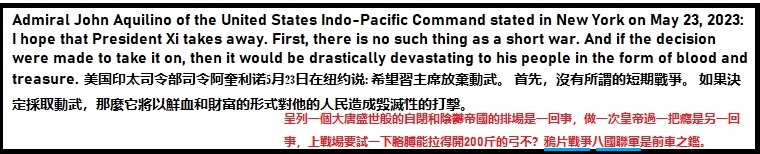
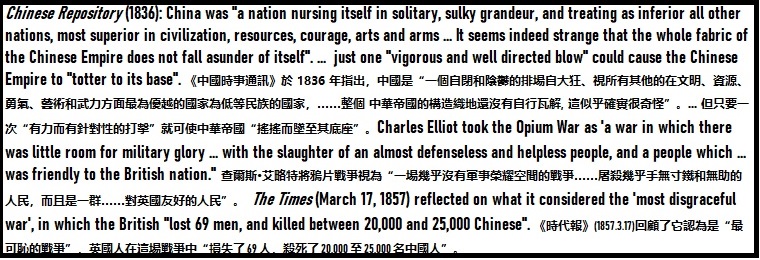
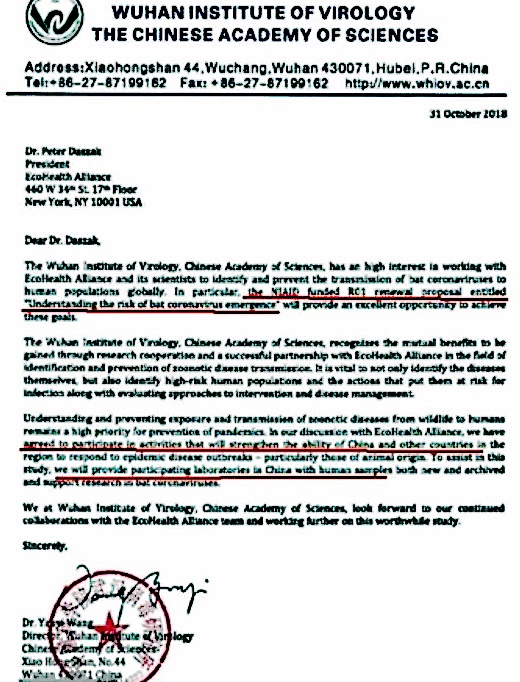


 ***
***


![Though, Anna Wang [Anneliese Martens], in her memoirs, expressed jealousy over Gong Peng by stating that the Anglo-American reporters had flattered the Chinese communists and the communist movement as a result of being entranced with the goldfish-eye'ed personal assistant of Zhou Enlai](GongPeng.jpg)
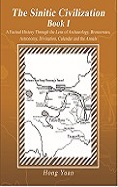
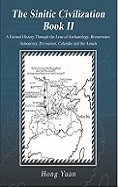


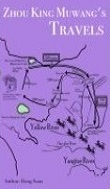

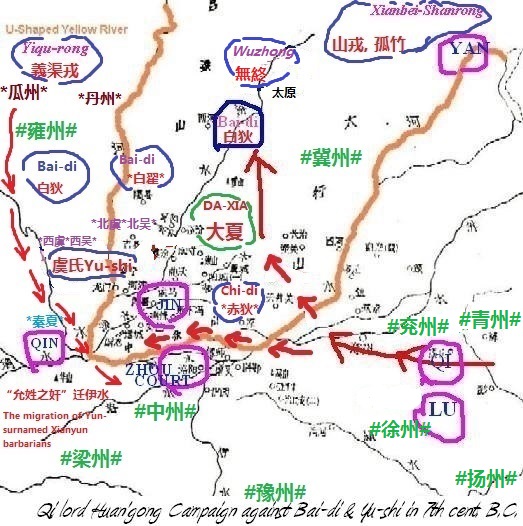
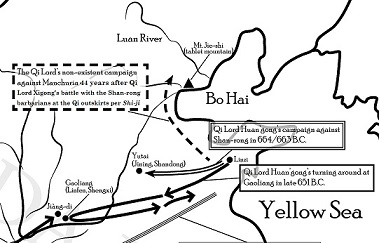 Per section "Qi Yu" of "Guo Yu", Qi Lord Huan'gong (r. 685-643 BC), who proclaimed himself a 'hegemony lord' in 679 B.C. according to Shi-ji, purportedly destroyed the statelets of Shan-rong and Guzhu in Manchuria [depending on how you interpret the localities of the two statelets] in 664 B.C., had campaigned against the Bai-di barbarians in the west [i.e., the area of central Shanxi] in 651 B.C. (i.e., the 9th year of Lu Lord Xigong). Qi Huan'gong was recorded to have occupied 'da xia' (i.e., the Grand Xia land) in today's southern/central Shanxi Province and might have crossed the river to subjugate 'xi yu' (i.e., the western Yu-shi clan's land) in today's Shenxi Province.
(Senior scholar Wei Juxian, with wild imagination, speculated that Qi lord Huan'gong had at one time reached the Bering Straits where the ex-Shang remnants had dwelled since the Shang-Zhou transition time period and that it was due to Qi Huan'gong's contacts with the Shang remnants that the American Indians or the Shang people paid a visit to China with tributes of humming birds that were recorded in the Soong Principality's chronicles. This was certainly an overblown reading of some latter-day add-on books, such as Yi Zhou Shu, which this webmaster had pointed out to be products from the post 3rd century B.C. Yuezhi-Hun War, not before that.)
Per section "Qi Yu" of "Guo Yu", Qi Lord Huan'gong (r. 685-643 BC), who proclaimed himself a 'hegemony lord' in 679 B.C. according to Shi-ji, purportedly destroyed the statelets of Shan-rong and Guzhu in Manchuria [depending on how you interpret the localities of the two statelets] in 664 B.C., had campaigned against the Bai-di barbarians in the west [i.e., the area of central Shanxi] in 651 B.C. (i.e., the 9th year of Lu Lord Xigong). Qi Huan'gong was recorded to have occupied 'da xia' (i.e., the Grand Xia land) in today's southern/central Shanxi Province and might have crossed the river to subjugate 'xi yu' (i.e., the western Yu-shi clan's land) in today's Shenxi Province.
(Senior scholar Wei Juxian, with wild imagination, speculated that Qi lord Huan'gong had at one time reached the Bering Straits where the ex-Shang remnants had dwelled since the Shang-Zhou transition time period and that it was due to Qi Huan'gong's contacts with the Shang remnants that the American Indians or the Shang people paid a visit to China with tributes of humming birds that were recorded in the Soong Principality's chronicles. This was certainly an overblown reading of some latter-day add-on books, such as Yi Zhou Shu, which this webmaster had pointed out to be products from the post 3rd century B.C. Yuezhi-Hun War, not before that.)
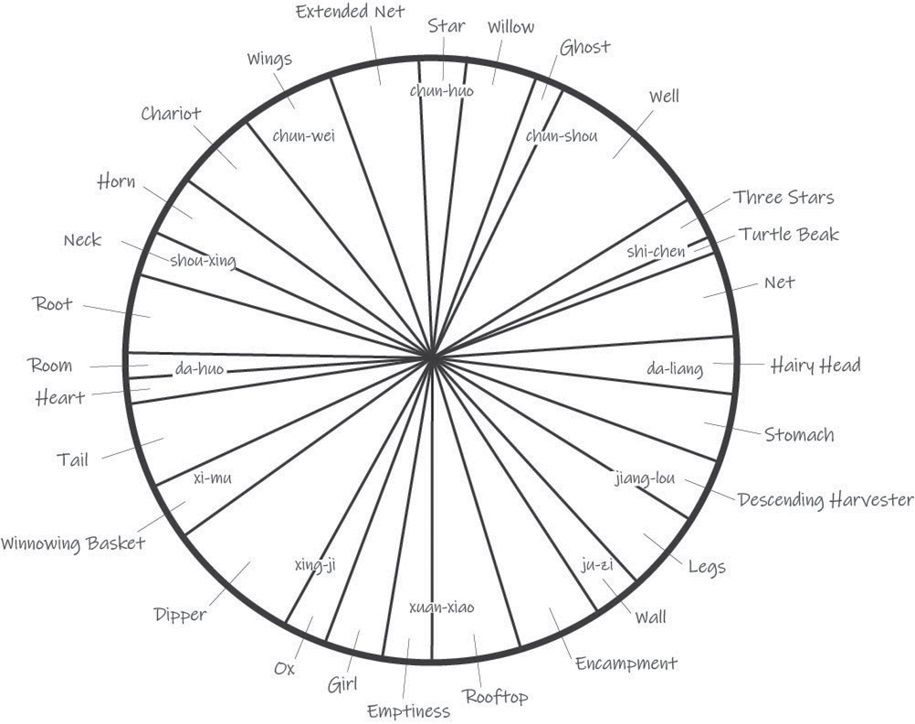
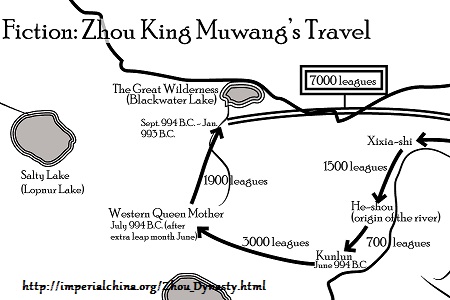 Paraphrased from The Bamboo Annals (For the fiction travelogue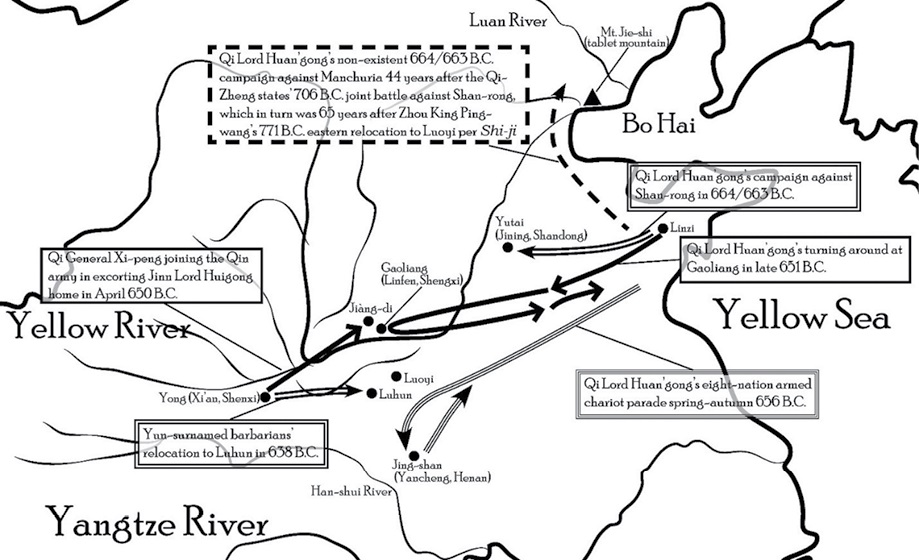
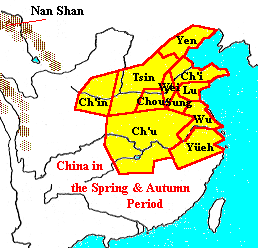

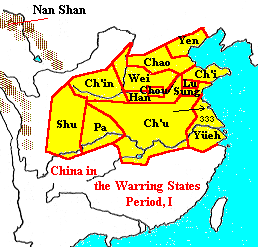
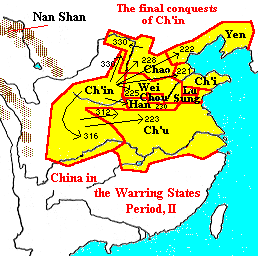
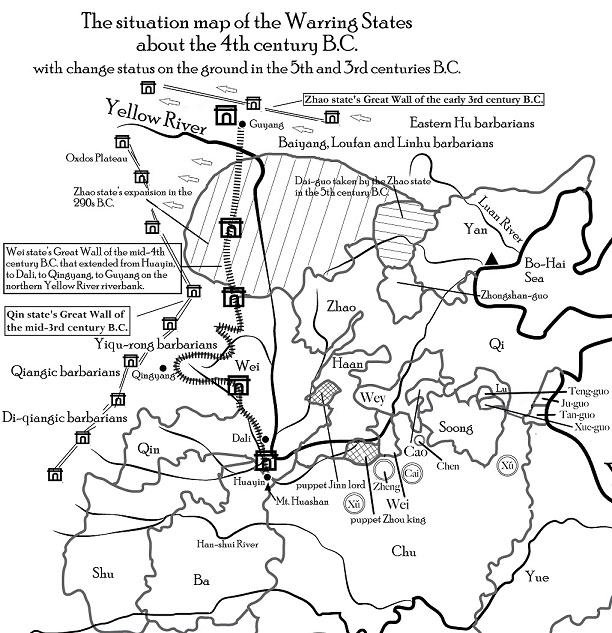 Qin lord Xiaogong, in 352 B.C., took advantage of the wars among the three post-Jinn-split states to attack Wei.
Shang Yang, who was 'da liang zhao', led an army across the Yellow River, and took over the old Wei capital city of Anyi (Xiaxian, Shanxi).
Wei king Huiwang ordered to build a cross-Yellow-River great wall between Xiaoshan and Guyang (Dingyang, Shenxi) to defend against Qin.
In 350 B.C., Shang Yang took over Guyang.
The Qin lord, knowing that Wei had befriended the other enemies for concentrating on the war to the west, had a truce meeting with the Wei king at the Tong-di (Huaxian, Shenxi) land.
In 350 B.C., the Qin lord ordered to build the Ji-que-gong Palace in Xianyang. Qin made Xian'yang the new capital.
Qin instituted an agriculture-related tax system in 350 B.C. and enacted the farming soldier rules.
In 349 B.C., Qin officially moved the capital to Xianyang from Liyang (Fuping, Weinan).
A second wave of reform decrees was issued in 349 and 348 B.C., including the division of land, the implementation of the county system in 349 B.C., the poll tax in 348 B.C., the standardization of measures, the order to burn Shi-jing, Shang-shu, and etc., and the revocation of the large family dwelling practice.
Qin lord Xiaogong, in 352 B.C., took advantage of the wars among the three post-Jinn-split states to attack Wei.
Shang Yang, who was 'da liang zhao', led an army across the Yellow River, and took over the old Wei capital city of Anyi (Xiaxian, Shanxi).
Wei king Huiwang ordered to build a cross-Yellow-River great wall between Xiaoshan and Guyang (Dingyang, Shenxi) to defend against Qin.
In 350 B.C., Shang Yang took over Guyang.
The Qin lord, knowing that Wei had befriended the other enemies for concentrating on the war to the west, had a truce meeting with the Wei king at the Tong-di (Huaxian, Shenxi) land.
In 350 B.C., the Qin lord ordered to build the Ji-que-gong Palace in Xianyang. Qin made Xian'yang the new capital.
Qin instituted an agriculture-related tax system in 350 B.C. and enacted the farming soldier rules.
In 349 B.C., Qin officially moved the capital to Xianyang from Liyang (Fuping, Weinan).
A second wave of reform decrees was issued in 349 and 348 B.C., including the division of land, the implementation of the county system in 349 B.C., the poll tax in 348 B.C., the standardization of measures, the order to burn Shi-jing, Shang-shu, and etc., and the revocation of the large family dwelling practice.